
Cell Culture Supply CDMO Market Size and Share
Market Overview
| Study Period | 2020 - 2031 |
|---|---|
| Market Size (2026) | USD 5.98 Billion |
| Market Size (2031) | USD 9.72 Billion |
| Growth Rate (2026 - 2031) | 10.21 % |
| Fastest Growing Market | Asia-Pacific |
| Largest Market | North America |
| Market Concentration | Medium |
Major Players *Disclaimer: Major Players sorted in no particular order Image © Mordor Intelligence. Reuse requires attribution under CC BY 4.0. | |
Cell Culture Supply CDMO Market Analysis by Mordor Intelligence
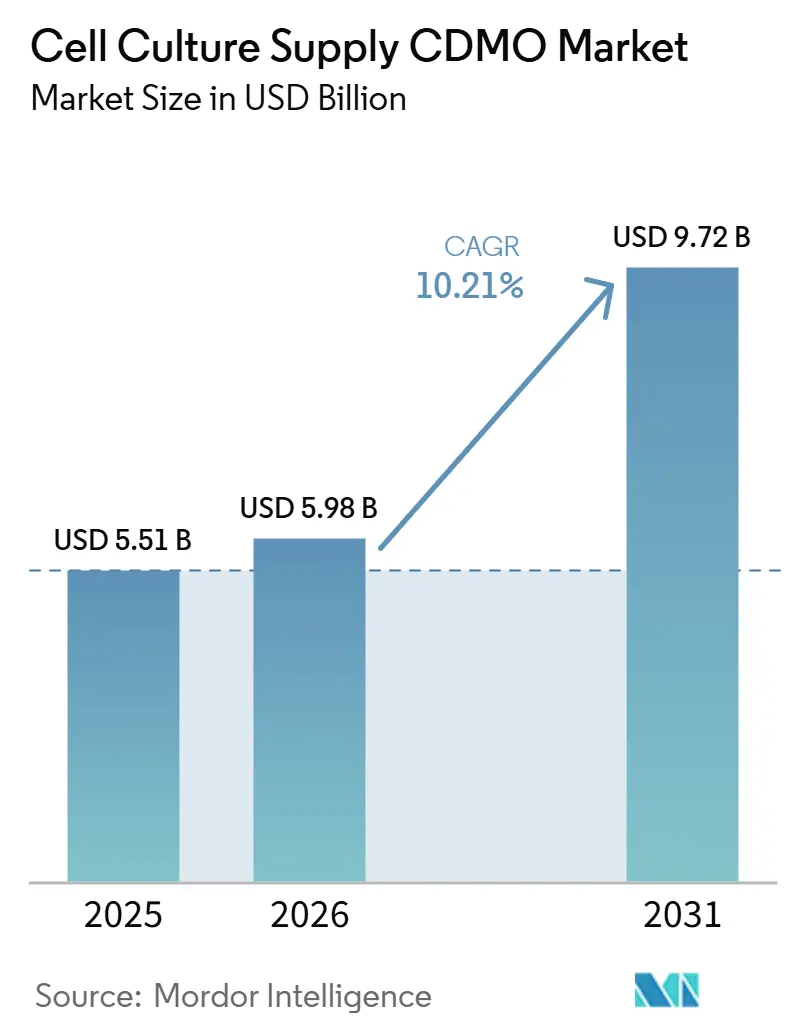
The cell culture supply CDMO market is expected to increase from USD 5.51 billion in 2025 to USD 5.98 billion in 2026, and to reach USD 9.72 billion by 2031, growing at a CAGR of 10.21% from 2026 to 2031. The cell culture supply CDMO market is expanding as biopharmaceutical companies continue to shift capital away from internal GMP infrastructure and toward specialist partners that can absorb process risk and shorten development timelines. The opening of FUJIFILM Diosynth Biotechnologies’ Holly Springs site in September 2025 showed how large providers are building commercial-scale capacity that supports long-term sponsor demand and deeper manufacturing partnerships. Regulatory support for domestic production also strengthened the operating backdrop, especially in the United States, where policy actions in 2025 aimed to reduce friction around pharmaceutical manufacturing expansion. The cell culture supply CDMO market is also benefiting from rising demand for complex biologics, biosimilars, and advanced therapies that need more specialized cell line work, stronger analytical support, and flexible capacity across development stages. At the same time, competition is becoming more defined by platform depth, speed, and commercial slot access, which is keeping opportunities open for both global leaders and specialist providers across the cell culture supply CDMO market.
Key Report Takeaways
- By service type, analytical development held 44.86% of the cell culture supply CDMO market share in 2025, while cell line development is projected to expand at a 11.18% CAGR through 2031.
- By cell line platform, CHO cells led with a 57.42% revenue share in 2025, while stem cells are forecasted to expand at a 12.74% CAGR to 2031.
- By scale, the bench scale accounted for 46.18% of the cell culture supply CDMO market in 2025, while the commercial scale is expected to advance at an 11.86% CAGR through 2031.
- By application, monoclonal antibody development captured 48.76% share in 2025, while gene therapy vector production is projected to grow at a 13.02% CAGR through 2031.
- By end-user, biopharmaceutical companies represented 51.34% of demand in 2025, while the contract development and manufacturing organizations acting as primary manufacturers are projected to expand at a 10.64% CAGR through 2031.
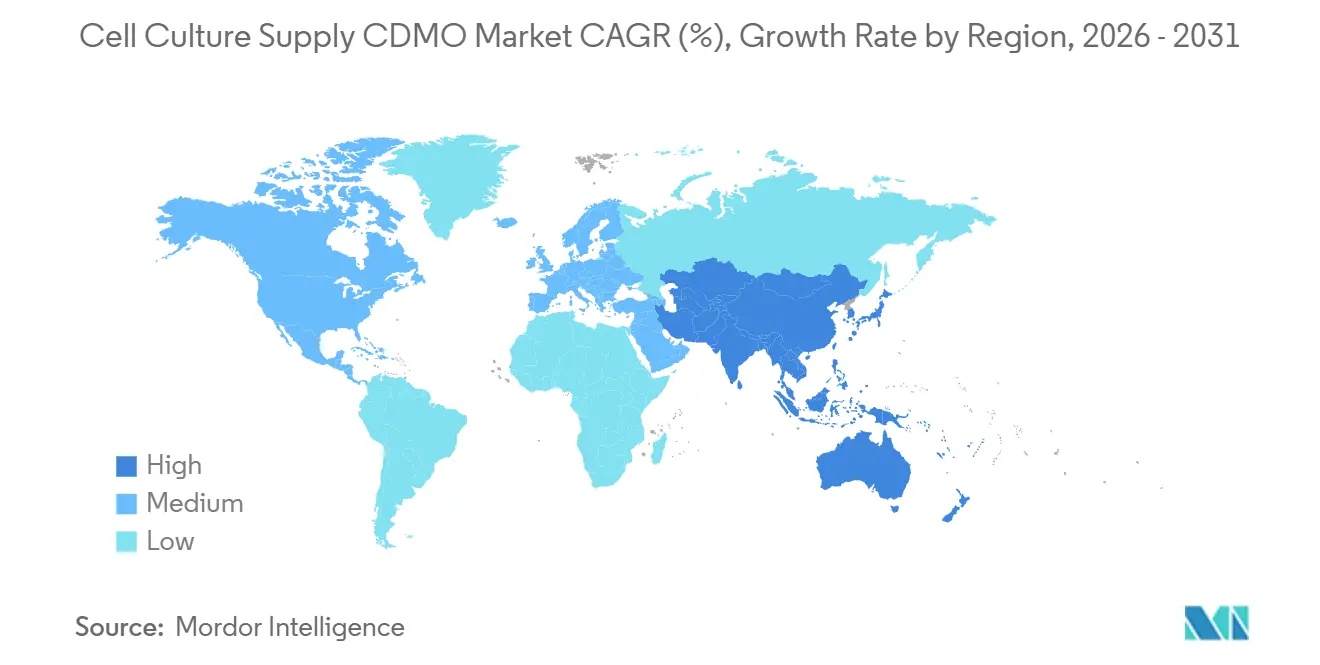
- By geography, North America held 41.92% of the cell culture supply CDMO market share in 2025, while Asia-Pacific is forecasted to grow at a 13.26% CAGR through 2031.
Note: Market size and forecast figures in this report are generated using Mordor Intelligence’s proprietary estimation framework, updated with the latest available data and insights as of January 2026.
Market Trends and Insights
Drivers Impact Analysis of Cell Culture Supply CDMO Market*
| Driver | (~) % Impact on CAGR Forecast | Geographic Relevance | Impact Timeline |
|---|---|---|---|
| Outsourcing of Cell Culture and Upstream Development | +3.0% | Global, concentrated in North America and Europe | Short term (≤ 2 years) |
| Adoption of Single-Use and Modular Biomanufacturing | +2.2% | Global, with highest uptake in North America, Europe, and South Korea | Short term (≤ 2 years) |
| Expansion of Complex Biologics and Biosimilars Pipelines | +1.8% | Global, strongest in North America and Asia-Pacific | Medium term (2-4 years) |
| Regional Onshoring of Critical Bioprocess Capacity | +1.3% | North America and Europe, with spillover to South Asia | Medium term (2-4 years) |
| Tightened Closed-System and Contamination-Control Expectations | +0.6% | Global, acute in North America and EU | Long term (≥ 4 years) |
| Increasing Demand for GMP-Grade Cell Culture Media and Reagent Manufacturing | +0.9% | Global, with early gains in Asia-Pacific and MEA | Medium term (2-4 years) |
| Source: Mordor Intelligence | |||
Outsourcing of Cell Culture and Upstream Development
Outsourcing remains one of the clearest growth supports for the cell culture supply CDMO market because building an internal GMP bioreactor network still requires very high capital commitments from sponsors. A single in-house GMP facility can exceed USD 500 million in capital expenditure, which keeps many developers focused on external manufacturing partners instead of asset ownership. WuXi Biologics reported 209 new integrated projects in 2025, which brought its total portfolio to 945 programs, and that scale shows how outsourcing now extends well beyond early development into longer duration relationships.[1]WuXi Biologics, “WuXi Biologics Reports Record 2025 Annual Results,” PR Newswire, prnewswire.com The cell culture supply CDMO market is also widening through cascading outsourcing, where full-service providers subcontract cell line development and analytical work to niche specialists when they do not maintain every capability internally. That pattern increases the number of addressable projects across the cell culture supply CDMO market because outsourcing now flows through sponsor networks and through the provider base itself.
Adoption of Single-Use and Modular Biomanufacturing
The cell culture supply CDMO market is also moving forward on the back of single-use and modular manufacturing systems that improve deployment speed and reduce contamination risk. WuXi Biologics stated that more than 70% of newly installed bioreactors are single-use, which shows that this format has moved well beyond early phase use and into broader production planning.[2]WuXi Biologics, “Dr. Chris Chen, How to Achieve 15-Ton MAb Production with Single-Use Bioreactors,” WuXi Biologics, wuxibiologics.com The same company also showed that a 50L single-use perfusion system could support drug substance needs for a Phase III clinical trial while cutting Protein A resin requirements by 92%, which connects equipment choice directly with process efficiency. FUJIFILM’s Holly Springs site used the kojoX modular design approach, and the company said this reduced facility design time by 70% versus conventional construction, which matters in a market where capacity timing affects sponsor decisions.[3]FUJIFILM Biotechnologies, “Grand Opening of Commercial-Scale Cell Culture Manufacturing Site in North Carolina,” FUJIFILM Biotechnologies, fujifilmbiotechnologies.fujifilm.comThe cell culture supply CDMO market therefore benefits not only from new capacity additions, but also from the fact that newer capacity can be deployed in smaller and faster increments that reduce investment risk for providers and shorten waiting time for customers.
Expansion of Complex Biologics, Biosimilars, and GMP-Grade Inputs
The growth path of the cell culture supply CDMO market is increasingly linked to the rise of more complex biologics that need tailored cell engineering, specialized process conditions, and more rigorous analytical control. The bispecific antibodies and antibody-drug conjugates require host cell engineering and process settings that standard CHO workflows cannot support without added customization. On the biosimilar side, the European Commission published the EU Biotechnology Act in 2025 with provisions aimed at streamlining biosimilar authorization and strengthening regional biomanufacturing capacity, which supports providers that already operate qualified cell culture facilities in Europe. Demand for GMP-grade media and reagents sits within the same expansion cycle because more advanced and more numerous biologics programs require dependable input supply as part of the full development and manufacturing chain.
Regional Onshoring, Closed Systems, and Contamination Control
The cell culture supply CDMO market is also being pushed by onshoring efforts in North America and Europe, where supply security has become a larger investment priority. In May 2025, the White House issued Executive Order 14293, which directed the FDA to reduce duplicative inspection and permitting requirements for domestic pharmaceutical manufacturing and signaled stronger policy support for local production capacity. The FDA then held a public meeting focused on onshoring manufacturing of drugs and biological products, reinforcing the same direction of travel for the operating environment. Dual-source strategies are creating downstream opportunities for mid-tier CDMOs in India and South America, because lower-cost regions are attracting early-stage work that can later convert into commercial manufacturing demand. At the same time, tighter closed-system and contamination-control expectations continue to favor providers that already run validated modern facilities, which gives the cell culture supply CDMO market a clear quality-driven advantage for newer infrastructure over legacy assets.
Restraints Impact Analysis of Cell Culture Supply CDMO Market*
| Restraint | (~) % Impact on CAGR Forecast | Geographic Relevance | Impact Timeline |
|---|---|---|---|
| Limited High-Capacity GMP Bioreactor Availability | -0.8% | Global, most acute in North America and Europe | Short term (≤ 2 years) |
| Skilled Bioprocess Talent Shortage | -0.6% | Global, with highest severity in North America and Europe | Medium term (2-4 years) |
| Single-Source Dependence for Critical Inputs | -0.4% | Global, with supply concentration risk in the Asia-Pacific | Medium term (2-4 years) |
| Tech Transfer and Validation Complexity | -0.3% | Global | Long term (≥ 4 years) |
| Source: Mordor Intelligence | |||
Limited High-Capacity GMP Bioreactor Availability
A major constraint on the cell culture supply CDMO market is that commercial scale GMP capacity remains tighter than bench scale and pilot scale availability. The late-phase programs moving forward after earlier delays extended lead times for commercial manufacturing slots through 2025, especially in CHO-based monoclonal antibody work and advanced therapy programs. This imbalance matters because sponsors can often secure development support, but still face delays when they need validated large-scale production slots that align with filing and launch schedules. The same section also points out that integrated providers with bench-to-commercial continuity gain an advantage because tech transfer and validation challenges become harder to manage when process ownership changes across multiple vendors. As a result, the cell culture supply CDMO market continues to reward providers that can combine scale, continuity, and prior commercial readiness instead of offering isolated service steps.
Skilled Bioprocess Talent Shortage
Workforce limitations remain another structural restraint on the cell culture supply CDMO market because qualified GMP bioprocess talent is still difficult to secure in several important regions. BIOTECanada has highlighted the need to build a future-ready biomanufacturing workforce, and that message aligns with the staffing constraints are slowing capacity expansion even when investment appetite is present. The same problem is intensified by onshoring ambitions, since local production growth can move faster than labor pool development. Single-source dependence for key inputs adds another layer of risk because any disruption in concentrated supply chains can affect development schedules and production continuity across the cell culture supply CDMO market.
*Our forecasts treat driver/restraint impacts as directional, not additive. The impact forecasts reflect baseline growth, mix effects, and variable interactions.
Cell Culture Supply CDMO Market Segment Analysis
By Service Type:
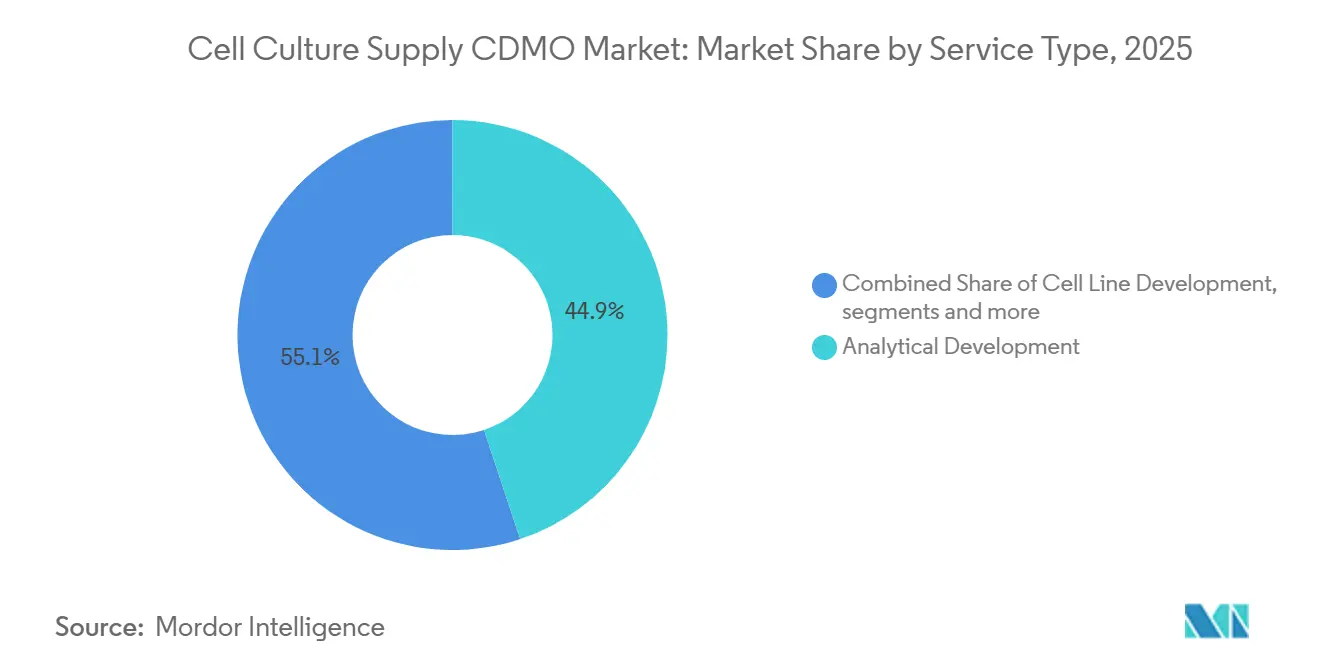
Analytical Services Anchor Revenue While Cell Line Development AcceleratesAnalytical development held 44.86% of the cell culture supply CDMO market in 2025, making it the largest service category in the current revenue mix. That position reflects the heavy documentation burden around process characterization, forced degradation testing, release support, and regulatory package preparation for increasingly complex biologics. Sponsors continue to delegate this work to specialist partners because the activity depends on sophisticated instrumentation, established quality systems, and teams that can support filing expectations across development stages.
Cell line development is projected to grow at a 11.18% CAGR through 2031, and that pace reflects the growing need for tailored host engineering in newer biologic formats. The bispecific antibodies and ADCs need more customized development paths to meet target glycosylation profiles and expression performance. In practical terms, the service mix of the cell culture supply CDMO market is shifting toward providers that can combine analytical precision, cell engineering capability, and downstream manufacturing continuity in one commercial relationship.



By Cell Line Platform:
CHO Cells Dominate While Stem Cell Programs Shape Future DemandCHO cells accounted for 57.42% of the cell culture supply CDMO market by platform in 2025, which keeps them far ahead of other cell line systems in commercial relevance. Their lead reflects years of regulatory familiarity, optimized media and feeding strategies, and highly developed clone screening workflows built around CHO biology. In the cell culture supply CDMO industry, an established base matters because sponsors still prefer platforms with proven manufacturing precedent when they move toward late-stage and commercial work. HEK293 cells continue to serve viral vaccine and gene therapy vector programs, while hybridoma platforms remain relevant but face gradual displacement as recombinant expression systems offer better scalability for biosimilar and monoclonal antibody developers.
Stem cells are expected to expand at a CAGR of 12.74% through 2031, and that growth signals where future capacity requirements are likely to build. The shift to the advancing pipeline of allogeneic cell therapies that need GMP-compliant expansion systems for induced pluripotent stem cells and mesenchymal stem cells. The result is not a decline in CHO dominance, but a broadening of platform demand that will require more varied facility design and operating expertise across the cell culture supply CDMO market over the forecast period.
By Scale:
Bench Scale Leads Current Activity While Commercial Scale Drives Future RevenueBench scale represented 46.18% share by scale in 2025, which shows how much of the cell culture supply CDMO market is still anchored in process development, cell line screening, and analytical method establishment. The bench segment also remains active because sponsors want flexibility while they refine processes, compare clones, and build documentation packages ahead of larger validation steps. In the cell culture supply CDMO market, that makes bench work is a critical feeder for later revenue conversion rather than a stand-alone service pool. Pilot scale continues to operate as the bridge between early development and commercial manufacturing, and highlights that this is often where tech transfer risk becomes most visible.
Commercial scale is anticipated to grow at a CAGR of 11.86% through 2031, because more programs that started in the earlier 2020 to 2024 development wave are now moving toward regulatory filing and launch readiness. That transition shifts revenue weight toward validated high-volume manufacturing slots, especially for biologics that need uninterrupted supply planning. The cell culture supply CDMO market, therefore, shows a two-stage structure, with bench scale generating broad project intake and commercial scale capturing the strongest downstream revenue expansion.
By Application:
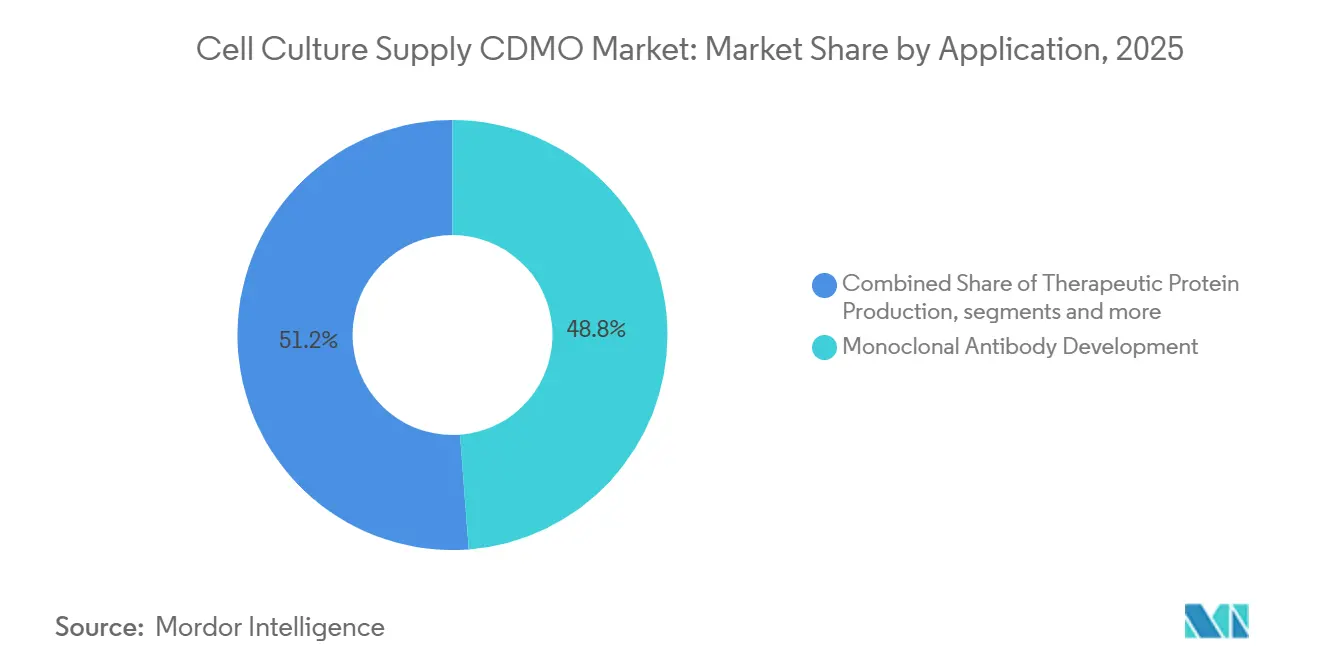
Monoclonal Antibodies Remain the Core While Gene Therapy Vectors Grow FastestMonoclonal antibody development captured 48.76% of the cell culture supply CDMO market by application in 2025, which keeps it as the largest demand center across application categories. That lead reflects the broad clinical and commercial base of monoclonal antibody programs, most of which still rely on CHO-based GMP manufacturing supported by outsourced partners. In the cell culture supply CDMO market, this concentration gives providers a stable volume foundation because mAb programs require repeatable development, analytical, and commercial manufacturing support over long timelines. Therapeutic protein production remains a steady source of work as well, while viral vaccine production can absorb capacity made available by the wind-down of pandemic response programs.
Gene therapy vector production is projected to expand at a CAGR of 13.02% through 2031, and that pace reflects sponsor demand for outsourced plasmid DNA and viral vector manufacturing instead of large internal build-outs. This matters because vector work carries its own process complexity, quality requirements, and facility constraints, which makes external specialization more valuable to developers. In the cell culture supply CDMO industry, this creates a more diverse application mix, even though monoclonal antibodies remain the dominant anchor.
By End-User:
Biopharmaceutical Companies Lead Demand While CDMO Subcontracting Reshapes The ChainBiopharmaceutical companies represented 51.34% of end-user demand in 2025, which keeps them as the largest source of business across the cell culture supply CDMO market. This group includes large innovators with advanced clinical assets and smaller biotech companies that do not have internal manufacturing infrastructure. Their outsourcing decisions are increasingly tied to development speed, filing readiness, and commercial timing rather than one-time cost reduction alone. The current end-user mix therefore shows that the cell culture supply CDMO market remains sponsor-led in volume, even as the provider ecosystem itself becomes more layered.
The fastest growing end-user cohort is the CDMO group acting as a primary manufacturer and subcontracting specialized upstream activities, with a projected CAGR of 10.64% through 2031. This reflects the value chain is stratifying into specialist tiers, especially in analytical development and cell line engineering, where boutique providers can support full-service manufacturers. Contract research organizations continue to contribute to the demand for cell line characterization and analytical reference standards, while academia and research institutes remain a smaller but stable base for early cell banking and tech transfer preparation work. That means the cell culture supply CDMO market is not only expanding in size, but is also becoming more relationship-driven as outsourcing flows through multi-year development structures instead of isolated transactions.
Geography Analysis
North America Cell Culture Supply CDMO Market
North America held 41.92% of the cell culture supply CDMO market in 2025, giving the region the largest geographic position in current revenue terms. The region benefits from a dense biologics pipeline, a mature regulatory structure, and policy actions in 2025 that aimed to make domestic pharmaceutical manufacturing easier to expand. Canada adds to the regional base through established research capability, although BIOTECanada has flagged workforce readiness as an important issue for long-term domestic capacity expansion.
APAC Cell Culture Supply CDMO Market
Asia-Pacific is expected to be the fastest-growing region in the cell culture supply CDMO market, with a projected CAGR of 13.26% through 2031. The region’s growth profile is supported by state-backed manufacturing clusters, rising platform depth, and a strong pace of capacity investment across South Korea, China, Japan, Singapore, and India. WuXi Biologics completed the modular topping-out of its Singapore drug product facility in June 2026, and the site is designed for around 100 million units of pre-filled syringes and vials per year, showing how the regional offer is moving beyond drug substance capacity alone. India is also deepening its role, and Aurobindo Pharma launched TheraNym in June 2026 with 15KL bioreactor capacity and an MSD supply agreement for domestic and export demand.
EMEA and South America Cell Culture Supply CDMO Market
Europe remains structurally important to the cell culture supply CDMO market because it combines mature GMP infrastructure with deep analytical capability and an established biologics customer base. The regional outlook is also supported by policy action, and the European Commission’s 2025 biotechnology package includes measures intended to strengthen biosimilar authorization and regional manufacturing capacity. Outside the three major hubs, South America, the Middle East, and Africa remain smaller but active areas where public-private manufacturing efforts and diversification strategies are creating selective opportunities for future provider expansion.

Competitive Landscape
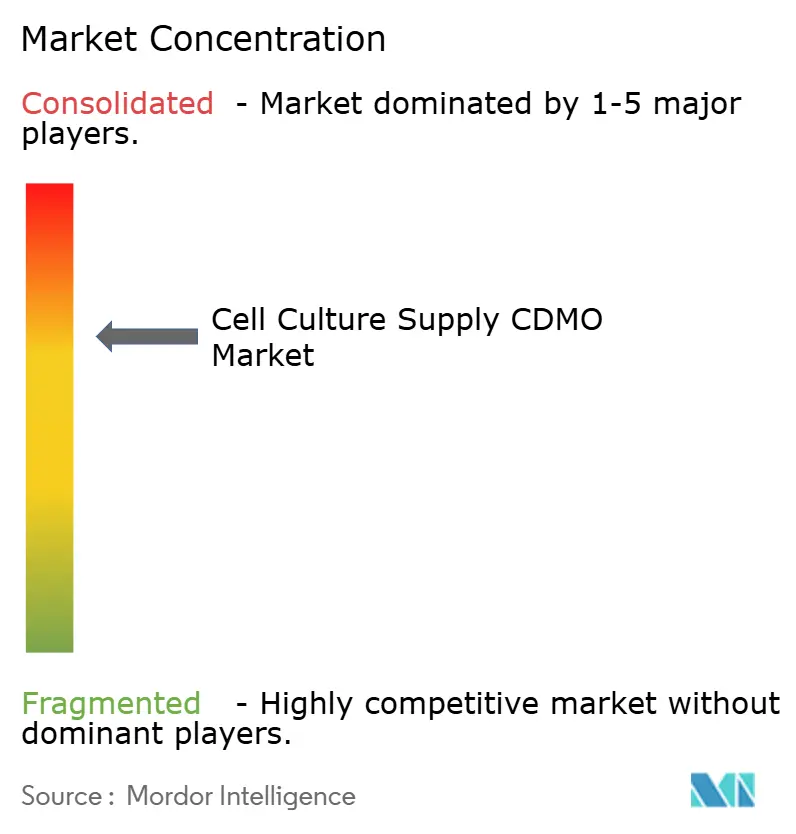
The cell culture supply CDMO market shows moderate to high concentration at the commercial scale, where a limited group of global providers controls a large share of mammalian bioreactor capacity, while a much broader field of regional specialists competes for early development and analytical programs. This split means the competitive picture looks different depending on the stage of work, because commercial manufacturing favors scale and continuity, while earlier work allows more room for specialist entrants. The largest companies in the cell culture supply CDMO market are using capacity depth, geographic reach, and integrated service structures to defend their positions as sponsors look for fewer handoffs across development and manufacturing stages. The overall result is a market where scale leaders set the tone in late stage and commercial work, but smaller firms still have room in platform-specific or project-specific niches.
A clear strategy pattern in the cell culture supply CDMO market is expansion through major facility investment and acquisition. FUJIFILM opened its Holly Springs commercial scale cell culture manufacturing site in North Carolina in September 2025, and the first phase included 8 bioreactors of 20,000L each, showing the scale at which top providers are building future supply platforms. Aurobindo Pharma’s launch of TheraNym in India in June 2026 shows that this expansion pattern is not limited to the very largest global companies, because regional providers are also building dedicated biologics CDMO platforms with export potential.
Technology and platform depth are becoming just as important as physical capacity across the cell culture supply CDMO market. KBI Biopharma’s proprietary CHO platform shows how providers can create differentiation inside a mature expression system by improving host performance and reducing development risk for clients. The provider base is becoming more layered, because primary CDMOs are subcontracting selected upstream activities to boutique specialists when they need narrower expertise. This cascading model broadens the addressable landscape without reducing the influence of large integrated providers. It also raises barriers for new entrants at the commercial end, since sponsors place high value on continuity, proven quality systems, and a credible record of carrying programs from development into routine GMP supply.
Cell Culture Supply CDMO Industry Leaders
Lonza Group AG
Samsung Biologics Co., Ltd.
WuXi Biologics Cayman Inc.
FUJIFILM Diosynth Biotechnologies
Thermo Fisher Scientific Inc.
- *Disclaimer: Major Players sorted in no particular order
Cell Culture Supply CDMO Market Companies Covered in this Report
- AGC Biologics
- BioVectra Inc.
- Boehringer Ingelheim
- Catalent
- Curia Global, Inc.
- Esco Aster Pte. Ltd.
- FUJIFILM
- Genscript
- KBI Biopharma, Inc.
- Lonza Group
- Minaris Regenerative Medicine GmbH
- Oxford Biomedica plc
- Rentschler Biopharma SE
- Samsung Biologics Co., Ltd.
- Siegfried Holding AG
- Syngene International
- Thermo Fisher Scientific
- WACKER Biotech GmbH
- WuXi Biologics Cayman Inc.
- Yposkesi

Recent Industry Developments in Cell Culture Supply CDMO Market
- July 2026: WuXi Biologics' MFG8 Drug Substance Facility secured FDA Pre-License Inspection (PLI) approval, advancing commercial supply of a potential blockbuster autoimmune therapy and maintaining the company's 100% FDA PLI pass rate across its global manufacturing network.
- June 2026: Aurobindo Pharma launched TheraNym, a dedicated biologics CDMO subsidiary with 15KL bioreactor capacity located near Hyderabad, India, anchored by an MSD supply agreement for domestic and export markets.
- June 2026: WuXi Biologics completed modular topping-out of its Singapore Drug Product facility, designed for approximately 100 million units of pre-filled syringes and vials annually, advancing its Asia-Pacific commercial manufacturing capabilities.
- May 2026: FUJIFILM Diosynth Biotechnologies secured a 10-year biologics manufacturing agreement with Regeneron, a long-term commercial commitment that substantially de-risks capacity utilization at the USD 3.2 billion Holly Springs facility.


Global Cell Culture Supply CDMO Market Report Scope
According to the report’s scope, the cell culture supply CDMO market refers to those that provide products and outsourced services supporting cell culture processes. These include the development, production, and supply of cell culture media, reagents, sera, supplements, bioprocess materials, and related manufacturing services used in biopharmaceutical production, cell and gene therapy, vaccine manufacturing, and research applications.
The cell culture supply CDMO market is segmented into service type, cell line platform, scale, application, end-user, and geography. By service type, the market is segmented into preserved analytical development, cell line development, cGMP manufacturing, process optimization, and other service types. By cell line platform, the market is segmented into CHO cells, HEK293 cells, hybridoma cells, stem cells, and other cell line platforms. By scale, the market is segmented into bench scale, pilot scale, and commercial scale. By application, the market is segmented into monoclonal antibody development, therapeutic protein production, gene therapy vector production, and viral vaccine production. By end-user, the market is segmented into biopharmaceutical companies, contract development and manufacturing organizations, contract research organizations, and academia and research institutes. By geography, the market is segmented into North America, Europe, Asia-Pacific, the Middle East and Africa, and South America. The report also covers the estimated market sizes and trends for 17 countries across major regions globally. The report offers values (USD) for all the above segments.
| Analytical Development |
| Cell Line Development |
| cGMP Manufacturing |
| Process Optimization |
| Other Service Types |
| CHO Cells |
| HEK293 Cells |
| Hybridoma Cells |
| Stem Cells |
| Other Cell Line Platforms |
| Bench Scale |
| Pilot Scale |
| Commercial Scale |
| Monoclonal Antibody Development |
| Therapeutic Protein Production |
| Gene Therapy Vector Production |
| Viral Vaccine Production |
| Biopharmaceutical Companies |
| Contract Development and Manufacturing Organizations |
| Contract Research Organizations |
| Academia and Research Institutes |
| North America | United States |
| Canada | |
| Mexico | |
| Europe | Germany |
| United Kingdom | |
| France | |
| Italy | |
| Spain | |
| Rest of Europe | |
| Asia-Pacific | China |
| Japan | |
| India | |
| Australia | |
| South Korea | |
| Rest of Asia-Pacific | |
| Middle East and Africa | GCC |
| South Africa | |
| Rest of Middle East and Africa | |
| South America | Brazil |
| Argentina | |
| Rest of South America |
| By Service Type | Analytical Development | |
| Cell Line Development | ||
| cGMP Manufacturing | ||
| Process Optimization | ||
| Other Service Types | ||
| By Cell Line Platform | CHO Cells | |
| HEK293 Cells | ||
| Hybridoma Cells | ||
| Stem Cells | ||
| Other Cell Line Platforms | ||
| By Scale | Bench Scale | |
| Pilot Scale | ||
| Commercial Scale | ||
| By Application | Monoclonal Antibody Development | |
| Therapeutic Protein Production | ||
| Gene Therapy Vector Production | ||
| Viral Vaccine Production | ||
| By End-User | Biopharmaceutical Companies | |
| Contract Development and Manufacturing Organizations | ||
| Contract Research Organizations | ||
| Academia and Research Institutes | ||
| By Geography | North America | United States |
| Canada | ||
| Mexico | ||
| Europe | Germany | |
| United Kingdom | ||
| France | ||
| Italy | ||
| Spain | ||
| Rest of Europe | ||
| Asia-Pacific | China | |
| Japan | ||
| India | ||
| Australia | ||
| South Korea | ||
| Rest of Asia-Pacific | ||
| Middle East and Africa | GCC | |
| South Africa | ||
| Rest of Middle East and Africa | ||
| South America | Brazil | |
| Argentina | ||
| Rest of South America | ||


Key Questions Answered in the Report
What is driving growth in the cell culture supply CDMO market demand through 2031?
Growth is being driven by sponsor outsourcing, larger use of single-use and modular biomanufacturing, and rising demand from complex biologics and advanced therapy programs. The market is projected to rise from USD 5.51 billion in 2025 to USD 5.98 billion in 2026 to USD 9.72 billion by 2031 at a 10.21% CAGR.
Which service area currently generates the most revenue?
Analytical development leads the revenue mix with 44.86% share in 2025 because sponsors need extensive process characterization, regulatory support, and documentation for complex biologics submissions.
Which cell line platform remains the most important today?
CHO cells remain the dominant platform with 57.42% share in 2025 due to established regulatory precedent and highly optimized development workflows.
Where is the fastest regional expansion happening?
Asia-Pacific is projected to grow at a 13.26% CAGR through 2031, supported by major investments in South Korea, Singapore, China, Japan, and India.
Page last updated on:





