
Caprylic Acid Market Size and Share
Market Overview
| Study Period | 2022 - 2032 |
|---|---|
| Market Size (2027) | USD 6.99 Million |
| Market Size (2032) | USD 10.92 Million |
| Growth Rate (2027 - 2032) | 9.34 % |
| Fastest Growing Market | Asia-Pacific |
| Largest Market | North America |
| Market Concentration | Medium |
Major Players *Disclaimer: Major Players sorted in no particular order Image © Mordor Intelligence. Reuse requires attribution under CC BY 4.0. | |
Caprylic Acid Market Analysis by Mordor Intelligence
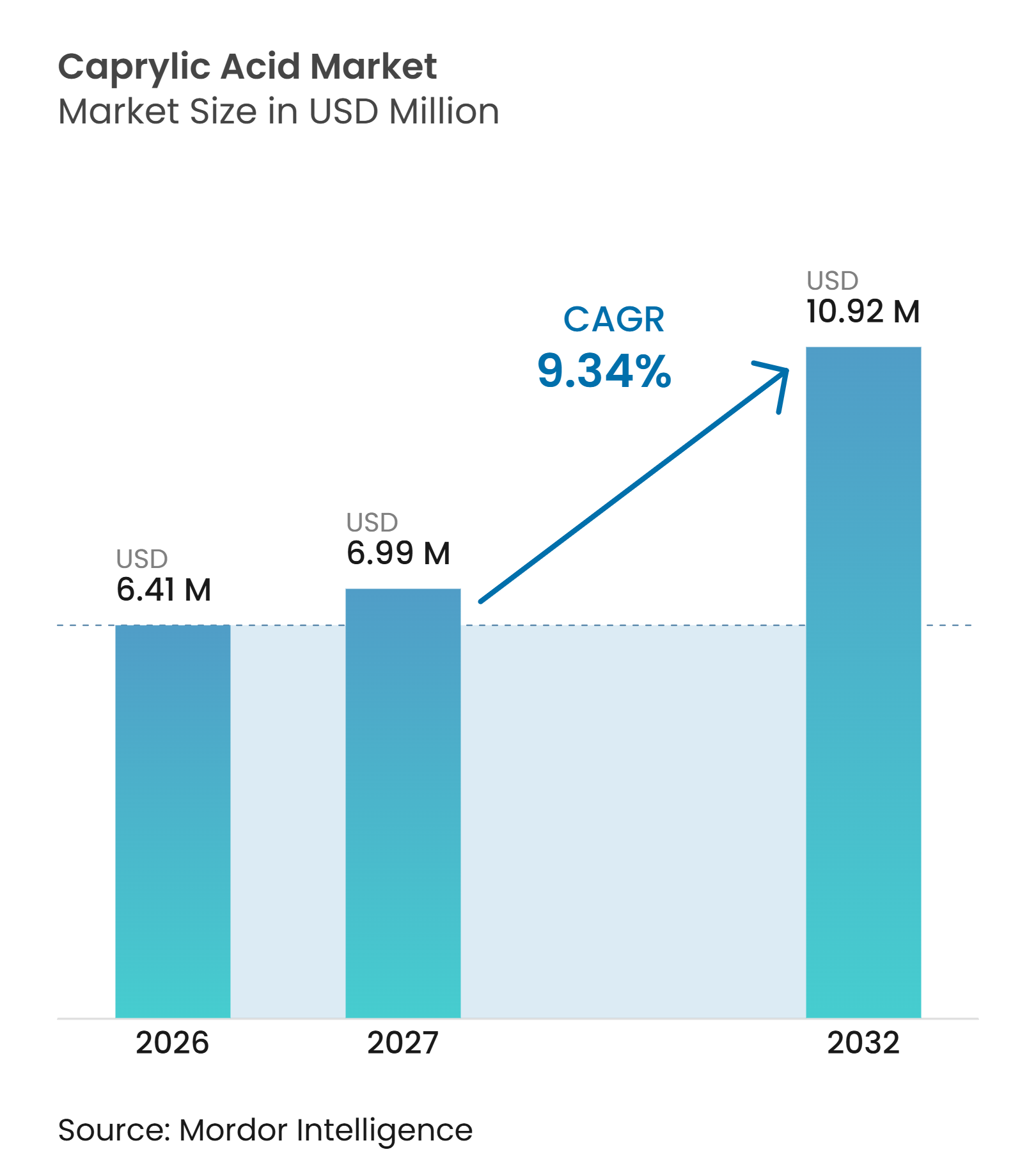
The Caprylic acid market size was valued at USD 6.41 million in 2026 and is estimated to grow from USD 6.99 million in 2027 to USD 10.92 million by 2032, at a CAGR of 9.34% during the forecast period (2027-2032). The caprylic acid market is supported by demand for traceable, plant-derived ingredients in food, personal care, pharmaceuticals, and nutrition products. Caprylic acid occurs naturally in coconut and palm kernel oils, and the US Food and Drug Administration (FDA) recognizes it for direct food use under 21 CFR 184.1025. This regulatory position supports established applications, although ingredient developers may face greater scrutiny of derivatives and new delivery systems following the US Department of Health and Human Services' March 2025 directive to the FDA to explore changes to self-affirmed Generally Recognized as Safe (GRAS) procedures. The market is also shaped by a shift toward verified renewable oleochemicals, as certification and traceability influence access to premium applications. Higher feedstock costs and inconsistent traceability remain material constraints, particularly for buyers requiring certified palm kernel oil.
Key Report Takeaways
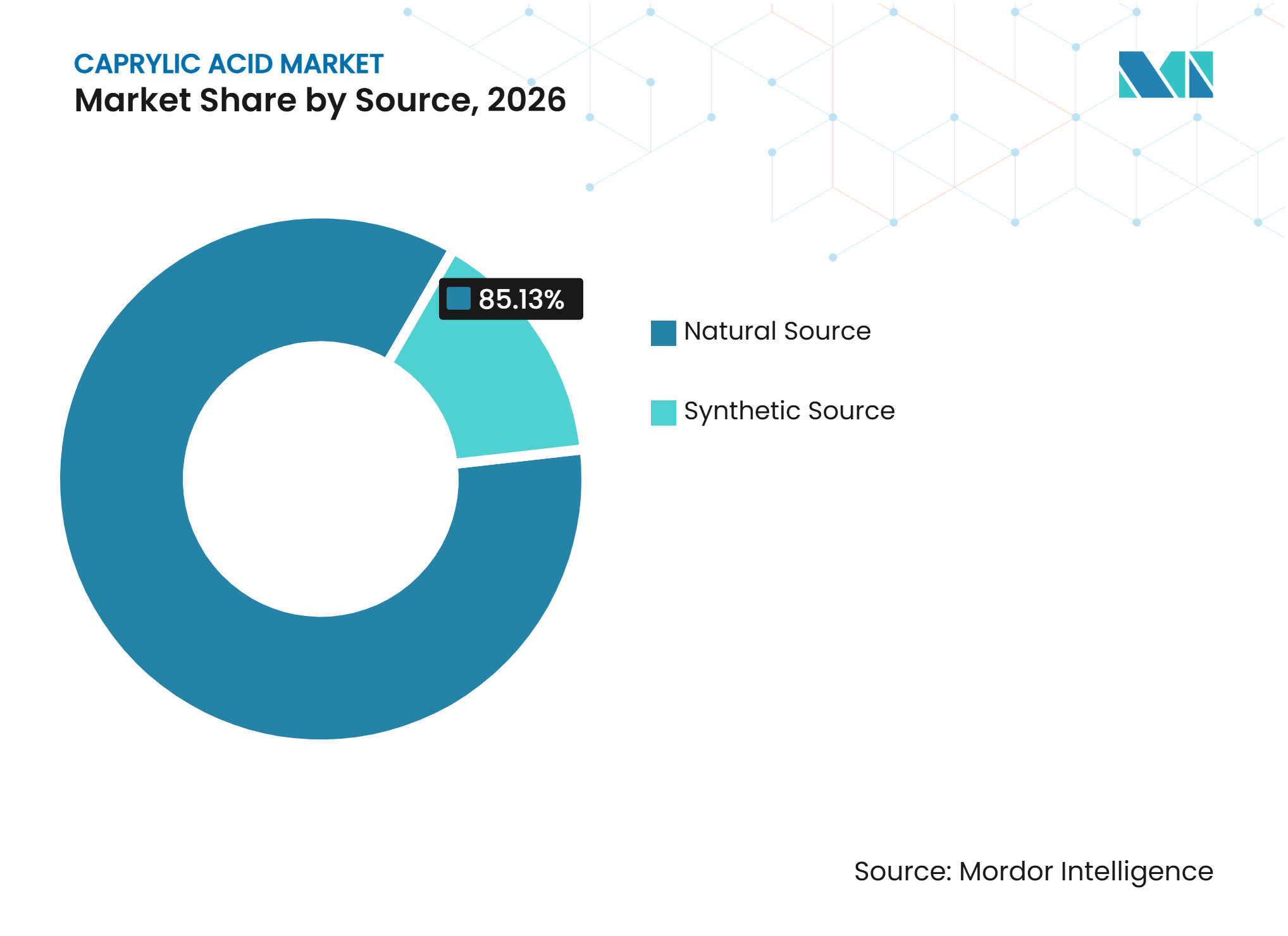
- By source, natural Caprylic acid held 85.13% of the Caprylic acid market share in 2026 and is projected to expand at a 10.05% CAGR through 2032.
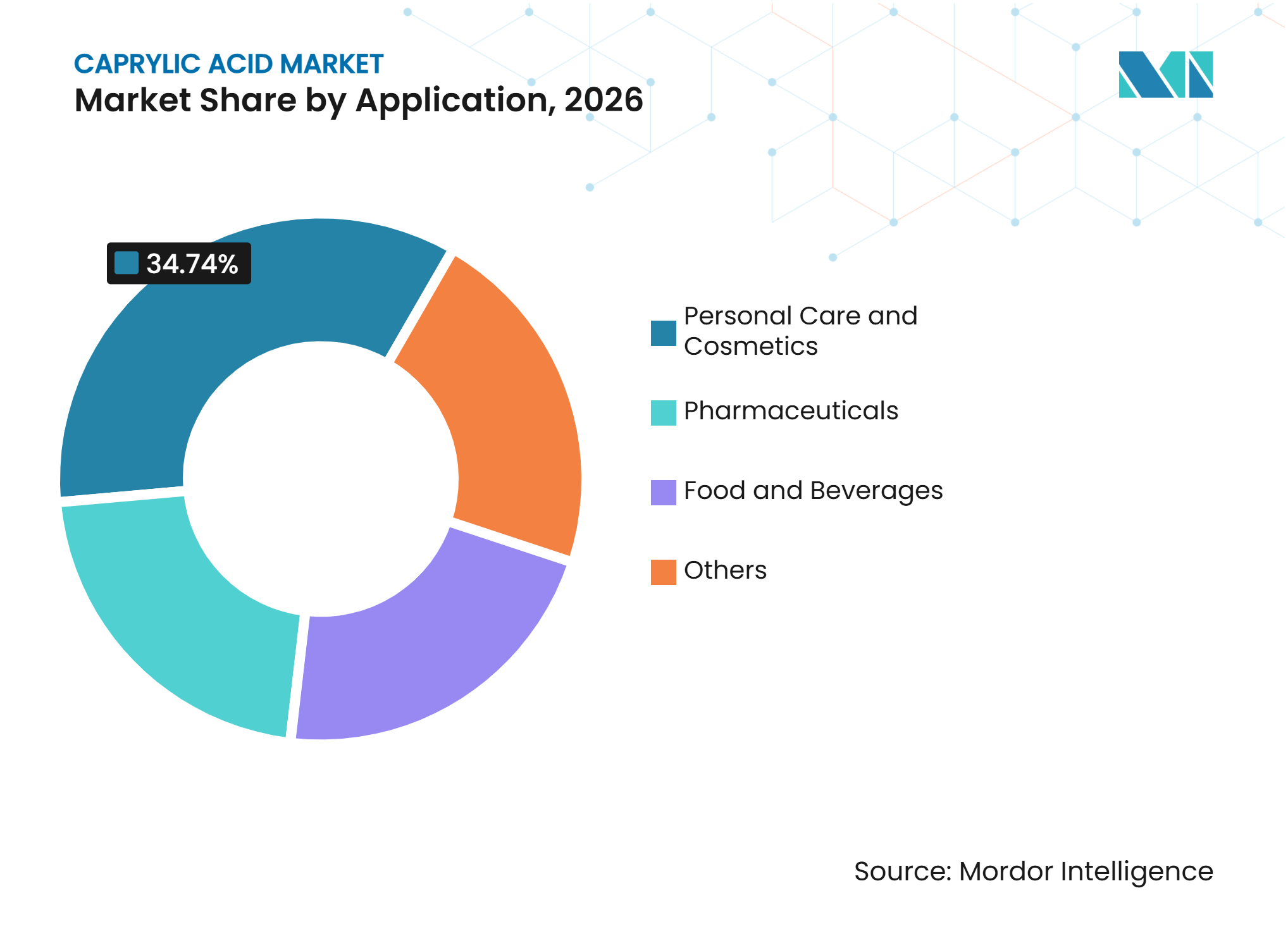
- By application, Personal Care and Cosmetics accounted for 34.74% of the Caprylic acid market size in 2026, while Food and Beverages is forecast to grow at a 10.41% CAGR through 2032.
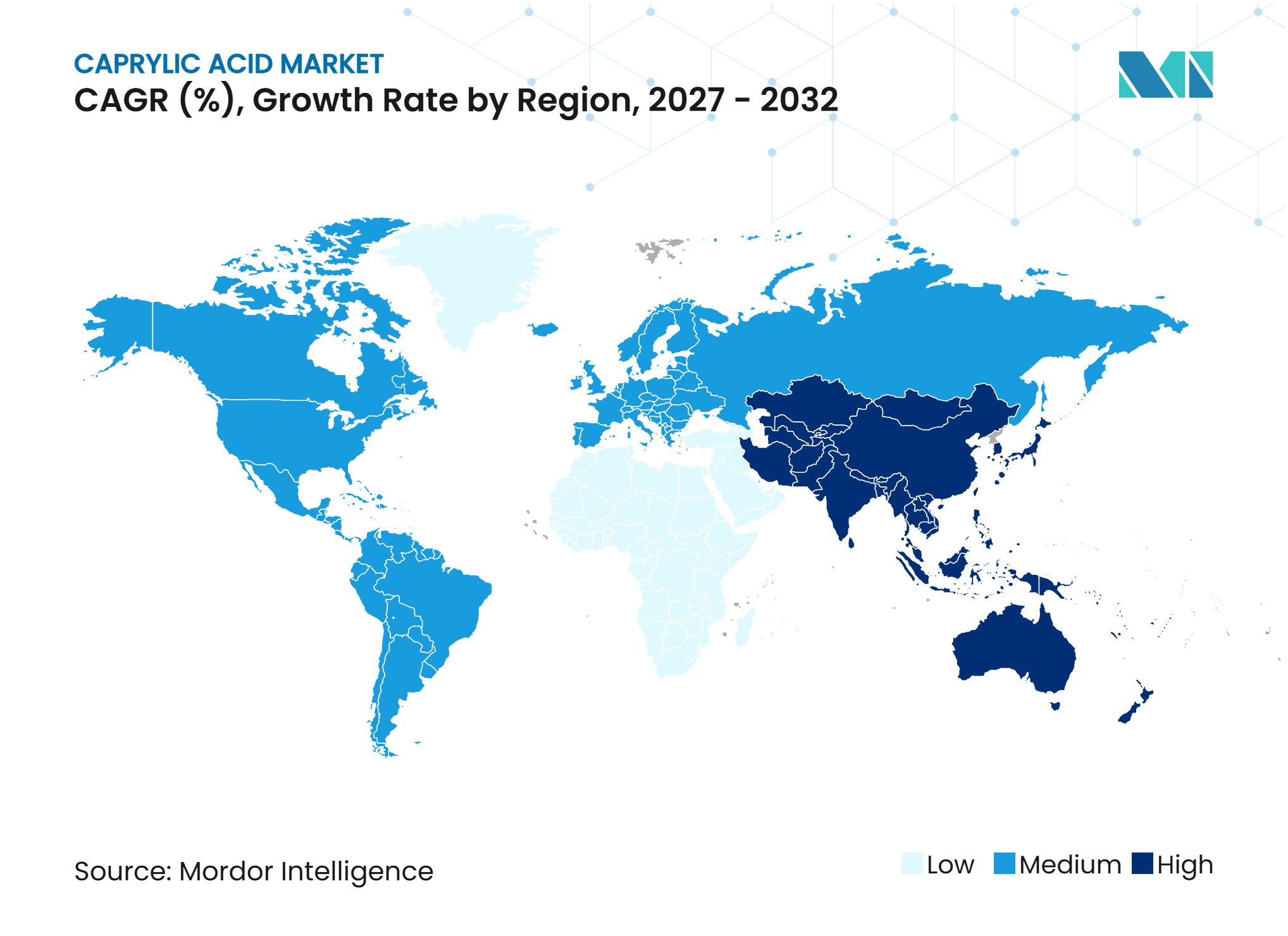
- By geography, North America held 36.48% of revenue in 2026, while Asia-Pacific is forecast to record a 10.33% CAGR through 2032.
Note: Market numbers in this report are based on Mordor Intelligence's proprietary estimation framework, which combines nine months of actuals with Q4 projections for base year 2026.
Market Trends and Insights
Drivers Impact Analysis of Caprylic Acid Market*
| Drivers | (~) % Impact on CAGR Forecast | Geographic Relevance | Impact Timeline |
|---|---|---|---|
| Demand for Naturally Derived and Clean-Label Ingredients | +2.3% | Global, most pronounced in North America and Western Europe | Short term (≤ 2 years) |
| Expansion of Functional Nutrition and Medium Chain Triglycerides (MCT) Applications | +2.0% | North America, Asia-Pacific | Medium term (2-4 years) |
| Growth in Personal Care and Cosmetic Formulations | +1.8% | Global, with Asia-Pacific as an accelerating growth area | Short term (≤ 2 years) to medium term (2-4 years) |
| Increasing Use in Pharmaceutical and Nutraceutical Formulations | +1.4% | North America, Europe, emerging Asia-Pacific pharmaceutical hubs | Medium term (2-4 years) to long term (≥ 4 years) |
| Demand for Verified Renewable and Traceable Oleochemicals | +0.9% | European Union-driven, with effects in North America and ASEAN | Medium term (2-4 years) |
| Source: Mordor Intelligence | |||
Demand for Naturally Derived and Clean-Label Ingredients
Demand for plant-derived and minimally processed ingredients is influencing specifications for personal care, food, and nutraceutical products. The caprylic acid market benefits from this trend, as the ingredient is derived from coconut and palm kernel oils and holds formal FDA approval for direct food use. Buyers increasingly assess the feedstock pathway alongside the ingredient itself, making documentation a key component of natural ingredient claims. The Roundtable on Sustainable Palm Oil's 2024 Principles and Criteria took effect in November 2025, and its updated Supply Chain Certification Standard V4.0 took effect in May 2026. These requirements increase the importance of traceability disclosures for downstream oleochemical buyers. Producers that can supply certified, documented material at scale are better positioned to serve buyers with natural and sustainability requirements.
Expansion of Functional Nutrition and MCT Applications
Caprylic acid, also referred to as C8, is a core fatty acid used in medium-chain triglyceride (MCT) products. A 2025 review reported that dietary medium-chain triacylglycerols affect glucose homeostasis, energy expenditure, and body weight outcomes[1]. This evidence supports the use of MCT ingredients in functional nutrition, including ketogenic products and clinical nutrition. Pure C8 plays a distinct role in formulations that prioritize ketone production, rather than in those that rely on broader C8-C10 blends. The caprylic acid market has an opportunity in high-purity inputs for functional beverages, ketogenic supplements, sports nutrition, and enteral feeding. The preference for clearly specified C8 content also gives suppliers reason to compete on purity, consistency, and application support rather than on feedstock availability alone.
Growth in Personal Care and Cosmetic Formulations
Caprylic acid can function as an emollient, stabilizer, penetration enhancer, and antimicrobial support ingredient in cosmetic formulations. A 2025 study found that caprylic-acid-based natural eutectic solvents improved pick-up and spreadability in COSMOS-compliant cream formulations while retaining satisfactory stability during accelerated aging. This broadens its role from a conventional carrier to a multifunctional formulation component. Product development with C8 and C10 derivatives indicates that these fatty acids can support both premium cosmetic functions and basic emollient uses. The caprylic acid market benefits from this type of product development, as premium cosmetic brands require ingredients that can simplify product design. Natural formulation standards and retailer expectations further favor documented ingredients over synthetic alternatives in clean-beauty products.
Increasing Use in Pharmaceutical and Nutraceutical Formulations
Caprylic acid is used as a carrier and solubilizing agent in pharmaceutical-grade MCT excipients. Its role may expand as researchers examine direct antimicrobial and anti-inflammatory applications. A 2025 review examined caprylic acid for the prevention and treatment of Helicobacter pylori infection and gastric disease. A separate 2025 wound-model study reported that a polygalacturonic and caprylic acid ointment eradicated Candida biofilms by more than 5 log10 for several species. These findings support further research on caprylic acid beyond its established role as an excipient, although they do not establish broad clinical use. IOI Oleo's spin-off, KetoLipix Therapeutics, illustrates commercial interest in therapeutics based on C8 chemistry. Pharmaceutical and nutraceutical customers are likely to place greater weight on purity, documentation, and formulation performance as these applications develop.
Restraints Impact Analysis of Caprylic Acid Market*
| Restraints | (~) % Impact on CAGR Forecast | Geographic Relevance | Impact Timeline |
|---|---|---|---|
| Coconut and Palm Kernel Oil Price Volatility | -0.8% | Global, most acute in the Asia-Pacific sourcing base | Short term (≤ 2 years) |
| Regulatory and Quality Compliance Costs | -0.4% | North America and the European Union as primary compliance centers | Medium term (2-4 years) |
| Feedstock Traceability Gaps in Smallholder Supply Chains | -0.3% | Association of Southeast Asian Nations (ASEAN) supply base, with effects on European Union buyers under the EU Deforestation Regulation (EUDR) | Medium term (2-4 years) |
| Source: Mordor Intelligence | |||
Coconut and Palm Kernel Oil Price Volatility
The caprylic acid market is exposed to coconut and palm kernel oil price fluctuations, as caprylic acid is produced from fatty acids derived from these feedstocks. Palm kernel oil averaged USD 2,093 per metric ton in 2025 and reached USD 2,264 per metric ton in August 2026. Coconut oil reached USD 2,841 per metric ton in July 2025 under tight supply conditions. Such cost changes can compress margins for producers operating under fixed-price or cost-plus contracts. Personal care and food customers may resist absorbing higher input costs in finished product pricing. Fixed-quantity supply arrangements with integrated, certified suppliers can reduce this exposure; however, fully certified palm kernel oil remains in limited supply.
Regulatory and Quality Compliance Costs
Regulatory and quality requirements add time and cost for producers serving food, pharmaceutical, and cosmetic applications. Caprylic acid holds an affirmation from the Food and Drug Administration (FDA) for direct food use, but this does not eliminate the need to assess derivative ingredients and new product formats. The March 2025 Department of Health and Human Services (HHS) directive on self-affirmed Generally Recognized as Safe (GRAS) procedures has introduced uncertainty for developers whose products rely on that pathway. Pharmaceutical applications require more robust quality systems and supporting documentation. The caprylic acid market may therefore favor suppliers that can meet European Pharmacopeia and United States Pharmacopeia standards for relevant derivatives. Smaller suppliers face a higher compliance burden when buyers require regulatory files, product traceability, and formal quality controls.
*Our forecasts treat driver/restraint impacts as directional, not additive. The impact forecasts reflect baseline growth, mix effects, and variable interactions.
Caprylic Acid Market Segment Analysis
By Source:
Natural Material Leads Demand and Raises the Need for Consistent PurityNatural caprylic acid held 85.13% of the caprylic acid market share in 2026 and is forecast to record a 10.05% CAGR through 2032. It is primarily produced from coconut and palm kernel oils through processes including saponification, fractional distillation, and esterification. Its position reflects demand for plant-based material across food, cosmetic, and pharmaceutical applications. Natural provenance also aligns with formal food-use recognition in the United States. Synthetic caprylic acid remains relevant in industrial applications where a bio-based claim is not a requirement. However, it has limited access to clean-label food, cosmetic, and pharmaceutical applications where ingredient origin influences buyer decisions.
Purity standards are becoming more important within natural-source production. A 2025 study in RSC Sustainability reported that Vortex Fluidic Device technology achieved a 95% yield of medium-chain free fatty acids from Palmester oil at 96% purity. The study also reported a 1.44-fold improvement over conventional water-bath saponification. This type of processing innovation can help producers target higher-value pharmaceutical and cosmetic applications. It also provides a route to differentiate natural ingredients on performance rather than on feedstock origin alone. Production choices can affect the level of testing required before an ingredient reaches a regulated customer. Consistent specifications also help customers maintain stable formulations when purchasing from multiple qualified suppliers. For the caprylic acid market, production consistency is therefore relevant to both commercial positioning and technical quality. Suppliers with controlled processes can better support customers that require repeatable sensory, stability, and purity outcomes. The caprylic acid market is likely to reward suppliers that combine natural sourcing with reproducible quality and documented process controls.



By Application:
Personal Care Is Largest While Food and Beverages Has the Fastest GrowthPersonal care and cosmetics accounted for 34.74% of the caprylic acid market size in 2026, while food and beverages are expected to expand at a 10.41% CAGR through 2032. Cosmetic formulators use caprylic acid because it can act as an emollient carrier, penetration enhancer, stabilizer, and preservation support ingredient. This multi-use profile may allow formulators to reduce the total number of ingredients in a product. Recent research on caprylic acid-based natural eutectic solvents supports their use in COSMOS-compliant (COSMetic Organic Standard) cream systems. The segment also benefits when brands seek alternatives to synthetic silicone-based ingredients. Natural formulation requirements and clean-label claims keep the focus on traceability and appropriate certification.
Food and beverage growth is connected to functional nutrition and the use of medium-chain triglyceride (MCT) ingredients in products such as ketogenic beverages, supplements, sports nutrition, and clinical nutrition. C8 is particularly relevant when a formulation aims to achieve rapid ketone production. Research on dietary medium-chain triacylglycerols provides a scientific basis for continued product development in this area. The caprylic acid market can benefit when downstream brands specify C8 content rather than purchasing undifferentiated MCT blends. Product developers must still balance ingredient claims with the available evidence for their finished formulations, while also ensuring reliable sensory performance and compatibility with other nutrients in beverages and nutrition products. Pharmaceutical applications remain important, as excipient-grade and active-grade material can command higher value. Research into antimicrobial and antifungal uses could broaden the range of pharmaceutical product concepts, subject to further validation. Other applications include antimicrobial surface treatments in food-processing environments and the synthesis of specialty lubricants, where food-contact requirements can influence material selection. These varied applications reduce dependence on a single customer category and emphasize application-specific documentation.

Geography Analysis
North America
North America held 36.48% of the caprylic acid market share in 2026. The United States anchors regional demand, as the FDA formally affirms caprylic acid for direct food use under 21 Code of Federal Regulations (CFR) 184.1025. This regulatory clarity supports its use in food, beverage, and supplement formulations. The adoption of MCT oil in ketogenic nutrition has established C8 as a specialty retail and direct-to-consumer product. The North American caprylic acid market additionally benefits from personal care brands that require documented natural ingredients to support their product claims. Buyers can assess the ingredient across several finished-product categories rather than treating it as a single-use input, which supports demand from brands seeking stable ingredient portfolios. Canada and Mexico contribute through linked personal care and food supply chains, although the United States remains the principal demand center. The region is shifting from generic MCT products toward pharmaceutical-grade specifications. In October 2025, IOI Oleo and ChemPoint announced a North American distribution partnership for the high-purity pharmaceutical excipients MIGLYOL and IMWITOR, reflecting demand for products with stronger regulatory documentation and pharmaceutical-grade quality.
Asia-Pacific
Asia-Pacific is forecast to expand at a 10.33% CAGR from 2027 to 2032. Malaysia and Indonesia provide an integrated palm kernel oil and oleochemical base that supports regional production. This supply position gives the region an important role in the caprylic acid market, but it also links suppliers closely to feedstock price movements and traceability requirements. Indonesia has oleochemical production capacity of over 23 million tons per year, while Malaysia has 2.6 million tons per year. Local processing capacity can shorten supply routes between feedstock producers and derivative manufacturers, and also allows processors to supply a range of fatty acid and derivative products from related feedstocks. Clean-beauty adoption in China, Japan, South Korea, and ASEAN economies supports demand for natural derivatives, while Japan also generates demand for pharmaceutical and nutraceutical C8 products. The Asia-Pacific caprylic acid market must respond to export buyer expectations for traceability and certification, with Roundtable on Sustainable Palm Oil (RSPO) certification requirements and EUDR-related compliance factors increasingly influencing regional suppliers serving export markets.
Europe, South America, Middle East, and Africa
Europe plays a role in pharmaceutical-grade and specialty derivatives, with Germany, the United Kingdom, France, and Italy driving demand for high-purity excipients and personal care ingredients. European compliance requirements create demand for traceable supply chains and product documentation. The European caprylic acid market therefore favors suppliers that can demonstrate feedstock origin, certification status, and appropriate quality records. These requirements support value-added products but may increase qualification work for new suppliers. In May 2025, Oleon renamed A. Azevedo Óleos as Oleon Brasil S.A., thereby extending its regional presence in Brazil. The company also developed an esterification plant in Conroe, Texas, which began operations in early 2026. South American demand is growing in pharmaceutical manufacturing and among international cosmetic brands seeking RSPO-compliant ingredients. Demand in the Middle East and Africa remains in its early stages, with Saudi downstream ambitions and South African personal care manufacturing as potential demand drivers. These regions are primarily supplied by producers in Asia-Pacific and Europe, and their growth depends on local consumer incomes and the development of downstream manufacturing.
Competitive Landscape
Market Concentration
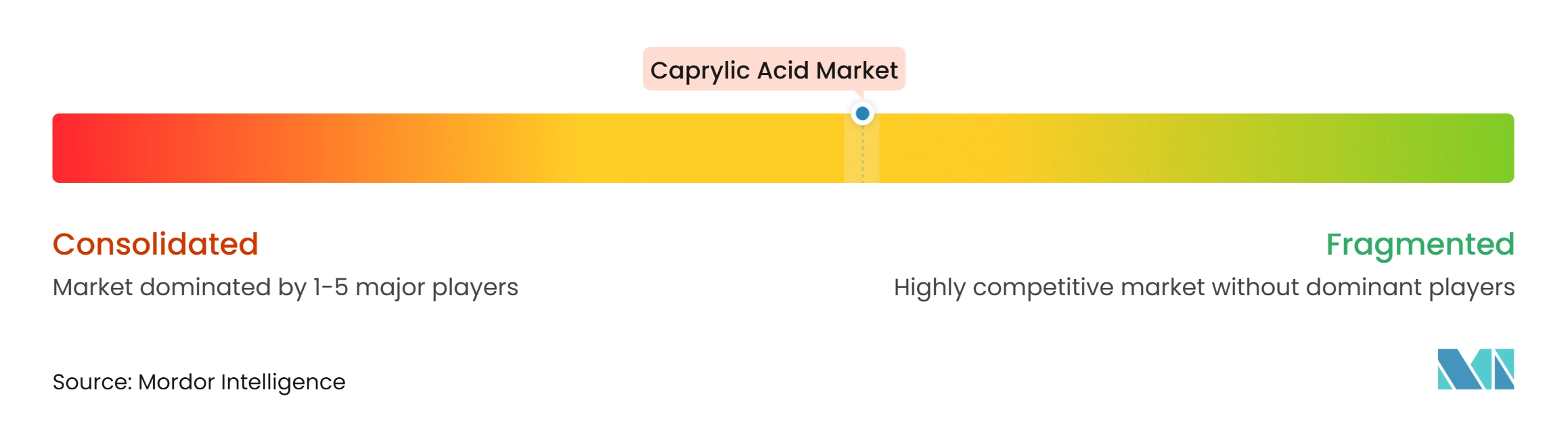
The caprylic acid market is moderately fragmented. Integrated producers, including KLK OLEO, IOI Oleo GmbH, Musim Mas, Wilmar International, and Pacific Oleochemicals, hold feedstock scale and cost advantages. Oleon NV and Croda International compete through formulation expertise, regulatory documentation, and sustainability credentials. VVF India and Emery Oleochemicals contribute regional supply strengths in India and the Americas. The market also depends on distributors that connect specialized producers with smaller formulation customers. Their role is significant where customers require technical guidance, local inventories, or regulatory information. Pharmaceutical-grade products present higher barriers, as customers expect European Pharmacopeia- and United States Pharmacopeia-aligned quality systems. This structure supports a role for distributors such as Acme-Hardesty and Cremer Oleo GmbH, which connect specialty producers with formulation customers.
Competitive differentiation is shifting toward customer co-development and application knowledge. IOI Oleo operates a CARE studio in Germany and has planned a studio in Penang, supporting a transition from ingredient supply to formulation partnerships. The company has filed 26 patents over nine years. This approach can reduce exposure to direct price competition, as buyers receive technical support alongside the ingredient. It can also improve the supplier's understanding of practical formulation constraints before a product reaches commercial scale. Development of C8 and C10 derivatives can help suppliers enter premium cosmetic applications. In this market, formulation support can be as important as basic feedstock availability for customers requiring specific sensory, stability, or compliance outcomes. Musim Mas expanded downstream processing through its Batangas surfactant facility initiative in the Philippines.
Pharmaceutical-grade caprylic acid and palm-free biosynthetic materials remain areas of competitive interest. IOI Oleo's KetoLipix Therapeutics spin-off represents work on ketone ester therapeutics based on C8 chemistry. In March 2025, Kao entered into an agreement with Future Origins for future purchases of a palm oil alternative, indicating interest in biosynthetic feedstocks for oleochemical uses. A comparable approach could eventually affect C8 sourcing, although no current commercial C8 alternative has been established. Certification is an established entry requirement for suppliers serving European buyers. Buyers who prioritize documented materials favor firms with established sourcing controls over those focused solely on output scale. The market distinguishes between commodity-scale capacity and specialized derivative supply with traceable input records. Companies without direct mill-level relationships have weaker access to customers seeking RSPO- and EUDR-aligned sourcing. The market will therefore continue to differentiate between commodity supply capabilities and specialized, documented derivative offerings.
Caprylic Acid Industry Leaders
-
Wilmar International Limited
-
KLK OLEO
-
Oleon NV
-
Emery Oleochemicals
-
Procter & Gamble
- *Disclaimer: Major Players sorted in no particular order
Caprylic Acid Market Companies Covered in this Report
- Acme-Hardesty Co.
- BASF
- Cremer Oleo GmbH and Co. KG
- Croda International Plc
- Emery Oleochemicals
- IOI Oleo GmbH
- Kao Corporation
- KLK OLEO
- KLK Temix SpA
- Musim Mas Group
- Oleon NV
- Pacific Oleochemicals Sdn. Bhd.
- Procter & Gamble
- VVF L.L.C.
- Wilmar International Limited
Recent Industry Developments in Caprylic Acid Market
- September 2025: Musim Mas registered its Batangas surfactant manufacturing facility with the Philippine Economic Zone Authority (PEZA). Masurf Inc., a Musim Mas subsidiary, registered its 35,058 m² Batangas facility following the May 2025 acquisition agreement, with commercial operations targeted for November 2025. The facility produces esterquat for fabric softeners and other oleochemical surfactants.
- September 2025: IOI Oleo launched SOFTISAN 650, a 100% natural cross-polymer (Polyglyceryl-3 Azelate/Caprate/Caprylate/Stearate Crosspolymer) derived from caprylic acid, capric acid, and natural azelaic acid. The product received the innovation award for functional ingredients at In-Cosmetics Global 2025 in Amsterdam and was the first 100% natural crosspolymer for film-forming applications in cosmetics.
Global Caprylic Acid Market Report Scope
Caprylic acid is a saturated medium-chain fatty acid (MCFA) with an eight-carbon chain. It occurs naturally in coconut oil, palm kernel oil, and the milk of certain mammals, including cows and goats. The acid is characterized by its relatively low molecular weight and rapid metabolic absorption compared to long-chain fatty acids. These properties make it applicable across multiple industries, including food and beverages, pharmaceuticals, personal care, and animal nutrition.
The caprylic acid market is segmented by source, application, and geography. By source, the market is segmented into natural source and synthetic source. By application, the market is segmented into personal care and cosmetics, pharmaceuticals, food and beverages, and others. The report also covers market sizes and forecasts for caprylic acid across 15 countries in major regions. The market sizes and forecasts are provided in terms of value (USD).
Segmentation Overview
| Natural Source |
| Synthetic Source |
| Personal Care and Cosmetics |
| Pharmaceuticals |
| Food and Beverages |
| Others |
| Asia-Pacific | China |
| India | |
| Japan | |
| South Korea | |
| ASEAN Countries | |
| Rest of Asia-Pacific | |
| North America | United States |
| Canada | |
| Mexico | |
| Europe | Germany |
| United Kingdom | |
| France | |
| Italy | |
| NORDIC Countries | |
| Rest of Europe | |
| South America | Brazil |
| Argentina | |
| Rest of South America | |
| Middle East and Africa | Saudi Arabia |
| South Africa | |
| Rest of Middle East and Africa |
| By Source | Natural Source | |
| Synthetic Source | ||
| By Application | Personal Care and Cosmetics | |
| Pharmaceuticals | ||
| Food and Beverages | ||
| Others | ||
| By Geography | Asia-Pacific | China |
| India | ||
| Japan | ||
| South Korea | ||
| ASEAN Countries | ||
| Rest of Asia-Pacific | ||
| North America | United States | |
| Canada | ||
| Mexico | ||
| Europe | Germany | |
| United Kingdom | ||
| France | ||
| Italy | ||
| NORDIC Countries | ||
| Rest of Europe | ||
| South America | Brazil | |
| Argentina | ||
| Rest of South America | ||
| Middle East and Africa | Saudi Arabia | |
| South Africa | ||
| Rest of Middle East and Africa | ||
Key Questions Answered in the Report
What is current market size of Caprylic Acid Market?
The Caprylic acid market size was valued at USD 6.41 million in 2026 and is estimated to grow from USD 6.99 million in 2027 to USD 10.92 million by 2032, at a CAGR of 9.34% during the forecast period (2027-2032).
Which source type provides caprylic acid?
Natural material leads with an 85.13% share in 2026 and is forecast to grow at a 10.05% CAGR through 2032. Coconut oil and palm kernel oil are the principal natural feedstocks, and process consistency is critical for high-purity applications.
Which application has the strongest growth outlook for caprylic acid?
Food and Beverages has the fastest projected growth at a 10.41% CAGR through 2032. Functional nutrition, ketogenic products, sports nutrition, and clinical feeding support this outlook, while research on medium-chain triglycerides (MCTs) supports continued formulation activity.
Which region has the highest caprylic acid demand?
North America leads with a 36.48% share in 2026, supported by regulatory clarity for food use and an established supplement base. The region is also shifting toward higher-purity pharmaceutical excipients with stronger documentation requirements.