
Canada Wire and Cable Market Size and Share
Market Overview
| Study Period | 2020 - 2031 |
|---|---|
| Forecast Data Period | 2026 - 2031 |
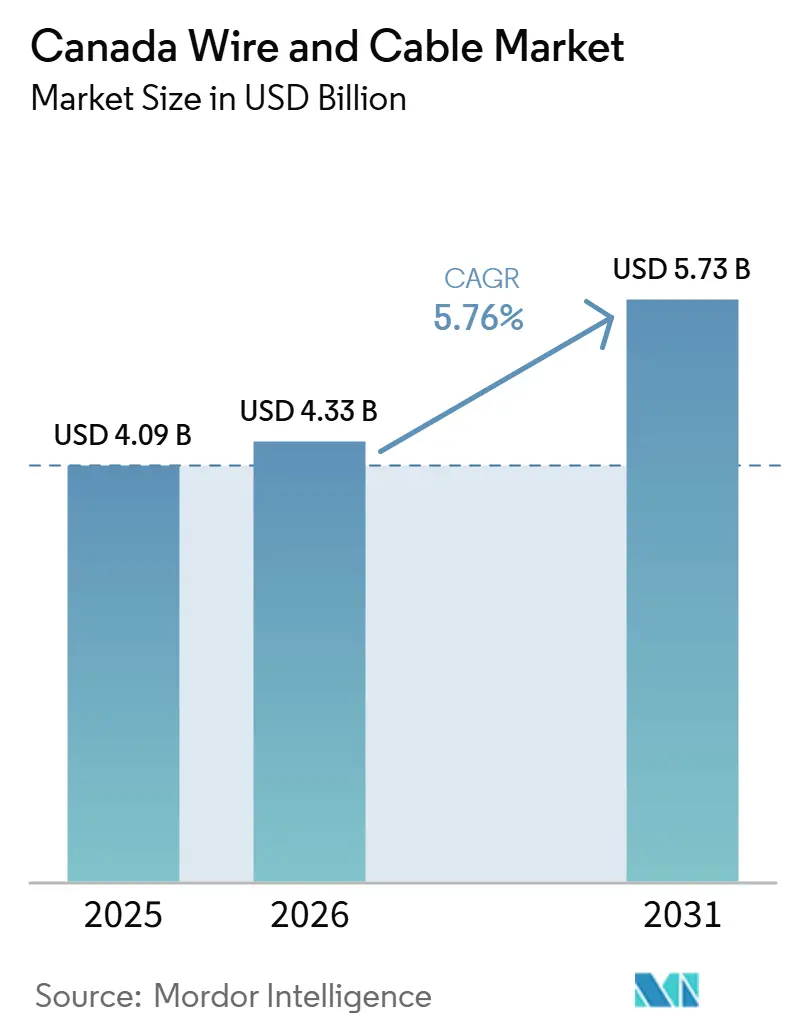
| Base Year Market Size (2025) | USD 4.09 Billion |
| Market Size (2026) | USD 4.33 Billion |
| Market Size (2031) | USD 5.73 Billion |
| Growth Rate (2026 - 2031) | 5.76 % |
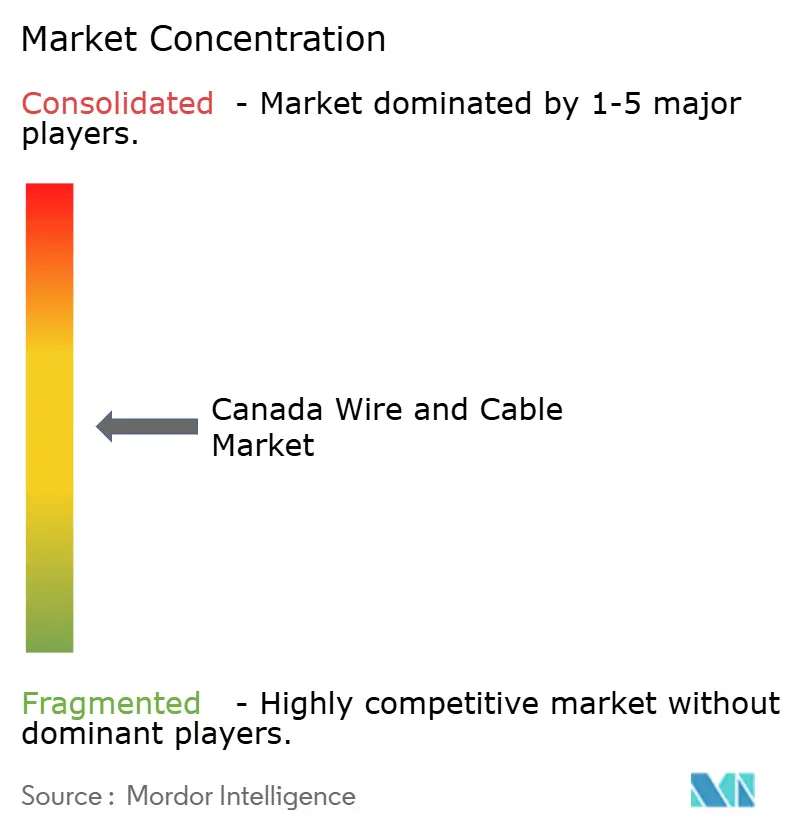
| Market Concentration | Medium |
Major Players *Disclaimer: Major Players sorted in no particular order Image © Mordor Intelligence. Reuse requires attribution under CC BY 4.0. | |
Canada Wire and Cable Market Analysis by Mordor Intelligence
The Canada Wire and Cable Market size is projected to be USD 4.09 billion in 2025, USD 4.33 billion in 2026, and reach USD 5.73 billion by 2031, growing at a CAGR of 5.76% from 2026 to 2031. Aging transmission and distribution assets, along with the federal electricity strategy, are expanding the pipeline for utility cable procurement. The Canada wire and cable market is also supported by electrification in transport, buildings, and industrial facilities, which requires upgrades to local distribution systems. Broadband expansion, 5G networks, and AI data centers are increasing demand for fiber-optic products alongside power cables. Long lead times for high-voltage and direct-current cable can favor suppliers with domestic capacity, established utility relationships, and dependable delivery schedules. Commodity costs, labor shortages in installation, and permitting delays may constrain execution, but they do not remove the underlying need for grid and connectivity investment.
Key Report Takeaways
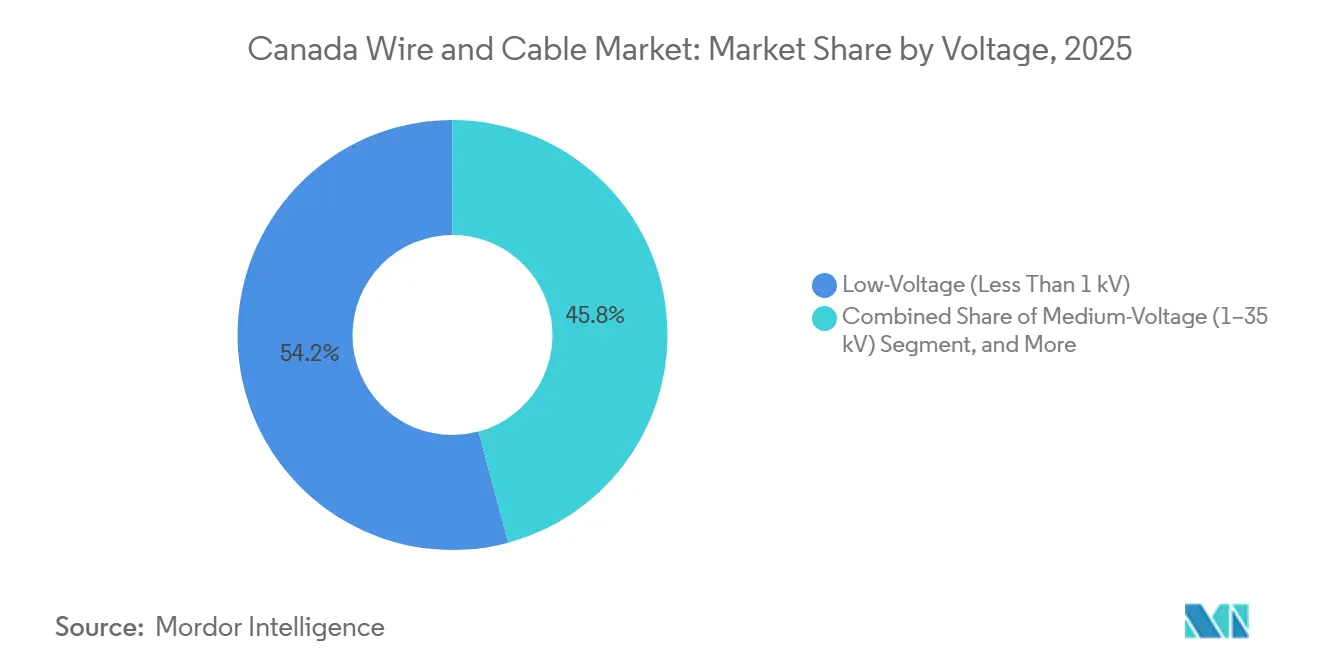
- By voltage, low-voltage (less than 1 kV) cables held 54.18% of the revenue share in the Canada wire and cable market in 2025, while extra- and high-voltage cables (more than 35 kV) are projected to expand at a 6.74% CAGR through 2031.
- By cable type, power cable accounted for 58.92% of the revenue share in the Canada wire and cable market in 2025, while fiber-optic cable is expected to expand at a 7.22% CAGR through 2031.
- By conductor material, copper held 63.11% of the revenue share in the Canada wire and cable market in 2025, while optical glass/polymer conductors are projected to grow at a 7.23% CAGR through 2031.
- By installation type, underground installations accounted for 51.86% of revenue share in the Canada wire and cable market in 2025, while submarine installations are projected to grow at a 6.63% CAGR through 2031.
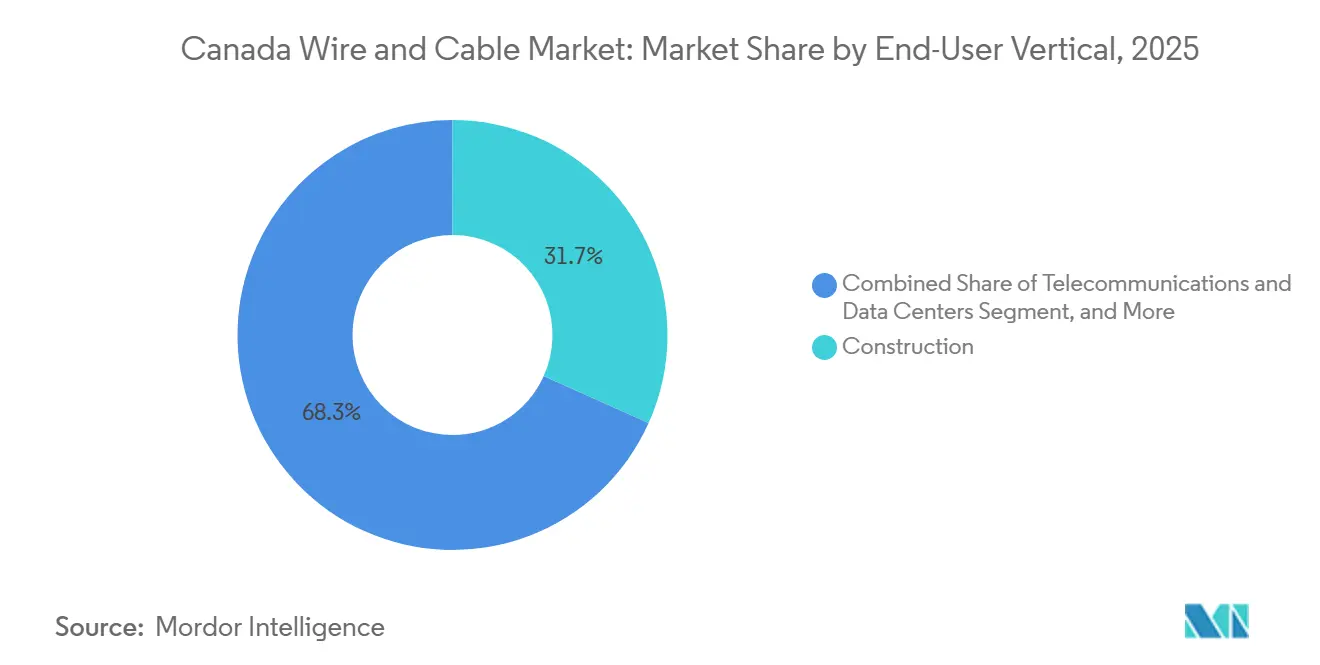
- By end-user vertical, construction accounted for 31.72% of revenue share in the Canadian wire and cable market in 2025, while telecommunications and data centers are expected to grow at a 6.89% CAGR through 2031.
- By insulation, insulated cable held 87.58% of revenue share in the Canada wire and cable market in 2025 and is expected to grow at a 5.91% CAGR through 2031.
Note: Market size and forecast figures in this report are generated using Mordor Intelligence’s proprietary estimation framework, updated with the latest available data and insights as of January 2026.
Canada Wire and Cable Market Trends and Insights
Drivers Impact Analysis*
| Driver | (~) % Impact on CAGR Forecast | Geographic Relevance | Impact Timeline |
|---|---|---|---|
| Accelerating Transmission and Distribution Grid Investment | +2.2% | National, with primary concentration in Ontario, Quebec, and British Columbia | Short term (≤ 2 years) |
| Electrification of Transportation, Buildings, and Industrial Loads | +1.4% | National, with early adoption gains in British Columbia, Ontario, and Quebec | Medium term (2-4 years) |
| Expansion of Renewable Generation and Interprovincial Interties | +0.8% | National, with focal projects in Atlantic Canada, the Alberta-British Columbia corridor, and Manitoba-Nunavut | Medium term (2-4 years) |
| Rural Fiber, 5G, and Data Center Network Expansion | +0.7% | National, with concentration in Ontario, Saskatchewan, and Quebec | Short term (≤ 2 years) |
| Northern and Remote Mining Connectivity Requirements | +0.3% | Nunavut, Northwest Territories, Northern Ontario, Northern British Columbia, and Northern Quebec | Long term (≥ 4 years) |
| Increasing Demand for Low-Loss, High-Ampacity Conductors in Constrained Corridors | +0.2% | Ontario, Alberta, and British Columbia | Medium term (2-4 years) |
| Source: Mordor Intelligence | |||
Accelerating Transmission and Distribution Grid Investment
Utility capital programs provide the strongest near-term demand base for the Canada wire and cable market. Hydro-Québec committed up to CAD 185 billion (USD 133.2 billion) through 2035 to generation expansion and the reinforcement of more than 5,000 km of transmission and distribution. BC Hydro outlined a CAD 36 billion (USD 25.9 billion) 10-year program for network expansion and modernization, while Hydro One committed CAD 17 billion (USD 12.2 billion) for 2023-2027, including 1,500 km of new or reinforced high-voltage lines. The Canada Electricity Advisory Council estimated that annual electricity investment will need to reach USD 55 billion to meet 2050 objectives.[1]Electro Federation Canada, “Building Canada’s Future Electricity Grid: Grid Technology Roadmap Final Report,” Electro Federation Canada, electrofed.com Concurrent programs across provinces reduce manufacturers' ability to balance orders among utility customers. This creates a more sustained procurement cycle for the Canada wire and cable market than sequential infrastructure programs.
Electrification of Transportation, Buildings, and Industrial Loads
Electrification is increasing demand for cable categories that previously moved largely with construction cycles. Public charging infrastructure is expanding alongside wider adoption of electric vehicles. The Canadian Charging Infrastructure Council stated in July 2026 that a strong light-duty vehicle emissions standard could unlock USD 21 billion in charging investment by 2035.[2]Canadian Charging Infrastructure Council, “New Standard, New Investment: Strong Vehicle Emissions Rules Will Help Unlock More Than USD 20 Billion in Charging Infrastructure Investment Across Canada,” Canadian Charging Infrastructure Council, ccic-ccir.ca It allocated USD 10 billion of that figure to public charging and USD 11 billion to residential installations, with 50-65% expected to flow to local electrical trades and cable suppliers. Heat pumps, battery storage, and bidirectional charging in multifamily buildings also require heavier-gauge wire and panel upgrades. These needs extend the demand base for the Canada wire and cable market beyond public charging activity.
Expansion of Renewable Generation and Interprovincial Interties
Interprovincial transmission is creating a cable demand category with larger conductor sizes and a higher value per installed kilometer than local distribution. The federal government identified five interprovincial transmission projects as national priorities in June 2026, including connections across British Columbia, Alberta, Saskatchewan, Manitoba, Nova Scotia, New Brunswick, and Prince Edward Island. The 2025 federal budget increased the Canada Infrastructure Bank’s capital envelope from CAD 35 billion (USD 25.56 billion) to CAD 45 billion (USD 32.86 billion), and the bank targets at least USD 14.4 billion in clean energy investments. Canada Energy Regulator scenarios indicate that interprovincial transmission capacity could rise 70% by 2050.[3]Canada Energy Regulator, “Canada’s Energy Future 2026: Scenario Results,” Government of Canada, cer-rec.gc.ca The scenarios point to 23,000-40,000 km of new transmission lines and a cost of USD 793,000 per kilometer. Coastal and mountainous routes also increase the need for submarine and ruggedized underground XLPE-insulated cable.
Rural Fiber, 5G, and Data Center Network Expansion
Rural broadband, 5G backhaul, and data center construction are creating separate sources of fiber-optic demand for the Canada wire and cable market. TELUS committed CAD 66 billion (USD 47.5 billion) in network investment through 2030, including more than 160 new cell towers and upgrades to over 1,000 existing sites. Bell’s 300 MW AI Fabric facility in Saskatchewan connects to the company’s national fiber backbone and requires new dark-fiber links from the Regina-area site. Data center interconnects are moving from 400G toward 800G and 1.6T optical transceivers. This transition supports demand for hollow-core fiber and advanced multimode cable with higher realized values than conventional single-mode fiber. These product specifications make the data center opportunity more valuable than a simple increase in fiber volume would suggest.
Restraints Impact Analysis*
| Restraint | (~) % Impact on CAGR Forecast | Geographic Relevance | Impact Timeline |
|---|---|---|---|
| Copper and Aluminum Price Volatility | -1.0% | Global commodity exposure, with direct effects on Canadian manufacturers and project budgets | Short term (≤ 2 years) |
| Skilled Labor Shortages for Medium-Voltage and Fiber Installation | -0.6% | National, most acute in Northern Canada and rapidly urbanizing centers in Ontario and British Columbia | Medium term (2-4 years) |
| Long Permitting Timelines for Interprovincial and Subsea Infrastructure | -0.4% | National, particularly severe for Atlantic subsea and Western interprovincial corridor projects | Long term (≥ 4 years) |
| Harsh-Climate Qualification and Product-Life Requirements | -0.3% | Yukon, Northwest Territories, Nunavut, Northern British Columbia, and Northern Ontario | Long term (≥ 4 years) |
| Source: Mordor Intelligence | |||
Copper and Aluminum Price Volatility
Conductor cost volatility creates risk for cable manufacturers and project owners because bid periods and installation programs often extend over different timeframes. Conductor materials typically represent 60-70% of the finished cable cost, making raw-material movements important to project budgets and manufacturer margins. Fixed-price procurement can leave manufacturers exposed when supply agreements lack escalation clauses. Aluminum availability is also important for overhead conductor production and reconductoring work. The Canada wire and cable market faces additional exposure, as imported materials and global supply chains affect delivery timing. Suppliers that manage material purchasing and contract terms effectively can limit the impact on project delivery.
Skilled Labor Shortages for Medium-Voltage and Fiber Installation
The shortage of trained tradespeople can slow the installation of committed cable projects. IBEW Canada stated that more than 1.4 million skilled trades workers will be needed by 2033. The federal government committed CAD 6 billion (USD 4.3 billion) in the 2026 Spring Economic Update to recruit, train, and hire up to 100,000 Red Seal tradespeople. Apprenticeship completion was near 46% in 2024, and the electricity sector could require up to 130,000 new jobs by 2050. Medium-voltage jointing and fiber splicing require specialized experience after certification. This can delay projects even where cable and capital are available.
*Our forecasts treat driver/restraint impacts as directional, not additive. The impact forecasts reflect baseline growth, mix effects, and variable interactions.
Segment Analysis
By Voltage: High-Voltage Projects Raise Value While Low-Voltage Cables Lead Volume
Low-voltage cable below 1 kV held 54.18% of the Canada wire and cable market share in 2025. The category is widely used in residential wiring, commercial fit-outs, and light industrial applications. Its demand is linked to construction starts and renovation activity in Canada’s main urban centers. As new residential construction moderates, retrofit work is becoming more important to low-voltage demand. Medium-voltage cable from 1 kV to 35 kV serves industrial facilities, commercial campuses, and distribution substation feeders. It also supports renewable collection systems and mine electrification in British Columbia and Ontario.
Extra- and high-voltage cable above 35 kV is projected to grow at a 6.74% CAGR from 2026 to 2031, the fastest rate within the voltage breakdown. Hydro One has active approval processes for the CAD 1.8 billion (USD 1.3 billion) Northeast Power Line, the CAD 1.2 billion (USD 864 million) Longwood to Lakeshore line, and the CAD 430 million (USD 310 million) Durham Kawartha Power Line. These projects support the growth of the Canada wire and cable market for high-voltage products, even though low-voltage products lead by meter count. Domestic high-voltage delivery can take 2-3 years, while international lead times can be longer. Utilities that delay orders can therefore face schedule pressure after approvals are complete. Suppliers with proven delivery capability can capture higher-value orders.



By Cable Type: Fiber-Optic Cable Benefits From Data Center Demand
Power cable held 58.92% of the cable-type segment in 2025. It is used across voltage classes, from building wire to underground and submarine transmission cable. Signal and control cable supports process industries, mining operations, and utility supervisory control and data acquisition systems. Coaxial and data cables remain relevant for legacy broadband distribution and enterprise local-area networks. Their role is gradually narrowing as fiber replaces coaxial products in last-mile uses. The broad deployment base keeps power cable central to the Canada wire and cable market.
Fiber-optic cable is expected to grow at a 7.22% CAGR from 2026 to 2031. Specialty fiber applications include hollow-core and polarization-maintaining products for 800G and 1.6T data center interconnects. Furukawa Electric resolved in March 2026 to invest up to JPY 300 billion (USD 2.0 billion) to expand optical fiber and cable capacity by up to 3 times. The investment was linked to AI infrastructure demand and activity in Japan and the United States. Greater demand for specialty fiber can support pricing for Canadian distributors before global capacity additions become available. The shift also reinforces the need for Canadian distributors to secure specialized products early.
By Conductor Material: Copper Leads While Optical Glass and Polymer Gain
Copper held 63.11% of the conductor-material segment in 2025. Its conductivity, flexibility, and established installation base make substitution difficult in many power cable applications below 110 kV. Aluminum remains an important alternative for overhead transmission because it reduces weight and can lower material costs. Prysmian processes aluminum rod at Lapointe, Quebec, and produces aluminum strand and armor at St. Maurice, Quebec. This gives Canada domestic capability for selected transmission-grade aluminum products.
Optical glass and polymer conductors are projected to expand at a 7.23% CAGR from 2026 to 2031, the fastest rate among material categories. The segment includes specialty photonic products for sensing, defense, and high-power laser applications, as well as telecommunications fiber. This growth rate is marginally higher than that of fiber-optic cable. Higher copper costs can also prompt utilities to assess reconductoring existing towers with aluminum conductor steel-reinforced (ACSR) conductors. That shift changes the material mix but does not reduce the Canadian wire and cable market because reconductoring has a higher per-tower value than standard replacement. Cable manufacturers with both copper and aluminum capabilities can address different utility requirements.
By Installation: Submarine Projects Support the Fastest Growth
Underground installation held 51.86% of the installation segment in 2025. Urban distribution networks rely on underground cable, and new transmission corridors use it more often where overhead routing faces public or environmental constraints. Overhead installation remains important for rural transmission and bulk distribution to remote mining sites. Its lower cost per kilometer continues to favor aerial conductors in appropriate terrain. The balance between underground and overhead systems varies with density, route approval, and project economics. This mix supports demand across the Canada wire and cable market.
Submarine installation is projected to advance at a 6.63% CAGR from 2026 to 2031. TELUS commissioned a 125-km submarine fiber-optic cable between Sept-Îles and Sainte-Anne-des-Monts in February 2026 through a joint CAD 20 million (USD 14.4 million) investment with the Government of Canada. The federal government announced CAD 5.9 million (USD 4.2 million) in initial design funding for 2 new 200 MW, 138-kV submarine power cables in the Prince Edward Island-New Brunswick interconnection project. Construction is expected to start in 2028. BC Hydro also issued a July 2026 request for proposals for submarine fiber-optic cable across its reservoir system. These projects broaden the technical requirements for installation providers and cable suppliers.
By End-User Vertical: Telecommunications and Data Centers Outpace Construction
Construction held 31.72% of the end-user segment in 2025, making it the largest end-use category. Residential and commercial building activity drives building wire demand, although high interest rates and affordability constraints can moderate housing starts. Commercial activity provides some offset through data center and logistics construction. Power infrastructure is the second-largest end-use area and is strengthening as utility capital programs expand. Oil and gas, petrochemicals, automotive, and industrial manufacturing create additional demand for power, instrumentation, and control cable. Their needs are more specialized than those of building construction.
Telecommunications and data centers are expected to grow at a 6.89% CAGR from 2026 to 2031. Bell’s 300 MW Saskatchewan AI Fabric facility connects to national fiber infrastructure and requires dark-fiber construction and high-density interconnect cable. Equipment upgrades from 400G to 800G and 1.6T increase the value per meter of data center interconnect products. The Canada wire and cable market is therefore exposed to both the number of network projects and their increasingly demanding specifications. Industrial manufacturers remain important users of cable designed for chemical exposure and Canadian Standards Association certification. This supports demand for products with defined performance and compliance requirements.
By Insulation: Insulated Cable Retains Its Dominant Position
Insulated cable held 87.58% of the insulation segment in 2025. Fixed building installations, underground systems, and submarine applications require conductor isolation for safety and reliability. Non-insulated cable mainly includes bare aluminum and steel-reinforced overhead conductors. It retains a role in rural and remote bulk transmission where aerial routes remain cost-effective. Its share can decline where denser corridors use more underground and submarine cable. Safety requirements continue to support insulated products across the Canada wire and cable market.
Insulated cable is expected to grow at a 5.91% CAGR from 2026 to 2031. Cross-linked polyethylene, or XLPE, is replacing ethylene propylene rubber and polyvinyl chloride in many medium- and high-voltage applications. XLPE provides stronger dielectric performance and higher thermal ratings, which can increase continuous operating temperature and ampacity. The performance improvement can allow smaller conductor sizes in thermally managed corridors. Canadian Standards Association approval for new insulation materials can take 6-18 months. This favors established XLPE and ethylene propylene rubber chemistries over newer bio-based materials.
Geography Analysis
Ontario and Quebec are the main demand and manufacturing bases for the Canadian wire and cable market. Ontario has active approvals for Hydro One’s CAD 1.8 billion (USD 1.3 billion) Northeast Power Line, CAD 1.2 billion (USD 864 million) Longwood to Lakeshore line, and CAD 430 million (USD 310 million) Durham Kawartha Power Line. Prysmian facilities in Prescott and St. Jerome, together with Nexans’s expanded Canadian presence after its 2025 Electro Cables acquisition, provide local low- and medium-voltage supply. Quebec’s demand is shaped by Hydro-Québec’s CAD 185 billion (USD 133.2 billion) commitment through 2035. The program includes generation expansion, more than 5,000 km of transmission construction, and distribution reinforcement. Prysmian’s Quebec aluminum operations also make the province a supply hub for overhead transmission cable.
Western Canada has a different demand profile, combining resource electrification, liquefied natural gas infrastructure, and renewable generation development. BC Hydro’s CAD 36 billion (USD 25.9 billion) plan includes North Coast Transmission Line expansion for liquefied natural gas and mining electrification, as well as grid work for offshore wind integration. Alberta is exploring a second intertie with British Columbia, with an estimated cost between CAD 2 billion (USD 1.44 billion) and CAD 3 billion (USD 2.16 billion). British Columbia’s streamlined authorization approach for renewable energy projects and transmission lines can accelerate project pipeline procurement. Saskatchewan is also becoming a data center hub due to Bell’s 300 MW Sherwood facility. Foran Mining energized the McIlvenna Bay transmission line with SaskPower in March 2026.
Atlantic Canada and Northern Canada create separate opportunities for submarine, underground, and remote connectivity cables. The Canada Infrastructure Bank committed CAD 285 million (USD 205.2 million) to the 160-km, 345-kV Nova Scotia-New Brunswick Wasoqonatl Reliability Intertie, which is expected to be completed in 2028. Prysmian expanded its Atlantic Canada distribution partnership with Munden Enterprises in January 2026 to include fiber-optic products for utility, renewable energy, and critical infrastructure projects. The Kivalliq Hydro-Fiber Link has a CAD 3.2 billion (USD 2.3 billion) value and would combine a 150 MW high-voltage line with 1,200 Gbps of fiber over 1,200 km from northern Manitoba to the Kivalliq region. The governments of Nunavut and Manitoba signed a memorandum of understanding in July 2026. The project gives remote connectivity a national strategic role beyond its regional demand base.
Competitive Landscape
The Canada wire and cable market is moderately concentrated at the top tier, with Nexans Canada Inc. and Prysmian Group Canada Inc. operating the largest domestic manufacturing footprints. Both companies serve power, overhead, and specialty cable segments through several Canadian sites. Nexans completed the all-cash acquisition of Electro Cables Inc. in December 2025 for EUR 125 million (USD 135 million). The transaction added a 200-person team and a revenue base exceeding CAD 200 million (USD 144 million). It strengthened Nexans’s position in data centers, infrastructure, and low-voltage cable systems. The deal also showed the value of certified product portfolios and local production in meeting Canadian customer requirements.
Prysmian is maintaining its Atlantic Canada presence through distributor expansion and has committed EUR 800 million (USD 867.4 million) in global 2026 capital expenditure for fiber capacity, transmission cable production, and digital solutions. Its shared technology and supply chain can support Canadian operations. The competitive setting may also attract vertically integrated manufacturers from South Korea and Japan that are expanding North American production in response to government incentives. Such entrants could add capacity in premium segments where lead times remain extended. Existing manufacturers, therefore, need to compete on technology, delivery certainty, and technical service. Regional suppliers can retain a role where those factors matter more than scale.
High-voltage direct-current cable for interties and advanced conductors for reconductoring are areas where the domestic supply remains insufficient. The Electro Federation Canada Grid Technology Roadmap stated that wire and cable, and advanced conductors, were only partly addressed by the existing Canadian supply. It identified advanced conductors as mainly imported and noted that conventional bare overhead conductor production was limited to Nexans in Saskatchewan and Prysmian in Quebec. Northern Cables Inc., Deca Cables Inc., Imeco Cables Inc., and HELU Canada Inc. compete through shorter lead times, custom reel configurations, and Canadian Standards Association-certified products. Hydro One’s June 2026 application for the Durham Kawartha Power Line illustrates the procurement pipeline that favors suppliers with local installation experience and technical support. The Canada wire and cable market will reward suppliers that can reduce import exposure and manage long project schedules.
Canada Wire and Cable Industry Leaders
Nexans Canada Inc.
Prysmian Group Canada Inc.
Southwire Company, LLC
Belden Inc.
LS Cable and System Co., Ltd.
- *Disclaimer: Major Players sorted in no particular order

Recent Industry Developments
- July 2026: The governments of Nunavut and Manitoba signed a memorandum of understanding to advance the Kivalliq Hydro-Fibre Link, a CAD 3.2 billion (USD 2.3 billion) infrastructure corridor spanning 1,200 km that will deliver 150 MW of electricity through high-voltage power transmission lines and 1,200 Gbps of fiber-optic bandwidth to 5 Kivalliq communities and Agnico Eagle’s Meliadine gold mine. The memorandum marked a major de-risking milestone for a technically advanced northern intertie project and for future cable procurement with Hydro-Fiber.
- July 2026: The Canada Infrastructure Bank committed CAD 5.9 million (USD 4.2 million) for the Prince Edward Island-New Brunswick Interconnection Expansion Project. The funding supported technical studies, marine surveys, and preliminary design for 2 new 200 MW, 138-kV submarine power cables and associated substation upgrades. Construction is expected to start in 2028.
- June 2026: The federal government named 5 interprovincial transmission projects as priorities under the National Electricity Strategy, covering the British Columbia-Alberta, Alberta-Saskatchewan, Saskatchewan-Manitoba, Nova Scotia-New Brunswick, and Prince Edward Island-New Brunswick corridors. These projects, if advanced, represent multi-year procurements of high-voltage and submarine cables, with combined capital expenditures in the billions of dollars across cable systems.


Canada Wire and Cable Market Report Scope
The Canadian wire and cable market revenue is generated through the sale of low-, medium-, and high-voltage wires and cables, including power, fiber-optic, signal and control, and coaxial/data cables with copper, aluminum, or optical glass/polymer conductors, along with associated value-added products and installation-specific solutions for overhead, underground, and submarine network deployments.
The Canada wire and cable market report is segmented by voltage (extra- and high-voltage (greater than 35 kV), medium-voltage (1-35 kV), and low-voltage (less than 1 kV)), cable type (power cable, fiber-optic cable, signal and control cable, and coaxial and data cable), conductor (copper, aluminum, and optical glass/polymer), installation (overhead, underground, and submarine), end-user vertical (construction (residential and commercial), power infrastructure (utilities and renewables), telecommunications and data centers, oil and gas and petrochemicals, automotive and mobility, and industrial manufacturing), and insulation (insulated and non-insulated). The market forecasts are provided in terms of value (USD).
| Extra- and High-Voltage (Greater Than 35 kV) |
| Medium-Voltage (1-35 kV) |
| Low-Voltage (Less Than 1 kV) |
| Power Cable |
| Fiber-Optic Cable |
| Signal and Control Cable |
| Coaxial and Data Cable |
| Copper |
| Aluminum |
| Optical Glass/Polymer |
| Overhead |
| Underground |
| Submarine |
| Construction | Residential |
| Commercial | |
| Power Infrastructure (Utilities and Renewables) | |
| Telecommunications and Data Centers | |
| Oil and Gas and Petrochemicals | |
| Automotive and Mobility | |
| Industrial Manufacturing |
| Insulated |
| Non-Insulated |
| By Voltage | Extra- and High-Voltage (Greater Than 35 kV) | |
| Medium-Voltage (1-35 kV) | ||
| Low-Voltage (Less Than 1 kV) | ||
| By Cable Type | Power Cable | |
| Fiber-Optic Cable | ||
| Signal and Control Cable | ||
| Coaxial and Data Cable | ||
| By Conductor Material | Copper | |
| Aluminum | ||
| Optical Glass/Polymer | ||
| By Installation | Overhead | |
| Underground | ||
| Submarine | ||
| By End-User Vertical | Construction | Residential |
| Commercial | ||
| Power Infrastructure (Utilities and Renewables) | ||
| Telecommunications and Data Centers | ||
| Oil and Gas and Petrochemicals | ||
| Automotive and Mobility | ||
| Industrial Manufacturing | ||
| By Insulation | Insulated | |
| Non-Insulated | ||


Key Questions Answered in the Report
What is the Canada wire and cable market size?
The sector was valued at USD 4.09 billion in 2025, is estimated at USD 4.33 billion in 2026, and is forecast to reach USD 5.73 billion by 2031.
What is driving demand for wire and cable in Canada?
Grid modernization, transport and building electrification, renewable interties, broadband, 5G, and data centers are supporting demand.
Which voltage category is growing fastest in Canada?
Extra- and high-voltage cable is projected to expand at a 6.74% CAGR from 2026 to 2031, supported by transmission projects.
Which cable type is expected to grow fastest?
Fiber-optic cable is expected to advance at a 7.22% CAGR through 2031, supported by broadband, 5G, and data center connections.
Which end-user group offers the strongest growth outlook?
Telecommunications and data centers are projected to grow at a 6.89% CAGR through 2031, the highest rate among end-user groups.
What are the main constraints on cable project delivery in Canada?
Conductor cost volatility, skilled-labor shortages, long permitting timelines, and harsh-climate qualification requirements can delay projects.
Page last updated on:





