
Canada Surfing Tourism Market Size and Share
Market Overview
| Study Period | 2021 - 2031 |
|---|---|
| Forecast Data Period | 2026 - 2031 |
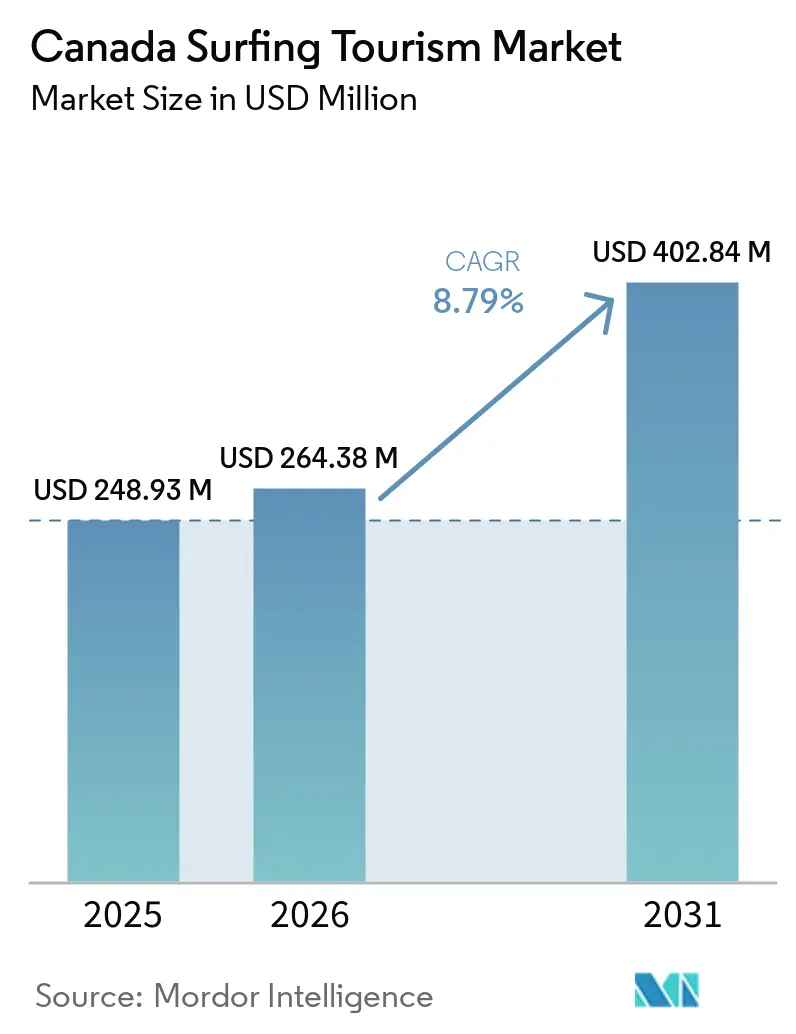
| Base Year Market Size (2025) | USD 248.93 Million |
| Market Size (2026) | USD 264.38 Million |
| Market Size (2031) | USD 402.84 Million |
| Growth Rate (2026 - 2031) | 8.79 % |
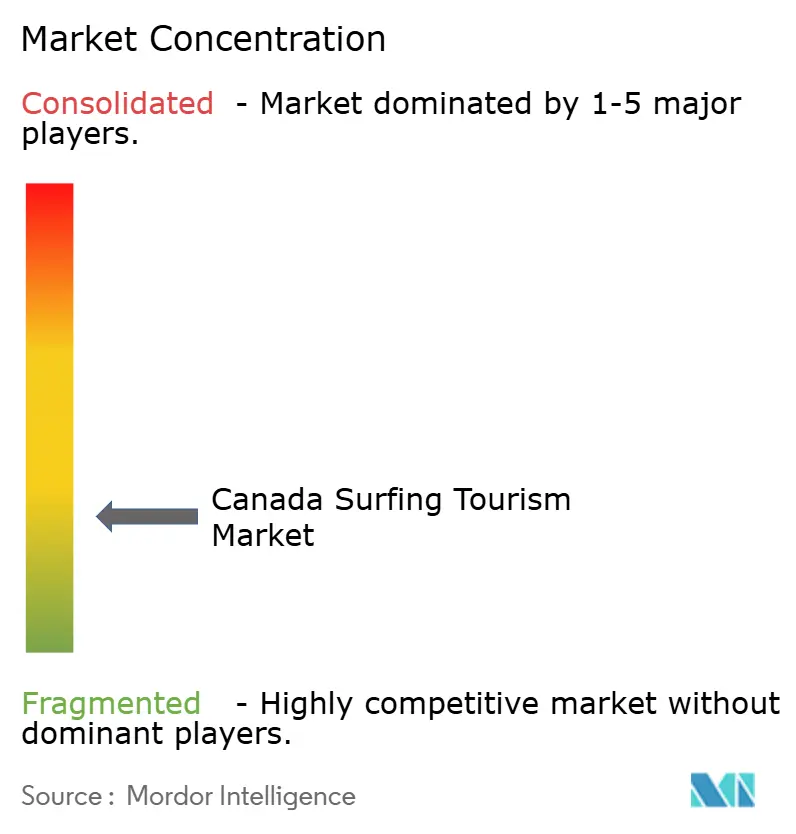
| Market Concentration | Low |
Major Players *Disclaimer: Major Players sorted in no particular order Image © Mordor Intelligence. Reuse requires attribution under CC BY 4.0. | |
Canada Surfing Tourism Market Analysis by Mordor Intelligence
The Canada surfing tourism market was valued at USD 248.93 million in 2025 and estimated to grow from USD 264.38 million in 2026 to reach USD 402.8 million by 2031, at a CAGR of 8.79% during the forecast period (2026–2031). Growth is driven by rising adventure travel demand, improved stay-and-surf options at coastal destinations, and structured coaching that extends trips beyond casual lessons. Indigenous-led hospitality is influencing the market, particularly in British Columbia, where beachfront lodging, cultural experiences, and surf access are integrated into visitor journeys[1]. Domestic travel remains the primary driver, with Canadians taking 90.6 million domestic trips in Q2 2025. A 21.6% decline in United States-bound Canadian travel during the same period redirected leisure budgets within Canada, supporting short-haul surf travel. Surfing’s inclusion in the Paris 2024 Olympics and the 2026 ISA World Surfing Games qualification cycle is increasing visibility, boosting competition-linked travel, athlete development, and event attendance. Canada’s tourism economy generated CAD 130 billion (USD 94.95 billion) in direct visitor spending in 2024. Destination Canada forecasts 5.4% annual growth, providing a favorable environment for experiential travel in the surfing tourism market.
Key Report Takeaways
- By experience type, Surf Camps & Retreats held a 33.84% share of the Canada Surfing Tourism Market in 2025, while Competition and Event-led Surf Trips are expected to expand at the highest CAGR of 9.83% in the Canada Surfing Tourism Market by 2031.
- By traveler origin, Domestic travelers accounted for 72.91% of the Canada Surfing Tourism Market in 2025, while international travelers are projected to grow at the highest CAGR of 9.12% in the Canada Surfing Tourism Market by 2031.
- By travel style, Independent/FIT Travel represented 60.13% of the Canada Surfing Tourism Market in 2025, while Group Tours & Surf Camps are expected to grow at the highest CAGR of 10.13% in the Canada Surfing Tourism Market by 2031.
- By Destination State, British Columbia commanded a 56.28% share of the Canada Surfing Tourism Market in 2025, while Nova Scotia is projected to grow at the highest CAGR of 9.67% in the Canada Surfing Tourism Market by 2031.
Note: Market size and forecast figures in this report are generated using Mordor Intelligence’s proprietary estimation framework, updated with the latest available data and insights as of January 2026.
Canada Surfing Tourism Market Trends and Insights
Drivers Impact Analysis*
| Driver | (~) % Impact on CAGR Forecast | Geographic Relevance | Impact Timeline |
|---|---|---|---|
| Adventure and experiential travel demand | +2.5% | Concentrated in British Columbia and Nova Scotia | Long term (≥ 4 years) |
| Domestic short-haul surf travel bias | +1.8% | National, strongest in British Columbia, Alberta, and the Maritimes | Medium term (2-4 years) |
| Millennial and Gen Z eco-wellness demand | +1.5% | National, led by British Columbia Lower Mainland and Atlantic Canada metros | Long term (≥ 4 years) |
| Resort-linked surf package growth | +1.0% | British Columbia, especially Cox Bay and Tofino, and Nova Scotia, especially Halifax coast | Medium term (2-4 years) |
| Indigenous-owned stay-and-surf expansion | +0.7% | British Columbia, especially Tofino and Vancouver Island, with early-stage potential in Nova Scotia | Long term (≥ 4 years) |
| Shoulder-season storm-surf packaging | +0.6% | British Columbia, especially Tofino and Ucluelet, and Nova Scotia, especially Lawrencetown and the South Shore | Short term (≤ 2 years) |
| Source: Mordor Intelligence | |||
Adventure and experiential travel demand
Surfing's combination of physical activity, skill development, and connection to Canada’s coastal destinations drives the country’s surfing tourism market. Surf operators increasingly focus on structured lessons, multi-session coaching, and camp formats instead of single beach activity bookings. The sport’s visibility after Paris 2024 has expanded interest beyond core surf communities, increasing demand for formal coaching and event participation. Surf Canada’s 2025 and 2026 event schedule highlight this trend, with competitions and qualifiers in Tofino and Ucluelet attracting athletes, coaches, families, and spectators, creating travel opportunities[2]. Destination Canada’s tourism outlook indicates favorable conditions for experiential travel categories, reinforcing surfing’s role in the leisure economy.
Domestic short-haul surf travel bias
Domestic travel plays a crucial role in supporting Canada's surfing tourism market. In Q2 2025, Canadian residents took 90.6 million domestic trips, reflecting a 10.9% increase compared to the same period the previous year. At the same time, trips to the United States declined by 21.6%, shifting leisure demand toward domestic destinations. This trend positively impacts surf travel, as British Columbia and Nova Scotia provide convenient short-haul options for Canadians seeking outdoor experiences without the higher costs and complexities of international surf vacations. The market benefits from a strong local demand base, particularly from travelers in British Columbia, Alberta, and the Halifax area, who can more easily make repeat surf trips compared to international visitors. This repeatability enhances the stability of bookings for lessons, camps, and weekend packages, even during periods of broader travel uncertainty.
Millennial and Gen Z eco-wellness demand
Younger travelers are expanding Canada's surfing tourism market by aligning surf trips with wellness-focused, nature-based travel. This trend is evident in yoga-surf retreats, cold-water surfing, and extended stays that combine coaching, lodging, and recovery-focused activities. Operators in Tofino and Nova Scotia are adapting to this demand by offering resort packages, retreat formats, and ethical travel experiences, positioning surf travel as a comprehensive activity. Indigenous tourism also aligns with this trend, appealing to travelers seeking low-impact, culturally immersive experiences rooted in local traditions and community involvement[3].As a result, demand in the Canada surfing tourism market is shifting toward packages that integrate instruction, accommodation, wellness, and cultural elements into a single trip.
Resort-linked surf package growth
Resort-linked packaging is increasing per-visitor value in the Canadian surfing tourism market as accommodation providers retain more of the tourism wallet within a single booking process. Long Beach Lodge Resort exemplifies this approach with its Surf Club, on-site dining, spa services, diverse accommodations, and sustainability-focused infrastructure investments, creating a higher-spend surf stay model. In Nova Scotia, Tourism Nova Scotia is advancing structured packages that combine lessons, lodging, and spa experiences. These offerings enhance average spending beyond lessons and simplify travel planning for visitors seeking coastal trips. This trend is driving stronger economic performance in camps, retreats, and surf-integrated accommodations compared to single-session lesson sales.
Restraints Impact Analysis*
| Restraint | (~) % Impact on CAGR Forecast | Geographic Relevance | Impact Timeline |
|---|---|---|---|
| Weather volatility and safety complexity | -0.8% | National, most acute in Nova Scotia winter and remote British Columbia offshore breaks | Long term (≥ 4 years) |
| Remote access and high trip costs | -1.0% | British Columbia, especially Highway 4 to Tofino, and Nova Scotia, especially the South Shore and Cape Breton | Long term (≥ 4 years) |
| Tofino housing and utility bottlenecks | -0.7% | British Columbia, especially Tofino, with spillover to Ucluelet | Medium term (2-4 years) |
| Access dependence on fragile coastal infrastructure | -0.6% | British Columbia, especially Highway 4, Nova Scotia coastal routes, and the rest of Canada | Long term (≥ 4 years) |
| Source: Mordor Intelligence | |||
Weather volatility and safety complexity
Weather poses a structural limitation to the Canada surfing tourism market due to rapidly changing wave quality, wind, water temperature, and safety conditions on both coasts. This challenge is more pronounced in cold-water destinations, where beginner participation relies on high-quality equipment, skilled instruction, and consistent operating windows. Operators mitigate these risks by offering certified coaching, full gear inclusion, and structured lesson formats, as seen with providers such as East Coast Surf School and Surf Sister. However, safety complexities reduce the potential audience compared to warmer, more predictable surf destinations. The market achieves growth where operators effectively combine strong safety measures with clear trip planning and dependable instruction.
Remote access and high trip costs
Remote access challenges influence the Canada surfing tourism market, particularly in Tofino and other coastal areas requiring long drives, additional transport, or limited accommodations. While standard daily surf rentals and lessons are reasonably priced (typically under CAD 150 (USD 109.55)), the total cumulative cost of high-season lodging, transit, and cold-water gear often exceeds CAD 1,000 (USD 730.36) for a multi-day trip. Nova Scotia’s dispersed coastal breaks face similar issues, as trip planning there is more complex compared to tropical resort towns with centralized amenities. These factors result in the market attracting higher-income travelers or dedicated surfing enthusiasts rather than the general leisure travel segment. While demand for surfing tourism in Canada continues to grow steadily, high structural travel costs and logistical barriers limit its accessibility and broader adoption across the country.
*Our forecasts treat driver/restraint impacts as directional, not additive. The impact forecasts reflect baseline growth, mix effects, and variable interactions.
Segment Analysis
By Experience Type: Surf Camps Lead, Competition Trips Drive Growth
Competition and Event-led Surf Trips are expected to grow at a 9.83% CAGR from 2026 to 2031, making them the fastest-growing segment in Canada’s surfing tourism industry. This growth is driven by Surf Canada’s expanded event calendar, including national championships and qualifier events at Cox Bay and Ucluelet, which generate recurring multi-night demand from athletes, coaches, families, and spectators. These events benefit multiple sectors of the visitor economy, such as hotels, food and beverage providers, and lesson operators. They also align with the Olympic qualification cycle, enhancing the visibility of competitive surfing and linking the market to athlete development travel[4].Lesson-led formats remain significant as high-volume entry points, particularly for schools offering beginner sessions with gear included in bookings.
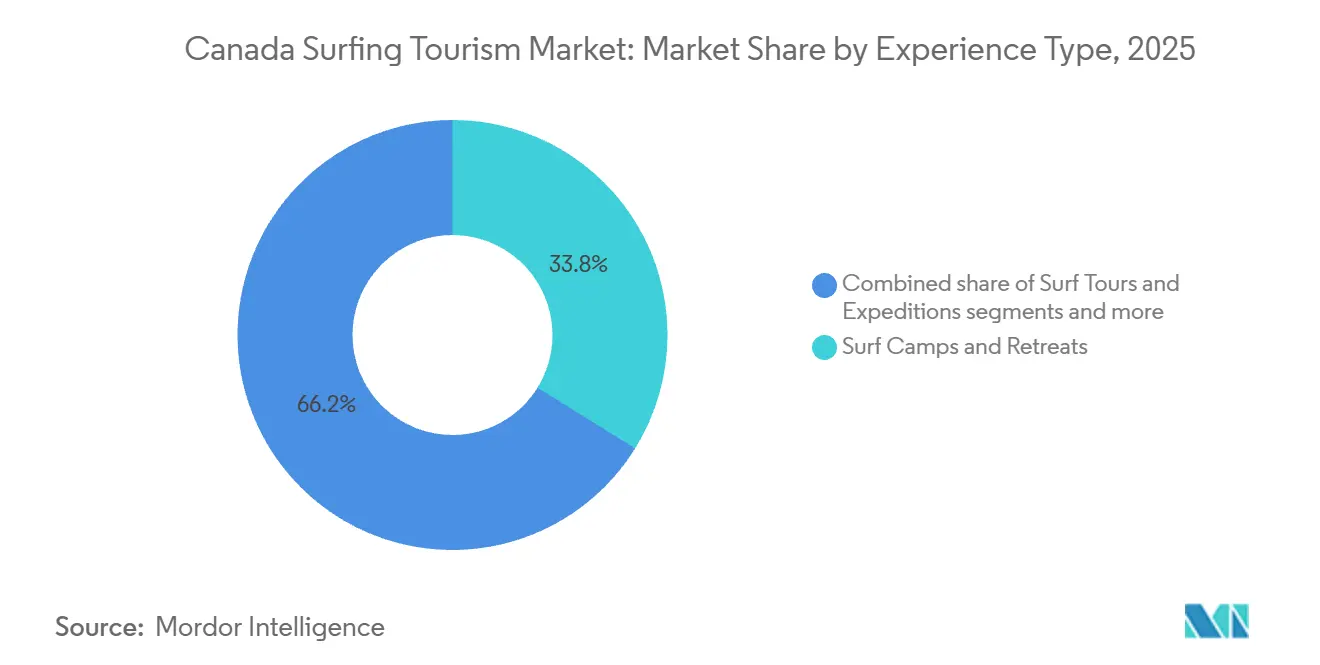
Surf Camps & Retreats accounted for 33.84% of the market in 2025, making them the largest experience category and a key driver of higher per-trip spending. These offerings extend visitor stays and capture more spending on accommodation, instruction, and retail compared to single lessons. Surf Sister’s camp calendar highlights this format’s depth, with programs catering to various age groups and skill levels, reducing churn as participants advance. Resort-linked offerings, such as those at Long Beach Lodge Resort, integrate lodging, surf instruction, dining, and spa services into comprehensive packages. These trends indicate that the market grows fastest where operators provide complete trip experiences rather than focusing solely on water activities.

By Traveler Origin: Domestic Dominance with International Growth Acceleration
International travelers are expected to grow at a 9.12% CAGR from 2026 to 2031, surpassing the domestic segment despite starting from a smaller base. The Canada surfing tourism market benefits from increased visibility through national team participation, global competitions, and the ISA pathway, which boosts destination awareness within global surf networks. In Q2 2025, overseas visitors to Canada spent an average of CAD 1,957 (USD 1,429.31) per trip, significantly higher than the CAD 449 (USD 327.9) spent by domestic overnight travelers. Even small increases in inbound volume can drive value growth in the market beyond visitor count growth.
Domestic travelers accounted for 72.91% of the market in 2025, forming the primary demand base. This reflects the influence of British Columbia and Alberta for Tofino and the Halifax area for Nova Scotia, which encourage repeat short-haul trips. Domestic overnight visits increased by 8.4% year-over-year in Q2 2025, with average overnight spending rising by 13.5%. This indicates Canadian leisure travelers took more trips and spent more per trip. The trend supports demand for camps, packages, and surf-integrated accommodations over lower-cost day bookings. Operators focused on local and regional customers are less affected by international travel fluctuations, providing resilience to the market.
By Travel Style: FIT Travel Leads, Group Format Grows Fastest
Group Tours & Surf Camps are expected to grow at a 10.13% CAGR from 2026 to 2031, making them the fastest-growing segment in Canada’s surfing tourism market. Structured camps drive this growth by simplifying trip planning, enabling earlier bookings, improving staffing visibility, and increasing spending on merchandise and add-on services. Operators such as Surf Sister, Pacific Surf Company, and East Coast Surf School support this model through diverse camp formats, destination-linked operations, and organized lesson delivery. The group segment also aligns with retreat and school-style programming, contributing to its growth over independent bookings. This format is becoming more valuable due to its ability to enhance yield management across seasonal operations.
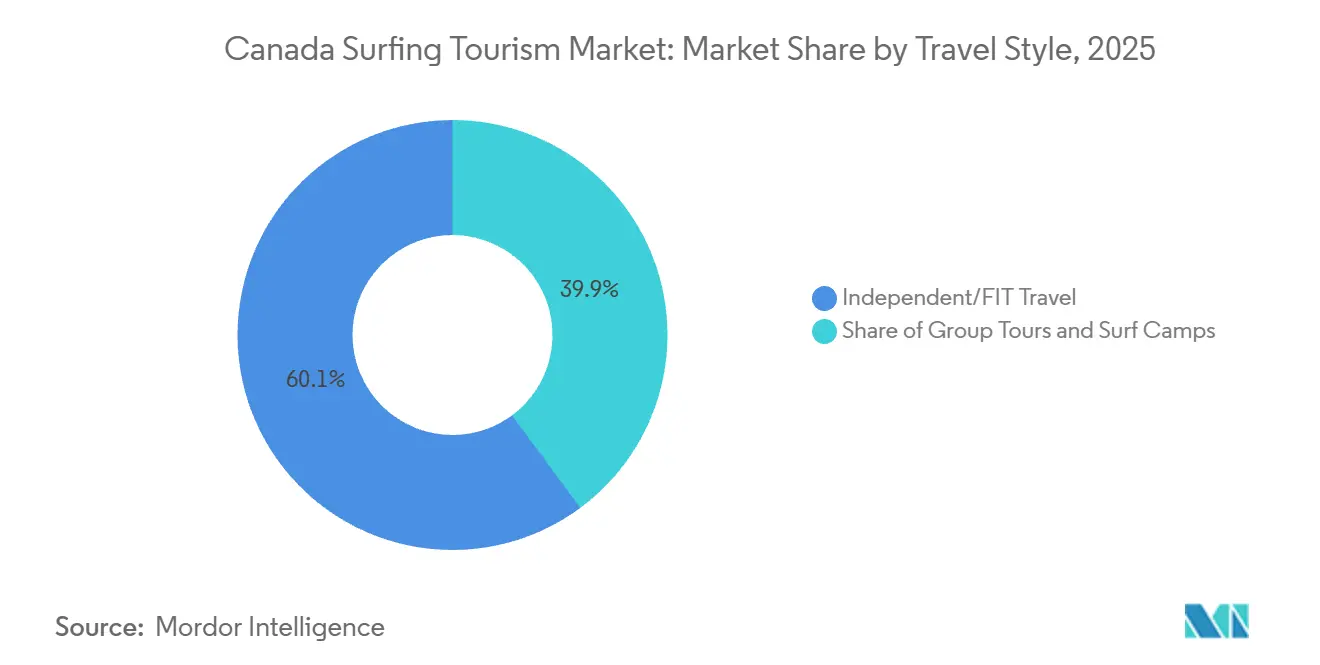
Independent/FIT Travel accounted for 60.13% of the market in 2025, reflecting the dominance of self-arranged trips. Many travelers book lessons online, select their own lodging, and drive to destinations, highlighting the practical structure of Canada’s surfing tourism market. Pacific Surf Company’s introduction of online rental reservations in 2025 reduced booking friction for self-directed travelers. However, FIT travel provides operators with less visibility on trip spending and generates fewer ancillary revenues compared to packaged formats. While FIT travel retains a significant market share, value growth is shifting toward group-led and accommodation-linked formats.
Geography Analysis
British Columbia accounted for 56.28% of Canada’s surfing tourism market share in 2025, driven by Tofino and the Pacific Rim. These areas feature lesson schools, camp operators, competitions, and resort infrastructure, making them the most developed surf destinations in the country. Vancouver Island hosts 16% of the province’s tourism businesses, while accommodations represent 29% of tourism spending, aligning with Tofino’s lodging model. However, development capacity, water planning, and transport resilience limit growth, despite strong visitor interest.
Nova Scotia is projected to grow at a 9.67% CAGR from 2026 to 2031, making it the fastest-growing provincial destination in Canada’s surfing tourism market. Lawrencetown Beach, near Halifax, offers accessible surf travel compared to remote coastal options. Tourism promotions now include “stay-and-surf” packages combining lessons, lodging, and spa experiences. East Coast Surf School supports beginner participation, converting interest into repeat visits. Nova Scotia combines growth potential, accessibility, and a year-round cold-water identity with room for further development.
Quebec and Ontario remain smaller, specialized segments of Canada’s surfing tourism market. Quebec’s surf activities are concentrated along the St. Lawrence corridor, including Sainte-Luce and Gaspésie, but lack the open-ocean conditions of British Columbia or Nova Scotia. Ontario focuses on paddle competitions and high-performance development, with Surf Canada’s SUP series and qualifiers in Collingwood. While other regions show long-term potential, British Columbia and Nova Scotia remain the primary centers of Canada’s surfing tourism market.
Competitive Landscape
The top operators in Canada's surfing tourism market hold a significant share, with the rest distributed among regional surf schools, surf-adjacent lodging providers, and localized operators, primarily in British Columbia and Nova Scotia. This fragmentation arises from businesses being tied to single destinations, seasonal instructor availability, and limited operational scope. While some operators are well-known, no national brand dominates pricing across the market. Competition depends on destination appeal, package offerings, and local reputation rather than scale.
Surf Sister has built its presence through coaching programs and camps and strengthened its community role by co-founding the Tofino Surf Lifesaving Club. It expanded internationally by launching surf retreats with Finisterra Travel, extending its reach beyond Canada. Pacific Surf Company focuses on operational efficiency and destination presence, offering online rental reservations and maintaining a long-standing presence in Tofino. These strategies align with market demands for streamlined bookings, diverse offerings, and relevance to various traveler types.
Operators such as Long Beach Lodge Resort and Indigenous businesses like Tin Wis and Tsawaak are diversifying beyond standalone schools. Long Beach Lodge Resort has enhanced its offerings through property renovations, digital booking improvements, sustainability initiatives, and water system investments. Tin Wis Resort and Tsawaak RV Resort leverage Indigenous tourism and beachfront locations to create integrated stay-and-surf experiences. The market increasingly favors operators combining accommodation, instruction, and destination identity into cohesive packages.
Canada Surfing Tourism Industry Leaders
-
Surf Sister
-
Pacific Surf Company
-
East Coast Surf School
-
Long Beach Lodge Resort
-
Tofino Paddle Surf
- *Disclaimer: Major Players sorted in no particular order
Recent Industry Developments
- May 2026: The 2026 Rip Curl Nationals & GromSearch, held May 8–10 at Cox Bay, Tofino, served as Canada's national surfing championship and the official Canadian qualifier for the ISA World Surfing Games. The event attracted elite athletes, coaches, family spectators, and media, contributing to Tofino's activity during the shoulder season.
- April 2026: Long Beach Lodge Resort uses an on-site private well to process up to 1,670 liters of water daily for its Surf Club and spa, avoiding Tofino's strict summer freshwater restrictions. This initiative has earned the BC Water-Friendly Business certification.
- February 2026: Surf Canada hosted the Vancouver Island Longboard Surf Contest National Championships at Wickaninnish Beach, Ucluelet, BC, from June 11 to 14, 2026. The event, an official national team qualifier for men's and women's longboard divisions, boosted multi-night surf travel demand across the Pacific Rim region.
- October 2025: The SUPTOBERFEST National Championships in 2025 took place in Tofino, featuring stand-up paddleboard and prone races across open, amateur, longboard, and Masters 50+ divisions, reinforcing Tofino's role as a central venue for Canadian surf-sport competitions.
Canada Surfing Tourism Market Report Scope
| Surf Tours & Expeditions |
| Surf Camps & Retreats |
| Surf Resorts & Accommodations |
| Surf Lessons & Coaching |
| Competition and Event-led Surf Trips |
| Domestic |
| International |
| Independent/FIT Travel |
| Group Tours & Surf Camps |
| British Columbia |
| Nova Scotia |
| Quebec |
| Ontario |
| Rest of Canada |
| By Experience Type | Surf Tours & Expeditions |
| Surf Camps & Retreats | |
| Surf Resorts & Accommodations | |
| Surf Lessons & Coaching | |
| Competition and Event-led Surf Trips | |
| By Traveler Origin | Domestic |
| International | |
| By Travel Style | Independent/FIT Travel |
| Group Tours & Surf Camps | |
| By Destination State | British Columbia |
| Nova Scotia | |
| Quebec | |
| Ontario | |
| Rest of Canada |
Key Questions Answered in the Report
What is driving growth in Canada’s surfing tourism space through 2031?
Growth is being supported by stronger adventure travel demand, a domestic travel shift, structured camps, Indigenous-led hospitality, and a more active competition calendar. The category is forecast to grow at an 8.79% CAGR from 2026 to 2031.
Which province leads surfing-related travel demand in Canada?
British Columbia led with 56.28% share in 2025 because Tofino remains the country’s most developed surf destination with the deepest concentration of schools, camps, events, and surf-linked lodging.
Which destination is growing the fastest for cold-water surf travel in Canada?
Nova Scotia is the fastest-growing province in this category, with a projected 9.67% CAGR from 2026 to 2031, supported by Lawrencetown access and growing stay-and-surf packaging.
Are domestic or international travelers more important for this category?
Domestic travelers are more important by volume, holding 72.91% share in 2025, but international travelers are expected to grow faster at a 9.1% CAGR through 2031.
Which trip format creates the most value for operators?
Camps, retreats, and surf-linked accommodation tend to create more value because they extend stay length and capture more spending across lodging, coaching, food, and add-on services. Surf Camps & Retreats held 33.84% share in 2025.
How competitive is the operator landscape in Canada’s surf travel segment?
The landscape is fragmented. The top 5 operators held an estimated 35.50% share in 2025, which means local reputation, destination fit, and package design matter more than national scale.