
Water Adventure Tourism Market Size and Share
Market Overview
| Study Period | 2020 - 2031 |
|---|---|
| Market Size (2026) | USD 72.17 Billion |
| Market Size (2031) | USD 91.70 Billion |
| Growth Rate (2026 - 2031) | 4.91 % |
| Fastest Growing Market | Asia-Pacific |
| Largest Market | Europe |
| Market Concentration | Low |
Major Players *Disclaimer: Major Players sorted in no particular order Image © Mordor Intelligence. Reuse requires attribution under CC BY 4.0. | |
Water Adventure Tourism Market Analysis by Mordor Intelligence
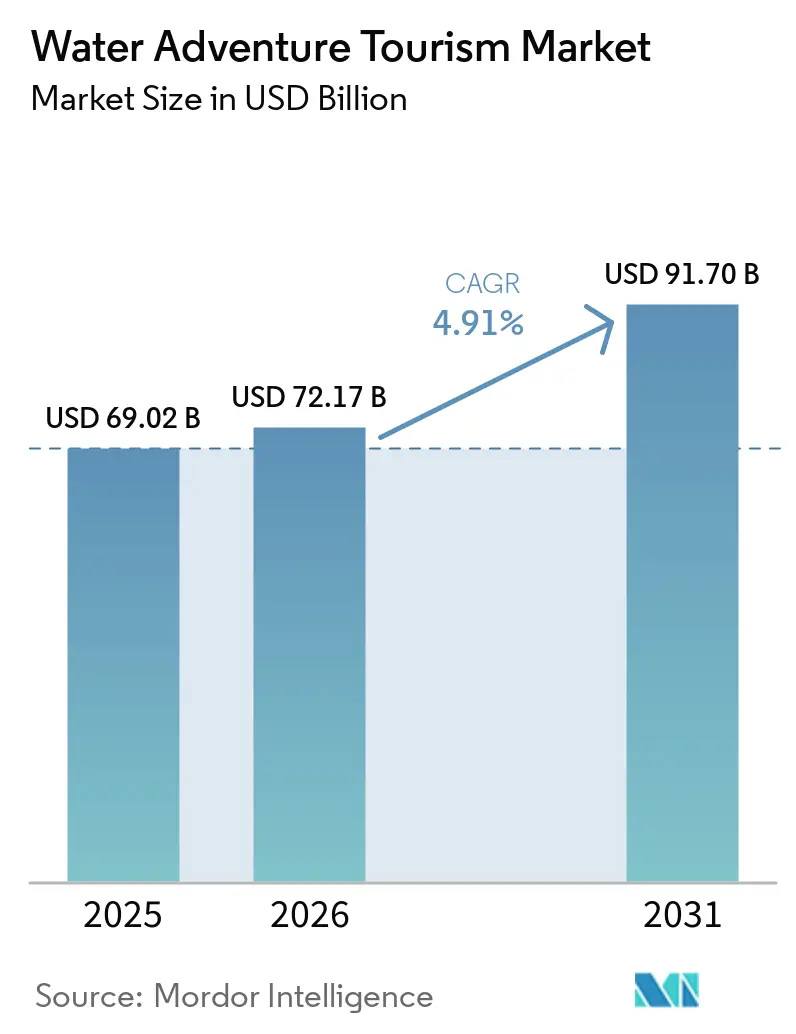
The global water adventure tourism market size stood at USD 72.17 billion in 2026, up from USD 69.02 billion in 2025, and is projected to reach USD 91.70 billion by 2031 at a 4.91% CAGR. Scuba diving remains one of the clearest proof points of the sector’s spending power, with a UN Ocean Decade endorsed study published in July 2025 estimating that scuba diving alone generates USD 8.5 billion to USD 20.4 billion in annual global economic output and supports up to 124,000 jobs across 170 countries, which shows that the broader water adventure tourism market has long been larger than most activity level counts suggest[1]. Demand remains supported by a broad leisure travel base, as Expedia Group’s 2025 Traveler Value Index found that 88% of global consumers planned a leisure trip within the next 12 months, and 61% were discovering travel ideas through social platforms, which keeps discovery and conversion closely linked in the water adventure tourism market[2]. Scuba and marine tourism content trending on social media is further accelerating destination visibility and consumer engagement across coastal tourism categories. Supply is also becoming more structured as destinations add marine infrastructure, formal recreation zones, and eco-tourism rules, which raises the value of licensed, safety-focused, and sustainability-aligned operators across the water adventure tourism market.
Key Report Takeaways
- By activity type, human-powered water adventure held 25.8% of the water adventure tourism market share in 2025, while Underwater Adventure is forecast to expand at a 6.7% CAGR through 2031.
- By traveler type, Independent or FIT travelers accounted for 43.9% of the global water adventure tourism market share in 2025, while Package or Organized Travelers are projected to grow at a 5.6% CAGR through 2031.
- By end user, leisure or recreational users represented 73.8% of the global water adventure tourism market share in 2025, while Corporate or Team-Building users are set to grow at a 6.6% CAGR through 2031.
- By age group, adults aged 25 to 44 captured 40.1% of the global water adventure tourism market share in 2025, while kids and youth under 24 are forecast to expand at a 7.2% CAGR through 2031.
- By geography, Europe held 31.3% of the water adventure tourism market share in 2025, while Asia-Pacific is projected to grow at a 5.9% CAGR through 2031.
Note: Market size and forecast figures in this report are generated using Mordor Intelligence’s proprietary estimation framework, updated with the latest available data and insights as of January 2026.
Market Trends and Insights
Drivers Impact Analysis of Water Adventure Tourism Market*
| Driver | (~) % Impact on CAGR Forecast | Geographic Relevance | Impact Timeline |
|---|---|---|---|
| Experiential Travel Shift Toward Active Coastal Trips | +0.9% | Global, strongest in North America, Europe, and the Asia-Pacific | Medium term (2-4 years) |
| Social-Media-Led Discovery and Direct Mobile Booking | +0.7% | Global, concentrated in Asia-Pacific, the Americas, the Middle East, and North Africa | Short term (≤ 2 years) |
| Government and Resort Investment in Marine Recreation Infrastructure | +0.8% | Asia-Pacific, the Middle East, Africa, and South America | Long term (≥ 4 years) |
| Safety Gear, Training, and Certification Widening First-Time Participation | +0.6% | Global, the highest incremental gains are in Asia-Pacific, the Middle East, and North Africa | Medium term (2-4 years) |
| Reef Restoration and Green Fins Standards Lifting Premium Dive and Snorkel Demand | +0.4% | Asia-Pacific, Red Sea, Caribbean, Mediterranean | Long term (≥ 4 years) |
| Cruise Shore Excursion and Beach Resort Water Sports Integration Boosting Ancillary Spend | +0.5% | Caribbean, Mediterranean, South Pacific, Arabian Gulf | Medium term (2-4 years) |
| Source: Mordor Intelligence | |||
Experiential Travel Shift Toward Active Coastal Trips
Active travel has moved into the mainstream, helping the water adventure tourism market capture a larger share of leisure budgets. Hilton’s 2025 Trends Report found that 70% of global travelers enjoy active travel, while 20% specifically planned outdoor adventure trips in 2025[3]. That preference matters because coastal trips are no longer built around one landmark or one beach, but around a sequence of bookable experiences that can stretch spending across several days. Travelers increasingly seeking experiential vacations are driving stronger demand for adventure-led coastal itineraries and curated marine experiences. In the water adventure tourism market, this favors operators who can bundle paddling, snorkeling, sailing, and beginner-level underwater activities into a single itinerary. It also reduces the relative appeal of single-activity providers that cannot extend the guest journey beyond one short booking.
Social-Media-Led Discovery and Direct Mobile Booking
Social platforms now account for a large share of first contact in the water adventure tourism market, especially among younger travelers and those interested in visually oriented marine activities. Expedia Group’s 2025 Traveler Value Index reported that 73% of travelers said influencer recommendations affected booking decisions, and that figure rose to 84% among travelers under 40. This shifts attention toward operators that can turn inspiration into a fast mobile booking with clear pricing and instant confirmation. It also supports shorter booking windows because travelers increasingly move from content discovery to transaction only after weather, timing, and destination details are clear. As a result, digital response speed is becoming as important as physical equipment quality for many providers in the water adventure tourism market. The growing influence of scuba and marine tourism content trending on social media is also increasing conversion rates for visually immersive travel experiences.
Government and Resort Investment in Marine Recreation Infrastructure
Public authorities and destination developers are expanding the supply base of the water adventure tourism market through marine zoning, access rules, and coastal tourism planning. Tonga’s 2025 eco-tourism guidelines for 63 Special Management Areas show how marine visitor activity is increasingly linked to community access, conservation, and formal operating standards[4]. A separate regional effort by the Pacific Tourism Organization and Australia’s Market Development Facility aims to develop a yachting strategy across Tonga, Samoa, Kiribati, and Fiji, demonstrating that small island destinations are seeking to convert dispersed natural assets into coordinated tourism circuits. These frameworks matter because greater clarity in access and marine-use rules reduces uncertainty for operators and investors. Over time, the water adventure tourism market should reward players who meet local permit requirements, comply with conservation rules, and operate consistently across regulated marine environments.
Safety Gear, Training, and Certification Widening First-Time Participation
Training and certification remain one of the clearest expansion levers in the water adventure tourism market, particularly for underwater activities that require trust before purchase. PADI stated in 2025 that it had expanded to 6,600 dive centers and resorts across 184 countries, while adding 220 new stores and converting more than 100 competitor operations in one year. A 2025 peer-reviewed study estimated the global market for diving certificates at USD 300 million to USD 470 million in annual turnover and identified PADI as holding close to 75% of the global market share, underscoring the close connection between training systems and travel demand. Stronger certification pathways reduce perceived risk for first-time participants and give operators a trusted sales tool for converting interest into booked instruction. They also create a repeat-travel cycle because certified participants are more likely to keep booking deeper, longer, and more specialized experiences in the water adventure tourism market. This trend continues to strengthen demand for scuba diving tourism among both beginner and advanced travelers seeking certified marine experiences.
Restraints Impact Analysis of Water Adventure Tourism Market*
| Restraint | (~) % Impact on CAGR Forecast | Geographic Relevance | Impact Timeline |
|---|---|---|---|
| Weather Volatility and Shorter Reliable Operating Windows | -0.7% | Global, concentrated in Asia-Pacific monsoon zones, the Caribbean hurricane belt, and northern European coasts | Medium term (2-4 years) |
| Liability Insurance and Compliance Costs for High-Risk Operators | -0.4% | North America, Europe, and globally for premium operators | Medium term (2-4 years) |
| Coral Reef Degradation and Carrying-Capacity Caps at Iconic Sites | -0.6% | Asia-Pacific, Red Sea, and Caribbean | Long term (≥ 4 years) |
| Fragmented Coastal Permits and Community Access Conflicts | -0.3% | South and Southeast Asia, the Pacific Islands, Africa, and Latin America | Long term (≥ 4 years) |
| Source: Mordor Intelligence | |||
Weather Volatility and Shorter Reliable Operating Windows
Weather volatility is reducing the number of dependable operating days across many parts of the water adventure tourism market. This does not remove underlying demand, but it does make revenue less predictable because bookings move closer to the activity date, and operators face more cancellations, rescheduling, or partial-capacity days. The effect is strongest in destinations where monsoon cycles, storm seasons, or rough water conditions already narrow the commercial season. It also shifts premium demand toward destinations that can prove year-round reliability, such as the Red Sea, the Maldives, and the Canary Islands. In practice, operators with flexible inventory, quick rebooking policies, and a mix of activity types are better placed to protect occupancy when weather patterns turn less stable.
Coral Reef Degradation and Carrying-Capacity Caps at Iconic Sites
Coral reef decline directly affects the core asset base of the water adventure tourism market because reef quality influences both destination choice and pricing power. A peer-reviewed study published in Coral Reefs in March 2026 reported that live hard coral cover in central Maldives lagoon reefs fell from 63.8% to 36.8%, while central ocean reefs dropped from 76.3% to 35.3% during the 2023-2024 bleaching event. At the same time, Green Fins has stated that only 4% of the estimated global dive and snorkeling operator base is currently covered by its framework, indicating that conservation accountability still covers only a small share of the operating landscape. This creates a double pressure, because degraded reefs lower visitor value and stricter site management can limit participant volumes at the very locations with the strongest demand. As these controls expand, the water adventure tourism market will increasingly favor operators that can demonstrate low-impact practices, site discipline, and credible sustainability performance. Demand for snorkeling holidays is also increasingly dependent on reef preservation and the quality of marine biodiversity.
*Our forecasts treat driver/restraint impacts as directional, not additive. The impact forecasts reflect baseline growth, mix effects, and variable interactions.
Water Adventure Tourism Market Segment Analysis
By Activity Type:
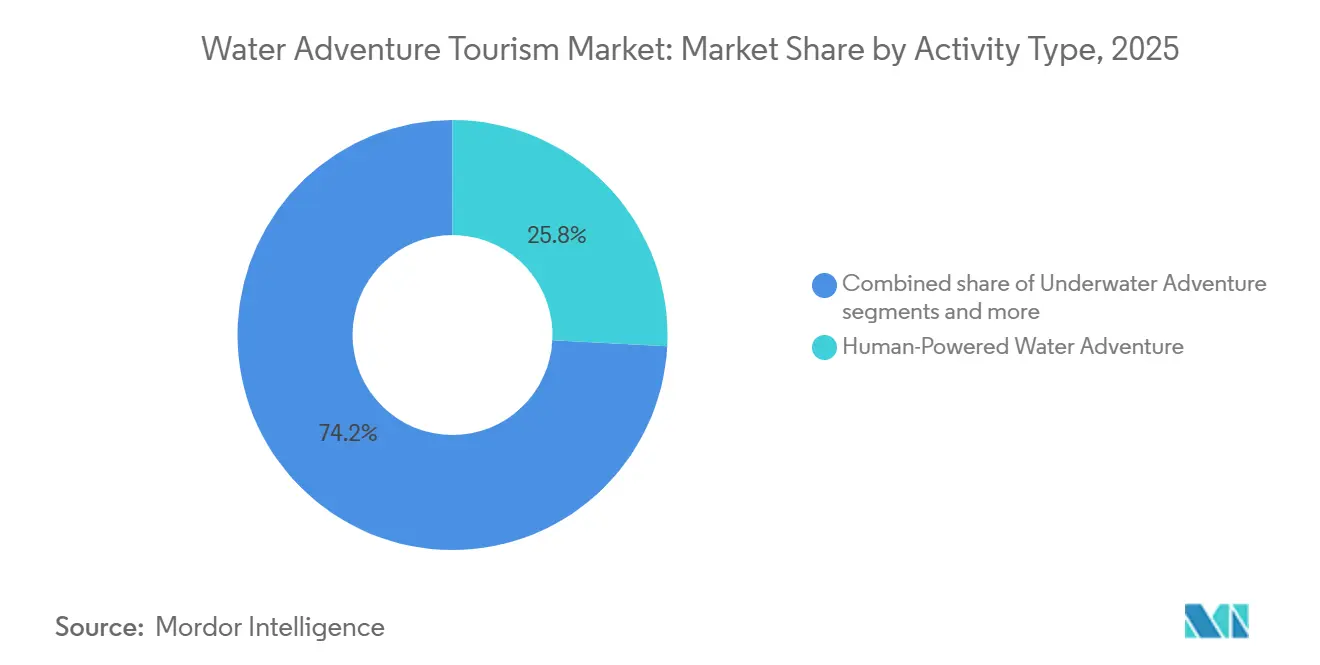
Underwater Sports Outpace a Diversified PortfolioHuman-powered water adventure accounted for 25.8% of the water adventure tourism market in 2025, making it the largest activity group by value. The segment benefits from broad appeal because kayaking, canoeing, and paddleboarding fit a wide range of age groups, skill levels, and resort formats. It also faces fewer technical barriers than scuba diving or wind-based activities, making it easier for first-time travelers to add on during a short coastal trip. That accessibility supports repeat use across both destination holidays and domestic blue space recreation.
Underwater adventure is projected to grow at a 6.7% CAGR from 2026 to 2031, making it the fastest expanding activity type in the water adventure tourism market. PADI’s 2025 network expansion and the strong value of the global diving certificate economy show that training infrastructure is continuing to widen the funnel for paid dive travel. The rest of the activity mix remains relevant, with wind and wave sports drawing loyal users, marine and sailing formats benefiting from premium, low-volume travel, and aerial or towed activities expanding through resort packages. White water and river formats add useful diversification by reducing dependence on beach-only demand and extending the water adventure tourism market's operating footprint inland.

By Traveler Type:
Structured Packages Rise Even as FIT LeadsIndependent or FIT travelers accounted for 43.9% of the market in 2025, reflecting the self-directed roots of the water adventure tourism market. Certified divers, experienced paddlers, and repeat coastal travelers often prefer flexible scheduling and direct operator choice rather than prebuilt itineraries. This format also suits travelers who want to combine several activities across one trip without being tied to a group pace. As digital discovery improves, FIT travelers can compare operators more quickly and make more selective decisions about quality, safety, and location. That keeps the segment important for specialist providers with strong reviews, direct booking capability, and niche activity depth.
Package or organized travelers are forecast to grow at a 5.6% CAGR through 2031, indicating rising demand from travelers seeking convenience and lower planning friction. This segment benefits from resort-integrated activity menus, bundled marine excursions, and multi-stop holiday formats that make water experiences easier to access for new participants. It also aligns well with cruise-linked shore programs and family travel, where a single organizer often manages safety, timing, and transport. Group travel remains a meaningful middle layer in the water adventure tourism market because schools, youth programs, and institutional buyers often prefer structured oversight. Operators with clear safety documentation, trained staff, and dependable scheduling are likely to capture more of this organized demand as procurement standards become more formal.
By End User:
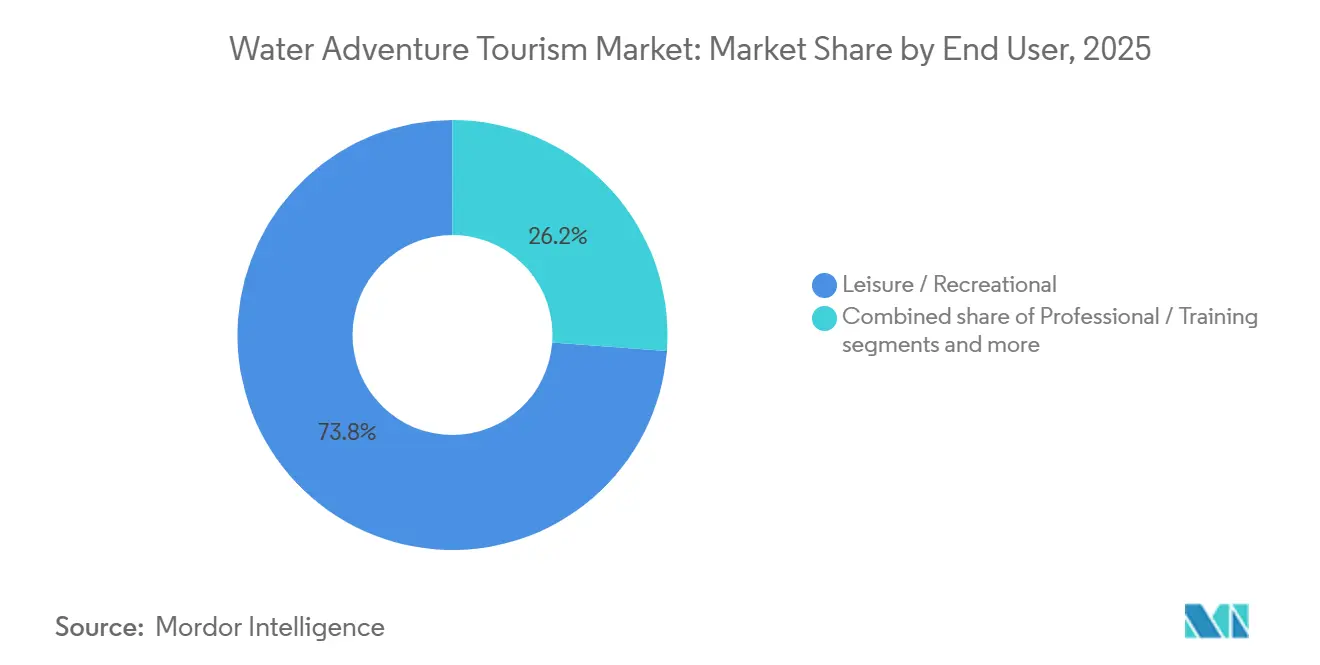
Leisure Dominance Masks a Fast-Growing Corporate NicheLeisure or recreational users accounted for 73.8% of demand in 2025, confirming that the water adventure tourism market remains fundamentally consumer-led. Even within that dominant base, traveler preferences are becoming more selective rather than more generic. Green Fins has reported that 95% of divers and tourists want to book with sustainable operators but struggle to identify them with confidence, suggesting a real quality premium for verified providers. That matters because sustainability is moving from a reputational advantage to a booking filter in premium underwater and snorkeling experiences. Leisure demand is therefore not just great, but increasingly segmented by trust, environmental performance, and experience quality.
Corporate or team-building users are set to grow at a 6.6% CAGR through 2031, making them the fastest-growing end-user group in the water adventure tourism market. This reflects a steady move toward retreat formats that combine outdoor participation with structured group interaction. Professional and training users remain a stable base because certification candidates, instructors, and skill development programs create repeat demand tied to organized learning. These customers often place more weight on safety systems, insurance coverage, and instructor credibility than on headline pricing. As a result, operators that can pair strong guest experience with audited process discipline are likely to gain share on the higher-value institutional side of the water adventure tourism industry.
By Age Group:
Youth Growth Is Reshaping Product DesignAdults aged 25 to 44 accounted for 40.1% of the demand in 2025, making them the largest age cohort in the water adventure tourism market. This group combines travel frequency, digital booking comfort, and the physical ability to participate in more demanding activities, such as open-water diving, kitesurfing, and rafting. It is also the cohort most likely to spend across both introductory and premium formats within a single trip. For many operators, this age group sets the baseline for pricing, scheduling, and content strategy. Their preferences continue to support products that blend convenience, adventure, and visible quality standards.
Kids and youth under 24 are projected to grow at a 7.2% CAGR from 2026 to 2031, providing the water adventure tourism market with a strong future demand pipeline. Growth in this group reflects broader exposure through school-linked ocean literacy, family resort experiences, junior certifications, and supervised beginner-level programs. The commercial value of this segment extends beyond current spending because early exposure often shapes later destination choice and brand loyalty. Middle-aged and senior travelers also remain important, particularly in snorkeling, sailing, and lower-impact paddling, where comfort and trip quality can outweigh intensity. This makes age-based product design more important across the water adventure tourism market, especially for operators trying to build repeat demand across multiple life stages.
Geography Analysis
Europe and North America Water Adventure Tourism Market
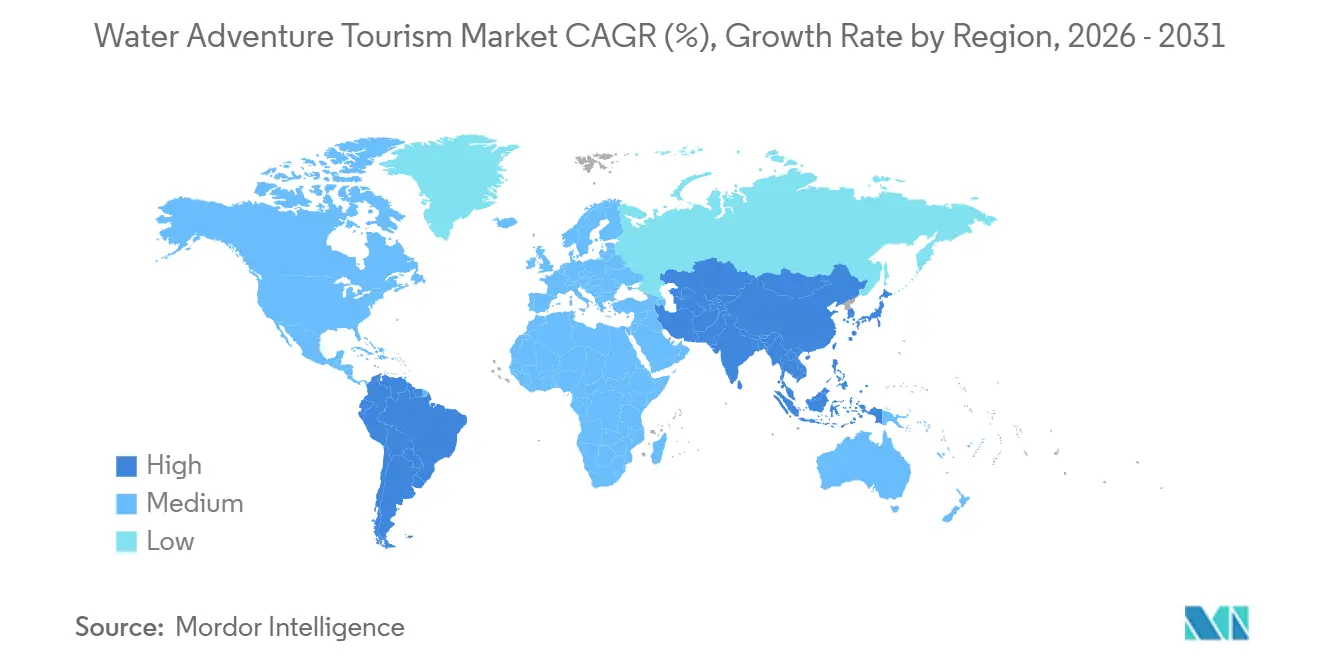
Europe accounted for 31.3% of the water adventure tourism market in 2025, making it the largest regional contributor. The region benefits from a dense mix of Mediterranean diving, Nordic Sea kayaking, Atlantic surf culture, and coastal sailing, which supports diverse activities year-round. The EU Blue Economy Report 2025 recorded more than 1.4 billion nights spent in EU coastal regions in 2023, up 6.4% year on year, which shows the depth of the region’s coastal demand base. Europe also benefits from mature infrastructure and a broad base of short-haul travelers, which supports both beginner and repeat participation. North America remains a steady market within the global water adventure tourism market because it combines a large installed base in diving, paddling, and rafting with strong domestic trip potential.
APAC Water Adventure Tourism Market
Asia-Pacific is projected to grow at a 5.9% CAGR from 2026 to 2031, making it the fastest-growing regional cluster in the water adventure tourism market. Growth is spread across several destination types, including dive-led island systems, resort-based marine recreation, and premium sailing or liveaboard routes. Regional tourism bodies are also moving toward more structured marine development, as shown by the Pacific Tourism Organization and the Market Development Facility strategy work across Tonga, Samoa, Kiribati, and Fiji. Tonga’s 2025 eco-tourism guidelines also show how fast-growing island destinations are pairing tourism growth with marine stewardship and community use rules. That combination of natural asset depth, rising infrastructure quality, and more formal operating frameworks supports the region’s long runway in the water adventure tourism market.
MEA and South America Water Adventure Tourism Market
The Middle East and Africa are gaining visibility in the water adventure tourism market because they offer year-round warm water, premium reef access, and a growing number of destination-led tourism projects. The Red Sea remains particularly important because it offers strong underwater visibility and year-round operating potential, helping offset weather disruptions seen in more seasonal markets. Africa’s coastal and reef assets are also becoming more investable when operators can prove environmental management and site discipline. In Jordan, Green Fins reported that Aqaba’s dive operators achieved a 51% reduction in environmental threats from marine tourism in the program’s second year, which shows how sustainability verification can strengthen destination positioning. South America remains smaller in absolute terms, but it continues to attract expedition-oriented demand through distinct niches in river, coastal, and cold-water adventure formats, broadening the global reach of the water adventure tourism market.
Competitive Landscape
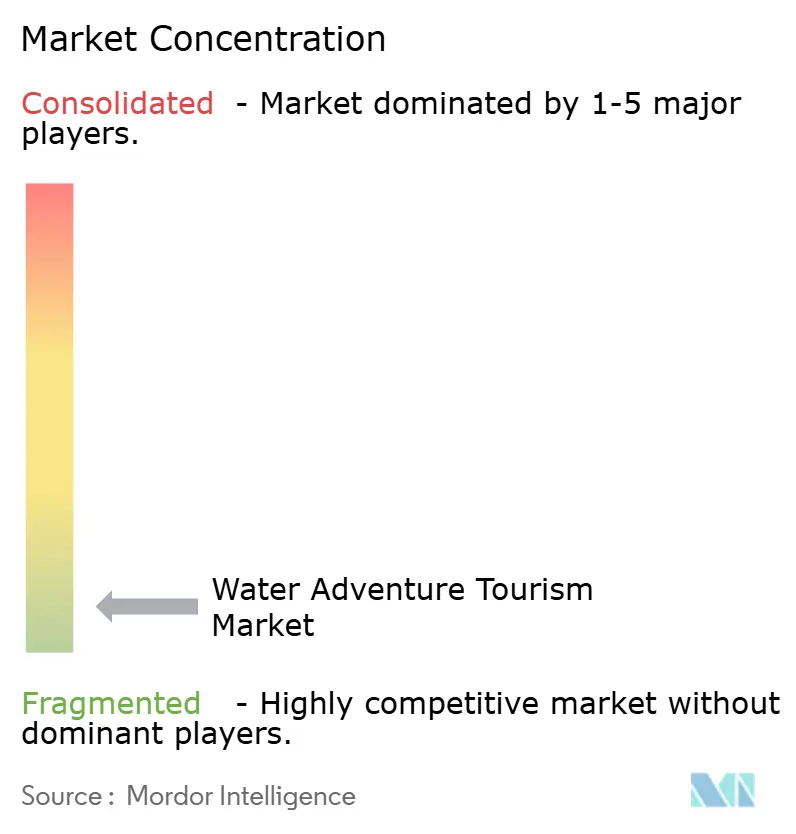
The water adventure tourism market remains highly fragmented, with the top five players accounting for only 9.6% of 2025 revenue. That structure leaves most of the market in the hands of independent dive centers, rafting operators, sailing charters, local marine excursion firms, and resort-based watersports providers. Scale still matters, but it works mainly through distribution, branding, and cross-selling rather than through dominant control of supply. TUI Group is a clear example, as its FY25 results showed 10.6 million experiences sold through TUI Musement and 99% occupancy in TUI Cruises, highlighting the power of packaging water-based experiences within a broader travel ecosystem.
Specialist brands compete differently inside the water adventure tourism market, usually through expertise, trust, and distinctive itinerary design. Lindblad Expeditions signed a multiyear charter agreement with Transcend Cruises in May 2025 to launch National Geographic Lindblad European River expeditions from 2026, demonstrating how niche operators are extending into adjacent water-based formats without sacrificing premium positioning. PADI also continues to reinforce a different kind of market power through network reach, training credibility, and operator affiliation, which can shape where first-time divers choose to book and learn. These advantages are harder for smaller providers to replicate because they depend on accumulated trust, recognized standards, and repeated customer engagement across destinations. As a result, competition in the water adventure tourism market is less than one winner taking a share quickly, and more about many operators defending specialized positions.
The most interesting white space is between large distributors and very small local specialists in the water adventure tourism market. Mid-sized operators that can combine authentic local execution with visible safety and sustainability credentials are well placed to win premium demand. Blue Alliance’s reef-positive liveaboard expansion in Indonesia shows how conservation-led product design can become a commercial differentiator rather than a cost center. The same logic applies to certified and Green Fins-aligned operators, as procurement standards and traveler expectations are moving toward measurable environmental performance. This means the water adventure tourism market is likely to remain fragmented, but the quality gap between compliant premium operators and undifferentiated providers should continue to widen.
Water Adventure Tourism Industry Leaders
-
TUI Group
-
G Adventures
-
Intrepid Travel
-
Lindblad Expeditions
-
PADI Travel
- *Disclaimer: Major Players sorted in no particular order
Water Adventure Tourism Market Companies Covered in this Report
- TUI Group
- G Adventures
- Intrepid Travel
- Lindblad Expeditions
- PADI Travel
- Aggressor Adventures
- Dive The World
- Dive Worldwide
- World Expeditions
- Mountain Travel Sobek
- Quark Expeditions
- Abercrombie & Kent
- Adventure Life
- Exodus Adventure Travels
- REI Travel
- Austin Adventures
- OARS
- ROW Adventures
- Western River Expeditions
- SwimTrek
Recent Industry Developments in Water Adventure Tourism Market
- March 2026: India’s Ministry of Tourism identified the National Institute of Water Sports (NIWS–IITTM) as the country’s nodal institution for training, certification, and capacity building in water sports. Andaman & Nicobar Islands, Gujarat, and Odisha have approached NIWS for satellite centers covering activities such as scuba diving, surfing, parasailing, and canoeing
- October 2025: Blue Alliance launched its second reef-positive liveaboard in Indonesia through BlueWild EcoVentures, operating the solar-powered, plastic-free vessel Bajau with a 220-guest annual target. The Blue Finance impact loan facility backed the project launched at COP16 in 2024, with commitments from BNP Paribas, establishing reef-positive liveaboard tourism as a bankable blue economy asset class.
- May 2025: Lindblad Expeditions signed a multiyear charter agreement with Transcend Cruises to launch National Geographic Lindblad European River expeditions starting in 2026, running through at least 2028. The deal marks Lindblad’s first European river program and will feature National Geographic naturalists and expedition leaders on each voyage.
- March 2025: The Reef-World Foundation and UNEP COBSEA convened the Green Fins National Workshop in Jakarta, producing a roadmap for sustainable diving and snorkeling in Indonesia aligned with the country’s 2030/45 MPA Vision and national biodiversity action plan.
Global Water Adventure Tourism Market Report Scope
Segmentation Overview
| Underwater Adventure (Scuba Diving, Snorkeling, Underwater Sea Walking, etc.) |
| Human-Powered Water Adventure (Kayaking, Canoeing, Paddleboarding, etc.) |
| White-Water & River Adventure (Rafting, River Tubing, Boarding, etc.) |
| Wind & Wave Adventure (Windsurfing, Kitesurfing) |
| Motorized Water Adventure (Jet Skiing, Speed Boating, etc.) |
| Aerial & Towed Water Adventure (Parasailing, Flyboarding, Towable Rides) |
| Marine / Sailing Adventure (Sailing, Deep-Sea Fishing, Expedition Boat Tours) |
| Independent / FIT Travelers |
| Group Travelers |
| Package / Organized Travelers |
| Corporate / Institutional Adventure Trips |
| Leisure / Recreational |
| Professional / Training |
| Corporate / Team-Building |
| Kids & Youth (Under 24 Years) |
| Adults (25–44 Years) |
| Middle-Age & Seniors (45+ Years) |
| North America | United States |
| Canada | |
| Mexico | |
| South America | Brazil |
| Peru | |
| Chile | |
| Argentina | |
| Rest of South America | |
| Europe | United Kingdom |
| Germany | |
| France | |
| Spain | |
| Italy | |
| BENELUX (Belgium, Netherlands, and Luxembourg) | |
| NORDICS (Denmark, Finland, Iceland, Norway, and Sweden) | |
| Rest of Europe | |
| Asia-Pacific | India |
| China | |
| Japan | |
| Australia | |
| South Korea | |
| South East Asia (Singapore, Malaysia, Thailand, Indonesia, Vietnam, and Philippines) | |
| Rest of Asia-Pacific | |
| Middle East And Africa | United Arab Emirates |
| Saudi Arabia | |
| South Africa | |
| Nigeria | |
| Rest of Middle East And Africa |
| By Activity Type | Underwater Adventure (Scuba Diving, Snorkeling, Underwater Sea Walking, etc.) | |
| Human-Powered Water Adventure (Kayaking, Canoeing, Paddleboarding, etc.) | ||
| White-Water & River Adventure (Rafting, River Tubing, Boarding, etc.) | ||
| Wind & Wave Adventure (Windsurfing, Kitesurfing) | ||
| Motorized Water Adventure (Jet Skiing, Speed Boating, etc.) | ||
| Aerial & Towed Water Adventure (Parasailing, Flyboarding, Towable Rides) | ||
| Marine / Sailing Adventure (Sailing, Deep-Sea Fishing, Expedition Boat Tours) | ||
| By Traveller Type | Independent / FIT Travelers | |
| Group Travelers | ||
| Package / Organized Travelers | ||
| By End User | Corporate / Institutional Adventure Trips | |
| Leisure / Recreational | ||
| Professional / Training | ||
| Corporate / Team-Building | ||
| By Age Group | Kids & Youth (Under 24 Years) | |
| Adults (25–44 Years) | ||
| Middle-Age & Seniors (45+ Years) | ||
| By Geography | North America | United States |
| Canada | ||
| Mexico | ||
| South America | Brazil | |
| Peru | ||
| Chile | ||
| Argentina | ||
| Rest of South America | ||
| Europe | United Kingdom | |
| Germany | ||
| France | ||
| Spain | ||
| Italy | ||
| BENELUX (Belgium, Netherlands, and Luxembourg) | ||
| NORDICS (Denmark, Finland, Iceland, Norway, and Sweden) | ||
| Rest of Europe | ||
| Asia-Pacific | India | |
| China | ||
| Japan | ||
| Australia | ||
| South Korea | ||
| South East Asia (Singapore, Malaysia, Thailand, Indonesia, Vietnam, and Philippines) | ||
| Rest of Asia-Pacific | ||
| Middle East And Africa | United Arab Emirates | |
| Saudi Arabia | ||
| South Africa | ||
| Nigeria | ||
| Rest of Middle East And Africa | ||
Key Questions Answered in the Report
What is the size of the global water adventure tourism market in 2026?
The global water adventure tourism market is valued at USD 72.2 billion in 2026 and is projected to reach USD 91.7 billion by 2031, with a 4.9% CAGR.
Which activity type leads demand, and which one is growing the fastest?
Human-powered water adventure led with 25.8% share in 2025, while underwater adventure is forecast to grow the fastest at a 6.7% CAGR through 2031.
Why is Asia-Pacific expanding faster than other regions?
Asia-Pacific is projected to grow at a 5.9% CAGR, driven by stronger marine assets, more structured tourism planning, marine zoning, and destination development.
What is the biggest risk for scuba diving and reef-based tourism?
Reef degradation is a major risk, as documented coral cover losses have already occurred in the Maldives, and tighter site controls can limit visitor volumes at iconic locations.