Canada Commercial Vehicles Lubricants Market Analysis by Mordor Intelligence
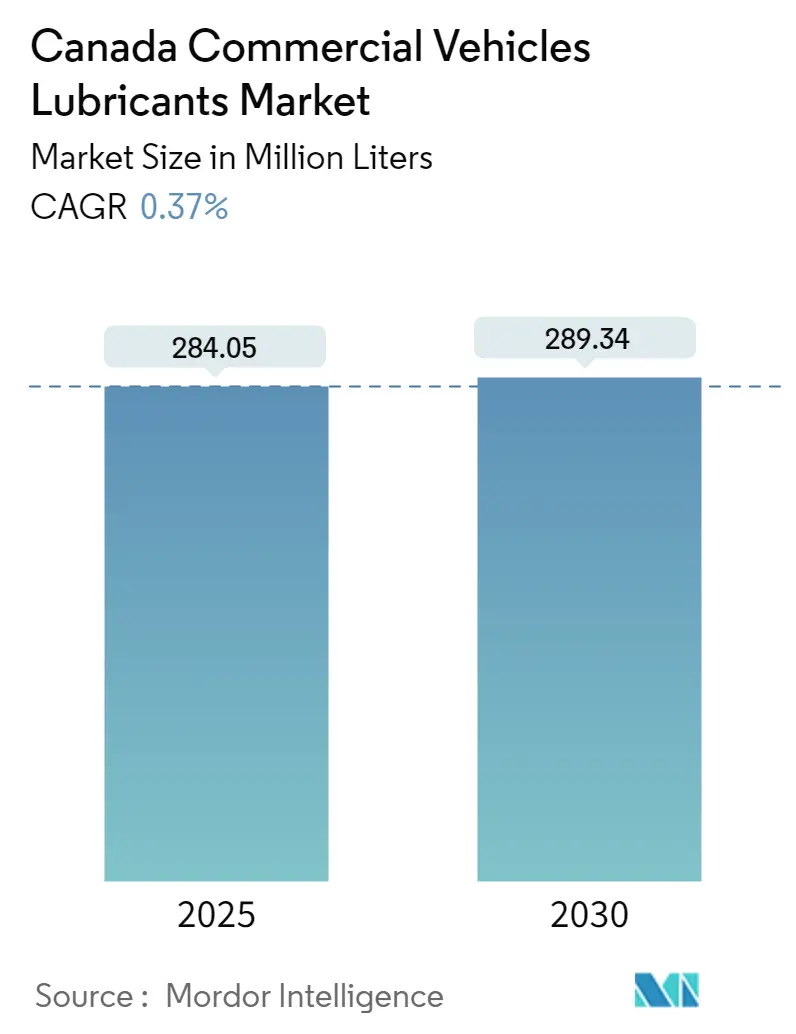
The Canada Commercial Vehicles Lubricants Market size is estimated at 284.05 million liters in 2025, and is expected to reach 289.34 million liters by 2030, at a CAGR of 0.37% during the forecast period (2025-2030).
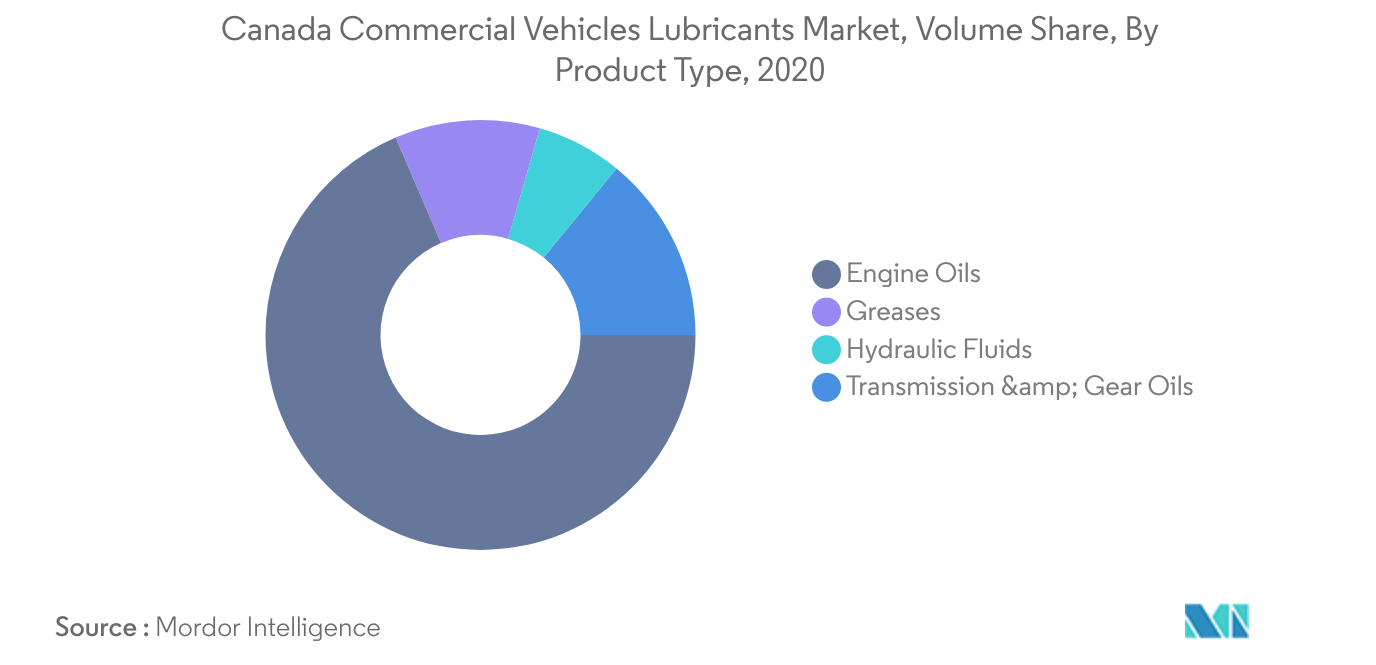
Largest Segment by Product Type - Engine Oils : Engine oils form the leading product type, owing to their high volume requirements and low drain intervals. They are used in high-temperature and high-pressure applications.
Fastest Segment by Product Type - Hydraulic Fluids : Increased trade activities and recovery of commercial vehicle sales in the country are likely to drive the demand for hydraulic fluids during the forecast period.
Canada Commercial Vehicles Lubricants Market Trends and Insights
Largest Segment By Product Type : Engine Oils
The cold weather conditions in Canada boost the need for synthetic diesel engine oils, such as 0W-40, which has led to an increase in drain intervals. This factor, combined with significant fluctuations in the production levels, resulted in a volatile trend pertaining to lubricant consumption during this period.
Post the COVID-19 outbreak, freight transportation in the country has been negatively affected, owing to the social restrictions imposed during the first half of 2020, resulting in decreased maintenance requirements for commercial vehicles and declining lubricant consumption in this sector.
The electric vehicle penetration in the commercial vehicles segment has been slow in Canada, as electric engines struggle to hold their charge in cold weather conditions, resulting in a minimal effect of electric vehicle penetration on the projected lubricant volume consumption.
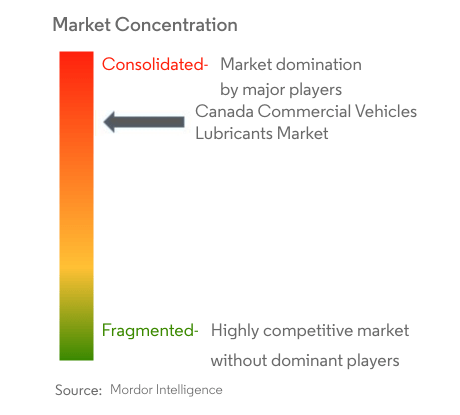
The Canada Commercial Vehicles Lubricants Market is fairly consolidated, with the top five companies occupying 76.14%. The major players in this market are BP PLC (Castrol), ExxonMobil Corporation, HollyFrontier (PetroCanada lubricants), Phillips 66 Lubricants and Royal Dutch Shell Plc (sorted alphabetically).
Canada Commercial Vehicles Lubricants Industry Leaders
BP PLC (Castrol)
ExxonMobil Corporation
HollyFrontier (Petro‑Canada lubricants)
Phillips 66 Lubricants
Royal Dutch Shell Plc
*Disclaimer: Major Players sorted in no particular order
January 2022: Effective April 1, ExxonMobil Corporation was organized along three business lines - ExxonMobil Upstream Company, ExxonMobil Product Solutions and ExxonMobil Low Carbon Solutions.
October 2021: Valvoline and Cummins extended their long-standing marketing and technology collaboration agreement for another five years. Cummins will endorse and promote Valvoline's Premium Blue engine oil for its heavy-duty diesel engines and generators and will distribute Valvoline products through its global distribution networks.
March 2021: Castrol announced the launch of Castrol ON (a Castrol e-fluid range that includes e-gear oils, e-coolants, and e-greases) to its product portfolio. This range is specially designed for electric vehicles.
Table of Contents for Canada Commercial Vehicles Lubricants Industry Report
How big is the Canada Commercial Vehicles Lubricants Market?
The Canada Commercial Vehicles Lubricants Market size is expected to reach 284.05 million Liters in 2025 and grow at a CAGR of 0.37% to reach 289.34 million Liters by 2030.
What is the current Canada Commercial Vehicles Lubricants Market size?
In 2025, the Canada Commercial Vehicles Lubricants Market size is expected to reach 284.05 million Liters.
Who are the key players in Canada Commercial Vehicles Lubricants Market?
BP PLC (Castrol), ExxonMobil Corporation, HollyFrontier (Petro‑Canada lubricants), Phillips 66 Lubricants and Royal Dutch Shell Plc are the major companies operating in the Canada Commercial Vehicles Lubricants Market.
What years does this Canada Commercial Vehicles Lubricants Market cover, and what was the market size in 2024?
In 2024, the Canada Commercial Vehicles Lubricants Market size was estimated at 283.00 million Liters. The report covers the Canada Commercial Vehicles Lubricants Market historical market size for years: 2019, 2020, 2021, 2022, 2023 and 2024. The report also forecasts the Canada Commercial Vehicles Lubricants Market size for years: 2025, 2026, 2027, 2028, 2029 and 2030.
Statistics for the 2025 Canada Commercial Vehicles Lubricants market share, size and revenue growth rate, created by Mordor Intelligence™ Industry Reports. Canada Commercial Vehicles Lubricants analysis includes a market forecast outlook for 2025 to 2030) and historical overview. Get a sample of this industry analysis as a free report PDF download.
Please copy & paste this embed code onto your site:
Images must be attributed to Mordor Intelligence. Learn more
About The Embed Code X
Mordor Intelligence's images may only be used with attribution back to Mordor Intelligence. Using the Mordor Intelligence's embed code renders the image with an attribution line that satisfies this requirement.
In addition, by using the embed code, you reduce the load on your web server, because the image will be hosted on the same worldwide content delivery network Mordor Intelligence uses instead of your web server.










 Your data is secure and never sold or shared.


