
Canada Coffee Market Size and Share
Market Overview
| Study Period | 2022 - 2032 |
|---|---|
| Forecast Data Period | 2027 - 2032 |
| Base Year Market Size (2026) | USD 4.74 Billion |
| Market Size (2027) | USD 5.13 Billion |
| Market Size (2032) | USD 7.73 Billion |
| Growth Rate (2027 - 2032) | 8.54 % |
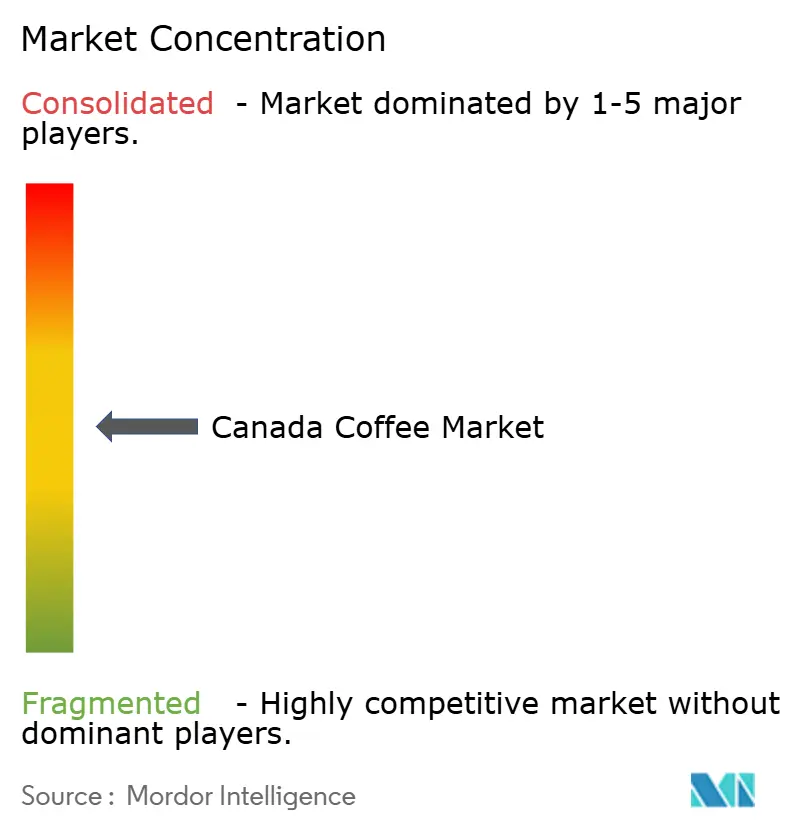
| Market Concentration | Medium |
Major Players *Disclaimer: Major Players sorted in no particular order Image © Mordor Intelligence. Reuse requires attribution under CC BY 4.0. | |
Canada Coffee Market Analysis by Mordor Intelligence
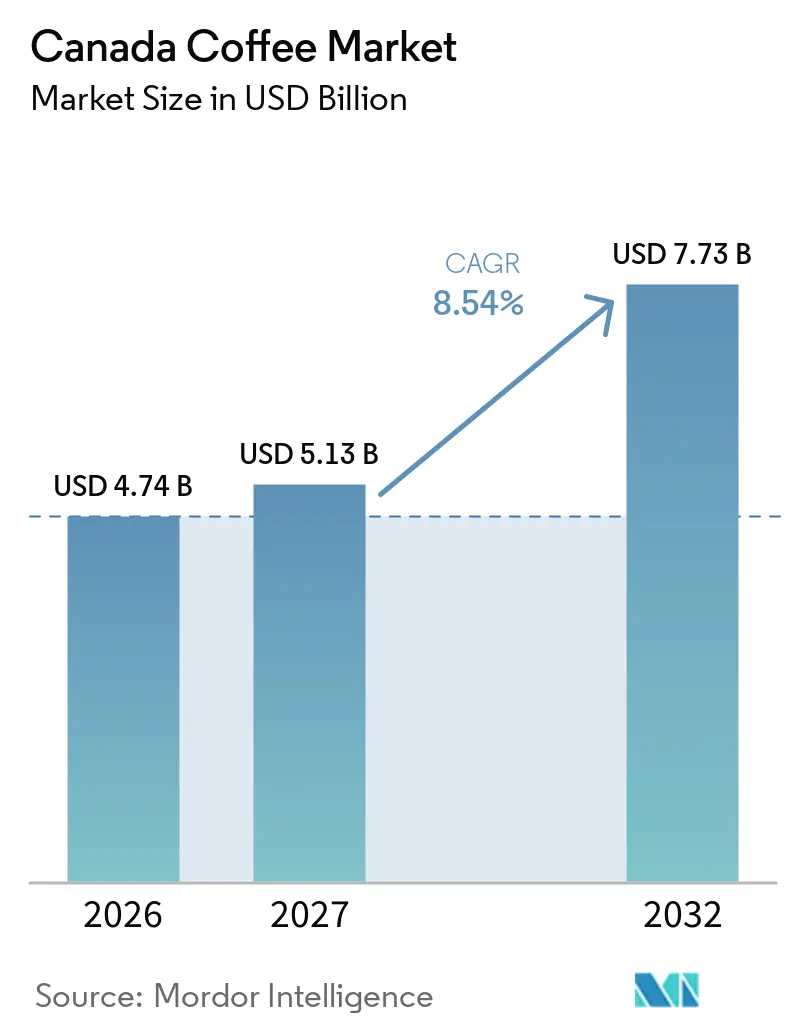
The Canada coffee market size is projected to be USD 4.74 billion in 2026, USD 5.13 billion in 2027, and reach USD 7.73 billion by 2032, growing at a CAGR of 8.54% from 2027 to 2032. Coffee remains a regular purchase for many households, with 71% of Canadians reporting coffee consumption on the prior day in 2025 [1]. Grocery coffee prices increased 27.9% year over year in August 2025, yet regular consumption continued, which supports demand even when household budgets are under pressure [2]. The Canada coffee market is therefore supported by routine at-home use while cafés, ready-to-drink products, and specialty formats create higher-value occasions. Supply pressure remains important because green coffee is priced in U.S. dollars and Arabica availability has been affected by weather conditions in major producing countries, according to the Bank of Canada. Packaging rules also raise the importance of recyclable and compostable single-serve formats, giving larger suppliers a reason to invest in product design and collection systems.
Key Report Takeaways
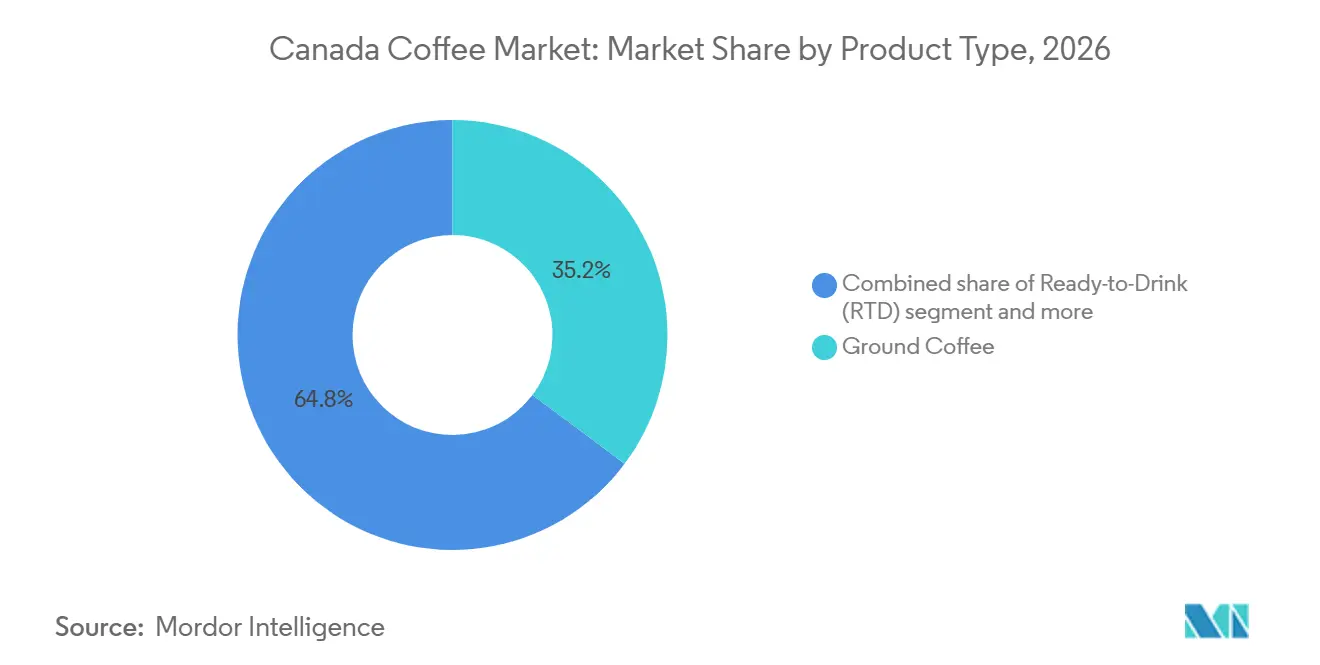
- By product type, Ground Coffee held 35.23% of the Canada coffee market share in 2026, while Ready-to-Drink coffee is forecast to grow at a 9.21% CAGR through 2032.
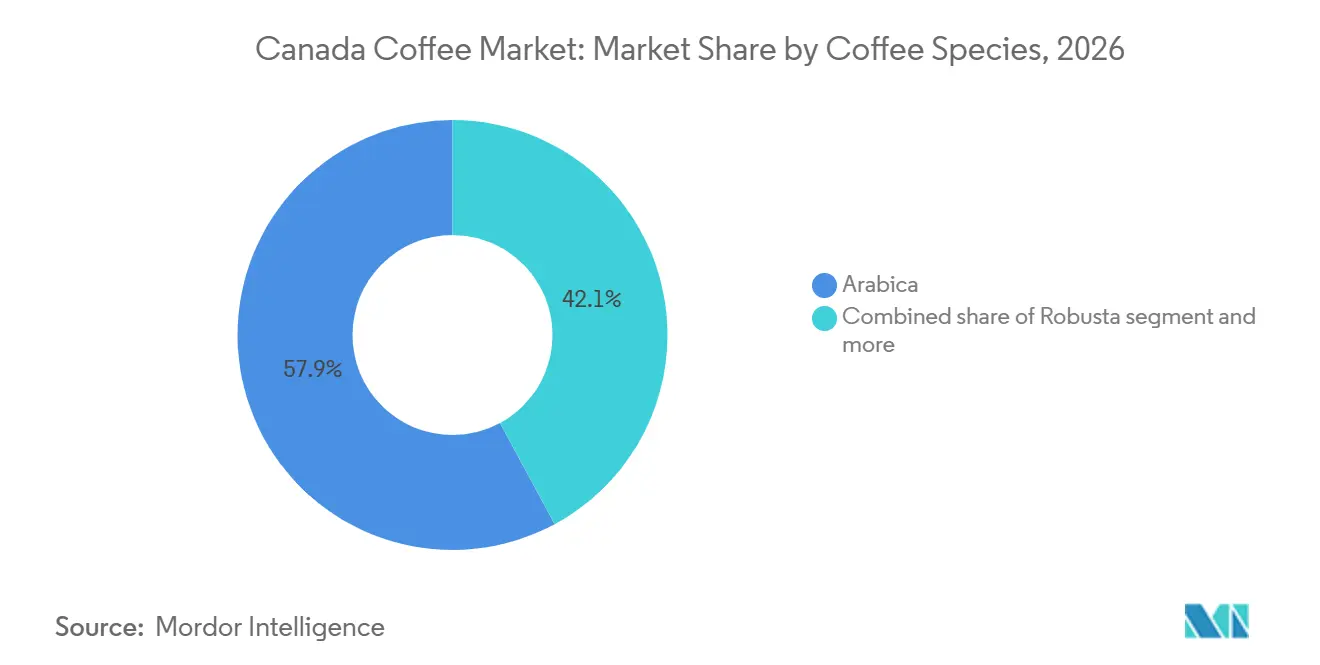
- By coffee species, Arabica held 57.88% revenue share in 2026, while Robusta is forecast to grow at a 9.55% CAGR through 2032.
- By origin, Mixed-origin coffee held a 72.37% revenue share in 2026 and is growing at a CAGR of 8.84% through 2032.
- By distribution channel, Off-Trade held 81.29% of the Canada coffee market share in 2026, while On-Trade is forecast to grow at a 9.47% CAGR through 2032.
Note: Market numbers in this report are based on Mordor Intelligence's proprietary estimation framework, which combines nine months of actuals with Q4 projections for base year 2026.
Canada Coffee Market Trends and Insights
Drivers Impact Analysis*
| Driver | (~) % Impact on CAGR Forecast | Geographic Relevance | Impact Timeline |
|---|---|---|---|
| Rising Preference for Premium Single-Origin Coffee | +1.8% | British Columbia, Ontario, Quebec (urban centres) | Medium term (2-4 years) |
| Demand for Distinctive Arabica Flavour Profiles | +1.3% | National; concentrated in Toronto, Vancouver, Montréal | Long term (≥ 4 years) |
| Preference for Freshly Ground Coffee in Cafés | +1.0% | National; on-trade concentration in Ontario and Quebec | Short term (≤ 2 years) |
| Shift Toward Single-Serve Coffee Pods and Capsules | +1.5% | National; household and office channels across all provinces | Medium term (2-4 years) |
| Demand for Convenient Instant Coffee Solutions | +0.9% | National; indexed higher in Atlantic Canada and Prairie provinces | Short term (≤ 2 years) |
| Diversification of Coffee Blends by Origin | +0.7% | National; supply-chain-driven across roasting hubs in Ontario and Quebec | Medium term (2-4 years) |
| Source: Mordor Intelligence | |||
Rising Preference for Premium Single-Origin Coffee
Specialty coffee consumption has moved beyond a narrow audience in the Canada coffee market. In 2025, 56% of Canadians consumed specialty coffee in the prior week, compared with 37% a decade earlier, and participation reached 75% among consumers aged 18 to 24, according to the Coffee Association of Canada. This shift gives roasters more room to sell traceable beans and distinctive roast profiles. It also places more value on clear origin information and relationships between roasters, cafés, and suppliers. Quebec shows stronger whole-bean purchasing than the national pattern, which is consistent with the influence of café culture on premium at-home consumption. The Canada coffee market can benefit when operators translate this interest into accessible premium offerings rather than treating specialty coffee as a limited urban niche.
Preference for Freshly Ground Coffee in Cafés
Freshly ground coffee remains important in cafés because preparation quality continues to influence how customers judge a coffee purchase. Traditional batch-brewed Ground Coffee accounted for the majority share of foodservice coffee servings in Canada in 2025, according to Circana. Café operators are therefore improving espresso and brewing equipment while retaining batch coffee as a core format. Tim Hortons upgraded espresso equipment across more than 800 locations by the end of 2025, and reported 10% cold beverage growth in the fourth quarter, according to Restaurant Brands International. For independent cafés, rotating roast selections and single-origin batch brews can distinguish an everyday product without changing the basic café routine. These choices help the Canada coffee market maintain relevance in foodservice while cold beverages gain attention.
Shift Toward Single-Serve Coffee Pods and Capsules
Single-serve pods give large brands a practical way to remain present in homes where consumers are also testing specialty coffee. The format combines convenience with a closed brewer and pod ecosystem, which encourages repeat purchasing. Keurig Dr Pepper Canada launched the Keurig Coffee Collective in February 2026 as its first premium pod range. The company also introduced AltaRounds for the new Keurig Alta system, using a plant-based coating and no plastic or aluminum. Ontario's acceptance of K-Cup pods in the Blue Box program increases the importance of collection and material choices for the Canada coffee market. Scaled suppliers are better placed to link pod innovation with the compliance work needed to address consumer concerns about waste.
Demand for Convenient Instant Coffee Solutions
Instant Coffee serves consumers seeking a lower-cost and simple preparation option, but it is also being adapted for cold and premium occasions. Liquid concentrates and flavored varieties extend its use across hot and iced occasions. Nestlé Canada introduced NESCAFÉ Espresso Concentrates in July 2025 for iced coffee preparation. This type of product broadens the role of soluble coffee beyond a conventional value format. It can also limit substitution toward pods and ready-to-drink formats by offering an easy way to make iced coffee at home. Convenience and format variety keep Instant Coffee relevant across the Canada coffee market.
Restraints Impact Analysis*
| Restraint | (~) % Impact on CAGR Forecast | Geographic Relevance | Impact Timeline |
|---|---|---|---|
| High Costs of Sustainable Coffee Certification | -0.8% | National; disproportionate burden on Ontario and Quebec micro-roasters | Medium term (2-4 years) |
| Fluctuating Foreign Exchange Rates for Coffee Imports | -0.9% | National; amplified in Alberta and British Columbia due to smaller roaster bases | Short term (≤ 2 years) |
| Environmental Concerns Over Single-Serve Packaging | -0.6% | National; regulatory pressure concentrated in British Columbia, Quebec, Ontario | Medium term (2-4 years) |
| Climate Risks in Major Coffee-Producing Regions | -1.5% | Global supply chain; affects all Canadian import channels | Long term (≥ 4 years) |
| Source: Mordor Intelligence | |||
High Costs of Sustainable Coffee Certification
Certification costs can be difficult for small roasters that want to make environmental or social claims. The cost burden includes certification fees, documentation, supplier coordination, and packaging changes. Fairtrade Canada provides a program designed for micro-roasters, which indicates that smaller businesses need a route suited to their scale [3]. Rainforest Alliance also states that certification costs vary with the applicant and the program requirements. For smaller companies, these costs may reduce funds available for equipment, staff, and marketing. The Canada coffee market can still support certified products, but the cost of meeting requirements can make participation uneven across roasters.
Fluctuating Foreign Exchange Rates for Coffee Imports
Foreign exchange movements affect coffee costs because green coffee purchases are generally denominated in U.S. dollars. The Canadian dollar traded near USD 0.69 in early 2025, adding to import costs when coffee prices were already elevated. The Bank of Canada noted that exchange-rate depreciation connected to trade uncertainty can increase the cost of imported goods. This pressure is particularly difficult for roasters that have limited ability to hedge currency exposure or negotiate longer contracts. It can lead to higher retail prices, smaller pack sizes, or changes in product mix. The Canada coffee market remains exposed because domestic consumption relies on imported green coffee.
*Our forecasts treat driver/restraint impacts as directional, not additive. The impact forecasts reflect baseline growth, mix effects, and variable interactions.
Segment Analysis
By Product Type: Ground Coffee Anchors Volume, RTD Redefines Value Growth
Ground Coffee held 35.23% of the Canada coffee market size in 2026, while Ready-to-Drink coffee is projected to grow at a 9.21% CAGR through 2032. Ground Coffee remains tied to routine home preparation through drip machines, French presses, and pour-over methods. It also benefits from consumers trading up to specialty roasts and single-origin products. Whole-bean coffee retains a smaller premium position, with stronger demand in Quebec. This format supports buyers who value grinding at home and knowing the roast origin.
Ready-to-Drink coffee is gaining momentum through cold brew, functional claims, canned formats, lower-sugar options, added protein, oat milk, and coffeehouse-inspired flavors. Kerry identified these attributes as notable signals within Canadian ready-to-drink coffee demand. Instant Coffee and pods serve different but complementary needs. Instant Coffee addresses value and simple iced preparation, while pods offer a controlled convenience system. The Canada coffee market is using product development to cover both everyday hot coffee and portable cold occasions. This mix gives suppliers several ways to respond to price sensitivity without relying on one format alone.

By Origin: Blended Dominance Masking a Structural Specialty Shift
Mixed-origin coffee held 72.37% of the Canada coffee market size in 2026 and is growing at a CAGR of 8.84% through 2032. National brands and private labels use multi-origin sourcing to maintain a familiar and consistent flavor profile. This model remains useful when input prices or availability change across producing countries. Functional blends, flavored mixed-origin pods, and value products also help keep the segment relevant. The scale of mixed-origin products makes them important to mainstream retail shelves.
Single-origin and specialty products have a smaller base but support higher-value purchases. Their appeal is linked to traceability, roast character, café menus, and buyers seeking a more specific product experience. Independent cafés in Vancouver, Toronto, and Montréal have helped make single-origin coffee a regular part of foodservice purchasing. This channel gives smaller roasters more predictable demand than occasional retail sales alone. The Canada coffee market can accommodate both blended consistency and specialty choice, although the two formats require different sourcing and pricing approaches. Specialty offerings are differentiated by traceability, preparation quality, and a more specific flavor profile.
By Coffee Species: Arabica Leads, Robusta Ascends on Supply and Quality Grounds
Arabica held 57.88% of value in 2026, reflecting its established role in premium, specialty, and foodservice coffee. It remains especially important in single-origin sales because consumers associate it with a wider range of flavor characteristics. At the same time, supply disruptions have increased the cost risk faced by roasters that depend on Arabica. Recent weather-related supply conditions have raised attention to the cost and availability of Arabica. This pressure affects both specialty sellers and mainstream brands that use Arabica-led blends.
Robusta is forecast to grow at a 9.55% CAGR through 2032 as processing quality improves and buyers seek cost flexibility. Reuters reported that Brazilian growers are improving Robusta processing and quality in response to tighter supply conditions. Canadian roasters can use Robusta in espresso and blended products where it fits the intended profile. Liberica and other species remain limited but are present in specialty stores serving diaspora communities in Ontario and British Columbia. The Canada coffee market is therefore likely to retain Arabica as its main premium species while broadening the role of Robusta. The change is driven by supply needs as much as by consumer experimentation.
By Distribution Channel: Off-Trade Commands Volume, On-Trade Accelerates
Off-trade held 81.29% of value in 2026, reflecting the role of supermarkets, grocery stores, specialist retailers, and online ordering in household coffee purchases. Supermarkets and hypermarkets remain the main volume outlet for familiar brands and private labels. Online subscriptions provide a growing route for specialty roasters to reach repeat buyers. Online retail is identified as a useful specialty channel for buyers who compare roast profiles, origins, and certifications. This gives consumers more access to product information before purchase.
On-trade is forecast to grow at a 9.47% CAGR through 2032 as café visits and espresso-based drinks gain importance. Tim Hortons continued to expand its café experience and beverage platform. Cafés help consumers discover premium and specialty formats that may have less impact on a grocery shelf. They also give ready-to-drink, cold, and espresso beverages a visible route to trial. The Canada coffee market depends on off-trade for regular household volume and on-trade for premium experience and menu innovation. Both channels remain connected because successful café formats can later move into retail products.
Geography Analysis
Ontario has a leading role in the Canada coffee market because of the size of Greater Toronto's grocery and foodservice base. Ontario and British Columbia are the most commercially significant regional markets for roasting and specialty activity. Ontario also benefits from a dense group of national retailers, café operators, and distributors. This makes it a practical location for new product launches, including premium pods and ready-to-drink coffee. It also concentrates the compliance work associated with packaging collection systems.
British Columbia is an important specialty market, particularly in Vancouver and Victoria. Its established café culture supports interest in independent roasters, premium formats, and sustainable packaging. The province has an established setting for recycling initiatives, which gives manufacturers a useful basis for testing collection and packaging programs. British Columbia's consumer base can make it a useful entry point for international brands seeking visibility in premium coffee.
Quebec remains distinctive because home preparation and café culture influence product preferences. The stronger whole-bean buying and more specialty boutique shopping among espresso machine users in the province. Nespresso extended its green bag recycling program to all Quebec municipalities in July 2025 through a partnership with Éco Entreprises Québec. Alberta and Atlantic Canada add further room for growth, identifying younger urban demand in Calgary and Edmonton and specialty interest in Halifax. The Canada coffee market is not uniform across provinces, so products, pricing, and distribution need to reflect local coffee routines.
Competitive Landscape
The Canada coffee market is moderately fragmented, with Keurig Dr Pepper Canada, Kraft Heinz Canada, and Nestlé Canada holding strong positions through brands, distribution, and product ecosystems. Keurig has focused on pod system depth, premium entries, and packaging changes. In April 2026, Keurig Dr Pepper and Nestlé USA extended their strategic partnership for Starbucks K-Cup pod manufacturing and distribution in the United States and Canada. Kraft Heinz continues to use Maxwell House and Nabob across Ground Coffee, instant formats, and pods. Nestlé Canada combines NESCAFÉ's accessible formats with Nespresso's premium positioning and recycling program.
Newer competitors are challenging established suppliers through product design and local distribution. NEXE Innovations reported 315,000 BPI-certified compostable pod shipments year to date in February 2026 and introduced 8 new products. Single Cup Coffee launched commercially compostable, BPI-certified, PFAS-free pods in July 2026 that work with Keurig brewers. These products show that material choices can become a point of competition rather than only a compliance issue.
Lavazza is an international challenger with a broader Canadian approach that includes Kicking Horse Coffee, cultural partnerships, and product visibility. In September 2026, Lavazza signed a multi-year agreement with the Toronto International Film Festival through 2028 as gala presenting partner and official coffee partner. Its strategy is directed at premium brand recognition instead of price competition alone. Companies that can address recyclability, offer a clear product purpose, and maintain dependable sourcing have a stronger basis for competing. The Canada coffee market still leaves room for smaller participants because consumer demand is spread across grocery, cafés, specialty products, and direct online sales.
Canada Coffee Industry Leaders
-
Nestlé S.A.
-
The Kraft Heinz Company
-
Keurig Dr Pepper Inc.
-
The J. M. Smucker Company
-
Luigi Lavazza S.p.A.
- *Disclaimer: Major Players sorted in no particular order
Recent Industry Developments
- April 2026: Keurig Dr Pepper and Nestlé USA extended their strategic partnership for manufacturing and distributing Starbucks K-Cup pods in the U.S. and Canada, adding expanded distribution programs and innovation commitments under Nestlé's global Starbucks at-home license.
- March 2026: Keurig introduced AltaRounds, plastic-free and aluminum-free single-serve pods made with a plant-based coating for the new Keurig Alta brewing system. The pods are expected to achieve BPI compostable certification and represent a significant single-serve packaging innovation.
- July 2025: Nestlé Canada launched NESCAFÉ Espresso Concentrates, a liquid espresso base for iced coffee targeting Gen Z, available at major retailers nationwide in Black and Sweet Vanilla variants, following successful trials in Australia and the U.S.
Canada Coffee Market Report Scope
The Canada Coffee Market comprises the sale of whole-bean, ground, instant, ready-to-drink, and pod-based coffee products across Arabica, Robusta, Liberica, and other species, segmented by single-origin/specialty and blended coffee offerings for retail and foodservice consumption. The Canada Coffee Market is Segmented by Product Type (Whole-Bean, Ground Coffee, Instant Coffee, Ready-to-Drink (RTD), and Coffee Pods and Capsules), by Origin (Single Origin/Specialty and Mixed), by Coffee Species (Arabica, Robusta, Liberica, and Other Coffee Species), and by Distribution Channel (On-trade and Off-trade). The Market Forecasts are Provided in Terms of Value (USD) and Volume (Tons).
| Whole-Bean |
| Ground Coffee |
| Instant Coffee |
| Ready-to-Drink (RTD) |
| Coffee Pods and Capsules |
| Arabica |
| Robusta |
| Liberica |
| Other Coffee Species |
| Single Origin/Specialty |
| Mixed |
| On-trade | |
| Off-trade | Supermarkets/Hypermarkets |
| Convenience Stores | |
| Specialist Retailers | |
| Online Retail | |
| Other Off-trade Channels |
| By Product Type | Whole-Bean | |
| Ground Coffee | ||
| Instant Coffee | ||
| Ready-to-Drink (RTD) | ||
| Coffee Pods and Capsules | ||
| By Coffee Species | Arabica | |
| Robusta | ||
| Liberica | ||
| Other Coffee Species | ||
| By Origin | Single Origin/Specialty | |
| Mixed | ||
| By Distribution Channel | On-trade | |
| Off-trade | Supermarkets/Hypermarkets | |
| Convenience Stores | ||
| Specialist Retailers | ||
| Online Retail | ||
| Other Off-trade Channels | ||
Key Questions Answered in the Report
What is the expected growth rate for coffee sales in Canada?
The Canada coffee market is forecast to grow at an 8.54% CAGR from 2027 to 2032 and reach USD 7.73 billion by 2032.
Which coffee product is expected to grow fastest in Canada?
Ready-to-Drink coffee is projected to grow at a 9.21% CAGR through 2032, supported by cold brew, functional products, and canned formats.
Why is Ground Coffee still important in Canada?
Ground Coffee held 35.23% of value in 2026 and remains closely linked to routine home brewing and café batch coffee.
Which sales channel leads coffee purchases in Canada?
Off-Trade held 81.29% of value in 2026 because supermarkets, grocery stores, specialist retailers, and online sellers serve regular household demand.