
Market Overview
| Study Period | 2020 - 2032 |
|---|---|
| Forecast Data Period | 2027 - 2032 |
| Base Year Market Size (2026) | USD 0.16 Billion |
| Market Size (2027) | USD 0.17 Billion |
| Market Size (2032) | USD 0.21 Billion |
| Growth Rate (2027 - 2032) | 4.49 % |
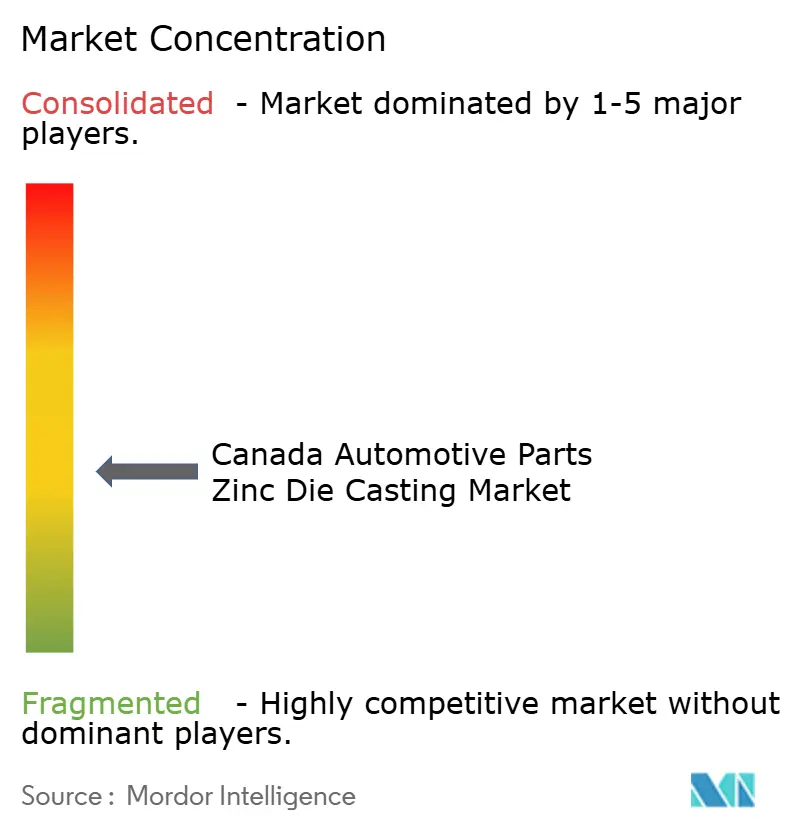
| Market Concentration | Medium |
Major Players *Disclaimer: Major Players sorted in no particular order Image © Mordor Intelligence. Reuse requires attribution under CC BY 4.0. | |
Canada Automotive Parts Zinc Die Casting Market Analysis by Mordor Intelligence
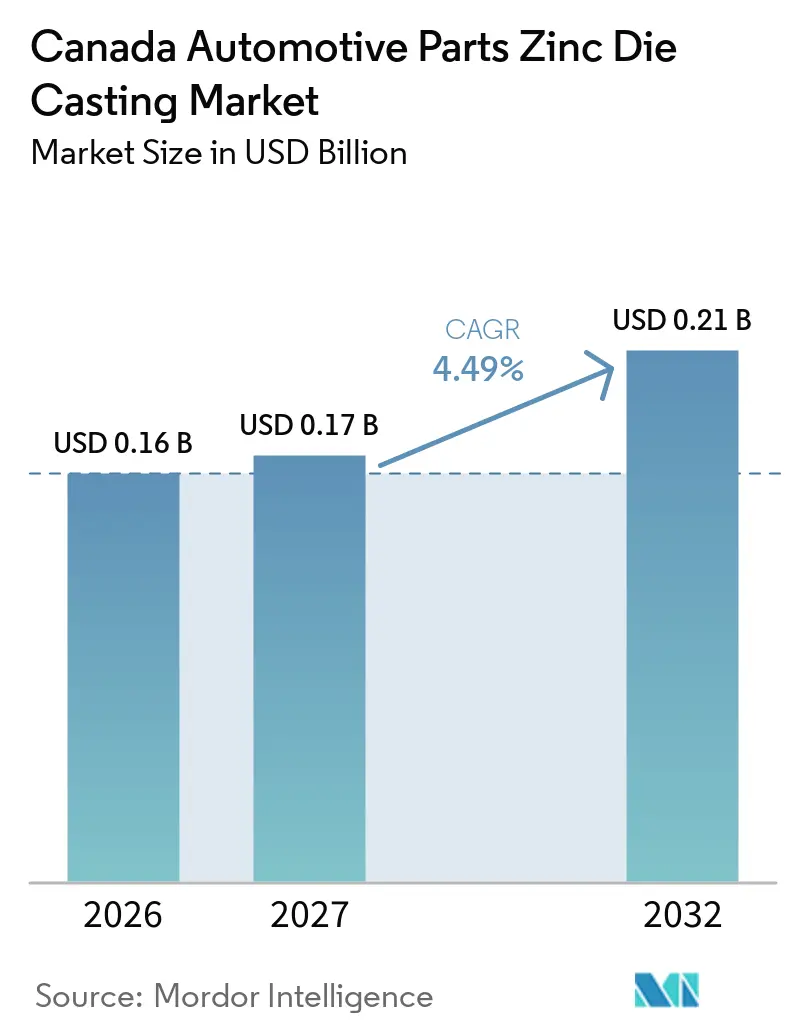
The Canada automotive parts zinc die casting market size was valued at USD 0.16 billion in 2026, is estimated at USD 0.17 billion in 2027, and is projected to reach USD 0.21 billion by 2032, growing at a CAGR of 4.49% from 2027 to 2032. Demand is tied to vehicle programs that need precise, durable parts with demanding dimensional requirements and closely managed production quality. Ontario’s EV and battery investments support a larger pipeline of new component programs, particularly for electrical enclosures, sensor covers, connector interfaces, and vehicle closures. The Canadian automotive parts zinc die-casting market also benefits when OEMs seek to combine several functions into a single near-net-shape component, reducing assembly steps after casting. This raises the value of tooling knowledge, stable production settings, documented quality systems, and close technical coordination with the customer. Suppliers able to meet those requirements can pursue longer program awards, while suppliers without vacuum capability or in-house tooling face a narrower set of opportunities.
Key Report Takeaways
- By production process type, Pressure Die Casting held 71.25% of the Canadian automotive parts zinc die casting market share in 2026, while Vacuum Die Casting is forecast to grow at a 7.13% CAGR through 2032.
- By alloy type, Zamak 3 held 46.33% of the Canadian automotive parts zinc die casting market share in 2026, while ZA Alloys is forecast to grow at a 6.28% CAGR through 2032.
- By application, Body Assemblies accounted for 29.75% of the Canadian automotive parts zinc die casting market size in 2026, while Electrical and Electronics Housings are forecast to grow at a 7.84% CAGR through 2032.
- By vehicle type, Passenger Vehicles held 66.24% of the Canadian automotive parts zinc die casting market share in 2026, while Light Commercial Vehicles are forecast to grow at a 5.86% CAGR through 2032.
- By sales channel, OEM accounted for 79.05% of the Canadian automotive parts zinc die casting market in 2026 and is forecast to grow at a 5.13% CAGR through 2032.
Note: Market numbers in this report are based on Mordor Intelligence's proprietary estimation framework, which combines nine months of actuals with Q4 projections for base year 2026.
Canada Automotive Parts Zinc Die Casting Market Trends and Insights
Drivers Impact Analysis*
| Driver | (~) % Impact on CAGR Forecast | Geographic Relevance | Impact Timeline |
|---|---|---|---|
| Rising Electrification and Hybridization | +1.2% | Ontario primary, Quebec emerging | Medium term (2-4 years) |
| Demand for Lightweight, Compact and Integrated Components | +0.9% | National, concentrated in Ontario OEM corridor | Short term (≤ 2 years) |
| Growth of Precision Zinc Components | +0.8% | National, led by Ontario Tier-1 supply chains | Medium term (2-4 years) |
| Supplier Localization and Made-in-Canada Procurement | +0.7% | National, early gains in Windsor, Oshawa, and Guelph corridor | Short term (≤ 2 years) |
| Closed-Loop Zinc Recycling and Scrap Availability | +0.5% | National | Long term (≥ 4 years) |
| Inserted Metal Assemblies and Net-Shape Manufacturing | +0.4% | National, spill-over to Quebec | Medium term (2-4 years) |
| Source: Mordor Intelligence | |||
Rising Automotive Electrification and Hybridization
Ontario’s EV supply-chain buildout supports demand for zinc components used in connector housings, sensor brackets, and signal covers. Honda has committed a significant investment to several Ontario facilities, including an EV assembly operation. These programs increase the number of electrical interfaces that require compact housings and stable sealing surfaces. The Canadian automotive parts zinc die casting market has an opening in parts where dimensional stability and shielding matter more than large structural weight reduction. The resulting opportunity favors suppliers that can qualify parts early in the vehicle development cycle.
OEM Demand for Lightweight, Compact and Highly Integrated Components
OEM specifications increasingly favor parts that arrive with integrated mounting features and limited machining requirements. Zinc casting can produce small, detailed components with repeatable geometry, which supports the consolidation of multi-part assemblies. This need changes the competitive basis in the Canadian automotive parts zinc die casting market from simple capacity toward tooling design and process discipline. Martinrea continues to invest in lightweight structures and propulsion-system modules, which shows how integrated systems are becoming central to supplier programs [1]. Suppliers with in-house die development can respond faster when a design requires multiple functions in a single casting. That capability can also reduce the risk of late changes during a program launch.
Growth of Precision Zinc Components in Closures, Sensor Housings and Electrical Systems
Sensor housings and electrical connector covers are becoming more important as vehicles carry more electronic content. These parts need stable interfaces, corrosion resistance, and protection from moisture in underhood and underfloor locations. The Canadian automotive parts zinc die casting market is therefore shifting toward programs with tighter quality requirements and more specialized tooling. Body closures remain important, but their demand profile is more mature than that of electronic housings. Plants with validated vacuum processes are better positioned to address applications in which internal porosity can affect sealing or service life.
Canadian Automotive Supplier Localization and Made-in-Canada Procurement
Automotive programs are increasingly assessed on their ability to support local supply chains and dependable delivery. In 2025, Minth Group selected Windsor as its first production location in Canada, supporting its strategy to strengthen Canadian operations and expand across North America. The company subsequently announced a joint venture with AISIN Corporation, further strengthening its regional supplier presence. For the Canadian automotive parts zinc die-casting market, local production can shorten delivery routes to support just-in-time schedules. It can also simplify coordination between foundries, toolmakers, and assembly plants during model launches. The strongest near-term benefit is expected in the Windsor-Guelph-Oshawa manufacturing corridor.
Restraints Impact Analysis*
| Restraint | (~) % Impact on CAGR Forecast | Geographic Relevance | Impact Timeline |
|---|---|---|---|
| Cross-Border Supply Chains and Trade Volatility | -0.8% | National, greatest exposure in Windsor and Oshawa export corridor | Short term (≤ 2 years) |
| Aluminum and Polymer Engineering Components | -0.6% | Concentrated near-term in Ontario OEM platforms | Medium term (2-4 years) |
| Limited Scale for High-Volume Zinc Programs | -0.4% | National | Long term (≥ 4 years) |
| Qualification and Traceability Burden | -0.3% | National | Medium term (2-4 years) |
| Source: Mordor Intelligence | |||
Dependence on Cross-Border Automotive Supply Chains and Trade Policy Volatility
Canadian automotive suppliers remain closely linked to North American production networks and U.S. customer demand. Global Affairs Canada identifies trade access and preferential treatment under CUSMA as important elements of Canada’s commercial relationship with the United States. Changes in trade rules can affect production planning, documentation work, and the timing of vehicle programs. The Canadian automotive parts zinc die-casting market is exposed because many casting contracts supply parts that move through integrated regional supply chains. Smaller foundries may find it harder to absorb administrative burdens when origin requirements change. Strong traceability systems and clear supplier records can reduce this exposure, but they require continuing investment.
Competition from Aluminum and Polymer Engineering Components
Aluminum and engineering polymers continue to compete with zinc in different vehicle part families. Aluminum is often considered where the principal design goal is mass reduction in medium or large structural parts. Polymers remain relevant for low-load interior and cosmetic components that need flexible surface finishes. The Canadian automotive parts zinc die casting market remains strongest where tooling life, dimensional accuracy, and compact geometry create a clear production advantage. Material decisions are usually revisited at vehicle platform refreshes, when design teams compare process options and supplier capacity. This makes early engineering engagement important for zinc foundries seeking to protect existing programs.
*Our forecasts treat driver/restraint impacts as directional, not additive. The impact forecasts reflect baseline growth, mix effects, and variable interactions.
Segment Analysis
By Production Process Type: Pressure Die Casting Dominates, Vacuum Sets New Quality Bar
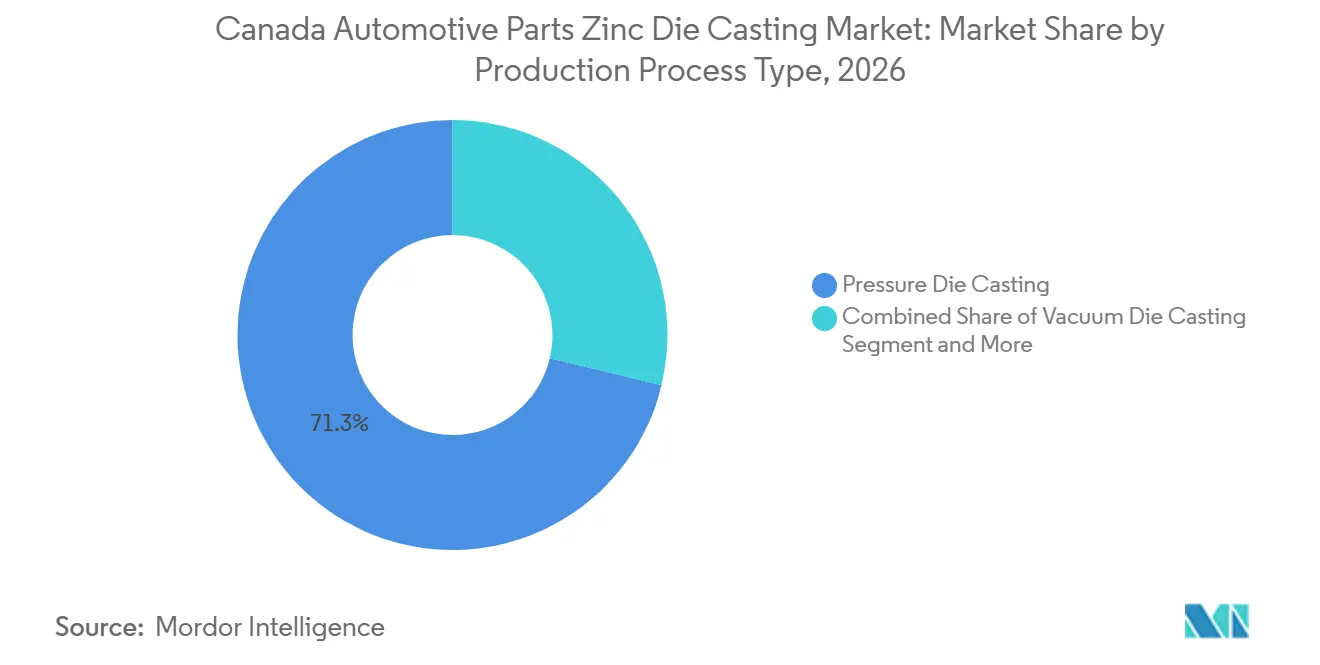
Pressure Die Casting held 71.25% of the Canadian automotive parts zinc die casting market share in 2026. It remains the main production method because it supports high volumes of small and medium components. Hot-chamber equipment keeps molten metal within the machine, which helps enable short cycles for suitable parts. This process is used for common applications such as latch components, brackets, handles, and other detailed hardware. Its installed base gives Canadian foundries a practical foundation for existing OEM programs.
Vacuum Die Casting is forecast to expand at a 7.13% CAGR through 2032. Lower cavity pressure can reduce trapped gas and support more demanding quality requirements. A 2025 Journal of Alloys and Compounds study found that ultra-vacuum-assisted high-pressure die casting improved mechanical properties in the tested alloy system. The finding supports the broader move toward cast parts that can meet stricter downstream processing requirements. Squeeze Die Casting and Semi-Solid Die Casting remain specialized methods for selected structural and development programs.

By Alloy Type: Zamak 3 Anchors Volume, ZA Alloys Capture the Electrification Opportunity
Zamak 3 accounted for 46.33% of the Canadian automotive parts zinc die casting market in 2026. Its position reflects reliable castability, dimensional stability, and compatibility with hot-chamber equipment. Canadian producers use it for door hardware, latch mechanisms, mounting brackets, and related vehicle parts. The alloy provides a practical fit for programs that need large volumes of detailed components. Its broad acceptance also supports continuity across established tooling and production lines.
ZA Alloys are forecast to grow at a 6.28% CAGR through 2032. Demand is driven by applications that require greater strength or temperature resistance than standard Zamak grades provide. These uses include underhood areas and locations near EV powertrain systems. The Canadian automotive parts zinc die casting market can benefit when suppliers match alloy selection to a component’s load and heat profile. Dynacast presents EZAC as a high-creep-resistance zinc alloy for demanding die-casting applications [2].
By Application: Body Assemblies Lead Volume, Electronics Housings Drive Growth
Body Assemblies accounted for 29.75% of the Canadian automotive parts zinc die-casting market share in 2026. Door handles, fuel-filler assemblies, hinge housings, and related closures sustain this position. These parts are used across internal-combustion, hybrid, and battery-electric vehicle architectures. Their widespread use provides the segment with a stable base even as individual vehicle programs change. Existing tooling and established component designs also reinforce demand for zinc in these applications.
Electrical and Electronics Housings is forecast to grow at a 7.84% CAGR through 2032. The category includes connector housings, sensor covers, and other components linked to a vehicle’s electrical systems. Growth reflects higher electronic content and stronger requirements for sealing and interface stability. It also creates a greater need for precise tooling and controlled casting conditions. Engine Parts and Transmission Parts retain near-term demand as hybrid production continues.
By Vehicle Type: Passenger Vehicles Anchor Volumes, LCVs Accelerate on Fleet Electrification
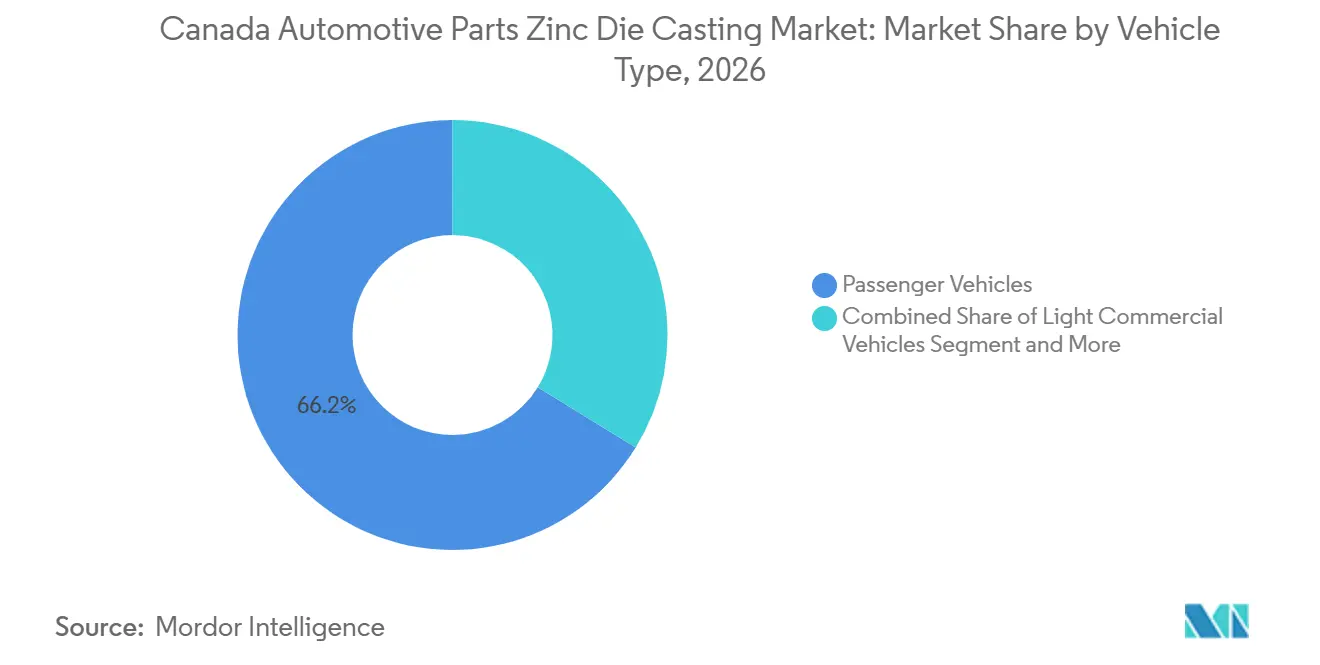
Passenger Vehicles accounted for 66.24% of the Canadian automotive parts zinc die casting market in 2026. This lead reflects the concentration of Canadian assembly programs around passenger vehicle platforms. These vehicles use zinc components in closures, sensor mounts, electrical parts, and selected powertrain applications. The established OEM footprint in Ontario provides a broad customer base for foundries serving this category. Volume programs also support recurring demand for common zinc hardware.
Light Commercial Vehicles is forecast to grow at a 5.86% CAGR through 2032. Fleet electrification supports demand for vans and pickup trucks with new electrical and closure components. Utility fleets, delivery operators, and municipal users are relevant customers for these platforms. Their operating conditions place value on durable hardware and reliable sealing. Medium and Heavy Commercial Vehicles retain a smaller, stable role centered on cab hardware and connector housings.
By Sales Channel: OEM Leads on Both Share and Growth, Aftermarket Fills Transition Gaps
Original Equipment Manufacturer (OEM) accounted for 79.05% of the Canadian automotive parts zinc die casting market share in 2026. OEM contracts require suppliers to meet detailed quality, traceability, and program documentation requirements. Once dedicated tooling is approved, suppliers can gain multi-year revenue visibility. That stability can justify the cost of qualification systems and process controls. Direct production also benefits from close coordination with vehicle assembly schedules.
OEM is forecast to grow at a 5.13% CAGR through 2032. The aftermarket continues to supply replacement door handles, lock mechanisms, trim pieces, and other service parts. Its demand is less directly tied to new vehicle output because it follows the age and maintenance needs of the installed fleet. Model transitions can create temporary tooling gaps that support aftermarket volumes. The Canadian automotive parts zinc die casting market, therefore, has two distinct demand patterns across its sales channels.
Geography Analysis
Ontario is the center of Canada's automotive parts zinc die casting market because it hosts the country’s major vehicle assembly operations. The province includes GM’s CAMI plant, Ford’s Oakville complex, Stellantis facilities in Windsor, Honda’s Alliston plant, and Toyota operations in Cambridge and Woodstock.
Ontario’s supplier network combines assembly plants, Tier-1 companies, toolmakers, and engineering resources. This concentration supports faster problem-solving during new program launches. It also raises the value of foundries that can provide tooling support, disciplined quality records, and dependable capacity. The Windsor, Guelph, and Oshawa corridor is particularly important for components that must meet tight delivery schedules. The Canadian automotive parts zinc die-casting market can draw on this dense manufacturing base as OEMs add electrical and closure components to new platforms.
Quebec is an emerging secondary location because its battery materials and industrial projects connect it to the broader EV supply chain. Quebec’s die-casting role is currently more closely tied to supply-chain support than to large local vehicle assembly programs. Western and Atlantic Canada have a smaller role because OEM assembly is concentrated in Ontario. CUSMA preferential access remains relevant across all regions for suppliers whose parts move through North American production networks.
Competitive Landscape
The Canadian automotive parts zinc die-casting market is moderately fragmented, comprising North American multi-facility operators and regional specialists. Dynacast has Canadian operations in Peterborough and Montréal and offers multi-slide zinc die-casting capabilities. Cascade Die Casting Group, Ridco Zinc Die Casting Company, and Carpenter Die Casting serve additional parts of the supplier base. Competition centers on program breadth, tooling capability, production consistency, and proximity to OEM customers.
Nemak completed its acquisition of GF Casting Solutions’ automotive business in February 2026 for USD 336 million [3]. The transaction adds 9 production sites and strengthens its scale in precision casting. Martinrea has also described investments in lightweight structures and propulsion-system modules. These moves show that larger suppliers are positioning casting capability within broader vehicle module offerings. Canadian foundries can respond by building deeper expertise in dedicated zinc programs rather than competing only on available machine capacity.
Automation, alloy development, and quality assurance are central areas of competition. Multi-slide zinc die casting can support complex geometry and reduce the need for secondary operations. The Canadian automotive parts zinc die-casting market rewards suppliers that can demonstrate process stability during customer qualification. Small and mid-sized foundries can remain competitive by serving local programs, maintaining trusted OEM relationships, and investing selectively in higher-specification work.
Canada Automotive Parts Zinc Die Casting Industry Leaders
-
Dynacast International (Form Technologies LLC)
-
Pace Industries, LLC
-
Brillcast Manufacturing LLC
-
Alumicast Technologies Inc.
-
Carpenter Die Casting Co. Ltd.
- *Disclaimer: Major Players sorted in no particular order
Recent Industry Developments
- October 2026: Geely Auto announced its entry into the Canadian market and plans to begin selling vehicles in 2027. The company aims to become the first Chinese mass-market electric vehicle brand to establish a presence in North America. This will significantly drive the demand for high-strength zinc die-cast auto components.
- August 2026: General Motors announced plans to assemble a heavy-duty pickup truck at an Ontario plant under a tentative agreement with a key union. The agreement includes an investment of CAD 1.1 billion (USD 791.31 million) in Canada’s automotive sector, which faces pressure from US tariffs. Production of heavy-duty pickup trucks and V8 engines at GM’s Ontario plants will increase demand for high-strength, precision components, including fuel systems, door brackets, and interior trim, thereby supporting zinc die-casting processes.
Canada Automotive Parts Zinc Die Casting Market Report Scope
The scope includes segmentation by production process type (pressure die casting, vacuum die casting, squeeze die casting, and semi-solid die casting), alloy type (Zamak 3, Zamak 5, ZA alloys, and others), application (body assemblies, engine parts, transmission parts, electrical and electronics housings, and interior and trim components), vehicle type (passenger vehicles, light commercial vehicles, heavy commercial vehicles, and two-wheelers), and sales channel (OEM and aftermarket). Market size and growth forecasts are presented in USD by value.
By Production Process Type
| Pressure Die Casting |
| Vacuum Die Casting |
| Squeeze Die Casting |
| Semi-Solid Die Casting |
By Alloy Type
| Zamak 3 |
| Zamak 5 |
| ZA Alloys |
| Others |
By Application
| Body Assemblies |
| Engine Parts |
| Transmission Parts |
| Electrical and Electronics Housings |
| Interior and Trim Components |
By Vehicle Type
| Passenger Vehicles |
| Light Commercial Vehicles |
| Medium and Heavy Commercial Vehicles |
| Two-Wheelers |
By Sales Channel
| Original Equipment Manufacturer (OEM) |
| Aftermarket |
Cross-Segmentation Analysis
| Production Process Type by Vehicle Type |
| By Production Process Type | Pressure Die Casting |
| Vacuum Die Casting | |
| Squeeze Die Casting | |
| Semi-Solid Die Casting | |
| By Alloy Type | Zamak 3 |
| Zamak 5 | |
| ZA Alloys | |
| Others | |
| By Application | Body Assemblies |
| Engine Parts | |
| Transmission Parts | |
| Electrical and Electronics Housings | |
| Interior and Trim Components | |
| By Vehicle Type | Passenger Vehicles |
| Light Commercial Vehicles | |
| Medium and Heavy Commercial Vehicles | |
| Two-Wheelers | |
| By Sales Channel | Original Equipment Manufacturer (OEM) |
| Aftermarket | |
| Cross-Segmentation Analysis | Production Process Type by Vehicle Type |
Key Questions Answered in the Report
What is the outlook for the automotive parts zinc die casting market in Canada by 2032?
The Canadian automotive parts zinc die casting market is projected to reach USD 0.21 billion by 2032, registering a CAGR of 4.49% during the forecast period from 2027 to 2032.
Which production process is growing the fastest in Canada’s zinc die-casting sector?
Vacuum die casting is the fastest-growing process, projected to register a CAGR of 7.13% through 2032.
Which automotive application offers the strongest growth potential for zinc castings?
The electrical and electronics housings market is forecast to expand at a CAGR of 7.84% through 2032, driven by increasing electronic content in vehicles.
Which alloy holds the leading share of the Canadian automotive zinc die casting market in 2026?
Zamak 3 accounted for 46.33% of demand in 2026, driven by its suitability for high-volume, detailed components and hot-chamber die-casting production.