
Brushless DC Motor Market Size and Share
Market Overview
| Study Period | 2021 - 2031 |
|---|---|
| Market Size (2026) | USD 20.94 Billion |
| Market Size (2031) | USD 30.82 Billion |
| Growth Rate (2026 - 2031) | 8.03 % |
| Fastest Growing Market | Asia-Pacific |
| Largest Market | Asia-Pacific |
| Market Concentration | Medium |
Major Players *Disclaimer: Major Players sorted in no particular order Image © Mordor Intelligence. Reuse requires attribution under CC BY 4.0. | |
Brushless DC Motor Market Analysis by Mordor Intelligence
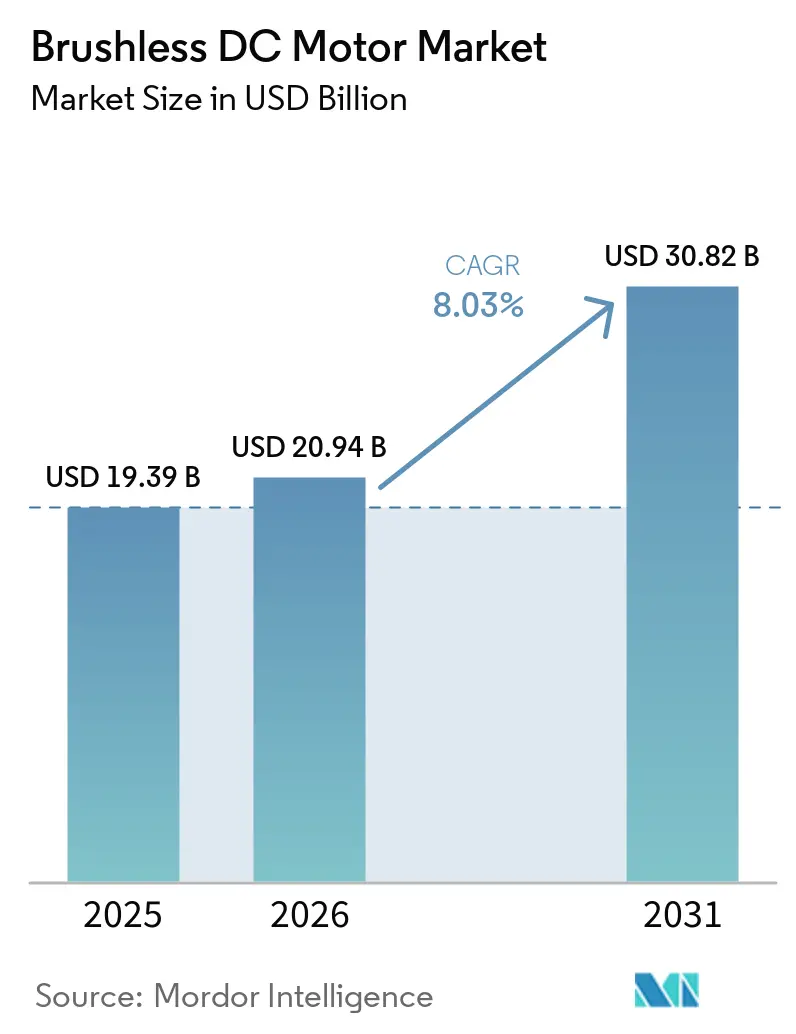
The Brushless DC Motor Market size is projected to expand from USD 19.39 billion in 2025 and USD 20.94 billion in 2026 to USD 30.82 billion by 2031, registering a CAGR of 8.03% between 2026 to 2031. Efficiency requirements, vehicle electrification, and factory automation support demand for electronically controlled motors. Buyers are also replacing older motors when operating costs and compliance requirements make a higher-efficiency option more attractive. The opportunity is strongest where compact size, low maintenance, and speed control matter in the final application. Supply conditions for rare-earth magnets remain a constraint for producers using sintered NdFeB magnets. Competition therefore combines scale in automotive and appliance supply with specialized engineering in medical, aerospace, and robotics uses.
Key Report Takeaways
- By rotor type, inner rotor motors held 65.4% of the Brushless DC Motor Market share in 2025, while outer rotor motors are forecast to grow at 8.9% CAGR through 2031.
- By speed, the 2,001–10,000 RPM range held 39.3% of the Brushless DC Motor Market share in 2025, while motors above 10,000 RPM are forecast to grow at 8.6% CAGR through 2031.
- By power rating, motors up to 100 kVA held 77.8% of the Brushless DC Motor Market share in 2025, while the 100 kVA–1 MVA range is forecast to grow at 9.7% CAGR through 2031.
- By end user, automotive and e-mobility held 32.7% of the Brushless DC Motor Market share in 2025 and is forecast to grow at 11.2% CAGR through 2031.
- By geography, Asia-Pacific held 51.3% of the Brushless DC Motor Market share in 2025 and is forecast to grow at 9.4% CAGR through 2031.
Note: Market size and forecast figures in this report are generated using Mordor Intelligence’s proprietary estimation framework, updated with the latest available data and insights as of January 2026.
Global Brushless DC Motor Market Trends and Insights
Drivers Impact Analysis*
| Driver | (~) % Impact on CAGR Forecast | Geographic Relevance | Impact Timeline |
|---|---|---|---|
| Energy-Efficiency Requirements and Motor Replacement | +2.10% | Global; peak intensity in EU and North America | Short-term (≤ 2 years) |
| Electric Vehicle and Electrified Auxiliary-System Adoption | +1.80% | APAC core (China, India, South Korea); spill-over to EU and Southeast Asia | Medium-term (2–4 years) |
| Industrial Automation, Robotics, and Smart Manufacturing | +1.50% | APAC core, North America, EU | Medium-term (2–4 years) |
| HVAC Retrofit and Building-Efficiency Demand | +0.90% | Global; early gains in EU, North America, and Middle East | Medium-term (2–4 years) |
| Sensorless Control and Integrated Motor-Drive Architectures | +0.70% | Global; strongest in North America and EU | Long-term (≥ 4 years) |
| Expansion of Drones, E-Bikes, E-Scooters, and Mobile Robotics | +0.60% | APAC core; spill-over to North America and EU | Long-term (≥ 4 years) |
| Source: Mordor Intelligence | |||
Energy-Efficiency Requirements and Motor Replacement
The European Union extended its IE4 requirement in July 2026 across the 0.75–1,000 kW motor range. The requirement raises the importance of efficiency when industrial buyers select new motors. The IE5 class described in IEC 60034-30-1:2026 exceeded 91% efficiency at rated output for the 4 kW benchmark, compared with 87.6% for a standard IE3 induction motor in the supplied research. The U.S. Department of Energy rule requires IE4 performance for mid-range motors from June 2027, while fractional horsepower motors follow from January 2029[1]ABB, “Understanding the 2027 DOE Motor Standards,” ABB News Center, new.abb.com. These deadlines can bring replacement decisions forward for facilities operating older continuous-duty motors. ABB stated that its 90 kW IE5 SynRM motor could save EUR 79,800 in energy costs and reduce carbon dioxide emissions by 95,760 kg over 20 years compared with an IE3 equivalent.
Electric Vehicle and Electrified Auxiliary-System Adoption
Electric vehicles require motors for cooling fans, oil pumps, seat actuators, and steering systems. This broadens demand beyond the traction motor and increases motor content in vehicle platforms. China accounted for 63% of global electric-car sales in 2025, according to the supplied source, which supported high-volume procurement for automotive auxiliary systems. Conventional vehicles also add BLDC units as manufacturers introduce electric water pumps, electronic throttle bodies, active grille shutters, and 48V systems. Vietnam’s passenger EV sales nearly doubled to 179,000 units in 2025, while Thailand reached 27% EV penetration in new car sales. These countries give suppliers additional demand centers and shorter qualification paths than some established vehicle supply chains.
Industrial Automation, Robotics, and Smart Manufacturing
Industrial automation supports demand for compact motors with accurate speed and position control. The supplied research stated that global robot installations reached 542,000 units in 2024 and were estimated at 575,000 units in 2025. It also stated that each industrial robot arm uses 4–7 BLDC motors at its joints. Collaborative robots require compact, high-torque motors with low vibration and integrated feedback. Kollmorgen documented the use of its frameless BLDC motors in RobCo standardized cobot joints[2]Kollmorgen, “Integrating Frameless BLDC Motors for Next-Generation Robotics Innovation,” Kollmorgen, kollmorgen.com. The installed robotics base also creates replacement demand for motors after the original equipment sale.
HVAC Retrofit and Building-Efficiency Demand
Commercial buildings, health care facilities, and data centers use BLDC motors in fan coil units, air handling systems, and refrigeration compressors. Long operating hours improve the case for replacing permanent-split-capacitor and shaded-pole induction motors. The supplied draft placed HVAC operating time at 6,000–8,000 hours each year, allowing efficiency gains to shorten payback periods. Saudi Arabia and the United Arab Emirates are installing commercial HVAC capacity under national building and energy programs. These projects can specify BLDC fan motors during procurement instead of treating them as premium equipment. ABB linked motor efficiency to industrial decarbonization when it announced its IE6 hazardous-area product in May 2026[3]ABB, “ABB Is First in World to Offer a Magnet-Free IE6 Motor for Hazardous Areas,” ABB, prnewswire.com.
Restraints Impact Analysis*
| Restraint | (~) % Impact on CAGR Forecast | Geographic Relevance | Impact Timeline |
|---|---|---|---|
| Higher Initial Cost Compared With Brushed and Induction Motors | -1.20% | Global; most acute in price-sensitive markets (South Asia, Sub-Saharan Africa, South America) | Short-term (≤ 2 years) |
| Rare-Earth Magnet Supply Concentration and Price Volatility | -1.80% | Global supply-side risk; downstream cost pressure concentrated in China-dependent supply chains | Medium-term (2–4 years) |
| Electronic-Control Complexity and Electromagnetic Compatibility Requirements | -0.70% | Global; most severe in consumer and medical qualification pathways | Medium-term (2–4 years) |
| Qualification Cycles and Thermal-Management Constraints in High-Performance Applications | -0.50% | North America and EU (aerospace, defense, medical sectors) | Long-term (≥ 4 years) |
| Source: Mordor Intelligence | |||
Higher Initial Cost Compared With Brushed and Induction Motors
A BLDC system includes the motor, encoder, and electronic speed controller. The supplied research indicated that this system can cost 2–4 times as much as a comparable brushed motor at small and medium power ratings. The difference can widen when buyers require diagnostic functions and industrial Ethernet connections. Agricultural irrigation, light industrial machinery, and small appliances often prioritize acquisition cost over lifecycle savings. Distributors in developing markets may not have the technical support needed to demonstrate operating savings to customers. Controller prices and manufacturing volumes can ease the pressure over time, but constrained financing and low operating margins keep price sensitivity relevant.
Rare-Earth Magnet Supply Concentration and Price Volatility
BLDC producers that use NdFeB permanent magnets face concentrated material supply. China introduced export licensing requirements for dysprosium and terbium through MOFCOM Announcement No. 18 in April 2025, according to the supplied research. These materials are important for high-temperature magnet grades used in EV auxiliary motors and high-speed drives. The supplied research also stated that NdPr oxide prices more than doubled between December 2024 and early 2026. This creates uncertainty in long-term contracts and places particular pressure on mid-performance motors with a larger magnet cost share. Producers are therefore balancing design requirements with magnet availability and input-cost exposure.
*Our forecasts treat driver/restraint impacts as directional, not additive. The impact forecasts reflect baseline growth, mix effects, and variable interactions.
Segment Analysis
By Rotor Type: Inner Rotor Leads While Outer Rotor Demand Grows
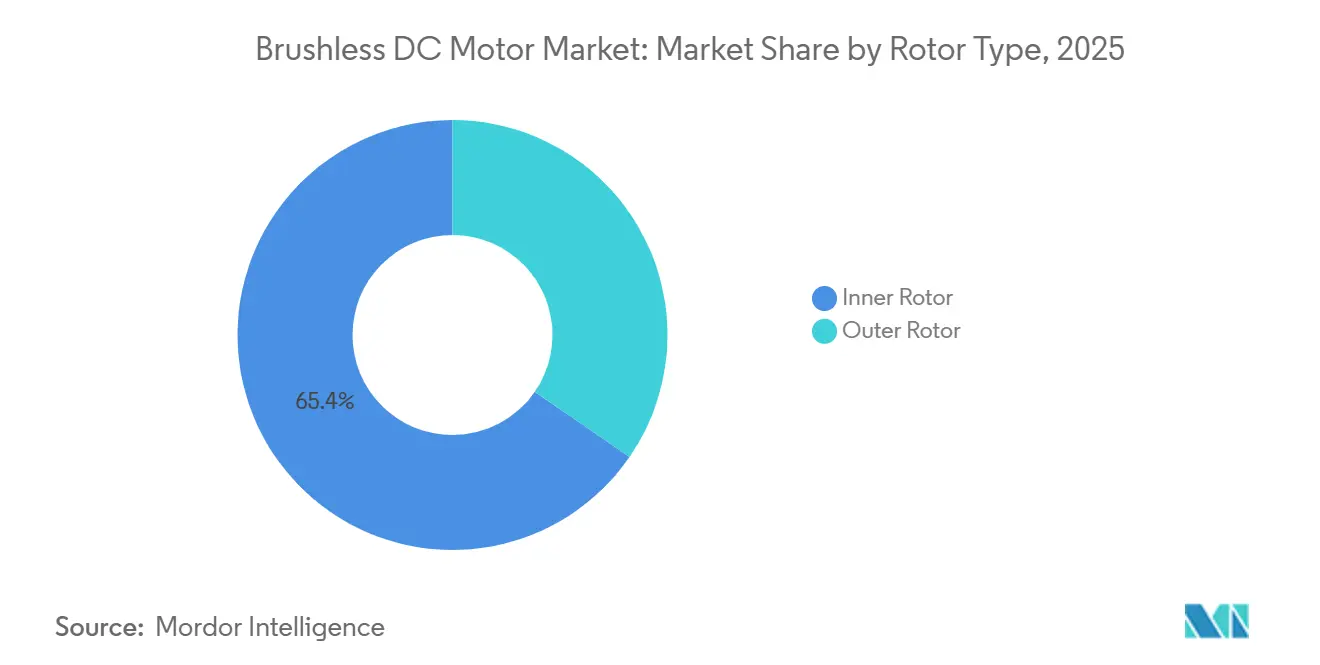
Inner rotor motors held 65.4% of the Brushless DC Motor Market share in 2025. Their power density and outer-stator thermal management suit EV cooling pumps, industrial servo drives, and appliance compressors. These applications can accept their higher rotational inertia because rapid bidirectional reversal is not always required. The design also fits precision shaft-load interfaces used across industrial equipment. Inner rotor configurations, therefore, retain a large installed base in high-volume applications.
Outer rotor motors are forecast to grow at 8.9% CAGR through 2031. They allow a propeller or wheel to attach directly to the rotating shell. This removes gearboxes in drone propulsion, e-bikes, e-scooters, and washing machine drum drives. The arrangement improves power-to-weight performance where mass limits the product design. MinebeaMitsumi expanded its patent portfolio for distributed-winding coils that can support both rotor designs. The share gap can narrow as direct-drive uses expand, though inner rotor products remain supported by automotive and HVAC volumes.



By Speed: Mid-Range Motors Remain the Largest Band
The 2,001–10,000 RPM range accounted for 39.3% of the Brushless DC Motor Market size in 2025. It covers conveyor drives, HVAC fans, EV thermal-management pumps, and household appliances. The breadth of these uses gives the range a stable demand base. Buyers can match established motor designs to familiar application requirements. This makes the band central to both consumer and industrial volume.
Motors above 10,000 RPM are forecast to grow at 8.6% CAGR through 2031. Dental handpieces, laboratory centrifuges, CNC spindles, and electric turbochargers need sustained high-speed operation. BLDC motors reduce mechanical wear compared with pneumatic and hydraulic alternatives in these applications. Falling digital signal processor costs support sensorless control in smaller packages. The supplied draft cited stable operation above 30,000 RPM without a physical encoder. This combination supports use cases that need high rotational speed and long duty cycles.
By Power Rating: Small Motors Provide Volume While Mid-Range Motors Accelerate
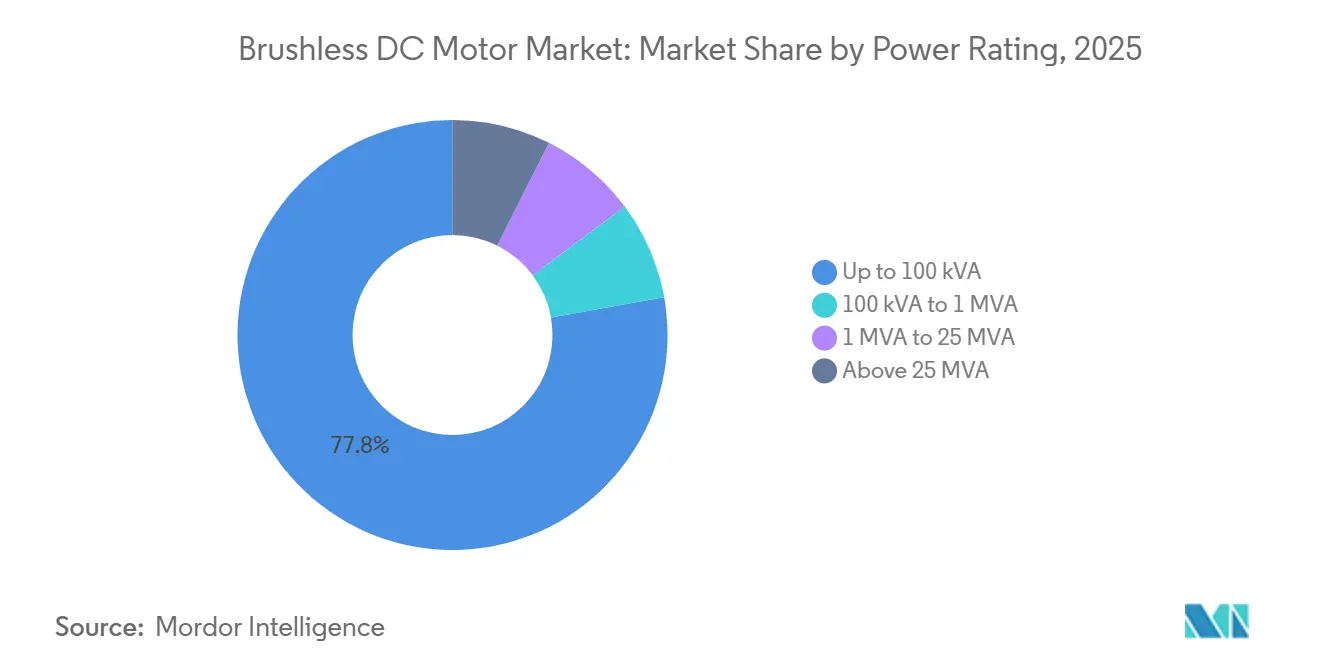
Motors up to 100 kVA held 77.8% of the Brushless DC Motor Market share in 2025. Consumer appliances, light automotive systems, and HVAC equipment generate substantial unit demand for this range. The manufacturing base is mature and highly competitive. As a result, producers compete on cost, supply reliability, and application-specific design. The large unit base remains important even where growth is slower than in higher-power categories.
The 100 kVA–1 MVA range is projected to grow at 9.7% CAGR through 2031. Industrial automation equipment, commercial HVAC chillers, cold-chain compressors, and mid-range EV auxiliary systems support demand. Efficiency requirements are particularly relevant within the 75 kW–1 MVA range. The European IE4 mandate and the U.S. DOE timetable increase replacement activity for continuous-duty equipment. ABB expanded its IE6 SynRM range to 110–450 kW in February 2026[4]ABB, “ABB Releases IE6 Hyper-Efficiency Motors in New Sizes and Power Ranges,” Automation World, automationworld.com. Higher ranges serve heavy industry, marine auxiliaries, and specialized defense needs.
By End User: Automotive and E-Mobility Holds the Largest Position
Automotive and e-mobility held 32.7% of the Brushless DC Motor Market size in 2025. It is also forecast to grow at 11.2% CAGR through 2031. EV platforms use BLDC motors for thermal management, braking, suspension, and comfort functions. The supplied research placed BLDC content at 5–10 auxiliary units for each new EV platform. This raises motor content while vehicle production also grows.
Industrial machinery and automation provide a second major demand base through servo drives, conveyors, CNC equipment, and packaging machinery. Consumer electronics and HVAC appliances provide high unit volumes but face price competition. Medical and aerospace applications support higher average selling prices because they require custom windings, certified vibration performance, and documentation. Johnson Electric formed the Jointelligence ventures with SMEIC in July 2025 to supply precision motion components for humanoid robots in China. Agriculture also uses motors in precision irrigation, autonomous steering, and drone spraying. These uses broaden the addressable applications for the Brushless DC Motor Market.
Geography Analysis
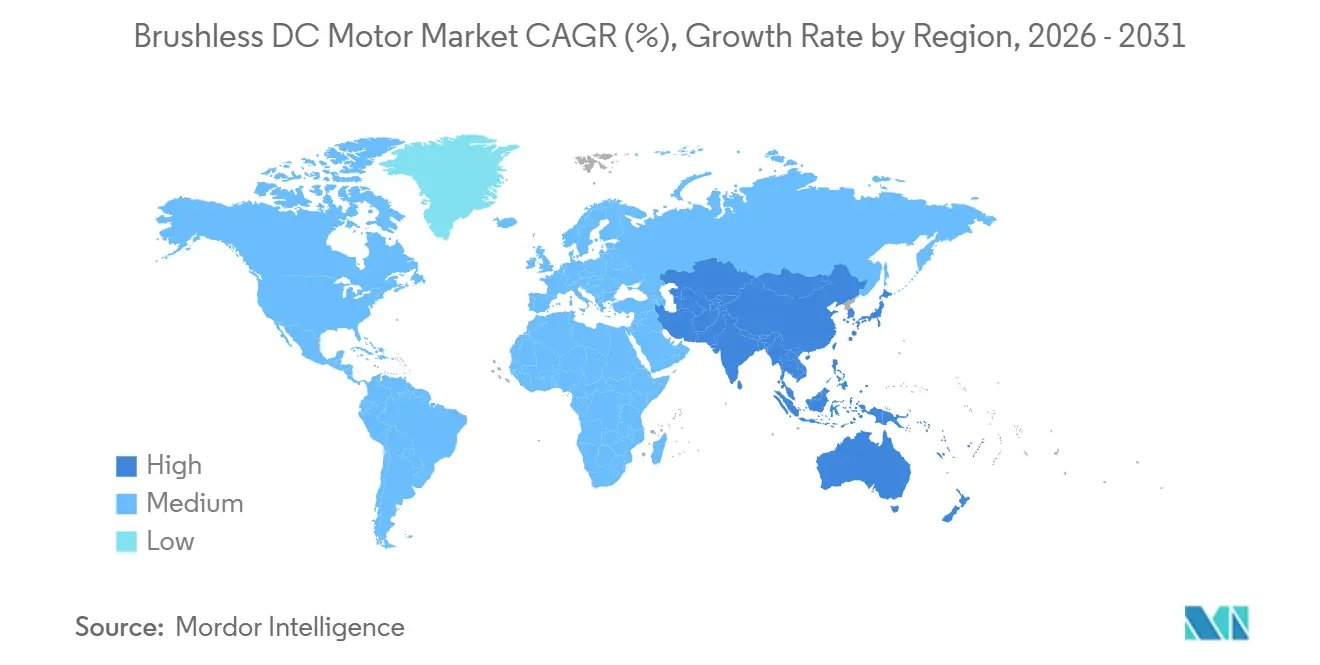
Asia-Pacific held 51.3% of the Brushless DC Motor Market share in 2025 and is forecast to grow at 9.4% CAGR through 2031. China combines the largest production base with demand from EVs, consumer electronics, and industrial automation. The supplied research stated that China accounted for 63% of global electric-car sales in 2025. It also cited China’s share of industrial robot installations at 54% in 2024. India benefits from two- and three-wheeler electrification, manufacturing incentives, and HVAC demand. Nidec opened its USD 55 million Orchard Hub campus in Hubli in June 2025 and started a third facility in Neemrana. Southeast Asia adds demand through EV adoption and the movement of consumer electronics production to Thailand, Indonesia, and Vietnam.
Europe benefits from a prescriptive motor-efficiency framework and continued demand from automotive and precision engineering. The July 2026 EU Ecodesign obligation covers motors from 0.75 kW to 1,000 kW. Germany remains important through automotive engineering and robotics adoption. The United Kingdom has a demand for medical technology and precision engineering. Poland is developing as a motor assembly and component hub closer to European customers. North America is supported by data centers, defense modernization, and manufacturing reshoring. The supplied research cited a projected 19% fall in U.S. EV sales in 2026, which creates near-term uncertainty for automotive motor volumes.
South America and the Middle East and Africa start from smaller demand bases. Brazil benefits from agribusiness automation, electric urban transport, and appliance manufacturing. Chile offers demand linked to mine decarbonization and battery-electric pit vehicles. Saudi Arabia and the United Arab Emirates are investing in smart buildings, HVAC, and EV readiness. South Africa anchors demand through mining and manufacturing. Morocco is increasing its role as an automotive component export hub for European OEMs. These developments create localized demand for qualified motor components across the Brushless DC Motor Market.

Competitive Landscape
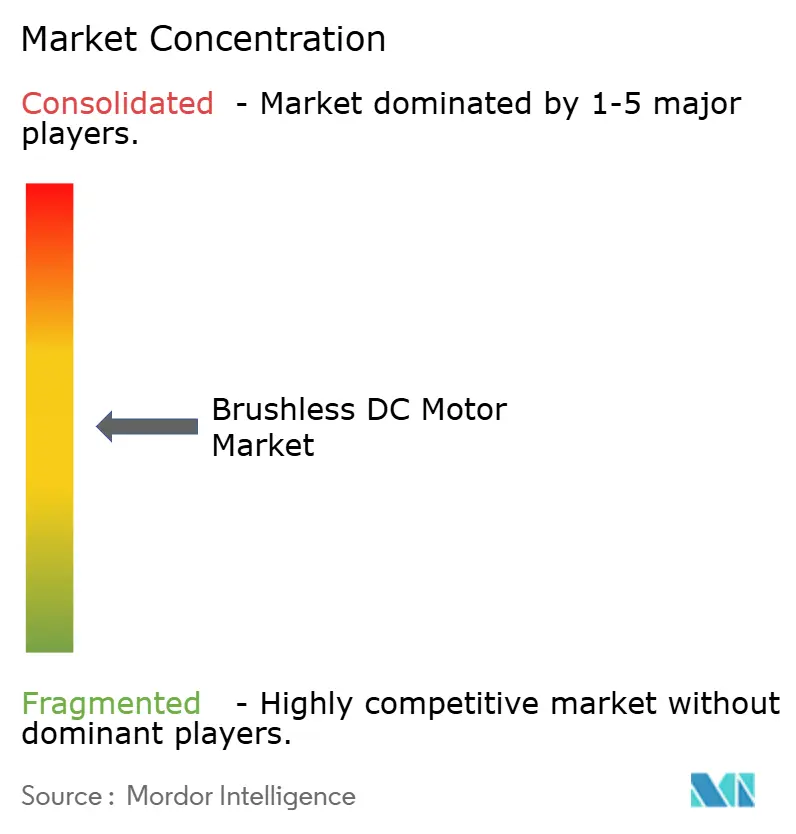
The Brushless DC Motor Market is moderately concentrated. The major companies, including Nidec Corporation, Johnson Electric, and MinebeaMitsumi, collectively accounted for major global revenue in the supplied research. No single producer held a decisive controlling position. The concentration score is therefore 4 out of 10, which is consistent with a top-player group holding 40–45% and a wide field of competitors. Suppliers differentiate through power-range coverage, certification capability, and manufacturing location. Precision specialists such as maxon, FAULHABER, and Portescap serve medical robotics and aerospace uses where qualification is important.
MinebeaMitsumi agreed in May 2026 to acquire Panasonic Industry’s automotive motor and cooling fan motor business. The acquired business generated JPY 31.8 billion in annual revenue, and completion is expected in November 2026, subject to approvals. The move expands MinebeaMitsumi’s exposure to automotive cooling technology. Nidec completed its acquisition of Xecom Qingdao in July 2025 for USD 17 million. The purchase expanded its capabilities in refrigeration and heat-pump applications. Nidec also expanded its Tennessee facility with a USD 52.4 million investment and 200 additional jobs in October 2025. These actions show that production footprint and adjacent equipment capability remain central to competitive positioning.
Integrated motor-drive systems place the controller inside the motor housing and use a single cable for power and data. ABB launched its LV Titanium Variable Speed Motor in June 2025 as an integrated motor-plus-drive product starting at 1.5 kW. The approach can simplify procurement and support maintenance data collection. Rare-earth-free motors are also becoming a competitive consideration where magnet price volatility affects sourcing. ABB introduced an IE6 magnet-free SynRM motor for hazardous areas in May 2026. These alternatives can compete in mid-power industrial applications, while high-precision BLDC applications continue to value magnet-based torque density.
Brushless DC Motor Industry Leaders
Nidec Corporation
Johnson Electric Holdings Limited
MinebeaMitsumi Inc.
AMETEK, Inc.
Allient, Inc.
- *Disclaimer: Major Players sorted in no particular order

Recent Industry Developments
- May 2026: MinebeaMitsumi agreed to acquire Panasonic Industry's automotive motor and cooling fan motor divisions, with the acquired business generating JPY 31.8 billion in annual revenue. Completion is expected in November 2026, pending regulatory approvals. The deal adds high-reliability automotive BLDC cooling technology to MinebeaMitsumi's portfolio and materially expands its automotive segment exposure.
- May 2026: ABB introduced the world's first magnet-free IE6 Hyper-Efficiency SynRM motor certified for hazardous areas under ATEX and IECEx standards, delivering up to 60% lower energy losses than equivalent IE3 induction motors in Zone 1 and Zone 2 environments. The product targets BLDC replacement in chemicals, marine, oil and gas, and pharmaceutical applications.
- July 2025: Nidec completed the acquisition of Chinese scroll compressor manufacturer Xecom (Qingdao) for USD 17 million, expanding its BLDC-driven refrigeration and heat pump motor capabilities in the appliance and HVAC segment.
- June 2025: Nidec inaugurated its USD 55 million Orchard Hub manufacturing campus in Hubli, Karnataka, India, a six-plant facility targeting automotive motor and appliance production, as the centerpiece of its India for India and India for Exports strategy.


Global Brushless DC Motor Market Report Scope
A Brushless DC (BLDC) motor is an electric motor that converts direct current (DC) electrical energy into mechanical rotational energy. It uses electronically controlled commutation instead of mechanical brushes and a commutator. The motor consists of a permanent-magnet rotor and a stator with windings. An electronic controller switches the current through the stator windings to generate a rotating magnetic field.
The Brushless DC Motor Market is segmented by rotor type, speed, power rating, end user, and geography. By rotor type, the market is segmented into inner rotor and outer rotor. By speed, the market is segmented into below 500 RPM, 501–2,000 RPM, 2,001–10,000 RPM, and above 10,000 RPM. By power rating, the market is segmented into up to 100 kVA, 100 kVA–1 MVA, 1–25 MVA, and above 25 MVA. By end user, the market is segmented into automotive, industrial, consumer electronics, HVAC, medical, and other end users. The report also covers the market size and forecasts for the global Brushless DC Motor Market across 26 countries in key regions. For each segment, the market sizing and forecasts have been provided on the basis of value (USD).
| Inner Rotor |
| Outer Rotor |
| Less than 500 RPM |
| 501–2,000 RPM |
| 2,001–10,000 RPM |
| More than 10,000 RPM |
| Up to 100 kVA |
| 100 kVA to 1 MVA |
| 1 MVA to 25 MVA |
| Above 25 MVA |
| Automotive and E-Mobility |
| Industrial Machinery and Automation |
| Consumer Electronics |
| HVAC and Appliances |
| Medical and Healthcare |
| Aerospace and Defense |
| Power and Energy |
| Agriculture |
| Other Industries |
| North America | United States |
| Canada | |
| Mexico | |
| Europe | Germany |
| France | |
| Italy | |
| Spain | |
| United Kingdom | |
| Poland | |
| Russia | |
| Rest of Europe | |
| Asia-Pacific | China |
| India | |
| Japan | |
| South Korea | |
| Australia | |
| Indonesia | |
| Vietnam | |
| Thailand | |
| Rest of Asia-Pacific | |
| South America | Brazil |
| Argentina | |
| Chile | |
| Rest of South America | |
| Middle East and Africa | Saudi Arabia |
| United Arab Emirates | |
| Egypt | |
| South Africa | |
| Morocco | |
| Rest of Middle East and Africa |
| By Rotor Type | Inner Rotor | |
| Outer Rotor | ||
| By Speed | Less than 500 RPM | |
| 501–2,000 RPM | ||
| 2,001–10,000 RPM | ||
| More than 10,000 RPM | ||
| By Power Rating | Up to 100 kVA | |
| 100 kVA to 1 MVA | ||
| 1 MVA to 25 MVA | ||
| Above 25 MVA | ||
| By End User | Automotive and E-Mobility | |
| Industrial Machinery and Automation | ||
| Consumer Electronics | ||
| HVAC and Appliances | ||
| Medical and Healthcare | ||
| Aerospace and Defense | ||
| Power and Energy | ||
| Agriculture | ||
| Other Industries | ||
| By Geography | North America | United States |
| Canada | ||
| Mexico | ||
| Europe | Germany | |
| France | ||
| Italy | ||
| Spain | ||
| United Kingdom | ||
| Poland | ||
| Russia | ||
| Rest of Europe | ||
| Asia-Pacific | China | |
| India | ||
| Japan | ||
| South Korea | ||
| Australia | ||
| Indonesia | ||
| Vietnam | ||
| Thailand | ||
| Rest of Asia-Pacific | ||
| South America | Brazil | |
| Argentina | ||
| Chile | ||
| Rest of South America | ||
| Middle East and Africa | Saudi Arabia | |
| United Arab Emirates | ||
| Egypt | ||
| South Africa | ||
| Morocco | ||
| Rest of Middle East and Africa | ||


Key Questions Answered in the Report
What is driving demand for brushless DC motors?
Efficiency rules, vehicle electrification, HVAC retrofits, and industrial automation support demand. These uses need efficient speed control, compact packaging, and lower maintenance in equipment that operates frequently.
How large is the brushless DC motor sector in 2026?
The sector stands at USD 20.94 billion in 2026 and is forecast to reach USD 30.82 billion by 2031. The supplied forecast represents an 8.03% CAGR between 2026 and 2031. Growth is supported by mandatory efficiency upgrades and rising motor content in vehicles, building systems, and automated factories across major regions.
Which rotor design leads sales?
Inner rotor motors held 65.4% of revenue in 2025, while outer rotor products are forecast to grow faster. Inner rotor products fit compact automotive, appliance, and industrial designs.
Why are high-speed BLDC motors gaining use?
Dental equipment, centrifuges, CNC spindles, and electric turbochargers require durable high-speed operation. These applications benefit from reduced mechanical wear during extended duty cycles.
Which region has the largest demand base?
Asia-Pacific held 51.3% in 2025 and is forecast to expand at 9.4% CAGR through 2031. China, India, and Southeast Asia support demand through EVs, electronics, automation, HVAC, and related component manufacturing. These areas also combine domestic production and local end-user demand, which supports regional scale.
How concentrated is the brushless DC motor sector?
It is moderately fragmented, with the top 6–8 companies accounting for 40–45% of global revenue. Suppliers compete through specialized engineering, customer certification, product range, and regional manufacturing coverage.
Page last updated on:





