
Brazil Project Logistics Market Size and Share
Market Overview
| Study Period | 2020 - 2031 |
|---|---|
| Forecast Data Period | 2026 - 2031 |
| Base Year Market Size (2025) | USD 1.11 Billion |
| Market Size (2026) | USD 1.16 Billion |
| Market Size (2031) | USD 1.45 Billion |
| Growth Rate (2026 - 2031) | 4.58 % |
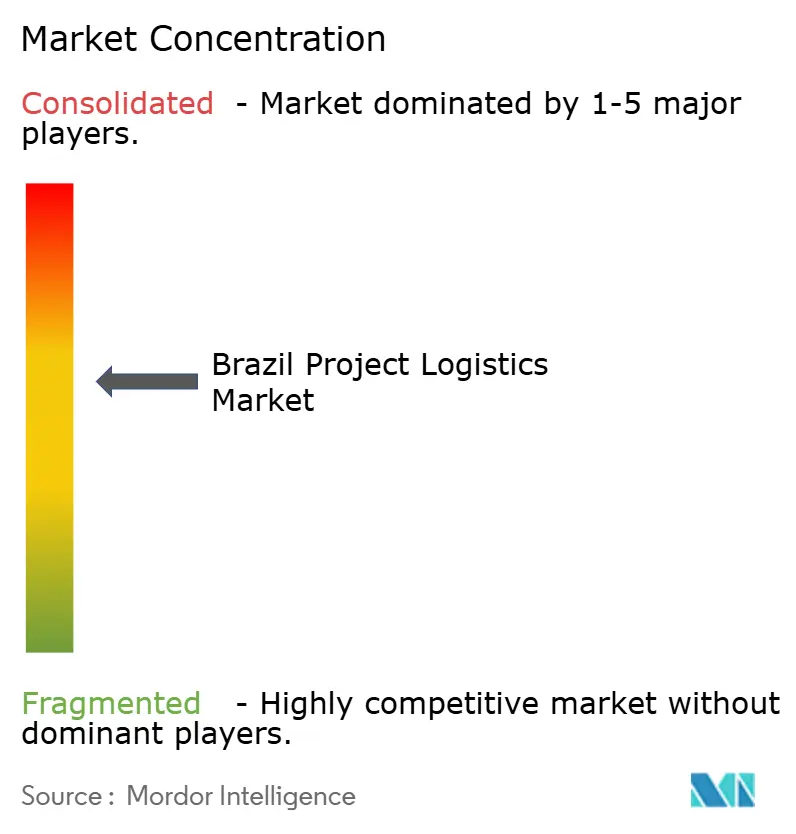
| Market Concentration | Medium |
Major Players *Disclaimer: Major Players sorted in no particular order Image © Mordor Intelligence. Reuse requires attribution under CC BY 4.0. | |
Brazil Project Logistics Market Analysis by Mordor Intelligence
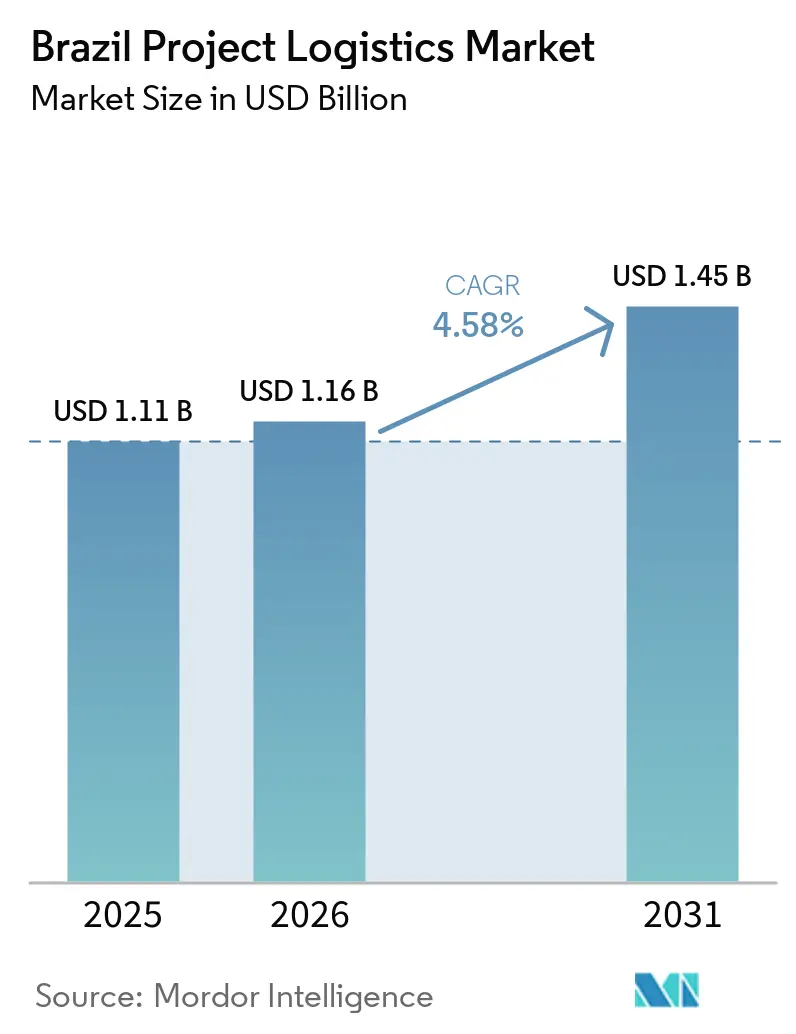
The Brazil project logistics market size was valued at USD 1.11 billion in 2025, and is estimated to grow from USD 1.16 billion in 2026 to reach USD 1.45 billion by 2031, at a CAGR of 4.58% during the forecast period (2026-2031).
Novo PAC is creating a substantial pipeline of transport, port, energy, and construction work that requires specialized cargo movements. The program had disbursed BRL 944.8 billion (USD 170.7 billion) by August 2025, equal to 70.8% of its BRL 1.3 trillion (USD 234.8 billion) target for the 2023 to 2026 cycle. Offshore oil and gas, renewable energy, mineral processing, and manufacturing localization are diversifying demand for the Brazil project logistics market. Providers that combine transport with route studies, permits, cargo tracking, and site coordination can address the operational needs of project owners. Road constraints, rail gauge differences, river conditions, and multi-agency approvals continue to increase the value of careful engineering and execution.
Key Report Takeaways
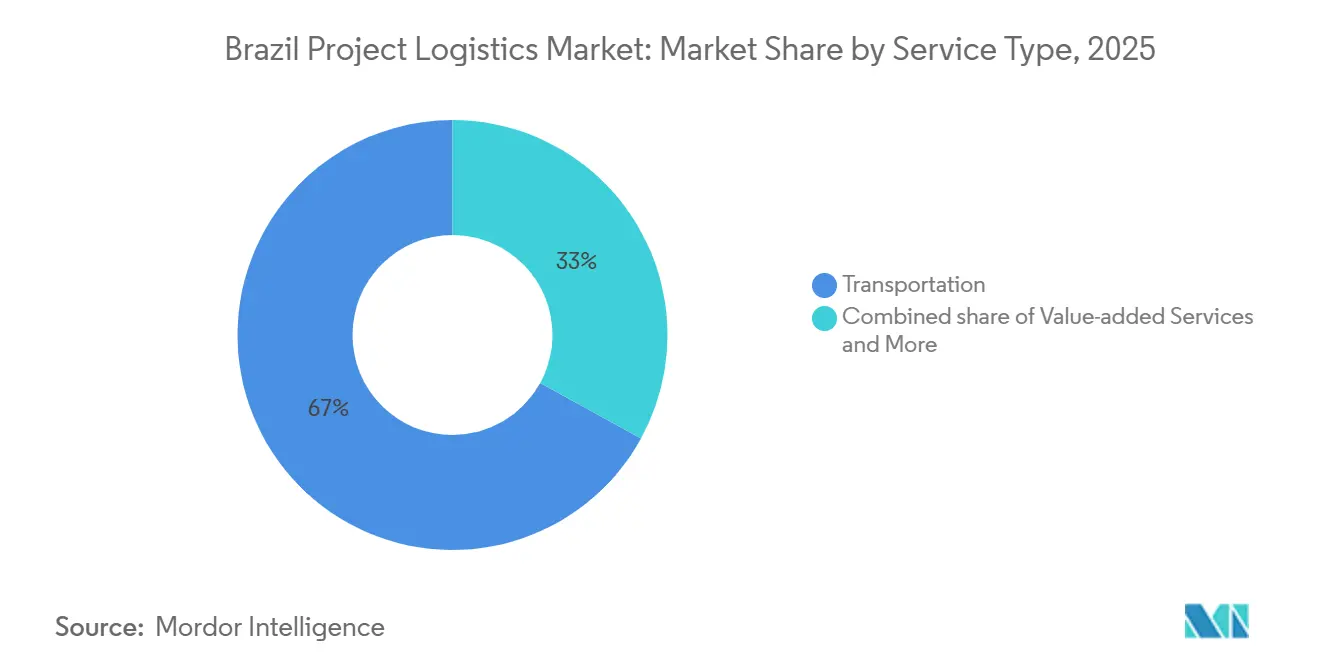
- By service, transportation held 67.01% of the Brazil project logistics market share in 2025, while the value-added services segment is forecast to grow at a 5.35% CAGR through 2031.
- By transportation mode, road held 52.05% of the Brazil project logistics market size in 2025, while air is forecast to grow at a 5.16% CAGR through 2031.
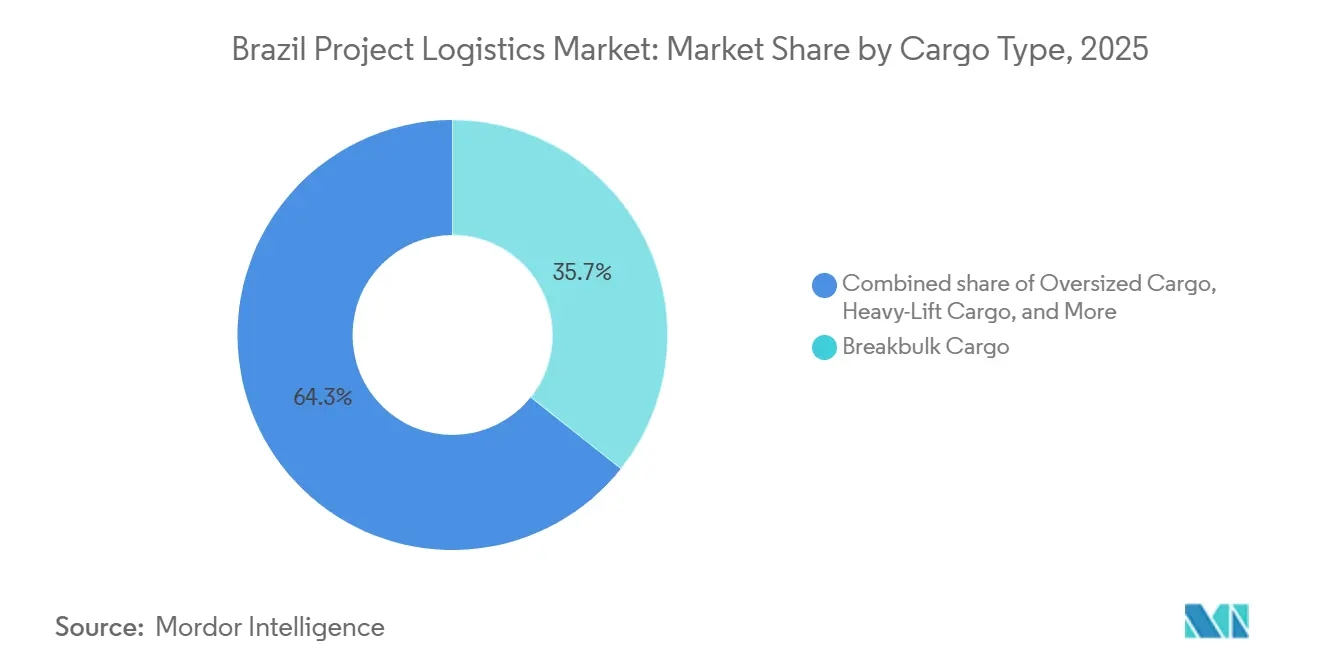
- By cargo type, breakbulk held 35.67% of the Brazil project logistics market share in 2025, while oversized cargo is forecast to grow at a 5.14% CAGR through 2031.
- By end-user industry, energy generation and transmission held 33.66% of the Brazil project logistics market size in 2025, while aerospace and defense is forecast to grow at a 5.85% CAGR through 2031.
Note: Market size and forecast figures in this report are generated using Mordor Intelligence’s proprietary estimation framework, updated with the latest available data and insights as of January 2026.
Brazil Project Logistics Market Trends and Insights
Drivers Impact Analysis*
| Driver | (~) % Impact on CAGR Forecast | Geographic Relevance | Impact Timeline |
|---|---|---|---|
| Novo PAC and Concession-Led Infrastructure Buildout | +1.5% | National, with concentration in North, Center-West, and Northeast | Medium term (2-4 years) |
| Pre-Salt, Offshore Wind, Grid and Renewable-Energy Project Pipeline | +1.2% | Southeast and Northeast coastal zones | Long term (≥ 4 years) |
| Mining Corridor Expansion and Critical-Minerals Projects | +0.8% | North, Northeast, and Southeast | Long term (≥ 4 years) |
| Northern Arc, Cabotage and Multimodal Corridor Integration | +0.6% | National, with early gains in North and Northeast ports | Medium term (2-4 years) |
| Digital Route Engineering, Permit Management and Project Visibility | +0.5% | National | Short term (≤ 2 years) |
| Localization of Manufacturing and Industrial Megaprojects | +0.7% | Southeast and South | Medium term (2-4 years) |
| Source: Mordor Intelligence | |||
Novo PAC and Concession-Led Infrastructure Buildout
Novo PAC is expanding the project pipeline for the Brazil project logistics market through public investment in transport and connected infrastructure. It had released BRL 944.8 billion (USD 170.7 billion) by August 2025, which represented 70.8% of the BRL 1.3 trillion (USD 234.8 billion) target for 2023 to 2026[1]. Federal highway investment is relevant because these corridors carry much of Brazil’s heavy and oversized cargo. The works take place across many locations, requiring operators to manage equipment, site access, staging, and delivery timing across several corridors. Road rehabilitation, bridge construction, port upgrades, and energy infrastructure each create distinct mobilization needs. Infrastructure Minister Silvio Costa Filho identified the North as a new efficiency frontier, pointing to a greater focus on inland connections to export gateways. Concession auctions scheduled for 2026 add private activity to the public program and can extend contract opportunities for the Brazil project logistics market.
Pre-Salt, Offshore Wind, Grid and Renewable-Energy Project Pipeline
The Brazil project logistics market is supported by offshore and energy projects that require marine transport, port handling, storage, and engineered inland deliveries. As of 2025, IBAMA had 96 offshore wind projects under environmental review, creating a potential multiyear need for installation vessels and movements of nacelles, blades, and towers[2]. Each installation needed close coordination between port operations, heavy transport, storage space, and offshore activity. Law No. 15,097, enacted in 2025, established a dedicated framework for offshore wind and reduced uncertainty around the development pipeline. Pre-salt activity supported heavy-lift and marine demand before offshore wind reached higher installation volumes. The P-82 program at Seatrium’s Aracruz facility illustrates the continuing logistics work associated with FPSO fabrication. Crane fleets, self-propelled modular transporters, and marine coordination procedures developed for FPSO modules can also support future wind work.
Mining Corridor Expansion and Critical-Minerals Projects
Critical minerals development is creating opportunities for the Brazil project logistics market in Para, Bahia, and Minas Gerais. Brazil signed the National Policy on Critical and Strategic Minerals into law in September 2026, with up to BRL 7 billion (USD 1.26 billion) in investment incentives and BRL 2 billion (USD 361.3 million) in federal backing for the Mineral Activity Guarantee Fund[3]. The National Mining Plan 2050 targets an increase in Brazil’s global critical-mineral production share from 8.3% to 12.2%. Processing and refining plants need large equipment, construction materials, and fabricated components that often move as breakbulk or oversized cargo. These projects need to connect mines, processing locations, ports, and established industrial centers through workable transport plans. Brazil has 21 million metric tons of mapped rare-earth reserves, while only 25% of the national territory has been geologically surveyed. This leaves scope for future routes and supporting infrastructure beyond the established industrial corridors.
Digital Route Engineering, Permit Management and Project Visibility
Digital route engineering is becoming more important in the Brazil project logistics market because oversized and high-value equipment requires route validation before dispatch. Providers can assess bridge ratings, vertical clearances, road geometry, and river conditions before committing vehicles, escorts, and site teams. This process can identify a physical constraint before it changes a delivery schedule or requires a late route redesign. Digital permit workflows can also improve coordination with ANTT’s authorization process for oversized loads. The capability is valuable when transport plans require escorts, route changes, and handoffs between road, port, river, and site operations. Real-time cargo tracking and deviation alerts can support decisions during a move and improve communication with project owners. Better planning also enables existing fleets to handle more movements without equivalent additions to physical capacity.
Restraints Impact Analysis*
| Restraint | (~) % Impact on CAGR Forecast | Geographic Relevance | Impact Timeline |
|---|---|---|---|
| Road Geometry, Bridge Clearance and Abnormal-Load Constraints | -0.6% | National, most acute on secondary roads in North and Center-West | Long term (≥ 4 years) |
| Gauge Fragmentation and Inter-Corridor Transshipment | -0.4% | National railway network | Long term (≥ 4 years) |
| Seasonal River Draft and Flood-Related Reliability Risk | -0.3% | North and Amazon Basin | Short term (≤ 2 years) |
| Fragmented Permitting, Escort and Inter-Agency Coordination | -0.2% | National | Medium term (2-4 years) |
| Source: Mordor Intelligence | |||
Road Geometry, Bridge Clearance and Abnormal-Load Constraints
Road limitations constrain the Brazil project logistics market, especially on secondary routes that serve construction, mining, and energy sites. Many roads and bridges were not designed for the load profiles of FPSO modules, wind nacelles, large transformers, or other abnormal cargo. Operators may need to survey structures, choose detours, or develop engineering workarounds before a move begins. The assessment needs to start well before mobilization because one unsuitable bridge can change the feasible route. These needs added distance, fuel use, time, and cost to each movement. The constraint is particularly difficult in the North and the Center-West, where alternative routes are limited. Federal highway rehabilitation is improving key corridors, but state and municipal roads remain the critical final links to many sites.
Gauge Fragmentation and Inter-Corridor Transshipment
Brazil's rail network operates primarily in metric gauge (1.00 m), while the North-South Railway was built in wide gauge (1.60 m). This fundamental incompatibility requires cargo to be transloaded at every gauge boundary. A 2025 FGV Transportes study found that mutual-traffic arrangements accounted for only 8.00% of cargo transport, indicating the network operated well below its structural potential and pushed a disproportionate share of project cargo onto highway corridors. A TCU audit found that 36.30% of Brazil's rail infrastructure carries no traffic at all. This systemic idleness makes rail modal substitution economically and operationally unfeasible for most project logistics movements. Equipment that could theoretically be moved by rail at a lower cost instead of being transported by truck, adding congestion on highway corridors already under pressure from Novo PAC construction traffic.
*Our forecasts treat driver/restraint impacts as directional, not additive. The impact forecasts reflect baseline growth, mix effects, and variable interactions.
Segment Analysis
By Service: Transportation Anchors Volumes While Value-Added Services Accelerate
Transportation held 67.01% of the Brazil project logistics market share in 2025. The segment reflects the challenge of reaching dispersed project locations, from offshore areas in the Campos and Santos basins to mines in the Carajas mineral province. Road transport carries the largest part of transportation activity because final delivery to most sites requires road transport. Sea and inland waterways are essential for Amazon corridor work where roads are unavailable or unsuitable for heavy loads.
The value-added services segment is the fastest-growing service category, with a forecast CAGR of 5.35% from 2026 to 2031. The Brazil project logistics market size for value-added services is supported by demand for integrated project management, customs brokerage, permit procurement, escort scheduling, and cargo visibility. Offshore wind and defense customers may prefer one operator to manage these tasks across the full delivery process. Warehousing, distribution, and inventory management support sites through bonded centers, port staging areas, and just-in-sequence delivery. These services become more important when several large projects are being built at the same time.

By Transportation Mode: Air Leads Rate Of Growth As Road Retains Scale
Road transport held 52.05% of the Brazil project logistics market size in 2025 because it provides the final connection to most project sites. It also remains flexible when locations change or construction schedules are compressed. Oversized movements can be routed by road when rail or waterway options cannot provide a complete solution. This flexibility is balanced by requirements for bridge assessments, permits, road-width checks, and escorts. Sea and inland waterways remain indispensable for Amazon Basin projects and coastal FPSO module movements.
Air is forecast to register a 5.16% CAGR from 2026 to 2031 and is the fastest-growing transportation mode. It serves time-critical defense components, specialized offshore spares, and shipments where operating delays have high costs. Cabotage can provide a cost-effective alternative to long-haul road transport for some breakbulk movements between the South and the Amazon. Rail remains limited because gauge differences require transshipment, and concession routes focus on commodity exports. The best transport option depends on cargo dimensions, destination, delivery deadline, and the available route infrastructure.
By Cargo Type: Breakbulk Leads While Oversized Cargo Expands
Breakbulk cargo held 35.67% of the Brazil project logistics market share in 2025. Its position is supported by FPSO fabrication and the movement of wind turbine components to onshore wind farms in the Northeast. Santos, Itaguai, and Suape have conventional breakbulk berths and crane capacity that support these movements. Specialized oversized and heavy-lift facilities are less available and are concentrated in fewer locations. Heavy-lift cargo has a smaller but distinct role in FPSO topside modules, industrial plant construction, and defense manufacturing.
Oversized cargo is forecast to register a 5.14% CAGR from 2026 to 2031 as offshore wind and industrial equipment dimensions increase. Larger turbines and rotor diameters can require handling beyond standard breakbulk arrangements. The Brazil project logistics market size for oversized cargo also benefits from aerospace and defense activity in Sao Paulo state. Local Gripen E assembly and guided missile production create movements with different timing and locations from traditional oil and gas work. Higher volumes can make investment in specialized trailers, extendable flatbeds, and modular bridges more practical.
By End-User Industry: Energy Leads Volume While Aerospace And Defense Leads Growth
Energy generation and transmission held 33.66% of the Brazil project logistics market size in 2025. Onshore wind and solar construction in the Northeast, gas-to-power investments in the Amazon Basin, and FPSO fabrication support this demand. Transformers, tower sections, and substation equipment frequently require specialized handling and oversized transport. Oil and gas, mining, and quarrying remained the second-largest vertical, supported by pre-salt investment and critical-mineral activity. Construction and infrastructure projects require modular bridges, precast tunnel sections, and heavy equipment across multiple work sites.
Aerospace and defense is forecast to register a 5.85% CAGR from 2026 to 2031, the fastest rate among end-user industries. Brazil inaugurated its first locally assembled Gripen E fighter jet at Embraer’s Gaviao Peixoto facility in March 2026 and commissioned a missile production plant in Cacapava, Sao Paulo, in early 2026. These facilities create technically specialized component movements and widen the geographic base of demand. Manufacturing plants, including the Arauco Sucuriu pulp project in Mato Grosso do Sul, also sustain heavy-lift work through 2026 and beyond.
Geography Analysis
The Southeast remained the center of gravity for the Brazil project logistics market because it combines industrial capacity, port infrastructure, and specialized logistics services. Rio de Janeiro and Rio Grande do Sul host FPSO fabrication activity, while Sao Paulo state contains the Paraiba Valley aerospace and defense cluster. Santos supports specialized cargo movements to destinations across the country as Latin America’s largest port gateway. Sao Paulo’s highways and access to Campinas logistics infrastructure support outbound deliveries to project sites. Minas Gerais adds critical minerals and steel demand, with cargo flows linked to the Carajas system and the developing FIOL corridor.
The North and Northeast are the fastest-growing project logistics zones, supported by offshore wind licensing, Suape expansion, and the Northern Arc’s growing importance. Northern Arc ports handled 163.3 million metric tons in 2025 and grew 10.3%, compared with a national average of 6.1%[4]. The Brazil project logistics market size in these regions is shaped by the need to reach sites with limited road access. Amazon, Tapajos, and Madeira barge routes can be the only workable option for large industrial equipment. Maersk moved 635 tons of WEG transformer equipment from Minas Gerais to Silves, Amazonas, in April 2025, illustrating the planning demands of Amazon corridor work.
The Center-West and South are gaining importance through different project drivers. Mato Grosso do Sul hosts the Arauco Sucuriu cellulose project, which requires heavy road transport from Santos and Paranagua through 2026. Southern ports provide another gateway for cargo serving Brazil and the Southern Cone. Parana’s Port of Paranagua is building Moegao, Brazil’s largest active port construction project, which requires dedicated project cargo mobilization during 2026. The regional opportunity depends on industrial construction, port upgrades, and inland routes that require integrated planning.
Competitive Landscape
The Brazil project logistics market is moderately concentrated, with global integrators, engineered-transport specialists, and domestic operators serving different parts of the value chain. Global operators compete through multi-country project management, digital systems, and combined ocean and inland transport. Specialized firms compete through crane fleets, self-propelled modular transporter capacity, and engineering capability for complex lifts. Domestic providers compete through selected cargo capabilities and local knowledge of routes and permits. These groups can compete for the same mandates while also working together when global providers subcontract specialized lifting work.
Technical execution is an important competitive factor in the Brazil project logistics market. Operators increasingly use route pre-survey tools, real-time load monitoring, and barge draft management to improve delivery planning. Mammoet completed lifting work for BW Energy’s Maromba B wellhead platform conversion ahead of schedule in August 2026. Sarens signed a memorandum of understanding with Prumo Logistica and the Port of Acu to study offshore wind component logistics before construction schedules are finalized. These examples show how leading operators build technical credibility and position around future project corridors.
A gap remains in integrated digital permit management for the Brazil project logistics market. A provider that combines ANTT approvals, state escort contracts, and river draft monitoring could simplify a process that currently crosses several agencies. Operators with environmental permitting experience can be better placed for offshore and mining projects that need close licensing coordination. Domestic companies are investing in visibility systems and port-based warehousing. Their capital resources and narrower geographic coverage can limit their ability to pursue complex cross-border or multimodal scopes.
Brazil Project Logistics Industry Leaders
-
A.P. Moller - Maersk
-
DHL Group
-
DSV A/S
-
Kuehne+Nagel International AG
-
GEODIS
- *Disclaimer: Major Players sorted in no particular order
Recent Industry Developments
- September 2026: Maersk began operating at the new APM Terminals Suape in Pernambuco, strengthening port-logistics integration for the growing Northeast renewable-energy and industrial corridor. The terminal enhances cargo velocity for oversized and project-related shipments transiting Suape.
- August 2026: Mammoet completed heavy lifting operations for the BW Maromba B wellhead platform conversion at Drydocks World Dubai, ahead of schedule. The converted platform, formerly a jackup drilling rig, is designated for deployment at the Maromba field in Brazil’s Campos Basin.
- May 2026: Wilson Sons announced a USD 220 million investment to expand Tecon Rio Grande, including an extension of the quay from 900 meters to 1,200 meters. The expansion is going to enable the terminal to accommodate three New Panamax vessels simultaneously by 2030, strengthening southern Brazil’s position as a project cargo gateway for the Southern Cone.
- October 2025: Sarens completed the load-out of 5 modules, weighing between 1,400 and 4,000 tons, for FPSO P-79 at the EBR Shipyard in Sao Jose do Norte using 136 axle lines of self-propelled modular transporters. The operation for Saipem demonstrated rapid mobilization capabilities under tight offshore project timelines.
Brazil Project Logistics Market Report Scope
| Transportation | Road |
| Rail | |
| Air | |
| Sea and Inland Waterways | |
| Warehousing, Distribution and Inventory Management | |
| Value-added Services |
| Oversized (Out-of-Gauge) Cargo |
| Heavy-Lift Cargo |
| Breakbulk Cargo |
| Others |
| Oil and Gas, Mining and Quarrying |
| Energy Generation and Transmission (Includes Renewable Energy) |
| Construction and Infrastructure |
| Manufacturing and Industrial Plants |
| Aerospace and Defense |
| Others (Maritime and Shipbuilding, Telecommunications, etc.) |
| By Service | Transportation | Road |
| Rail | ||
| Air | ||
| Sea and Inland Waterways | ||
| Warehousing, Distribution and Inventory Management | ||
| Value-added Services | ||
| By Cargo Type | Oversized (Out-of-Gauge) Cargo | |
| Heavy-Lift Cargo | ||
| Breakbulk Cargo | ||
| Others | ||
| By End-User Industry | Oil and Gas, Mining and Quarrying | |
| Energy Generation and Transmission (Includes Renewable Energy) | ||
| Construction and Infrastructure | ||
| Manufacturing and Industrial Plants | ||
| Aerospace and Defense | ||
| Others (Maritime and Shipbuilding, Telecommunications, etc.) |
Key Questions Answered in the Report
What is the value of Brazil project logistics in 2026?
Brazil project logistics was estimated at USD 1.16 billion in 2026. The forecast value is USD 1.45 billion by 2031.
What is driving demand for project logistics services in Brazil?
Novo PAC work, offshore energy, critical-minerals development, manufacturing localization, and defense production support specialized cargo requirements.
Which service holds the largest revenue share?
Transportation led with 67.01% in 2025 because cargo needs to be moved across several modes.
Which cargo category is growing fastest?
Oversized cargo is forecast to grow at a 5.14% CAGR through 2031.
Why are the North and Northeast important for project cargo?
Offshore wind, Northern Arc port activity, Suape expansion, and Amazon waterway needs support demand in these regions.
What limits project cargo movement in Brazil?
Road and bridge constraints, rail gauge fragmentation, river conditions, and multi-agency permitting can add time and cost.