
Brazil Project Cargo Logistics Market Size and Share
Market Overview
| Study Period | 2021 - 2032 |
|---|---|
| Forecast Data Period | 2027 - 2032 |
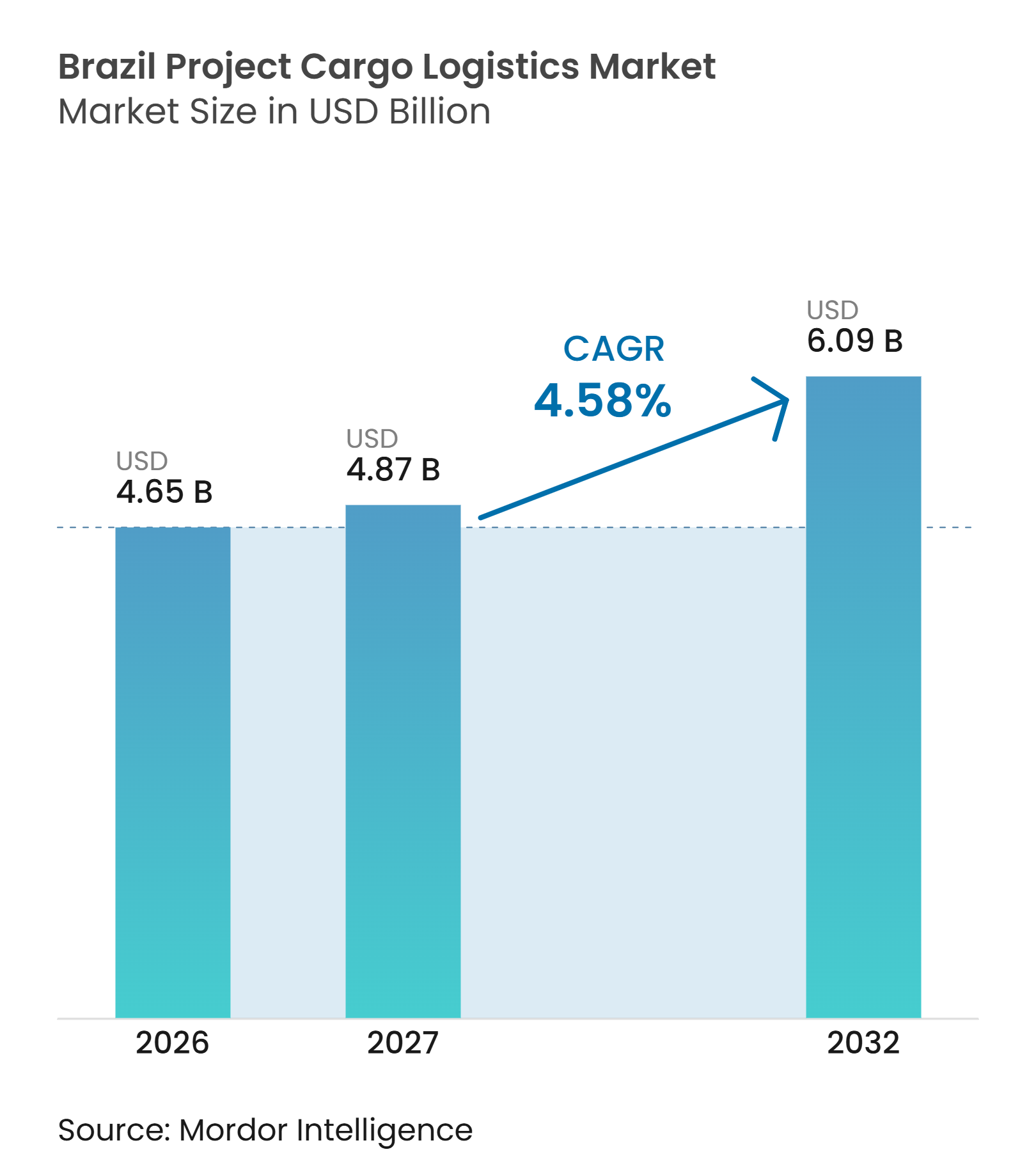
| Base Year Market Size (2026) | USD 4.65 Billion |
| Market Size (2027) | USD 4.87 Billion |
| Market Size (2032) | USD 6.09 Billion |
| Growth Rate (2027 - 2032) | 4.58 % |
| Market Concentration | Medium |
Major Players *Disclaimer: Major Players sorted in no particular order Image © Mordor Intelligence. Reuse requires attribution under CC BY 4.0. | |
Brazil Project Cargo Logistics Market Analysis by Mordor Intelligence
The Brazil project cargo logistics market size is valued at USD 4.65 billion in 2026. It is estimated to grow from USD 4.87 billion in 2027 to reach USD 6.09 billion by 2032, at a CAGR of 4.58% during the forecast period from 2027 to 2032.
The Brazil project cargo logistics market is supported by infrastructure construction, renewable energy projects, mining expansion, and industrial investment that require engineered movement of oversized equipment. Demand is moving toward integrated services because many projects require road, rail, coastal shipping, river transport, storage, route engineering, and permit management within the same delivery plan. Providers with engineering capability, local permitting knowledge, and multimodal networks are better placed to manage demanding projects. At the same time, drought conditions, road restrictions, rail incompatibility, and multilevel approvals can extend project schedules. The Brazil project cargo logistics market therefore has opportunities in specialized planning and execution, particularly where project sites are distant from ports or located in regions with limited transport alternatives.
Key Report Takeaways
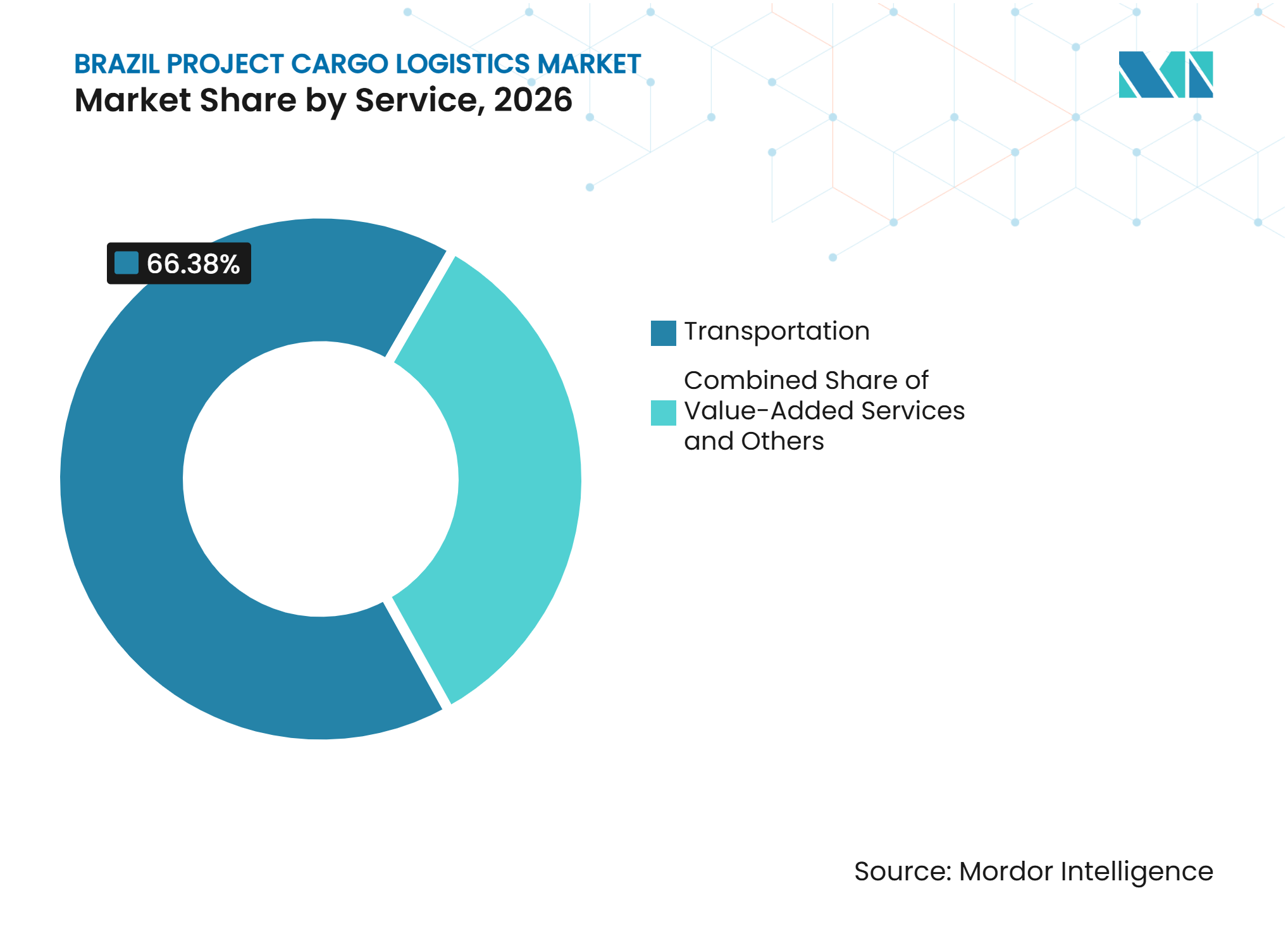
- By service, transportation accounts for 66.38% of the Brazil project cargo logistics market share in 2026, while value-added services and others are forecast to register a 7.76% CAGR through 2032.
- By cargo type, breakbulk project cargo accounts for 36.82% of the Brazil project cargo logistics market size in 2026, while oversized and out-of-gauge cargo is forecast to register a 6.12% CAGR through 2032.
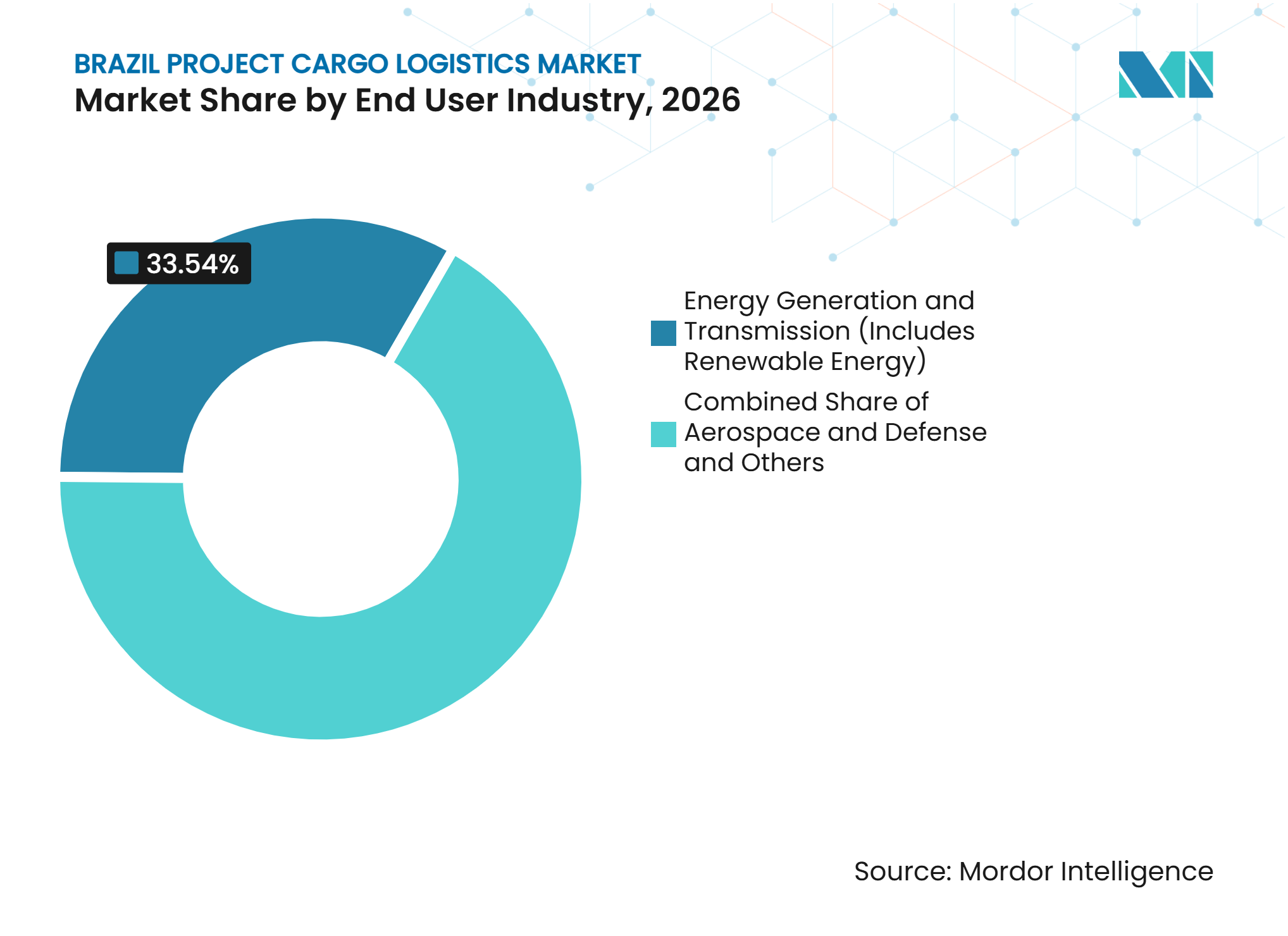
- By end-user industry, energy generation and transmission accounts for 33.54% of the Brazil project cargo logistics market share in 2026, while aerospace and defense is forecast to register a 5.98% CAGR through 2032.
- By geography, Southeast Brazil accounts for 45.62% of the Brazil project cargo logistics market size in 2026, while Northeast Brazil is forecast to register a 7.15% CAGR through 2032.
Note: Market numbers in this report are based on Mordor Intelligence's proprietary estimation framework, which combines nine months of actuals with Q4 projections for base year 2026.
Market Trends and Insights
Drivers Impact Analysis of Brazil Project Cargo Logistics Market*
| Driver | (~) % Impact on CAGR Forecast | Geographic Relevance | Impact Timeline |
|---|---|---|---|
| Novo PAC Investment Expanding Project Logistics Demand | +1.1% | National, with priority gains in North, Northeast, and Central-West corridors | Medium term (2-4 years) |
| Energy Expansion Increasing Specialized Heavy-Cargo Movements | +1.0% | Northeast and Central-West for wind and solar, North for gas, and Southeast for offshore activity | Long term (≥ 4 years) |
| Mining Projects Strengthening Oversized Equipment Logistics Demand | +0.8% | Pará, Minas Gerais, and Mato Grosso | Medium term (2-4 years) |
| Multimodal Corridors Improving Project Cargo Connectivity | +0.7% | National, with early gains in Santos to Mato Grosso and Northeast rail to port corridors | Long term (≥ 4 years) |
| Digital Route Planning Improving Project Execution Visibility | +0.5% | National, with operational depth in Southeast and South | Short term (≤ 2 years) |
| Industrial Localization Expanding Complex Project Logistics Requirements | +0.4% | Southeast, South, and emerging Central-West hubs | Medium term (2-4 years) |
| Source: Mordor Intelligence | |||
Novo PAC Investment Expanding Project Logistics Demand
Brazil's federal infrastructure program is a significant source of project cargo demand through 2026 and beyond. The 2026 concession calendar includes 8 railway auctions, 13 highway lots, 18 port terminals, and 1 hydroway concession, with projected private investment of up to BRL 300 billion (USD 54.19 billion), across their contract horizons[1]. Each project requires inbound movement of construction equipment, steel, and electromechanical modules before civil work begins. Concurrent delivery across multiple corridors can raise demand for specialized abnormal-load transporters, especially in the North. This pipeline gives the Brazil project cargo logistics market a longer demand base than isolated construction campaigns.
Energy Expansion Increasing Specialized Heavy-Cargo Movements
Renewable energy construction is increasing the need for specialized logistics across Brazil. Wind turbine nacelles, rotor blades, and tower sections require dedicated equipment, road escorts, and planned movement windows. Power transformers for the Amazon grid can exceed 340 tons and require detailed route assessment before dispatch. Offshore projects also require marine heavy-lift planning for modules and equipment. These requirements increase the value of providers that combine transport capacity with engineering, permits, and load planning. Energy-related activity will continue to support the Brazil project cargo logistics market across the Northeast, Central-West, North, and Southeast.
Mining Projects Strengthening Oversized Equipment Logistics Demand
Mining projects in Pará, Minas Gerais, and Mato Grosso require equipment that standard road carriers cannot handle. Vale's S11D expansion at Canaã dos Carajás used a semi-mobile crushing station with 4 modules, including an ABON sizer weighing more than 270 tons. Remote mining routes may combine river barges and long road stages, creating demanding cargo plans for large equipment. Loads with wide and tall dimensions can require customized trailers, bridge checks, and route modifications. The DNIT AET framework requires Structural Viability Studies for loads above 288 tons before a permit is issued. These conditions favor logistics companies that can plan the full route rather than only provide a vehicle.
Multimodal Corridors Improving Project Cargo Connectivity
Investment in rail, waterways, and port terminals is creating alternatives to purely road-based heavy haulage. BNDES approved BRL 377.2 million (USD 68.14 million) for Brado Logística's Projeto Carrossel rail-port corridor, which connects Santos, Sumaré, and Rondonópolis[2]. The first phase includes terminal investment and technology upgrades that support rail and port integration. The Bioceanic Corridor is also progressing, linking Santos with Pacific ports through Paraguay and Argentina. Brazil joined the TIR Convention on July 30, 2026, reducing repeated customs inspections for eligible cross-border consignments. These developments can improve the ability of the Brazil project cargo logistics market to serve inland production and project sites.
Restraints Impact Analysis of Brazil Project Cargo Logistics Market*
| Restraint | (~) % Impact on CAGR Forecast | Geographic Relevance | Impact Timeline |
|---|---|---|---|
| Road Geometry Constraints Limiting Abnormal-Load Movements | -0.6% | National, most acute in Southeast routes and mining interiors | Long term (≥ 4 years) |
| Rail Gauge Fragmentation Increasing Transshipment Complexity | -0.5% | National, particularly at Campinas and North-South Railway junctions | Long term (≥ 4 years) |
| Seasonal River Conditions Disrupting Inland Project Logistics | -0.4% | North region, including the Amazon, Madeira, and Tapajós basins | Short term (≤ 2 years) |
| Permitting Complexity Delaying Heavy-Cargo Project Execution | -0.5% | National, particularly for interstate abnormal-load movements | Medium term (2-4 years) |
| Source: Mordor Intelligence | |||
Road Geometry Constraints Limiting Abnormal-Load Movements
Brazil's road network creates physical limits for abnormal-load transport. CONTRAN Resolution 882/2021 sets standard vehicle limits of 2.60 m in width, 4.40 m in height, and 19.80 m in length. Cargo exceeding these limits requires an AET from federal, state, or municipal authorities. Loads above 288 tons also require an EVE for bridges and elevated structures under the DNIT framework. Route studies can therefore require bridge reinforcement, removal of aerial obstructions, and traffic coordination before transport begins. These requirements increase lead times and execution costs for the Brazil project cargo logistics market.
Seasonal River Conditions Disrupting Inland Project Logistics
Northern inland waterway logistics remains exposed to hydrological conditions that cannot be fully managed through scheduling. El Niño conditions in 2026 limited the allowable draft at critical Amazon River navigation points to 8 m. The 2025 dry season forced lighter barge payloads on the Madeira River, reducing the volume that could move during critical periods. Heavy components for northern energy and mining sites may need to be positioned before low-water periods. Road substitution is not always possible because equipment can exceed available road limits. Waterway uncertainty therefore increases the value of early planning, alternative routing, and staged cargo delivery.
*Our forecasts treat driver/restraint impacts as directional, not additive. The impact forecasts reflect baseline growth, mix effects, and variable interactions.
Brazil Project Cargo Logistics Market Segment Analysis
By Service:
Transportation Anchors Revenue While Value-Added Services GrowTransportation accounts for 66.38% of the Brazil project cargo logistics market share in 2026. Overland, coastal, and river movements remain essential because many project sites are 500 to 2,500 km from a deep-water port. Road transport remains the main final-mile option for oversized cargo headed to energy, mining, and infrastructure sites. Rail access to project locations is often unavailable or constrained by gauge differences. Southeast transformer movements from Guarulhos and Betim to Itaguaí can require multiweek schedules, overnight operation, and police escorts. Transport planning must therefore consider the available route, restrictions on travel hours, escorts, and the sequence in which site equipment is needed. The transport provider also has to coordinate with ports, local authorities, customers, and installation teams before cargo is released. Delays at any stage can leave high-value equipment waiting at a port or storage site. This work keeps transportation central to the service mix, even as customers require broader planning support.
Value-added services and others are forecast to register a 7.76% CAGR through 2032. The Brazil project cargo logistics market size for value-added services is supported by route engineering, digital monitoring, customs coordination, and feasibility work that customers increasingly treat as part of transport delivery. Providers with internal engineering teams can use these activities to distinguish their offering from basic carrier services. This shift also makes commercial performance more dependent on planning quality and execution reliability.



By Cargo Type:
Breakbulk Leads While Oversized Cargo ExpandsBreakbulk project cargo accounts for 36.82% of the Brazil project cargo logistics market share in 2026. It includes pressure vessels, structural steel sections, transformers, and turbine assemblies handled through ports such as Santos, Sepetiba, Itaguaí, and Suape. These ports support recurring flows tied to industrial construction, power projects, and large equipment imports. Breakbulk remains practical for many project shipments because its cargo can be handled with established port equipment and conventional methods. Cargo still needs secure lifting, port coordination, and a planned onward route once it leaves the terminal. Individual components may arrive as part of larger campaigns that must be matched with the construction sequence at the destination.
Oversized and out-of-gauge cargo is forecast to register a 6.12% CAGR through 2032. Wind turbine blades that exceed 70 m and mining equipment with large physical footprints require specialized equipment and detailed route engineering. Equipment complexity, rather than shipment count alone, will shape the segment's contribution to revenue. Providers need tailored trailers, loading platforms, bridge studies, escorts, and permit plans before movement begins. Curves, overhead lines, bridge strength, and access at the project site may limit route choices. Loads may also need to move at night to reduce disruption on public roads. Heavy-lift cargo also benefits from active FPSO fabrication and load-out work at Brazilian shipyards. Other specialized cargo, including industrial modules, aerospace components, and telecom tower assemblies, requires customized execution beyond standard carrier capability.
By End-User Industry:
Energy Leads While Aerospace and Defense Builds DemandEnergy generation and transmission accounts for 33.54% of the Brazil project cargo logistics market size in 2026. Wind turbines, solar equipment, hydroelectric components, and grid transformers require specialized movement from ports or domestic factories to installation sites. Energy projects often involve strict installation schedules because project delays can affect construction commissioning and power delivery. The scale of individual cargo units is also increasing, raising the need for heavy-haul engineering. Site access can vary widely between coastal, inland, and remote locations, so transport plans must be prepared for each route. The equipment often needs safe staging close to the installation date because long-term storage can create handling and condition risks.
Aerospace and defense is forecast to register a 5.98% CAGR through 2032, supported by requirements for precision handling of high-value aerospace components. Brazil's Embraer supply chain expansion and defense modernization programs support this demand base. Maritime and telecommunications activity also adds specialized cargo needs across the Brazil project cargo logistics industry. Manufacturing and industrial plants add demand as companies expand domestic production and require machinery and production-line components. Each of these users has different cargo profiles, delivery windows, and safety requirements. This diversity limits the usefulness of a single standard operating model.

Geography Analysis
Southeast Brazil accounts for 45.62% of the Brazil project cargo logistics market size in 2026, supported by requirements for precision handling of high-value aerospace components. The region combines heavy manufacturing, major ports, and large project cargo origins and destinations. São Paulo includes facilities operated by Hitachi Energy, WEG, and other heavy equipment manufacturers that require abnormal-load movements to Santos and Itaguaí. Minas Gerais adds mining and industrial activity that must connect with Atlantic ports. The region has a broad base of road infrastructure, logistics providers, and industrial customers, but individual heavy hauls still require detailed route review. Port access does not remove the need for coordination between origin facilities, road authorities, terminal operators, and end users.
Northeast Brazil is forecast to register a 7.15% CAGR through 2032. Wind development across Ceará, Rio Grande do Norte, and Piauí is increasing demand for equipment movement, while port investment is improving the region's gateway role. The Northeast handled 329.7 million tons of maritime and inland waterway cargo in 2025, reflecting its broad transport base. Renewable projects can require delivery of long blades, nacelles, tower sections, transformers, and other components to sites away from the coast. This need creates demand for road surveys, escorts, and carefully timed heavy-haul movements. A.P. Moller - Maersk began operations at APM Terminals Suape in September 2026, adding a fully electrified terminal with initial capacity of 400,000 TEUs per year and planned capacity of 1 million TEUs[3].
The North, Central-West, and South each have different demand patterns. In the North, activity follows the Manaus Free Trade Zone as well as energy and mining development in Pará. Low river levels can constrain northbound movement, so cargo planning often needs earlier dispatches and alternative modes. The remoteness of some northern destinations also requires close alignment between river schedules, road access, and site readiness. In the Central-West, grain infrastructure, processing facilities, fertilizer plants, and highway projects are expanding the need for industrial equipment logistics. These projects can require links between agricultural areas, processing sites, rail terminals, and ports.
Competitive Landscape
Market Concentration
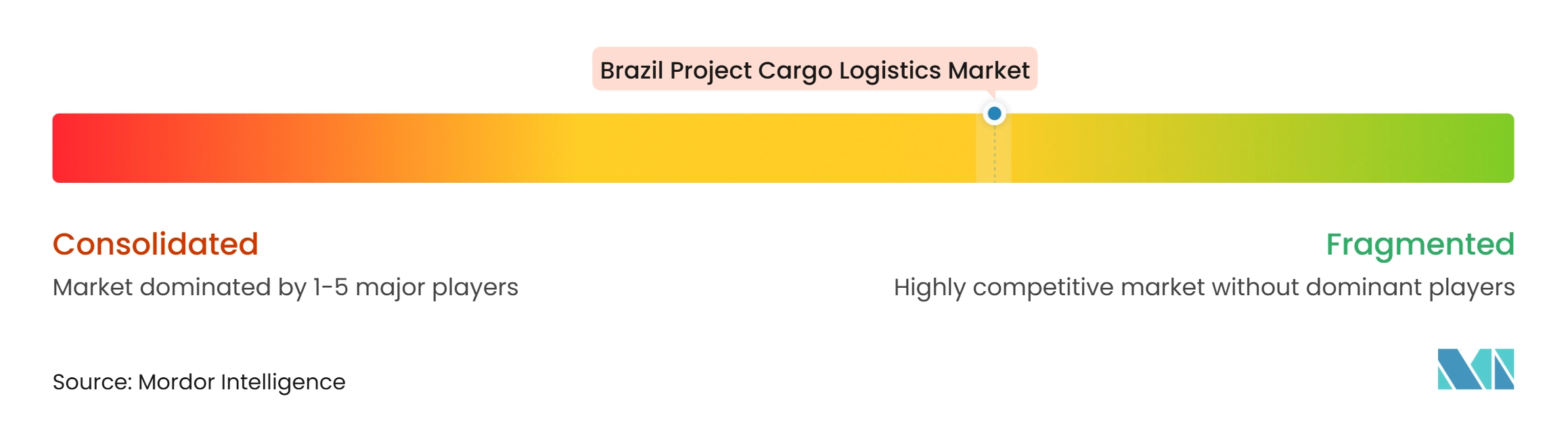
The Brazil project cargo logistics market is fragmented across its service areas. A.P. Moller - Maersk, DHL Group, Kuehne+Nagel, DSV, GEODIS, and Rhenus compete through multimodal coverage, digital visibility, and financial scale. Specialized providers such as Deugro, Trans Global Projects, Hansa Meyer Global Transport, FOX Brasil, and F.H. Bertling Logistics compete through route engineering, abnormal-load permits, and local relationships. International providers may bring broad network coverage, while Brazilian specialists can add local execution knowledge. Heavy-lift projects also depend on the availability of cranes, trailers, lift plans, and trained field teams.
Competition often begins during engineering and feasibility work, before a formal transport tender is issued. Sarens' FPSO P-82 work at Seatrium's Aracruz yard showed the importance of long technical preparation for complex module load-outs. Planning tools for route modeling, cargo tracking, and feasibility simulation can shorten preparation time and improve delivery control. They can also help teams identify route restrictions before equipment is mobilized. Rhenus was awarded the full transport contract for 24 train sets for the Metrô BH renovation in May 2026, using a 4,000 km inland route study as part of the delivery plan[4]. The contract shows the importance of combining ocean transport, inland planning, and final delivery within one project plan. These capabilities make engineering depth and compliance performance important competitive factors.
The Brazil project cargo logistics market has a clear opportunity in end-to-end service for deep-interior sites. Northern and Central-West projects can require river barges, rail links, final-mile heavy haulage, permits, and temporary infrastructure work within a single movement plan. Few providers can execute all of these steps with one operating model. Customers may instead need to manage several separate suppliers and handoffs. This position matters in the Brazil project cargo logistics market because coordination failures can disrupt installation schedules. Providers that coordinate these stages can reduce the operational burden for project owners.
Brazil Project Cargo Logistics Industry Leaders
-
deugro
-
A.P. Moller - Maersk
-
DSV AS
-
DHL Group
-
Kuehne+Nagel International AG
- *Disclaimer: Major Players sorted in no particular order
Brazil Project Cargo Logistics Market Companies Covered in this Report
- deugro
- A.P. Moller - Maersk
- DSV AS
- DHL Group
- Kuehne+Nagel International AG
- GEODIS
- Rhenus Group
- Mammoet Holding BV
- Sarens NV
- Hansa Meyer Global Transport GmbH
- Trans Global Projects Group
- F.H. Bertling Logistics GmbH
- FOX Brasil
- COLI Shipping & Transport do Brasil
- Brasil Projects
- DIRECT Intercontinental
- DC Logistics Brasil
- Logistics Plus Inc.
- Interoceanica
- Locar Guindastes e Transportes Intermodais SA
- Rohlig Logistics
Recent Industry Developments in Brazil Project Cargo Logistics Market
- May 2026: Rhenus Project Logistics was awarded the full transport contract for 24 train sets, 96 railway cars, each 54 tons and 24 m long, from China to Brazil for the Metrô BH renovation in Belo Horizonte, Minas Gerais, in collaboration with COSCO Shipping Project Logistics.
- April 2026: Deugro opened its fifth Brazilian office in Porto Alegre, Rio Grande do Sul, adding renewable energy, oil and gas, petrochemical, and mining project logistics capabilities to its South Brazil footprint.
- December 2025: GEODIS signed a strategic interline agreement with Atlas Air and MAS to expand its air freight network across South America, strengthening freight connectivity in Brazil, Colombia, Chile, Panama, and Costa Rica and enabling direct connections from Hong Kong via Mexico for project cargo shipments requiring air freight segments.
- November 2025: Trans Global Projects opened a new office in Belo Horizonte, Minas Gerais, its third in Brazil, targeting the country's most significant industrial and mining corridor. The office supports both commercial and operations functions for clients in energy, mining, oil and gas, pulp and paper, and infrastructure.
Brazil Project Cargo Logistics Market Report Scope
Segmentation Overview
| Transportation | Road |
| Rail | |
| Air | |
| Sea / Barge | |
| Warehousing, Distribution and Inventory Management | |
| Value-Added Services and Others |
| Oversized / Out-of-Gauge Cargo |
| Heavy-Lift Cargo |
| Breakbulk Project Cargo |
| Other Specialized Project Cargo |
| Oil and Gas, Mining and Quarrying |
| Energy Generation and Transmission (Includes Renewable Energy) |
| Construction and Infrastructure |
| Manufacturing and Industrial Plants |
| Aerospace and Defense |
| Others (Maritime and Shipbuilding, Telecommunications, etc.) |
| North |
| Northeast |
| Central-west |
| Southeast |
| South |
| By Service | Transportation | Road |
| Rail | ||
| Air | ||
| Sea / Barge | ||
| Warehousing, Distribution and Inventory Management | ||
| Value-Added Services and Others | ||
| By Cargo Type | Oversized / Out-of-Gauge Cargo | |
| Heavy-Lift Cargo | ||
| Breakbulk Project Cargo | ||
| Other Specialized Project Cargo | ||
| By End-User Industry | Oil and Gas, Mining and Quarrying | |
| Energy Generation and Transmission (Includes Renewable Energy) | ||
| Construction and Infrastructure | ||
| Manufacturing and Industrial Plants | ||
| Aerospace and Defense | ||
| Others (Maritime and Shipbuilding, Telecommunications, etc.) | ||
| By Region | North | |
| Northeast | ||
| Central-west | ||
| Southeast | ||
| South |
Key Questions Answered in the Report
What is the projected value of Brazil project cargo logistics by 2032?
The sector is projected to reach USD 6.09 billion by 2032, expanding at a 4.58% CAGR from 2027.
Which service leads Brazil project cargo logistics?
Transportation leads with 66.38% revenue share in 2026 because delivery to distant project sites relies on road, coastal, and river movement.
Which cargo type is growing fastest in Brazil?
Oversized and out-of-gauge cargo is forecast to register a 6.12% CAGR through 2032, supported by renewable equipment and mining machinery.
Which end-user segment has the greatest demand for specialized logistics?
Energy generation and transmission leads with 33.54% revenue share in 2026, covering wind, solar, hydroelectric, and grid equipment.
Which Brazilian region is expanding fastest for project cargo logistics?
Northeast Brazil is forecast to register a 7.15% CAGR through 2032 as renewable development and port investment expand.
What limits oversized cargo movement in Brazil?
Road geometry, multilevel AET permits, bridge studies for very heavy loads, rail gauge differences, and low river levels can extend delivery schedules.