
Brazil Luxury Residential Real Estate Market Size and Share
Market Overview
| Study Period | 2021 - 2032 |
|---|---|
| Forecast Data Period | 2027 - 2032 |
| Base Year Market Size (2026) | USD 15.60 Billion |
| Market Size (2027) | USD 16.75 Billion |
| Market Size (2032) | USD 23.91 Billion |
| Growth Rate (2027 - 2032) | 7.38 % |
| Market Concentration | Low |
Major Players *Disclaimer: Major Players sorted in no particular order Image © Mordor Intelligence. Reuse requires attribution under CC BY 4.0. | |
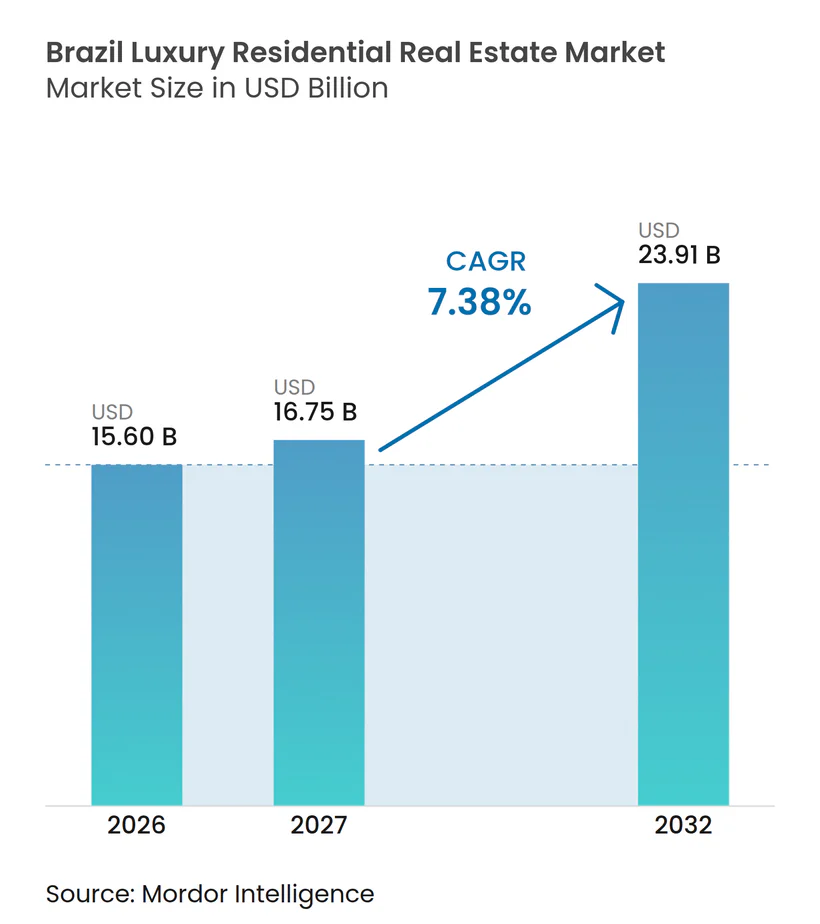
Brazil Luxury Residential Real Estate Market Analysis by Mordor Intelligence
The Brazil Luxury Residential Real Estate Market size is projected to be USD 15.60 billion in 2026, USD 16.75 billion in 2027, and reach USD 23.91 billion by 2032, growing at a CAGR of 7.38% from 2027 to 2032.
High-net-worth buyers remain less exposed to mortgage costs because many transactions are funded in cash or settled quickly. The policy rate remained at 14.75% in 2025, which raised development funding costs while also increasing the appeal of real assets for wealth preservation among buyers with liquid capital and longer holding periods. Demand is moving toward branded homes, managed residences, and secure leisure communities as buyers seek service, privacy, and asset quality. Scarce land in established São Paulo and Rio de Janeiro districts is pushing developers toward redevelopment and nearby districts with stronger mixed-use plans. The Brazil luxury residential real estate market therefore offers opportunities for developers that can secure land, manage construction costs, and support premium pricing through differentiated projects. Success will depend on disciplined project selection, credible execution, and the ability to match a property format with the priorities of each city, neighborhood, and buyer group.
Key Report Takeaways
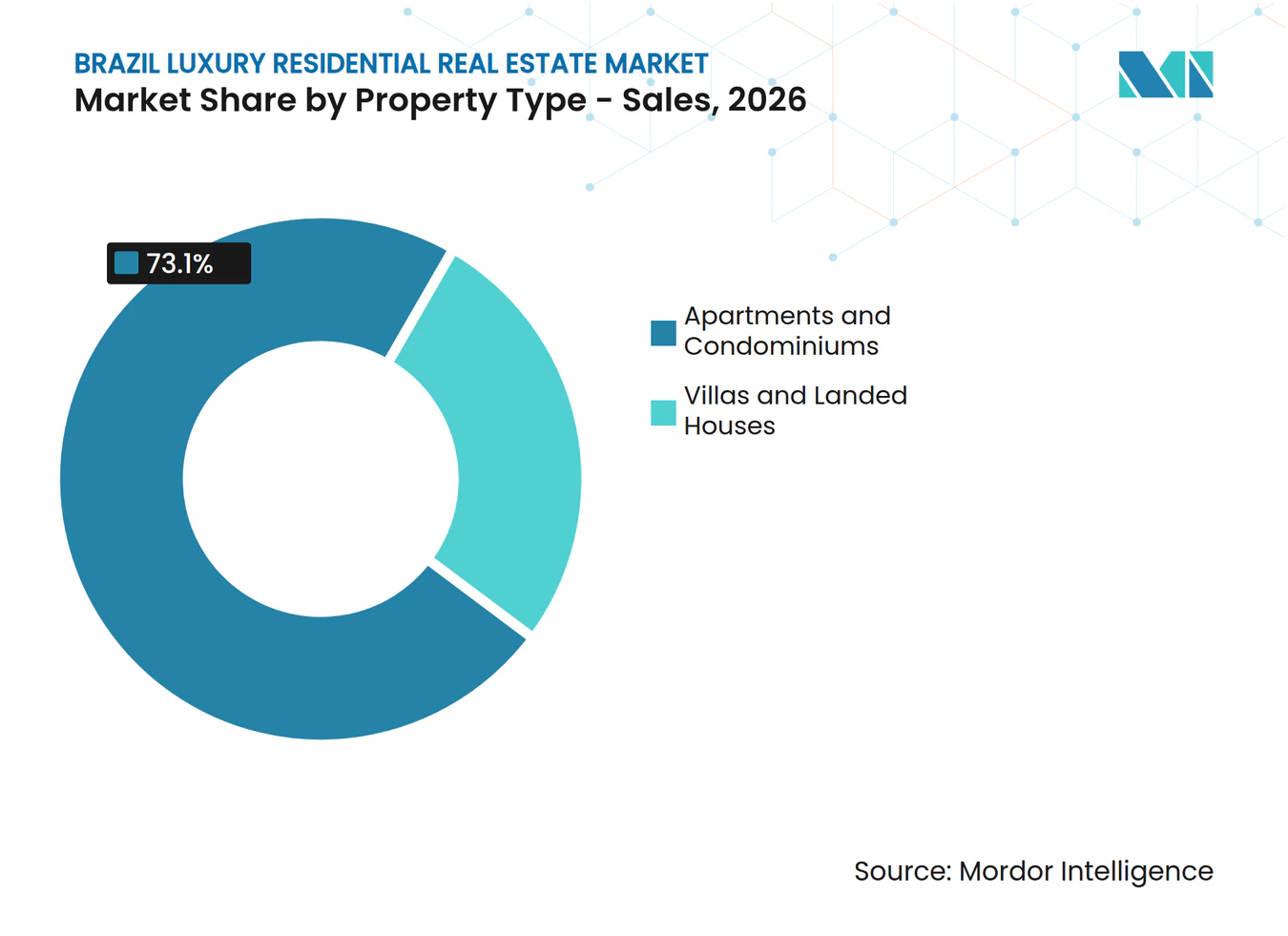
- By property type in sales, apartments and condominiums held 73.1% of the Brazil luxury residential real estate market share in 2026, while villas and landed houses are forecast to grow at a 7.96% CAGR through 2032.
- By mode of sale in sales, secondary existing-home resale held 66.8% of the Brazil luxury residential real estate market share in 2026, while primary new-build homes are forecast to grow at a 7.85% CAGR through 2032.
- By city in sales, São Paulo held a 49.4% share of luxury residential sales in 2026, while Salvador is forecast to grow at an 8.35% CAGR through 2032.
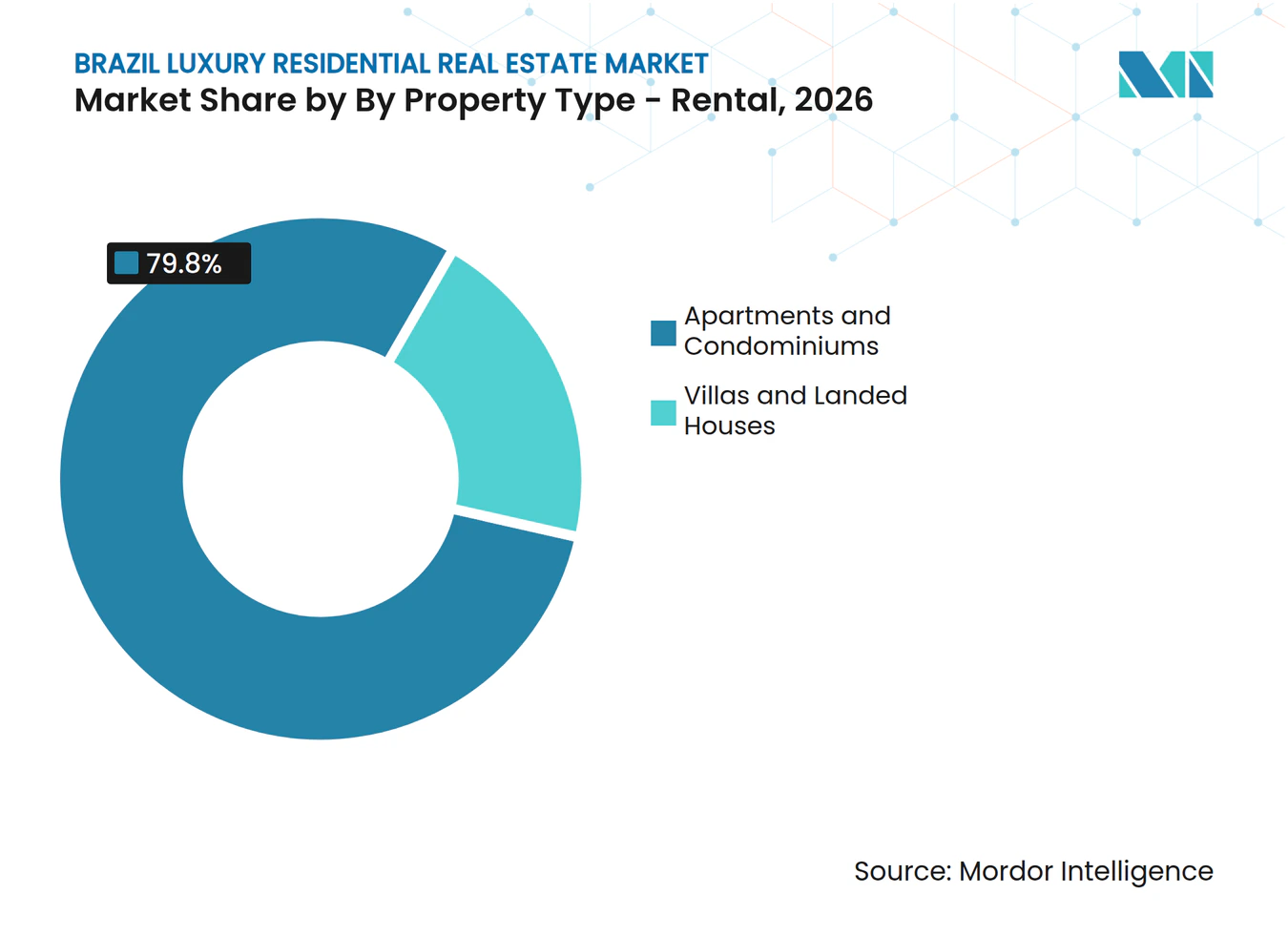
- By property type in rentals, apartments and condominiums held a 79.8% share of luxury rental activity in 2026, while villas and landed houses are forecast to grow at an 8.10% CAGR through 2032.
Note: Market numbers in this report are based on Mordor Intelligence's proprietary estimation framework, which combines nine months of actuals with Q4 projections for base year 2026.
Market Trends and Insights
Drivers Impact Analysis of Brazil Luxury Residential Real Estate Market*
| Drivers | (~) % Impact on CAGR Forecast | Geographic Relevance | Impact Timeline |
|---|---|---|---|
| Domestic high-net-worth wealth supports premium residential demand | +2.0% | National, concentrated in São Paulo and Rio de Janeiro | Medium term (2-4 years) |
| Second-home demand supports coastal and leisure investments | +1.2% | National, including Salvador, Florianópolis, and Rio de Janeiro | Long term (≥ 4 years) |
| Gated-community preferences support secure low-density development | +1.0% | National, São Paulo periphery, and Northeast capitals | Medium term (2-4 years) |
| Prime-district redevelopment enables luxury apartments and mixed-use projects | +0.8% | São Paulo and Rio de Janeiro core districts | Medium term (2-4 years) |
| Branded residences attract buyers seeking services and managed properties | +0.7% | São Paulo, Rio de Janeiro, and Salvador | Short term (≤ 2 years) |
| Sustainable and smart-home features support demand for efficient homes | +0.5% | National | Long term (≥ 4 years) |
| Source: Mordor Intelligence | |||
Domestic High-Net-Worth Wealth Creates a Self-Sustaining Buyer Pool
Brazilian high-net-worth wealth increased even as the number of wealthy individuals declined slightly in 2025. Brazilian billionaire wealth rose by more than 50% during 2025, supported by asset appreciation and new billionaires[1]. The available wealth data identified 43,000 Brazilian residents with assets from USD 5 million to USD 100 million and 386,000 individuals with wealth above USD 1 million. This buyer pool can sustain large ticket transactions with less reliance on long-term mortgages, especially where buyers can use diversified financial assets and accumulated business wealth as their principal funding source across property, financial, and operating-company holdings. It also concentrates demand in residences that offer location, privacy, and a credible long-term store of value. The Brazil luxury residential real estate market benefits because the strongest buyers can continue acquiring premium assets when financing conditions weaken.
Second-Home Demand Supports Coastal and Leisure Destinations
Second-home demand is extending beyond the largest urban centers and into leisure locations. Luxury communities in the São Paulo interior gained 60% in value across 5 years, while cumulative consumer price inflation was 33% over the same period, based on the supplied brokerage evidence. Available sector data show that the national inventory of development lots fell from 243,800 in Q3 2020 to 157,600 in Q3 2024. Months of supply fell from 18 to 12.8 over the same period. This tighter supply supports pricing for well-located coastal and resort projects, particularly when a project combines controlled access, practical road access, hospitality services, and a recognized local development partner. The Brazil luxury residential real estate market is therefore gaining a broader set of destinations that combine second-home use with investment demand.
Gated-Community Preferences Reshape Supply Composition
Secure, low-density communities are changing the composition of premium housing supply. Closed-lot subdivisions represented 93.5% of new lot launches in Q1 2025, and gated-lot sales represented 92.4% of transactions in that quarter, based on available sector data. These communities combine security with amenities such as equestrian facilities, surf lagoons, heliports, and hospitality services, which allow owners to use one location for family stays, recreation, and client entertainment. Houses increased from 20% to 33% of Bossa Nova Sotheby's transaction portfolio in 2025. Searches for houses above USD 0.3 million rose 19.3% in January 2025, exceeding the 12.4% increase in apartment searches in the same price range. The Brazil luxury residential real estate market is responding through a larger pipeline of villas and landed homes in suburban and leisure settings.
Urban Redevelopment Opens Premium Supply in Constrained Cores
Redevelopment is one of the few ways to add luxury homes in established urban districts. São Paulo's Pinheiros riverbank is being repositioned as a mixed-use area that combines residences, education, health care, and offices. In Rio de Janeiro, Porto Maravilha had received more than USD 1.5 billion in private investment by 2025, and 90% of its 12,000 residential units had been sold[2]. The extended planning framework in São Cristóvão allows towers up to 36 floors in selected areas, compared with a former limit of 12 floors. Office conversions also create a limited source of distinctive high-specification homes, including buildings with established architectural character that cannot be reproduced on newly assembled development sites. The Brazil luxury residential real estate market can gain supply through these projects without relying on scarce greenfield sites.
Restraints Impact Analysis of Brazil Luxury Residential Real Estate Market*
| Restraints | (~) % Impact on CAGR Forecast | Geographic Relevance | Impact Timeline |
|---|---|---|---|
| High interest rates and financing costs restrict leveraged purchases and development funding | -1.4% | National, especially development funding and mid-tier luxury buyers | Short term (≤ 2 years) |
| Rising material and skilled-labor costs increase development spending | -1.1% | National | Medium term (2-4 years) |
| Zoning complexity and approvals delay premium project launches | -0.7% | São Paulo and Rio de Janeiro metropolitan areas | Medium term (2-4 years) |
| Limited prime land constrains new supply in established districts | -0.5% | São Paulo Zones Sul and Oeste, plus Leblon and Ipanema | Long term (≥ 4 years) |
| Source: Mordor Intelligence | |||
High Interest Rates Raise the Cost of Development Capital
The 14.75% policy rate increases financing costs for developers and buyers who need leverage[3]. Funding costs for real estate receivables certificates tend to follow benchmarks connected to the policy rate. The Brazilian Association of Real Estate Credit and Savings Entities warned that proposed changes to real estate credit instruments could add 0.7 percentage points to project borrowing costs. The monthly income needed for a USD 0.3 million loan rose by 15% from 2023 to 2025 in the supplied evidence. Caixa also increased the minimum down payment on standard mortgage contracts from 20% to 30%. Cash buyers remain relatively protected, but constrained finance slows demand among buyers in the middle tier of the Brazil luxury residential real estate market and raises the importance of careful launch timing for developers.
Construction Cost Inflation Erodes Project Feasibility
Construction inflation places sustained pressure on project margins and launch schedules. The national construction cost index rose 5.3% in the national construction cost index in the 12 months to October 2025. A broader construction-cost index rose 6.78% in the 12 months to September 2025, with labor accounting for 4.06 percentage points of the increase. Structural PVC tubes and fittings rose 21.2%, glass rose 13.9%, and steel wire rod costs also increased. Developers are using earlier fixed-price contracts and higher selling prices to protect feasibility. These actions preserve project delivery, but they can reduce margins and raise the entry price for part of the Brazil luxury residential real estate market, particularly where designs require imported finishes, specialized glazing, or extensive shared amenities.
*Our forecasts treat driver/restraint impacts as directional, not additive. The impact forecasts reflect baseline growth, mix effects, and variable interactions.
Brazil Luxury Residential Real Estate Market Segment Analysis
By Property Type Sales:
Apartments Remain the Core Format While Villas Gain DemandApartments and condominiums accounted for 73.1% of luxury residential sales during 2026. Their lead reflects the density and convenience of prime districts in São Paulo and Rio de Janeiro, where luxury owners can combine a central address with access to commercial areas, private schools, health care, and daily services. Addresses in Itaim Bibi, Vila Nova Conceição, Jardins, and Leblon place residents near high-quality services, schools, restaurants, and business areas. High-rise projects can also combine hotel-style services and premium security within established urban locations, which is valuable to owners who divide their time between Brazil and other business or leisure destinations. Buyers who value a primary city residence often prefer this format because well-located land is scarce. The format will remain central to the Brazil luxury residential real estate market as developers build around transport corridors and mature luxury districts, where buyers generally place a premium on an established address and ready access to daily amenities.
Villas and landed houses are projected to expand at a 7.96% CAGR through 2032. Demand is linked to private outdoor areas, controlled access, and the ability to offer amenities within a single community, rather than requiring residents to depend on amenities located elsewhere in the city. In 2025, houses increased from 20% to 33% of the Bossa Nova Sotheby's transaction portfolio. The evidence also showed stronger online search growth for high-value houses than for comparable apartments. Planning rules in some outer São Paulo districts favor lower-density development, which helps direct this supply toward the periphery and creates a clearer distinction between core-city towers and larger homes in secure communities. The Brazil luxury residential real estate industry is consequently balancing continued vertical urban development with growth in horizontal luxury formats.



By Mode of Sale:
Resale Liquidity Leads While Branded New-Build Projects ExpandSecondary existing-home resale held 66.8% of luxury residential sales in 2026. Established districts have deep stocks of premium homes, and owners often recycle equity into another property within the same area. Resale supply provides buyers with a known neighborhood, completed infrastructure, and a clearer view of the building's condition, which can reduce uncertainty for a buyer comparing several high-value properties. The supplied brokerage data showed that 54% of recent luxury transactions involved condominiums under 20 years old. It also showed that 61% occurred in buildings under 10 years old. This pattern indicates that buyers favor newer resale inventory even while the secondary channel remains dominant, because recently completed buildings are more likely to meet current expectations for layouts, technology, security, common areas, parking, and practical storage for families and staff.
Primary new-build homes are forecast to grow at a 7.85% CAGR through 2032. Branded residences are helping developers draw buyers into off-plan projects by combining a home with design, hospitality, and property-management credentials that can support the project long after the initial sale is complete. São Paulo ranked fifth globally for branded residential hotspots in the supplied sector evidence. Cyrela launched 74 Capri Lifestyle by Dolce & Gabbana Casa units in Pinheiros during Q4 2025, with a potential sales value of USD 116 million. Brand-led projects can support pricing and pre-sales, although their execution depends on controlling land and construction costs. The Brazil luxury residential real estate market will continue to rely on resale liquidity while new-build projects refresh supply in constrained neighborhoods.
By Property Type:
Rental. Apartments Lead While Villas Serve a Separate NeedApartments and condominiums accounted for 79.8% of luxury residential rental activity during 2026. Corporate executives, finance and technology professionals, and expatriates are key users of urban luxury rentals. These tenants often place more value on location and professional management than on the space offered by a villa, particularly when an employer assignment, business travel pattern, or family timetable requires a furnished and well-serviced home. Prime apartments offer access to commercial districts in São Paulo and Rio de Janeiro. They also provide security and building services that suit temporary or mobile households. This demand profile keeps apartment rentals at the center of the Brazil luxury residential real estate market, because a professionally managed unit can offer a fast, flexible, secure, and reliable housing solution in a city with demanding commuting patterns and varied work locations.
Villas and landed houses are projected to expand at an 8.10% CAGR through 2032. High-income families use them during relocations, while primary homes are under construction, or when longer stays require more private space. Coastal areas such as Salvador and Florianópolis also support premium short-stay demand, where rental homes can serve visitors who want privacy and space without sacrificing access to beaches, clubs, and urban services. JHSF has integrated property, hospitality, and club services into its Fasano-branded residential model, which supports more professional management of high-value homes. Green Building Council Brasil's home certification is also becoming a visible feature in premium listings for tenants that value energy efficiency. This creates a clearer service proposition for villa rentals in the Brazil luxury residential real estate industry, helping owners present larger homes as managed accommodation rather than as occasional-use properties with uneven service standards.

Geography Analysis
São Paulo held 49.4% of luxury residential sales during 2026. The city is the country's strongest center for high-value transactions because it has the highest concentration of affluent buyers, established broker networks, and a broad development pipeline. Branded projects from Cyrela, Gafisa, and Even have supported premium pricing through design and hospitality partnerships. The supplied evidence placed selling prices for leading branded projects between USD 6,838 and USD 17,094 per square meter. Pinheiros accounted for 26.5% of luxury and super-luxury launches in Q2 2025, showing the geographic expansion of the city’s premium development base. CPP Investments and Cyrela set a USD 291 million investment target for high-end São Paulo condominiums, confirming institutional interest in the city.
Rio de Janeiro remains defined by scarcity, especially in Ipanema and Leblon. The Brazil luxury residential real estate market size in the city is supported by limited oceanfront land and high barriers to replicating established locations. Leblon super-luxury launches reached USD 10,833 per square meter in 2025 in the supplied evidence. Porto Maravilha has attracted more than USD 1.5 billion in private investment, while 90% of its 12,000 residential units had been sold. The expanded regulatory framework for São Cristóvão provides a further source of development land. Gafisa's planned redevelopment with Alexandre Allard illustrates the emphasis on transforming scarce prime assets instead of building on greenfield sites.
Salvador is projected to record the fastest growth at an 8.35% CAGR through 2032. The city had the highest residential price appreciation among Brazilian capitals in 2025, at 16.25%, based on the available residential price data. Its luxury and super-luxury category increased 16% during the year, while the sales market recorded a tight 6-month inventory absorption horizon. These conditions encourage developers to advance waterfront and regeneration projects, especially where a limited set of well-located sites can address demand from both local households and buyers from Brazil's larger cities. The Rest of Brazil includes São Paulo interior communities and Santa Catarina coastal locations, where leisure use and lifestyle migration support demand. The Brazil luxury residential real estate market is becoming more geographically varied as buyers seek secure second homes and resort-style settings outside the largest metropolitan centers.
Competitive Landscape
Market Concentration
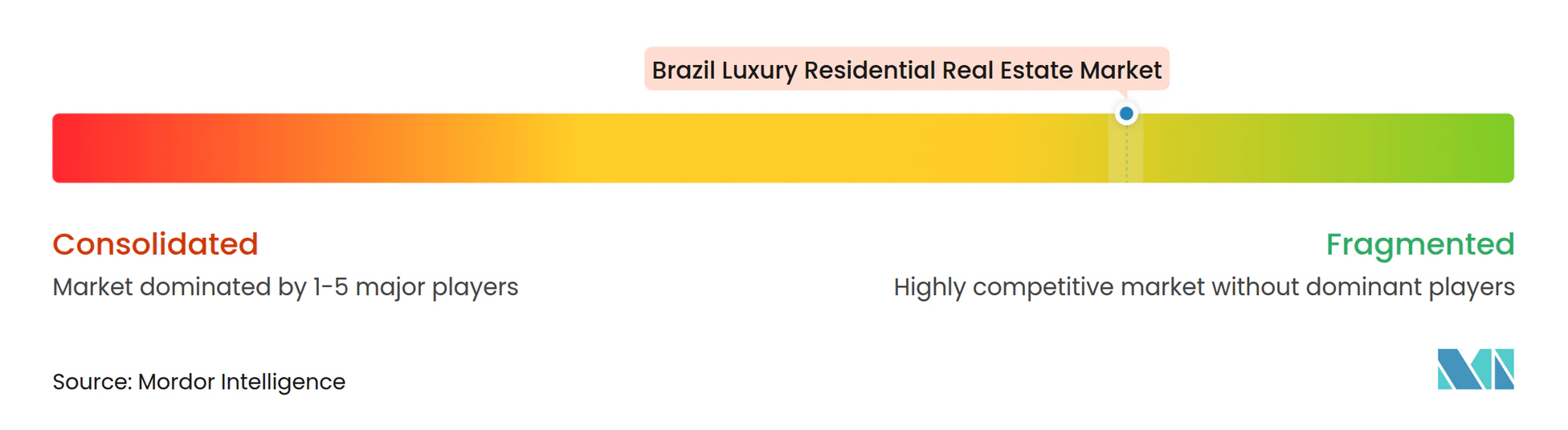
The Brazil luxury residential real estate market is moderately fragmented, with Cyrela Brazil Realty, JHSF Participações, Moura Dubeux Engenharia, Even Construtora, and Gafisa holding stronger positions through capital access, brand recognition, and project pipelines. Boutique and regional developers compete through location knowledge, architecture, and smaller projects. Brand partnerships have become an important way to stand out in ultra-premium developments. These partnerships connect residential projects with names such as Armani, Dolce & Gabbana, Pininfarina, Faena, and Tonino Lamborghini. They can strengthen pre-sales when buyers place value on a known design or hospitality concept. Competition is therefore strongest in securing development sites, building credible project brands, and delivering the service level promised to buyers throughout sales, handover, and ongoing property management, rather than simply offering larger unit sizes or more elaborate marketing materials.
JHSF uses an integrated model that links luxury homes with clubs, hospitality, and recurring services. Its club and rental-residence net revenue rose 148.7% year over year in Q1 2025, based on its reported results. The company opened the Fasano Tennis Club and São Paulo Surf Club in May 2025 and planned adjacent residential towers. Cyrela is expanding branded residences, including the Capri Lifestyle by Dolce & Gabbana Casa project in Pinheiros, which had USD 116 million in potential sales value. Moura Dubeux is developing the Northeast through urban regeneration and experience-led sales presentation. These strategies show that leading participants are competing through recurring revenue, partnerships, and more distinctive residential environments.
Technology-enabled brokerages are also using transaction data from real estate transfer tax records to improve pricing and buyer targeting, giving brokers a better basis for comparing rare assets that may have few directly comparable listings. Boutique developers including Idea! Zarvos and Benx focus on lower-volume projects with 20 to 74 units, allowing greater customization for ultra-high-net-worth buyers. International capital is entering through structured partnerships rather than broad acquisitions, which allows investors to use the local execution capability, land knowledge, and sales network of established Brazilian developers. CPP Investments formed its Cyrela joint venture in January 2025 with a target of USD 291 million and potential project sales above USD 1.0 billion. Developers are also aligning projects with Green Building Council Brasil and Leadership in Energy and Environmental Design standards to meet institutional environmental, social, and governance expectations. The Brazil luxury residential real estate market remains open to specialized firms because no disclosed top-player share data establishes dominant control. However, scale and financing capacity give the leading developers an advantage when projects require a long construction period.
Brazil Luxury Residential Real Estate Industry Leaders
-
Cyrela Brazil Realty S.A. Empreendimentos e Participações
-
Moura Dubeux Engenharia S.A.
-
JHSF Participações S.A.
-
Gafisa S.A.
-
Mitre Realty Empreendimentos e Participações S.A.
- *Disclaimer: Major Players sorted in no particular order
Brazil Luxury Residential Real Estate Market Companies Covered in this Report
- Cyrela Brazil Realty S.A. Empreendimentos e Participações
- Moura Dubeux Engenharia S.A.
- JHSF Participações S.A.
- Gafisa S.A.
- Mitre Realty Empreendimentos e Participações S.A.
- Even Construtora e Incorporadora S.A.
- EZTEC Empreendimentos e Participações S.A.
- Lavvi Empreendimentos Imobiliários S.A.
- Helbor Empreendimentos S.A.
- Tegra Incorporadora
- Idea!Zarvos
- Benx Incorporadora
- Patrimar Engenharia S.A.
- Plano and Plano Desenvolvimento Imobiliário S.A.
- Setai Grupo GP
- FG Empreendimentos
- Lopes Consultoria de Imóveis S.A.
- Bossa Nova Sotheby’s International Realty
- Coelho da Fonseca
- MBRAS
Recent Industry Developments in Brazil Luxury Residential Real Estate Market
- August 2026: CPP Investments formed a joint venture with HSI and acquired a 49.5% interest in Hilton Copacabana in Rio de Janeiro and Hilton Morumbi in São Paulo. The 545-room and 503-room hotels, respectively, are under phased renovation, reinforcing institutional interest in premium hospitality-adjacent real estate.
- August 2026: Cyrela launched Heritage Riviera in Porto Feliz, São Paulo. Phase 1 includes 29 lots, 34 completed homes, and 185 apartments, with a potential sales value of USD 170.9 million. The 4-phase project has a total potential sales value of USD 512.8 million to USD 683.8 million, while Cyrela plans to self-fund at least USD 256.4 million.
- July 2026: HBR Realty submitted a public acquisition offer to acquire Helbor and cancel its B3 listing. The offer price is USD 0.43 per share, adjusted by the policy rate through settlement. The proposed transaction combines HBR's recurring-income platform with Helbor's premium residential pipeline.
Brazil Luxury Residential Real Estate Market Report Scope
Segmentation Overview
| Apartments and Condominiums |
| Villas and Landed Houses |
| By Property Type | Apartments and Condominiums |
| Villas and Landed Houses |
Key Questions Answered in the Report
What is the Brazil luxury residential real estate market size?
The market is projected at USD 15.6 billion in 2026 and USD 23.91 billion by 2032, expanding at a 7.38% CAGR from 2027 to 2032.
Which property type leads luxury home sales in Brazil?
Apartments and condominiums lead sales with a 73.1% share in 2026, supported by demand in prime urban districts.
Which city has the highest projected growth in luxury residential sales?
Salvador is forecast to grow at an 8.35% CAGR through 2032, supported by tight inventory and demand for coastal premium homes.
Why are branded residences gaining relevance in Brazil?
Branded projects combine premium design, hospitality, and property management, supporting developer pricing and buyer confidence.
How do high interest rates affect premium residential development?
High rates increase development finance costs and make mortgage-funded purchases less accessible, while cash buyers remain less exposed.
Who are the leading developers in Brazilian luxury residential real estate?
Cyrela, JHSF, Moura Dubeux, Even, and Gafisa hold stronger positions through capital access, project pipelines, and brand partnerships.