
Brazil Hydrogen Fuel Cell Vehicle Market Size and Share
Market Overview
| Study Period | 2019 - 2032 |
|---|---|
| Forecast Data Period | 2027 - 2032 |
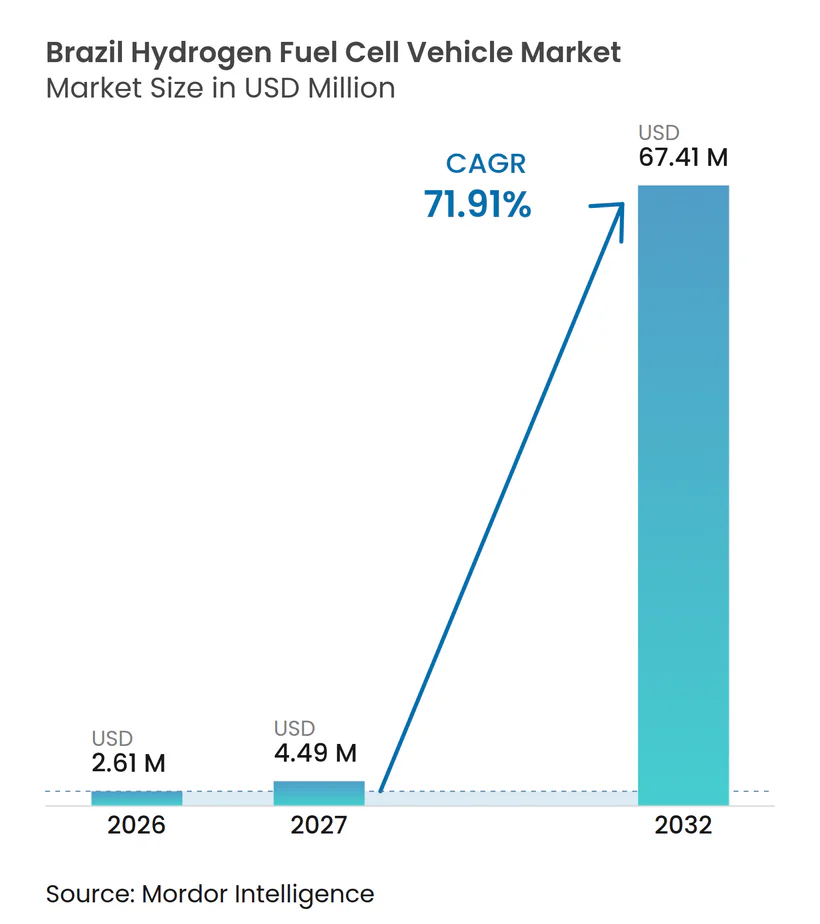
| Base Year Market Size (2026) | USD 2.61 Million |
| Market Size (2027) | USD 4.49 Million |
| Market Size (2032) | USD 67.41 Million |
| Growth Rate (2027 - 2032) | 71.91 % |
| Market Concentration | Medium |
Major Players *Disclaimer: Major Players sorted in no particular order Image © Mordor Intelligence. Reuse requires attribution under CC BY 4.0. | |
Brazil Hydrogen Fuel Cell Vehicle Market Analysis by Mordor Intelligence
The Brazil hydrogen fuel cell vehicle market size was valued at USD 2.61 million in 2026 and is expected to grow from USD 4.49 million in 2027 to USD 67.41 million by 2032, at a CAGR of 71.91% during 2027-2032. The Brazil hydrogen fuel cell vehicle market remains small because deployments are still centered on demonstrations and captive fleets. Policy support now provides a clearer basis for low-carbon hydrogen production, certification, and industrial use. Brazil also has an ethanol supply chain that can support on-site hydrogen production for vehicle operations. Commercial fleets with predictable routes can build refueling capacity around known demand. International vehicle makers and local research partners are using early projects to establish operating data and technical capability.
Key Report Takeaways
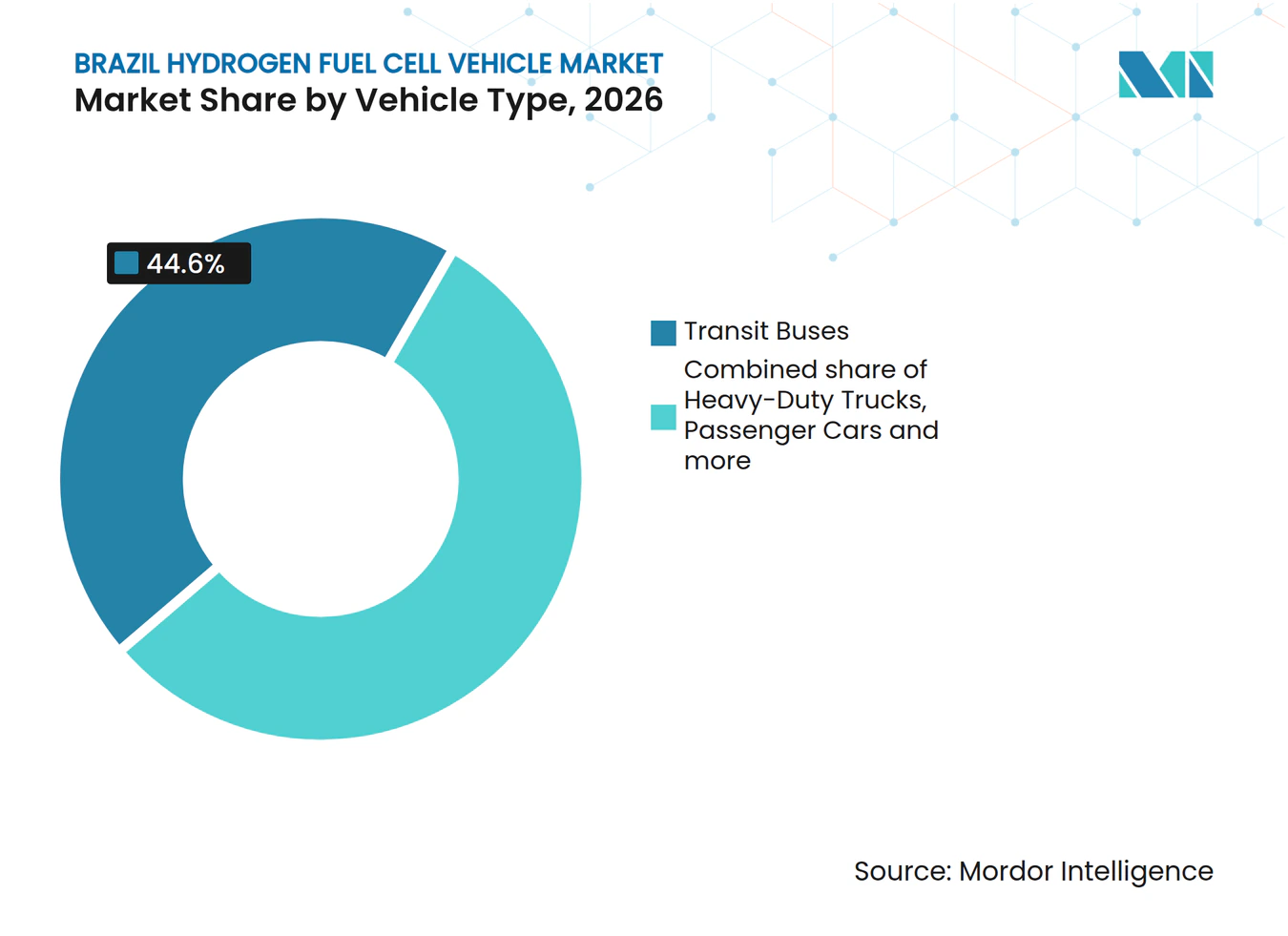
- By vehicle type, transit buses held a 44.60% share in 2026, while heavy-duty trucks are projected to grow at a 76.80% CAGR through 2032.
- By technology, proton-exchange-membrane fuel cells held a 96.50% share in 2026 and are projected to grow at a 72.00% CAGR through 2032.
- By driving range, medium-range vehicles held a 55.12% share in 2026, while long-range vehicles are projected to grow at a 74.78% CAGR through 2032.
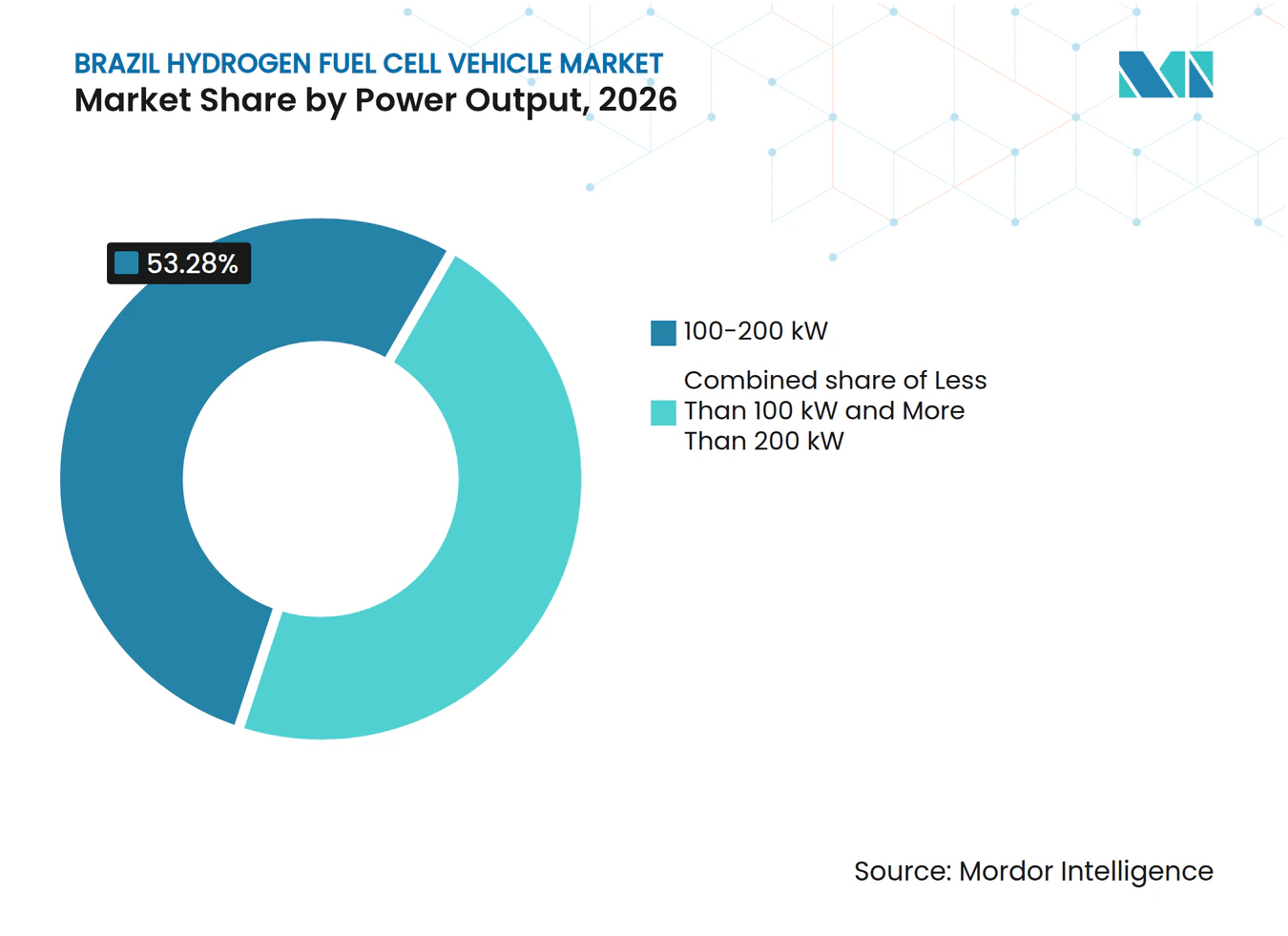
- By power output, the 100-200 kW segment held a 53.28% share in 2026, while the above-200 kW segment is projected to grow at a 74.28% CAGR through 2032.
- By application, public transportation held a 61.29% share in 2026, while commercial freight and logistics is projected to grow at a 75.19% CAGR through 2032.
- By end-user ownership, public transit authorities held a 57.72% share in 2026, while fleet operators are projected to grow at a 75.87% CAGR through 2032.
- By geography, Southeast Brazil held a 55.22% share in 2026, while Northeast Brazil is projected to grow at a 75.33% CAGR through 2032.
Note: Market numbers in this report are based on Mordor Intelligence's proprietary estimation framework, which combines nine months of actuals with Q4 projections for base year 2026.
Market Trends and Insights
Drivers Impact Analysis of Brazil Hydrogen Fuel Cell Vehicle Market*
| Driver | (~) % Impact on CAGR Forecast | Geographic Relevance | Impact Timeline |
|---|---|---|---|
| Growth in Low-Carbon Hydrogen Policy and Fiscal Support | +12.5% | National, concentrated in Southeast and Northeast Brazil | Medium term (2–4 years) |
| Expansion of Ethanol-Based Hydrogen Production Pathways | +11.2% | Southeast Brazil, with spillover to South Brazil | Short term (≤ 2 years) |
| Heavy-Duty Fleet Decarbonization and Long-Range Mobility Requirements | +10.8% | National, strongest on Southeast and South Brazil freight corridors | Long term (≥ 4 years) |
| International Technology-Transfer Partnerships | +7.6% | National, anchored in Southeast Brazil OEM facilities | Medium term (2–4 years) |
| Regional Availability of Renewable Power and Industrial Hydrogen Offtake | +7.3% | Northeast Brazil, with spillover to North and Central-West | Long term (≥ 4 years) |
| Existing Ethanol Logistics as a Transitional Hydrogen Distribution Network | +6.9% | National, strongest in São Paulo, Paraná, and Minas Gerais | Short term (≤ 2 years) |
| Source: Mordor Intelligence | |||
Growth in Low-Carbon Hydrogen Policy and Fiscal Support
Brazil enacted Decree No. 13,096 in August 2026, activating Rehidro and the Low-Carbon Hydrogen Development Program, known as PHBC. Rehidro suspends PIS/Pasep and COFINS on purchases for approved hydrogen projects until December 2026, after which the suspension moves to the new IBS and CBS taxes for five years. PHBC provides up to BRL 18.3 billion (about USD 3.3 billion) in tax credits for producers and industrial users between 2030 and 2034 [1]. The decree also created the Brazilian Hydrogen Certification System and eligibility rules linked to local content and research commitments. Heavy transport is a priority PHBC offtake sector, which supports the case for fuel cell bus and truck procurement. In March 2026, MDIC Ordinance No. 68 added hydrogen technologies to the MOVER program, giving fuel cell electric vehicles the highest complexity score and making fuel cells and ethanol reformers eligible for MOVER credits.
Expansion of Ethanol-Based Hydrogen Production Pathways
Brazil can produce fuel-cell-grade hydrogen from sugarcane ethanol using an established agricultural supply chain and steam reforming technology. In February 2025, USP’s Research Center for Greenhouse Gas Innovation launched an experimental renewable hydrogen station based on ethanol reforming [2]. The station has the capacity to produce 100 kg of hydrogen per day. It has fueled three Marcopolo fuel cell buses and two light vehicles, a Toyota Mirai and a Hyundai Nexo, on USP campus routes. Ethanol steam reforming can offer lower levelized hydrogen costs than water electrolysis in the short- to medium-term. However, water electrolysis becomes more competitive in regions with low-cost renewable power. Existing ethanol logistics could support local reforming at refueling sites and reduce dependence on a dedicated hydrogen pipeline system.
Heavy-Duty Fleet Decarbonization and Long-Range Mobility Requirements
Heavy-duty transport plays a critical role in the Brazil hydrogen fuel cell vehicle market, as long-distance routes can complicate battery charging and payload trade-offs. Brazil’s major freight corridors support extensive long-haul road transport. Road transport represents a significant share of the transport sector’s carbon dioxide emissions, while freight operations consume substantial volumes of diesel annually. The MOVER program is expected to set carbon dioxide targets for commercial trucks in a later compliance phase [3]. Captive fleets in mining, agribusiness, and port logistics can align hydrogen supply with predictable routes and vehicle utilization patterns. This operating structure provides fleet operators with a practical early opportunity to test fuel cell trucks before broader hydrogen refueling infrastructure becomes available.
International Technology-Transfer Partnerships
International manufacturers are bringing fuel cell truck platforms and operating experience into Brazil through local trials and engineering partnerships. GWM Hydrogen’s FTXT unit has chosen Brazil as its international deployment hub and is testing a 49-ton fuel cell truck under Brazilian conditions. Hyundai has committed USD 1.1 billion to Brazil through 2032, including hydrogen technologies, and in March 2026 announced eight XCIENT Fuel Cell trucks for timber logistics in Uruguay, its first fuel cell truck operation in South America. Partnerships with universities and research centers can also build local knowledge on vehicle integration, fuel quality, and operating conditions.
Restraints Impact Analysis of Brazil Hydrogen Fuel Cell Vehicle Market*
| Restraint | (~) % Impact on CAGR Forecast | Geographic Relevance | Impact Timeline |
|---|---|---|---|
| Limited Hydrogen Refueling Infrastructure and Fleet Density | -8.4% | National, most acute outside Southeast Brazil | Short term (≤ 2 years) |
| High Vehicle, Hydrogen, and Infrastructure Total Cost of Ownership | -7.9% | National | Medium term (2–4 years) |
| Import Dependence for Automotive-Grade Fuel-Cell Components | -5.1% | National | Medium term (2–4 years) |
| Brazil-Specific Validation Requirements for Ethanol-Derived Hydrogen in Heavy-Duty Duty Cycles | -2.8% | Southeast Brazil and South Brazil | Short term (≤ 2 years) |
| Source: Mordor Intelligence | |||
Limited Hydrogen Refueling Infrastructure and Fleet Density
Hydrogen refueling infrastructure remains the central near-term constraint on the Brazil hydrogen fuel cell vehicle market. Brazil has only a few hydrogen refueling points, most of them at research institutions rather than at public commercial sites. This limits vehicle use outside campus, depot, or dedicated fleet settings. GWM has focused on captive fleet corridors and proprietary supply arrangements rather than waiting for a public network. That approach can support selected projects, but it excludes operators unable to finance on-site equipment. Neoenergia’s Taguatinga facility created a commercial green hydrogen filling point in Brasília, yet a national refueling network will require additional projects.
High Vehicle, Hydrogen, and Infrastructure Total Cost of Ownership
Fuel cell vehicle ownership costs in Brazil remain significantly higher than those of comparable diesel vehicles. Imported components, limited production volumes, and hydrogen prices that exceed diesel prices on an energy-equivalent basis drive this cost gap. Hydrogen production costs vary considerably by location, with favorable grid-connected areas offering lower costs than remote locations. Dependence on imported automotive fuel cell components further increases vehicle costs and limits local industrial development. In addition, heavy-duty systems using ethanol-derived hydrogen require Brazil-specific validation before wider deployment.
*Our forecasts treat driver/restraint impacts as directional, not additive. The impact forecasts reflect baseline growth, mix effects, and variable interactions.
Brazil Hydrogen Fuel Cell Vehicle Market Segment Analysis
By Vehicle Type:
Transit Buses Anchor Early Commercialization While Heavy-Duty Trucks AccelerateTransit buses held 44.60% of the Brazil hydrogen fuel cell vehicle market share in 2026. Government-backed bus programs and depot-based operations have provided the first procurement base for fuel cell vehicles in Brazil. Marcopolo has operated three fuel cell buses on USP routes as part of the ethanol-hydrogen consortium, and Brasília’s Rota Monumental bus runs on hydrogen from Neoenergia’s Taguatinga station. Their operating pattern allows refueling and maintenance to remain concentrated at one location. Coaches and intercity buses add demand on fixed routes where refueling can be planned around known schedules.
Heavy-duty trucks are forecast to grow at a 76.80% CAGR through 2032, the highest rate among vehicle types. Brazil’s freight system depends heavily on road transport, especially for high-payload and high-mileage operations, which makes the segment relevant for hydrogen systems that can refuel quickly and retain a useful range. GWM’s 49-ton truck began road tests at the SENAI CIMATEC hydrogen center in Camaçari, Bahia, in July 2026, after earlier trials with USP in São Paulo. The vehicle delivers up to 400 kW and has a range of up to 500 km. Medium-duty trucks can follow in urban delivery fleets that use depot-based vehicles on repeatable daily routes. Passenger cars and light commercial vehicles remain confined mainly to research and pilot activity. Toyota Mirai and Hyundai Nexo units have been used in the USP and Neoenergia programs rather than conventional retail sales. Special-purpose vehicles can serve refuse collection, airports, ports, and municipal services, where controlled operations reduce dependence on a public hydrogen network. The Brazil hydrogen fuel cell vehicle market can therefore develop first through vehicle classes with a clear duty cycle and centralized refueling.



By Technology:
PEM Fuel Cells Set the Benchmark for Vehicular ApplicationsProton-exchange-membrane fuel cells held 96.50% of the Brazil hydrogen fuel cell vehicle market share in 2026 and are forecast to expand at a 72.00% CAGR through 2032. PEM fuel cells operate at relatively low temperatures and offer a compact design, rapid start-up, and high power density, making them well-suited for vehicle integration. They deliver higher energy conversion efficiency than conventional diesel engines. These characteristics support their leading role in transit buses and commercial vehicles. PEM fuel cells are also expected to be the fastest-growing technology segment during the forecast period. Global bus module supply is concentrated around PEM systems. Ballard’s FCmove-HD+ and FCmove-SC platforms are examples of products used in this part of the supply chain. GWM FTXT also supplies PEM stacks designed for extended heavy-duty operations.
Brazil’s early technology choices closely reflect the operational requirements of road vehicles. PEM systems support repeated starts, sustained traction demand, and compact packaging in buses and trucks. Solid oxide fuel cells have niche relevance as range extenders for heavy vehicles, while alkaline and phosphoric acid fuel cell systems have a limited presence in the vehicle base. The Brazilian Hydrogen Certification System will establish purity and emissions criteria for qualifying hydrogen. These requirements will be important for PEM fuel cell integrators using ethanol-derived hydrogen and seeking eligibility for incentives.
By Driving Range:
Medium-Range Vehicles Reflect Current Infrastructure LimitsMedium-range vehicles with 400-800 km of range held 55.12% of demand in 2026. Current deployments largely serve urban transit and peri-urban logistics. Those uses fit the range available from existing campus and depot refueling points. GWM’s 49-ton truck has a stated range of up to 500 km. The current vehicle base, therefore, reflects operational routes rather than open-road national coverage. Medium-range operations can return to a known refueling site at the end of a shift. This lowers the immediate risk created by sparse public infrastructure.
Long-range vehicles above 800 km are forecast to grow at a 74.78% CAGR through 2032. Their outlook depends on additional production capacity and corridor refueling stations. Short-range vehicles serve airport ground support, municipal fleets, port operations, and other depot-based applications. These applications can avoid the need for public access to hydrogen. GWM’s station pipeline and the SENAI Cimatec hub in Bahia indicate the early formation of corridor capacity. The expected shift toward long-range vehicles depends on that capacity moving from projects into reliable commercial operations. The Brazil hydrogen fuel cell vehicle market will not reach this segment’s potential without dependable refueling along freight routes.
By Power Output:
High-Power Traction Needs Support the 100-200 kW BandThe 100-200 kW segment held 53.28% of the Brazil hydrogen fuel cell vehicle market share in 2026. Transit buses and medium-duty trucks are the main early vehicle categories in this power band. Their traction demand fits fuel cell modules that can be combined in multi-stack configurations. Ballard’s FCmove-HD+ can be scaled to 200 kW in dual-stack configurations. This power range is relevant to Brazilian bus operations because routes and depots can be planned around known performance needs. It also gives fleet operators a standardized technical starting point. The segment’s leading position is consistent with public transportation’s role in early deployment.
The above-200 kW segment is forecast to grow at a 74.28% CAGR through 2032. Its expansion is linked to 49-ton heavy freight vehicles that need more traction power. GWM FTXT’s tested truck delivers 400 kW, which establishes a higher power tier for the local vehicle base. The sub-100 kW category serves passenger vehicles and light commercial applications. The Toyota Mirai and Hyundai Nexo, used in the USP pilot program, illustrate this lower-power use case. Brazil still needs formal validation for high-power systems operating under heavy-duty cycles. This need is particularly relevant where the systems use ethanol-derived hydrogen. Formal validation under the MOVER framework would remove a technical barrier for truck deployments.

By Application:
Public Transit Leads While Freight and Logistics AcceleratePublic transportation held 61.29% of demand in 2026. Government-backed bus programs have provided the initial procurement base for hydrogen mobility projects. Brasília’s Rota Monumental hydrogen bus used fuel supplied from Neoenergia’s Taguatinga station. The project combined public sector participation, research funding, and a dedicated hydrogen source. This model reduces the cost and operational uncertainty faced by a fleet buyer. It also makes it possible to test a bus, a station, a maintenance process, and a route as a single system. Public transportation can therefore demonstrate use in visible operating conditions. Its current leadership reflects procurement capacity rather than the broad availability of fuel cell vehicles.
Commercial freight and logistics are forecast to grow at a 75.19% CAGR through 2032. Agribusiness, mining, and port logistics fleets can use vehicles on fixed, high-mileage routes. GWM has pursued discussions with private operators and technology centers for applications that can justify collocated hydrogen infrastructure. Private transportation, material handling, and agricultural use remain earlier-stage opportunities. Rail, maritime, and airport ground support also have a structural advantage because vehicles can return to centralized facilities. No broad Brazilian regulatory framework yet covers hydrogen use across all of these subsectors. The pace of commercial freight adoption will depend on fuel cost, vehicle supply, and station development. The Brazil hydrogen fuel cell vehicle market has its clearest private-sector opening where operators can control both fleet movement and fuel supply.
By End-User Ownership:
Public Authorities Anchor Demand While Fleet Operators AcceleratePublic transit authorities held 57.72% of demand in 2026. State and municipal entities can use pilot procurement to support green mobility objectives. The Federal District’s work with Neoenergia and TEVX on a commercial hydrogen bus illustrates its role as an early buyer. Public authorities can also link vehicle deployment to route approvals and public infrastructure planning. Their involvement has supported the transition from a laboratory setting to public-route operations. Government and defense organizations remain smaller, stable sources of demand. Their structured procurement processes can support pilot contracts. Individual consumers have little role in the Brazil hydrogen fuel cell vehicle market through 2032.
Fleet operators are forecast to grow at a 75.87% CAGR through 2032. Logistics firms with reporting requirements and emission targets are assessing hydrogen on high-use captive routes. Their decisions will be based on operational costs and the reliability of a dedicated supply system. Imported trial vehicles and the lack of public refueling make conventional private ownership impractical. Total cost of ownership also remains well above diesel alternatives in 2026. Mining and industrial operators are an emerging part of this group. GWM reported in July 2026 that it was negotiating hydrogen truck supply with seven private companies and technology centers in Brazil. These customers can move first where vehicle utilization is high enough to support a site-specific hydrogen investment.
Geography Analysis
Southeast Brazil accounted for 55.22% of demand in 2026. São Paulo has a concentration of vehicle manufacturing, research institutions, and hydrogen demonstration assets. USP’s ethanol-hydrogen station is located in São Paulo and includes partners such as Raízen, Hytron, Toyota, Hyundai, Marcopolo, and others. GWM’s Iracemápolis facility and the hydrogen refueling station at USP add to the regional base. These assets connect vehicle testing, fuel production, and engineering activity. Southeast Brazil is therefore the country’s main location for initial commercial validation. Its advantage lies in a concentration of existing capabilities rather than a fully developed retail hydrogen network.
South Brazil offers opportunities in soybeans, agribusiness, and industrial logistics. Rio Grande do Sul, Santa Catarina, and Paraná have fixed-route freight activity that can suit captive truck fleets. Ethanol production and distribution are also relevant across parts of this wider corridor. Plug Power and GH2 Global partnered in September 2025 to supply hydrogen-powered material-handling equipment to logistics and industrial hubs. The region can support the use of hydrogen in warehouses, ports, manufacturing sites, and freight operations. Its initial deployment is likely to remain concentrated in facilities with dedicated equipment and predictable usage. Expansion beyond those locations will depend on the availability of refueling and maintenance support.
Northeast Brazil is forecast to grow at a 75.33% CAGR through 2032. Green hydrogen investment around Pecém in Ceará provides the regional basis for future fuel availability. Rio Grande do Norte established a state-level green hydrogen framework under Law No. 12,336/2025. Northeast production projects can reduce the fuel-cost barrier for fleets as infrastructure development progresses. North and Central-West Brazil remain nascent through 2032. North Brazil has hydroelectric potential but lacks refueling capacity and faces dispersed industrial demand. Central-West Brazil has longer-term relevance for grain and soy transport. Inland demand will depend on whether PHBC credits from 2030 direct support toward industrial users outside the coastal hubs.
Competitive Landscape
Market Concentration
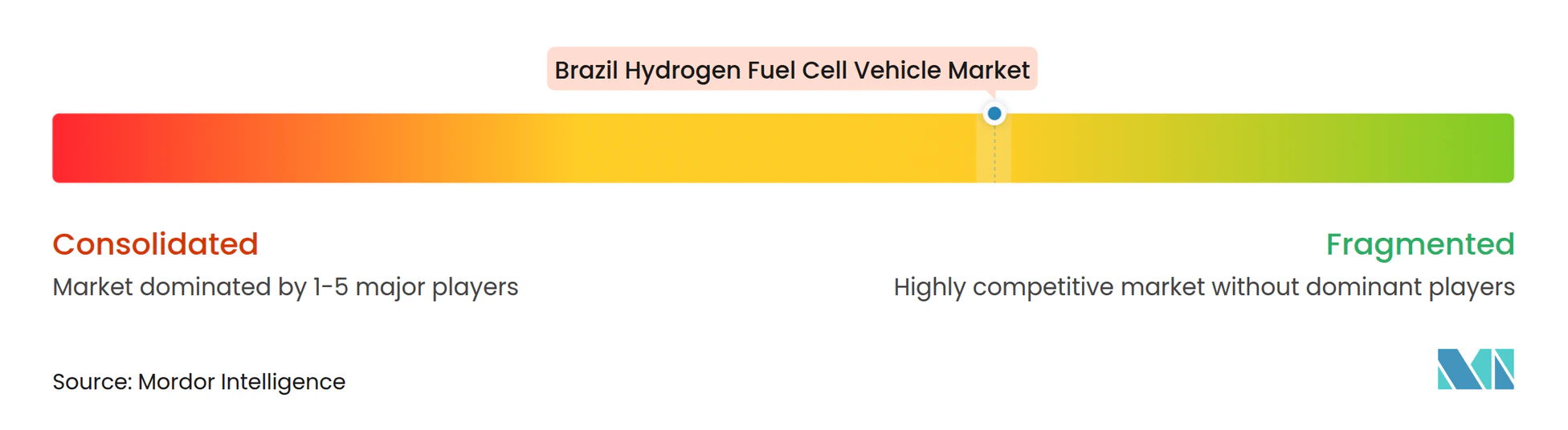
The Brazil hydrogen fuel cell vehicle market is moderately concentrated, with a limited number of companies conducting trials or pursuing commercial opportunities. GWM Hydrogen and FTXT hold early positions in the commercialization of hydrogen trucks. Their testing programs in São Paulo and Bahia are expected to generate operational data under local road and fueling conditions. GWM expects revenue from vehicle sales, components, and retrofit programs. Hyundai has committed USD 1.1 billion to Brazil through 2032, including hydrogen technologies. In March 2026, it announced eight XCIENT Fuel Cell trucks for timber logistics in Uruguay, its first fuel cell truck operation in South America.
Ballard supplies fuel cell modules for transit buses, while its agreement with New Flyer covers FCmove-HD+ fuel cell engines. Marcopolo supports local vehicle integration by manufacturing bus bodies. Neoenergia provides hydrogen supply and mobility demonstrations through its Brasília hydrogen project. Plug Power and GH2 Global focus on material-handling applications in logistics, manufacturing, and distribution facilities. No company has announced a complete local fuel cell stack manufacturing base in Brazil. Imported stacks and related components continue to constrain costs and supply within the local value chain.
Competition also depends on companies’ ability to generate operational data and meet emerging certification requirements. GWM has partnered with IPT for real-world hydrogen truck testing, while Hyundai is building fuel cell truck operating experience in Uruguay. Companies that meet hydrogen purity requirements for ethanol-derived fuel will be better positioned to qualify for projects. The developing certification framework favors companies already working with local researchers, fleet operators, and fuel providers. Although moderately concentrated, the Brazil hydrogen fuel cell vehicle market includes participants positioned across a developing supply chain.
Brazil Hydrogen Fuel Cell Vehicle Industry Leaders
-
Great Wall Motor Company Limited
-
Toyota Motor Corporation
-
Hyundai Motor Company
-
Ballard Power Systems Inc.
-
Marcopolo S.A.
- *Disclaimer: Major Players sorted in no particular order
Brazil Hydrogen Fuel Cell Vehicle Market Companies Covered in this Report
- Great Wall Motor Company Limited
- FTXT Energy Technology Co., Ltd.
- Toyota Motor Corporation
- Hyundai Motor Company
- Ballard Power Systems Inc.
- Marcopolo S.A.
- Mercedes-Benz do Brasil Ltda.
- AB Volvo
- Scania Latin America Ltda.
- Volkswagen Truck & Bus Indústria e Comércio de Veículos Ltda.
- Cummins Inc.
- Plug Power Inc.
- PowerCell Sweden AB
- Eletra Industrial Ltda.
Recent Industry Developments in Brazil Hydrogen Fuel Cell Vehicle Market
- August 2026: Brazil issued Decree No. 13,096 to regulate the low-carbon hydrogen framework, including Rehidro, the PHBC tax credits, and the Brazilian Hydrogen Certification System.
- July 2026: GWM’s 49-ton fuel cell truck completed its first green hydrogen refueling at the SENAI CIMATEC hydrogen center in Camaçari, Bahia, and began road tests.
- March 2026: Neoenergia, the Federal District government, and TEVX launched Brazil’s first commercial green hydrogen bus on Brasília’s Rota Monumental, fueled at Neoenergia’s Taguatinga station.
- March 2026: Brazil’s Ministry of Development, Industry, Trade and Services added hydrogen fuel cell vehicles and fuel cells to the MOVER program’s eligible technologies.
Brazil Hydrogen Fuel Cell Vehicle Market Report Scope
The Brazil hydrogen fuel cell vehicle market report is segmented by vehicle type (passenger cars, light commercial vehicles, medium-duty trucks, heavy-duty trucks, transit buses, coaches and intercity buses, and special-purpose and municipal vehicles), technology (proton-exchange-membrane fuel cell, solid-oxide fuel cell range extender, alkaline fuel cell, phosphoric acid fuel cell, and other fuel-cell technologies), driving range (short range (up to 400 km), medium range (400-800 km), and long range (above 800 km)), power output (less than 100 kW, 100-200 kW, and more than 200 kW), application (private transportation; public transportation; commercial freight and logistics; material handling; rail, maritime, and airport ground support; military and defense; and agriculture and off-road operations), end-user ownership (individual consumers, fleet operators, public transit authorities, government and defense organizations, and mining and industrial operators), and geography (Southeast Brazil, South Brazil, Northeast Brazil, North Brazil, and Central-West Brazil). The market forecasts are provided in terms of value (USD) and volume (units).
Segmentation Overview
| Passenger Cars |
| Light Commercial Vehicles |
| Medium-Duty Trucks |
| Heavy-Duty Trucks |
| Transit Buses |
| Coaches and Intercity Buses |
| Special-Purpose and Municipal Vehicles |
| Proton-Exchange-Membrane Fuel Cell |
| Solid-Oxide Fuel Cell Range Extender |
| Alkaline Fuel Cell |
| Phosphoric Acid Fuel Cell |
| Other Fuel-Cell Technologies |
| Short Range (Up to 400 km) |
| Medium Range (400-800 km) |
| Long Range (Above 800 km) |
| Less Than 100 kW |
| 100-200 kW |
| More Than 200 kW |
| Private Transportation |
| Public Transportation |
| Commercial Freight and Logistics |
| Material Handling |
| Rail, Maritime, and Airport Ground Support |
| Military and Defense |
| Agriculture and Off-Road Operations |
| Individual Consumers |
| Fleet Operators |
| Public Transit Authorities |
| Government and Defense Organizations |
| Mining and Industrial Operators |
| Southeast Brazil |
| South Brazil |
| Northeast Brazil |
| North Brazil |
| Central-West Brazil |
| By Vehicle Type | Passenger Cars |
| Light Commercial Vehicles | |
| Medium-Duty Trucks | |
| Heavy-Duty Trucks | |
| Transit Buses | |
| Coaches and Intercity Buses | |
| Special-Purpose and Municipal Vehicles | |
| By Technology | Proton-Exchange-Membrane Fuel Cell |
| Solid-Oxide Fuel Cell Range Extender | |
| Alkaline Fuel Cell | |
| Phosphoric Acid Fuel Cell | |
| Other Fuel-Cell Technologies | |
| By Driving Range | Short Range (Up to 400 km) |
| Medium Range (400-800 km) | |
| Long Range (Above 800 km) | |
| By Power Output | Less Than 100 kW |
| 100-200 kW | |
| More Than 200 kW | |
| By Application | Private Transportation |
| Public Transportation | |
| Commercial Freight and Logistics | |
| Material Handling | |
| Rail, Maritime, and Airport Ground Support | |
| Military and Defense | |
| Agriculture and Off-Road Operations | |
| By End-User Ownership | Individual Consumers |
| Fleet Operators | |
| Public Transit Authorities | |
| Government and Defense Organizations | |
| Mining and Industrial Operators | |
| By Geography | Southeast Brazil |
| South Brazil | |
| Northeast Brazil | |
| North Brazil | |
| Central-West Brazil |
Key Questions Answered in the Report
What is the forecast for fuel cell vehicles in Brazil?
The Brazil hydrogen fuel cell vehicle market size is forecast to reach USD 67.41 million by 2032 from USD 4.49 million in 2027, at a 71.91% CAGR.
Which vehicle type has the strongest current position in Brazil?
Transit buses held 44.60% of the market share in 2026, reflecting the role of public transit procurement in early deployment.
Why is ethanol relevant for hydrogen mobility in Brazil?
Ethanol can be reformed into renewable hydrogen through an established domestic supply chain, and USP’s pilot has demonstrated this pathway.
Which fuel cell technology leads vehicle deployment?
Proton-exchange-membrane fuel cells held 96.50% of the market share in 2026 because their design and operating characteristics suit vehicles.
Which users are likely to adopt fuel cell vehicles first?
Public transit authorities led demand in 2026, while fleet operators on predictable high-use routes are forecast to grow the fastest.