
Brazil Healthcare Logistics Market Size and Share
Market Overview
| Study Period | 2021 - 2032 |
|---|---|
| Forecast Data Period | 2027 - 2032 |
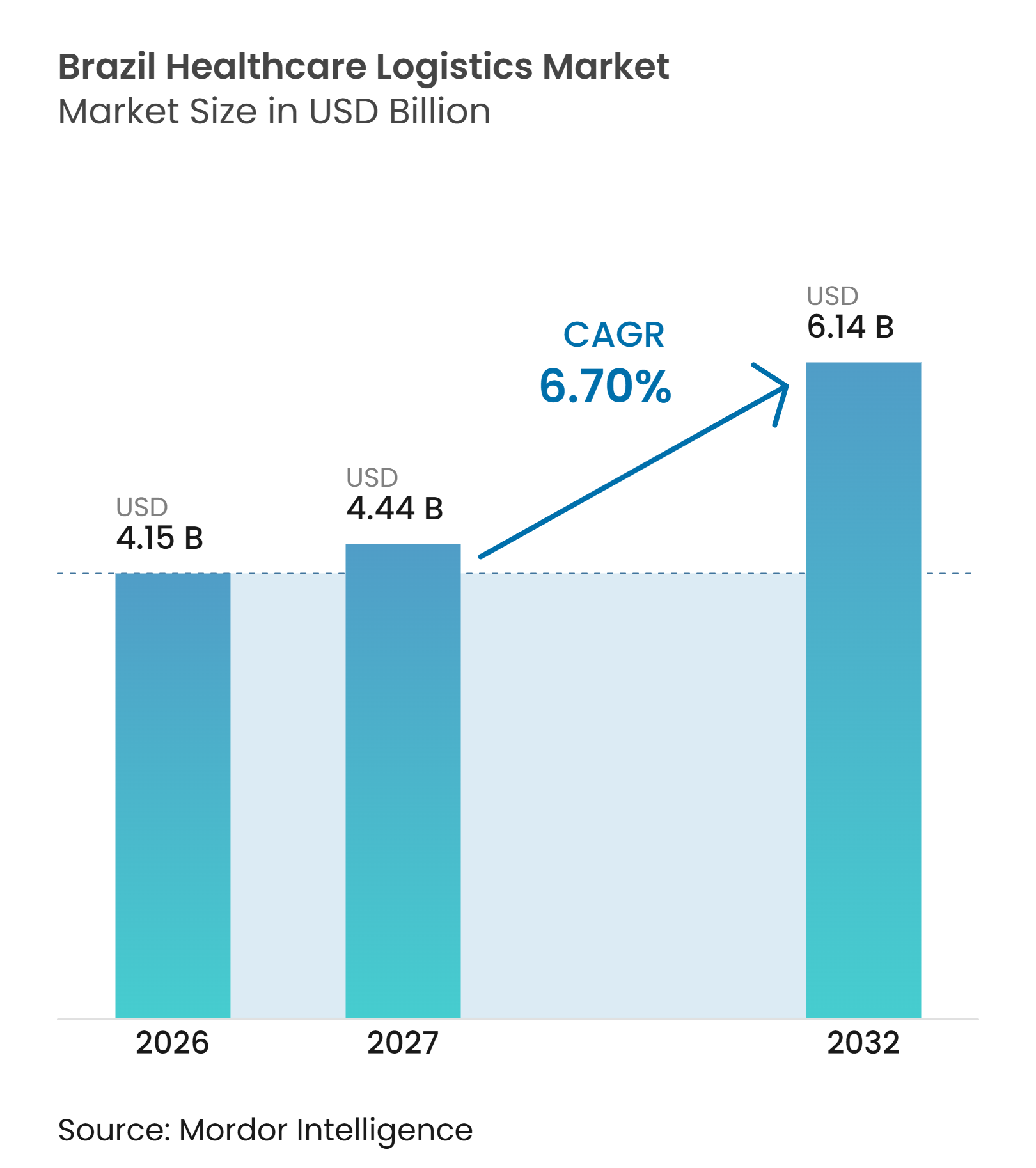
| Base Year Market Size (2026) | USD 4.15 Billion |
| Market Size (2027) | USD 4.44 Billion |
| Market Size (2032) | USD 6.14 Billion |
| Growth Rate (2027 - 2032) | 6.70 % |
| Market Concentration | Low |
Major Players *Disclaimer: Major Players sorted in no particular order Image © Mordor Intelligence. Reuse requires attribution under CC BY 4.0. | |
Brazil Healthcare Logistics Market Analysis by Mordor Intelligence
The Brazil healthcare logistics market size is valued at USD 4.15 billion in 2026. It is estimated to grow from USD 4.44 billion in 2027 to reach USD 6.14 billion by 2032, at a CAGR of 6.70% during the forecast period from 2027 to 2032.
The Brazil healthcare logistics market is supported by a healthcare system that needs dependable distribution across a large and unevenly connected country. Higher demand for biologics, biosimilars, oncology medicines, vaccines, and specialty treatments is shifting investment toward validated transport, multi-temperature storage, and traceable handling. ANVISA’s Good Distribution, Storage, and Transport Practices raise the importance of documented temperature control and qualified logistics lanes, which favors providers with healthcare-specific capabilities. The Brazil healthcare logistics market also faces a difficult cost base because road networks carry most domestic flows, security needs remain high, and remote routes require multiple transport modes. These conditions create opportunities for operators that can link compliant warehousing, transport, monitoring, and delivery under one service model.
Key Report Takeaways
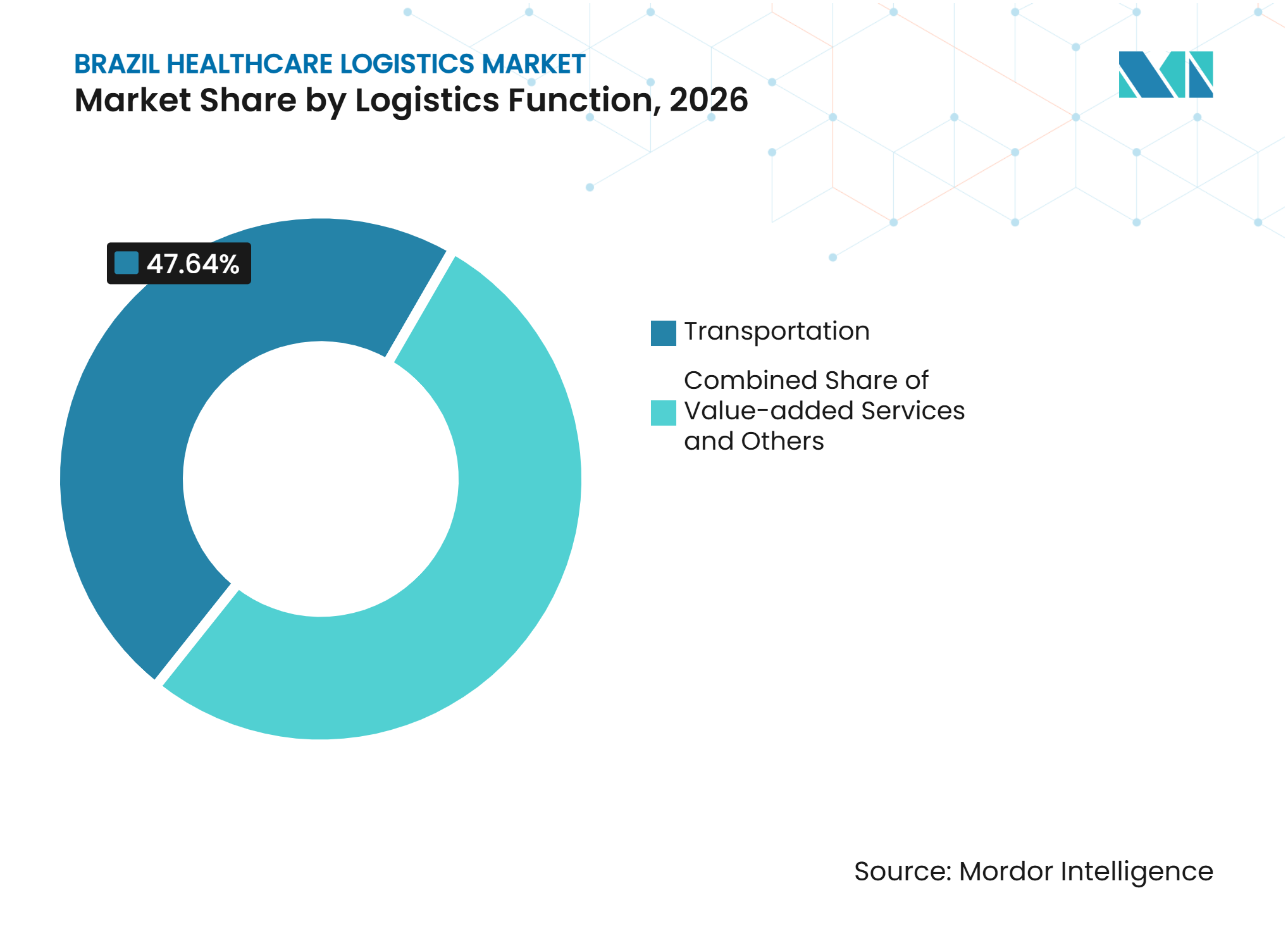
- By logistics function, transportation accounts for 47.64% of the Brazil healthcare logistics market share in 2026, while value-added services and others are forecast to expand at a 7.42% CAGR through 2032.
- By temperature type, non-temperature-controlled logistics accounts for 65.83% of the Brazil healthcare logistics market size in 2026, while temperature-controlled logistics is forecast to expand at an 8.12% CAGR through 2032.
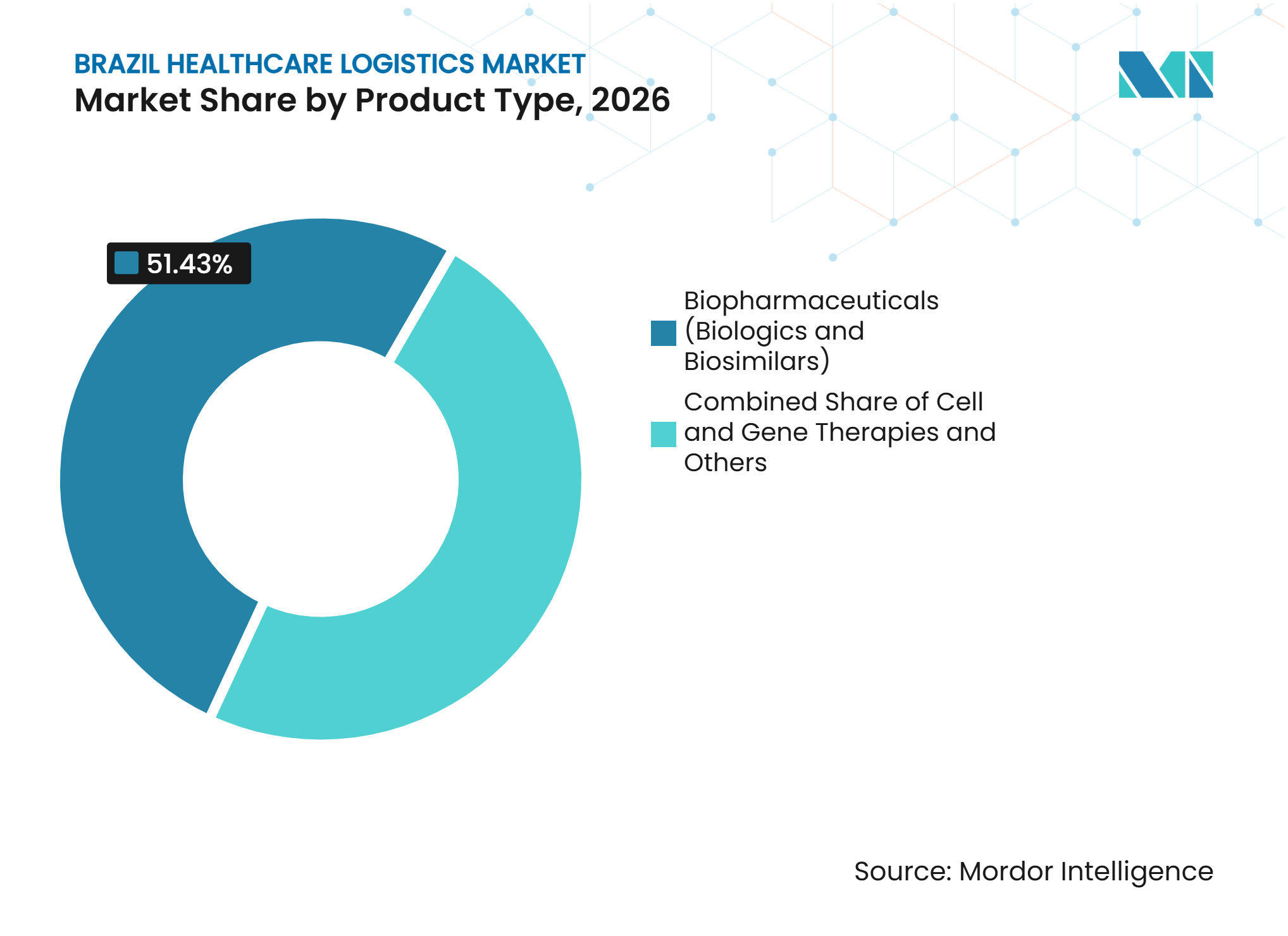
- By product type, biopharmaceuticals account for 51.43% of the Brazil healthcare logistics market share in 2026, while cell and gene therapies are forecast to expand at a 7.64% CAGR through 2032.
- By destination, domestic logistics accounts for 72.34% of the Brazil healthcare logistics market size in 2026, while international logistics is forecast to expand at a 7.12% CAGR through 2032.
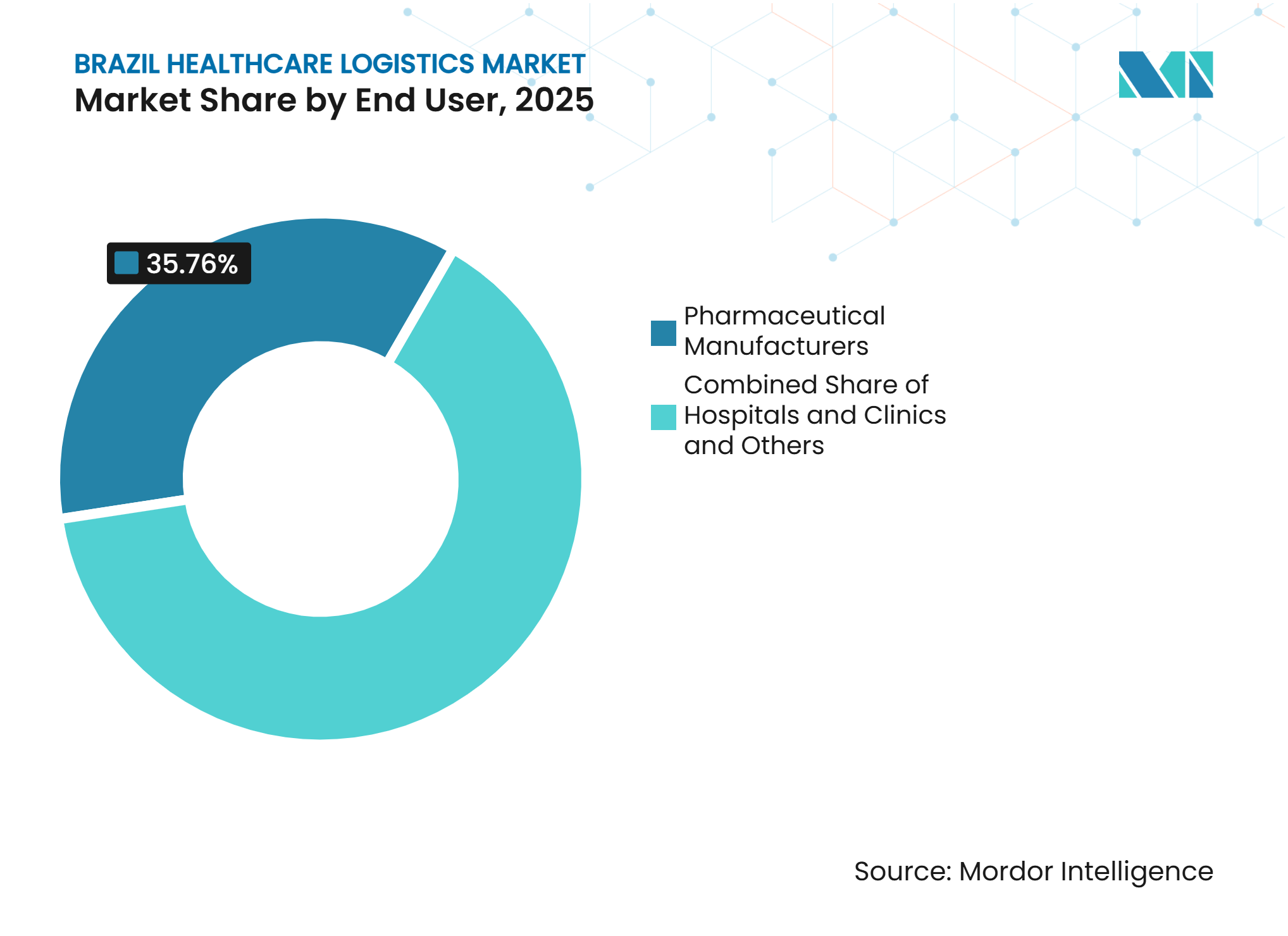
- By end user, pharmaceutical manufacturers account for 35.76% of the Brazil healthcare logistics market share in 2026, while hospitals and clinics are forecast to expand at a 7.23% CAGR through 2032.
- By geography, the Southeast accounts for 55.63% of the Brazil healthcare logistics market share in 2026, while the North is forecast to expand at a 7.92% CAGR through 2032.
Note: Market size and forecast figures in this report are generated using Mordor Intelligence’s proprietary estimation framework, updated with the latest available data and insights as of January 2026.
Market Trends and Insights
Drivers Impact Analysis of Brazil Healthcare Logistics Market*
| Driver | (~) % Impact on CAGR Forecast | Geographic Relevance | Impact Timeline |
|---|---|---|---|
| Biopharma Growth Expanding Specialized Healthcare Logistics Demand | +1.8% | Southeast and Central-West, with spill-over to the South | Medium term (2-4 years) |
| Temperature-Sensitive Therapies Increasing Cold-Chain Distribution Requirements | +1.4% | National, with highest intensity in Southeast and South hubs | Short term (≤ 2 years) |
| Logistics Outsourcing Increasing Specialist Provider Adoption | +0.9% | National, with early gains in the São Paulo metropolitan region | Medium term (2-4 years) |
| Medical Device Growth Expanding Healthcare Distribution Volumes | +0.7% | Southeast and South, with growing demand from Northeast public procurement | Short term (≤ 2 years) |
| Regional Fulfillment Improving Interior Healthcare Delivery Coverage | +0.5% | North and Northeast, with the Central-West as a secondary area | Long term (≥ 4 years) |
| Advanced Therapies Increasing Ultra-Specialized Logistics Requirements | +0.6% | Southeast, particularly São Paulo, with emerging demand in Rio de Janeiro | Long term (≥ 4 years) |
| Source: Mordor Intelligence | |||
Biopharma Growth Expanding Specialized Healthcare Logistics Demand
Biopharmaceutical growth is moving the Brazil healthcare logistics market toward facilities and transport systems built for controlled conditions. Biologics, biosimilars, monoclonal antibodies, and blood-derived products need stable handling conditions to protect their quality during storage and movement. Dependence on imported active ingredients can also increase buffer-stock needs and support the use of multi-temperature storage by manufacturers and their logistics partners. The CEIS policy framework encourages domestic production, which can deepen the need for compliant distribution within Brazil rather than simply shifting activity toward import handling.
Temperature-Sensitive Therapies Increasing Cold-Chain Distribution Requirements
Temperature-sensitive therapies are increasing the need for precision across the Brazil healthcare logistics market. Demand is rising for chilled handling of GLP-1 medicines, oncology treatments, vaccines, and other thermolabile products. The highest risk often occurs during handovers between warehouses, airport ramps, loading bays, and vehicles, where a documented process is as important as refrigeration equipment. ANVISA’s requirements for regulated medicines mean that each route must be qualified before operators can use it for temperature-sensitive products. This process slows the release of new routes but gives established healthcare operators an advantage because they already have validated networks. The result is a greater focus on lane-specific records, monitoring, and response procedures throughout the Brazil healthcare logistics market.
Logistics Outsourcing Increasing Specialist Provider Adoption
Outsourcing is increasing demand for specialist providers in the Brazil healthcare logistics market. Manufacturers are moving from owned fleets toward logistics partners that can operate GDP-aligned facilities and transport networks. Sanofi Medley’s arrangement involving two distribution centers in Extrema and Guarulhos processes 49 million medicine units each month, showing the scale of long-term outsourced operations in the country. Tax structures can affect warehouse location decisions even when a location adds transport distance, which makes multi-state coverage valuable. Providers that understand both ANVISA requirements and state-level fiscal rules can address these operational tradeoffs more effectively. This supports contracts that combine warehouse management, transport, compliance documentation, and national distribution.
Medical Device Growth Expanding Healthcare Distribution Volumes
Medical device demand is adding volume and service complexity to the Brazil healthcare logistics market. ABIIS reported that medical device consumption reached USD 15.5 billion in 2025 and grew 7% from the previous year[1]. These products often require quick replenishment of field-service parts for hospitals and clinics. DHL Supply Chain began managing nationwide transport and inventory for GE HealthCare’s critical components in Brazil in February 2026, with operations based in Barueri and Extrema. The activity processes 5,000 invoices each month and supports deliveries to hospitals and clinics, mainly within 24 hours in the Southeast and South. This type of contract requires transport reliability, inventory visibility, and delivery processes aligned with hospital operations.
Restraints Impact Analysis of Brazil Healthcare Logistics Market*
| Restraint | (~) % Impact on CAGR Forecast | Geographic Relevance | Impact Timeline |
|---|---|---|---|
| Compliance Requirements Increasing Qualification and Validation Costs | -0.6% | National, with the highest burden in multi-state distribution | Short term (≤ 2 years) |
| Cold-Chain Operations Increasing Healthcare Logistics Costs | -0.7% | National, with the greatest pressure on North and Northeast corridors | Medium term (2-4 years) |
| Road Variability Reducing Delivery-Time Reliability | -0.5% | North, Northeast, and Central-West remote municipalities | Long term (≥ 4 years) |
| Ultra-Low-Temperature Capacity Shortages Limiting Specialized Distribution | -0.4% | Outside the Southeast, including secondary cities with emerging treatment centers | Long term (≥ 4 years) |
| Source: Mordor Intelligence | |||
Compliance Requirements Increasing Qualification and Validation Costs
Compliance requirements raise the fixed cost of participation in the Brazil healthcare logistics market. Operators must qualify distribution hubs, vehicles, and transport lanes before carrying regulated pharmaceutical products. That work includes temperature mapping, stability work, risk controls, and records that regulators can review. The cost is especially difficult for lower-volume routes because qualification expenses do not fall in line with shipment volume. Expansion into the North and Northeast can therefore pressure margins even when those regions offer long-term demand. Sindusfarma has discussed potential compliance adjustments with ANVISA while maintaining technical standards, although the timing of any change remains uncertain.
Cold-Chain Operations Increasing Healthcare Logistics Costs
Cold-chain operations carry a higher cost than ambient distribution in the Brazil healthcare logistics market. Long routes, variable climates, high-value cargo, and security controls all add to operating requirements. Security expenditure rose by 20% to 60% for most pharmaceutical distributors in 2025[2]. Providers may split valuable loads across several vehicles to limit the loss on any one truck, which raises transport expense. Remote refrigerated routes can also require passive packaging and air transport when regular road economics do not work. These factors limit price flexibility, especially on routes where demand is still developing.
*Our forecasts treat driver/restraint impacts as directional, not additive. The impact forecasts reflect baseline growth, mix effects, and variable interactions.
Brazil Healthcare Logistics Market Segment Analysis
By Logistics Function:
Transportation Leads While Value-Added Services Grow FasterTransportation accounts for 47.64% of the Brazil healthcare logistics market share in 2026, reflecting the central role of freight movement in pharmaceutical distribution. Trucks carry ambient medicines and chilled products to major population centers, while air cargo is more important for time-critical products moving to distant regions. This makes transportation the largest operating component of the Brazil healthcare logistics industry. Providers must manage security, route qualification, proof of delivery, and temperature records as part of their core service. The same route can require different controls depending on the product, service level, and destination.
Value-added services and others are forecast to register a 7.42% CAGR through 2032, the fastest rate within logistics functions. Serialization, regulatory relabeling, reverse logistics, and clinical trial supply support this expansion. Brazil’s serialization requirement makes packaging and labeling a regulated service rather than a basic warehouse task. DHL Supply Chain’s Bristol Myers Squibb operation in Extrema includes regulated carimbage, imported medicine reception, storage across 2 °C to 25 °C, and distribution to hospitals and specialty distributors.



By Temperature Type:
Controlled Logistics Gains Value Despite Ambient VolumeNon-temperature-controlled logistics accounts for 65.83% of the Brazil healthcare logistics market size in 2026, supported by conventional small-molecule medicines, over-the-counter products, and ambient medical devices. This share shows that ambient distribution remains the largest volume base in the Brazil healthcare logistics market. Its revenue per shipment is generally lower than that of controlled services, and regional carriers compete strongly for standard deliveries. The segment remains necessary for broad pharmacy, distributor, and institutional coverage. It also supports routine replenishment where products do not require refrigeration. Operators serving this segment still need dependable handling, secure transport, and accurate delivery records.
Temperature-controlled logistics is forecast to register an 8.12% CAGR through 2032, the highest rate among the reported segments. Chilled handling is the primary volume category, while deep-frozen and ultra-low-temperature handling grows as cell and gene therapies and mRNA products enter the country. The Brazil healthcare logistics market size for this segment is shaped by a concentration of capacity in the South and Southeast, which leaves gaps elsewhere. Active-container solutions and route monitoring are becoming more important for international and domestic transfers.
By Product Type:
Biopharmaceuticals Set the Current Base and Advanced Therapies Add ComplexityBiopharmaceuticals account for 51.43% of the Brazil healthcare logistics market size in 2026, making them the largest product group in the Brazil healthcare logistics market. Public procurement through SUS and the increasing use of biosimilars in oncology and autoimmune care support this position. Biopharmaceutical handling requires controlled storage and transport, which has encouraged wider use of multi-temperature warehouse designs. Facilities serving biosimilars often need chilled and controlled-ambient zones at the same location. The combination of these requirements makes biopharmaceutical logistics less interchangeable with general freight. It also raises the value of validated processes that preserve product quality through each handover.
Cell and gene therapies are forecast to register a 7.64% CAGR through 2032, the fastest rate by product type. These treatments require patient-specific chain-of-identity controls, deep-frozen or cryogenic transport, and narrow delivery windows. Vaccines, clinical trial materials, medical devices, veterinary products, blood and plasma, and diagnostics each add separate handling requirements. The National Immunization Program requires ongoing cold-chain coverage across municipalities, while hospital device networks need fast parts availability. These product groups widen the service range expected from the Brazil healthcare logistics industry.

By Destination:
Domestic Coverage Remains Larger While International Lanes ExpandDomestic logistics accounts for 72.34% of the Brazil healthcare logistics market size in 2026 because Brazil’s healthcare supply chain depends on moving products across a large internal geography. This is the largest destination segment in the Brazil healthcare logistics market. Abradimex reported pharmaceutical distribution coverage across all municipalities in the South, 99% in the Southeast, 93% in the Central-West, 67% in the Northeast, and 63% in the North[3]. The differences in coverage show where distribution capacity remains limited. They also show why domestic networks need more than a single national route plan. Operators must adapt to local transport conditions, demand density, and the availability of compliant handover points.
International logistics is forecast to expand at a 7.12% CAGR through 2032. Imported biologics and medical devices require qualified international freight, while pharmaceutical exports need credible cold-chain capacity at airport gateways. The Brazil healthcare logistics market has a growing need for lanes that preserve shipment conditions between overseas origin points and local treatment sites. UPS opened an automated processing center at Viracopos Airport in November 2025 with dedicated regulated areas and expanded temperature-control capacity for pharmaceutical and vaccine handling. International handling must link airport procedures, customs documentation, storage, and domestic distribution without losing temperature records. These requirements increase the importance of certified airport infrastructure and experienced healthcare freight operators.
By End User:
Manufacturers Lead While Hospitals and Clinics Gain MomentumPharmaceutical manufacturers account for 35.76% of the Brazil healthcare logistics market size in 2026, the largest end-user share. This reflects the upstream role of contract logistics in the Brazil healthcare logistics market. Manufacturers manage primary distribution to wholesalers, institutions, pharmacies, and other channels. They also require storage, transport, quality documentation, and sometimes labeling or returns management. These activities create a broad outsourcing opportunity for providers that can meet pharmaceutical quality requirements. Manufacturing clusters in São Paulo, Minas Gerais, and Goiás further support demand for specialized logistics capacity.
Hospitals and clinics are forecast to register a 7.23% CAGR through 2032, the fastest end-user rate. Hospital groups are increasing procurement volumes and using more specialty therapies that need direct cold-chain delivery. This changes the delivery model because hospitals need temperature-monitored receiving areas, GDP-aligned protocols, and delivery windows that support clinical use. The Brazil healthcare logistics market must therefore serve hospital receiving operations rather than only central pharmacy depots. Retail pharmacies and distributors remain important users, while healthcare providers increasingly expect faster replenishment and better product visibility.
Geography Analysis
The Southeast accounts for 55.63% of the Brazil healthcare logistics market size in 2026, giving it the largest regional share. São Paulo concentrates pharmaceutical manufacturing, GDP-aligned third-party logistics campuses, and major air gateways for high-value imports. Viracopos renewed its CEIV Pharma certification through December 2028, while Guarulhos remains the principal air entry point for imported biologics. Extrema benefits from its location between São Paulo and Belo Horizonte and has attracted integrated operations for Bristol Myers Squibb and GE HealthCare. ANVISA compliance and IATA CEIV Pharma practices reinforce the value of validated facilities and documented handovers across a connected manufacturing, storage, airport, and clinical network.
The North is forecast to register a 7.92% CAGR through 2032, the fastest regional rate. The region has historically faced long delivery times because routes often combine road, river, and air transport for temperature-sensitive products. Braspress Air Cargo’s Campinas to Manaus service reduced eligible shipment lead times from as long as 15 days to between 36 hours and 4 days. Each transfer creates a possible temperature-control failure point, while demand from SUS programs and regional biologic use is raising the need for validated cold-chain capacity. The opportunity depends on air capacity, river services, secure storage, and procedures designed for local conditions rather than a simple extension of Southeast networks.
The Central-West is an important emerging node because Goiás hosts the Anápolis pharmaceutical cluster and its related distribution activity. Motiva Aeroportos’ refrigerated terminal at Goiânia provides pharmaceutical air cargo capacity that links an interior manufacturing area with qualified handling. The Northeast has pharmaceutical distribution reaching 67% of municipalities, while the South has complete reported coverage and is extending its cold-storage base.
Competitive Landscape
Market Concentration
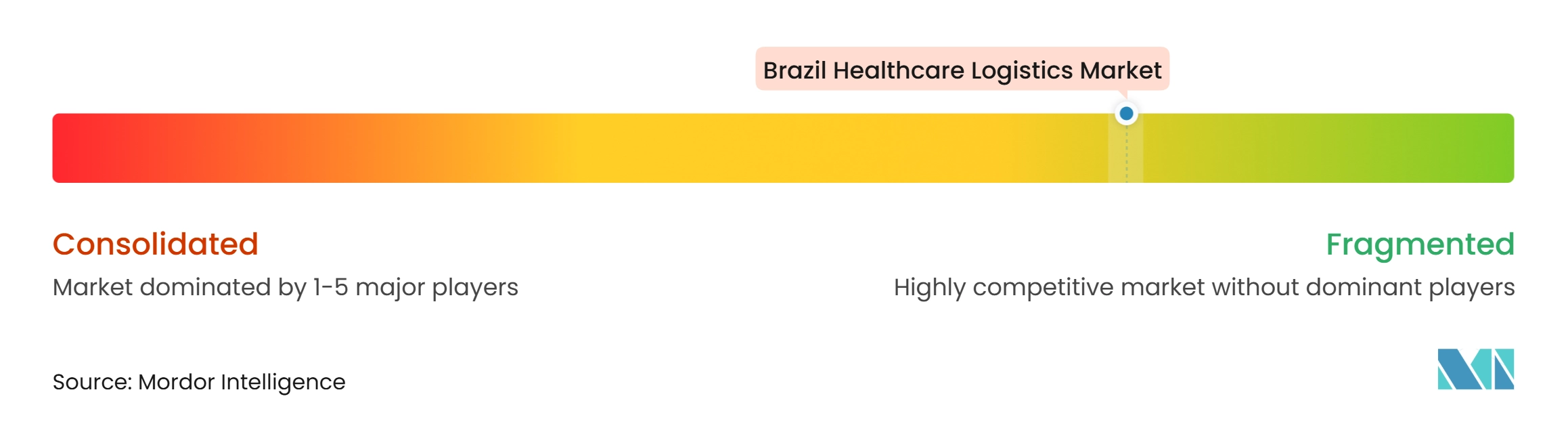
The Brazil healthcare logistics market is fragmented. Global providers, including DHL Group, Kuehne+Nagel, UPS Healthcare, DSV, CEVA Logistics, and FedEx, compete alongside domestic specialists such as Luft Logistics, Andreani Logística, and F&F Logística de Medicamentos. Competition is strongest in pharmaceutical distribution, healthcare freight forwarding, and temperature-controlled storage. Market concentration is higher in controlled air freight and GDP-compliant warehousing because qualified lanes and healthcare-specific infrastructure require investment. The Brazil healthcare logistics market favors operators with established quality systems, temperature expertise, and access to key airport and warehouse hubs.
DHL Supply Chain expanded its Bristol Myers Squibb operation in Extrema to include imported medicine reception, controlled storage, carimbage, and national distribution[4]. UPS Healthcare added its Premier Gold service in Brazil with priority handling and continuous monitoring for critical shipments. These moves show that leading firms are strengthening specialized capabilities rather than competing only on standard transport capacity. Technology-enabled visibility, nationwide coverage, and integrated services can help providers address pharmaceutical customer needs under a single contract.
A major gap remains in ultra-low-temperature distribution outside São Paulo and Rio de Janeiro. The gap is relevant for cell and gene therapies, where handling must protect patient identity and clinical viability. The Brazil healthcare logistics market also needs validated processes that link clinical trial material and commercial products. Competitive activity is likely to remain focused on controlled storage, digital records, hospital delivery capability, and qualified access to regions outside the Southeast.
Brazil Healthcare Logistics Industry Leaders
-
Luft Logistics
-
Ativa Logística
-
RV Ímola Transportes e Logística
-
DHL Group
-
CEVA Logistics (CMA CGM Group)
- *Disclaimer: Major Players sorted in no particular order
Brazil Healthcare Logistics Market Companies Covered in this Report
- DHL Group
- Luft Logistics
- Ativa Logística
- CEVA Logistics (CMA CGM Group)
- DSV AS
- Kuehne+Nagel International AG
- United Parcel Service Inc. (UPS Healthcare)
- Cencora Inc. (World Courier)
- JSL SA
- Penske Logistics LLC
- ID Logistics Group
- Andreani Logística
- Rhenus Logistics
- FedEx Corp.
- Mundial Logistics Group
- RV Ímola Transportes e Logística
- BBM Logística SA
- FM Logistic
- Braspress Transportes Urgentes
- F&F Logística de Medicamentos
- Buick Logística
- SIGA Logística Integrada
Recent Industry Developments in Brazil Healthcare Logistics Market
- October 2026: Andreani Logística and Sandoz expanded their cold-chain partnership, adding 1,000 pallet positions of refrigerated storage capacity to Andreani’s multi-client operation in Brazil.
- September 2026: FedEx announced plans to invest more than USD 15 million in Brazil through a program covering 34 facilities, expanding its international transportation and supply chain infrastructure.
- July 2026: FedEx launched FedEx Life Sciences, a global organization focused on specialized logistics for pharmaceuticals, biologics, medical devices, and clinical trial materials.
- March 2026: Peli BioThermal partnered with Polar Group to expand the availability of reusable and single-use temperature-controlled packaging solutions for Brazil's pharmaceutical and healthcare sectors.
Brazil Healthcare Logistics Market Report Scope
Segmentation Overview
| Transportation | Road |
| Air | |
| Sea and Inland Waterways | |
| Rail | |
| Warehousing and Distribution | |
| Value-added Services and Others |
| Temperature Controlled | Chilled (0-5 °C) |
| Frozen (-20-0 °C) | |
| Ambient | |
| Deep-Frozen / Ultra-Low (less than-20 °C) | |
| Non-Temperature Controlled |
| Pharmaceuticals | Prescription and Specialty Drugs |
| OTC Drugs | |
| Biopharmaceuticals (Biologics and Biosimilars) | |
| Vaccines | |
| Clinical Trial Materials | |
| Cell and Gene Therapies | |
| Medical Devices | |
| Veterinary Medicine | |
| Blood, Plasma and Blood Components | |
| Diagnostic and Laboratory Products | |
| Organs and Human Tissues | |
| Others |
| Domestic |
| International |
| Pharmaceutical Manufacturers |
| Biopharmaceutical Manufacturers |
| Hospitals and Clinics |
| Pharmacies (Hospital/Institutional and Retail) |
| Healthcare Distributors and Wholesalers |
| Others |
| North |
| Northeast |
| Central-West |
| Southeast |
| South |
| By Logistics Function | Transportation | Road |
| Air | ||
| Sea and Inland Waterways | ||
| Rail | ||
| Warehousing and Distribution | ||
| Value-added Services and Others | ||
| By Temperature Type | Temperature Controlled | Chilled (0-5 °C) |
| Frozen (-20-0 °C) | ||
| Ambient | ||
| Deep-Frozen / Ultra-Low (less than-20 °C) | ||
| Non-Temperature Controlled | ||
| By Product Type | Pharmaceuticals | Prescription and Specialty Drugs |
| OTC Drugs | ||
| Biopharmaceuticals (Biologics and Biosimilars) | ||
| Vaccines | ||
| Clinical Trial Materials | ||
| Cell and Gene Therapies | ||
| Medical Devices | ||
| Veterinary Medicine | ||
| Blood, Plasma and Blood Components | ||
| Diagnostic and Laboratory Products | ||
| Organs and Human Tissues | ||
| Others | ||
| By Destination | Domestic | |
| International | ||
| By End User | Pharmaceutical Manufacturers | |
| Biopharmaceutical Manufacturers | ||
| Hospitals and Clinics | ||
| Pharmacies (Hospital/Institutional and Retail) | ||
| Healthcare Distributors and Wholesalers | ||
| Others | ||
| By Region | North | |
| Northeast | ||
| Central-West | ||
| Southeast | ||
| South | ||
Key Questions Answered in the Report
What is the projected value of Brazil healthcare logistics by 2032?
The sector is projected to reach USD 6.14 billion by 2032, rising from USD 4.44 billion in 2027 at a 6.70% CAGR. The forecast reflects higher demand for compliant transport, multi-temperature storage, and monitored delivery services.
Which logistics function has the largest share in Brazil?
Transportation leads with a 47.64% share in 2026 because road freight remains central to medicine distribution.
Why is cold-chain capacity important for healthcare distribution in Brazil?
Biologics, vaccines, oncology medicines, and advanced therapies require validated conditions during storage and transport.
Which product category leads healthcare logistics demand in Brazil?
Biopharmaceuticals lead with a 51.43% share in 2026, supported by biologics and biosimilars.
Which region is growing fastest for healthcare logistics services?
The North region is projected to register a 7.92% CAGR through 2032 as air and multimodal networks improve access. Its progress depends on dependable handovers across road, river, air, storage, and final delivery operations.
What are the main operational challenges for healthcare logistics providers?
Compliance qualification, cold-chain costs, security needs, and uneven transport infrastructure remain the primary challenges. These factors are more difficult on lower-volume routes and in locations outside the Southeast.