
Brazil Full Truckload (FTL) Market Size and Share
Market Overview
| Study Period | 2021 - 2032 |
|---|---|
| Forecast Data Period | 2027 - 2032 |
| Base Year Market Size (2026) | USD 36.81 Billion |
| Market Size (2027) | USD 38.52 Billion |
| Market Size (2032) | USD 47.77 Billion |
| Growth Rate (2027 - 2032) | 4.40 % |
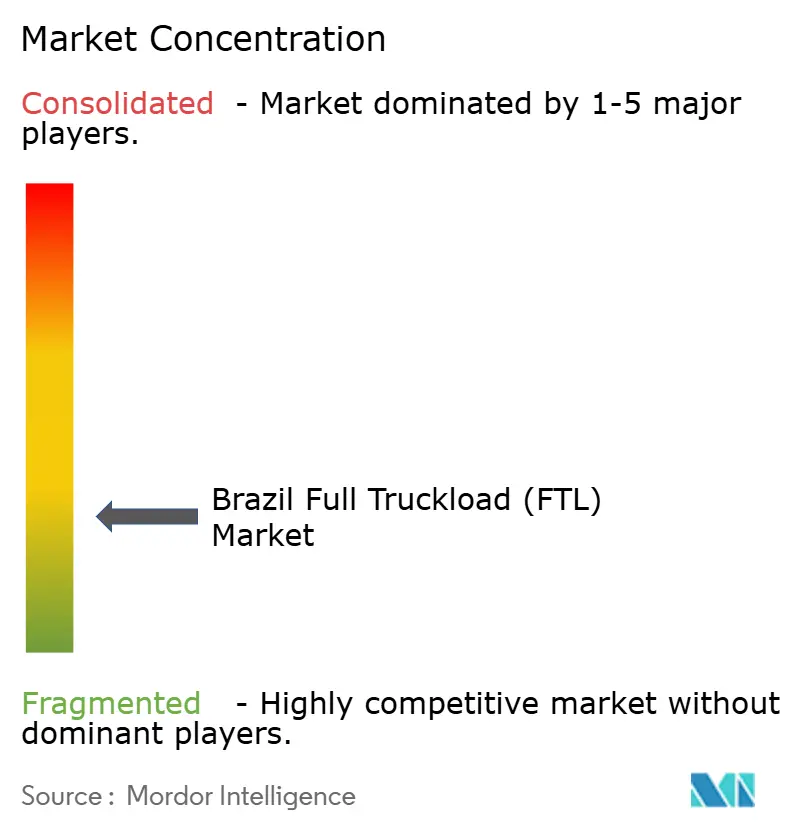
| Market Concentration | Low |
Major Players *Disclaimer: Major Players sorted in no particular order Image © Mordor Intelligence. Reuse requires attribution under CC BY 4.0. | |
Brazil Full Truckload (FTL) Market Analysis by Mordor Intelligence
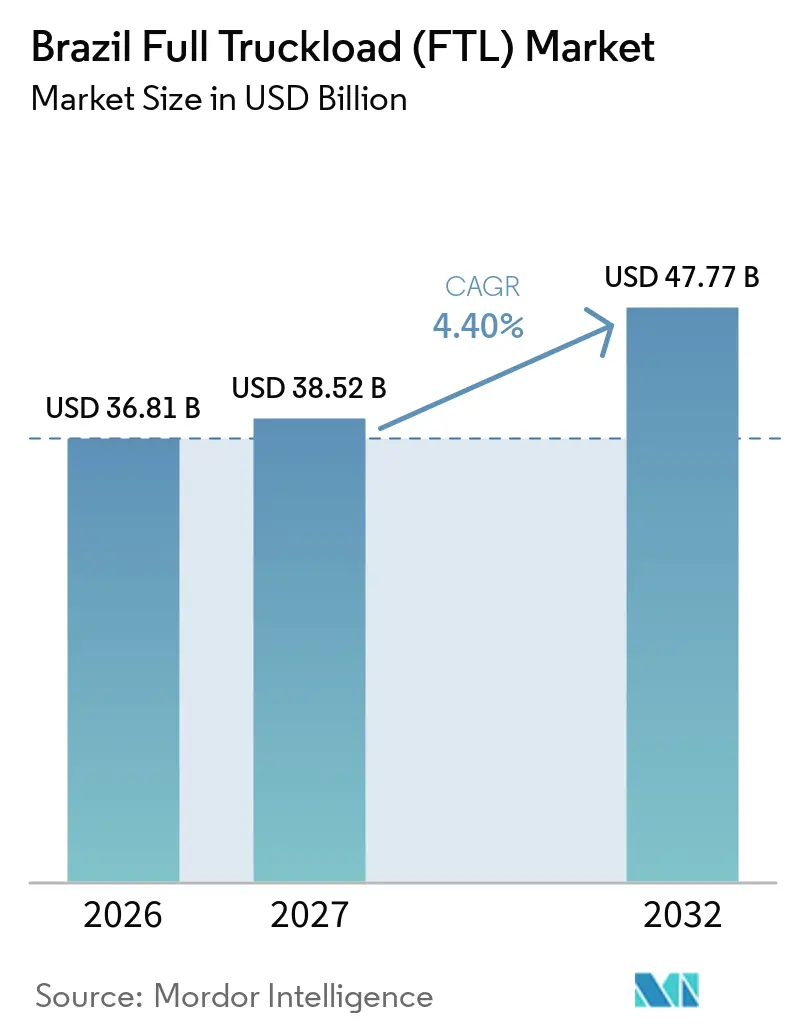
The Brazil full truckload (FTL) market size is valued at USD 36.81 billion in 2026 and is estimated to grow from USD 38.52 billion in 2027 to reach USD 47.77 billion by 2032, at a CAGR of 4.40% during the forecast period from 2027 to 2032.
The Brazil full truckload (FTL) market relies on road transport as the main link between production centers, industrial clusters, consumer markets, and ports. Agricultural shipments, manufacturing output, and retail replenishment are the main sources of demand for dedicated truck capacity. Digital commerce is raising the frequency of palletized shipments into fulfillment centers, while agricultural exports continue to create large seasonal requirements on long-distance corridors. Large operators are seeking dedicated contracts and integrated visibility tools, while platforms help smaller carriers find return loads. Fuel costs, limited road quality, and driver availability remain material constraints on the Brazil full truckload (FTL) market.
Key Report Takeaways
- By destination, domestic freight accounts for 62.34% of the Brazil full truckload (FTL) market share in 2026, while international freight is forecast to expand at a 6.36% CAGR through 2032.
- By temperature control, dry van accounts for 86.71% of the Brazil full truckload (FTL) market size in 2026, while reefer freight is forecast to expand at a 7.83% CAGR through 2032.
- By haul length, long-haul accounts for 55.63% of the Brazil full truckload (FTL) market share in 2026, while local haul is forecast to expand at a 6.97% CAGR through 2032.
- By end-user industry, manufacturing accounts for 41.36% of the Brazil full truckload (FTL) market size in 2026, while wholesale and retail trade is forecast to expand at a 5.23% CAGR through 2032.
- By geography, Southeast accounts for 48.16% of the Brazil full truckload (FTL) market share in 2026, while Northeast is forecast to expand at a 5.36% CAGR through 2032.
Note: Market numbers in this report are based on Mordor Intelligence's proprietary estimation framework, which combines nine months of actuals with Q4 projections for base year 2026.
Market Trends and Insights
Drivers Impact Analysis of Brazil Full Truckload (FTL) Market*
| Driver | (~) % Impact on CAGR Forecast | Geographic Relevance | Impact Timeline |
|---|---|---|---|
| Agricultural Exports Expanding Long-Haul Demand | +1.1% | Central-West, South, Southeast, North | Short term (≤ 2 years) |
| Industrial Growth Increasing Freight Volumes | +0.9% | Southeast, South | Medium term (2-4 years) |
| E-Commerce Expansion Strengthening Distribution Density | +0.8% | Southeast, Northeast, Central-West | Short term (≤ 2 years) |
| Highway Concessions Improving Corridor Reliability | +0.5% | National, especially South and Northeast | Long term (≥ 4 years) |
| Digital Platforms Reducing Empty-Kilometer Operations | +0.3% | National | Medium term (2-4 years) |
| Cold-Chain Compliance Increasing Specialized Demand | +0.2% | Southeast, South, Northeast | Medium term (2-4 years) |
| Source: Mordor Intelligence | |||
Agricultural Exports Expanding Long-Haul FTL Demand
Brazil produced 171.5 million metric tons of soybeans in 2025, while exports reached 108.2 million metric tons, increasing pressure on inland truck capacity. The Brazil full truckload (FTL) market moves large volumes from the Central-West toward coastal export terminals, particularly during harvest periods. USDA reported that road transport carried 60% of soybean production and 58% of corn output in 2025, equating to 98 million tons and 82 million tons, respectively[1]. The Mato Grosso to Santos route can extend from 1,500 km to 2,000 km, making reliable truck capacity essential to the export chain. High seasonal volumes give carriers on these routes greater leverage when harvest demand peaks. Agricultural growth also increases the need for return-load matching because export corridors often have imbalanced freight flows.
Industrial Growth Increasing Full-Truckload Freight Volumes
Manufacturing accounts for 41.36% of FTL end-user demand in 2026, making it the largest user group in the Brazil full truckload (FTL) market. Automotive production, consumer goods, and industrial components create recurring flows between factories, suppliers, ports, and distribution sites. ANTT recorded a monthly peak of 8.35 million road freight trips in September 2025, with manufacturing ranking behind agribusiness among the major freight categories. BYD’s Camaçari operation in Bahia added inbound and outbound logistics requirements that Tegma began handling as a separate logistics activity in 2026. Longer contracts favor providers that can commit equipment, drivers, service controls, and predictable arrival windows. JSL reported an average contract term of 70 months in 2025, which illustrates the long-cycle character of dedicated industrial work.
E-Commerce Expansion Strengthening Distribution Network Density
Digital retail is increasing upstream replenishment loads from supplier parks to fulfillment centers across the Brazil full truckload (FTL) market. Mercado Libre expects to operate 72 logistics centers in Brazil by the end of 2026, raising its network by 39% from 2025. The additional facilities require scheduled pallet-load movements that are different from final-mile parcel delivery. Amazon and Shopee are also increasing distribution capacity, widening the number of origins and destinations that require regular replenishment. This distribution pattern supports local and regional truck demand because retailers need stock close to urban consumers. It also raises the value of carriers that can coordinate appointment times, warehouse handling requirements, and short-notice capacity.
Highway Concessions Improving Long-Haul Corridor Reliability
Highway concessions can improve the operating conditions that support the Brazil full truckload (FTL) market, although their full effects will emerge over a longer period. Between 2022 and 2026, the federal government awarded 24 concessions covering 11,815 km of federal highways, with contracted private investment of BRL 268.7 billion (USD 48.54 billion). Better pavement, safer road designs, and more predictable travel times can reduce vehicle wear and cargo-loss risk. Free-flow tolling under Law 14.157/2021 can also reduce delays caused by physical toll plazas. These changes matter most on long-haul routes where small delays can disrupt factory appointments and port delivery slots. The investment cycle is therefore more relevant to network reliability than to immediate freight-volume growth.
Restraints Impact Analysis of Brazil Full Truckload (FTL) Market*
| Restraint | (~) % Impact on CAGR Forecast | Geographic Relevance | Impact Timeline |
|---|---|---|---|
| Diesel Volatility Increasing Operating Cost Pressure | -0.8% | National | Short term (≤ 2 years) |
| Road Quality Gaps Reducing Long-Haul Reliability | -0.5% | North, Northeast, Central-West | Long term (≥ 4 years) |
| Driver Shortages Constraining Long-Distance Capacity | -0.4% | National, especially South and Southeast | Medium term (2-4 years) |
| Backhaul Imbalances Reducing Export-Corridor Utilization | -0.3% | North, Northeast | Long term (≥ 4 years) |
| Source: Mordor Intelligence | |||
Diesel Volatility Increasing FTL Operating Cost Pressure
Diesel remains a central cost risk because trucking limits the fuel alternatives on long-distance routes. Average diesel S-10 prices reached BRL 7.01(USD 1.27) per liter in the third quarter of 2026, 15.1% higher than a year earlier, and spot freight rates increased 13.1% over the same period. Autonomous drivers are more exposed because they may not have contract provisions that pass through fuel increases. ANTT revised minimum freight floors in May 2025 after a 5.28% diesel-price movement, providing some protection but limiting price flexibility during weaker demand periods. Petrobras reduced refinery-gate diesel prices by 4.6% in April 2025, but later cost and exchange-rate changes reversed the short-term relief. This volatility can delay investment in fleet renewal and specialized equipment.
Road Quality Gaps Reducing Long-Haul Network Reliability
Road-quality gaps continue to affect delivery certainty across the Brazil full truckload (FTL) market, especially outside the main southern and southeastern corridors. CNT reported that only 12% of Brazil’s 1.7 million km road network is paved, while more than 60% shows surface-condition deficiencies[2]. USDA estimated that agricultural logistics infrastructure gaps created USD 14 billion of economic costs in 2025 through added freight expense, fuel consumption, and cargo loss. Poor access roads can cause vehicle queues at terminals during harvest seasons and can reduce the number of productive trips a truck completes. Public funding remains below the annual maintenance need identified for the network. The problem is most acute where growing agricultural freight demand meets the weakest roads in the North and Central-West.
*Our forecasts treat driver/restraint impacts as directional, not additive. The impact forecasts reflect baseline growth, mix effects, and variable interactions.
Brazil Full Truckload (FTL) Market Segment Analysis
By Destination:
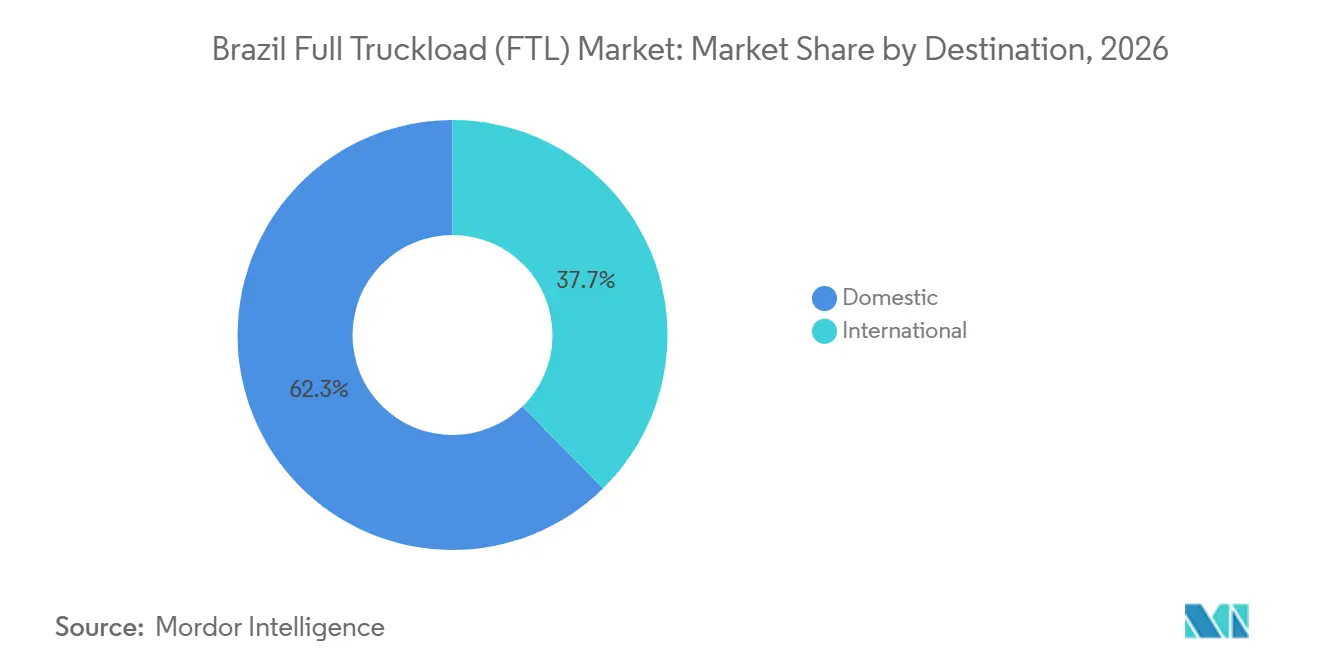
Domestic Freight Anchors Supply, International Corridors Gain PaceDomestic freight accounts for 62.34% of the Brazil full truckload (FTL) market share in 2026. Its position reflects the distance between production zones in the Central-West and South and large consumer and port centers in the Southeast. Bulk commodities, manufactured products, and retail goods all require direct point-to-point movement across a large domestic territory. Long hauls commonly exceed 1,000 km, which favors dedicated capacity over repeated handling. Domestic demand remains supported by agricultural harvests and industrial supply chains. It will continue to absorb most available truck capacity during the forecast period.
International freight is smaller, but its Brazil full truckload (FTL) market size is projected to rise at a 6.36% CAGR through 2032. Growth is linked to road links with Argentina, Chile, Paraguay, Uruguay, and Bolivia. These routes require operators to manage border documentation, axle-weight rules, driver hours, and phytosanitary procedures. DSV offers dedicated FTL and weekly LTL services between São Paulo, Buenos Aires, and Santiago, showing the demand for repeatable cross-border capacity. Compliance requirements favor carriers that combine transport management with customs and documentation capabilities. This leaves room for integrated providers as trade lanes gain density.

By Temperature Control:
Dry Van Dominates, Reefer Demand RisesDry vans account for 86.71% of the Brazil full truckload (FTL) market share in 2026. Grains, construction materials, manufactured products, and general merchandise create most of the demand for this equipment. Dry vans remain essential to Brazil’s road freight system because they accommodate a wide range of agricultural commodities and other nonperishable goods. The country’s commodity-driven freight mix supports sustained demand for standard dry equipment across domestic and cross-border routes. Long-distance operations, however, increase vehicle wear and maintenance requirements, making equipment reliability important for consistent service delivery.
Reefer freight is facing the fastest projected growth in the Brazil full truckload (FTL) market at a 7.83% CAGR through 2032. Pharmaceutical transport must meet thermal qualification, active temperature monitoring, and cold-chain validation requirements under ANVISA RDC 430/2020. Food and animal-origin exports also require controlled transport and traceability under RIISPOA rules. DHL Supply Chain is investing BRL 100 million (USD 18.07 million) in specialized cold-chain and armored pharmaceutical assets[3]. Purpose-built fleets can provide the monitoring, backup systems, and staff training that standard dry fleets cannot offer. This makes reefer capacity an attractive area for operators with the capital to meet higher service requirements.
By Haul Length:
Long-Haul Leads, Local Operations Expand FasterLong-haul freight accounts for 55.63% of the Brazil full truckload (FTL) market size in 2026. Grain corridors from the Central-West to ports can cover 1,500 km to 2,000 km. Interregional manufacturing links also connect São Paulo with Minas Gerais, Rio Grande do Sul, and the Northeast. Road transport carried 69% of Brazilian grain movement, compared with 22% by rail and 9% by waterways, keeping truck capacity central to agricultural flows. Long-haul carriers gain from high outbound volumes during harvest periods. However, they must manage higher fuel exposure and weaker return-load availability.
Local haul is forecast to advance at a 6.97% CAGR through 2032 in the Brazil full truckload (FTL) market. Urban fulfillment centers need frequent replenishment from regional consolidation sites to avoid stock shortages. This supports shorter dedicated loads for e-commerce and fast-moving consumer goods. Regional hauls also connect secondary industrial sites and agricultural collection points with primary corridors. Long-haul export operations can face empty-return rates above 40%, while denser city networks often offer better backhaul options. Digital load-matching platforms can help long-distance fleets reduce empty kilometers and compete more effectively with shorter-haul networks.
By End-User Industry:
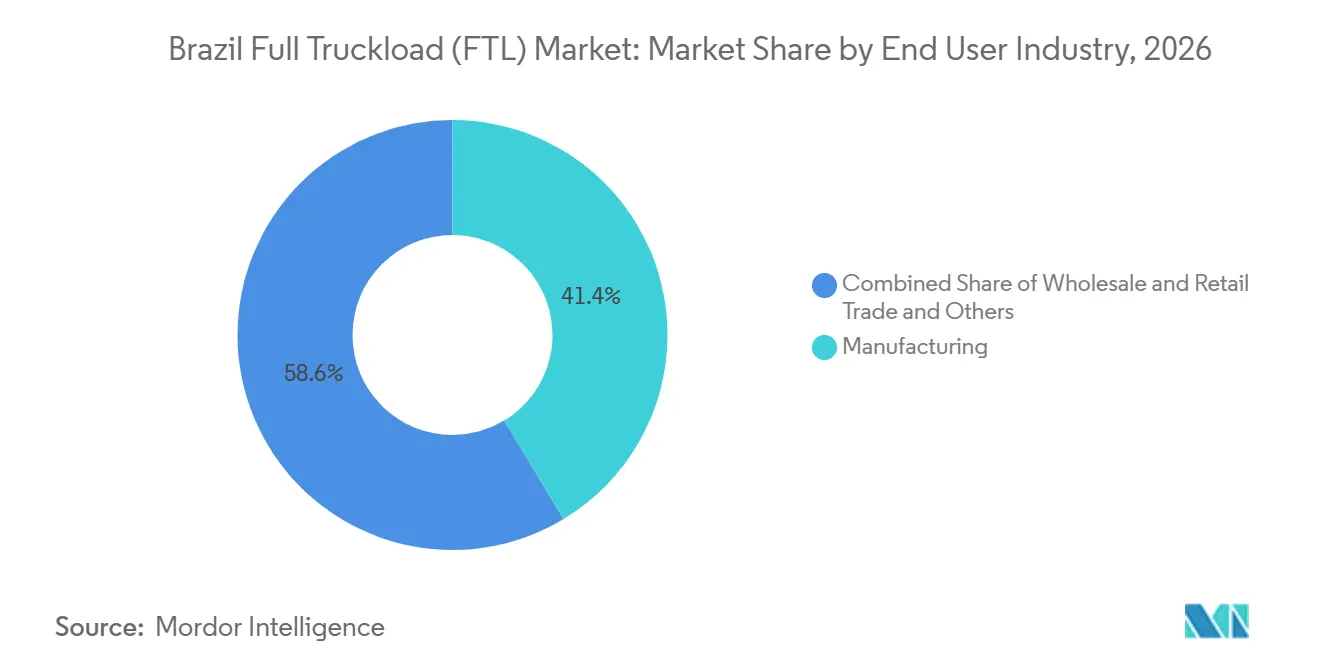
Manufacturing Leads, Wholesale and Retail Trade AcceleratesManufacturing accounts for 41.36% of the Brazil full truckload (FTL) market size in 2026. Automotive clusters in São Paulo and Rio Grande do Sul remain core demand centers. New production activity in Camaçari and Manaus is adding inbound component and outbound finished-product flows. Dedicated contracts are useful for manufacturers because they provide greater control over arrival times and freight handling. The Brazil full truckload industry also serves oil and gas, mining, and construction supply chains with specialized equipment requirements. This diverse base limits reliance on agricultural shipments alone.
Wholesale and retail trade is projected to register a 5.23% CAGR through 2032. More urban fulfillment facilities and tighter delivery commitments are shifting some replenishment work from consolidated shipments to dedicated loads. Agricultural, fishing, and forestry activity remains seasonally important, especially during soybean and corn harvest windows. Mining freight is concentrated in Minas Gerais, Pará, and Mato Grosso do Sul, while oil and gas activity is linked to Santos Basin and pre-salt operations. Construction-material shipments follow infrastructure spending and concession construction. The resulting end-user mix combines export-driven volumes with consumer-demand flows, which requires carriers to balance different seasonal patterns.
Geography Analysis
The Southeast accounts for 48.16% of national FTL demand in 2026. It links automotive production, retail distribution, and the Port of Santos in the country’s largest freight concentration. São Paulo supports frequent component, finished-product, and consumer-goods movements. Volkswagen, General Motors, and BYD contribute to dedicated logistics demand in this area. The Port of Santos handled 142.8 million tons in 2025, reinforcing its role in connecting inland freight with export cargo. Mercado Libre’s expanding fulfillment footprint raises scheduled replenishment requirements around São Paulo. The region therefore remains the principal demand center for integrated operators and local carriers.
Northeast demand records the highest regional projected growth rate at 5.36% through 2032. Bahia and Maranhão are gaining relevance in agricultural flows, while Camaçari adds automotive logistics. The federal government announced BRL 3.7 billion (USD 668.41 million) in port investments for the region in February 2026. Arco Norte ports handled 37.5% of national soybean exports in 2025, redirecting some freight toward northern corridors. New distribution and cross-docking sites also broaden the retail logistics base.
Central-West, South, and North each retain separate roles in the Brazil full truckload (FTL) market. Central-West generates dense long-haul grain volumes, while South combines grains, meat, automotive parts, paper, and cellulose. The Rondonópolis to Santos route can cover 1,800 km and can account for 70% of soybean export cost. North is growing from a lower base as the Arco Norte port cluster develops.
Competitive Landscape
The Brazil full truckload (FTL) market remains fragmented, with autonomous owner-operators and small regional carriers forming much of the active fleet. ANTT registration data show that autonomous cargo transporters represent the largest group of registered carriers. Their fleets are generally older than corporate fleets, which creates differences in service reliability and cost. JSL, CEVA Logistics, DHL Supply Chain, and DSV compete for long-term dedicated work through network visibility and broader logistics services. JSL secured BRL 4.9 billion (USD 885.19 million) in new contracts across 32 clients in 2025, with 71% of new revenue arising from existing-customer expansion[4].
Digital intermediaries influence competition by matching freight demand with available trucks. Frete.com, nstech’s TNS Match, and Fortio can reduce empty trips without carriers adding fleet capacity. This is most relevant on agricultural routes with strong outbound demand and weak return volumes. Frete.com created a BRL 150 million (USD 27.10 million) credit vehicle in January 2026 to support carrier working capital. The arrangements increase the ability of smaller carriers to obtain loads, financing, and verified documentation.
Specialized reefer transport, Arco Norte agricultural routes, and Mercosur cross-border services offer focused opportunities. DHL’s monitored pharmaceutical and cold-chain fleet shows how specialized providers can compete beyond price. Tegma agreed to acquire 70% of TSS Holding in August 2026, while DSV is integrating DB Schenker’s Brazilian operations and expanding in Minas Gerais. The competitive environment combines a broad carrier base with a smaller group of integrated and specialized providers.
Brazil Full Truckload (FTL) Industry Leaders
-
JSL SA
-
BBM Logística SA
-
Grupo Tora
-
DHL Group
-
CEVA Logistics (CMA CGM Group)
- *Disclaimer: Major Players sorted in no particular order
Brazil Full Truckload (FTL) Market Companies Covered in this Report
- JSL SA
- VIX Logística
- BBM Logística SA
- Tegma Gestão Logística SA
- Expresso Nepomuceno SA
- Grupo Tora
- Transpanorama Transportes SA
- SADA Transportes e Armazenagens SA
- CEVA Logistics (CMA CGM Group)
- Gafor SA
- DHL Group
- DSV
- A.P. Moller - Maersk
- Veloce Logística
- Ghelere Transportes
- Sotran Logística
- Transportes Bertolini
- Transvale
- Transportadora Veronese
- Transportes Cordenonsi
- DP World
- Luft Logistics
Recent Industry Developments in Brazil Full Truckload (FTL) Market
- September 2026: DHL Supply Chain and Amazon inaugurated a joint distribution center in Cariacica, Espírito Santo, measuring 31,000 m² and processing more than 420,000 packages per week. The facility supports same-day delivery in Espírito Santo and extends Amazon’s national logistics coverage.
- August 2026: Tegma Gestão Logística, through subsidiary Tegma Cargas Especiais, signed a purchase agreement to acquire 70% of TSS Holding (Transcopa group) for BRL 99.4 million (USD 17.95 million), gaining access to chemicals and grain port logistics, bulk terminal operations at the Port of São Sebastião, and a chemical corridor connecting the Vale do Paraíba to coastal shippers. CADE approval is pending. The deal expands Tegma's Integrated Logistics Division beyond automotive transport.
- March 2026: DHL Supply Chain opened multi-client fulfillment centers in Cajamar, São Paulo, and Brasília as part of the DHL Fulfillment Network expansion for small and medium e-commerce retailers.
- January 2026: Frete.com, parent of Fretebras and CargoX, finalized a BRL 150 million (USD 27.10 million) Credit Rights Investment Fund with XP, BTG Pactual, and Polígono Capital to provide working-capital credit to carriers on its platform.
Brazil Full Truckload (FTL) Market Report Scope
Segmentation Overview
| Domestic |
| International |
| Dry |
| Reefer |
| Long-Haul (More than 500 miles) |
| Regional (100-500 miles) |
| Local (Less than 100 miles) |
| Agriculture |
| Fishing and Forestry |
| Construction |
| Manufacturing |
| Oil and Gas |
| Mining and Quarrying |
| Wholesale and Retail Trade |
| Others |
| North |
| Northeast |
| Central-west |
| Southeast |
| South |
| By Destination | Domestic |
| International | |
| By Temperature Control | Dry |
| Reefer | |
| By Haul Length | Long-Haul (More than 500 miles) |
| Regional (100-500 miles) | |
| Local (Less than 100 miles) | |
| By End-User Industry | Agriculture |
| Fishing and Forestry | |
| Construction | |
| Manufacturing | |
| Oil and Gas | |
| Mining and Quarrying | |
| Wholesale and Retail Trade | |
| Others | |
| By Region | North |
| Northeast | |
| Central-west | |
| Southeast | |
| South |
Key Questions Answered in the Report
What is the forecast growth rate for full truckload services in Brazil?
The Brazil full truckload (FTL) market is projected to register a 4.40% CAGR from 2027 to 2032, reaching USD 47.77 billion by 2032.
Which freight destination segment is growing fastest in Brazil?
International freight is the fastest-growing destination segment, with a projected CAGR of 6.36% through 2032.
Why does long-haul trucking remain important in Brazil?
Long-haul services account for 55.63% of demand in 2026 because agricultural and industrial routes often extend more than 1,000 km.
What is driving reefer truck demand in Brazil?
Pharmaceutical, food, and export compliance requirements support reefer freight, which is projected to register at a 7.83% CAGR through 2032.
Which Brazilian region records the greatest demand for full truckload services?
Southeast leads demand with a 48.16% share in 2026 because it combines industrial production, consumer markets, and the Port of Santos.
What are the main operating risks for truck carriers in Brazil?
Diesel-price movements, poor road conditions, and limited driver availability can raise costs and reduce service reliability.