
Brazil Cash Logistics Market Size and Share
Market Overview
| Study Period | 2020 - 2031 |
|---|---|
| Forecast Data Period | 2026 - 2031 |
| Base Year Market Size (2025) | USD 0.82 Billion |
| Market Size (2026) | USD 0.86 Billion |
| Market Size (2031) | USD 1.19 Billion |
| Growth Rate (2026 - 2031) | 6.69 % |
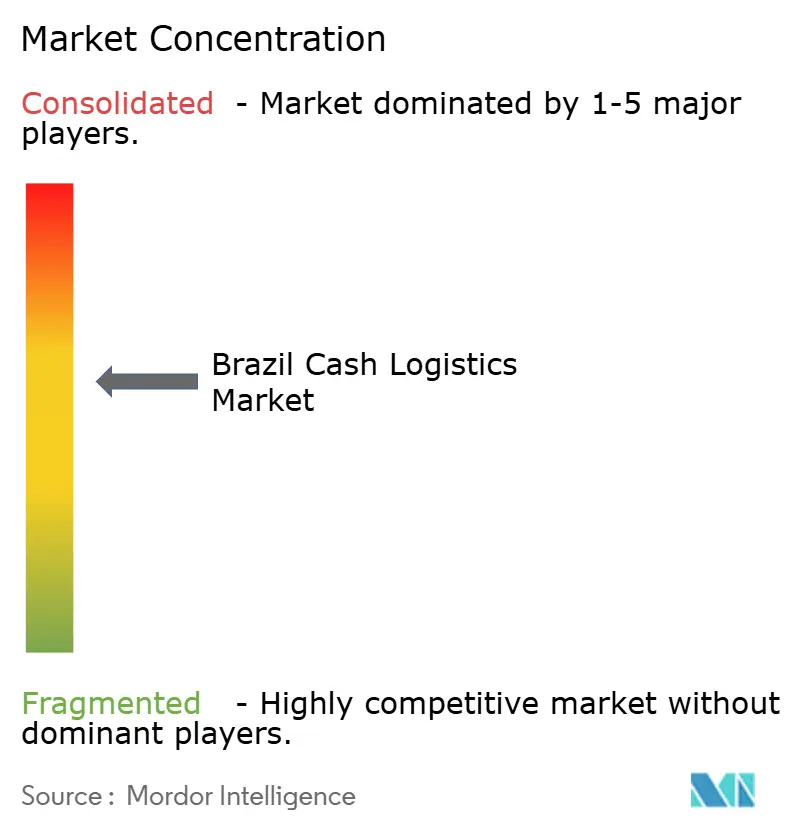
| Market Concentration | Medium |
Major Players *Disclaimer: Major Players sorted in no particular order Image © Mordor Intelligence. Reuse requires attribution under CC BY 4.0. | |
Brazil Cash Logistics Market Analysis by Mordor Intelligence
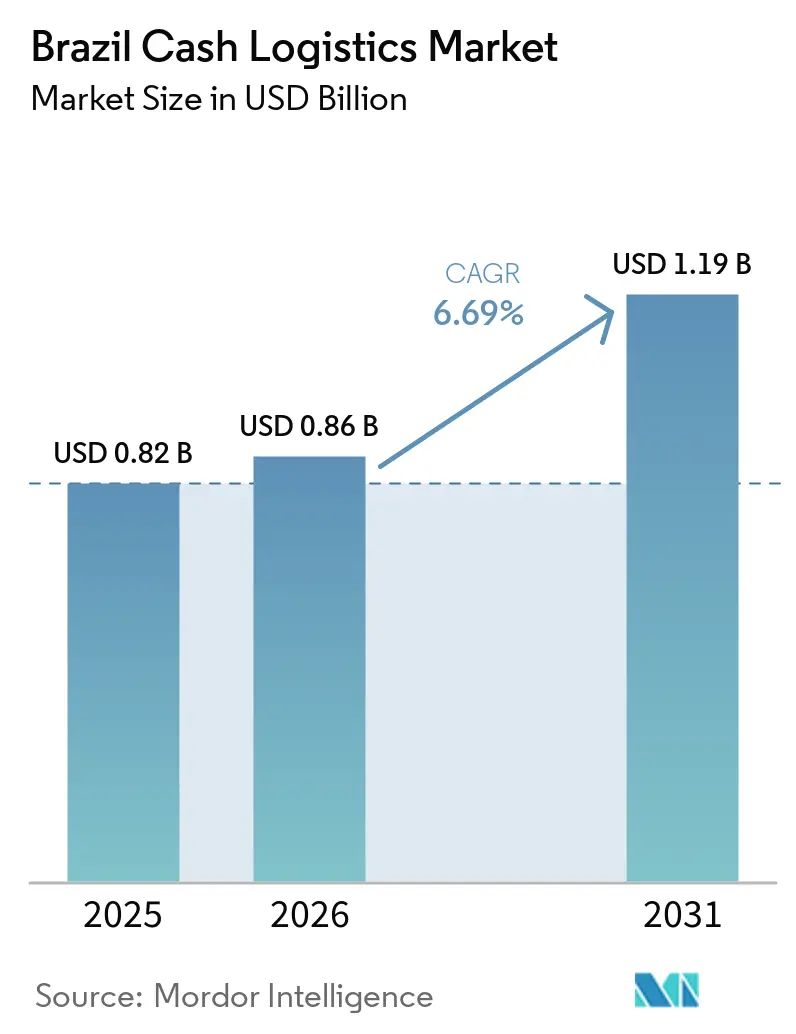
The Brazil cash logistics market size was valued at USD 0.82 billion in 2025, and is estimated to grow from USD 0.86 billion in 2026 to reach USD 1.19 billion by 2031, at a CAGR of 6.69% during the forecast period (2026-2031).
The continued use of physical currency supports demand for secure custody, transport, and processing, even as Pix changes how consumers make routine payments. Pix accounted for 54.7% of retail payment transactions in the second half of 2025, while notes and coins in circulation reached USD 62.1 billion in early 2026. Cash, therefore, remained important as a store of value and as a contingency for payment disruptions, especially where digital access was limited. The Brazil cash logistics market was also being reshaped by branch closures, outsourced ATM operations, smart safes, and stricter operating requirements. These changes favored providers that combined physical security with real-time monitoring, cash automation, and managed-service contracts.
Key Report Takeaways
- By service type, cash-in-transit held 35.55% of the Brazil cash logistics market share in 2025, while ATM services are projected to grow at a 7.60% CAGR through 2031.
- By end user, financial institutions held 61.00% of the Brazil cash logistics market size in 2025, while hospitality is projected to grow at an 8.10% CAGR through 2031.
- By mode of transit, roadways held 91.55% share of the Brazil cash logistics market size in 2025, while airways are projected to grow at a 7.50% CAGR through 2031.
Note: Market size and forecast figures in this report are generated using Mordor Intelligence’s proprietary estimation framework, updated with the latest available data and insights as of January 2026.
Brazil Cash Logistics Market Trends and Insights
Drivers Impact Analysis*
| Driver | (~) % Impact on CAGR Forecast | Geographic Relevance | Impact Timeline |
|---|---|---|---|
| Cash Usage in Informal, Rural, and Small-Business Settings | +1.5% | National, with highest intensity in the Northeast, North, and peripheral urban zones | Long term (≥ 4 years) |
| Outsourcing of ATM and Cash Processing Operations | +1.3% | National, concentrated in large-bank branch-closure corridors | Medium term (2-4 years) |
| Financial Inclusion and Banking Infrastructure Expansion | +1.2% | North and Northeast, with spillover to the Central-West | Medium term (2-4 years) |
| Smart Safes and Merchant Cash Recycling | +1.1% | National, led by Southeast retail hubs | Medium term (2-4 years) |
| Security Threats and Organized Crime Risk | +0.8% | Southeast core and urban last-mile segments nationally | Short term (≤ 2 years) |
| Remote-Region and Intermodal Cash Distribution | +0.4% | North and Central-West, including the Amazon basin | Long term (≥ 4 years) |
| Source: Mordor Intelligence | |||
Continued Cash Usage in Informal Economies, Rural Areas, and Small Businesses
Brazil’s informal economy and wide geographic dispersion maintained a resilient demand base for cash logistics services. Cash represented 38% of retail purchases in Brazil, and the share exceeded 60% in peripheral urban areas and rural interiors.[1]“Pix at 5, The Innovation That Transformed Payments in Brazil,” Banco Central do Brasil, bcb.gov.br The Banco Central do Brasil reported that physical currency increasingly served as a store of value, rather than only a means of payment. This behavior sustained the Brazil cash logistics market in locations where households and small businesses retained cash reserves for payment outages. The 2025 consumer finance survey found that 14% of Brazilians had no active use of digital banking channels. Correspondent locations, including lotteries, pharmacies, and Correios branches, created distributed cash-access points that required cash restocking and collection services.
Growth of Smart Safes and Merchant Cash-Recycling Solutions
Smart safes changed retail cash management by reducing the need for frequent armored collections. Demand for smart safe solutions in Brazil grew 20% in 2025 as large retailers and supermarkets sought to lower collection frequency and cost. SESAMI Prosegur Cash launched Cash Today Front Office in May 2026, a front-of-counter cash automation device that validated notes, dispensed change, and credited merchant accounts in real time. Grupo Protege introduced Protege One, a Brazilian-developed smart safe with note validation and reconciliation across payment instruments. Brink’s Brasil presented its Digital Retail Solutions ecosystem, supported by the Speed Light Smart Safe, at the 16th Concred in August 2026. These systems broadened the Brazil cash logistics market service base, although lower pickup frequency changed route-density economics for operators.
Increasing Outsourcing of ATM and Cash-Processing Operations
Bank branch closures shifted more ATM and cash-processing work to specialist providers in the Brazil cash logistics market. Brazil’s branch network fell from 22,866 to fewer than 15,000 locations between 2015 and 2025. The 3 largest private banks closed 2,334 branches and service posts in 2025. Tecban completed a modernization partnership with Banrisul in February 2025 that deployed 1,000 recycling ATMs under an outsourced model. By August 2026, Tecban had extended comparable agreements to Crefisa, Agibank, and Banco do Nordeste. Brink’s reported that ATM managed services and digital retail solutions increased from 24% of global revenue in 2025 to 31.6% in the first quarter of 2026, with 19% year-on-year growth.
Security Threats and Organized-Crime Risk
Security risks supported investment in fleet technology, route design, and digital protection across the Brazil cash logistics market. Brazil recorded 8,570 cargo robbery incidents in 2025, with direct losses of USD 155 million. Incident counts fell 8.71% in the first 5 months of 2026 from the same period in 2025, but the average loss per event rose as criminals targeted higher-value goods. Medicine cargo theft rose from 1.7% of incidents in the first quarter of 2025 to 22.3% in the first quarter of 2026. Grupo Protege committed USD 0.5 million to a cybersecurity project in 2026 with CrowdStrike after tripling its cumulative cybersecurity investment over 4 years. Law 14,967/2024 and Decree 13,012/2026 reinforced requirements for crew certification and vehicle specifications, which raised compliance costs and entry barriers.[2]“Decreto nº 13.012 de 2026, Do Transporte de Numerário, Bens ou Valores,” Governo Federal do Brasil, modeloinicial.com.br
Restraints Impact Analysis*
| Restraint | (~) % Impact on CAGR Forecast | Geographic Relevance | Impact Timeline |
|---|---|---|---|
| Pix and Cashless Payment Adoption | -2.0% | National, most acute in the urban Southeast and South | Short term (≤ 2 years) |
| Declining ATM Footprint and Withdrawal Volumes | -1.2% | National, concentrated in metropolitan areas with digital banking penetration | Medium term (2-4 years) |
| High Costs and Security Exposure on Remote Routes | -0.5% | North and Central-West, including remote Amazon communities | Long term (≥ 4 years) |
| Regulatory Transition and Compliance Complexity | -0.4% | National, with an early burden in the South and Southeast | Medium term (2-4 years) |
| Source: Mordor Intelligence | |||
Rapid Adoption of Pix and Cashless Payment Instruments
Pix adoption reduced the transactional role of cash and lowered the frequency of retail collections in the Brazil cash logistics market. Pix was used in 54.7% of retail payment transactions in the second half of 2025. ATM withdrawals fell 13.8% during the same period compared with the second half of 2024. New banknote issuance fell 31% between 2020 and 2025. Physical currency valued at USD 62.1 billion remained in circulation in early 2026, but revenue was increasingly concentrated on fewer high-value routes.
Declining ATM Footprint and Withdrawal Volumes
Brazil’s shrinking ATM network limited traditional ATM servicing volumes for providers in the Brazil cash logistics market. The number of ATM cash withdrawals fell 42% between 2019 and 2024. Total cash withdrawn declined from USD 204 billion to USD 113.9 billion over the same period. Banco do Brasil’s ATM count fell 7% year-on-year in 2024 as large institutions continued to reduce proprietary fleets. Outsourced managed services partly offset lower route density, but revenue per terminal remained lower than for a high-volume proprietary fleet. Resolution 4,282/2022 continued to add operating complexity as more institutions moved to interoperable ATM models.
*Our forecasts treat driver/restraint impacts as directional, not additive. The impact forecasts reflect baseline growth, mix effects, and variable interactions.
Segment Analysis
By Service Type: ATM Outsourcing Reshapes the CIT Revenue Mix
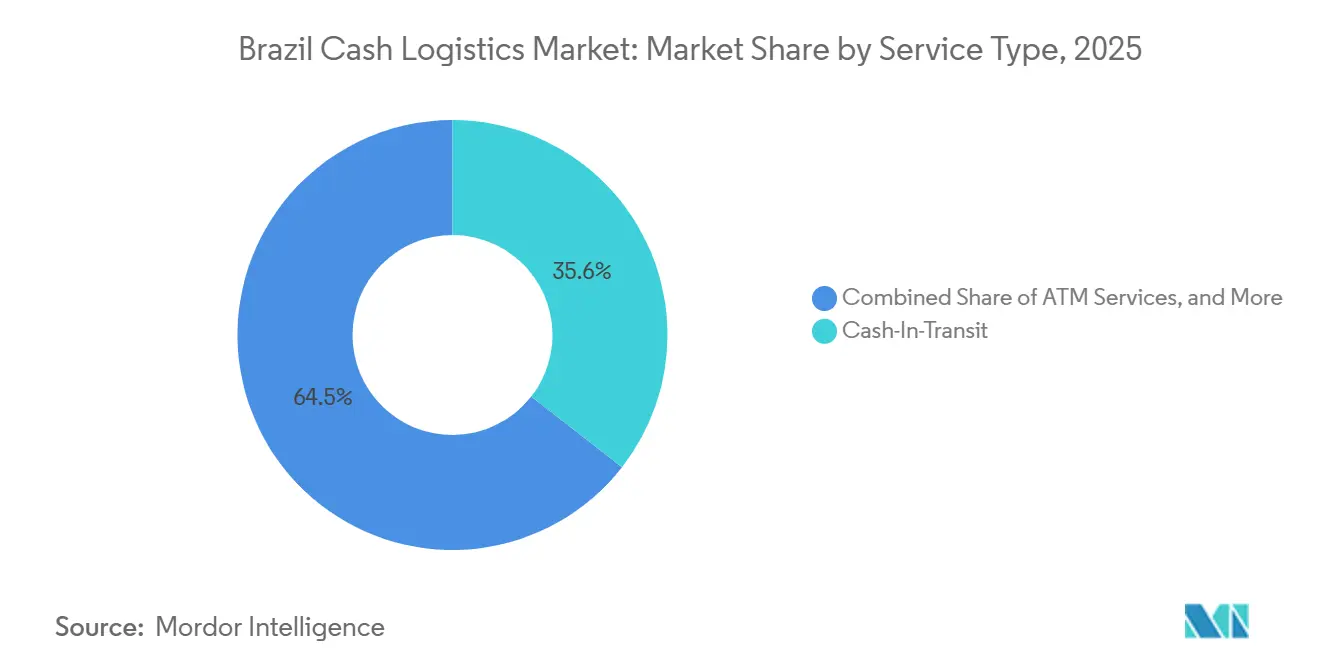
Cash-in-transit accounted for 35.55% of the Brazil cash logistics market size in 2025, making it the largest service category. Financial institutions, retailers, and government agencies continued to require secure collection and movement of accumulated currency. Notes and coins valued at USD 62.1 billion were in circulation in early 2026, which maintained a necessary operational role for cash-in-transit providers. Cash management services included vault management, counting, sorting, and processing under the requirements of Decree 13,012/2026.
ATM services are projected to grow at a 7.60% CAGR through 2031, the fastest rate among service categories. Major banks were transferring terminal ownership, maintenance, and cash-management responsibilities to specialist operators. Tecban’s agreements with Banrisul, Crefisa, Agibank, and Banco do Nordeste converted bank capital spending into managed-service payments. Nearly 30% of transactions at partner-branded terminals were completed by customers of other institutions, improving utilization. Brink’s launched B-POD in August 2026, combining ATM management, smart safes, and real-time cash monitoring for locations affected by branch closures.



By End User: Financial Institutions Anchor Revenue, Hospitality Emerges as a Growth Pocket
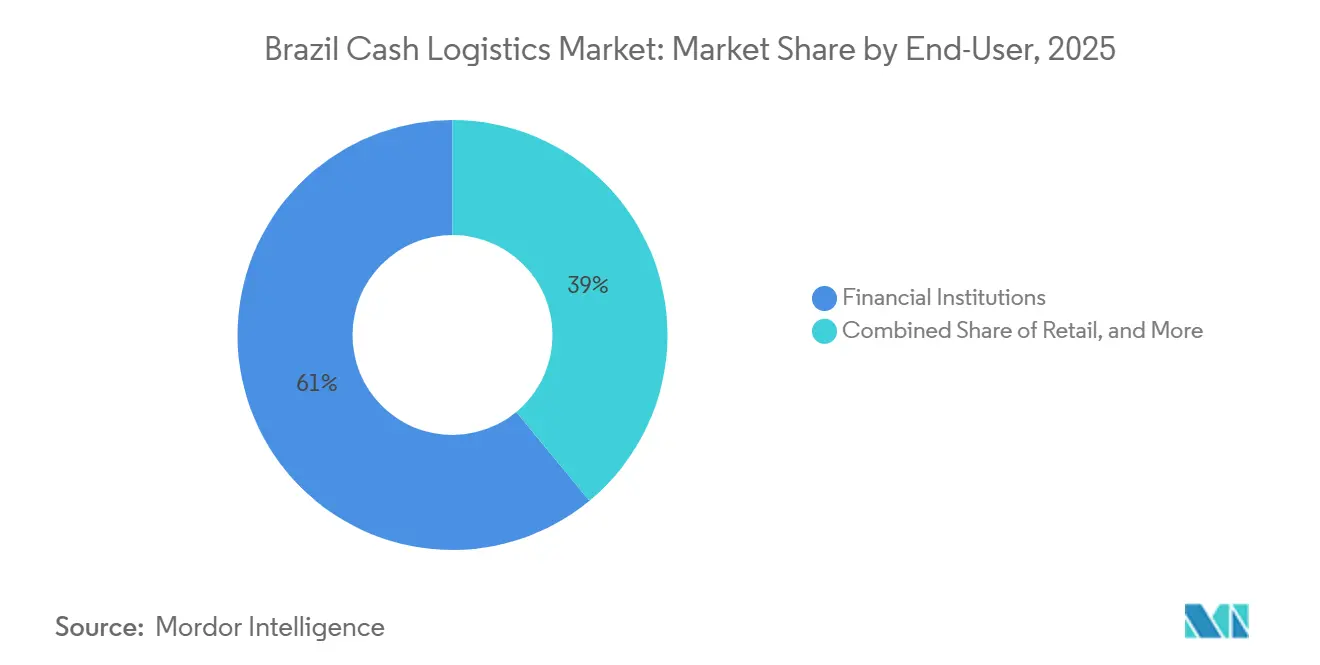
Financial institutions held 61.00% of the Brazil cash logistics market share in 2025 because they maintained cash availability across branch, ATM, and interbank networks. Bradesco estimated in early 2026 that it supplied USD 1.19 billion per day to ATMs, requiring specialized armored infrastructure. Government and public institutions supported stable demand through treasury offices, courts, and social welfare centers. Caixa Economica Federal formalized a contract with Prosegur Brasil in September 2026 for cash transport, processing, and custody services in Goias.
Hospitality is projected to grow at an 8.10% CAGR through 2031, the highest rate among end-user categories. Tourism recovery, casino-sector regulatory development, and foreign-currency cash use supported hotels, resorts, and entertainment locations. Lei Complementar 214/2025 introduced split-payment mechanics for hospitality from 2026, affecting cash-flow timing and real-time treasury management needs. Smart-safe-integrated contracts could support this requirement more directly than traditional collection schedules. Lower incumbent penetration created room for providers offering multi-currency handling, denomination exchange, and same-day digital crediting.
By Mode of Transit: Road Remains the Foundation, Air Expands the Frontier
Roadways held 91.55% of the Brazil cash logistics market size in 2025, reflecting the country’s highway network and established armored fleet base. Prosegur Cash operated more than 1,700 proprietary armored vehicles and more than 100 treasury facilities in Brazil. Grupo Protege acquired 60 Euro 6-compliant Volkswagen armored trucks in March 2025 through an investment of USD 5.3 million. Law 14.967/2024 and Decree 13,012/2026 shaped the technology and cost base by setting requirements for vehicles, crews, and route certification.
Airways are projected to grow at a 7.50% CAGR through 2031, the fastest rate among transit modes. Northern and central-western Brazil had limited road access or security conditions that restricted road transport of high-value cash. The Banco Central do Brasil identified the Amazon basin as an area where cash restocking required non-road solutions. Caixa operated riverboat branches, while air transport served time-sensitive and high-denomination consignments. IATA recognized Brazil in April 2025 as the first country in both North America and Latin America to adopt the electronic air waybill, reducing documentation needs and improving traceability.[3]“Brazil’s Adoption of Electronic Air Waybill a Milestone for Modernization,” IATA, iata.org
Geography Analysis
The Southeast was the largest regional revenue base of the Brazil cash logistics market in 2025 because it concentrated financial institutions, retail chains, and urban ATM networks. Sao Paulo hosted the headquarters and principal operating centers of the largest providers, while the region also had the greatest exposure to lower cash transaction volumes associated with Pix use. Rio de Janeiro and Sao Paulo together accounted for 67.5% of cargo robbery losses in the first half of 2026. This security burden maintained demand for technology-equipped cash-in-transit services. Brink’s Brasil served more than 3,000 municipalities from 71 branches and operated 1,200 vehicles, with substantial activity in Southeast corridors.
The North and Northeast had lower digital banking penetration, a higher proportional use of cash, and expanding financial-inclusion activity. The Banco Central do Brasil reported in April 2026 that correspondent agents, including lotteries, Correios outlets, and pharmacies, remained primary cash-access points in many municipalities without bank branches. Caixa inaugurated branches in Carauari and Novo Aripuana in late 2025, extending professional custody and transport needs. Tecban prioritized the regions in its mini Banco24Horas rollout during 2025, with 477 units in the Northeast and 211 in the North. This contrast favored providers with regional reach and multimodal capacity.
The South and Central-West formed a stable, slower-growth geography supported by agribusiness corridors, retail cooperatives, and credit unions. Credit cooperatives operated in 58% of Brazilian municipalities, often as the only formal financial institution, and their ATM restocking and vault requirements supported recurring demand. Brink’s Brasil attended the 16th Concred in August 2026, while Tecban demonstrated its Tecban Manager platform for ATM interoperability. A 2025 joint ordinance introduced ANAC OEA-ANAC certification, expanding secure air-freight options for high-value shipments in Central-West corridors.[4]“Unprecedented Certification for Air Exports, OEA-ANAC,” Agência Gov, omaringa.com.br
Competitive Landscape
The Brazil cash logistics market had a moderately consolidated structure at the national level, led by Prosegur and Brink’s, with regional operators competing for local and sector-specific volumes. Prosegur Cash generated USD 2.15 billion in global revenue in 2025 and reported that more than 35% of revenue came from transformation products. In Brazil, it broadened its portfolio through pharmaceutical cold-chain armored transport, cash automation, tokenized gold custody, and hybrid Pix-cash payment devices. Brink’s Brasil operated 71 branches, employed 7,000 people, and used 1,200 vehicles. It positioned 'B-POD' and 'Digital Retail Solutions' as recurring physical-banking services.
Mid-sized providers competed through technology credentials, compliance, and specialized customer groups. Grupo Protege had more than 12,000 employees and more than 60 operating units, and it renewed its maximum-level OEA-S certification in January 2026. Tecban’s ATMManager model lets banks leave ATM capital spending while retaining brand presence through terminal co-branding. Hospitality, pharmaceuticals, and agricultural cooperatives had openings for integrated cash-management contracts. These areas were not fully served through one standardized model.
Smaller operators, including AM/PM Seguranca, Corpvs Seguranca, Federal Seguranca, and Seguranca, competed on local route density and pricing flexibility. Decree 13,012/2026 and Lei 14.967/2024 imposed vehicle, crew certification, and Policia Federal authorization requirements that remained key barriers to entry. Service-contract models increasingly mattered more than ownership of individual assets. Providers competed by connecting cash transport, smart safes, ATM management, and real-time monitoring.
Brazil Cash Logistics Industry Leaders
Prosegur Group
The Brink’s Company
Grupo Protege
Tecban
Comando G8
- *Disclaimer: Major Players sorted in no particular order

Recent Industry Developments
- August 2026: Brink’s Brasil launched the B-POD at Febraban Tech 2026 in Sao Paulo, a modular banking hub designed to replace conventional bank branches with turnkey ATM management, smart safe integration, and digital retail solutions.
- August 2026: Tecban announced the expansion of its bank ATM substitution model to Crefisa, Agibank, and Banco do Nordeste, building on its Banrisul agreement.
- April 2026: Prosegur Cash introduced the Bitruck MB2426, a refrigerated armored truck for pharmaceutical and temperature-sensitive high-value cargo.
- March 2025: Grupo Protege acquired 60 Euro 6-compliant Volkswagen VW 11.180 CE armored trucks through a USD 5.3 million investment.


Brazil Cash Logistics Market Report Scope
| Cash-In-Transit |
| Cash Management Services |
| ATM Services |
| Other Services |
| Financial Institutions |
| Retail |
| Hospitality |
| Government and Public Institutions |
| Other End Users |
| Roadways |
| Railways |
| Airways |
| By Service Type | Cash-In-Transit |
| Cash Management Services | |
| ATM Services | |
| Other Services | |
| By End User | Financial Institutions |
| Retail | |
| Hospitality | |
| Government and Public Institutions | |
| Other End Users | |
| By Mode of Transit | Roadways |
| Railways | |
| Airways |


Key Questions Answered in the Report
What is the forecast for Brazil cash logistics through 2031?
The Brazil cash logistics market is forecast to reach USD 1.19 billion by 2031, with a 6.69% CAGR from 2026 to 2031.
Why does physical currency still require logistics services in Brazil?
Notes and coins valued at USD 62.1 billion were in circulation in early 2026, supporting custody, processing, and secure transport needs.
Which cash logistics service is expanding fastest in Brazil?
ATM services are projected to grow at a 7.60% CAGR through 2031 as banks outsource terminal management and maintenance.
Which customer group uses the most cash logistics services?
Financial institutions held 61.00% share in 2025 because they require cash availability across branches, ATMs, and interbank networks.
Which transit mode is expected to grow fastest?
Airways are projected to grow at a 7.50% CAGR through 2031 because remote northern and central-western areas require non-road delivery options.
How are smart safes changing retail cash handling?
Smart safes are reducing manual counting and collection frequency while supporting real-time account crediting for merchants.
Page last updated on:





