
Brazil Agricultural Logistics Market Size and Share
Market Overview
| Study Period | 2021 - 2032 |
|---|---|
| Forecast Data Period | 2027 - 2032 |
| Base Year Market Size (2026) | USD 7.02 Billion |
| Market Size (2027) | USD 7.40 Billion |
| Market Size (2032) | USD 9.53 Billion |
| Growth Rate (2027 - 2032) | 5.20 % |
| Market Concentration | Medium |
Major Players *Disclaimer: Major Players sorted in no particular order Image © Mordor Intelligence. Reuse requires attribution under CC BY 4.0. | |
Brazil Agricultural Logistics Market Analysis by Mordor Intelligence
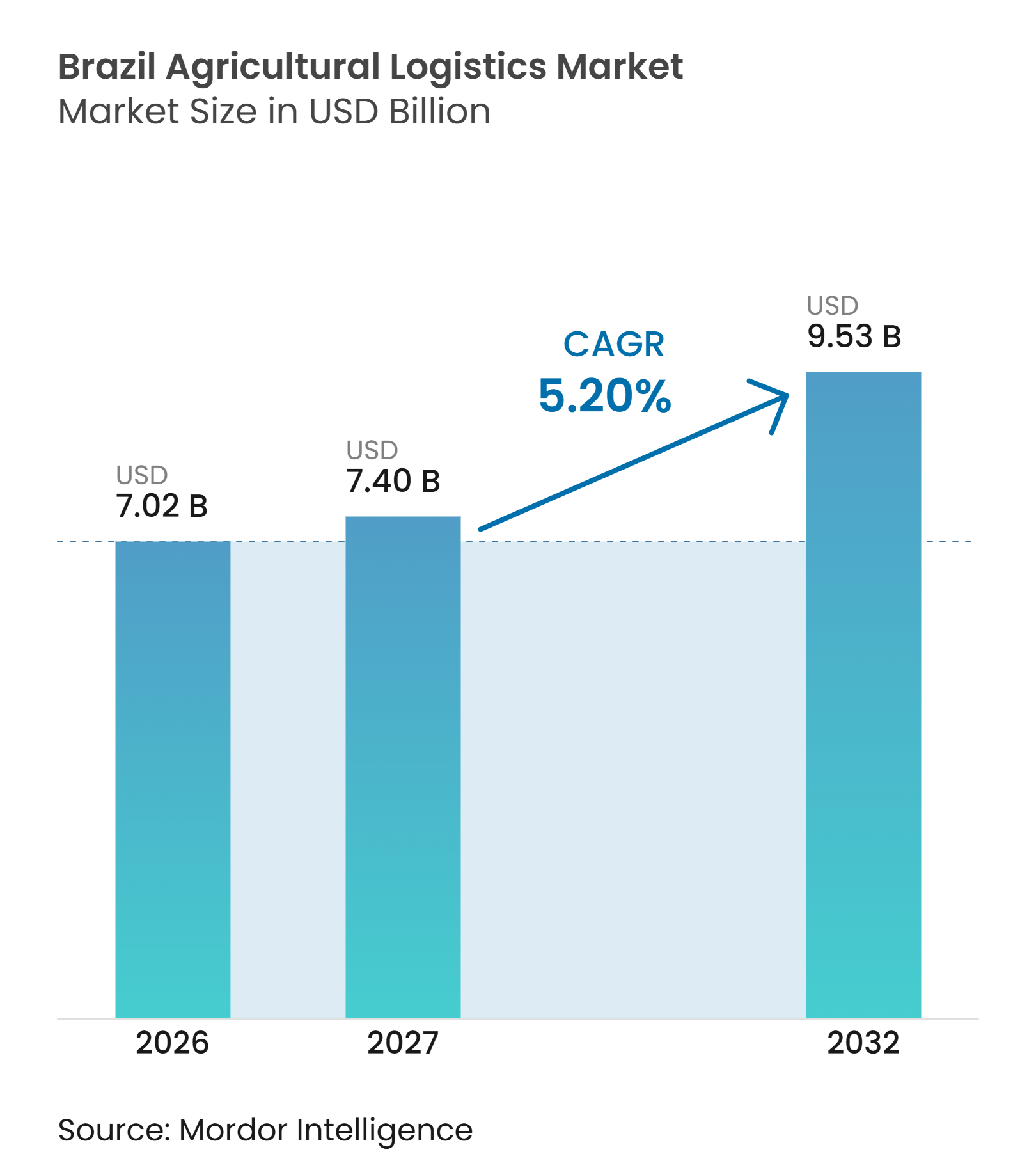
The Brazil agricultural logistics market size is valued at USD 7.02 billion in 2026 and is estimated to grow from USD 7.40 billion in 2027 to USD 9.53 billion by 2032 at a 5.20% CAGR over 2027-2032.
Brazil's role as a major soybean exporter sustains the need for transport, terminal, and storage capacity across export corridors. CONAB estimated the 2025/26 grain crop at 353.4 million metric tons, keeping logistics networks under pressure during concentrated harvest periods. The Brazil agricultural logistics market is moving toward rail, waterways, and integrated services as operators seek more predictable movement from production areas to ports. Capacity constraints at storage sites and export gateways continue to create demand for private infrastructure and value-added services. The Brazil agricultural logistics industry also benefits when operators combine export loads with fertilizer imports, which improves return-trip utilization through major port corridors.
Key Report Takeaways
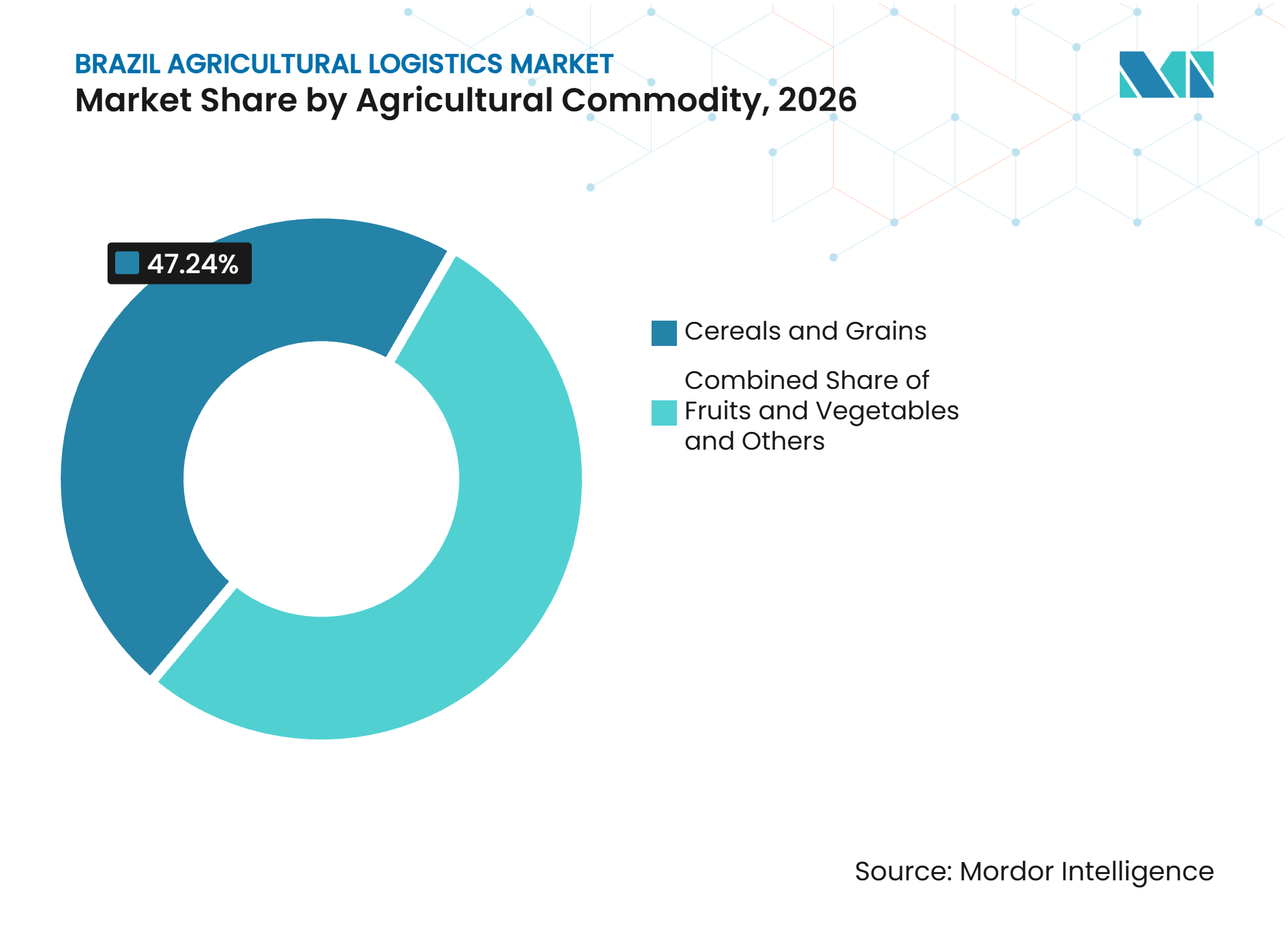
- By agricultural commodity type, cereals and grains account for 47.24% of the Brazil agricultural logistics market share in 2026, while fruits and vegetables are forecast to register a 6.98% CAGR through 2032.
- By logistics function, freight transport services account for 60.16% of the Brazil agricultural logistics market size in 2026, while value-added logistics services are forecast to register a 7.76% CAGR through 2032.
- By destination, international logistics accounts for 59.63% of the Brazil agricultural logistics industry size in 2026 and is forecast to register an 8.65% CAGR through 2032.
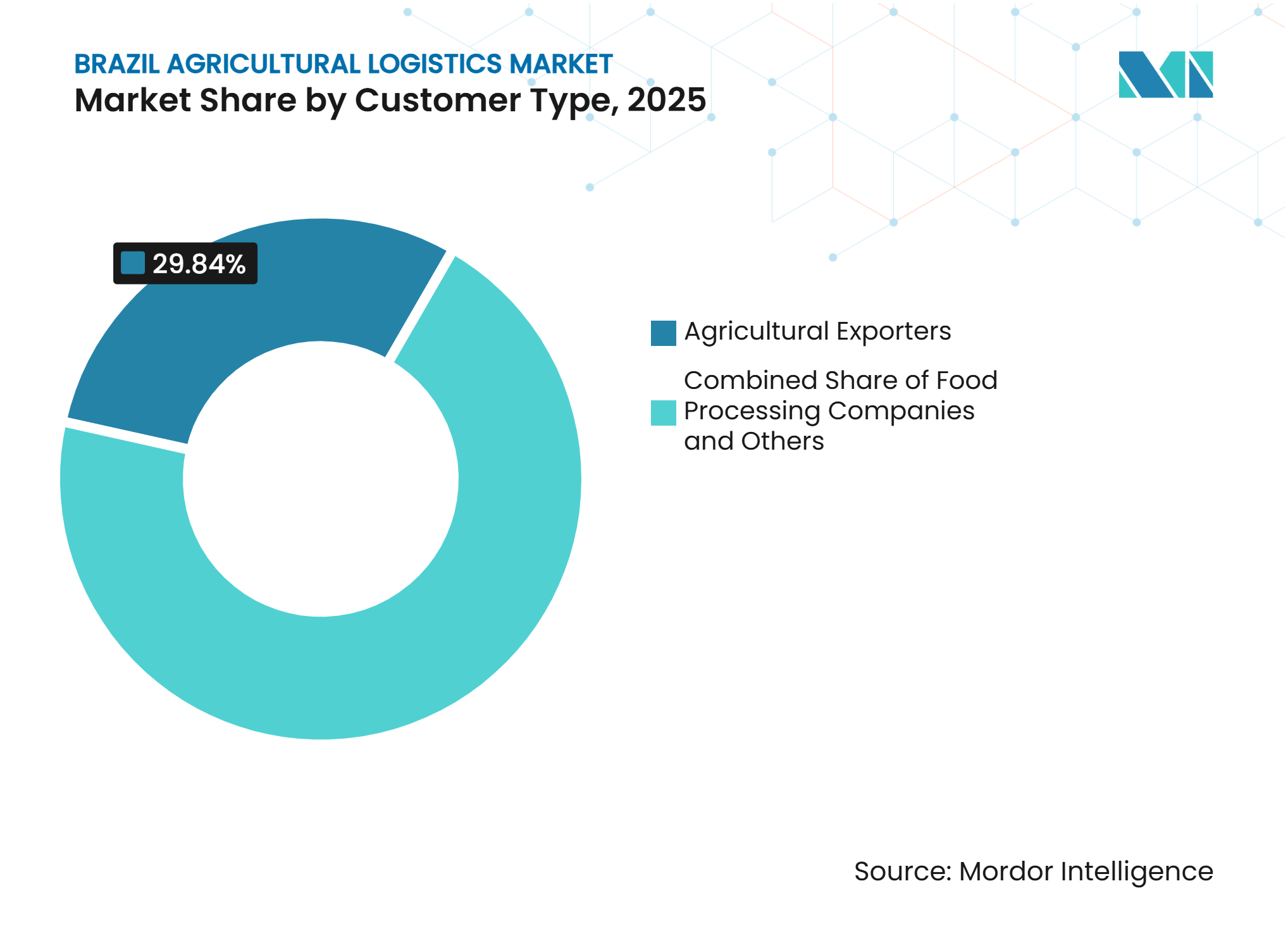
- By customer type, agricultural exporters account for 29.84% of the Brazil agricultural logistics market share in 2026, while food processing companies are forecast to register a 6.84% CAGR through 2032.
- By geography, the Southeast accounts for 43.63% of the Brazil agricultural logistics industry share in 2026, while the North is forecast to register a 7.65% CAGR through 2032.
Note: Market size and forecast figures in this report are generated using Mordor Intelligence’s proprietary estimation framework, updated with the latest available data and insights as of 2026.
Market Trends and Insights
Drivers Impact Analysis of Brazil Agricultural Logistics Market*
| Driver | (~) % Impact on CAGR Forecast | Geographic Relevance | Impact Timeline |
|---|---|---|---|
| Agricultural Production Growth Increasing Export Logistics Demand | +1.8% | National, concentrated in Mato Grosso, Goiás, Mato Grosso do Sul | Medium term (2-4 years) |
| Arco Norte Expansion Strengthening Northern Export Corridors | +0.9% | North, Pará, Maranhão, Amazonas, Roraima, and MATOPIBA | Medium term (2-4 years) |
| Multimodal Investment Improving Agricultural Freight Connectivity | +0.8% | National, with early gains in Central-West and North corridors | Long term (≥ 4 years) |
| Integrated Logistics Adoption Expanding End-to-End Service Demand | +0.6% | National, led by Southeast and Central-West | Medium term (2-4 years) |
| Freight Digitalization Improving Visibility and Route Efficiency | +0.5% | National, led by São Paulo, Mato Grosso, and Paraná | Short term (≤ 2 years) |
| Fertilizer Backhauls Improving Agricultural Logistics Network Utilization | +0.4% | Arco Norte ports, Santos, and Paranaguá | Short term (≤ 2 years) |
| Source: Mordor Intelligence | |||
Agricultural Production Growth Increasing Export Logistics Demand
Brazil's 2025 grain harvest reached 345.4 million metric tons, with record soybean output of 165.3 million metric tons and corn output of 141.2 million metric tons. The scale of this production creates recurring demand for first-mile trucking, rail movement, barge capacity, storage, and port handling. Brazil's planted area increased to 101.3 million hectares in 2025, extending freight requirements into agricultural frontiers that remain distant from established rail terminals[1]. The Brazil agricultural logistics market gains when recurring cargo volumes justify investment in corridors and equipment that can serve more than one harvest cycle.
Arco Norte Expansion Strengthening Northern Export Corridors
Arco Norte ports handled 163.3 million metric tons in 2025, an annual increase of 10.33%. Soybean and corn shipments through the corridor increased as producers sought alternatives to southern export gateways. The corridor's expanding role supports the Brazil agricultural logistics market because it brings northern ports closer to production areas in the Central-West and MATOPIBA. AMPORT expects Arco Norte to handle 50% of national soybean and corn exports by 2030 as terminal capacity expands. Fertilizer flows through these ports can also provide inbound cargo that improves asset use on return journeys.
Multimodal Investment Improving Agricultural Freight Connectivity
Federal and private investments are expanding the set of options available for moving agricultural cargo across Brazil. COFCO International committed BRL 1.2 billion (USD 240 million) to 979 rail wagons and 23 locomotives operated through Rumo's network[2]. This investment gives the company greater access to transport capacity serving its Santos export terminal. Rumo is also extending rail access in Mato Grosso, linking grain-producing areas more directly with larger networks. Better connections between roads, railways, waterways, and terminals can reduce dependence on single corridors. The Brazil agricultural logistics market gains from this investment because reliable multimodal links allow operators to offer more consistent service during harvest peaks.
Integrated Logistics Adoption Expanding End-to-End Service Demand
Exporters, processors, and cooperatives increasingly require providers to coordinate transport, storage, customs processes, and port handling. DP World and MRS Logística launched an integrated corridor in July 2026 that combines road movement, REDEX customs clearance, containerized rail, and port services between Central-West Brazil and Santos. The partners stated that each container train can replace 40 trucks and reduce greenhouse gas emissions by up to 80% compared with all-road movement. These arrangements create a larger role for operators that can manage cargo across several stages rather than provide only a single transport mode. Digital monitoring, route planning, and documentation tools support this model by improving cargo visibility and operational control. The Brazil agricultural logistics market therefore creates scope for providers that combine physical capacity with coordinated services.
Restraints Impact Analysis of Brazil Agricultural Logistics Market*
| Restraint | (~) % Impact on CAGR Forecast | Geographic Relevance | Impact Timeline |
|---|---|---|---|
| Road Infrastructure Gaps Increasing Transport Inefficiency | -1.2% | National, most acute in Mato Grosso, Pará, and frontier states | Long term (≥ 4 years) |
| Storage Deficits Intensifying Harvest-Season Logistics Congestion | -0.9% | National, most acute in Central-West and North regions | Short term (≤ 2 years) |
| Port Bottlenecks Disrupting Export Cargo Scheduling | -0.8% | Santos, Paranaguá, and Itaqui | Medium term (2-4 years) |
| Climate Disruptions Increasing Northern Waterway Reliability Risks | -0.6% | Tapajós, Madeira, and Amazon Rivers, North and Central-West | Short term (≤ 2 years) |
| Source: Mordor Intelligence | |||
Road Infrastructure Gaps Increasing Transport Inefficiency
Road transport remains central to grain logistics because many farms, warehouses, and terminals depend on truck access. Inadequate rural roads and weak intermodal connections raise transport costs and increase exposure to harvest-period capacity shortages. Record freight rates on the Sorriso to Santos route during the 2025 harvest illustrated the effect of constrained road capacity when demand rises. The Brazil agricultural logistics market remains exposed where production expands faster than durable links to rail, waterways, and export terminals. This pressure is especially relevant in frontier areas where long first-mile movements are still unavoidable.
Storage Deficits Intensifying Harvest-Season Logistics Congestion
Limited storage forces producers to move commodities during narrow harvest windows, creating simultaneous demand for trucks, rail terminals, barges, and ports. This pattern weakens scheduling discipline and increases price volatility for transport services. The shortage is more severe when production zones lack nearby commercial storage or access to multiple transport modes. The Brazil agricultural logistics market faces further strain where refrigerated capacity is not aligned with fresh-product production areas.
*Our forecasts treat driver/restraint impacts as directional, not additive. The impact forecasts reflect baseline growth, mix effects, and variable interactions.
Brazil Agricultural Logistics Market Segment Analysis
By Agricultural Commodity Type:
Grain Volumes Support Core Demand While Perishables Need Specialized ServicesCereals and grains account for 47.24% of the Brazil agricultural logistics market share in 2026, reflecting the volume of soybean and corn that moves through Brazil's export chain. Brazil shipped major quantities of these crops in 2025, and production remained high entering the 2025/26 season. Grain movements require dependable road collection, rail loading, barge operations, storage, and bulk terminal capacity. Large crop volumes give carriers and terminal operators recurring cargo, but seasonal harvest timing can concentrate demand within short periods. This structure favors networks that can switch volumes between corridors when a port or road faces congestion, and the Brazil agricultural logistics market remains closely tied to grain because soybean and corn shipments sustain the largest flow of export-bound cargo.
Fruits and vegetables are forecast to register a 6.98% CAGR through 2032, supported by demand for controlled-temperature logistics and container handling. Fresh-product logistics requires faster transit, reliable refrigeration, cargo condition monitoring, and coordinated port or airport processing. At the same time, a 2025 ENEGEP study identified temperature breaks on long routes as a cause of quality losses for horticultural products. Sugar logistics is shifting toward rail-linked terminals, while seafood, spices, and livestock require specialized handling, and these commodity differences broaden the Brazil agricultural logistics industry beyond bulk freight and favor providers with temperature-controlled and compliance-oriented capabilities.



By Logistics Function:
Freight Transport Provides the Base While Integrated Services ExpandFreight transport services account for 60.16% of the Brazil agricultural logistics market size in 2026, making them the largest segment in the Brazil agricultural logistics market. Farm-to-terminal and terminal-to-port movement remain the basic requirement for most agricultural supply chains. Road freight continues to handle a large part of the first mile, while rail and waterways offer scale for longer routes. Operators with access to wagons, barge capacity, and terminal slots can reduce exposure to spot transport rates. Transport providers also benefit when they can coordinate outbound exports with inbound fertilizer movements, making core freight capacity a necessary foundation for the wider agricultural logistics system.
Value-added logistics services are forecast to register a 7.76% CAGR through 2032 as customers seek storage, packaging, quality support, documentation, and customs coordination in one service arrangement. COFCO International's investment in rolling stock illustrates how logistics assets can support activity at several points in the export chain. Warehousing remains strategically important because storage shortages limit flexibility during harvest periods. Integrated providers can use storage to smooth cargo flows before arranging rail, waterway, or port movement. Service models also need stronger data exchange because exporters increasingly require shipment visibility, and the Brazil agricultural logistics market is therefore becoming more attractive to operators that combine asset ownership with planning and compliance services.
By Destination:
International Cargo Combines Scale With the Fastest GrowthInternational logistics accounts for 59.63% of the Brazil agricultural logistics market share in 2026 and is forecast to register an 8.65% CAGR through 2032. Brazil's export position makes ports, cross-border documentation, vessel scheduling, and terminal access central to logistics demand. A small number of ports handle a substantial portion of this trade, increasing the importance of dependable access to Santos, Paranaguá, São Luís, Rio Grande, and Barcarena. This concentration encourages exporters to maintain options across several routes, and the Brazil agricultural logistics market benefits from international cargo because export shipments usually require more coordination than domestic point-to-point movements.
Exporters increasingly require services that link inland collection to terminal operations and vessel departure schedules. AD Ports Group completed its acquisition of CLI in October 2026, gaining CLI Sul in Santos and CLI Norte in Itaqui after regulatory approvals[3]. The company stated that the assets could support direct Brazil-to-Abu Dhabi routes through Khalifa Port. Such investment shows why terminal access and route diversification matter to international service providers. Cargo owners also need timely customs work, accurate documents, and practical alternatives when a gateway becomes congested, so international logistics supports demand for multimodal providers that can manage both inland and port-side activity.
By Customer Type:
Exporters Remain the Largest Buyers While Processors Need Controlled Supply ChainsAgricultural exporters account for 29.84% of the Brazil agricultural logistics market size in 2026 because Brazil's production model relies heavily on seaborne commodity trade. Large traders often procure logistics capacity directly, and some also own terminals, rail equipment, or waterway assets. Their buying decisions influence demand for freight, storage, port services, and export documentation. Exporters place high value on capacity security during harvest and on alternatives when primary gateways become congested. This makes long-term operating agreements important across major corridors, and the Brazil agricultural logistics market remains shaped by the procurement strategies of these large export customers.
Food processing companies are forecast to register a 6.84% CAGR through 2032. These customers need dependable inbound supplies from dispersed production areas and often require traceability, temperature control, and scheduled delivery. Their requirements create opportunities for operators that provide more than spot truck capacity. Farmers and cooperatives are also bringing some logistics activities closer to the production chain to retain more value and improve delivery control. Retail, foodservice, and supermarket customers can add demand for specialized cold-chain distribution, especially for fresh produce, and the Brazil agricultural logistics market can expand with processor demand where providers meet tighter service and product-handling requirements.

Geography Analysis
The Southeast accounts for 43.63% of the Brazil agricultural logistics market share in 2026. The region is anchored by Santos, which handled major agricultural commodity and container flows in 2025. DP World's terminal expansion is expected to increase its Santos capacity by 25% to 2.1 million TEUs by 2028. This investment shows that operators still see a strong case for the corridor despite higher utilization. Louis Dreyfus Company opened an intermodal sugar terminal in Pederneiras in August 2025 with 90,000 tons of static capacity and 1 million tons of annual throughput. The site supports rail movement to Santos and increased the company’s rail-transported sugar share to 50%. Compliance with port and customs procedures remains important because cargo moving through Santos often requires precise coordination between inland sites, terminals, and exporters.
The North is projected to register a 7.65% CAGR through 2032. Arco Norte handled 163.3 million metric tons through its ports in 2025. The northern route gives grain shippers shorter options from some Central-West and northern production areas. AMAGGI's Roraima waterway operation provides an example of the infrastructure being added to connect production with the Amazon waterway network. It uses barge convoys with 2,000-ton capacity. However, low water levels have reduced flows on northern rivers, which means service plans must account for waterway reliability. ANTAQ's regulatory role remains material as private terminals and waterway services expand. The Brazil agricultural logistics market size in the North will depend on whether infrastructure growth is matched by resilience against climate-related disruption.
The Central-West produces large grain volumes and depends on growing rail access to reduce long road movements. Rumo added 162 km of rail in Mato Grosso during 2025 and plans a 740 km extension toward Lucas do Rio Verde. The Northeast is gaining importance through MATOPIBA production and the development of Itaqui, Pecém, and Suape as gateways. Better integration with the Norte-Sul Railway would strengthen connections between inland production and Maranhão port infrastructure. Portos do Paraná is investing in rail receiving capacity at Paranaguá, supporting its role as pressure at Santos grows. These regions give cargo owners multiple routing choices and reduce dependence on any one gateway.
Competitive Landscape
Market Concentration
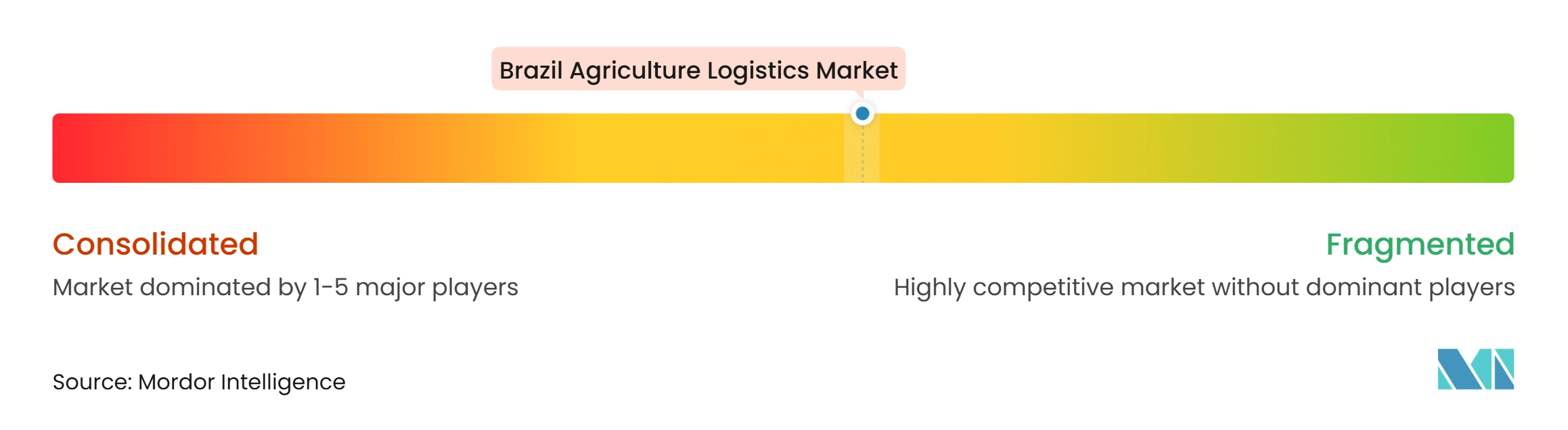
The Brazil agricultural logistics market has a fragmented structure. Vertically integrated commodity traders include Bunge, Cargill, AMAGGI, Louis Dreyfus Company, and COFCO International. These firms operate alongside rail concessionaires such as Rumo, VLI, and MRS Logística. Waterway operators, port companies, and third-party logistics providers also compete for freight and service contracts. This mix divides competition between companies with proprietary export assets and providers that sell logistics capacity to several customers. The Brazil agricultural logistics market favors firms that can secure access to transport equipment, storage, and terminal handling during peak periods.
COFCO International's January 2025 investment in 979 rail wagons and 23 locomotives, operated through Rumo, is a clear example of this asset-focused strategy. The equipment supports transport of up to 4 million metric tons of grain and sugar annually to COFCO's STS-11 terminal in Santos. Technology is also part of competition, as operators use monitoring, data integration, and fuel-saving systems to improve service reliability. JSL reported a 20% reduction in road accidents between 2021 and 2025 after deploying technology-supported safety monitoring.
Cold-chain coverage remains an area where providers can differentiate, especially in the faster-growing fruits and vegetables segment. GCCA Brazil reported 18.3 million m³ of refrigerated capacity in 2025, with 48% in the Southeast and 3% in the North[4]. This uneven distribution creates a service gap near some production areas and northern export corridors. AD Ports Group's acquisition of CLI adds an international owner to strategic agri-bulk assets in Santos and Itaqui. The transaction also increases competitive attention on routes connecting Brazil with the Middle East. The Brazil agricultural logistics market remains open to several types of competitors, but a provider's access to corridor assets is more important than a broad transport offering alone.
Brazil Agricultural Logistics Industry Leaders
-
Rumo SA
-
VLI SA
-
Hidrovias do Brasil SA
-
Bunge Global SA
-
Cargill Inc.
- *Disclaimer: Major Players sorted in no particular order
Brazil Agricultural Logistics Market Companies Covered in this Report
- Rumo SA
- VLI SA
- Bunge Global SA
- Cargill Inc.
- Hidrovias do Brasil SA
- AMAGGI
- Louis Dreyfus Company BV
- COFCO International
- AD Ports Group (CLI)
- Copersucar SA
- MRS Logistica SA
- Caramuru Alimentos SA
- DP World
- JSL SA
- Coamo Agroindustrial Cooperativa
- BBM Logistica SA
- Wilson Sons SA
- Andali SA
- DHL Group
- CEVA Logistics
- Kuehne+Nagel International AG
- DSV AS
Recent Industry Developments in Brazil Agricultural Logistics Market
- October 2026: AD Ports Group completed the acquisition of Corredor Logística e Infraestrutura, CLI, which operates agricultural export terminals in Santos and Itaqui, for USD 835 million.
- July 2026: DP World and MRS Logística launched an integrated multimodal agri-export corridor connecting Central-West Brazil to the Port of Santos. The corridor combines road, REDEX customs clearance, containerized rail, and port handling in one flow.
- April 2026: MRS Logística partnered with DP World to establish an integrated road, rail, and port export solution for agricultural commodities.
- February 2026: Louis Dreyfus Company inaugurated a logistics hub in Rondonópolis, Mato Grosso, integrating its agricultural inputs and cotton operations.
Brazil Agricultural Logistics Market Report Scope
Segmentation Overview
| Cereals and Grains |
| Coffee |
| Fruits and Vegetables |
| Spices and Specialty Crops |
| Seafood and Aquaculture Products |
| Sugar and Other Plantation Crops |
| Livestock, Meat and Animal Products |
| Other Agricultural Products |
| Freight Transport Services | Road |
| Rail | |
| Sea and Inland Waterways | |
| Air | |
| Warehousing and Storage Services | |
| Value-Added Logistics Services |
| Domestic Distribution Logistics |
| International Logistics |
| Farmers and Cooperatives |
| Agricultural Exporters |
| Food Processing Companies |
| Commodity Traders |
| Retail and Supermarket Chains |
| Foodservice and Hospitality |
| Other Agricultural Customers |
| North |
| Northeast |
| Central-West |
| Southeast |
| South |
| By Agricultural Commodity Type | Cereals and Grains | |
| Coffee | ||
| Fruits and Vegetables | ||
| Spices and Specialty Crops | ||
| Seafood and Aquaculture Products | ||
| Sugar and Other Plantation Crops | ||
| Livestock, Meat and Animal Products | ||
| Other Agricultural Products | ||
| By Logistics Function | Freight Transport Services | Road |
| Rail | ||
| Sea and Inland Waterways | ||
| Air | ||
| Warehousing and Storage Services | ||
| Value-Added Logistics Services | ||
| By Destination | Domestic Distribution Logistics | |
| International Logistics | ||
| By Customer Type | Farmers and Cooperatives | |
| Agricultural Exporters | ||
| Food Processing Companies | ||
| Commodity Traders | ||
| Retail and Supermarket Chains | ||
| Foodservice and Hospitality | ||
| Other Agricultural Customers | ||
| By Region | North | |
| Northeast | ||
| Central-West | ||
| Southeast | ||
| South | ||
Key Questions Answered in the Report
What is the forecast for Brazil agricultural logistics through 2032?
The sector is forecast to rise from USD 7.40 billion in 2027 to USD 9.53 billion by 2032, at a 5.20% CAGR.
Which cargo category leads agricultural logistics in Brazil?
Cereals and grains account for a 47.24% share in 2026 because soybean and corn exports create the largest recurring volumes.
Why is Arco Norte important for Brazilian agricultural exports?
Arco Norte handled 163.3 million metric tons in 2025 and offers additional export routing for northern and Central-West production areas.
Which logistics service is growing fastest in Brazil?
Value-added logistics services are forecast to register a 7.76% CAGR through 2032 as customers seek bundled transport, storage, documentation, and customs support.
What are the major constraints on agricultural cargo movement in Brazil?
Road gaps, a 15.9 million metric ton storage shortfall, port congestion, and northern waterway disruptions remain material constraints.
Why do food processors need specialized logistics providers?
Food processing companies are forecast to register a 6.84% CAGR through 2032 because they need reliable supply, traceability, temperature control, and scheduled delivery.