
Brazil 3PL Warehousing Market Size and Share
Market Overview
| Study Period | 2021 - 2032 |
|---|---|
| Forecast Data Period | 2027 - 2032 |
| Base Year Market Size (2026) | USD 2.44 Billion |
| Market Size (2027) | USD 2.62 Billion |
| Market Size (2032) | USD 3.71 Billion |
| Growth Rate (2027 - 2032) | 7.18 % |
| Market Concentration | Medium |
Major Players *Disclaimer: Major Players sorted in no particular order Image © Mordor Intelligence. Reuse requires attribution under CC BY 4.0. | |
Brazil 3PL Warehousing Market Analysis by Mordor Intelligence
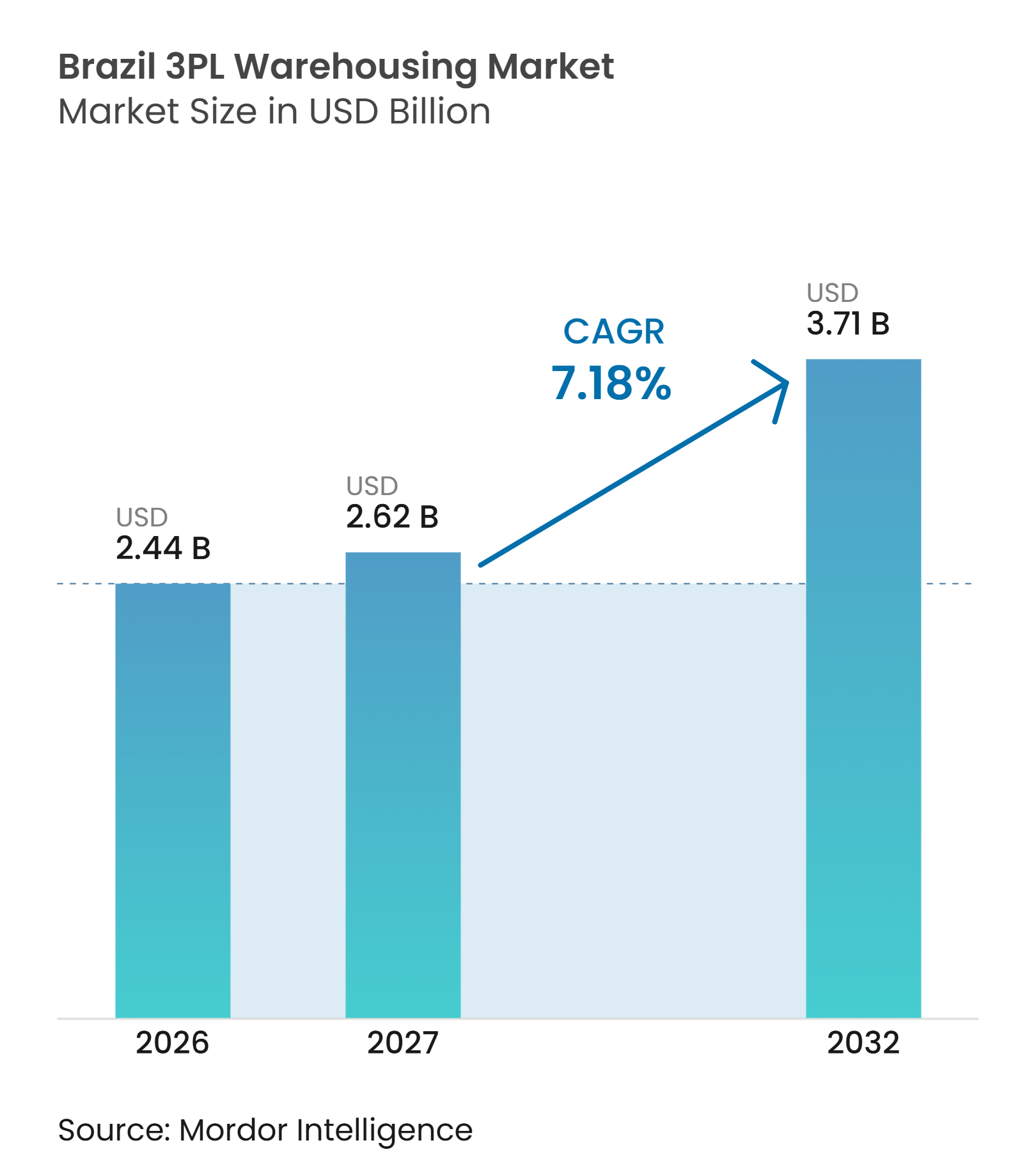
The Brazil 3PL warehousing market size is valued at USD 2.44 billion in 2026. It is estimated to grow from USD 2.62 billion in 2027 to reach USD 3.71 billion by 2032, at a CAGR of 7.18% during the forecast period (2027-2032).
E-commerce platforms such as Mercado Libre, Shopee, and Amazon are driving demand for warehouse space in Brazil, both directly and through their third-party logistics (3PL) partners. The Brazil 3PL warehousing market also benefits from demand generated by independent logistics operators serving businesses across retail, manufacturing, and other industries, supporting the need for outsourced storage and fulfilment capacity beyond online retail. Tax reform is changing location decisions because the transition from origin-based ICMS to destination-based IBS reduces the benefit of placing distribution centers in tax-incentive states. The Brazil 3PL warehousing market therefore favors flexible service contracts as companies reconsider long-lived private warehouse investments during the transition period.
Key Report Takeaways
- By service type, storage accounts for 49.16% of Brazil 3PL warehousing market share in 2026, while value-added services and others are forecast to expand at an 8.19% CAGR through 2032.
- By warehouse type, general shared/multi-client warehousing accounts for 49.37% of Brazil 3PL warehousing market size in 2026, while bonded warehousing is forecast to expand at a 9.27% CAGR through 2032.
- By temperature control, non-temperature controlled warehousing accounts for 79.63% of Brazil 3PL warehousing market share in 2026, while temperature-controlled warehousing is forecast to expand at an 8.37% CAGR through 2032.
- By technology adoption, manual operations account for 62.18% of Brazil 3PL warehousing market size in 2026, while fully automated operations are forecast to expand at an 8.02% CAGR through 2032.
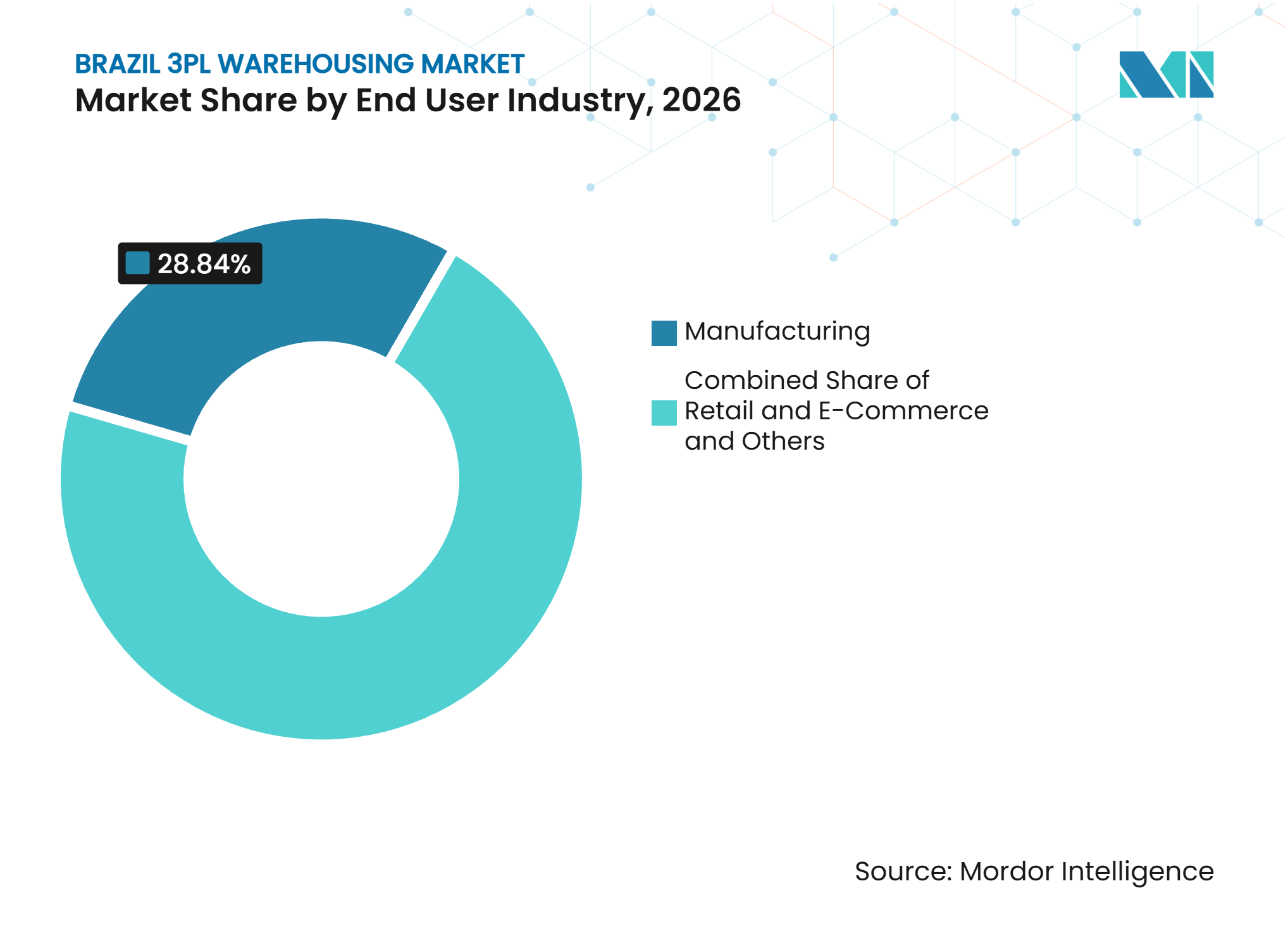
- By end user industry, manufacturing accounts for 28.84% of Brazil 3PL warehousing market share in 2026, while retail and e-commerce is forecast to expand at a 9.91% CAGR through 2032.
- By region, Southeast accounts for 41.37% of Brazil 3PL warehousing market size in 2026, while Northeast is forecast to expand at an 8.14% CAGR through 2032.
Note: Market numbers in this report are based on Mordor Intelligence's proprietary estimation framework, which combines nine months of actuals with Q4 projections for base year 2026.
Market Trends and Insights
Drivers Impact Analysis of Brazil 3PL Warehousing Market*
| Driver | (~) % Impact on CAGR Forecast | Geographic Relevance | Impact Timeline |
|---|---|---|---|
| E-Commerce Growth Expanding Outsourced Warehousing Demand | +2.1% | National, with highest concentration in Southeast and Northeast | Medium term (2-4 years) |
| Logistics Outsourcing Increasing Third-Party Distribution Requirements | +1.3% | National, with early gains in São Paulo, Rio de Janeiro, and Minas Gerais | Short term (≤ 2 years) |
| Grade-A Warehousing Expanding Near Major Consumption Hubs | +0.9% | Southeast primarily, with spillover to Northeast and Central-West | Medium term (2-4 years) |
| Pharmaceutical Growth Increasing Specialized Cold-Chain Warehousing Demand | +0.8% | Southeast and South, expanding to Northeast | Medium term (2-4 years) |
| Agribusiness Growth Strengthening Hinterland Distribution Requirements | +0.5% | Central-West, South, and North | Long term (≥ 4 years) |
| Tax Reform Repositioning Warehouses Toward Demand Centers | +0.6% | National, with early gains in major consumer cities | Long term (≥ 4 years) |
| Source: Mordor Intelligence | |||
E-Commerce Growth Expanding Outsourced Warehousing Demand
Brazil's online retail activity is converting higher parcel volumes into demand for outsourced warehouse operations. From January through March 2025, Loggi reported that a new e-commerce parcel was dispatched every 7 seconds and 55% reached the customer within 3 days. E-commerce businesses directly absorbed more than 34% of total logistics warehouse leasing by the first quarter of 2026[1]. The Brazil 3PL warehousing market benefits when retailers need inventory closer to customers and require faster order processing. Long-term leases signed before recent rental increases can also support 3PL margins when operators provide capacity to clients under integrated contracts. This pattern gives the Brazil 3PL warehousing market a durable role in fulfillment as service levels become central to retailer selection. Higher delivery expectations also encourage retailers to use multi-client networks rather than operate inventory from a single distant site.
Logistics Outsourcing Increasing Third-Party Distribution Requirements
Brazil's 3PL operators billed BRL 247 billion (USD 42.6 billion) in 2025. The sector had an estimated 1,500 active operators, which was 15% above the prior survey count. Outsourcing gives companies access to storage, distribution, inventory management, and value-added services without a full private warehouse commitment. This is particularly relevant while companies review distribution networks under changing tax rules and uncertain facility locations. The Brazil 3PL warehousing market gains when clients seek operating flexibility and avoid committing capital to facilities that may not remain optimally located. The model also lets clients adjust capacity and service scope as distribution requirements change.
Grade-A Warehousing Expanding Near Major Consumption Hubs
Brazil delivered 3 million m² of new Grade-A logistics inventory during 2025 across 19 states. New facilities can support automation because they include higher floor loads, 12 m clear heights, and reinforced electrical infrastructure. LOG Commercial Properties allocated 43% of its 2 million m² pipeline to the Northeast. It had delivered 434,000 m² by the second quarter of 2026, with the delivered area fully pre-leased. The Brazil 3PL warehousing market benefits because modern sites can serve existing customer requirements and preserve the option to add robotics as volume grows. Pre-leasing in the Northeast also indicates that users are seeking this quality of space before all planned supply is delivered.
Pharmaceutical Growth Increasing Specialized Cold-Chain Warehousing Demand
Pharmaceutical warehouse operations are governed by ANVISA RDC 430 and RDC 653, which require continuous temperature monitoring, qualified facility management, and batch traceability. DHL Supply Chain moved Bristol Myers Squibb pharmaceutical operations to its multi-client campus in Extrema, Minas Gerais, where temperature-controlled zones operate between 2 °C and 25 °C. Cold-chain logistics capacity is expected to expand 4.5% in 2026 to 25.8 million m³ across 408 units[2]. Refrigeration can represent up to 70% of cold-storage operating costs, so larger operators have a clear reason to develop efficient multi-temperature sites. The Brazil 3PL warehousing market can capture higher-value contracts where compliance and temperature integrity matter as much as space. These operating requirements favor providers that can sustain documented procedures throughout storage and handling.
Restraints Impact Analysis of Brazil 3PL Warehousing Market*
| Restraint | (~) % Impact on CAGR Forecast | Geographic Relevance | Impact Timeline |
|---|---|---|---|
| Road Infrastructure Gaps Increasing Distribution Inefficiencies | -1.7% | National, most severe in North, Central-West, and rural Northeast | Long term (≥ 4 years) |
| Tax Compliance Complexity Increasing Multi-State Operating Burden | -0.9% | National, with a disproportionate burden on multi-state 3PL operators | Medium term (2-4 years) |
| Cargo Theft Increasing Security and Insurance Costs | -0.6% | Southeast concentrated, with BR-101 and BR-116 as hotspot corridors | Short term (≤ 2 years) |
| Refrigeration Energy Costs Pressuring Cold-Storage Economics | -0.5% | Southeast and South | Medium term (2-4 years) |
| Source: Mordor Intelligence | |||
Road Infrastructure Gaps Increasing Distribution Inefficiencies
Roads carry 63.4% of national freight volume in Brazil, but only 12.6% of the country's 1.7 million road km were paved in 2025. The CNT survey found that 72.8% of publicly managed roads were inadequate. Total logistics costs reached 15.5% of GDP in 2025, compared with an OECD average of 8.4%, while road freight alone represented 8.5% of GDP[3]. Poor road conditions required 1.2 billion additional liters of diesel in 2025 and caused BRL 7.2 billion (USD 1.23 billion) in losses. These conditions extend transit times, weaken temperature control on the last mile, and limit the operational efficiency of the Brazil 3PL warehousing market. The constraint is more severe where freight must travel through rural areas and long-distance interior routes.
Tax Compliance Complexity Increasing Multi-State Operating Burden
Multi-state warehouse networks must manage legacy tax structures as the transition to IBS moves forward. Companies with sites in several states face a larger administrative burden while incentives remain in place and then expire. This can make network planning slower and can delay decisions on new distribution centers. The tax transition supports long-term flexibility, but its interim complexity can restrict the Brazil 3PL warehousing market for providers managing multi-state client networks. Providers must continue to coordinate tax-sensitive flows while customers assess where future distribution capacity should sit.
*Our forecasts treat driver/restraint impacts as directional, not additive. The impact forecasts reflect baseline growth, mix effects, and variable interactions.
Brazil 3PL Warehousing Market Segment Analysis
By Service Type:
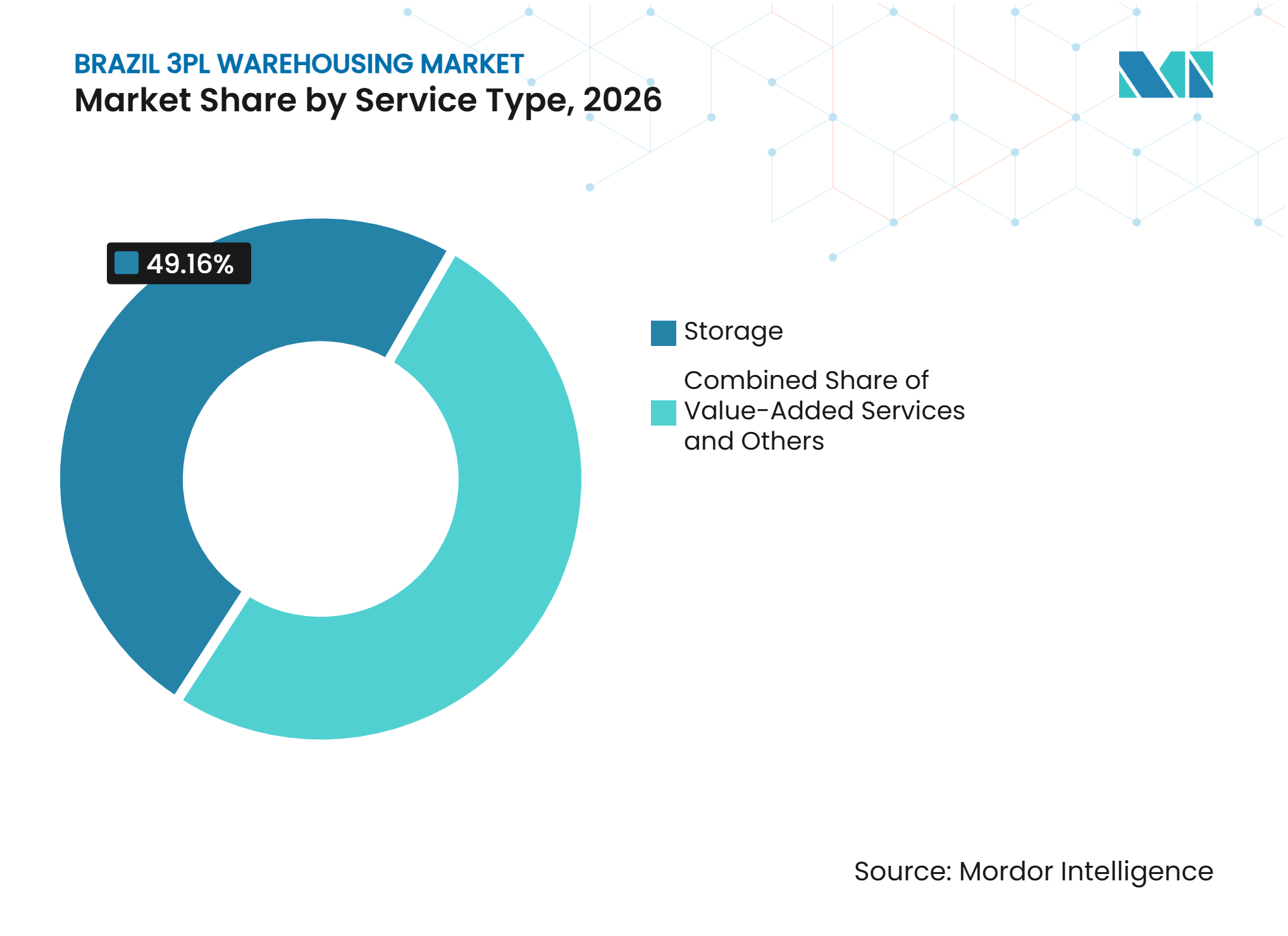
Value-Added Services Gaining GroundStorage accounts for 49.16% of the Brazil 3PL warehousing market share in 2026, remaining the foundation of outsourced warehouse contracts. Distribution and inventory management represent the next-largest service area, supported by omnichannel clients requiring stock visibility and replenishment across multiple locations. Value-added services, including kitting, labeling, packaging, and product handling, complement storage operations and help providers serve private-label manufacturing, cross-border e-commerce, and pharmaceutical requirements.
Value-added services and others are forecast to register an 8.19% CAGR through 2032. Growth is supported by increasing demand for specialized warehouse activities and opportunities to expand services beyond basic storage. JSL/Intralog signed BRL 2.8 billion (USD 505.82 million) in new contracts during the 12 months through early 2026, with cross-selling value-added services to existing storage clients accounting for 56% of new contracting[4]. This highlights the growing importance of service expansion in increasing revenue per m². Digital integration is also gaining importance in 3PL contracts as clients seek connected inventory management and planning capabilities, giving providers with warehouse management systems an advantage in securing integrated contracts.



By Warehouse Type:
Bonded Facilities Reposition as Strategic Trade AssetsGeneral shared/multi-client warehousing accounts for 49.37% of Brazil's 3PL warehousing market size in 2026. The format fits companies that want capacity without committing capital to a dedicated facility during a period of elevated interest rates and tax transition. Dedicated contract warehousing serves automotive, pharmaceutical, and high-value consumer electronics customers that require tailored infrastructure.
Bonded warehousing is forecast to register a 9.27% CAGR through 2032. The Brazil 3PL warehousing market size for bonded facilities is supported by import activity and the digital customs modernization associated with the DUIMP single-import-declaration platform. Bonded capacity remains concentrated near Santos, Paranaguá, and Suape, which leaves an inland supply gap. CLIA Pouso Alegre relocated to a 49,800 m² bonded site in Minas Gerais during September 2025. Inland certified sites can help importers reduce exposure to port congestion while maintaining customs compliance. Receita Federal requirements create entry barriers that can support established operators with approved bonded infrastructure.
By Temperature Control:
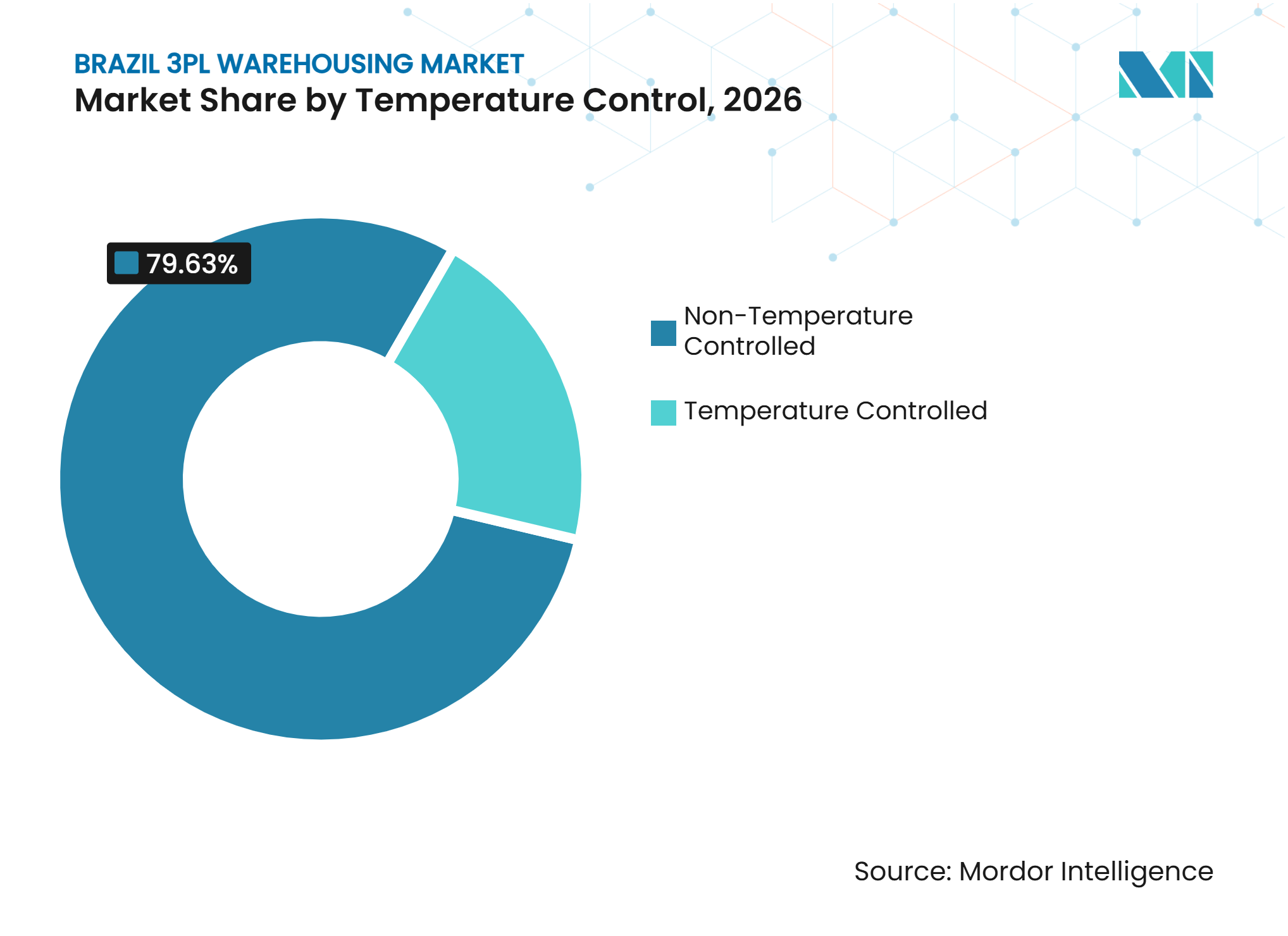
Cold Chain Scales Under Pharma and Protein DemandNon-temperature-controlled warehousing accounts for 79.63% of Brazil's 3PL warehousing market share in 2026, supported by demand from industrial and consumer goods sectors. These products represent a substantial portion of stored volumes and rely on conventional warehouse facilities. Temperature-controlled warehousing serves more specialized requirements, particularly in pharmaceuticals, food processing, and agri-protein exports. Brazil's cold-chain infrastructure is expected to reach 25.8 million m³ across 408 facilities in 2026, highlighting the importance of temperature monitoring, product integrity, and qualified facility management.
Temperature-controlled warehousing is forecast to register an 8.37% CAGR through 2032. Pharmaceutical compliance requirements and increasing demand for specialized storage for food and agricultural exports support growth. In September 2025, Emergent Cold Latin America completed its acquisition of Comfrio, creating a network of 37 facilities across 12 Brazilian states, with 4 million m³ of capacity and 610,000 pallet positions. The acquisition strengthened its cold-storage footprint and expanded its ability to serve customers requiring specialized temperature-controlled facilities. Larger networks also allow operators to spread energy, monitoring, and compliance costs across a broader asset base.

By Technology Adoption:
Automation Premium Widens the Competitive GapManual operations account for 62.18% of Brazil's 3PL warehousing market share in 2026, supported by the continued use of labor-intensive warehouse models among smaller regional providers, particularly those serving food, beverage, and fast-moving consumer goods clients. Semi-automated facilities combine conveyor systems, barcode scanning, and warehouse management systems with manual processes to improve operational efficiency. Fully automated facilities remain less widespread but are gaining relevance as e-commerce and fulfillment requirements become more demanding.
Fully automated operations are forecast to register an 8.02% CAGR through 2032. Growth is supported by increasing demand for picking accuracy, higher throughput, and compliance with service-level agreements. E-commerce platforms such as Amazon, Shopee, and Mercado Libre are raising technology requirements for warehouse operators through their requests for proposals. This is encouraging providers to adopt goods-to-person robotics and AI-driven inventory optimization. New Grade-A logistics facilities are also incorporating automation-ready infrastructure, including heavy-duty floors, higher clear heights, and reinforced electrical systems, allowing operators to install automated systems as requirements evolve. These capabilities are becoming increasingly important in securing contracts and retaining customers.
By End User Industry:
Manufacturing Anchors Volume, E-Commerce Drives GrowthManufacturing accounts for 28.84% of Brazil's 3PL warehousing market share in 2026, remaining the largest end-user category. Demand is supported by automotive, chemical, and paper-and-pulp companies that require consistent warehousing and distribution services. Consumer goods and food and beverage represent the next-largest end-user segments, as companies expand distribution networks into Brazil's interior. Healthcare and pharmaceutical customers also require specialized warehousing providers that can meet ANVISA requirements.
Retail and e-commerce is forecast to register a 9.91% CAGR through 2032, supported by demand for fulfillment capacity, automation, and wider distribution networks. Large online marketplaces prioritize high-throughput operations and broad network coverage, while direct-to-consumer (D2C) and social commerce businesses place greater emphasis on custom packaging and returns processing. In Q1 2026, JSL/Intralog reported winning a contract with a Chinese automotive original equipment manufacturer (OEM), highlighting opportunities for 3PL providers to serve new manufacturing entrants that outsource warehousing instead of developing their own networks. This creates opportunities for established providers to expand their industrial customer base alongside online retail clients.
Geography Analysis
The Southeast region accounts for 41.37% of Brazil 3PL warehousing market share in 2026. The region combines industrial output, population density, and established logistics assets, which makes it the primary national demand center. São Paulo generated 32% of national GDP and remained central to Brazil's most liquid logistics property base. DHL Supply Chain confirmed a 137,000 m² Jundiaí campus, while ID Logistics managed more than 1 million m² across 72 national sites. The concentration of global providers supports larger multi-client networks and shorter delivery times. The Southeast also faces the highest cargo theft exposure, so security planning remains a material compliance and cost issue for warehouse contracts.
The Northeast region is forecast to register an 8.14% CAGR through 2032, the fastest regional rate in the Brazil 3PL warehousing market. Modern warehouse supply, improving port connectivity, and rising intra-regional consumption are supporting a wider institutional logistics base. LOG Commercial Properties allocated 43% of its 2 million m² expansion program to the region, including activity in Fortaleza, Recife, Natal, and Maceió. Maersk opened an 11,920 m² distribution center in Cabo de Santo Agostinho in July 2026, located 20 km from the Port of Suape. The facility provides 11,297 pallet positions and 36 loading docks for integrated ocean-to-warehouse logistics. APM Terminals Suape began commercial operations in September 2026 with USD 350 million in investment and 400,000 TEU of initial capacity.
The South is tied to protein exports and grain corridors through Paranaguá, while the Central-West needs more storage and distribution capacity near agricultural production. Maersk expanded its Paranaguá cargo services area to 6,000 m² in April 2026. The Central-West has a 132 million-ton warehouse deficit, which directs 3PL interest toward inland distribution and bonded storage. DP World and MRS Logística launched a multimodal corridor in July 2026 that links the Central-West to Santos by rail. The North remains smaller but is developing early 3PL demand through agribusiness corridors.
Competitive Landscape
Market Concentration
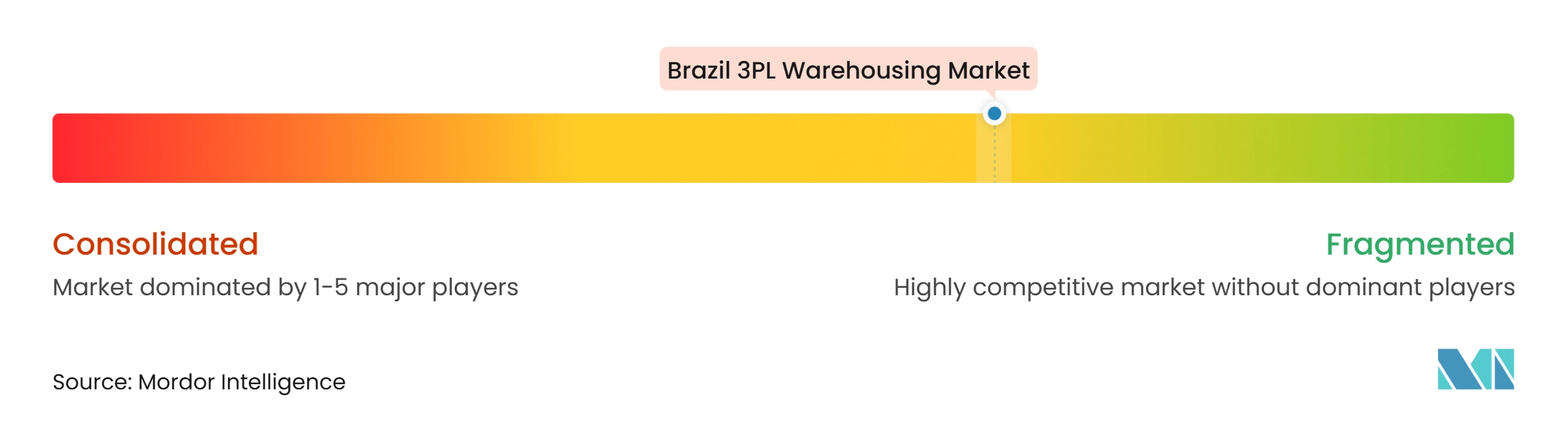
The Brazil 3PL warehousing market is moderately fragmented, with no operator holding a commanding national share. DHL Group, ID Logistics, CEVA Logistics, A.P. Moller-Maersk, Kuehne+Nagel, DSV, and GEODIS compete alongside JSL/Intralog, BBM Logística, Multilog, Tegma, and Sequoia Logística. Global providers offer connected ocean, inland, warehouse, and last-mile services under a single contract. Domestic providers compete through regional proximity, sector knowledge, and flexible operating models. The Brazil 3PL warehousing market has regional concentration and sector specialization rather than a single national leader.
CEVA Logistics expanded its Brazilian footprint by 150,000 m² in 12 months to nearly 300,000 m² nationally. ID Logistics doubled its Brazilian operation to 72 sites within 3 years by pursuing e-commerce fulfillment contracts that can extend into broader network activity. JSL created INTRALOG as an independent warehousing and intralogistics unit in November 2025. The subsidiary consolidated 65 distribution centers, more than 2 million m² of operational area, and around 15,000 direct employees across 14 states. The move shows how a domestic provider can organize specialized warehousing assets to compete with global integrators.
Warehouse management systems, AI-driven forecasting, and real-time inventory dashboards are central factors in contract renewal. Cold-chain automation and inland bonded warehousing remain areas with limited capacity, particularly where port-adjacent assets are full. Kuehne+Nagel handled 45,220 TEUs of containerized exports from January through October 2025, illustrating how forwarding activity can support contract logistics cross-selling.
Brazil 3PL Warehousing Industry Leaders
-
DHL Group
-
JSL SA
-
ID Logistics
-
Emergent Cold Latin America
-
Penske Logistics
- *Disclaimer: Major Players sorted in no particular order
Brazil 3PL Warehousing Market Companies Covered in this Report
- DHL Group
- JSL SA
- ID Logistics
- Emergent Cold Latin America
- Penske Logistics
- CEVA Logistics
- DSV A/S
- Kuehne+Nagel International AG
- A.P. Moller - Maersk
- FedEx Corp.
- BBM Logística SA
- GEODIS
- Multilog SA
- Tegma Gestão Logística SA
- FM Logistic
- Nippon Express Co. Ltd
- Yusen Logistics Co. Ltd
- Sequoia Logística e Transporte SA
- Friozem Armazéns Frigoríficos
- Luft Logistics
- TPC Logística Inteligente
- Andreani Logística
Recent Industry Developments in Brazil 3PL Warehousing Market
- September 2026: DHL Supply Chain and Amazon inaugurated a 31,000 m² distribution center in Cariacica, Espírito Santo, with an initial processing capacity exceeding 420,000 packages per week. Operated by DHL Supply Chain, the facility supports inventory storage, order fulfillment, and same-day delivery, strengthening Brazil's outsourced e-commerce warehousing infrastructure.
- July 2026: DP World and MRS Logística launched a multimodal agri-export corridor from the Central-West to the Port of Santos. Each container train displaces 40 trucks and can cut greenhouse gas emissions by up to 80% versus road transport.
- April 2026: A.P. Moller-Maersk opened new depots in Rio Grande and Paranaguá, adding dry and refrigerated cargo capacity along Southern agricultural export corridors. The expansion strengthens the operator's network in Rio Grande do Sul and Paraná.
- November 2025: CEVA Logistics signed a contract with Iveco Group to operate a 20,000 m² distribution center in Pouso Alegre, Minas Gerais. The facility supports Latin American spare-parts distribution and is backed by BRL 93 million (USD 16 million) in Iveco investment.
Brazil 3PL Warehousing Market Report Scope
Segmentation Overview
| Storage |
| Distribution and Inventory Management |
| Value-Added Services and Others (Kitting, Labeling) |
| General Shared / Multi-client Warehousing |
| Dedicated Contract Warehousing |
| Bonded Warehousing |
| Non-Temperature Controlled |
| Temperature Controlled |
| Manual |
| Semi-automated |
| Fully Automated |
| Manufacturing |
| Consumer Goods |
| Food and Beverage |
| Retail and E-commerce |
| Healthcare and Pharma |
| Other End-user Industries |
| North |
| Northeast |
| Central-West |
| Southeast |
| South |
| By Service Type | Storage |
| Distribution and Inventory Management | |
| Value-Added Services and Others (Kitting, Labeling) | |
| By Warehouse Type | General Shared / Multi-client Warehousing |
| Dedicated Contract Warehousing | |
| Bonded Warehousing | |
| By Temperature Control | Non-Temperature Controlled |
| Temperature Controlled | |
| By Technology Adoption | Manual |
| Semi-automated | |
| Fully Automated | |
| By End User Industry | Manufacturing |
| Consumer Goods | |
| Food and Beverage | |
| Retail and E-commerce | |
| Healthcare and Pharma | |
| Other End-user Industries | |
| By Region | North |
| Northeast | |
| Central-West | |
| Southeast | |
| South |
Key Questions Answered in the Report
What is the projected value of Brazil's 3PL warehousing sector by 2032?
Brazil's 3PL warehousing sector is projected to reach USD 3.71 billion by 2032, growing at a 7.18% CAGR from 2027. The outlook reflects demand for outsourced capacity, e-commerce fulfillment, and more flexible distribution networks.
Which service is expanding fastest in Brazil's 3PL warehousing sector?
Value-added services and others is the fastest-growing service category, with an 8.19% CAGR projected through 2032. Kitting, labeling, and packaging help providers build more integrated contracts with existing storage customers.
Why is e-commerce important to outsourced warehousing in Brazil?
E-commerce requires faster fulfillment, inventory positioning, and reliable order processing. It directly absorbed more than 34% of logistics warehouse leasing by the first quarter of 2026, increasing the value of sites near consumption centers.
Which warehouse format has the highest growth outlook in Brazil?
Bonded warehousing has the highest projected growth among warehouse types, at a 9.27% CAGR through 2032. Growth is linked to import activity, customs modernization, and the need to relieve port-adjacent capacity constraints.
What is the leading challenge for cold-chain warehouse operators in Brazil?
Refrigeration can represent up to 70% of cold-storage operating costs, making energy price volatility a major margin constraint. Larger networks can have an advantage where they can improve energy procurement and spread fixed compliance costs.
Which Brazilian region has the strongest growth outlook for 3PL warehousing?
The Northeast has the strongest forecast regional expansion, with an 8.14% CAGR through 2032, supported by new warehouse and port infrastructure. The Suape area is becoming more relevant for bonded, cold-chain, and general logistics services.