
Brazed Plate Heat Exchangers Market Size and Share
Market Overview
| Study Period | 2022 - 2032 |
|---|---|
| Market Size (2027) | USD 1.35 Billion |
| Market Size (2032) | USD 1.89 Billion |
| Growth Rate (2027 - 2032) | 6.92 % |
| Fastest Growing Market | Asia-Pacific |
| Largest Market | Europe |
| Market Concentration | High |
Major Players *Disclaimer: Major Players sorted in no particular order Image © Mordor Intelligence. Reuse requires attribution under CC BY 4.0. | |
Brazed Plate Heat Exchangers Market Analysis by Mordor Intelligence
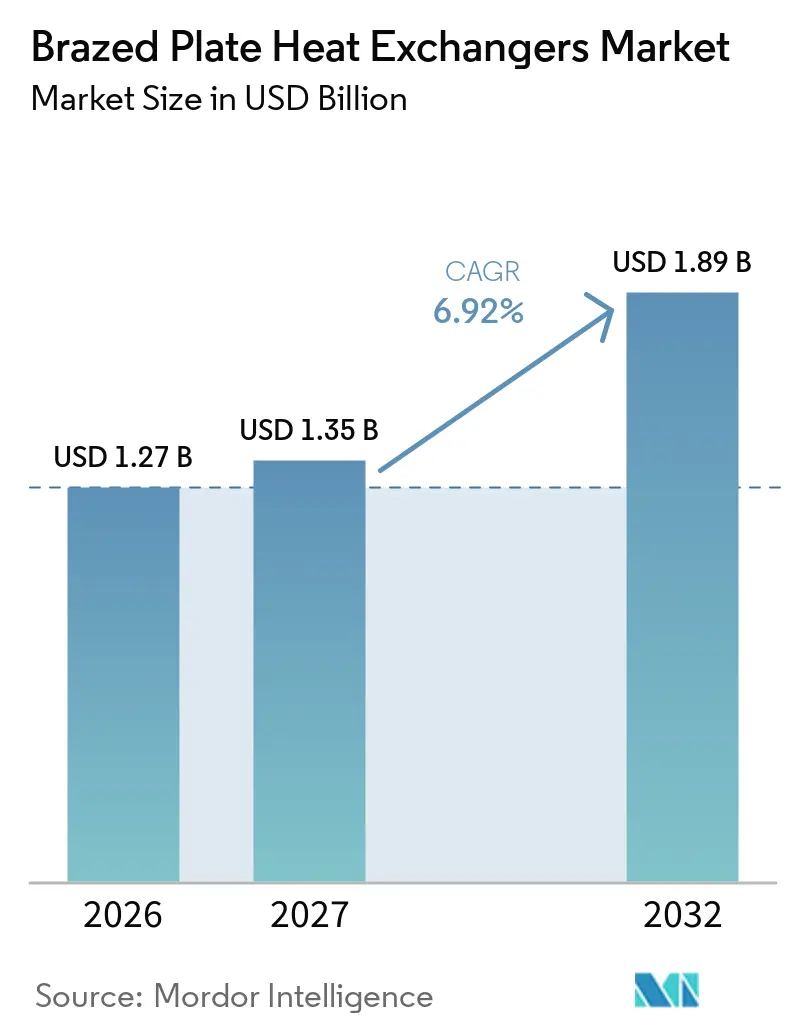
The Brazed Plate Heat Exchangers Market size is projected to expand from USD 1.27 billion in 2026 and USD 1.35 billion in 2027 to USD 1.89 billion by 2032, registering a CAGR of 6.92% between 2027 and 2032. The brazed plate heat exchangers market is supported by building electrification, higher energy-efficiency requirements, industrial heat recovery, and liquid cooling for data centers. Its compact, sealed construction is valuable where available space is limited, and service access is difficult. Heat-pump equipment and refrigeration systems are moving toward refrigerants that require higher pressure capability and stronger safety controls. These requirements favor suppliers that can validate products for specific operating conditions and support equipment manufacturers during design work. The brazed plate heat exchangers market also faces limits in applications with dirty fluids, because permanently bonded units cannot be opened for mechanical cleaning.
Key Report Takeaways
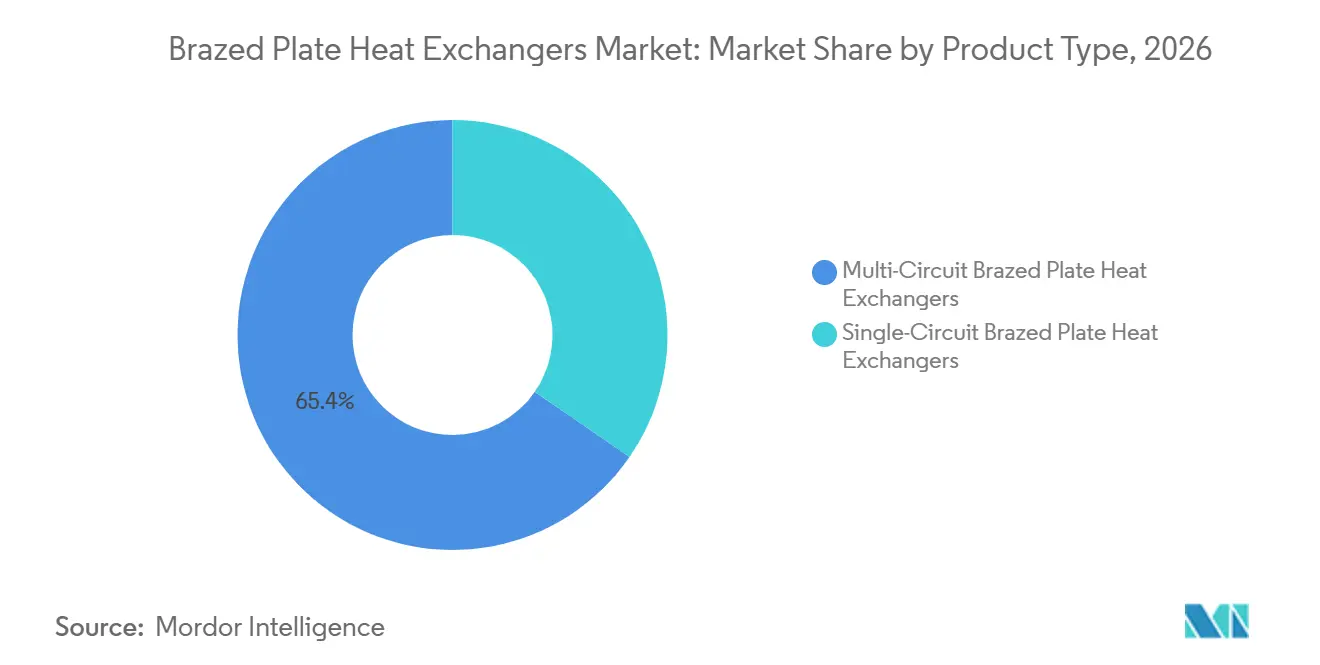
- By product type, multi-circuit designs held 65.4% of the brazed plate heat exchangers market share in 2026, while single-circuit designs are forecast to grow at a 7.2% CAGR through 2032.
- By brazing material, copper-brazed units accounted for 45.7% of revenue in 2026, while nickel-brazed units are forecast to grow at a 7.8% CAGR through 2032.
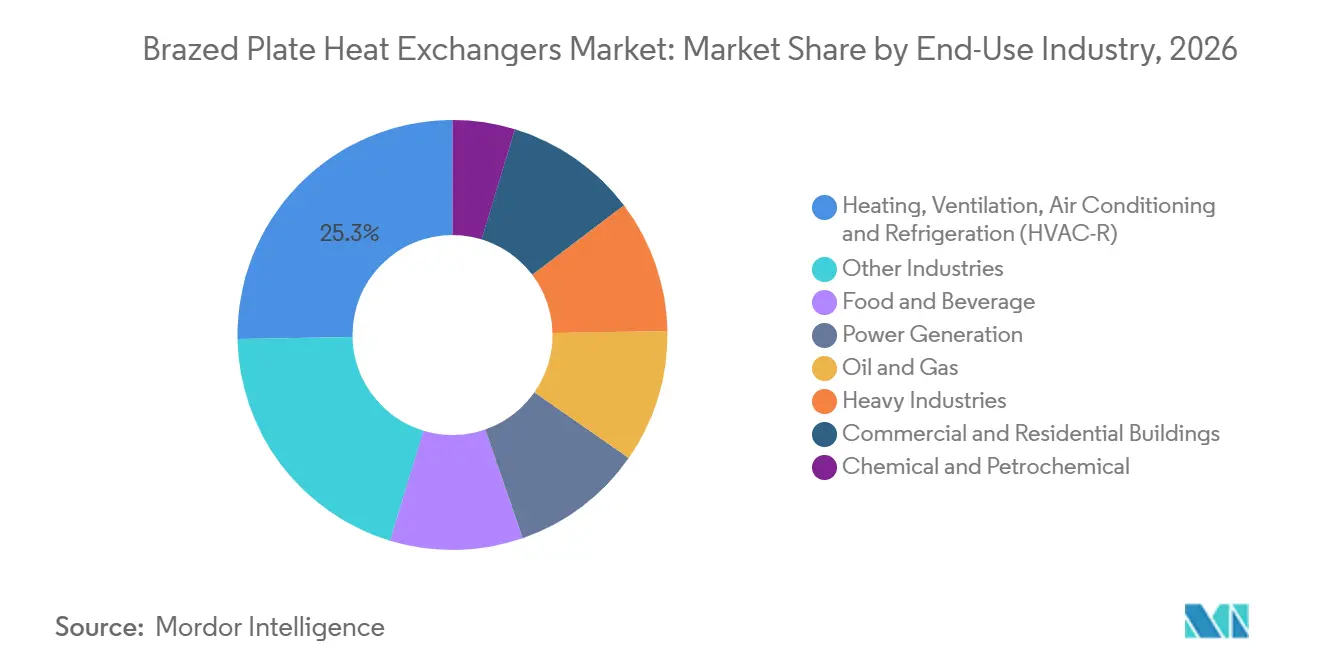
- By end-use industry, Heating, Ventilation, Air Conditioning, and Refrigeration (HVAC-R) accounted for 25.3% of revenue in 2026, while Chemical and Petrochemical is forecast to grow at a 7.6% CAGR through 2032.
- By geography, Europe held 32.2% of revenue in 2026, while Asia-Pacific is forecast to grow at an 8.1% CAGR through 2032.
Note: Market numbers in this report are based on Mordor Intelligence's proprietary estimation framework, which combines nine months of actuals with Q4 projections for base year 2026.
Market Trends and Insights
Drivers Impact Analysis of Brazed Plate Heat Exchangers Market*
| Driver | (~) % Impact on CAGR Forecast | Geographic Relevance | Impact Timeline |
|---|---|---|---|
| Heat Pump and Building Electrification Deployment | +1.8% | Europe, North America, and Asia-Pacific | Medium term (2-4 years) |
| Energy-Efficiency and Carbon-Reduction Requirements | +1.5% | Global, led by the EU, Japan, and South Korea | Long term (≥ 4 years) |
| AI Data Center Liquid-Cooling Capacity Expansion | +1.7% | North America, Asia-Pacific, and EMEA | Short term (≤ 2 years) |
| Industrial Waste-Heat Recovery and Process Intensification | +1.0% | Asia-Pacific, Europe, and the Middle East and Africa | Medium term (2-4 years) |
| Low-GWP and Natural-Refrigerant System Adoption | +0.9% | Europe, North America, and Asia-Pacific | Medium term (2-4 years) |
| Compact Thermal Management in Space-Constrained Equipment | +0.6% | Global, especially urban commercial and data-center applications | Medium term (2-4 years) |
| Source: Mordor Intelligence | |||
Heat Pump and Building Electrification Deployment
Heat-pump deployment is a major source of demand for the brazed plate heat exchangers market. The European Heat Pump Association and Bundesverband Wärmepumpe reported 2.62 million residential heat-pump sales across 16 reporting countries in 2025. The same source placed Europe’s installed base at 28 million units. Air-to-water heat pumps use brazed plate heat exchangers as condensers or evaporators, which link component demand to equipment installation. Danfoss introduced a cold-climate economizer in February 2025 that pairs a brazed plate heat exchanger with vapor-injection technology. The design supports scroll-compressor operation at low outdoor temperatures and addresses a barrier that has limited adoption in colder areas.[1] Building renovation programs and the replacement of gas boilers create a continuing need for compact heat-transfer components. This makes product qualification with heat-pump original equipment manufacturers important for the brazed plate heat exchangers market.[2]
AI Data Center Liquid-Cooling Capacity Expansion
Data-center cooling is creating a distinct demand channel for the brazed plate heat exchangers market. Liquid cooling requires an interface between facility water and coolant loops inside cooling distribution units. Brazed construction helps separate these loops in a compact assembly. SWEP introduced the B327 and B224 models in December 2025 for data-center cooling and heat-reuse applications. The company designed the products with large ports for higher flow and lower pressure drop. The B327 supports heat-reuse duties up to 1,000 kW, which can connect cooling infrastructure with district-heating uses. This application can require multiple heat-transfer points within one facility when cooling and recovered heat are both managed. The requirement for validated hydraulic and thermal performance strengthens the role of engineering support in the brazed plate heat exchangers market.[3]
Energy-Efficiency and Carbon-Reduction Requirements
Energy efficiency affects equipment choices across building and industrial systems. A 2025 scientific study reported that water-cooled brazed plate condenser designs can provide high heat-transfer performance in a compact form factor. Compact equipment can reduce the space required for a given thermal duty when compared with larger conventional configurations. This is relevant in retrofit projects where plant-room space or equipment footprint is restricted. SWEP introduced CO2-reduced steel for European brazed plate heat exchanger ranges in April 2025. The company stated that ISO 14067-verified carbon calculations are available by product type. Product-level environmental information can help equipment manufacturers document material choices in procurement and reporting processes. These developments give the brazed plate heat exchangers market an additional route to compete beyond capacity and price.[4]
Low-Global Warming Potential (GWP) and Natural-Refrigerant System Adoption
The transition to lower-global-warming-potential refrigerants changes the performance requirements placed on heat exchangers. Carbon dioxide systems require units suited to high-pressure operation, while propane systems require designs that limit refrigerant charge and protect water circuits. Danfoss launched the H48T-CH CO2/water brazed heat exchanger in May 2025 for transcritical commercial refrigeration systems. The company positioned the product for gas-cooler, condenser, sub-cooler, and economizer duties. Danfoss also introduced three R290 Micro Plate models in November 2025 for residential heat pumps. The HDW30-C is a double-wall unit intended to prevent refrigerant-to-water contamination in domestic hot-water circuits. Product designs for CO2 and R290 systems create higher engineering and validation requirements across the brazed plate heat exchangers market.
Restraints Impact Analysis of Brazed Plate Heat Exchangers Market*
| Restraint | (~) % Impact on CAGR Forecast | Geographic Relevance | Impact Timeline |
|---|---|---|---|
| Stainless Steel, Copper, Nickel, and Specialty-Alloy Price Volatility | -0.9% | Global, with high exposure in North America and Asia-Pacific | Short term (≤ 2 years) |
| Fouling and Limited Mechanical Cleanability | -0.6% | Global, especially water-intensive industrial and food-processing applications | Long term (≥ 4 years) |
| High-Pressure Design and Validation Complexity for CO2 Systems | -0.4% | Europe, Japan, and North America | Medium term (2-4 years) |
| Fixed Plate Configuration and Limited Post-Installation Modularity | -0.3% | Global, especially data-center and modular industrial applications | Long term (≥ 4 years) |
| Source: Mordor Intelligence | |||
Fouling and Limited Mechanical Cleanability
Fouling limits the use of brazed units in process streams that contain minerals, biological material, or particulates. The plates are permanently bonded, so the unit cannot be opened and mechanically cleaned in the way a gasketed plate heat exchanger can. Chemical circulation is the available cleaning method, but it may not remove all forms of scale or deposits. This constraint can lead engineering teams to use brazed units for clean secondary circuits rather than primary process duties. The US Department of Energy’s Office of Scientific and Technical Information published 2025 research on joining approaches for formed plate heat exchangers. The research supports continued work on materials and joining methods, although commercial use of fouling-resistant surface approaches remains limited in this product category. Cleanability therefore remains an important selection factor in the brazed plate heat exchangers market.
Stainless Steel, Copper, Nickel, and Specialty-Alloy Price Volatility
Material costs affect component margins and contract pricing in the brazed plate heat exchangers market. Stainless steel, copper, nickel, and specialty alloys are important inputs in plates and brazing materials. Cost changes can be difficult to pass through when equipment suppliers have fixed-price customer agreements. Buyers can respond by approving more than one source or by choosing alternative material when the application permits it. These decisions increase the value of reliable supply planning and clear material specifications. Material changes can also require performance review when pressure, corrosion resistance, or compatibility with refrigerants is affected. Manufacturers therefore need to manage material availability alongside technical compliance and lead times.
*Our forecasts treat driver/restraint impacts as directional, not additive. The impact forecasts reflect baseline growth, mix effects, and variable interactions.
Brazed Plate Heat Exchangers Market Segment Analysis
By Product Type:
Multi-Circuit Designs Lead, Single-Circuit Gains in Distributed CoolingMulti-circuit designs accounted for 65.4% of revenue in 2026. This leadership reflects their use in heat pumps, district-energy substations, and industrial refrigeration. Multiple circuits can transfer heat while keeping fluids hydraulically separated. This is particularly important where refrigerant must be isolated from potable water. Danfoss introduced the HDW30-C double-wall unit for R290 applications in November 2025. The product shows how multi-circuit and double-wall designs address domestic hot-water safety needs. The brazed plate heat exchangers industry benefits when a change in refrigerant requires a more specialized unit rather than a direct replacement. These product requirements also give qualified suppliers a stronger role in heat-pump system design.
Single-circuit designs are forecast to grow at a 7.2% CAGR through 2032. Their growth is tied to cooling distribution units and decentralized heat substations. Data-center applications value lower pressure drop and large-port configurations that can carry higher flows. SWEP developed the B327 and B224 for these operating needs. The same products are designed for cooling and heat-reuse duties, which widens their possible use within a facility. Apartment-level heat interface units are another relevant application because compact equipment preserves usable building space. The brazed plate heat exchangers market size for single-circuit designs is therefore supported by both digital infrastructure and district-energy connections.

By Brazing Material:
Copper Anchors Volume, Nickel Advances on Pressure and ChemistryCopper-brazed units accounted for 45.7% of revenue in 2026. They are widely used in HVAC-R, food and beverages, and standard industrial systems that use water or glycol fluids. Copper offers strong thermal conductivity and supports a broad installed base of conventional applications. European heat-pump installations provide an important volume base for this category. SWEP’s CO2-reduced steel option also gives purchasers supporting environmental product information for relevant European product ranges. This allows copper-brazed product lines to be evaluated on thermal performance and documented material information.
Nickel-brazed units are forecast to grow at a 7.8% CAGR through 2032. They are suited to chemical, petrochemical, oil and gas, and high-salinity applications where copper may be unsuitable. Higher pressure requirements in transcritical CO2 systems also favor materials and designs with greater pressure capability. The brazed plate heat exchangers market share held by copper remains substantial, but nickel addresses applications with distinct requirements for chemical compatibility. Stainless steel and specialty-alloy variants serve more demanding corrosive or offshore conditions. These products compete on lifecycle performance instead of initial equipment cost alone. Suppliers must match the brazing material to refrigerant, process fluid, design pressure, and expected service conditions.
By End-Use Industry:
HVAC-R Anchors the Base, Chemical and Petrochemical AcceleratesHVAC-R accounted for 25.3% of end-use revenue in 2026. Heat pumps, chillers, and district-energy substations each use brazed units in several thermal duties. Heat-pump design is becoming more complex as equipment moves to CO2 and R290 refrigerants. These systems may need thicker walls, higher pressure ratings, or specialized plate geometry. Higher technical requirements can increase the value of the component even when equipment volumes follow established installation cycles. The brazed plate heat exchangers industry is therefore closely connected to heat-pump product development. The growth of installed heat-pump fleets can also support replacement and service demand over time.
Chemical and Petrochemical are forecast to grow at a 7.6% CAGR through 2032. Process intensification supports compact heat-transfer equipment in brownfield expansions with limited floor space. Brazed units can be appropriate for clean streams and secondary cooling or heating loops. Fouling restrictions remain important in primary streams that contain solids or difficult deposits. Food and beverage applications show a similar tradeoff, with brazed units more suitable for clean duties than particulate-laden streams. Power generation and oil and gas support demand through waste-heat recovery and process-fluid cooling. Heavy industries, commercial buildings, and residential buildings add demand through electrification and energy-management investments. These ends create a broad application base for the brazed plate heat exchangers market.
Geography Analysis
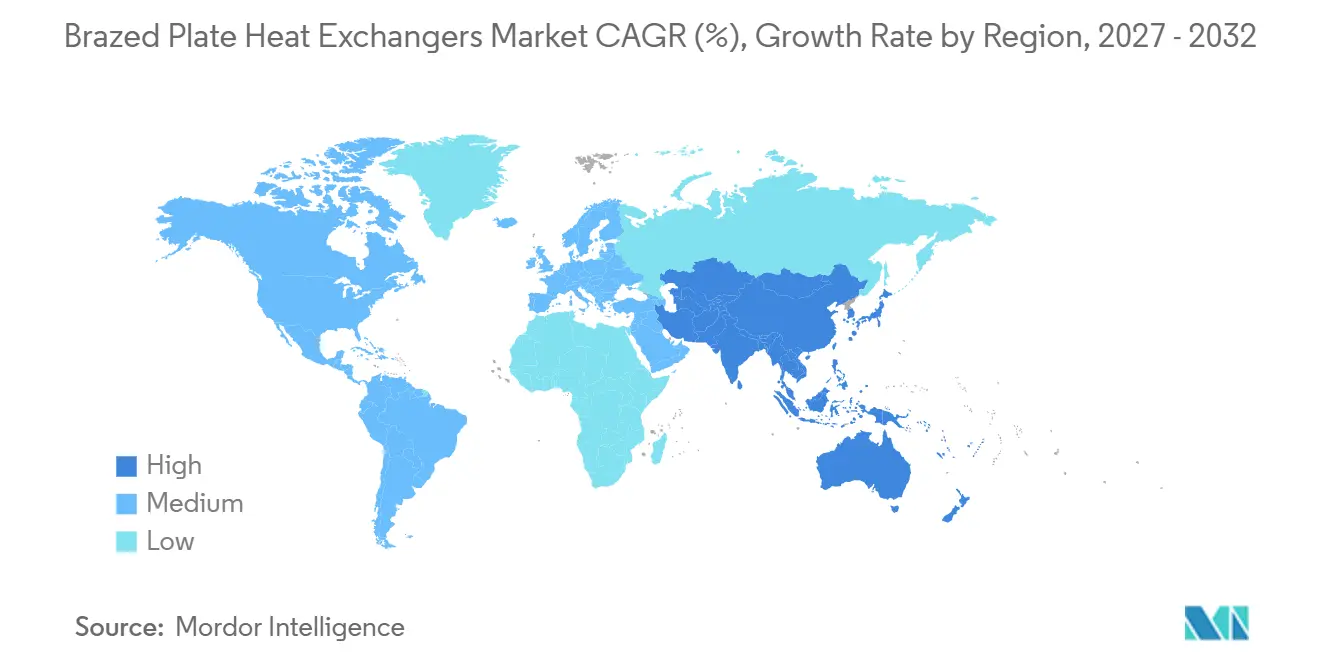
Europe held 32.2% of revenue in 2026. District-heating systems, building electrification, and refrigerant transition requirements support demand across the region. Germany, France, and the Nordic countries have dense heat-pump and district-energy activity. Poland and the Netherlands are also modernizing district-heating infrastructure and expanding heat-pump deployment. The European Heat Pump Association and Bundesverband Wärmepumpe (BWP) reported 2.62 million residential heat-pump sales in 2025 across 16 reporting countries. They also reported an installed base of 28 million units in Europe. These conditions give Europe a large installed equipment base for the brazed plate heat exchangers market.
Asia-Pacific is forecast to grow at an 8.1% CAGR through 2032. The region combines data-center investment, industrial equipment demand, and developing heat-pump adoption. China, India, and Southeast Asia are relevant for cooling infrastructure and industrial process equipment. Indonesia, Malaysia, and Thailand contribute demand from industrial activity. Japan and South Korea add a residential heat-pump opportunity linked to their carbon-reduction programs. This combination provides several end-use channels rather than reliance on a single application. The brazed plate heat exchangers market size in Asia-Pacific is therefore supported by industrial, digital, and building-related demand.
North America is a mid-growth region led by cooling distribution units and commercial heat-pump demand. The Heat Pumping Technologies program reported that US heat-pump sales rebounded 15% in 2025 and that heat pumps outsold gas furnaces. This supports a larger base for residential and light-commercial thermal equipment. South America, the Middle East, and Africa are smaller contributors. Brazil, Saudi Arabia, and the United Arab Emirates are relevant through industrial and petrochemical investment. High ambient temperatures and process pressures in refinery settings can support demand for nickel-brazed and specialty-alloy units. These regional requirements keep the brazed plate heat exchangers market tied to both electrification and industrial modernization.
Competitive Landscape
The brazed plate heat exchangers market is highly consolidated among leading suppliers and more fragmented across regional specialists. Large suppliers benefit from proprietary plate geometry, brazing capacity, and long-standing original equipment manufacturer approvals. These capabilities are difficult to reproduce quickly because customers validate thermal performance against specific product designs. Digital selection tools can deepen this relationship by connecting equipment design with a supplier’s product data. Suppliers that achieve certification for high-pressure or natural-refrigerant systems gain an additional entry barrier. Regional companies compete through faster lead times and local technical support. The competitive position of each supplier therefore depends on technical validation, manufacturing capacity, and service response.
SWEP’s December 2025 launch of the B327 and B224 shows a focus on cooling distribution units and heat reuse. The B327 supports duties up to 1,000 kW, which addresses data-center cooling and recovery of waste heat. Danfoss launched the H48T-CH CO2/water model in May 2025 for transcritical commercial refrigeration. It then introduced 3 R290 models in November 2025 for residential heat pumps. These moves show how suppliers are tailoring products to refrigerant, pressure, and application requirements. SWEP also introduced CO2-reduced steel with ISO 14067-verified calculations for European ranges. Carbon information can become relevant in customer selection where equipment manufacturers need documented product data.
Kaori Heat Treatment and Onda are examples of regional specialists that can compete where localized supply and support matter. Companies with established gasketed or welded plate portfolios may seek brazed product opportunities in cooling and natural-refrigerant applications. However, original equipment manufacturer requalification remains necessary before new products can secure recurring equipment programs. Certification for pressure and refrigeration safety requirements can extend product-development timelines. Supplier selection therefore remains application specific, especially for CO2, R290, high-pressure, and corrosive-service duties. The brazed plate heat exchangers market continues to reward companies that combine product specialization with dependable local support.
Brazed Plate Heat Exchangers Industry Leaders
-
Alfa Laval AB
-
Danfoss A/S
-
Kelvion Holding GmbH
-
SWEP International AB
-
Kaori Heat Treatment Co., Ltd.
- *Disclaimer: Major Players sorted in no particular order

Brazed Plate Heat Exchangers Market Companies Covered in this Report
- AIC
- Alfa Laval AB
- API Heat Transfer Inc.
- Barriquand Technologies Thermiques
- Boyd Corporation
- Chart Industries, Inc.
- Danfoss A/S
- Diversified Heat Transfer, Inc.
- FUNKE Wärmeaustauscher Apparatebau GmbH
- GEA Group Aktiengesellschaft
- Hisaka Works, Ltd.
- HRS Heat Exchangers Ltd.
- Kaori Heat Treatment Co., Ltd.
- Kelvion Holding GmbH
- Onda S.p.A.
- Secespol Sp. z o.o.
- SPX FLOW, Inc.
- SWEP International AB
- Tranter Inc.
- Xylem Inc.
Recent Industry Developments in Brazed Plate Heat Exchangers Market
- December 2025: SWEP, part of Dover Corporation, launched the B327 and B224 brazed plate heat exchangers for data-center liquid cooling and district energy applications. The B327 also supports heat reuse up to 1,000 kW.
- May 2025: Danfoss launched the H48T-CH CO2/water brazed heat exchanger for transcritical CO2 commercial refrigeration systems. The unit can serve as a gas cooler, condenser, sub-cooler, and economizer.
- April 2025: SWEP introduced CO2-reduced steel as a material option for its European brazed plate heat exchanger ranges. The company made ISO 14067-verified carbon calculations available by product type.
Global Brazed Plate Heat Exchangers Market Report Scope
A brazed plate heat exchanger (BPHE) is a high-efficiency device that transfers thermal energy between two fluids without mixing them.
The global brazed plate heat exchangers market is segmented by product type, brazing material, end-use industry, and geography. By product type, the market is segmented into single-circuit and multi-circuit brazed plate heat exchangers. By brazing material, the market is segmented into copper-brazed, nickel-brazed, stainless steel, and specialty-alloy brazed plate heat exchangers. By end-use industry, the market is segmented into heating, ventilation, air conditioning, and refrigeration (HVAC-R), chemical and petrochemical, food and beverage, power generation, oil and gas, heavy industries, commercial and residential buildings, and other industries. The report also covers the market size and forecasts for the global brazed plate heat exchanger market across 28 countries in key regions. For each segment, the market sizing and forecasts have been provided on the basis of value (USD).
Segmentation Overview
| Single-Circuit Brazed Plate Heat Exchangers |
| Multi-Circuit Brazed Plate Heat Exchangers |
| Copper-Brazed Plate Heat Exchangers |
| Nickel-Brazed Plate Heat Exchangers |
| Stainless Steel and Specialty-Alloy Brazed Plate Heat Exchangers |
| Heating, Ventilation, Air Conditioning and Refrigeration (HVAC-R) |
| Chemical and Petrochemical |
| Food and Beverage |
| Power Generation |
| Oil and Gas |
| Heavy Industries |
| Commercial and Residential Buildings |
| Other Industries |
| North America | United States |
| Canada | |
| Mexico | |
| Europe | Germany |
| France | |
| Italy | |
| Spain | |
| United Kingdom | |
| Poland | |
| Netherlands | |
| Russia | |
| Rest of Europe | |
| Asia-Pacific | China |
| India | |
| Japan | |
| South Korea | |
| Australia | |
| Indonesia | |
| Malaysia | |
| Thailand | |
| Philippines | |
| Rest of Asia-Pacific | |
| South America | Brazil |
| Argentina | |
| Colombia | |
| Rest of South America | |
| Middle East and Africa | Saudi Arabia |
| United Arab Emirates | |
| South Africa | |
| Egypt | |
| Nigeria | |
| Rest of Middle East and Africa |
| By Product Type | Single-Circuit Brazed Plate Heat Exchangers | |
| Multi-Circuit Brazed Plate Heat Exchangers | ||
| By Brazing Material | Copper-Brazed Plate Heat Exchangers | |
| Nickel-Brazed Plate Heat Exchangers | ||
| Stainless Steel and Specialty-Alloy Brazed Plate Heat Exchangers | ||
| By End-Use Industry | Heating, Ventilation, Air Conditioning and Refrigeration (HVAC-R) | |
| Chemical and Petrochemical | ||
| Food and Beverage | ||
| Power Generation | ||
| Oil and Gas | ||
| Heavy Industries | ||
| Commercial and Residential Buildings | ||
| Other Industries | ||
| By Geography | North America | United States |
| Canada | ||
| Mexico | ||
| Europe | Germany | |
| France | ||
| Italy | ||
| Spain | ||
| United Kingdom | ||
| Poland | ||
| Netherlands | ||
| Russia | ||
| Rest of Europe | ||
| Asia-Pacific | China | |
| India | ||
| Japan | ||
| South Korea | ||
| Australia | ||
| Indonesia | ||
| Malaysia | ||
| Thailand | ||
| Philippines | ||
| Rest of Asia-Pacific | ||
| South America | Brazil | |
| Argentina | ||
| Colombia | ||
| Rest of South America | ||
| Middle East and Africa | Saudi Arabia | |
| United Arab Emirates | ||
| South Africa | ||
| Egypt | ||
| Nigeria | ||
| Rest of Middle East and Africa | ||
Key Questions Answered in the Report
What is the projected growth rate for brazed plate heat exchangers through 2032?
The category is forecast to grow at a 6.92% CAGR from 2027 to 2032, increasing from USD 1.35 billion in 2027 to USD 1.89 billion in 2032.
Which product type leads brazed plate heat exchanger demand?
Multi-circuit designs lead with 65.4% of revenue in 2026, supported by heat pumps, district energy, and industrial refrigeration.
Why are nickel-brazed heat exchangers growing faster than other materials?
Nickel-brazed units are forecast to grow at a 7.8% CAGR because they suit chemical, petrochemical, high-salinity, and high-pressure applications.
Which end-use sector is growing fastest for brazed plate heat exchangers?
Chemical and Petrochemical is forecast to grow at a 7.6% CAGR through 2032, supported by compact equipment needs in process-intensification projects.
Which region leads and which region grows fastest?
Europe leads with 32.2% of 2026 revenue, while Asia-Pacific is forecast to grow fastest at an 8.1% CAGR through 2032.
What are the main constraints on brazed plate heat exchanger use?
Fouling and limited mechanical cleanability restrict use with difficult process streams, while changes in metal and alloy costs can complicate pricing and procurement.