
Brazil Air Freight Transport Market Size and Share
Market Overview
| Study Period | 2021 - 2032 |
|---|---|
| Forecast Data Period | 2027 - 2032 |
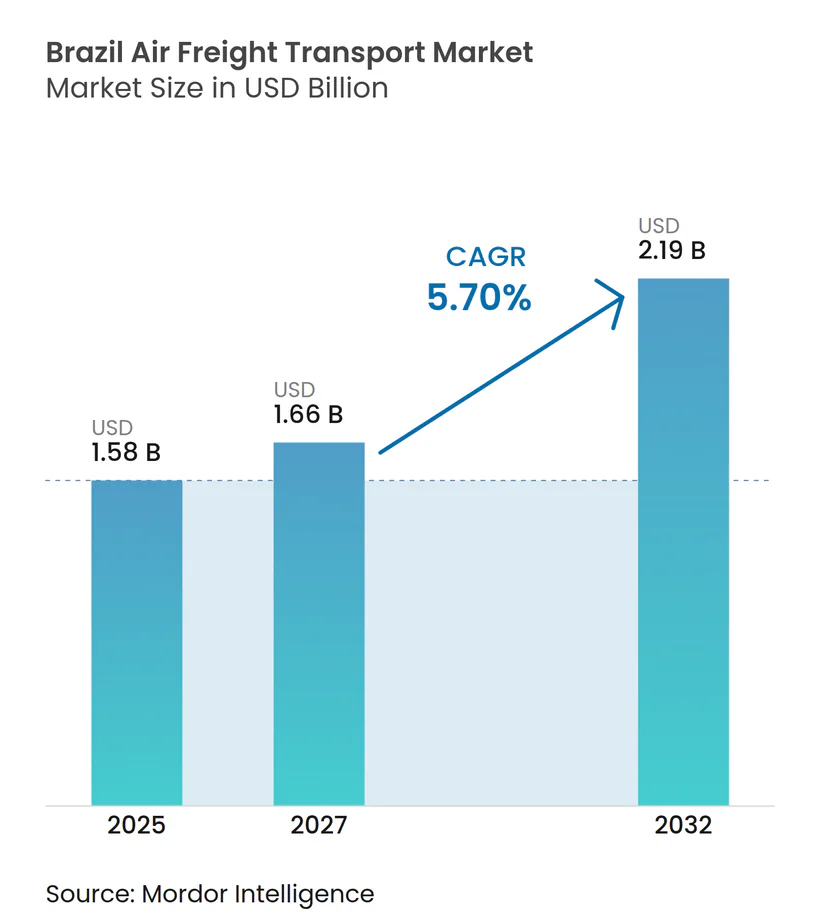
| Base Year Market Size (2025) | USD 1.58 Billion |
| Market Size (2027) | USD 1.66 Billion |
| Market Size (2032) | USD 2.19 Billion |
| Growth Rate (2027 - 2032) | 5.70 % |
| Market Concentration | High |
Major Players *Disclaimer: Major Players sorted in no particular order Image © Mordor Intelligence. Reuse requires attribution under CC BY 4.0. | |
Brazil Air Freight Transport Market Analysis by Mordor Intelligence
The Brazil air freight transport market size is valued at USD 1.58 billion in 2026 and is estimated to grow from USD 1.66 billion in 2027 to reach USD 2.19 billion by 2032, at a CAGR of 5.70% during the forecast period (2027-2032).
The Brazil air freight transport market is being shaped by cross-border e-commerce, which is raising demand for reliable movement of small, time-sensitive shipments. Dedicated freighter fleets are becoming more relevant because they give operators control over schedules that passenger aircraft capacity cannot always provide. Pharmaceutical imports, fresh produce exports, and high-value industrial cargo are also shifting demand toward temperature-controlled, compliant, and closely monitored services. The concentration of cargo activity in the Southeast supports network efficiency, but it also exposes shippers to congestion at Guarulhos and nearby gateways. Competition is widening as domestic airlines, global integrators, and international freighter operators invest in aircraft, automation, customs processes, and regional airport access.
Key Report Takeaways
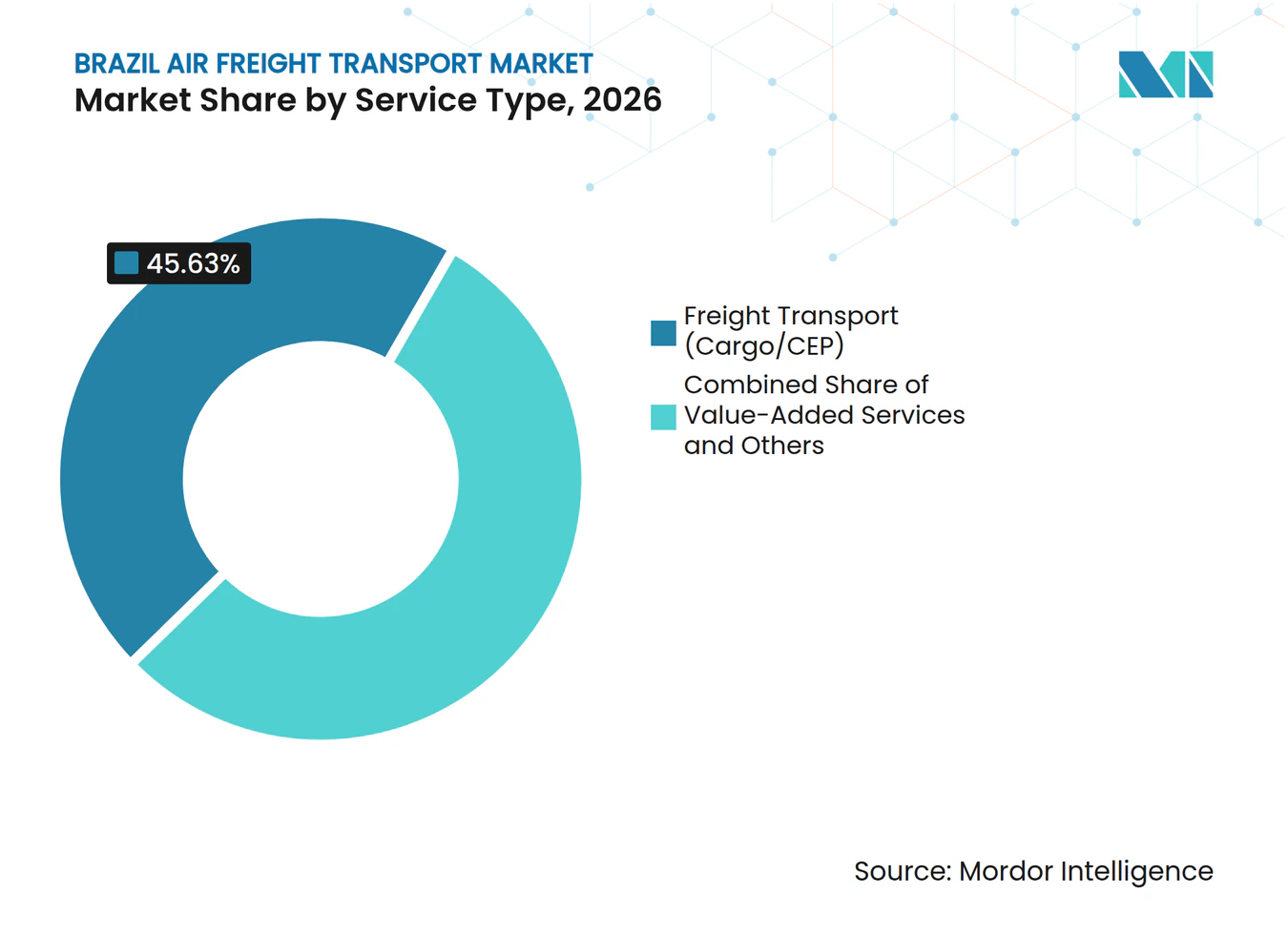
- By service, freight transport (cargo/CEP) accounts for 45.63% of the Brazil air freight transport market size in 2026, while other value-added services are projected to register a 7.31% CAGR through 2032.
- By destination, international cargo accounts for 72.19% of the Brazil air freight transport market share in 2026, while domestic routes are forecast to expand at a 7.21% CAGR through 2032.
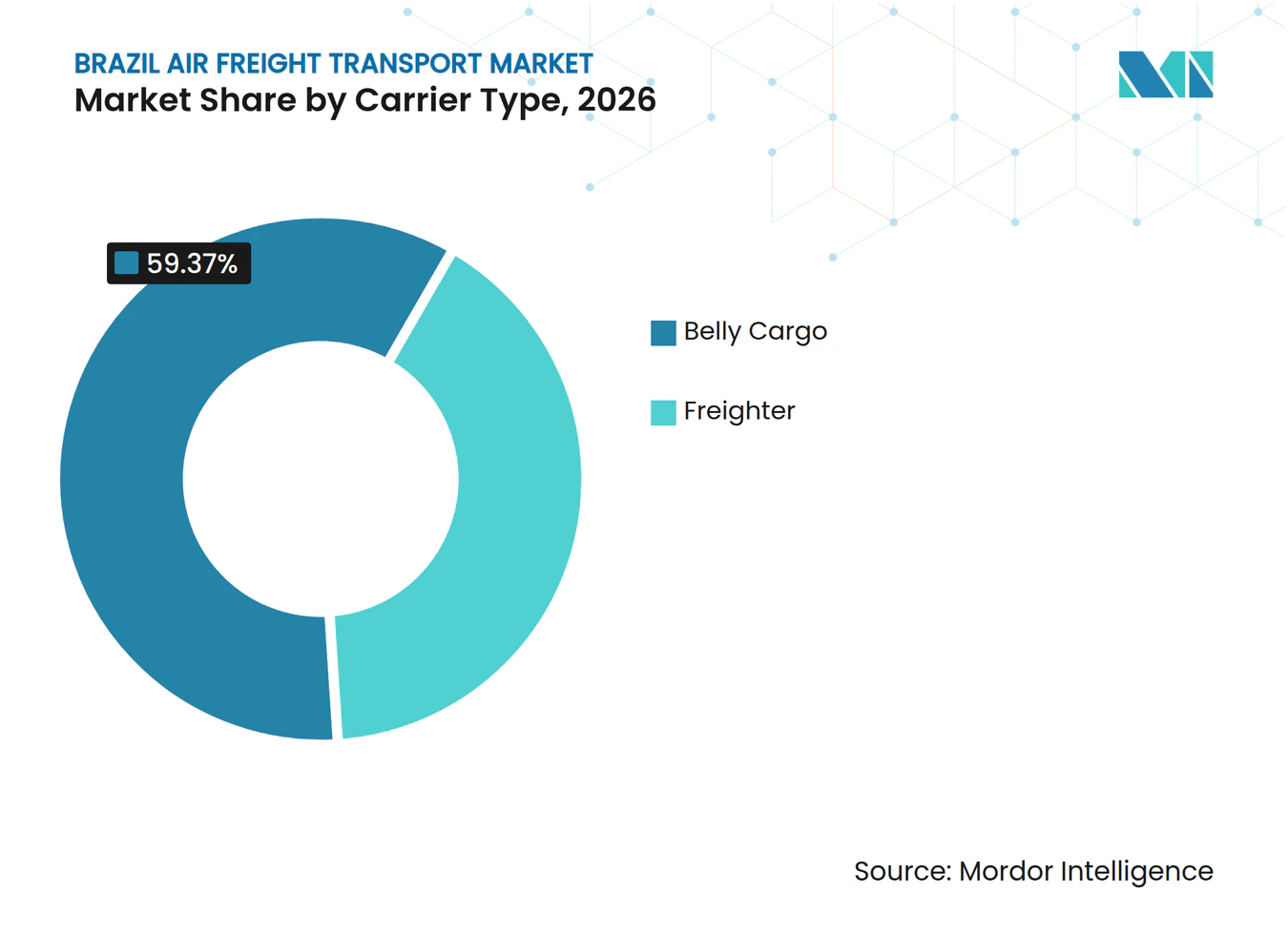
- By carrier type, belly cargo accounts for 59.37% of the Brazil air freight transport market size in 2026, while freighter services are forecast to register a 7.64% CAGR through 2032.
- By cargo type, general cargo accounts for 62.31% of the Brazil air freight transport market share in 2026, while special cargo is projected to expand at a 6.92% CAGR through 2032.
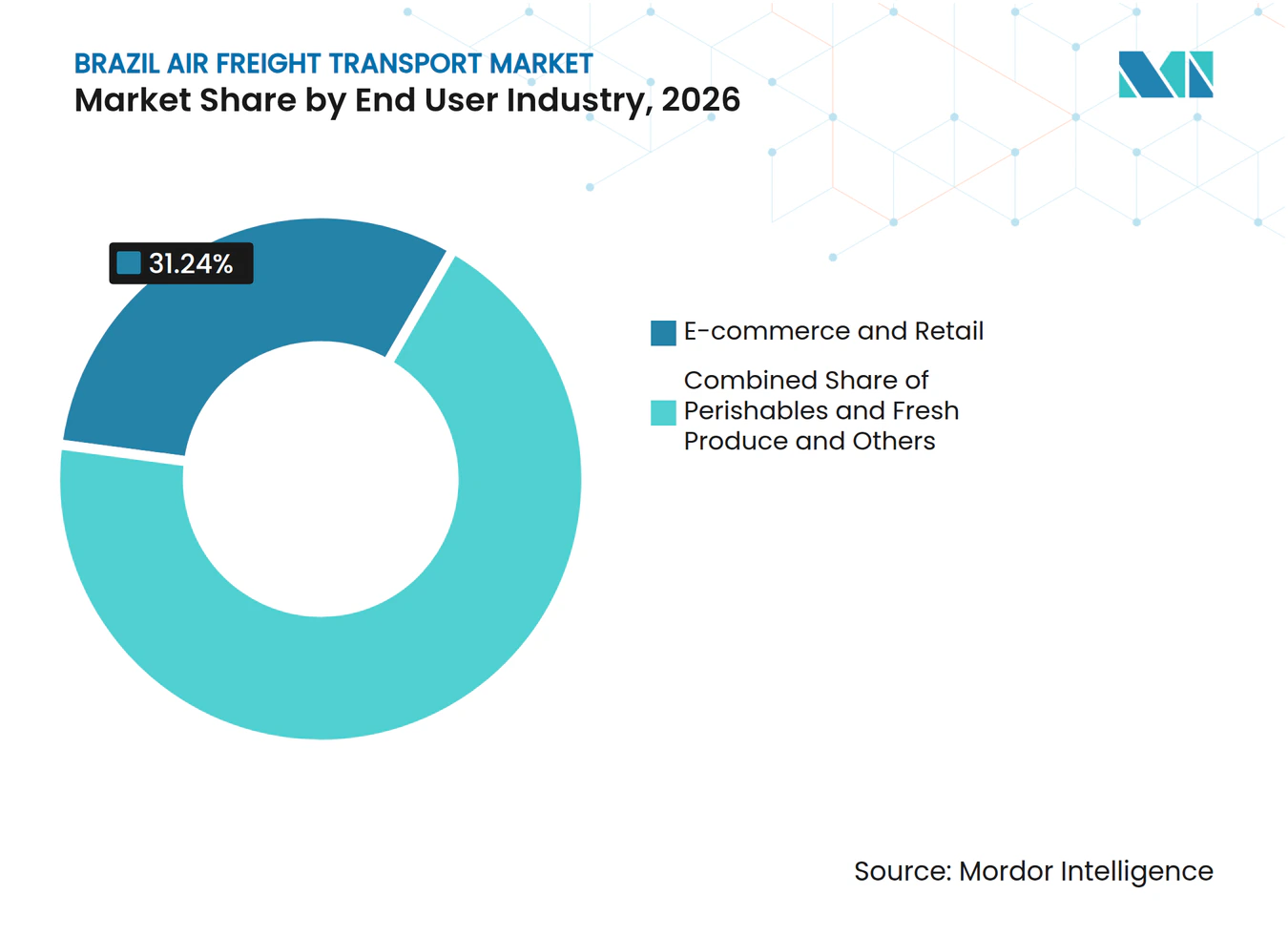
- By end-user industry, e-commerce and retail accounts for 31.24% of the Brazil air freight transport market size in 2026, while perishables and fresh produce are forecast to register a 7.73% CAGR through 2032.
- By region, Southeast accounts for 57.36% of the Brazil air freight transport market share in 2026, while Northeast is projected to expand at an 8.13% CAGR through 2032.
Note: Market numbers in this report are based on Mordor Intelligence's proprietary estimation framework, which combines nine months of actuals with Q4 projections for base year 2026.
Market Trends and Insights
Drivers Impact Analysis of Brazil Air Freight Transport Market*
| Driver | (~) % Impact on CAGR Forecast | Geographic Relevance | Impact Timeline |
|---|---|---|---|
| Cross-Border E-Commerce Increasing Time-Critical Air Freight Demand | +1.4% | National; most acute at São Paulo and Rio gateways, with rapid rise in Northeast and North corridors | Medium term (2–4 years) |
| Freighter Capacity Expansion Strengthening Domestic Cargo Connectivity | +0.9% | Southeast-anchored (GRU, VCP); expanding to Manaus, Recife, and Belém | Short term (≤ 2 years) |
| Pharma Growth Increasing Temperature-Controlled Air Cargo Demand | +0.8% | Southeast (GRU, VCP lead); secondary cold-chain nodes in Recife and Curitiba | Medium term (2–4 years) |
| Digital Cargo Processes Improving Customs and Shipment Visibility | +0.6% | National via Portal Único de Comércio Exterior; earliest efficiency gains at GRU and VCP | Short term (≤ 2 years) |
| Regional Airport Investment Expanding Air Freight Accessibility | +0.7% | Northeast (Recife, Fortaleza), North (Manaus, Belém), Central-West (Cuiabá) | Long term (≥ 4 years) |
| High-Value Industries Increasing Specialized Air Cargo Volumes | +0.6% | São Paulo and Manaus Free Trade Zone; secondary demand from Rio de Janeiro and Curitiba | Medium term (2–4 years) |
| Source: Mordor Intelligence | |||
Cross-Border E-Commerce Raising Time-Critical Demand
Cross-border online shopping is increasing the use of air freight for lightweight parcels that require quick delivery. Viracopos recorded strong international express shipment growth during the first half of 2026. Azul Logística moved 8.9 million parcels in the first half of 2025, with an average of 50,000 packages per day. Carriers are increasingly aligning flight schedules with marketplace peaks, rather than treating cargo as spare passenger-aircraft capacity. This places delivery performance, customs visibility, and airport throughput at the center of airline competition, since an online seller’s service promise depends not only on the flight itself but also on predictable acceptance, clearance, sorting, transfer, and delivery of a large number of small consignments.
Freighter Capacity and Regional Airport Investment
Dedicated freighters are strengthening domestic cargo connectivity because they can operate around parcel peaks and regional demand patterns. Azul Logística deployed Airbus A321P2F aircraft in Brazil and plans further fleet additions by 2027[1], while GOLLOG operates a Boeing 737-800BCF fleet for Mercado Livre services. LATAM Cargo Brasil also increased freighter activity on the São Paulo-Manaus corridor in 2026, adding capacity on a major domestic route. Regional airport investment extends this effect beyond the Southeast, including planned logistics facilities at Recife and regulatory capacity at Cuiabá. These developments help the Brazil air freight transport market serve interior locations where road delivery can take several days. The resulting network is likely to favor carriers that combine aircraft capacity with reliable ground handling and local distribution, since a freighter flight alone does not ensure delivery performance when cargo must still be received, screened, sorted, transferred, cleared, and moved to customers across a large national territory.
Pharmaceutical and High-Value Cargo Demand
Pharmaceutical shipments are supported by specialized air cargo services because they require controlled temperatures, documented handling, and dependable release processes. Europe-to-Brazil pharmaceutical flows are an important source of specialized inbound demand. Guarulhos, Curitiba, and Viracopos are key receiving points for these shipments, which often require Good Distribution Practice procedures and IATA CEIV Pharma standards. The Brazil air freight transport industry also supports high-value electronics, semiconductor components, industrial parts, and urgent automotive supplies. Manaus is particularly relevant because its manufacturing zone depends on inbound components and onward distribution. Specialized handling can support higher-value service offerings, but it requires investment in cold storage, trained personnel, compliance systems, monitoring equipment, and clear operating procedures that protect shipment condition from airport acceptance through final release.
Digital Cargo Processes and Shipment Visibility
Digital processes are reducing friction in customs and cargo handling across Brazilian airports. The Portal Único de Comércio Exterior replaced legacy import workflows through CCT Importação, and the October 2025 Release Zambeze update improved data access and integration with transit systems. Cargo-XML standards and real-time shipment information can reduce documentation errors and improve coordination among carriers, customs brokers, and shippers. LATAM Cargo installed automated sorting equipment at Guarulhos that processes 72,000 packages each day, and the company reported a 31% reduction in last-mile delivery time in the first half of 2026[2]. The benefit is largest when physical capacity and customs operations improve alongside data quality, because digital records cannot remove a bottleneck caused by limited warehouse space, insufficient inspection coverage, slow truck collection, or weak coordination between the airport terminal and the carrier’s domestic distribution network during daily peak operating periods at major Brazilian cargo gateways.
Restraints Impact Analysis of Brazil Air Freight Transport Market*
| Restraint | (~) % Impact on CAGR Forecast | Geographic Relevance |
|---|---|---|
| Guarulhos Capacity Constraints Limiting Cargo Handling Efficiency | -0.7% | São Paulo metropolitan area (GRU, VCP); systemic effects for shippers dependent on hub-connecting flows |
| Fuel and Currency Volatility Increasing Freight Costs | -0.9% | National; most acute for smaller domestic carriers without fuel hedging; international routes exposed to BRL/USD movements |
| Inspection Delays for Agro-Sanitary Cargo Suppressing Perishable Export Throughput | -0.5% | Northeast (Fortaleza, Recife); South (Curitiba, Florianópolis); secondary exposure at GRU for high-volume agricultural imports |
| Regional Cold-Chain Infrastructure Gaps Limiting Perishable and Pharma Air Cargo | -0.4% | Northeast, North (Manaus, Belém), and Central-West; most acute at secondary airports lacking refrigerated warehousing |
| Source: Mordor Intelligence | ||
Guarulhos Capacity Constraints Limiting Handling Efficiency
Guarulhos handles 36% of Brazil's cargo imports and remains a critical point of exposure for the Brazil air freight transport market. Elevated terminal capacity in mid-2026 showed that cleared freight was not always leaving the airport at the same pace as inbound freight arrived. The airport is expanding its warehouse footprint to 345,000 m², including 3 new warehouses that add 120,000 m²[3]. The federal government also committed BRL 1.4 billion (USD 272 million) for airport technology, apron, and taxiway upgrades. Capacity additions will have a limited effect unless customs inspection, cargo release, and ground handling performance improve at the same time. ANAC and Receita Federal requirements therefore remain important to the reliability of the country’s largest cargo gateway.
Fuel and Currency Volatility Raising Freight Costs
Jet fuel represented 35-39% of Brazilian airline operating costs in 2026. Airlines cannot always pass these increases through to freight customers because routes remain price-sensitive and competitive. This can narrow margins for domestic operators that have less access to fuel hedging or broad international networks. The constraint highly affects the Brazil air freight transport market, where schedule reliability and speed already carry a premium cost.
*Our forecasts treat driver/restraint impacts as directional, not additive. The impact forecasts reflect baseline growth, mix effects, and variable interactions.
Brazil Air Freight Transport Market Segment Analysis
By Service:
Freight Transport Holds the Largest Revenue Base While Integrated Services GrowFreight transport (cargo/CEP) accounts for 45.63% of the Brazil air freight transport market share in 2026, making physical movement the largest service category. This category captures airline and logistics revenue from cargo uplift, line-haul capacity, express parcels, airport handling, and planned collection or delivery services. It covers the regular airport-to-airport movement that allows shippers to secure defined transit times for customer orders, industrial inputs, and urgent replacement items. Freight forwarding remains important for international shipments because it coordinates multimodal movement, customs documentation, cargo booking, and delivery planning across several parties.
Other value-added services are forecast to register at a 7.31% CAGR through 2032. These services include customs brokerage, insurance, compliance support, temperature monitoring, storage coordination, and final delivery management. They give shippers one accountable provider when cargo must pass through airline, terminal, customs, road carrier, and customer receiving processes. Pharmaceutical and agricultural cargo customers need more documentation because ANVISA import licensing, MAPA phytosanitary rules, and temperature-control requirements apply to their shipments. Providers that combine movement, monitoring, customs support, and delivery can reduce handoffs, simplify claims handling, and make shipment status easier for customers to follow, while giving smaller shippers access to services that would otherwise require separate contracts with several specialized logistics providers.



By Destination:
International Flows Lead While Domestic Networks ExpandInternational cargo accounts for 72.19% of the Brazil air freight transport market share in 2026. Brazil imports electronics, machinery, finished medicines, and production inputs, while exports include high-value agribusiness products, manufactured goods, pharmaceutical materials, and fresh produce. These flows rely on links to Asian and European production centers where maritime transit is not suitable for urgent, high-value, temperature-sensitive, or small shipments. They also depend on dependable customs procedures because delays in clearance can erode the benefit of faster air movement. International volumes benefit from the continued use of express delivery for imported e-commerce parcels and the supporting distribution activity that follows their arrival.
Domestic routes are forecast to register at a 7.21% CAGR through 2032. Brazil’s geography makes air transport useful for moving time-sensitive shipments between the Southeast and northern cities such as Manaus, where road transit can exceed 72 hours. Dedicated cargo flights can offer a more consistent service level when passenger schedules, available belly capacity, or road connections do not match marketplace delivery windows. The Remessa Conforme program has also improved the handling of low-value international parcels at key gateways. Domestic distribution gains as parcels enter the country and need rapid delivery to consumers, businesses, and regional collection points, which means airport processing, transfer connections, sorting capacity, and final-mile coordination all influence the service level that customers ultimately experience.
By Carrier Type:
Belly Cargo Leads While Freighters Gain GroundBelly cargo accounts for 59.37% of the Brazil air freight transport market share in 2026. Passenger aircraft provide dense links between São Paulo, Rio de Janeiro, regional capitals, and overseas hubs in Europe, North America, and the Middle East. Cargo revenue uses available aircraft space and can supplement passenger flight economics without a separate all-cargo operation or a dedicated cargo-only route. This model remains useful for regular international flows where volumes are steady, flight schedules are frequent, and cargo does not need an immediate capacity response. It is less suited to shipment peaks that require extra uplift at short notice or operating times outside passenger travel patterns.
Freighter services are projected to register at a 7.64% CAGR through 2032. E-commerce, pharmaceutical cold-chain needs, perishable exports, and urgent industrial shipments require capacity that can be scheduled around cargo demand rather than passenger timetables. Dedicated aircraft also make it easier to plan uplift for cities with strong cargo demand but fewer passenger flights, especially on domestic and regional routes. Azul Logística’s A321P2F fleet and GOLLOG’s Boeing 737-800BCF operation illustrate two domestic approaches, one based on aircraft flexibility and the other on dense marketplace networks. International freighter operators provide additional capacity at Brazilian gateways and give exporters more options for direct or connecting services, particularly when regular passenger schedules are full, when shipment volume requires dedicated uplift, or when an exporter needs specialized handling for sensitive products.

By Cargo Type:
General Cargo Remains the Largest Category While Special Cargo Grows FasterGeneral cargo accounts for 62.31% of the Brazil air freight transport market share in 2026. It includes industrial components, packaged consumer goods, standard e-commerce shipments, and other routine consignments that move through the principal airports. The category remains central to overall volume because it serves a wide range of shippers across consumer, manufacturing, wholesale, and distribution activity. Some non-urgent shipments can shift to road freight when time requirements allow, particularly when route reliability and costs favor ground transport. This places pressure on providers to reserve air capacity for consignments where speed, security, inventory continuity, or product value creates a clear commercial benefit, while still maintaining a broad and stable volume base for regular shipments moving through the country’s major import and distribution gateways.
Special cargo is forecast to register a 6.92% CAGR through 2032. Dangerous goods, high-value electronics, pharmaceutical shipments, and oversized industrial equipment require handling procedures, trained staff, secure storage, and documentation that standard cargo does not always need. The Manaus Free Trade Zone contributes demand for imported electronics components, manufacturing inputs, and regional redistribution to the Norte region. Reefer cargo is also expanding as fruit, seafood, and other temperature-sensitive food exports use air links to preserve product quality and meet delivery windows. LATAM Cargo carried 18.6 thousand tons of fruit in the first half of 2026, an increase of 42.3% from the prior-year period, indicating the practical importance of reliable cold-chain coordination between producers, airport warehouses, aircraft operators, customs functions, and overseas buyers.
By End-User Industry:
E-Commerce Leads While Perishables Expand FastestE-commerce and retail accounts for 31.24% of the Brazil air freight transport market share in 2026. Marketplace delivery speed has become a commercial differentiator, increasing demand for express parcel movement, accurate shipment tracking, and reliable hub operations. Azul Logística transported more than 60,000 tons and completed 8.9 million deliveries in the first half of 2025, while LATAM Cargo reported higher e-commerce volumes in the first half of 2026. This scale requires carriers to align aircraft schedules, sorting systems, customs clearance, final distribution, and customer communication around short delivery commitments. Manufacturing, automotive, healthcare, and electronics customers form the next group of users because they depend on urgent replenishment, secure handling, cold-chain performance, or protection from product obsolescence, and because production or customer service can be affected when a critical component is delayed.
Perishables and fresh produce are forecast to register at a 7.73% CAGR through 2032. Tropical fruits, specialty coffee by-products, and marine proteins can gain access to export markets when storage, inspection, airline capacity, and destination handling are available. The value of these shipments depends on preserving quality from collection through airport receipt, cold storage, aircraft loading, international transit, and final market distribution. Secondary airports still face limits in refrigerated warehousing and phytosanitary inspection availability, constraining export volumes and routing choices. MAPA-certified inspection capability is important for cargo that must meet destination-country plant health requirements before it can be exported, because a missed inspection window or incomplete documentation can delay a perishable shipment beyond the period in which air transport preserves its commercial value.
Geography Analysis
The Southeast accounts for 57.36% of the Brazil air freight transport market share in 2026. Guarulhos and Viracopos provide the largest concentration of international capacity, cargo terminals, customs services, and downstream distribution links. Guarulhos alone handled 36% of the country’s cargo imports, which makes its operating performance material to national supply chains. LATAM Cargo expanded the Guarulhos e-commerce area by 47% in April 2026, reinforcing the airport’s role in parcel processing.
Northeast is forecast to register an 8.13% CAGR through 2032. The region is gaining activity from agribusiness exports, logistics investment, and Recife’s role as a structured domestic hub. Recife moved more than 6,000 tons to over 40 domestic destinations in the first half of 2025 through Azul Logística operations[4]. Fortaleza also recorded 22% export cargo growth in the first half of 2025, showing stronger demand for regional international freight capacity. The North region is centered on Manaus, where the Zona Franca de Manaus supports steady inbound flows of electronics components and consumer goods. LATAM Cargo expanded the São Paulo-Manaus cargo corridor, and the route remains important for connecting the industrial zone with national distribution networks.
Central-West activity is tied to Mato Grosso’s agribusiness output and the need for timely export movement of soy and cotton by-products. MAPA expanded Vigiagro inspection operations at Cuiabá airport in 2025, providing a compliance pathway for formal international cargo operations. This development can reduce reliance on overland transfers to Southeast gateways when exporters need faster access to global markets. The regional share remains below the Southeast, but specialized demand widens the network beyond the country’s main hubs. For carriers, the opportunity is to link local production zones with dependable cold-chain, customs, and freighter capacity, then provide shippers with predictable collection, documentation, flight connections, and delivery arrangements that allow regional products to reach overseas customers without excessive handling or extended transit time.
Competitive Landscape
Market Concentration
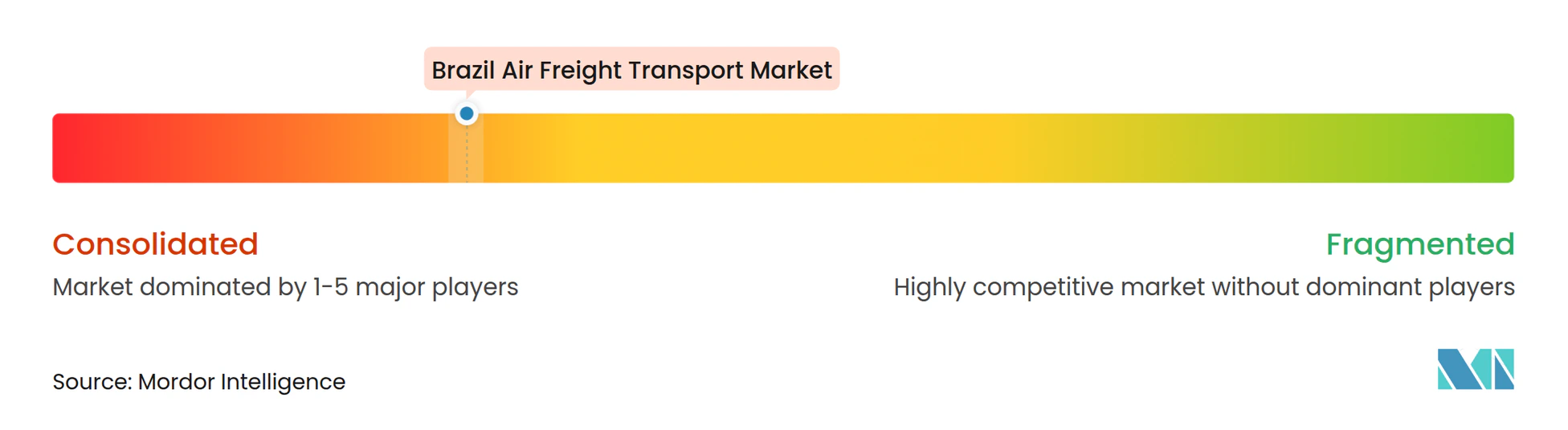
The Brazil air freight transport market is consolidated. Global integrators, Middle Eastern long-haul carriers, and European freighter specialists compete on international import and export corridors. Domestic airlines compete through freighter networks, marketplace partnerships, and distribution coverage. Competition increasingly depends on cargo capacity, airport infrastructure, customs efficiency, and the ability to provide reliable end-to-end shipment visibility.
Technology and service reliability are key points of competition. FedEx announced BRL 75 million (USD 14.6 million) for Brazilian infrastructure investment that includes new service centers and larger logistics hubs. LATAM Cargo expanded e-commerce capacity at Guarulhos and increased freighter capacity on the São Paulo-Manaus route. Azul Logística is expanding its A321P2F fleet and positioning itself as a multimodal provider across air, road, and sea operations.
Secondary airports in the Northeast and North offer room for differentiation because cold-chain capacity remains less developed than demand from pharmaceuticals and perishables. ANAC licensing requirements and Receita Federal digital cargo standards reward companies that can run reliable and documented processes. GOLLOG’s freighter operation for Mercado Livre demonstrates how a long-term marketplace partnership can support dedicated capacity. Any stronger consolidation within Abra Group could increase domestic freighter concentration on high-density routes. Competition will remain active because international specialists, integrators, and domestic carriers each address different parts of the Brazil Air Freight Transport market, serve different customer needs, operate different aircraft types, and bring distinct strengths in customs support, network reach, airport capacity, or final-mile delivery coverage.
Brazil Air Freight Transport Industry Leaders
-
LATAM Airlines Group SA (including LATAM Cargo Brasil)
-
Abra Group (including GOL Linhas Aéreas)
-
Azul SA (including Azul Cargo Express)
-
FedEx Corp.
-
Emirates SkyCargo
- *Disclaimer: Major Players sorted in no particular order
Brazil Air Freight Transport Market Companies Covered in this Report
- LATAM Airlines Group SA (including LATAM Cargo Brasil)
- Abra Group (including GOL Linhas Aéreas)
- Azul SA (including Azul Cargo Express)
- FedEx Corp.
- Emirates SkyCargo
- United Parcel Service, Inc.
- Qatar Airways Group (including Qatar Airways Cargo)
- Lufthansa Cargo AG
- Air France-KLM Group (including Martinair Cargo)
- Cargolux Airlines International SA
- Turkish Airlines (including Turkish Cargo)
- Atlas Air Worldwide
- Ethiopian Airlines Group (including Ethiopian Cargo)
- Braspress Air Cargo
- Modern Transporte Aéreo de Carga SA
- Sideral Linhas Aéreas
- Total Linhas Aéreas SA
- American Airlines Group Inc.
- United Airlines Holdings Inc.
- International Airlines Group (IAG)
- TAP Air Portugal
- Air Canada (including Air Canada Cargo)
Recent Industry Developments in Brazil Air Freight Transport Market
- September 2026: FedEx announced BRL 75 million (USD 14.6 million) in Brazil infrastructure investment, encompassing 34 new service centers and expansion of logistics hubs at Cajamar from 55,000 to 90,000 pallet positions and Jaboatão dos Guararapes from 16,000 to 26,000 m², broadening last-mile and supply-chain coverage across Brazilian states.
- September 2026: Atlas Air added a third weekly Boeing 747-400F frequency to Rio de Janeiro Galeão (Miami–GIG–Lima routing) following the May 2026 import-tax elimination for e-commerce purchases under USD 50, which drove Galeão's monthly parcel volumes to 5.6 million in June–August 2026.
- April 2026: LATAM Cargo Brasil expanded its Guarulhos TECA by 47% in the e-commerce area and increased São Paulo-Manaus freighter frequency from 10 to 12 weekly flights, adding 110 tons of weekly capacity on Brazil’s busiest domestic cargo corridor.
- November 2025: FedEx launched a formal import cargo clearance service at its Viracopos facility, enabling in-warehouse customs release and reducing formal import declaration timelines for international air freight customers.
Brazil Air Freight Transport Market Report Scope
Segmentation Overview
| Freight Transport (Cargo/CEP) |
| Freight Forwarding |
| Other Value-Added Services (Customs Brokerage, Insurance, etc.) |
| Domestic |
| International |
| Belly Cargo |
| Freighter |
| General Cargo |
| Refeer Cargo |
| Special Cargo (Dangerous, High Value, Oversized, etc.) |
| E-commerce and Retail |
| Manufacturing and Automotive |
| Healthcare and Pharmaceuticals |
| Perishables and Fresh Produce |
| High-Tech and Electronics |
| Others |
| North |
| Northeast |
| Central-west |
| Southeast |
| South |
| By Service | Freight Transport (Cargo/CEP) |
| Freight Forwarding | |
| Other Value-Added Services (Customs Brokerage, Insurance, etc.) | |
| By Destination | Domestic |
| International | |
| By Carrier Type | Belly Cargo |
| Freighter | |
| By Cargo Type | General Cargo |
| Refeer Cargo | |
| Special Cargo (Dangerous, High Value, Oversized, etc.) | |
| By End-User Industry | E-commerce and Retail |
| Manufacturing and Automotive | |
| Healthcare and Pharmaceuticals | |
| Perishables and Fresh Produce | |
| High-Tech and Electronics | |
| Others | |
| By Region | North |
| Northeast | |
| Central-west | |
| Southeast | |
| South |
Key Questions Answered in the Report
What is the projected value of Brazil air freight transport by 2032?
Brazil air freight transport is projected to reach USD 2.19 billion by 2032, expanding at a 5.70% CAGR from 2027.
Which service category leads Brazil air freight transport?
Freight transport (cargo/CEP) leads with a 45.63% share in 2026, while value-added services are forecast to register faster at a 7.31% CAGR.
Why is international cargo important to Brazil air freight transport?
International cargo accounts for 72.19% of activity because Brazil depends on air links for electronics, machinery, medicines, high-value exports, and express parcels.
Which carrier type is growing fastest in Brazil air freight transport?
Freighter services are forecast to register at a 7.64% CAGR through 2032 as e-commerce, pharmaceuticals, and fresh produce require more schedule control.
Which region is expanding fastest for Brazilian air cargo services?
Northeast is forecast to register an 8.13% CAGR through 2032, supported by Recife logistics investment and stronger agricultural export activity.
What are the main constraints on Brazilian air cargo operations?
Guarulhos capacity constraints and fuel and currency volatility can reduce reliability and raise carrier costs. Airport construction, customs operations, ground handling, airline cost control, and accurate cargo data must improve together to protect service quality.