
Bra Market Size and Share
Market Overview
| Study Period | 2021 - 2031 |
|---|---|
| Market Size (2026) | USD 42.72 Billion |
| Market Size (2031) | USD 57.68 Billion |
| Growth Rate (2026 - 2031) | 6.19 % |
| Fastest Growing Market | Asia-Pacific |
| Largest Market | Asia-Pacific |
| Market Concentration | Medium |
Major Players *Disclaimer: Major Players sorted in no particular order Image © Mordor Intelligence. Reuse requires attribution under CC BY 4.0. | |
Bra Market Analysis by Mordor Intelligence
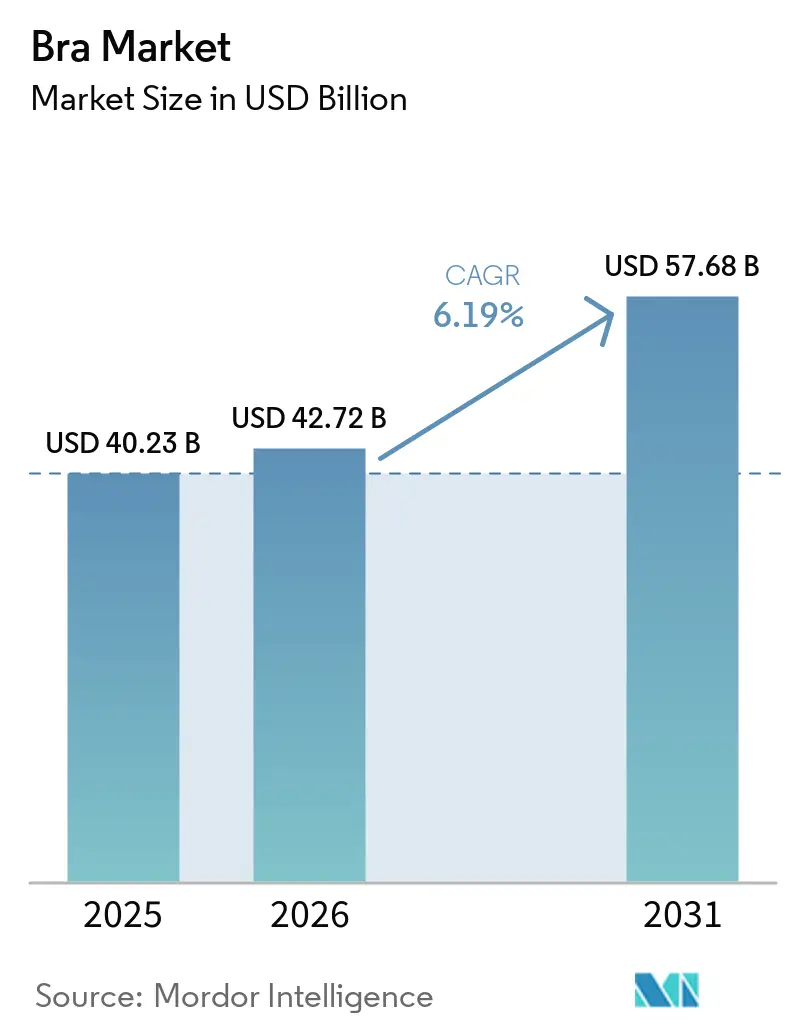
The Bra Market size was valued at USD 40.23 billion in 2025 and is estimated to grow from USD 42.72 billion in 2026 to reach USD 57.68 billion by 2031, at a CAGR of 6.19% during the forecast period (2026-2031). Rising participation in sports and fitness, greater demand for comfort-focused innerwear, and wider online access are supporting the bra market. These factors connect product demand with changing retail practices because sports participation increases interest in performance styles, while digital fitting tools make online purchases easier to complete. Companies are responding through performance fabrics, inclusive size ranges, wireless support, and online fit guidance. Competitive activity also reflects a shift toward partnerships, acquisitions, and licensed product platforms that combine athletic performance with lingerie design. Material costs, inconsistent sizing, and low-quality counterfeit products remain important limits on growth because they affect margins, returns, and consumer trust.
Key Report Takeaways
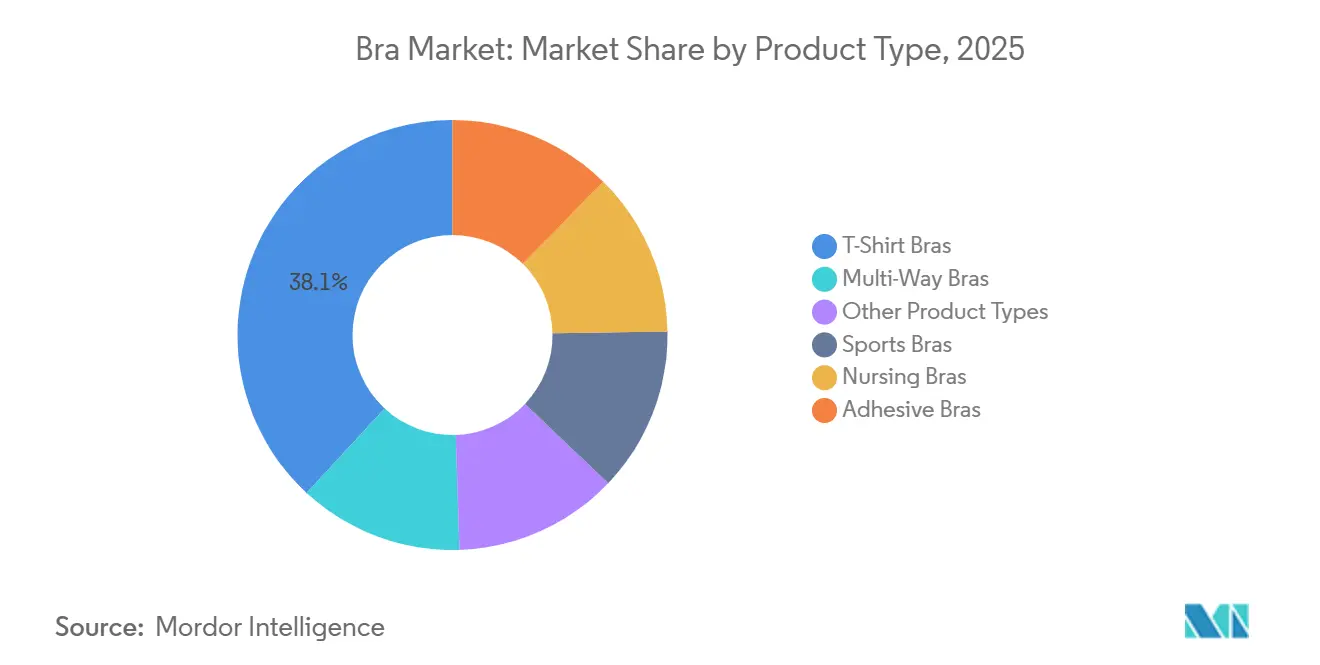
- By product type, T-shirt bras held 38.13% of the bra market share in 2025, while sports bras are projected to advance at a 6.65% CAGR through 2031.
- By material, cotton held 41.56% of the bra market share in 2025, while satin is projected to advance at a 6.83% CAGR through 2031.
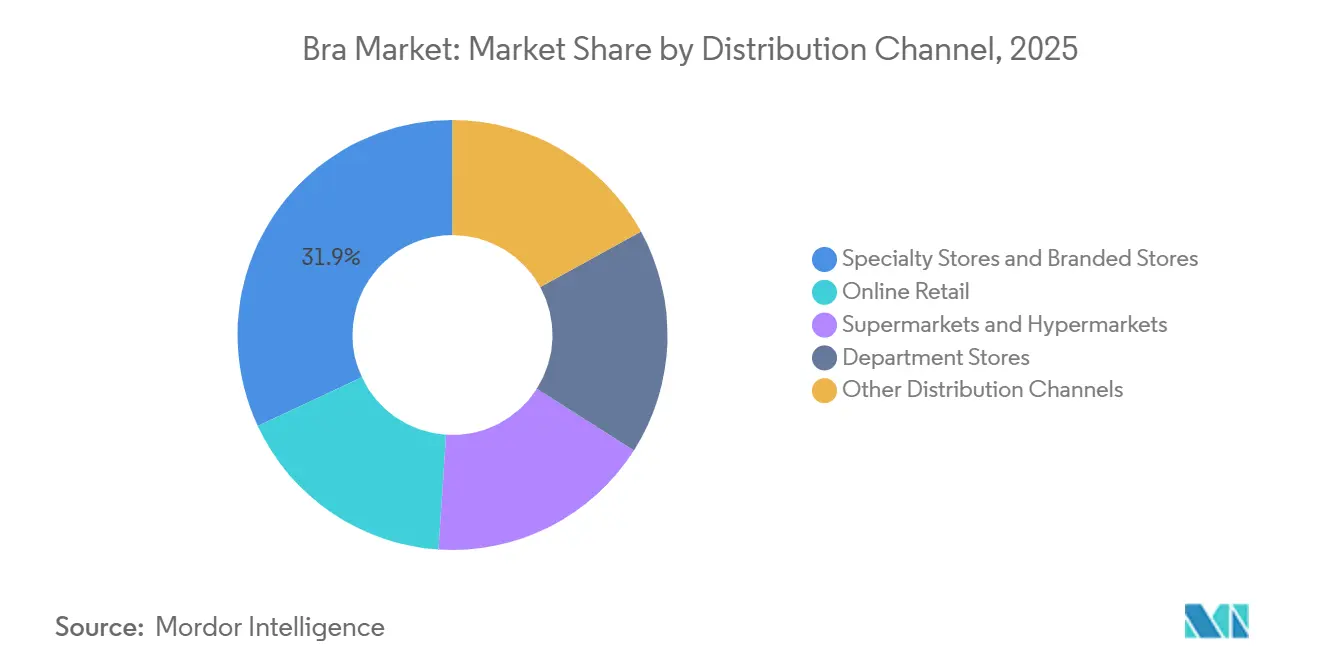
- By distribution channel, specialty stores and branded stores held 31.95% of the bra market share in 2025, while online retail is projected to advance at a 7.13% CAGR through 2031.
- By geography, Asia-Pacific held 34.22% of the bra market share in 2025 and is projected to advance at a 7.06% CAGR through 2031.
Note: Market size and forecast figures in this report are generated using Mordor Intelligence’s proprietary estimation framework, updated with the latest available data and insights as of January 2026.
Global Bra Market Trends and Insights
Drivers Impact Analysis*
| Driver | (~) % Impact on CAGR Forecast | Geographic Relevance | Impact Timeline |
|---|---|---|---|
| Rising Participation of Women in Sports and Fitness | +1.9% | Global, strongest gains in Asia-Pacific and North America | Medium term (2-4 years) |
| E-Commerce, Virtual Fitting and Inclusive Sizing | +1.4% | Global, led by Asia-Pacific and North America | Short term (≤ 2 years) |
| Athleisure and Everyday Use of Sports Bras | +1.1% | North America, Europe, APAC urban centers | Medium term (2-4 years) |
| Comfort-First and Wireless Bra Adoption | +0.8% | North America, Europe | Short term (≤ 2 years) |
| AI-Assisted Fit Personalization and Digital Bra Recommendations | +0.5% | North America, Europe, APAC | Long term (≥ 4 years) |
| Source: Mordor Intelligence | |||
Rising Participation of Women in Sports and Fitness
Women’s participation in organized sports and fitness is changing the product mix of the bra market. Around 50% of the global population followed women’s sports in 2024, compared with 45% in 2022, and U.S. audiences watched 46 billion minutes of women’s sports coverage in 2025[1]. Garmin reported that women completed 6% more strength-training activity than men in 2025, continuing several years of strong growth in this activity. The Paris 2024 Olympic Games reached gender parity, with women representing 50.7% of athletes, which increased the visibility of women’s performance categories. Higher-impact exercise increases the need for engineered support, moisture management, and a better fit. This demand gives brands a reason to develop accessible performance products for consumers in South and Southeast Asia, where new fitness users are widening the addressable customer base.
Comfort-First and Wireless Bra Adoption
Comfort-focused purchasing is supporting a lasting move toward wireless formats in the bra market. The shift accelerated during remote work, but it also reflects a broader preference for garments that are easier to wear for long periods. Advances in seamless knitting and multi-panel fabric construction are improving support in wireless designs, including for larger cup sizes. This development expands the category beyond lightweight everyday styles and challenges the historical reliance on underwires for structured support. Brands that improve support without compromising comfort can compete more effectively for mid-to-large-cup consumers and reduce the appeal of conventional structured alternatives.
Athleisure and Everyday Use of Sports Bras
Athleisure is widening the everyday role of sports bras within the bra market. Consumers now use these products for exercise, casual wear, and layered outfits, which increases the value of designs that can perform across several settings. Seamless and wire-free construction supports this use because it combines ease of wear with a cleaner appearance under clothing. Companies can use performance fabrics and multi-activity styling to support higher price points than basic everyday products. The lululemon athletica launched the Go Further Bra in March 2025 with Support Code technology and Ultralu fabric, following research conducted during the FURTHER women’s six-day ultramarathon. The product shows how athletic research is shaping technical standards and positioning in the bra market, where technical validation can strengthen product credibility with performance-oriented consumers.
E-Commerce, Virtual Fitting and Inclusive Sizing
Online retail is projected to grow at a 7.13% CAGR through 2031, making it the fastest-growing distribution channel in the bra market. Fit uncertainty remains a major constraint because returns are costly and consumers cannot assess support, comfort, or sizing before purchase. Virtual fitting, inclusive sizing, and digital recommendations are intended to reduce this barrier by making product selection more specific. Etam reported a 5% revenue increase and a 16% reduction in returns in an April 2026 live test of Kleep’s assisted fit recommendation flow. Privacy-preserving virtual fitting methods are also protected by U.S. Patent 12,608,741, granted in 2025, which indicates that fit technology is becoming more important to digital competition. Brands that do not improve fit guidance may face higher return costs and weaker repeat purchasing as online demand grows.
Restraints Impact Analysis*
| Restraint | (~) % Impact on CAGR Forecast | Geographic Relevance | Impact Timeline |
|---|---|---|---|
| Inconsistent Sizing and Fit-Related Returns | -0.5% | Global, most pronounced in e-commerce-heavy markets | Short term (≤ 2 years) |
| Raw Material Price Volatility and Margin Pressure | -0.4% | Global, highest exposure in Asia-Pacific manufacturing hubs | Medium term (2-4 years) |
| Counterfeit and Low-Quality Product Competition | -0.3% | Global, concentrated in South and Southeast Asia and online markets | Long term (≥ 4 years) |
| Source: Mordor Intelligence | |||
Inconsistent Sizing and Fit-Related Returns
Inconsistent sizing limits conversion and repeat purchasing in the bra market, especially when consumers shop without an in-person fitting. Different cup and band grading systems create a difficult experience for brands selling across Asian and Western markets. A product that fits in one location can produce returns in another when the sizing system or consumer expectation changes. Return processing costs, lost conversions, and lower repeat purchases can therefore affect the same customer group at once. Digital sizing platforms can reduce this issue, but adoption remains uneven across mass-market and mid-tier brands. The resulting gap gives companies with established fit tools an operational advantage over competitors that rely on basic size charts.
Raw Material Price Volatility and Margin Pressure
Nylon and polyester are important materials for sports and performance bras, but their petrochemical inputs expose the bra market to oil-related cost changes. Feedstock disruptions raised concern about the cost of nylon intermediates and related technical fabrics. Fabric can account for 60%-70% of finished garment costs, so rapid input-price movements can place direct pressure on manufacturers’ margins. Price increases are difficult to pass through in price-sensitive markets because higher retail prices can weaken demand for branded products. Cotton-oriented supply chains can also face higher landed costs when freight conditions change, adding pressure beyond synthetic fabrics. These conditions favor companies with stronger sourcing relationships, disciplined inventory planning, and product lines that can sustain premium prices.
*Our forecasts treat driver/restraint impacts as directional, not additive. The impact forecasts reflect baseline growth, mix effects, and variable interactions.
Segment Analysis
By Product Type: T-Shirt Bras Lead Demand, While Sports Bras Accelerate Faster
T-shirt bras commanded 38.13% of the bra market share in 2025 because seamless construction and discreet wearability suit everyday use. Their broad appeal spans income groups and retail formats, while nursing bras offer room for product development through hands-free pumping compatibility, postpartum comfort, and improved online access in areas with limited maternity retail. Multi-way and adhesive bras serve separate styling needs and maintain demand where consumers need flexible dressing options. Victoria’s Secret launched its Invisible by Victoria’s Secret Strapless Collection in April 2026 with wear-tested no-slip grip technology, showing continued investment in strapless designs. Product improvement in this segment can address consumer concerns about poor strapless performance and support more frequent use.
Sports bras are projected to advance at a 6.65% CAGR through 2031. Organized sports participation and the broader use of athleisure are increasing demand for high-impact, moisture-wicking styles, while premium technical designs can deliver higher average selling prices in North America and Western Europe. Victoria’s Secret is also directing its VSX (Victoria's Secret Sport) range toward performance bras and inclusive sizing, reflecting the need for brands to address a wider range of body types. These actions show that sports bras are being developed as dedicated technical products rather than adaptations of conventional designs.

By Material: Cotton Retains Scale While Satin Supports Premium Demand
Cotton commanded 41.56% of the bra market share in 2025, while satin is projected to advance at a 6.83% CAGR through 2031. Cotton remains important because consumers value skin compatibility and breathability, particularly in tropical and subtropical climates. Its use is strongest in mass-market and mid-tier products, where cotton blends provide a practical route to everyday comfort, while satin supports premium positioning in European and East Asian markets. Consumers in these markets seek lingerie that can also function as loungewear. Material choice, therefore, separates high-volume everyday products from higher-value styles without changing the need for fit and comfort.
Nylon and polyester remain necessary for sports bras because they provide stretch recovery and moisture management. Silk maintains a high-value position in Japan and South Korea, where premium intimate apparel can command higher material value, while chiffon supports a narrower role in lighter overlay and combination designs. The European Union’s proposed Ecodesign for Sustainable Products Regulation is expected to encourage earlier discussion of recyclability for synthetic-heavy construction from 2027. Brands that document material supply chains can be better prepared for European retail requirements and sustainability-focused product selection.
By Distribution Channel: Specialty Stores and Branded Stores Retain Scale, While Online Retail Accelerates
Specialty stores and branded stores retained 31.95% of the bra market share in 2025, reflecting the value of tactile evaluation and professional fitting. This channel is particularly relevant for premium and full-figure products, where shoppers may require detailed support and size guidance. Chantelle Group’s specialist retail presence and full-cup expertise illustrate the role of trained service in complex fit categories. Physical channels must maintain staff knowledge and a relevant store experience because physical presence alone does not ensure consumer loyalty. Supermarkets and hypermarkets retain a role in convenient purchases of basic styles, while department stores remain curated multi-brand destinations in North America and Europe.
Online retail is projected to advance at a 7.13% CAGR through 2031, supported by convenience, privacy, wider size availability, and improving fit tools. The channel is useful where specialist lingerie stores are scarce or where consumers prefer discretion. Its growth changes, fitting from an in-store activity to a digital service, rather than eliminating the need for it. Wacoal’s anti-gravity non-wire bra collection recorded 117% year-over-year e-commerce sales growth in its fiscal 2026 third quarter, showing that digital brand experiences can perform well in comfort-led categories when shoppers receive useful product guidance. Retailers that combine online recommendations with consistent sizing and clear product information can reduce friction across the purchase process.
Geography Analysis
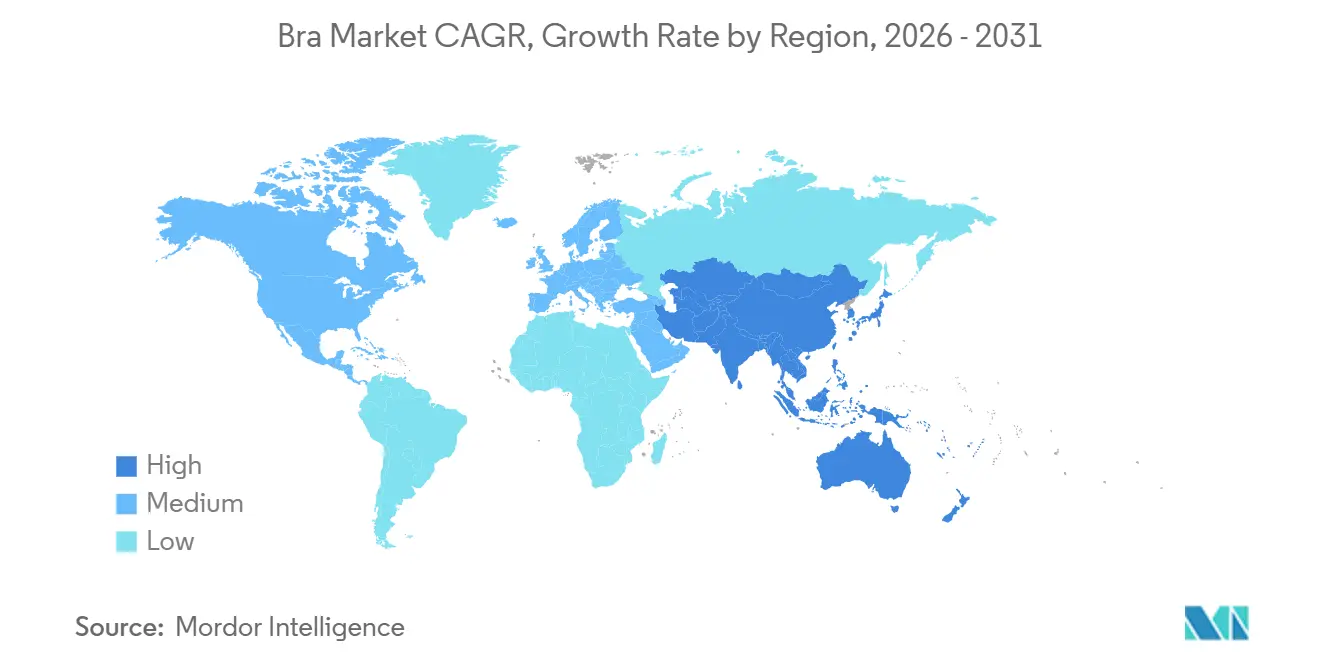
Asia-Pacific held 34.22% of the market revenue in 2025 and is projected to advance at a 7.06% CAGR through 2031. China remains a major production and consumption center, while India and Southeast Asia are expanding the addressable base for branded innerwear. Zivame announced in February 2026 that it planned to open 60-80 franchise-led stores in India’s tier-2 and tier-3 cities within the following 12 months, indicating that branded demand is moving beyond large metropolitan areas. XIXILI introduced a 3D Avatar Try-On Tool in Malaysia in May 2026, bringing personalized virtual fitting to an emerging online retail setting and positioning the region as a source of demand and retail innovation.
North America is a mature region that remains strategically active through premium product launches, inclusive product development, and direct-to-consumer retail. Victoria’s Secret launched its global Season of Strapless campaign with Angel Reese in April 2026 and introduced the Invisible by Victoria’s Secret Strapless Collection across 1,420 stores and around 70 countries, linking a product launch with wider interest in women’s sports[2]. Europe continues to support demand for premium materials, sustainability-focused design, and full-figure expertise. Wacoal’s European business reported 20.2% revenue growth in its fiscal 2026 fourth quarter, supported by wider continental European distribution following the Bravissimo acquisition. Nordic consumers also provide an early customer base for eco-conscious and technically advanced intimate apparel.
South America and the Middle East and Africa offer different paths for the bra market. Brazil supports regional demand through gym culture, rising household incomes, and developing e-commerce access beyond major cities, while Argentina contributes mid-market demand, and other South American countries are more closely linked to basic formats. In the Middle East, women’s fitness participation is increasing alongside social reforms and investment in sports infrastructure. A 2025 study found that 72.2% of Saudi women were sedentary or physically inactive, which points to a large population that may engage more actively as participation conditions improve. Full-coverage and modest styling can be important across parts of the Middle East and Africa so that local product design can strengthen brand relevance and customer loyalty.
Competitive Landscape
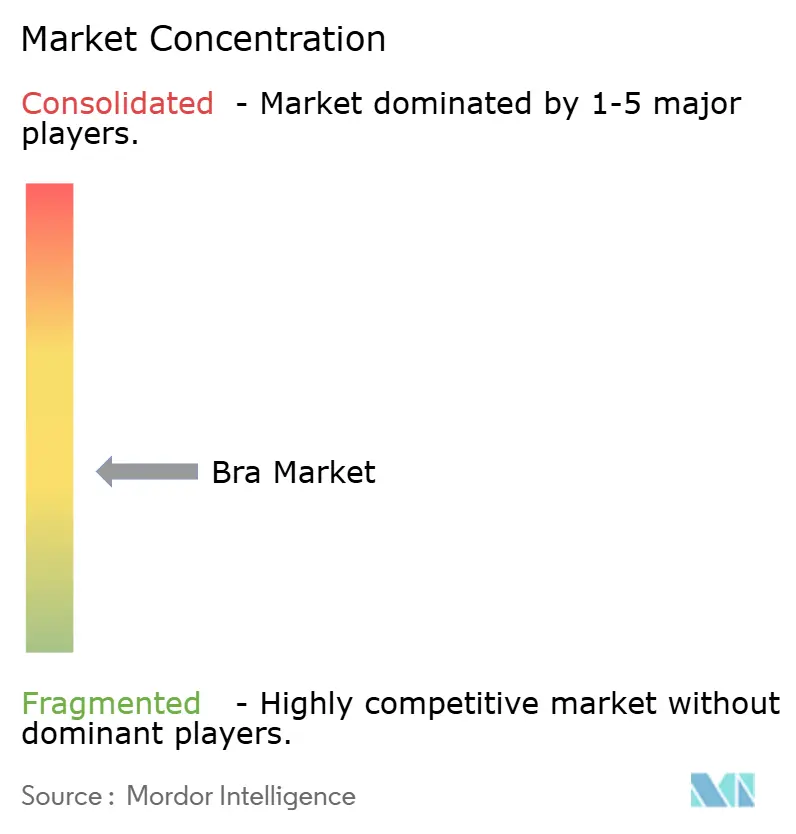
The bra market is moderately concentrated, with the top five players including Victoria's Secret, Gildan Activewear, PVH Corp., Triumph Intertrade AG, and Wacoal. Nike, Inc. and SKIMS announced the NikeSKIMS joint venture in February 2025 to combine athletic performance with shapewear-led design. The partnership expands the overlap between sportswear and lingerie rather than treating them as separate categories. This convergence increases pressure on established companies to improve product performance, design relevance, and fit inclusion.
Wacoal announced its acquisition of Glamorise Foundations, Inc. in April 2026, adding a direct-to-consumer plus-size bra brand to its U.S. portfolio and strengthening access to digital selling and full-figure product development. Chantelle Group uses full-cup specialty ranges to serve technically demanding large-figure segments. Zivame is extending its reach through planned franchise stores in smaller Indian cities while examining Southeast Asian expansion. These moves demonstrate that companies are pursuing growth through acquisition, product specialization, and geographic expansion. The bra market also gives supply-chain partners such as MAS Holdings an important role as sustainable sourcing and supplier certification become more relevant to global brands.
Extended size architecture and digital personalization remain important areas of competition because fit technology can improve online conversion and reduce return costs. The 2025 grant of U.S. Patent 12,608,741 highlights the growing importance of protected methods for privacy-conscious virtual fitting, and companies that secure an early position can gain an advantage in online retail. Sustainable material documentation is also becoming more important to product selection and retail access. Jockey International, Inc., Leonisa S.A., PVH Corp., and CALIDA Holding AG compete in mid-market and premium-adjacent channels where brand recognition supports pricing above unbranded alternatives, and competitive conditions are shaped by product credibility, fit reliability, channel capability, and the ability to serve specific consumer needs across the bra market.
Bra Industry Leaders
-
Victoria's Secret
-
Gildan Activewear
-
Triumph Intertrade AG
-
PVH Corp.
-
Wacoal
- *Disclaimer: Major Players sorted in no particular order
Recent Industry Developments
- April 2026: Victoria’s Secret launched its global “The Season of Strapless” campaign featuring Angel Reese, introducing the Invisible by Victoria’s Secret Strapless Collection with wear-tested no-slip grip technology. The launch supports demand in the bra Market for strapless designs that combine secure fit, comfort, and improved wearability.
- April 2026: Wacoal announced the acquisition of Glamorise Foundations, Inc., adding a direct-to-consumer plus-size bra brand to its U.S. portfolio. The acquisition expands Wacoal’s presence in the full-figure bra segment and strengthens its digital sales and inclusive product development capabilities.
Global Bra Market Report Scope
Bras are supportive garments designed to provide comfort, shaping, coverage, and support for the upper body. They are available in different constructions and materials to suit varying functional and wearing requirements.
The Bra Market is segmented by product type, material, distribution channel, and geography. By product type, the market is segmented into T-shirt bras, sports bras, nursing bras, multi-way bras, adhesive bras, and other product types. By material, the market is segmented into cotton, chiffon, silk, satin, nylon and polyester, and other materials. By distribution channel, the market is segmented into specialty stores and branded stores, supermarkets and hypermarkets, department stores, online retail, and other distribution channels. The report also covers the market size and forecasts for bras in 15 countries across major regions. For each segment, the market sizing and forecasts have been done on the basis of value (USD).
| T-Shirt Bras |
| Sports Bras |
| Nursing Bras |
| Multi-Way Bras |
| Adhesive Bras |
| Other Product Types |
| Cotton |
| Chiffon |
| Silk |
| Satin |
| Nylon and Polyester |
| Other Materials |
| Specialty Stores and Branded Stores |
| Supermarkets and Hypermarkets |
| Department Stores |
| Online Retail |
| Other Distribution Channels |
| Asia-Pacific | China |
| India | |
| Japan | |
| South Korea | |
| ASEAN Countries | |
| Rest of Asia-Pacific | |
| North America | United States |
| Canada | |
| Mexico | |
| Europe | Germany |
| United Kingdom | |
| France | |
| Italy | |
| NORDIC Countries | |
| Rest of Europe | |
| South America | Brazil |
| Argentina | |
| Rest of South America | |
| Middle East and Africa | Saudi Arabia |
| South Africa | |
| Rest of Middle East and Africa |
| By Product Type | T-Shirt Bras | |
| Sports Bras | ||
| Nursing Bras | ||
| Multi-Way Bras | ||
| Adhesive Bras | ||
| Other Product Types | ||
| By Material | Cotton | |
| Chiffon | ||
| Silk | ||
| Satin | ||
| Nylon and Polyester | ||
| Other Materials | ||
| By Distribution Channel | Specialty Stores and Branded Stores | |
| Supermarkets and Hypermarkets | ||
| Department Stores | ||
| Online Retail | ||
| Other Distribution Channels | ||
| By Geography | Asia-Pacific | China |
| India | ||
| Japan | ||
| South Korea | ||
| ASEAN Countries | ||
| Rest of Asia-Pacific | ||
| North America | United States | |
| Canada | ||
| Mexico | ||
| Europe | Germany | |
| United Kingdom | ||
| France | ||
| Italy | ||
| NORDIC Countries | ||
| Rest of Europe | ||
| South America | Brazil | |
| Argentina | ||
| Rest of South America | ||
| Middle East and Africa | Saudi Arabia | |
| South Africa | ||
| Rest of Middle East and Africa | ||
Key Questions Answered in the Report
What is the size of the bra market?
The bra market stands at USD 42.72 billion in 2026 and is projected to reach USD 57.68 billion by 2031.
What is driving demand for bras?
Women’s participation in sports and fitness, comfort-focused purchasing, athleisure, and online retail are supporting demand.
Which product type is projected to advance fastest through 2031?
Sports bras are projected to advance at a 6.65% CAGR through 2031, supported by performance and athleisure demand.
Which material held the largest share in 2025?
Cotton held 41.56% of the market share in 2025 because breathability and skin compatibility support everyday use.