
Black Masterbatch Market Size and Share
Market Overview
| Study Period | 2021 - 2031 |
|---|---|
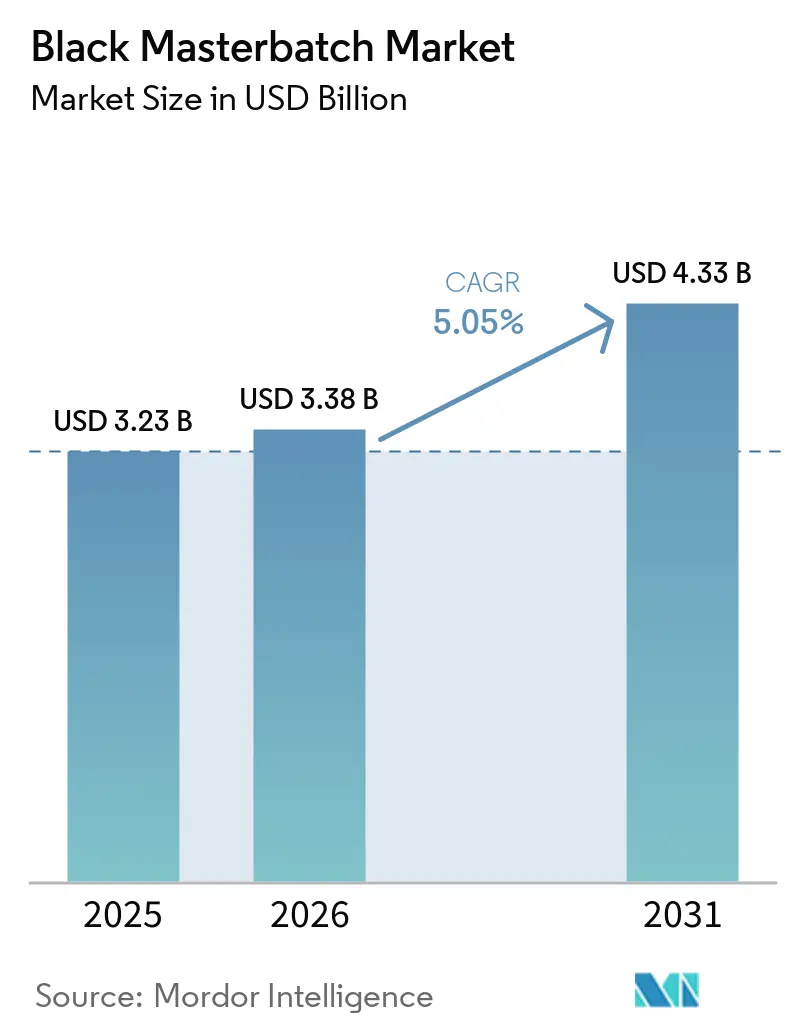
| Market Size (2026) | USD 3.38 Billion |
| Market Size (2031) | USD 4.33 Billion |
| Growth Rate (2026 - 2031) | 5.05 % |
| Fastest Growing Market | Asia-Pacific |
| Largest Market | Asia-Pacific |
| Market Concentration | Low |
Major Players *Disclaimer: Major Players sorted in no particular order Image © Mordor Intelligence. Reuse requires attribution under CC BY 4.0. | |
Black Masterbatch Market Analysis by Mordor Intelligence
The Black Masterbatch market size was valued at USD 3.23 billion in 2025 and is estimated to grow from USD 3.38 billion in 2026 to USD 4.33 billion by 2031, at a CAGR of 5.05% during the forecast period (2026-2031). The black masterbatch market is driven by demand for opacity, UV resistance, and thermal stability in packaging films, pipes, automotive panels, cable jackets, agricultural films, and geomembranes. Standard formulations continue to account for most of the output, while conductive, near-infrared (NIR)-sortable, and recycled-polymer-compatible grades are receiving increased attention in product development. Flexible packaging and public infrastructure programs provide stable demand across major processing applications. Recycling regulations are influencing packaging product selection, as conventional carbon black impedes reliable optical sorting. Feedstock cost fluctuations remain significant, as many packaging buyers have limited tolerance for price increases. The black masterbatch market also depends on converters that require consistent formulation quality across multiple polymer systems. This requirement supports demand for products that meet processing, protection, and appearance needs in a single additive concentrate. Suppliers are responding with formulations tailored to specific end-use conditions.
Key Report Takeaways
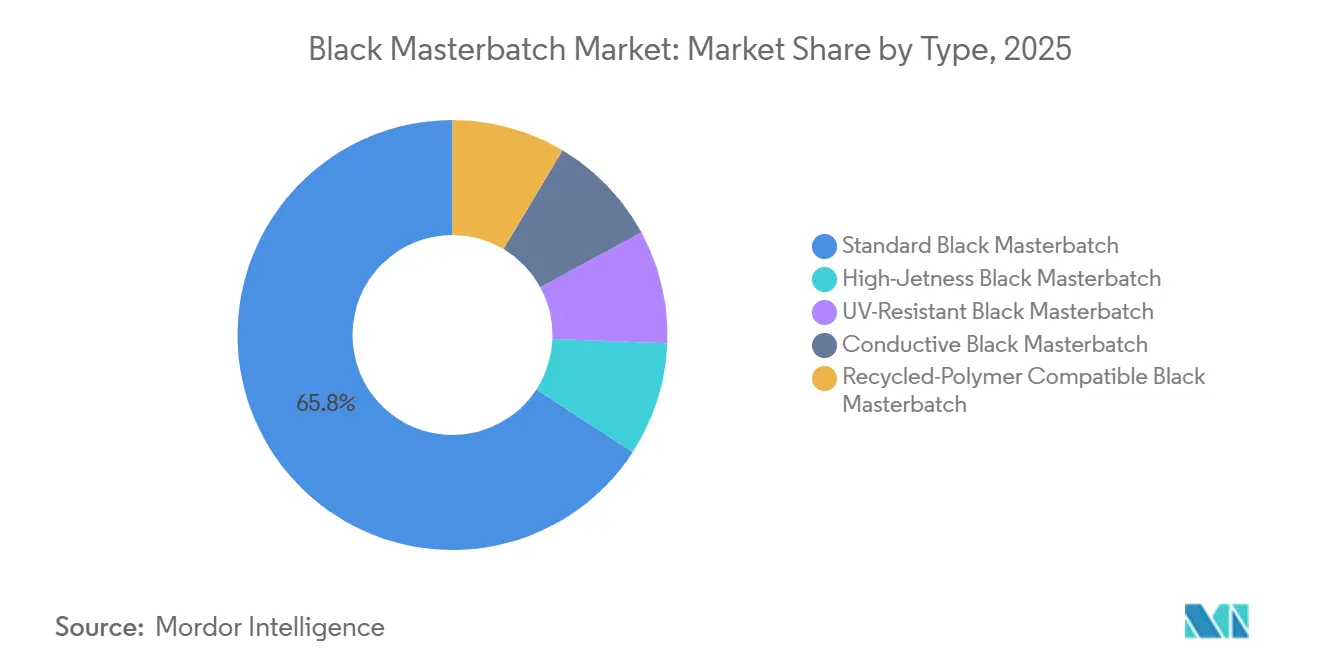
- By type, Standard Black Masterbatch held 65.84% revenue share in 2025, while Conductive Black Masterbatch is forecast to expand at a 5.67% CAGR through 2031.
- By carrier resin, Polypropylene held 30.56% revenue share in 2025, while Linear Low-Density Polyethylene (LLDPE) is forecast to expand at a 5.88% CAGR through 2031.
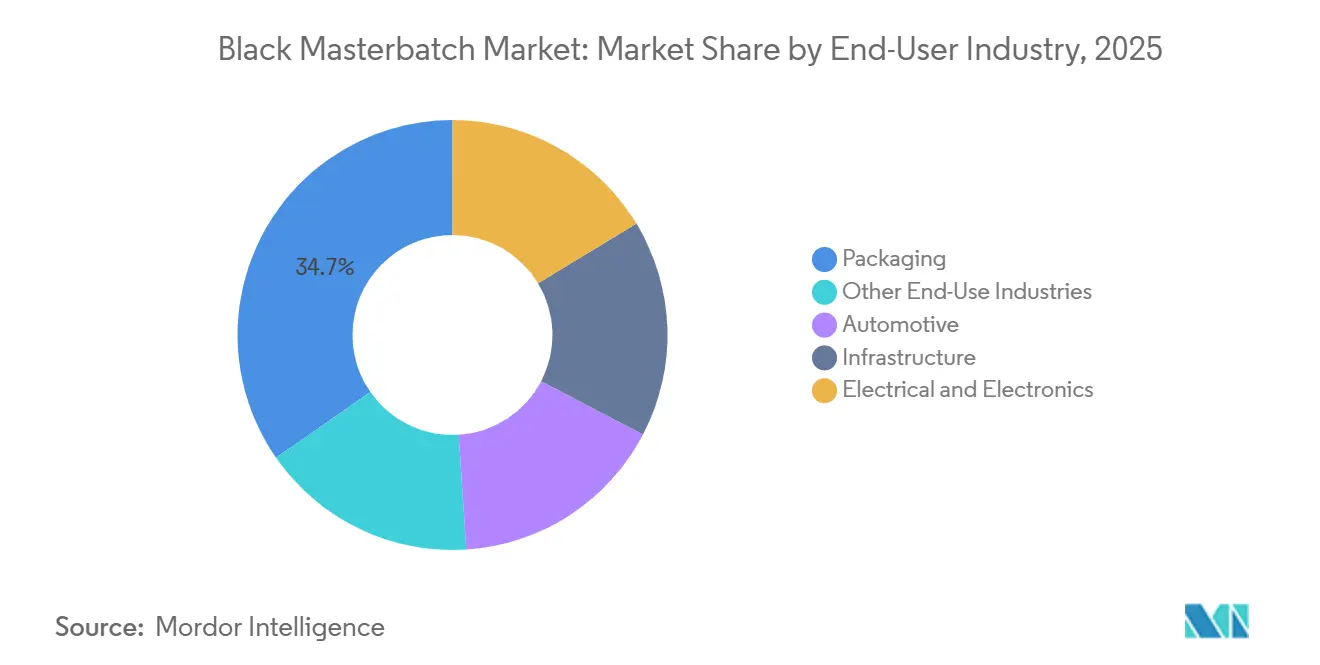
- By end-user industry, Packaging held 34.67% revenue share in 2025, while Automotive is forecast to expand at a 6.21% CAGR through 2031.
- By geography, Asia-Pacific accounted for 47.81% of revenue in 2025 and is forecast to expand at a 5.83% CAGR through 2031.
Note: Market size and forecast figures in this report are generated using Mordor Intelligence’s proprietary estimation framework, updated with the latest available data and insights as of January 2026.
Global Black Masterbatch Market Trends and Insights
Drivers Impact Analysis*
| Drivers | (~) % Impact on CAGR Forecast | Geographic Relevance | Impact Timeline |
|---|---|---|---|
| Expansion of Flexible and Rigid Plastic Packaging | +1.4% | Global, strongest in Asia-Pacific and South America | Short term (≤ 2 years) |
| Lightweighting and Electrification of Vehicles | +1.2% | Europe, North America, China, South Korea | Medium term (2-4 years) |
| Rising UV-Stability Requirements in Infrastructure and Agriculture | +0.9% | APAC core, spillover to MEA and South America | Medium term (2-4 years) |
| Growth of Conductive Plastics in Electronics and Electric Vehicles | +0.8% | Asia-Pacific, North America, Europe | Long term (≥ 4 years) |
| Near-Infrared (NIR)-Sortable Formulations Under Recyclability Rules | +0.6% | Europe, North America, and East Asia | Medium term (2-4 years) |
| Source: Mordor Intelligence | |||
Expansion of Flexible and Rigid Plastic Packaging
Flexible packaging remains the primary driver of demand in the black masterbatch market. The shift toward mono-material polyethylene and polypropylene films reinforces demand for polypropylene (PP) and linear low-density polyethylene (LLDPE) carrier systems. These film structures allow converters to control black masterbatch loading without interference from adhesive layers. Opaque mailers for electronics returns and medical supplies require consistent UV protection and moisture resistance on high-throughput film lines. In Brazil, packaging converters are expanding production of agricultural bale wrap and silage films that require protection from subtropical UV exposure. Ampacet launched UVBLOCK 1496 in March 2025 to combine pigmentation, UV protection, and regulatory support in a single concentrate for packaging converters.
Lightweighting and Electrification of Vehicles
Vehicle electrification is changing the performance requirements for automotive plastic compounds in the black masterbatch market. Battery electric vehicle platforms use larger thermoplastic parts, including battery housings, underbody cladding, and aerodynamic panels. These parts require opacity, UV stability, and controlled conductivity without compromising impact strength. Cabot launched REPLASBLAK reUN5285 and reUN5290 in May 2024, with 45% and 20% International Sustainability and Carbon Certification (ISCC) PLUS mass-balance-certified recycled content, respectively, for automotive compounders. End-of-life vehicle requirements also make black masterbatch more important at the design stage. Suppliers that qualify for certified recycled-carrier formulations are better positioned to meet future material requirements.
Rising UV-Stability Requirements in Infrastructure and Agriculture
Infrastructure and agricultural applications create steady demand for UV-stabilized grades in the black masterbatch market. HDPE and PVC pipes, geomembranes, and roofing membranes carry service-life requirements of 20 to 50 years. Carbon black loading of 2.00% to 2.50% by weight is used for UV protection in these applications. Water management and irrigation projects in India, Southeast Asia, Saudi Arabia, and South Africa require pipe compounds with consistent carbon black dispersion. Mulch films, greenhouse covers, and silage wraps also require longer service life across more than one growing season. Granula offers near-infrared (NIR)-detectable black masterbatch options for food-contact applications, demonstrating how UV performance and sorting compatibility can be addressed together.
Growth of Conductive Plastics in Electronics and Electric Vehicles
Conductive grades support a growing set of electrical applications in the black masterbatch market. Battery pack enclosures, sensor housings, and anti-static fuel system parts require controlled electrical behavior. Static-dissipative applications may require a volume resistivity of 10⁶ to 10⁹ Ω·cm, which requires careful carbon black dispersion. Semiconductor trays, cable jackets, and connector housings also use conductive formulations. The rollout of 5G networks and data centers supports demand for black, flame-retardant cable compounds. Avient launched Nymax REC formulations in February 2026 for recycled-nylon industrial systems, featuring a high-jetness black masterbatch. Conductive formulations require tighter control than products used solely for color, as even a small change in dispersion can affect electrical performance and customer qualification. This makes application support important for component makers and compounders. Cable and electronics applications can also combine conductivity requirements with flame-retardant or durability requirements. Suppliers that can accommodate these needs in a compatible carrier resin have a clearer route to specialized demand. The black masterbatch market is moving beyond standard pigmentation in higher-performance electrical applications, where electrical reliability and repeatable processing are both necessary. Product development must still fit the cost expectations of electronics and vehicle supply chains.
Restraints Impact Analysis*
| Restraints | (~) % Impact on CAGR Forecast | Geographic Relevance | Impact Timeline |
|---|---|---|---|
| Volatility in Carbon Black and Polymer Feedstock Costs | -0.7% | Global, particularly China, India, and the Middle East | Short term (≤ 2 years) |
| Carbon-Black-Induced Failure of Conventional NIR Sorting | -0.5% | Europe, North America, and East Asia | Medium term (2-4 years) |
| Batch-to-Batch Variability in Mixed Recycled Feedstocks | -0.4% | Global, notably Europe and North America | Long term (≥ 4 years) |
| Source: Mordor Intelligence | |||
Volatility in Carbon Black and Polymer Feedstock Costs
Carbon black and polymer feedstock costs remain a restraint for the black masterbatch market. In 2025 and 2026, carbon black prices in Shandong ranged from CNY 6,250 to CNY 8,800 per ton amid rising coal tar costs. Limited availability of anthracite and tire-sector buying cycles added further pressure on producers. Disruption to traffic in the Strait of Hormuz in early 2026 also raised feedstock costs before prices retreated. Packaging customers often resist spot-price increases, making cost recovery difficult for producers. Plastiblends India Ltd reported that geopolitical factors and supply chain disruptions affected raw material prices.
Carbon-Black-Induced Failure of Conventional NIR Sorting
Conventional carbon black absorbs near-infrared (NIR) radiation, limiting the recycling potential of many black plastics. NIR sorting systems cannot reliably identify carbon-black-filled polyolefins in common packaging recovery streams. RecyClass classifies carbon-black-colored packaging as non-recyclable under its assessment criteria, while APR guidance discourages the use of carbon black in rigid packaging recovery streams[1]RecyClass, “Recyclability Assessment,” RecyClass, recyclass.eu. Regulation (EU) 2025/40 applies from August 12, 2026, and links recyclability performance grades with extended producer responsibility fee structures. Higher costs for detectable formulations can delay adoption, while current sorting systems remain optimized for non-black streams. In January 2026, Sabert converted its FastPac rigid black container range to carbon-black-free pigmentation, improving NIR sortability. The black masterbatch market is affected by this issue because packaging design decisions determine whether material can return to a usable recycling stream. Brand owners must weigh the higher cost of detectable alternatives against potential costs associated with lower recyclability performance. Converter decisions also depend on the availability of formulations that retain the required black appearance.
*Our forecasts treat driver/restraint impacts as directional, not additive. The impact forecasts reflect baseline growth, mix effects, and variable interactions.
Segment Analysis
By Type: Standard Black Grades Lead by Share, Conductive and Circular Grades Drive Value Growth
Standard Black Masterbatch held 65.84% of the black masterbatch market share in 2025. It remains widely used in commodity film extrusion, pipe production, and injection molding. Buyers in these applications prioritize cost per ton, carbon black loading, dispersion quality, and carrier-resin compatibility. High-Jetness Black Masterbatch is used in automotive instrument panels, electronic housings, and premium packaging, where deep color is required, and smaller particle sizes and higher carbon black concentrations may be necessary. UV-Resistant Black Masterbatch is used in infrastructure and agriculture, where materials must withstand weathering.
Conductive Black Masterbatch is expected to grow at a 5.67% CAGR through 2031. Demand for conductive grades is supported by a growing number of electrically managed plastic components in electric vehicles (EVs) and stricter electrostatic discharge (ESD) protection requirements in electronics. Recycled-polymer-compatible grades remain the smallest type segment, but they help mask color variation in post-consumer recycled feedstocks, supporting commercially usable output from variable recyclate streams. Cabot's REPLASBLAK portfolio includes options with up to 45% International Sustainability and Carbon Certification (ISCC) PLUS mass-balance certified recycled carrier content. LyondellBasell reported commercial uptake of its Circulen circular masterbatch portfolio in January 2026, indicating procurement interest in recycled-carrier products.
Recycled-polymer-compatible products address a distinct processing challenge. Recyclate often has varied colors and properties due to mixed collection streams. Black formulations can provide a more uniform finished appearance and improve the commercial viability of these materials. This is particularly relevant where customers require recycled-content products without inconsistent visual output. Near-infrared (NIR)-detectable formulations offer an additional recycling benefit in applications that require sortability. The black masterbatch market is therefore developing grades that address both variations in recycled feedstocks and end-of-life recovery requirements. Product qualification remains important because recycled carriers can behave differently from virgin resins during processing. Suppliers must demonstrate that performance claims can be maintained across the intended resin systems. Circular material certifications are also relevant when customers require verified supply chain documentation.



By Carrier Resin: Polypropylene Leads by Share, LLDPE Records Fastest Growth
Polypropylene held 30.56% of the black masterbatch market share in 2025. Its position reflects broad use in packaging closures, automotive interior parts, and white goods housings. PP-carrier formulations can be integrated directly into these production streams without carrier-resin compatibility issues. LDPE and HDPE serve as important secondary bases in agricultural films and infrastructure pipes. HDPE masterbatch is particularly relevant for pipe extrusion in Asia-Pacific and the Middle East. PET-carrier masterbatch is used in thermoformed packaging and polyester films, where food-contact requirements and intrinsic viscosity constrain formulation choices.
LLDPE is forecast to expand at a 5.88% CAGR through 2031. The black masterbatch market for LLDPE benefits from growth in flexible packaging in South and Southeast Asia and from agricultural film programs in India and Brazil. LLDPE offers higher puncture resistance and flexibility than LDPE and is suited to thin-gauge film extrusion, where masterbatch must disperse at low let-down ratios. PVC grades remain in use for cable sheathing and profiles, while polyamide and polystyrene carriers serve lower-volume engineering applications. Process monitoring systems deployed during 2024 and 2025 reduced color variation in thin-film extrusion and allowed some converters to reduce masterbatch loading while maintaining optical performance.
LLDPE formulations must support stable film production across varying operating conditions. Clean dispersion is important because defects are more visible in thin films. Agricultural film applications require reliable weathering performance, while packaging applications place greater emphasis on output consistency and efficient use of additives. These requirements make carrier-resin selection a practical consideration in product design. Converters using LLDPE must balance flexibility with process stability, and development work focuses on both optical properties and line performance. The carrier system must also be compatible with the customer's base resin, which can determine whether a formulation is suitable for high-throughput film production.
By End-User Industry: Packaging Leads by Share, Automotive Records Fastest Growth
Packaging accounted for 34.67% of the black masterbatch market share in 2025. Black masterbatch is used in packaging for pigmentation, light protection, UV stabilization, and outdoor storage and film performance. Pharmaceutical and photographic materials may require light-blocking formulations to protect the product. E-commerce logistics also supports demand for opaque protective films and mailing bags. Food-safe UV-barrier products such as UVBLOCK 1496 address converters that require longer shelf life from flexible multilayer structures. Infrastructure demand for high-density polyethylene (HDPE) pipes, geomembranes, and cable conduits provides a stable, project-linked source of output.
The automotive industry is projected to grow at a 6.21% CAGR through 2031. The black masterbatch market is supported by battery electric vehicle (BEV) battery housings, underbody panels, and charge-port assemblies that require thermal stability. Certain components also require controlled conductivity. Electrical and electronics applications add demand for conductive and flame-retardant compounds in cable management and device housings. Automotive specifications are shifting toward materials that serve multiple functions within a single component. Black masterbatch suppliers must therefore support molding behavior, long-term thermal performance, appearance, and electrical requirements.
Battery-related applications involve testing and qualification requirements that differ from those for commodity packaging, creating a higher barrier to entry for conductive or high-thermal-stability grades. At the same time, the larger installed base of conventional vehicles continues to support demand for standard automotive compounds. The black masterbatch market must serve both established vehicle programs and newer electrified platforms. Formulations approved by original equipment manufacturer (OEM) suppliers can remain in use throughout long vehicle production cycles, extending the commercial role of qualified products after approval. This also makes local technical support important when a component maker changes resin systems or production conditions.
Geography Analysis
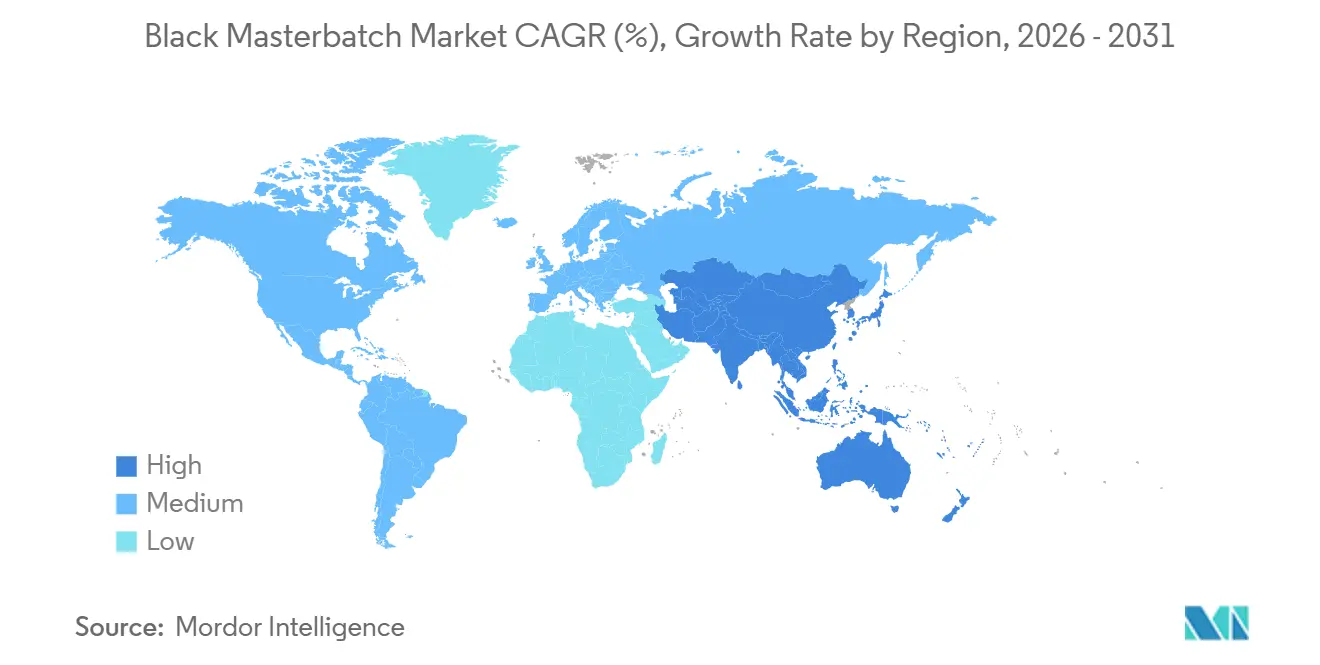
Asia-Pacific accounted for 47.81% of the black masterbatch market share in 2025 and is forecast to grow at a 5.83% CAGR through 2031. China supports regional demand through automotive, electronics, and packaging production. India is emerging as a second growth center, driven by plastics processing and construction-linked pipe demand. Japan and South Korea address higher-value demand for automotive electronics and optical components. Vietnam and Thailand continue to attract packaging and consumer goods manufacturing. The region's carbon black supply base supports standard and commodity production, while Japanese and Korean formulators serve premium conductive grades.
Europe and North America are shaped more by regulation and automotive requirements than by output growth alone. The black masterbatch market in Europe is moving toward Near-Infrared (NIR)-detectable and carbon-black-free formulations due to requirements under the Packaging and Packaging Waste Regulation (PPWR) and differentiated Extended Producer Responsibility (EPR) fees. These requirements support demand for performance formulations even as packaging-reduction measures limit some plastic consumption. LyondellBasell expanded masterbatch and custom performance color distribution into Germany and Austria through Interpolimeri, effective in Q1 2026[2]LyondellBasell, “LYB Expands Masterbatch and Custom Performance Color Distribution with Interpolimeri,” LyondellBasell, lyondellbasell.com. North America shows demand for sustainable black formulations and high-end automotive applications. Renewable energy cable installations also support demand for UV-resistant and low-smoke zero-halogen (LSZH)-compliant black compounds.
South America, the Middle East, and Africa follow infrastructure and agricultural investment cycles. Food and beverage output and e-commerce packaging support demand in these regions. Mulch films and irrigation pipes for sugarcane, coffee, and citrus cultivation use UV-stabilized HDPE and LDPE formulations. Mexico benefits from automotive near-shoring and higher demand for trim and exterior panel compounds. Saudi Arabia and South Africa support project-led demand for UV-stable HDPE pipe compounds through infrastructure investment and water-system rehabilitation. Investment cycles in these regions tend to link demand with specific construction, irrigation, and agricultural procurement programs, which can make order patterns less consistent than in mature packaging markets. UV protection is particularly important in these applications due to exposure to high outdoor temperatures and solar radiation. Suppliers must maintain stable dispersion to meet the service-life expectations of pipe and film customers. The black masterbatch market presents opportunities as local conversion capacity expands alongside these projects, though realizing them depends on consistent product supply and technical support for regional processors.

Competitive Landscape
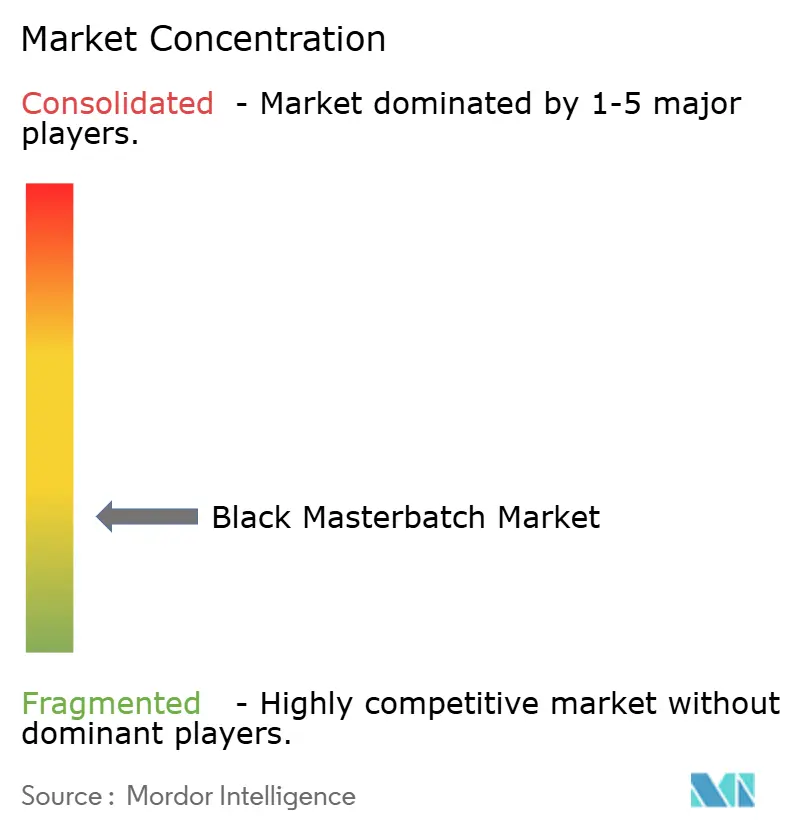
The black masterbatch market is fragmented. Cabot Corporation, Ampacet Corporation, LyondellBasell, Clariant, and Avient Corporation hold multi-regional positions through manufacturing networks, carbon black sourcing, and application laboratories. Regional specialists in India, Southeast Asia, and Eastern Europe compete through custom formulations, local technical support, and short lead times. Global suppliers are directing investment toward functional grades and circular material certifications, while regional producers are expanding standard black capacity for domestic packaging and pipe converters. Cabot's REPLASBLAK portfolio combines recycled carrier content with International Sustainability and Carbon Certification (ISCC) PLUS mass-balance certification for automotive compounders.
Technology adoption also affects the relative position of suppliers in the black masterbatch market. Process monitoring systems for carbon black dispersion improve batch consistency and can reduce energy use, though smaller producers may find it harder to match this level of process control. Sesotec launched the VARISORT+ CARBON BLACK system in September 2026 to detect carbon-black-filled polyolefins through mid-wave infrared sorting. This capability may improve recovery options for material that conventional near-infrared (NIR) systems cannot detect. NIR-sortable grades present a significant opportunity for smaller European packaging converters seeking to meet the requirements of the Packaging and Packaging Waste Regulation (PPWR). These converters may need formulation support to move away from standard carbon black without losing visual quality. Tosaf established a color masterbatch production facility in Olkusz, Poland, which began operations in Q2 2026 with an initial capacity of 3,000 tons per year. The facility targets converters in Poland, Ukraine, and across wider Eastern Europe, providing local production and technical support for customers requiring short turnaround times. LyondellBasell's expanded distribution arrangement in Germany and Austria is another example of a local-service strategy.
The black masterbatch market continues to reward suppliers that can combine color performance with traceable circular-content claims. Certified material pathways can reduce qualification work for customers who need documented recycled content. However, the same products must maintain the repeatable processing behavior expected in automotive compound operations, a requirement that favors companies with application laboratories and established testing capabilities. Regional competitors retain an advantage where converters need rapid product adjustment or shorter supply routes. Competition in this market is therefore based on both technical qualification and local service capacity.
Black Masterbatch Industry Leaders
Cabot Corporation
Ampacet Corporation
Avient Corporation
LyondellBasell Industries Holdings B.V.
Plastiblends
- *Disclaimer: Major Players sorted in no particular order

Recent Industry Developments
- May 2026: LyondellBasell (LYB) signed a distribution agreement with Interpolimeri Spa to expand masterbatch and custom performance color supply into Germany and Austria, effective Q1 2026. This extended an existing partnership that already covered Italy, Slovenia, and Iberia. The expansion targets growing demand for local technical support and fast-access masterbatch supply in markets where LYB identified underserved customer segments during a 2025 European go-to-market review.
- April 2026: Tosaf Compounds Ltd. announced the establishment of a new color masterbatch production facility in Olkusz, Poland (approximately 40 km from Kraków), with an initial annual capacity of 3,000 tons across a 5,500 m² site. The facility became operational in Q2 2026, serving Poland, Ukraine, and broader Eastern Europe as a regional production and technical support hub.


Global Black Masterbatch Market Report Scope
Black masterbatch is a concentrated mixture of carbon black pigments, a carrier resin, and functional additives used to color and enhance plastic products. It is widely used across industries such as packaging, automotive, agriculture, and construction, where consistent black coloration and performance properties are required.
The black masterbatch market is segmented by type, carrier resin, end-user industry, and geography. By type, the market is segmented into standard black masterbatch, high-jetness black masterbatch, UV-resistant black masterbatch, conductive black masterbatch, and recycled-polymer compatible black masterbatch. By carrier resin, the market is segmented into polypropylene, linear low-density polyethylene, low-density polyethylene, high-density polyethylene, polyethylene terephthalate, polyvinyl chloride, polystyrene, polyamide, and other carrier resins. By end-user industry, the market is segmented into automotive, packaging, infrastructure, electrical and electronics, and other end-use industries. The report also covers market size and forecasts for black masterbatch across 15 countries in major regions. The market sizes and forecasts are provided in terms of value (USD).
| Standard Black Masterbatch |
| High-Jetness Black Masterbatch |
| UV-Resistant Black Masterbatch |
| Conductive Black Masterbatch |
| Recycled-Polymer Compatible Black Masterbatch |
| Polypropylene |
| Linear Low-Density Polyethylene |
| Low-Density Polyethylene |
| High-Density Polyethylene |
| Polyethylene Terephthalate |
| Polyvinyl Chloride |
| Polystyrene |
| Polyamide |
| Other Carrier Resins |
| Automotive |
| Packaging |
| Infrastructure |
| Electrical and Electronics |
| Other End-Use Industries |
| Asia-Pacific | China |
| India | |
| Japan | |
| South Korea | |
| ASEAN Countries | |
| Rest of Asia-Pacific | |
| North America | United States |
| Canada | |
| Mexico | |
| Europe | Germany |
| United Kingdom | |
| France | |
| Italy | |
| NORDIC Countries | |
| Rest of Europe | |
| South America | Brazil |
| Argentina | |
| Rest of South America | |
| Middle East and Africa | Saudi Arabia |
| South Africa | |
| Rest of Middle East and Africa |
| By Type | Standard Black Masterbatch | |
| High-Jetness Black Masterbatch | ||
| UV-Resistant Black Masterbatch | ||
| Conductive Black Masterbatch | ||
| Recycled-Polymer Compatible Black Masterbatch | ||
| By Carrier Resin | Polypropylene | |
| Linear Low-Density Polyethylene | ||
| Low-Density Polyethylene | ||
| High-Density Polyethylene | ||
| Polyethylene Terephthalate | ||
| Polyvinyl Chloride | ||
| Polystyrene | ||
| Polyamide | ||
| Other Carrier Resins | ||
| By End-User Industry | Automotive | |
| Packaging | ||
| Infrastructure | ||
| Electrical and Electronics | ||
| Other End-Use Industries | ||
| By Geography | Asia-Pacific | China |
| India | ||
| Japan | ||
| South Korea | ||
| ASEAN Countries | ||
| Rest of Asia-Pacific | ||
| North America | United States | |
| Canada | ||
| Mexico | ||
| Europe | Germany | |
| United Kingdom | ||
| France | ||
| Italy | ||
| NORDIC Countries | ||
| Rest of Europe | ||
| South America | Brazil | |
| Argentina | ||
| Rest of South America | ||
| Middle East and Africa | Saudi Arabia | |
| South Africa | ||
| Rest of Middle East and Africa | ||


Key Questions Answered in the Report
What is current market size of Black Masterbatch Market?
The Black Masterbatch market size was valued at USD 3.23 billion in 2025 and is estimated to grow from USD 3.38 billion in 2026 to USD 4.33 billion by 2031, at a CAGR of 5.05% during the forecast period (2026-2031).
Which type of black masterbatch has the largest share?
Standard Black Masterbatch held a 65.84% share in 2025 due to its broad use in film, pipe, and injection molding.
Which carrier resin is growing fastest?
LLDPE is forecast to grow at a 5.88% CAGR through 2031, supported by flexible packaging and agricultural film uses.
Why are NIR-sortable black formulations important?
Conventional carbon black is difficult for NIR systems to detect, while European recyclability rules increase the cost of poor sorting outcomes.
Page last updated on:





