
Biofuel-Powered Machinery Market Size and Share
Market Overview
| Study Period | 2021 - 2031 |
|---|---|
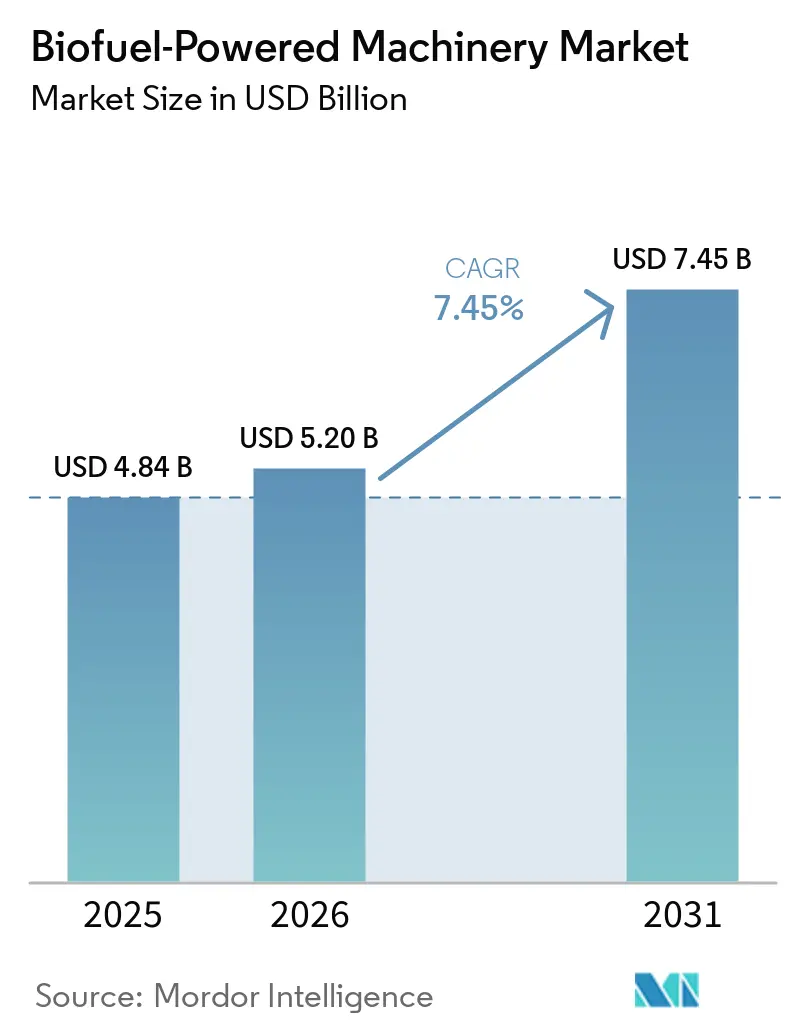
| Market Size (2026) | USD 5.20 Billion |
| Market Size (2031) | USD 7.45 Billion |
| Growth Rate (2026 - 2031) | 7.45 % |
| Fastest Growing Market | Asia-Pacific |
| Largest Market | Europe |
| Market Concentration | Low |
Major Players *Disclaimer: Major Players sorted in no particular order Image © Mordor Intelligence. Reuse requires attribution under CC BY 4.0. | |
Biofuel-Powered Machinery Market Analysis by Mordor Intelligence
The Biofuel-Powered Machinery Market size was valued at USD 4.84 billion in 2025 and is estimated to grow from USD 5.20 billion in 2026 to reach USD 7.45 billion by 2031, at a CAGR of 7.45% during the forecast period (2026-2031). The biofuel-powered machinery market is being shaped by tighter off-highway emissions rules and by equipment makers that are approving more fuel options at the factory. Buyers are increasingly considering high-blend fuel compatibility when they select tractors, excavators, and other diesel equipment. Public policy is supporting demand through blending mandates, tax measures, and renewable fuel programs in major producing regions. Manufacturers are responding with fuel-system approvals, warranty coverage, and monitoring technology that can reduce operational risk. Feedstock prices and uneven fuel quality remain important constraints because they can weaken the operating-cost case for some fleets.
Key Report Takeaways
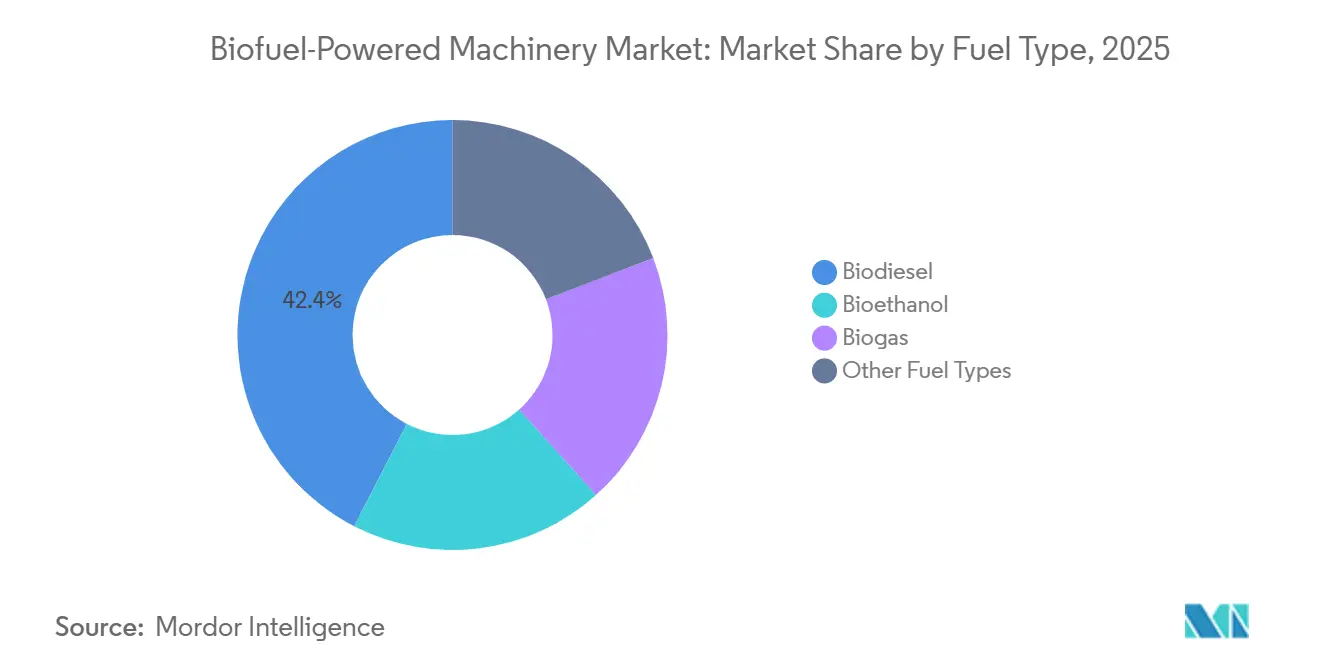
- By fuel type, biodiesel held 42.44% of the biofuel-powered machinery market share in 2025, while biogas is projected to advance at a 7.89% CAGR through 2031.
- By machinery type, biofuel-powered tractors held 34.56% of the biofuel-powered machinery market share in 2025, while biofuel-powered construction equipment is projected to advance at an 8.34% CAGR through 2031.
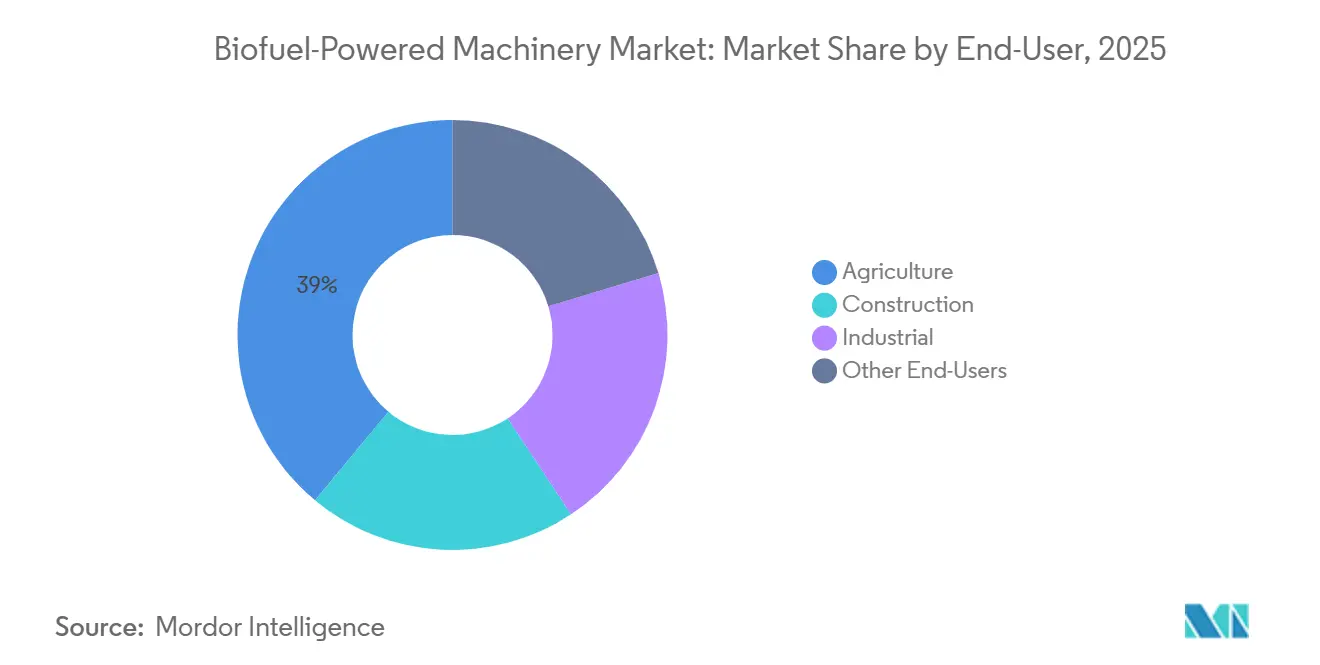
- By end-user, agriculture held 38.95% of the biofuel-powered machinery market share in 2025, while construction is projected to advance at an 8.63% CAGR through 2031.
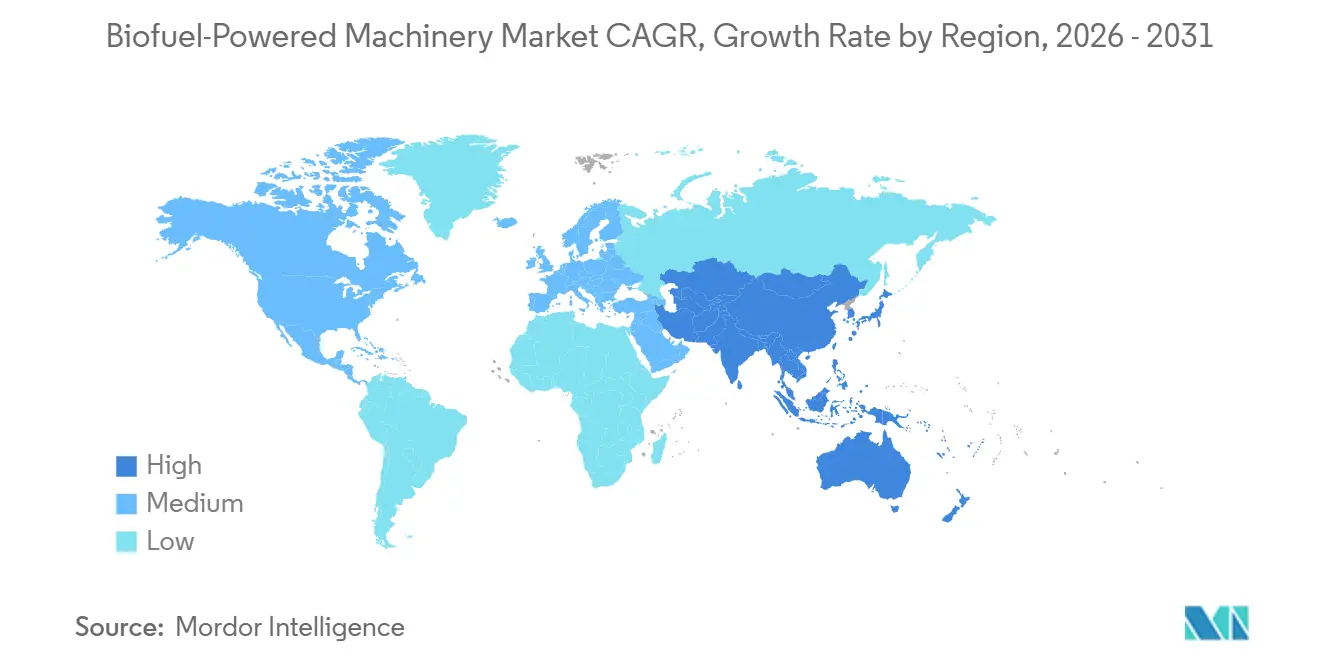
- By geography, Europe held 30.81% of the biofuel-powered machinery market share in 2025, while Asia-Pacific is projected to advance at an 8.22% CAGR through 2031.
Note: Market size and forecast figures in this report are generated using Mordor Intelligence’s proprietary estimation framework, updated with the latest available data and insights as of January 2026.
Global Biofuel-Powered Machinery Market Trends and Insights
Drivers Impact Analysis*
| Driver | (~) % Impact on CAGR Forecast | Geographic Relevance | Impact Timeline |
|---|---|---|---|
| Stricter Emissions Standards for Off-Highway Machinery | +2.2% | Global, with early concentration in EU, North America, and China; spillover to India and Southeast Asia | Medium term (2–4 years) |
| Government Biofuel Blending Mandates and Incentives | +1.8% | Global, led by North America (RFS), EU (RED III), and Southeast Asia (Indonesia B40, India blending targets) | Medium term (2–4 years) |
| Higher Biodiesel Compatibility Across Existing Diesel Fleets | +1.5% | Global, strongest in North America, EU, and Brazil where OEM certification cycles are most advanced | Short term (≤ 2 years) |
| Expansion of Biofuel Production and Rural Fuel Supply Chains | +1.2% | APAC core and South America, with spillover to Sub-Saharan Africa | Long term (≥ 4 years) |
| Decarbonization of Construction and Remote Heavy Equipment | +0.9% | North America, EU, and APAC; early gains in Scandinavia, UK, and Australia | Medium term (2–4 years) |
| Source: Mordor Intelligence | |||
Stricter Emissions Standards for Off-Highway Machinery
China implemented China Non-Road Stage IV standards in 2024, including a particulate-number requirement for engines above 37 kilowatts. India introduced European Union Stage V-equivalent requirements for tractors in 2026, extending regulatory pressure into a major agricultural equipment base[1]Association of Equipment Manufacturers, “Navigating the Global Emissions Regulations for Non-Road Engines and Powertrains,” AEM News, aem.org. These rules make emissions compliance a more central consideration in equipment procurement and change how equipment makers plan engine approvals. The biofuel-powered machinery market, therefore, favors manufacturers that can support approved renewable fuels without compromising emissions-system performance or warranty terms. Higher fatty acid methyl ester blends can create durability concerns in aftertreatment systems designed for conventional diesel, especially when fuel quality is inconsistent. This supports interest in hydrotreated vegetable oil and in engines that can operate across several approved fuel blends, which gives fleet owners more fuel choices.
Government Biofuel Blending Mandates and Incentives
The U.S. Environmental Protection Agency finalized Renewable Fuel Standard Set 2 volumes of 9.07 billion Renewable Identification Numbers for biomass-based diesel in 2026 and 9.20 billion Renewable Identification Numbers in 2027[2]U.S. Environmental Protection Agency, “Final Renewable Fuel Standards for 2026 and 2027,” EPA.gov, epa.gov. The agency stated that these requirements call for biodiesel and renewable diesel production to increase by more than 60% from 2025, giving fuel suppliers clearer volume requirements. The Internal Revenue Service issued 45Z Clean Fuel Production Tax Credit guidance in June 2026 that included regenerative agricultural practices in emissions calculations and expanded the basis for qualifying feedstocks. Germany reinstated its agricultural diesel tax rebate in November 2025 and extended it to biodiesel, vegetable oil fuel, and hydrotreated vegetable oil. These measures improve fuel-cost visibility for farm fleets, support planning for local fuel supply, and can shorten the payback case for compatible machinery. Renewable Energy Directive III compliance also increases the importance of verified fuel supply chains for larger operators that need documented sustainability credentials.
Higher Biodiesel Compatibility Across Existing Diesel Fleets
Higher blend approvals allow equipment owners to use existing machinery rather than replace fleets, which protects the value of installed equipment. Deere & Company announced B30 approval for its complete Tier 4 engine portfolio in August 2025. JC Bamford Excavators Ltd. announced full B100 fatty acid methyl ester approval for 5 X-Series excavators in 2026 when factory specifications and service requirements are met. A peer-reviewed study of Komatsu Ltd. HD785-7 haul trucks found that B5, B15, and B35 reduce reduced carbon dioxide emissions by as much as 17% relative to fossil diesel while maintaining operational performance. The biofuel-powered machinery market is consequently moving beyond B20 approvals in selected equipment categories, although fuel suitability still depends on the specific engine and operating conditions. Factory approval and warranty coverage can matter more than fuel availability alone when public fleets and contractors write procurement specifications.
Decarbonization of Construction and Remote Heavy Equipment
Construction equipment remains heavily dependent on liquid fuel because many high-duty-cycle machines are difficult to electrify in the near term and often operate away from fixed power supplies. Cummins Inc., Komatsu Ltd., and Vale commissioned test cells in June 2025 for dual-fuel ethanol and diesel haul trucks in the 230-290 metric ton range. The modified QSK60 engines are designed to operate with up to 70% ethanol, with a potential carbon dioxide reduction of up to 70%. This work shows why the biofuel-powered machinery market has a practical role at remote sites where charging infrastructure is limited and uninterrupted machine availability is essential. Sustained, high-load operating cycles also preserve the value of liquid fuels with high energy density and established storage practices. Contractors can use approved renewable fuels while continuing to operate established equipment platforms, rather than waiting for a full change in site power systems.
Restraints Impact Analysis*
| Restraint | (~) % Impact on CAGR Forecast | Geographic Relevance | Impact Timeline |
|---|---|---|---|
| Feedstock Price and Availability Volatility | -1.5% | Global, most acute in North America and Southeast Asia | Short to Medium term (≤ 4 years) |
| Inconsistent Fuel Quality and Higher-Blend Performance Risks | -1.0% | Global, highest severity in markets lacking established ASTM D6751 or EN 14214 quality infrastructure | Medium term (2–4 years) |
| Limited Fueling Infrastructure in Remote Operating Areas | -0.7% | APAC remote zones, Sub-Saharan Africa, and remote South American agricultural regions | Long term (≥ 4 years) |
| Source: Mordor Intelligence | |||
Feedstock Price and Availability Volatility
The biofuel-powered machinery market remains exposed to the cost and availability of feedstocks used for biodiesel and renewable diesel. Research from the University of Illinois found that the price relationship between soybean oil and palm oil became less stable after 2020, with periods of divergence lasting longer. The U.S. renewable fuel program raises demand certainty, but it also increases demand for qualifying feedstocks and can tighten the supply available to fuel producers. Higher fuel costs can weaken the total-cost-of-ownership case for agricultural and construction operators, even where equipment is fully compatible. This pressure is most significant for cost-sensitive fleets that have limited ability to pass fuel costs through to customers or secure long-term supply contracts. Supply-chain planning and access to multiple approved fuel types can therefore become important procurement considerations for the biofuel-powered machinery market.
Inconsistent Fuel Quality and Higher-Blend Performance Risks
Fuel quality remains a practical concern where operators use higher biodiesel blends. A field study of Bavarian state agricultural estates reported initial fuel-filter blockage after the switch from diesel to biodiesel or hydrotreated vegetable oil because deposits were released from tanks. A peer-reviewed assessment of B40-B70 fatty acid methyl ester blends in a Komatsu Ltd. engine found 5%-10% lower brake power and 12%-25% higher fuel consumption than conventional diesel. The same study found that hydrotreated vegetable oil blends at these levels performed comparably to conventional diesel, showing that the two renewable fuel pathways should not be treated as equivalent. The difference between fatty acid methyl ester and hydrotreated vegetable oil performance requires careful fuel selection, tank management, and equipment support. Markets without American Society for Testing and Materials (ASTM) D6751 or EN 14214 quality controls face greater reliability risk when they move to higher blends.
*Our forecasts treat driver/restraint impacts as directional, not additive. The impact forecasts reflect baseline growth, mix effects, and variable interactions.
Segment Analysis
By Fuel Type: Biodiesel Holds the Broadest Equipment Base While Biogas Expands
Biodiesel held 42.44% of the market share in 2025. Its position reflects broad original equipment manufacturer approvals, compatibility with established diesel infrastructure, and long-standing ASTM D6751 and EN 14214 standards that give operators defined fuel-quality reference points. In April 2026, the Technology and Promotion Centre surveyed 120 agricultural machinery manufacturers and found that Stage V approvals included biodiesel, biodiesel blends, hydrotreated vegetable oil, rapeseed oil fuel, and compressed natural gas. CLAAS KGaA mbH had supplied its Stage V machinery with hydrotreated vegetable oil from the factory since October 2023, according to the survey, and had shown the range of approved fuels available in the biofuel-powered machinery market.
Biogas is projected to advance at a 7.89% CAGR through 2031. Its role is strongest where farms can produce biomethane from manure through anaerobic digestion and use the fuel within their own operating system. New Holland Agriculture opened orders for its T7.270 Methane Power compressed natural gas tractor at the end of 2025, with commercial deliveries beginning in spring 2026. On-farm fuel production can reduce dependence on external fuel purchases after digestion assets have been developed, while also linking waste management with farm energy use. Bioethanol also remains relevant in Brazil, where agricultural equipment makers are developing ethanol-powered machines for sugarcane operations and can draw on an established feedstock base.



By Machinery Type: Biofuel-Powered Tractors Lead, While Biofuel-Powered Construction Equipment Grows Faster
Biofuel-powered tractors held 34.56% of the market share in 2025. Tractors are major energy users in farming and have a wide installed base of diesel equipment, making approved fuel use more practical than a full equipment replacement for many operators. Deere & Company certified B30 across all Tier 4 engines in 2025, while other manufacturers have expanded alternative-fuel development across agricultural platforms. Brazil provides a commercial operating environment for ethanol-powered harvesters because of the scale of its sugarcane sector and the local availability of ethanol. This machinery category also benefits from the ability to use approved fuels through existing farm refueling systems, which supports steady adoption across the biofuel-powered machinery market.
Biofuel-powered construction equipment is projected to advance at an 8.34% CAGR through 2031. JCB approved factory-specified B100 fatty acid methyl ester configurations for 5 X-Series tracked excavators from June 2026. The approval shifts attention from conventional B20 use toward higher-blend options in excavator platforms, where buyers need machine availability alongside lower-emissions fuel options. YANMAR HOLDINGS CO., LTD. presented engine options using hydrotreated vegetable oil, biodiesel, and biogas at Bauma 2025. Kubota Corporation also introduced a hydrotreated vegetable oil fuel-monitoring sensor that can identify bio-content levels within a fuel-filter assembly and support equipment reliability in the biofuel-powered machinery market.
By End-User: Agriculture Retains the Largest Base While Construction Speeds Adoption
Agriculture held 38.95% of the biofuel-powered machinery market size in 2025. Farm operators can link fuel production with machinery use through biodiesel, ethanol, or biomethane pathways, which creates a direct connection between agricultural output, energy production, and equipment operation. Mahindra & Mahindra Limited displayed compressed natural gas and compressed biogas dual-fuel, ethanol flex-fuel, and electric tractor platforms at Agrovision 2025. These options reflected a wider effort to reduce agricultural dependence on conventional diesel and accommodate different regional fuel supplies. Agricultural logistics and managed forestry operations are also using hydrotreated vegetable oil blends through established diesel infrastructure, avoiding major changes to storage and daily refueling routines in the biofuel-powered machinery market.
Construction is projected to advance at an 8.63% CAGR through 2031. Contractors face carbon-reporting requirements while still needing machines that can operate for long periods under heavy load and in locations that lack power infrastructure. The biofuel-powered machinery industry can meet part of this need through approved renewable fuels that work with diesel-based equipment and established service networks. The Cummins Inc., Komatsu Ltd., and Vale program addresses mining haul trucks, where fuel consumption is substantial, and equipment replacement cycles are long. Industrial users in mining, logistics, and materials handling can, therefore, benefit from fuel substitution without a complete shift to new powertrains, provided fuel supply and engine approvals are available across the biofuel-powered machinery market.
Geography Analysis
Europe held 30.81% of the market share in 2025. The region combines European Union Stage V compliance, Renewable Energy Directive III obligations, and established renewable-fuel supply networks that support both farm and construction applications. Germany extended its agricultural diesel tax rebate to biodiesel, hydrotreated vegetable oil, and vegetable oil fuel in November 2025. Germany, Denmark, and Nordic countries also have biodigester infrastructure that supports farm-level biomethane use and makes fuel production more accessible to livestock operations. In Sweden, hydrotreated vegetable oil remained more expensive than fossil diesel, which continued to affect operating economics within the biofuel-powered machinery market.
In North America, the U.S. Environmental Protection Agency set biomass-based diesel volumes at 9.07 billion Renewable Identification Numbers for 2026. Deere & Company displayed an E98 ethanol-powered 8R tractor prototype in March 2026. The prototype used a 9.0-liter ethanol powertrain and was planned for field trials in Nebraska and Illinois, while uneven fuel infrastructure and domestic incentives in Canada and Mexico influenced fleet decisions within the biofuel-powered machinery market.
Asia-Pacific is projected to advance at an 8.22% CAGR through 2031. Indonesia set a 2025 B40 national biodiesel quota of 15.6 million kiloliters under the Ministry of Energy and Mineral Resources Decree No. 341.K/EK.01/MEM.E/2024. India adopted Stage V-equivalent tractor emissions standards in 2026. Brazil remains an important agricultural biofuel ecosystem, with ethanol applications in sugarcane equipment and active development of compatible machinery. The Middle East and Africa are at an earlier stage, where individual blending programs and feedstock projects are creating initial fuel infrastructure for future machinery adoption in the biofuel-powered machinery market.

Competitive Landscape
The biofuel-powered machinery market is highly fragmented, with the top five players including Deere & Company, CNH Industrial N.V., AGCO Corporation, Caterpillar, and AB Volvo. Deere & Company, CNH Industrial N.V., AB Volvo, Caterpillar, and AGCO Corporation have broad engine portfolios and dealer networks that support large fleet customers across several equipment categories. Their position reflects certification coverage, regulatory compliance, and access to customers who require standard service and parts support.
Competition is increasingly based on certification speed and the range of fuels that equipment can use. Manufacturers with biodiesel, hydrotreated vegetable oil, biomethane, and ethanol approvals can better address varied regional fuel supplies and allow buyers to use a fuel pathway suited to each location. This capability can matter in fleet tenders where operators require factory-backed fuel approval, clear maintenance practices, and warranty coverage. JCB announced B100 fatty acid methyl ester approval for 5 production excavator models in 2026. The move provided warranty-backed higher-blend capability when machines meet its factory and service conditions.
Regional manufacturers have room to compete in small-tractor categories where certified biofuel configurations remain less common, and equipment buyers often focus closely on operating costs. Mahindra & Mahindra Limited and YANMAR HOLDINGS CO., LTD. are developing alternative-fuel options for these applications. Kubota Corporation introduced a hydrotreated vegetable oil monitoring sensor at Bauma 2025 to measure fuel composition within operating machinery. Cummins Inc., Komatsu Ltd., and Vale are also developing a dual-fuel program for large mining haul trucks. These initiatives show that product differentiation now includes fuel management, high-blend approvals, and applications for heavy-duty equipment where alternatives to liquid fuel remain limited in the biofuel-powered machinery market.
Biofuel-Powered Machinery Industry Leaders
Deere & Company
CNH Industrial N.V.
AGCO Corporation
Caterpillar
AB Volvo
- *Disclaimer: Major Players sorted in no particular order


Recent Industry Developments
- June 2026: YANMAR HOLDINGS CO., LTD. launched the YT4S/5S Series tractor lineup in Japan, comprising four models ranging from 88 to 114 horsepower and equipped with high-precision autonomous-assist features. The launch expanded YANMAR HOLDINGS CO., LTD.’s advanced agricultural machinery portfolio and supports the broader adoption of biofuel-compatible tractor engines as the company advances its multi-fuel engine development program.
- March 2026: JC Bamford Excavators Ltd. announced plans to introduce B100 biodiesel compatibility for selected tracked excavators manufactured from June 2026, using fuel derived from recycled vegetable oils. The initiative expands the use of renewable fuels in construction machinery and enables operators to reduce greenhouse-gas emissions while retaining conventional diesel-engine performance.


Global Biofuel-Powered Machinery Market Report Scope
Biofuel-powered machinery refers to equipment designed to operate using fuels derived from renewable biological sources. It can reduce reliance on conventional fossil fuels while supporting the operation of heavy-duty machinery across various working environments.
The Biofuel-Powered Machinery Market is segmented by fuel type, machinery type, end-user, and geography. By fuel type, the market is segmented into biodiesel, bioethanol, biogas, and other fuel types. By machinery type, the market is segmented into biofuel-powered tractors, biofuel-powered harvesters, biofuel-powered construction equipment, and other machinery types. By end-user, the market is segmented into agriculture, construction, industrial, and other end-users. The report also covers the market size and forecasts for biofuel-powered machinery in 15 countries across major regions. For each segment, the market sizing and forecasts have been done on the basis of value (USD).
| Biodiesel |
| Bioethanol |
| Biogas |
| Other Fuel Types |
| Biofuel-Powered Tractors |
| Biofuel-Powered Harvesters |
| Biofuel-Powered Construction Equipment |
| Other Machinery Types |
| Agriculture |
| Construction |
| Industrial |
| Other End-Users |
| Asia-Pacific | China |
| India | |
| Japan | |
| South Korea | |
| ASEAN Countries | |
| Rest of Asia-Pacific | |
| North America | United States |
| Canada | |
| Mexico | |
| Europe | Germany |
| United Kingdom | |
| France | |
| Italy | |
| NORDIC Countries | |
| Rest of Europe | |
| South America | Brazil |
| Argentina | |
| Rest of South America | |
| Middle East and Africa | Saudi Arabia |
| South Africa | |
| Rest of Middle East and Africa |
| By Fuel Type | Biodiesel | |
| Bioethanol | ||
| Biogas | ||
| Other Fuel Types | ||
| By Machinery Type | Biofuel-Powered Tractors | |
| Biofuel-Powered Harvesters | ||
| Biofuel-Powered Construction Equipment | ||
| Other Machinery Types | ||
| By End-User | Agriculture | |
| Construction | ||
| Industrial | ||
| Other End-Users | ||
| By Geography | Asia-Pacific | China |
| India | ||
| Japan | ||
| South Korea | ||
| ASEAN Countries | ||
| Rest of Asia-Pacific | ||
| North America | United States | |
| Canada | ||
| Mexico | ||
| Europe | Germany | |
| United Kingdom | ||
| France | ||
| Italy | ||
| NORDIC Countries | ||
| Rest of Europe | ||
| South America | Brazil | |
| Argentina | ||
| Rest of South America | ||
| Middle East and Africa | Saudi Arabia | |
| South Africa | ||
| Rest of Middle East and Africa | ||


Key Questions Answered in the Report
What is the size of the biofuel-powered machinery market?
The biofuel-powered machinery market stands at USD 5.20 billion in 2026 and is projected to reach USD 7.45 billion by 2031.
What is driving demand for biofuel-powered machinery?
Emissions standards, fuel blending mandates, and factory-backed approvals for higher blends are supporting equipment adoption across farming and construction uses in the biofuel-powered machinery market.
Which fuel type held the largest market share in 2025?
Biodiesel held 42.44% of the market share in 2025 because it had broad equipment approvals, established standards, and compatibility with existing diesel infrastructure.
Which machinery type is projected to advance fastest through 2031?
Biofuel-powered construction equipment is projected to advance at an 8.34% CAGR through 2031, supported by site-level emissions and reporting requirements.
Page last updated on:





