
Bio-Based Leather Market Size and Share
Market Overview
| Study Period | 2022 - 2032 |
|---|---|
| Market Size (2027) | USD 194.75 Million |
| Market Size (2032) | USD 369.58 Million |
| Growth Rate (2027 - 2032) | 13.67 % |
| Fastest Growing Market | Asia-Pacific |
| Largest Market | Europe |
| Market Concentration | Low |
Major Players *Disclaimer: Major Players sorted in no particular order Image © Mordor Intelligence. Reuse requires attribution under CC BY 4.0. | |
Bio-Based Leather Market Analysis by Mordor Intelligence
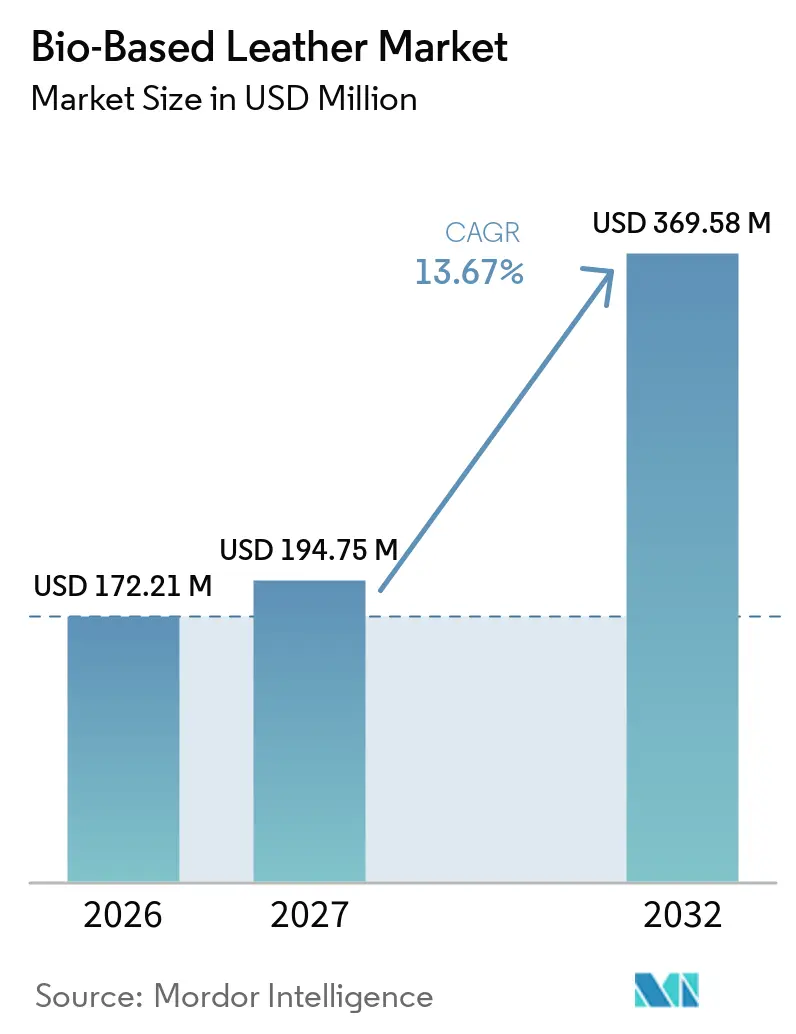
The Bio-Based Leather Market size was valued at USD 172.21 million in 2026 and is estimated to grow from USD 194.75 million in 2027 to reach USD 369.58 million by 2032, at a CAGR of 13.67% during the forecast period (2027-2032). The bio-based leather market is being shaped by material sourcing requirements in fashion, automotive, and furniture supply chains, where carbon commitments now influence supplier selection and buyers increasingly seek materials with documented origin. Brand commitments to reduce Scope 3 emissions are shortening the time available for suppliers to move from sampling to reliable commercial supply, and this has made production readiness a more immediate requirement in the bio-based leather market. European compliance requirements now make durability, traceability, lifecycle evidence, and environmental performance more important in material selection, particularly for textiles and footwear, because product decisions must be supported by more structured environmental information. The bio-based leather market also faces a supply constraint because few producers can demonstrate repeatable commercial output across the volumes and quality levels needed by large brand programs, especially when customers require tailored colors, finishes, or performance characteristics. Recent restructurings among several producers show that technical performance must be matched by a financially sustainable manufacturing model, a credible path to scale, and the ability to support long customer qualification cycles while maintaining material consistency.
Key Report Takeaways
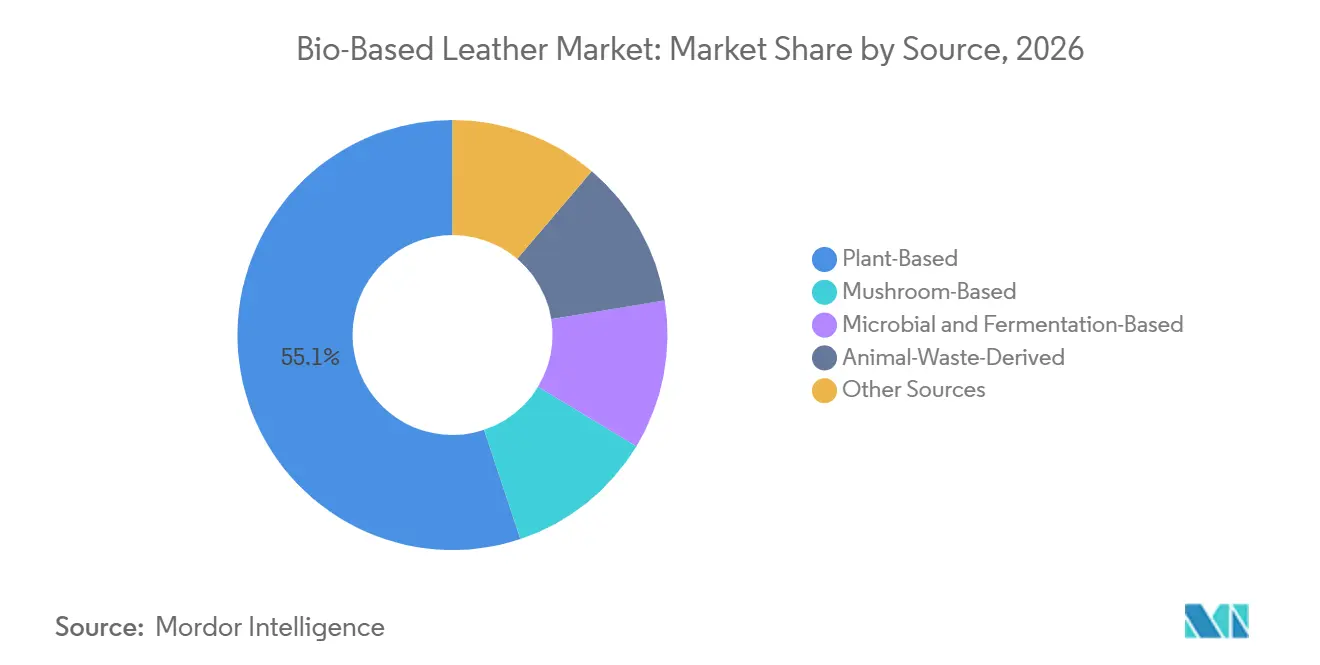
- By source, plant-based held 55.12% of the bio-based leather market share in 2026, while microbial and fermentation-based are forecast to advance at a 14.48% CAGR through 2032.
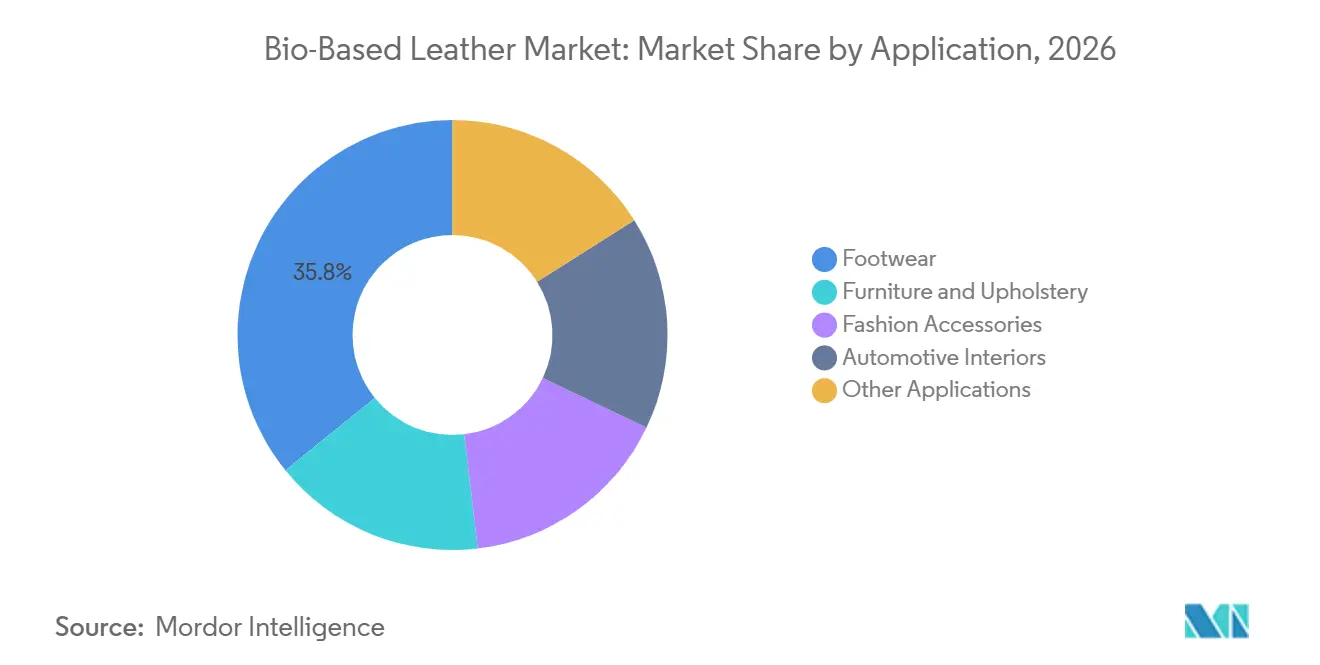
- By application, footwear held 35.83% of the bio-based leather market share in 2026, while automotive interiors are forecast to advance at a 15.45% CAGR through 2032.
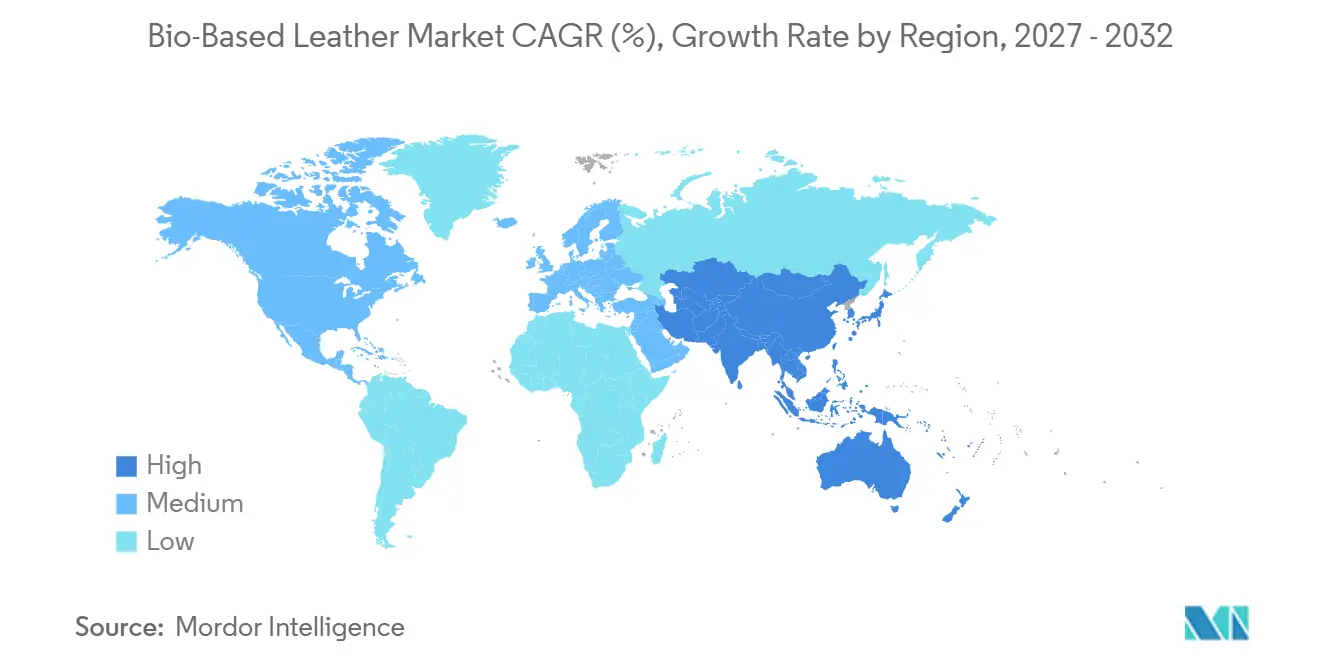
- By geography, Europe held 38.57% of the bio-based leather market share in 2026, while Asia-Pacific is forecast to advance at a 14.59% CAGR through 2032.
Note: Market numbers in this report are based on Mordor Intelligence's proprietary estimation framework, which combines nine months of actuals with Q4 projections for base year 2026.
Market Trends and Insights
Drivers Impact Analysis of Bio-Based Leather Market*
| Driver | (~) % Impact on CAGR Forecast | Geographic Relevance | Impact Timeline |
|---|---|---|---|
| Brand Decarbonization and Animal-Free Material Commitments | +3.8% | Global, concentrated in EU and North America | Short term (≤ 2 years) |
| Biotechnology Advances Improving Mycelium and Bio-Fiber Performance | +3.2% | North America, EU, spillover to APAC | Medium term (2-4 years) |
| Regulatory and Disclosure Pull for Traceable Bio-Based Content | +2.1% | EU core, expanding to North America | Medium term (2-4 years) |
| Agricultural and Food-Processing Residue Valorization | +1.5% | APAC, Latin America, EU | Long term (≥ 4 years) |
| Automotive Interior Qualification for Low-Carbon Materials | +1.2% | EU and Germany, spillover to North America and APAC | Medium term (2-4 years) |
| Source: Mordor Intelligence | |||
Brand Decarbonization and Animal-Free Material Commitments
Brand decarbonization commitments are the most immediate demand signal for the bio-based leather market, particularly in fashion, automotive, and furniture supply chains, where material purchasing is linked to wider emissions programs. Luxury and sportswear groups with Science Based Targets initiative commitments are adding material-origin requirements to supplier contracts, moving the discussion from voluntary sampling toward documented procurement criteria. This makes compliant alternatives more relevant than they were during the earlier period of voluntary sampling, when most engagement centered on small design-led collections. Procurement teams need qualified materials, rather than waiting for pilot suppliers to mature later in the decade, because supplier decisions are being made against near-term reporting commitments. Polybion and TÔMTEX are, therefore, giving production readiness a similar priority to material development, including repeatable manufacturing and customer qualification work. The resulting demand pressure supports adoption but also exposes the limited number of suppliers with proven commercial throughput, which can delay programs even where brand interest is strong.
Biotechnology Advances Improving Mycelium and Bio-Fiber Performance
Fermentation engineering and material processing are improving the performance limits that held back early alternatives, particularly where tensile strength, surface finish, and production consistency affected buyer confidence. MycoWorks, Inc. introduced Rei-Tanning in 2025 and reported tensile strength above 18 MPa for its mycelium material, compared with performance below 10 MPa before the reported advance. The company presented the technology as a route toward more demanding furniture and automotive specifications, where mechanical performance must be maintained across repeatable production runs. Modern Synthesis secured USD 5.5 million in February 2025 to expand bacterial nanocellulose production and move its platform toward commercial launch. Research published in 2025 also described engineered bacteria that produced black bacterial nanocellulose without a separate synthetic dyeing stage, reducing the need for an additional chemically intensive process. These developments support the move from prototype trials toward volume procurement, where materials meet performance requirements and can be processed through established supply chains.
Regulatory and Disclosure Pull for Traceable Bio-Based Content
European requirements are adding a cost and disclosure basis for the bio-based leather market, rather than treating material origin as only a voluntary brand claim. The Ecodesign for Sustainable Products Regulation working plan identifies textiles and footwear as priority products for future requirements on performance and durability[1]. The European Commission issued Product Environmental Footprint Category Rules for apparel and footwear in June 2025, creating a common approach for life cycle information in these product groups. These rules make life cycle information more material in product comparisons and encourage suppliers to retain evidence for material composition and processing. CEN/TC 411 provides a standards pathway for bio-based material claims, while the United States Department of Agriculture BioPreferred Program offers a separate certification framework for eligible products. Leap Materials ApS demonstrated that commercial materials can meet this route, with Leap certified at 91% bio-based content.
Agricultural and Food-Processing Residue Valorization
Agricultural and food-processing residues give the bio-based leather market a feedstock model that differs from dedicated biomass cultivation and can connect materials production with existing food-industry streams. Fruitleather Rotterdam uses mango waste, VEGEA SRL uses grape pomace, Leap Materials ApS uses apple pressing residue, and Polybion uses fruit waste (e.g., mango waste slurry) to produce bacterial cellulose. These inputs can reduce raw-material exposure where food-industry residues would otherwise require disposal, although they still require collection, preparation, and processing systems. Nature Biotechnology reported in 2025 that Polybion uses mango waste slurry to feed modified Acetobacter bacteria for Celium production. The company had produced more than 1 million square feet of the material at its solar-powered Guanajuato facility, offering a visible example of residue use at a commercial facility. Residue-based sourcing can also make pricing discussions more predictable because it is less connected to dedicated agricultural commodity cycles.
Restraints Impact Analysis of Bio-Based Leather Market*
| Restraint | (~) % Impact on CAGR Forecast | Geographic Relevance | Impact Timeline |
|---|---|---|---|
| Higher Unit Cost and Limited Commercial-Scale Economies | -1.8% | Global, most acute in North America and APAC | Short term (≤ 2 years) |
| Durability, Moisture, Abrasion and Heat-Resistance Qualification Gaps | -1.2% | Global, most critical in Automotive and Furniture end-uses | Medium term (2-4 years) |
| Plastic Coating Dependence and Inconsistent End-of-Life Claims | -0.8% | EU and North America, driven by regulatory scrutiny | Medium term (2-4 years) |
| Source: Mordor Intelligence | |||
Higher Unit Cost and Limited Commercial-Scale Economies
Unit cost remains a central obstacle to wider adoption in the bio-based leather market, especially outside premium uses where buyers can absorb a higher material price. TÔMTEX has targeted USD 2.50 to USD 3.50 per square foot at scale, a level aligned with mid-tier animal leather and dependent on reaching larger production runs. Reaching that level depends on production volumes that most producers have not achieved, which leaves unit costs exposed to small-batch manufacturing and specialized inputs. Ecovative LLC has raised more than USD 120 million since 2019 and built 120,000 square feet of manufacturing facilities, yet it continues to use its Forager branded-goods unit to improve demand visibility rather than rely only on commodity-scale orders. Fermentation and bioreactor systems also require significant capital investment before a producer can spread fixed costs over a larger output. Until output becomes comparable with established tanneries, price pressure is likely to confine many products to premium applications.
Durability, Moisture, Abrasion and Heat-Resistance Qualification Gaps
Performance qualification remains inconsistent across bio-based material categories, particularly when buyers assess durability under repeated use, moisture exposure, abrasion, and heat. Relevant test methods include International Organization for Standardization (ISO) 3376 for tensile strength, ISO 3377-1 for tear strength, ISO 17076-2 for abrasion resistance, and ISO 14268 for water vapor permeability. A 2025 review found that several waste-derived and gel-based alternatives still face moisture resistance and thermal-cycling limits, which are central concerns for automotive interiors and furniture. VEGEA SRL has reported chemical resistance suitable for automotive uses, while MycoWorks, Inc. reported Reishi performance of up to 50,000 Martindale abrasion cycles. These cases are not yet representative of the full category, so material performance cannot be assumed from feedstock origin alone. Extended qualification periods slow volume ramp-up in automotive interiors and furniture.
*Our forecasts treat driver/restraint impacts as directional, not additive. The impact forecasts reflect baseline growth, mix effects, and variable interactions.
Bio-Based Leather Market Segment Analysis
By Source:
Plant-Based Anchors Revenue as Microbial and Fermentation-Based Sources Gain a Performance EdgeThe plant-based source held 55.12% of the bio-based leather market share in 2026. Cactus pulp, grape pomace, apple waste, and fruit-fed bacterial inputs give purchasers a broad choice of feedstocks. This breadth allows buyers to consider local availability, unit cost, finish requirements, and the intended application when selecting a material. It also reduces dependence on a single crop or supplier network. Mushroom-based materials, mainly mycelium composites, serve premium uses where customers value traceability, controlled growing conditions, and distinct surface properties.
The microbial and fermentation-based source is projected to advance at a 14.48% CAGR through 2032. Modern Synthesis has demonstrated the strong potential of bacterial nanocellulose at the nanofiber level, while research has also shown that engineered bacteria can form self-pigmented material. Polybion reported production of more than 1 million square feet of Celium from fruit-waste-fed bacteria at its Guanajuato facility, giving the bio-based leather industry a visible scale-up example. Animal-waste-derived materials have a smaller role in circular material programs, while other noncellulose bacterial platforms remain at an early commercial stage. ISO 21701:2025 can support biodegradability validation for fermentation-derived materials when the final product meets the applicable conditions.

By Application:
Footwear Anchors Revenue, While Automotive Interiors Command Growth PremiumFootwear held 35.83% share in the bio-based leather market in 2026. Shorter batch cycles, frequent design changes, and multiple tier-1 suppliers make footwear more accessible than applications with multiyear qualification requirements. The segment also gives brands room to introduce limited collections before committing to broader material use. Fashion accessories provide a related setting for design-led materials, particularly where small production runs can accommodate higher unit costs. TÔMTEX presented BloomCell as a hand-finished belt at Iris van Herpen’s Paris Haute Couture show in July 2026, and reported an annual capacity of 100,000 square meters.
Automotive interiors are projected to advance at a 15.45% CAGR through 2032. Modern Meadow’s Mercedes-Benz partnership places its INNOVERA biomaterial in a formal vehicle technology program, where materials are assessed against demanding interior requirements. Furniture and upholstery also gained visibility when Ligne Roset introduced the Reishi-upholstered Kobold sofa in April 2025. Automotive qualification reinforces the need for traceable, recyclable, and consistently performing interior materials. These requirements make automotive a demanding application, but they also support longer supplier engagement once a material is qualified.
Geography Analysis
Europe
Europe held 38.57% of the bio-based leather market share in 2026. The Ecodesign for Sustainable Products Regulation working plan places textiles and footwear among the product groups prioritized for future requirements, and Product Environmental Footprint Category Rules make life cycle scoring more relevant to apparel and footwear choices. VEGEA SRL, Leap Materials ApS, ECCO Leather, and MycoWorks, Inc. operate through established European material and tanning networks, which give brands access to familiar converting and finishing capabilities. Germany is an active automotive testing location because BMW and Mercedes-Benz are assessing lower-carbon interior materials. VEGEA SRL completed an expansion in 2026 that increased GrapeSkin capacity from 10,000 to 50,000 square meters per year, with equipment scalable to 500,000 square meters.
Asia-Pacific
Asia-Pacific is projected to advance at a 14.59% CAGR through 2032. China’s raw-material processing base and South Korea’s polyurethane coating capabilities can support higher-volume material finishing without every supplier making a new investment in facilities. India offers agricultural-residue feedstocks and an expanding manufacturing base for global brands, linking upstream inputs with downstream product production. Japan’s Ministry of Economy, Trade and Industry (METI) has supported biotechnology research and implementation through the Green Innovation Fund, which can strengthen upstream biofiber development for leather applications[2]. The Association of Southeast Asian Nations (ASEAN) region is emerging as a finishing location for mid-tier bio-based fabrics and can absorb supply-chain shifts as producers adjust their manufacturing footprint.
North America, South America, Middle East and Africa
North America remains a major geography for the bio-based leather market, supported by Ecovative LLC, Modern Meadow, and TÔMTEX. The United States Department of Agriculture BioPreferred Program provides a certification route that supports the procurement of qualifying bio-based products and gives buyers a defined basis for evaluating bio-based content. South America remains at an earlier stage, although Adriano Di Marti SA DE CV and Polybion provide active commercial examples in Mexico and Brazil’s sugarcane and coffee-processing streams offer a longer-term feedstock base. The Middle East and Africa remain nascent, while South Africa’s developing textile manufacturing base can add downstream demand over time.
Competitive Landscape
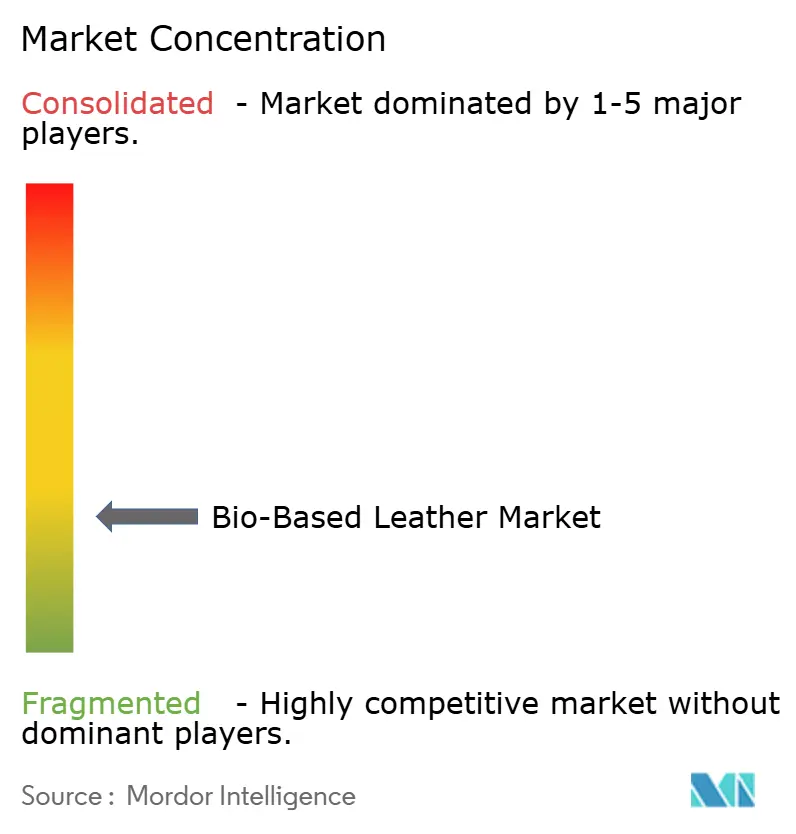
The bio-based leather market is highly fragmented, with the top five players including MycoWorks, Inc., Ananas Anam, Adriano Di Marti SA DE CV, Ecovative LLC, and Leap Materials ApS. Competition is based on application fit, material performance, supply reliability, and production strategy rather than direct price competition. In the bio-based leather market, this means that a material’s customer pathway can matter as much as its underlying feedstock because buyers also assess finishing capability, quality consistency, and the supplier’s ability to provide samples and commercial orders over time. MycoWorks, Inc. moved toward a tanning and technology-licensing model after DFX Corporation acquired it in January 2026, a change that places greater focus on processing partnerships rather than ownership of a large dedicated production site. VEGEA SRL expanded GrapeSkin capacity in 2026, while Ecovative LLC built dedicated capacity to support Forager, illustrating different approaches to controlling material output. Modern Meadow reported commercial production capacity above 500,000 square meters per year for INNOVERA in 2025, which positions it for programs requiring greater volume readiness.
Recent restructurings have narrowed the competitive field. Ananas Anam entered administration in 2025, MycoWorks, Inc. closed its South Carolina facility in 2025 before the 2026 acquisition, and Natural Fiber Welding received a strategic investment in January 2026 after its wind-down. These events show that material innovation alone does not establish a durable commercial position, especially when companies must fund new processing capacity and long customer qualification cycles. Producers need an operating model that supports consistent output, financial resilience, and a path to cost-competitive scale. For buyers, this means supplier diligence extends beyond the environmental profile of the material to the stability of the manufacturing partner.
Certification and supply-chain traceability are becoming differentiators for the bio-based leather market. Leap Materials ApS obtained United States Department of Agriculture certification for Leap at 91% bio-based content, giving it a clear third-party reference for buyer discussions. TÔMTEX introduced BloomCell in a Paris couture application in 2026, while Polybion progressed product development work with Secrid and Sistta in 2025, showing parallel efforts to establish commercial use cases in luxury and accessories. Ecovative LLC and Modern Meadow also reported intellectual property activity related to mycelium processing and protein-polyurethane materials. These moves show that competition is extending from finished materials to process capability, certification evidence, and protected formulation know-how.
Bio-Based Leather Industry Leaders
-
MycoWorks, Inc.
-
Ananas Anam
-
Adriano Di Marti SA DE CV
-
Ecovative LLC
-
Leap Materials ApS
- *Disclaimer: Major Players sorted in no particular order
Bio-Based Leather Market Companies Covered in this Report
- Adriano Di Marti SA DE CV
- Ananas Anam
- Bolt Threads, Inc.
- ECCO Leather
- Ecovative LLC
- Fruitleather Rotterdam
- Leap Materials ApS
- Modern Meadow
- Modern Synthesis Ltd.
- MycoWorks, Inc.
- Natural Fiber Welding, Inc.
- Polybion
- TÔMTEX
- Ultrafabrics Holdings Co.,Ltd.
- VEGEA SRL
Recent Industry Developments in Bio-Based Leather Market
- August 2026: The Indian Council of Agricultural Research–National Institute of Natural Fibre Engineering and Technology (ICAR-NINFET) transferred its natural fiber-based vegan leather technology to Bengaluru-based Shreyaskam Private Limited through a formal technology-transfer agreement. The development supports the bio-based leather market by accelerating the commercialization of natural-fiber leather alternatives for footwear, bags, fashion accessories, and lifestyle products.
- February 2026: Allbirds launched its Terralux footwear collection using INNOVERA, a leather alternative developed by Modern Meadow from plant-based proteins, biopolymers, and recycled nylon sourced from end-of-life tires. With more than 80% renewable carbon content, the material supports the bio-based leather market by expanding the commercial use of bio-based leather alternatives in consumer footwear.
Global Bio-Based Leather Market Report Scope
Bio-based leather refers to leather alternatives made partly or primarily from renewable biological sources, such as plants, fungi, and microbial materials. These materials are developed to provide a leather-like appearance, texture, and functionality while reducing reliance on conventional animal-derived leather and fossil-based inputs.
The Bio-Based Leather Market is segmented by source, application, and geography. By source, the market is segmented into plant-based, mushroom-based, microbial and fermentation-based, animal-waste-derived, and other sources. By application, the market is segmented into footwear, fashion accessories, automotive interiors, furniture and upholstery, and other applications. The report also covers the market size and forecasts for bio-based leather across 15 countries. For each segment, the market sizing and forecasts have been done on the basis of value (USD).
Segmentation Overview
| Plant-Based |
| Mushroom-Based |
| Microbial and Fermentation-Based |
| Animal-Waste-Derived |
| Other Sources |
| Footwear |
| Fashion Accessories |
| Automotive Interiors |
| Furniture and Upholstery |
| Other Applications |
| Asia-Pacific | China |
| India | |
| Japan | |
| South Korea | |
| ASEAN Countries | |
| Rest of Asia-Pacific | |
| North America | United States |
| Canada | |
| Mexico | |
| Europe | Germany |
| United Kingdom | |
| France | |
| Italy | |
| NORDIC Countries | |
| Rest of Europe | |
| South America | Brazil |
| Argentina | |
| Rest of South America | |
| Middle East and Africa | Saudi Arabia |
| South Africa | |
| Rest of Middle East and Africa |
| By Source | Plant-Based | |
| Mushroom-Based | ||
| Microbial and Fermentation-Based | ||
| Animal-Waste-Derived | ||
| Other Sources | ||
| By Application | Footwear | |
| Fashion Accessories | ||
| Automotive Interiors | ||
| Furniture and Upholstery | ||
| Other Applications | ||
| By Geography | Asia-Pacific | China |
| India | ||
| Japan | ||
| South Korea | ||
| ASEAN Countries | ||
| Rest of Asia-Pacific | ||
| North America | United States | |
| Canada | ||
| Mexico | ||
| Europe | Germany | |
| United Kingdom | ||
| France | ||
| Italy | ||
| NORDIC Countries | ||
| Rest of Europe | ||
| South America | Brazil | |
| Argentina | ||
| Rest of South America | ||
| Middle East and Africa | Saudi Arabia | |
| South Africa | ||
| Rest of Middle East and Africa | ||
Key Questions Answered in the Report
What is the size of the bio-based leather market?
The bio-based leather market size was valued at USD 172.21 million in 2026 and is estimated to grow from USD 194.75 million in 2027 to reach USD 369.58 million by 2032, at a CAGR of 13.67% during the forecast period (2027-2032).
What is driving demand for bio-based leather?
Brand Scope 3 commitments, European product requirements, and automotive material qualification programs are supporting demand.
Which source held the largest share in 2026?
Plant-based held a 55.12% share in 2026 because cactus, grape, apple, and other feedstocks are already commercially available.
Which application is expected to grow fastest through 2032?
Automotive interiors are projected to advance at a 15.45% CAGR through 2032 as vehicle programs assess lower-carbon interior materials.