
Beverage Flavoring System Market Size and Share
Market Overview
| Study Period | 2021 - 2031 |
|---|---|
| Market Size (2026) | USD 7.44 Billion |
| Market Size (2031) | USD 9.74 Billion |
| Growth Rate (2026 - 2031) | 5.54 % |
| Fastest Growing Market | Asia-Pacific |
| Largest Market | Asia-Pacific |
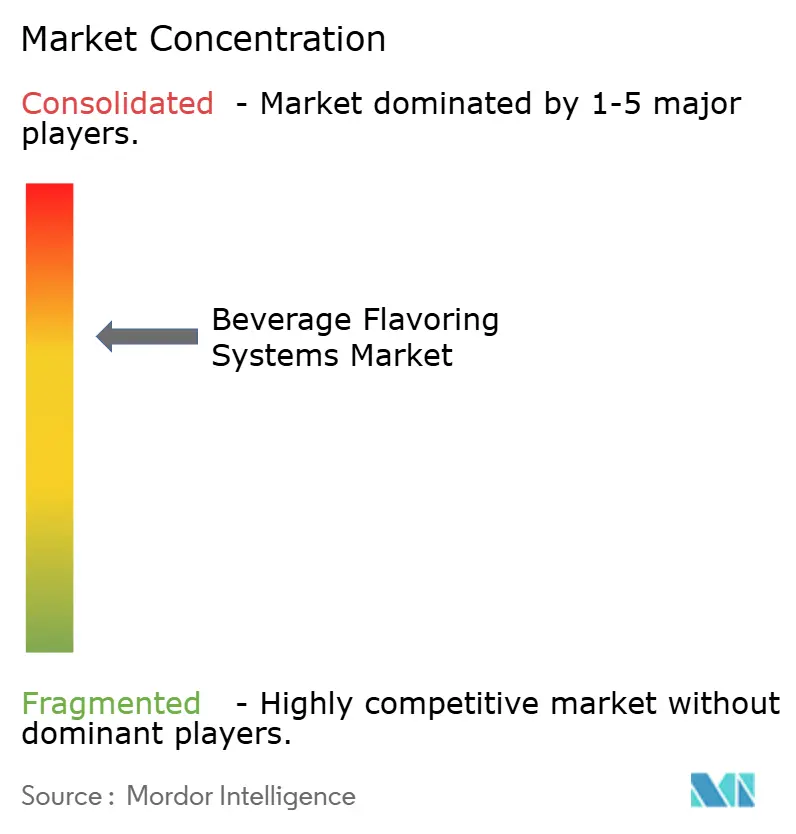
| Market Concentration | Medium |
Major Players *Disclaimer: Major Players sorted in no particular order Image © Mordor Intelligence. Reuse requires attribution under CC BY 4.0. | |
Beverage Flavoring System Market Analysis by Mordor Intelligence
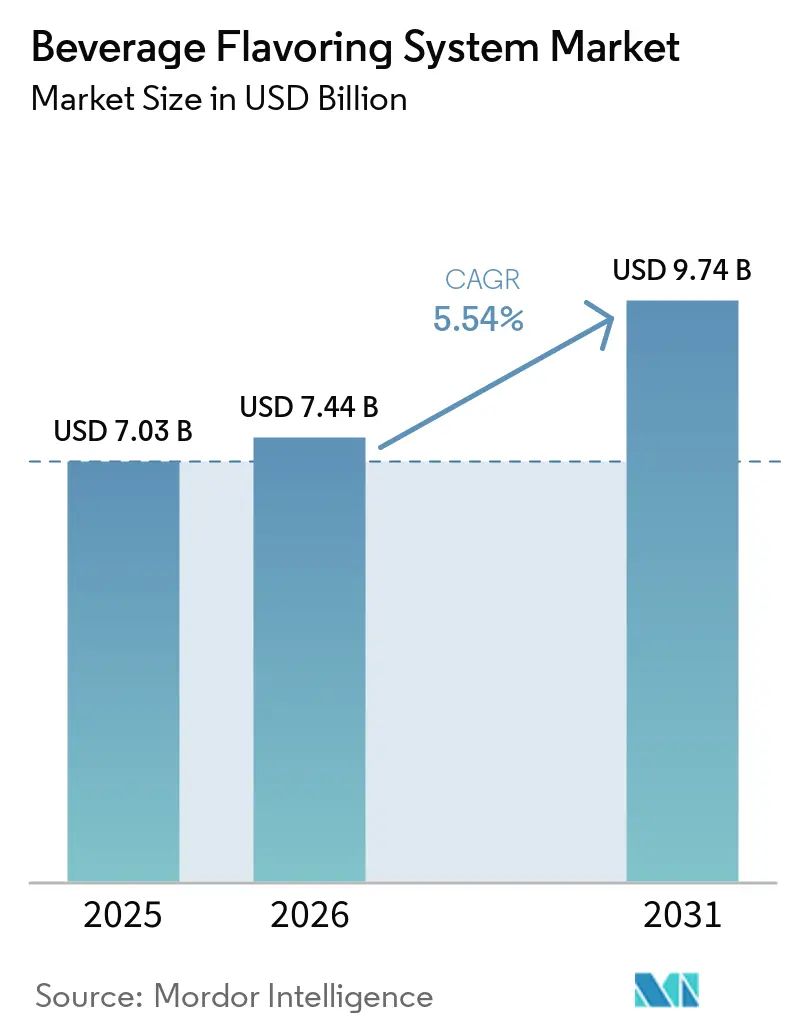
The beverage flavoring system market was valued at USD 7.03 billion in 2025 and is projected to grow from USD 7.44 billion in 2026 to USD 9.74 billion by 2031, registering a CAGR of 5.54% during the forecast period (2026-2031). Natural flavoring agents are being used by beverage manufacturers in response to an increasing focus on recognizable ingredients, transparent sourcing, and clean-label product positioning. This trend enhances the importance of suppliers that can provide reliable ingredient traceability, consistent quality, secure supply chains, and reformulation support. The growing demand for functional beverages and reduced-sugar products is also increasing the need for flavor systems that mask off-notes and preserve familiar taste profiles. At the same time, stricter regulatory requirements for novel ingredients favor suppliers with established safety assessment and compliance capabilities. Fermentation-based flavor production offers an alternative to conventional agricultural extraction; however, its wider commercialization depends on securing market-specific regulatory approvals.
Key Report Takeaways
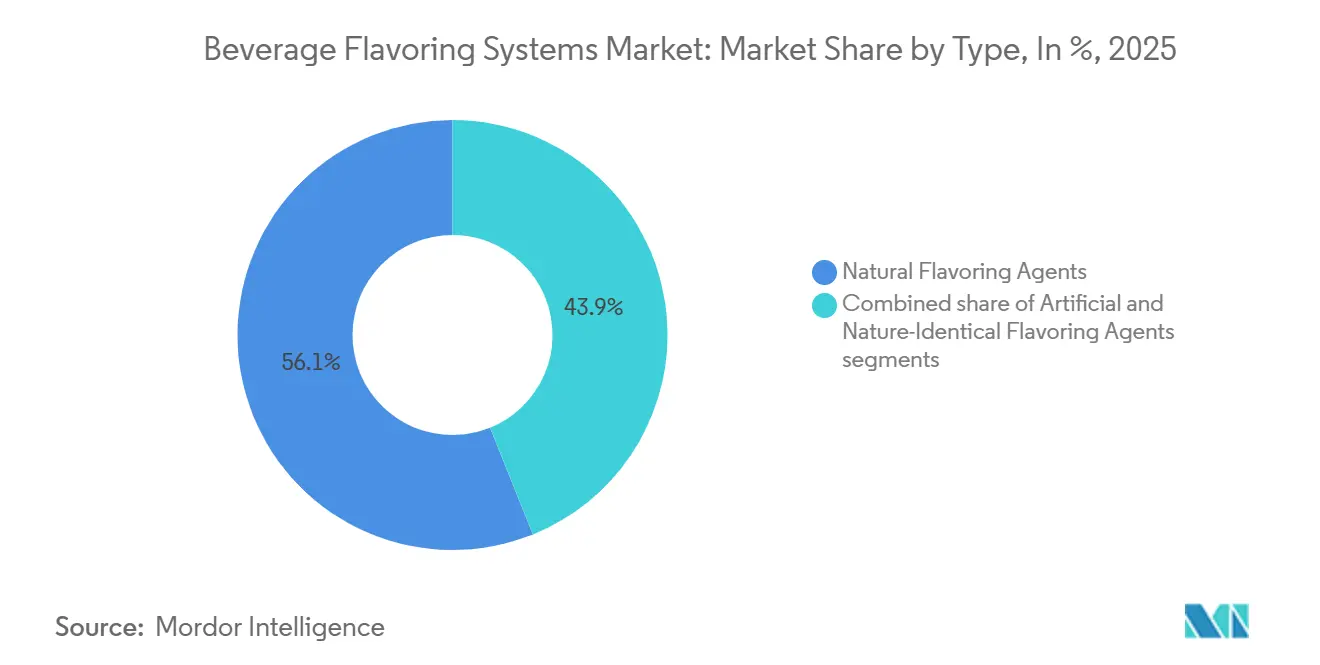
- By type, natural flavoring agents held 56.10% of the beverage flavoring agents market share in 2025 and are forecast to grow at a 6.20% CAGR through 2031.
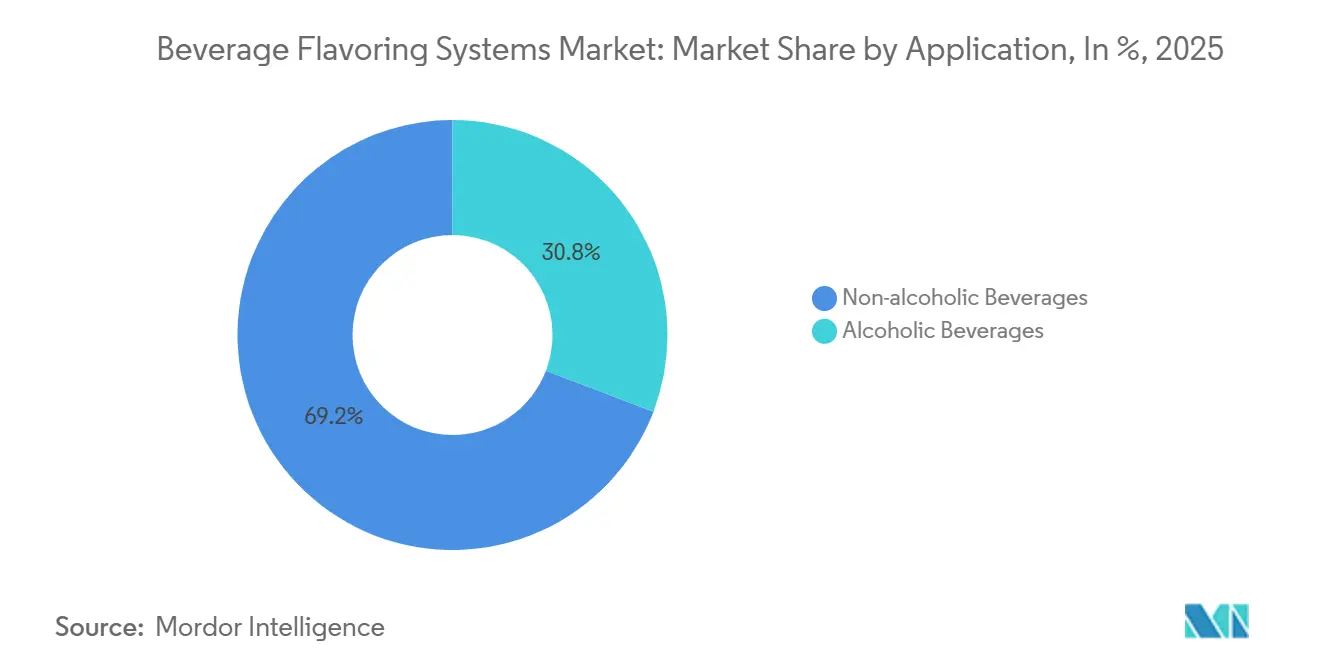
- By application, non-alcoholic beverages accounted for 69.20% of the beverage flavoring agents market size in 2025, while alcoholic beverages are forecast to expand at a 6.90% CAGR through 2031.
- By geography, Asia-Pacific held 38.40% of the beverage flavoring agents market share in 2025 and is expected to grow at a 6.30% CAGR through 2031.
Note: Market size and forecast figures in this report are generated using Mordor Intelligence’s proprietary estimation framework, updated with the latest available data and insights as of January 2026.
Market Trends and Insights
Drivers Impact Analysis of Beverage Flavoring System Market*
| Driver | (~) % Impact on CAGR Forecast | Geographic Relevance | Impact Timeline |
|---|---|---|---|
| Clean-label and natural flavor demand | +1.4% | Global, strongest in North America and Europe | Short term (≤ 2 years) |
| Functional and fortified beverage expansion | +1.1% | Asia-Pacific, with spillover to North America and Middle East and Africa | Medium term (2-4 years) |
| Premium, exotic, and regionally localized flavor innovation | +0.8% | Global, with early leadership in Europe and Asia-Pacific | Medium term (2-4 years) |
| Sugar reduction and taste-modulation requirements | +0.7% | Europe and North America | Short term (≤ 2 years) |
| Ingredient traceability and digital ingredient passports | +0.4% | Europe, North America, and Asia-Pacific exporters | Long term (≥ 4 years) |
| Precision fermentation and biotechnology for flavor supply resilience | +0.6% | Global, especially North America, Europe, and Japan | Long term (≥ 4 years) |
| Source: Mordor Intelligence | |||
Clean-Label and Natural Flavor Demand
Growing consumer preference for clean-label beverages and products with fewer artificial ingredients is prompting beverage manufacturers to reformulate their offerings with natural flavoring systems. According to the 2025 International Food Information Council (IFIC) Food & Health Survey, 25% of Americans considered limited or no artificial ingredients or preservatives a characteristic of healthy food, while 24% identified natural as an important criterion[1]. This consumer shift is increasing demand for natural flavor solutions in soft drinks, juices, functional beverages, flavored water, and other beverage categories. Beverage manufacturers are increasingly seeking flavor systems that provide authentic taste, maintain product stability, and support clean-label claims without affecting product quality or sensory appeal. In response, flavor manufacturers are expanding their naturally derived flavor portfolios and investing in solutions that help brands meet evolving consumer expectations for transparency, recognizable ingredients, and healthier beverage choices.
Sugar Reduction and Taste-Modulation Requirements
Increasing consumer efforts to reduce sugar intake are prompting beverage manufacturers to reformulate products without compromising taste, sweetness, or mouthfeel. According to the 2025 International Food Information Council (IFIC) Food & Health Survey, 75% of Americans are trying to limit or avoid sugars in their diets, and 63% of these consumers specifically seek to reduce added sugar consumption[2]. This trend is driving demand for advanced beverage flavoring and taste-modulation systems that preserve flavor intensity, enhance perceived sweetness, and create a balanced sensory profile in reduced-sugar formulations. These solutions also help manufacturers mask the bitterness, metallic notes, and lingering aftertaste often associated with high-intensity sweeteners and sugar substitutes, supporting the development of healthier beverages that meet consumer expectations for both nutritional value and taste.
Functional and Fortified Beverage Expansion
The growing consumption of energy, sports, immunity, and other functional beverages is increasing demand for specialized flavoring systems that enhance palatability and mask undesirable tastes associated with vitamins, minerals, botanicals, proteins, electrolytes, and other active ingredients. Consumers increasingly seek beverages that deliver targeted health and wellness benefits without compromising on taste, aroma, or overall drinking experience. In response, beverage manufacturers are focusing on formulations that combine functional ingredients with appealing flavor profiles and clean-label positioning. Flavor suppliers are consequently developing customized flavor, masking, and taste-modulation solutions that address bitterness, astringency, metallic notes, and other formulation challenges.
Premium, Exotic, and Regionally Localized Flavor Innovation
Rising consumer interest in premium and differentiated beverages is prompting manufacturers to incorporate exotic fruit, floral, herbal, and botanical flavor profiles that reflect regional tastes, cultural preferences, and specific consumption occasions. These distinctive flavor combinations enable brands to differentiate their product portfolios, support premium positioning, and appeal to consumers seeking novel and authentic beverage experiences. Flavor suppliers with strong regional sensory expertise can help beverage manufacturers convert local taste preferences into commercially scalable formulations while ensuring flavor consistency, product stability, and regulatory compliance. This trend is particularly significant in Asia-Pacific, where diverse preferences for tea, tropical fruits, spices, herbs, and botanicals are driving demand for customized flavor systems and supporting product innovation across premium, functional, and ready-to-drink beverage categories.
Restraints Impact Analysis of Beverage Flavoring System Market*
| Restraint | (~) % Impact on CAGR Forecast | Geographic Relevance | Impact Timeline |
|---|---|---|---|
| Limited availability and price volatility of natural raw materials | -0.4% | Global, especially Asia-Pacific sourcing origins and European importers | Short term (≤ 2 years) |
| High processing and formulation costs | -0.3% | Global, with a greater burden on mid-tier and regional suppliers | Short term (≤ 2 years) |
| Climate exposure of botanical and citrus supply chains | -0.3% | Global, including Southeast Asia, North Africa, and the Mediterranean | Long term (≥ 4 years) |
| Regulatory and sensory uncertainty for novel and synthetic-biology-derived ingredients | -0.2% | Europe and North America | Medium term (2-4 years) |
| Source: Mordor Intelligence | |||
Regulatory and Sensory Uncertainty for Novel and Synthetic-Biology-Derived Ingredients
Evolving regulatory requirements increase the time, cost, and complexity associated with commercializing novel beverage flavoring ingredients, particularly those developed through fermentation and other emerging technologies. In the United States, the Food and Drug Administration’s Generally Recognized as Safe's Notice Inventory continues to reflect ongoing regulatory scrutiny of substances intended for use in food and beverages, requiring manufacturers to establish ingredient safety before market entry[3]. In Europe, European Food Safety Authority has assessed approximately 2,000 flavoring substances through its flavouring group evaluation process, while its Food and Agriculture Organization (FAO) and World Health Organization (WHO) Food Additive Evaluations database includes information on more than 2,600 chemically defined flavoring substances. Meeting these regulatory requirements often involves extensive safety assessments, documentation, and approval procedures, which can delay product launches and increase compliance-related costs. In addition, suppliers must ensure that new flavoring systems deliver acceptable taste, aroma, stability, and sensory performance across different beverage formulations.
Limited Availability and Price Volatility of Natural Raw Materials
Limited availability and price volatility of natural raw materials, including vanilla, citrus oils, herbs, and botanical extracts, can raise production costs and create supply-chain uncertainty for beverage flavoring system manufacturers. Vanilla remains especially vulnerable to supply disruptions, as Madagascar accounts for approximately 70–80% of global vanilla production, according to International Flavors & Fragrances. Adverse weather conditions, crop disease, yield fluctuations, and logistical disruptions in this key sourcing region can significantly affect raw material availability and prices. These challenges can increase formulation costs, complicate long-term pricing agreements, and affect the ability of manufacturers to maintain consistent flavor profiles and product quality. Although large flavor manufacturers are expanding their sourcing networks and developing extraction capabilities closer to raw material production regions to reduce supply risks, smaller suppliers may face greater pressure on profit margins and may struggle to secure a stable, cost-effective supply of natural ingredients.
*Our forecasts treat driver/restraint impacts as directional, not additive. The impact forecasts reflect baseline growth, mix effects, and variable interactions.
Beverage Flavoring System Market Segment Analysis
By Type:
Natural Agents Lead as Biotechnology Reshapes SupplyNatural flavoring agents dominated the global beverage flavoring systems market in 2025, accounting for 56.10% of the market. Increasing consumer demand for clean-label products, naturally sourced ingredients, and clear ingredient information continues to propel the adoption of natural flavor solutions. Beverage manufacturers are integrating natural flavors into soft drinks, juices, functional beverages, dairy-based beverages, and other product categories to meet consumer preferences for authenticity and simpler formulations. Advances in flavor extraction and stabilization technologies are further enhancing the functionality and versatility of natural flavors. The segment is expected to remain the fastest-growing type through 2031, registering a projected CAGR of 6.20%.
Artificial and nature-identical flavoring agents remain important in beverage applications that require cost efficiency, uniform flavor profiles, formulation stability, and large-scale production. Manufacturers widely use these solutions in high-volume beverage production to ensure consistent sensory characteristics across batches. Nevertheless, growing consumer preference for natural ingredients is encouraging manufacturers to broaden their natural flavor portfolios and create alternatives that offer similar taste profiles and stability. Companies are also investing in flavor innovations that address changing formulation needs, including low-sugar, low-calorie, and functional beverages. This transition is anticipated to increase the use of natural flavoring systems in alcoholic and non-alcoholic beverages, while artificial and nature-identical flavors remain relevant for cost-sensitive and performance-oriented applications.

By Application:
Volume Scale in Non-Alcoholic, Premiumization in AlcoholicNon-alcoholic beverages dominated the global beverage flavoring systems market in 2025, accounting for 69.20% of the application segment. Strong consumption of soft drinks, juices, energy drinks, sports and hydration beverages, and dairy-based drinks supported this leadership position. The segment also benefits from continuous product innovation and the growing availability of flavored beverage options. Expanding consumer demand across both developed and emerging markets further drives the adoption of flavoring systems in non-alcoholic beverage formulations.
Alcoholic beverages are expected to be the fastest-growing application segment through 2031, recording a projected CAGR of 6.90%. Rising demand for flavored beers, wines, spirits, liqueurs, and ready-to-drink alcoholic beverages is driving growth in the segment. Consumers are increasingly seeking distinctive flavor profiles and premium alcoholic beverage experiences. This trend is encouraging manufacturers to incorporate advanced flavoring systems into new product formulations and expand their flavored alcoholic beverage portfolios.
Geography Analysis
APAC Beverage Flavoring System Market
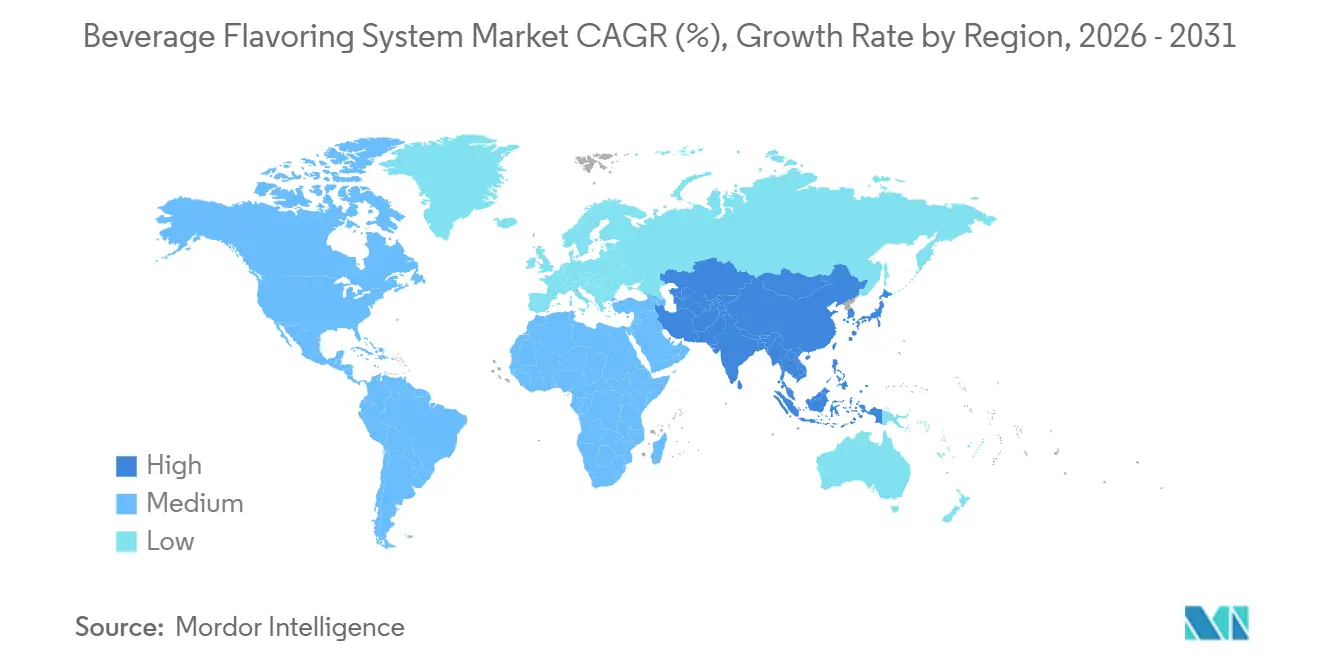
Asia-Pacific held 38.40% of the global beverage flavoring systems market in 2025 and is projected to grow at a 5.30% CAGR through 2031. Growth is supported by rising consumption of non-alcoholic beverages, functional drinks, ready-to-drink tea, and fruit- and botanical-based beverages. China remains a major demand center, while Japan’s mature beverage industry continues to support demand for sophisticated flavor solutions. Southeast Asian markets also offer opportunities through the increasing consumption of tropical fruits, tea, coconuts, and botanical beverages.
North America and Europe Beverage Flavoring System Market
North America and Europe remain significant markets due to their established beverage industries, ongoing product innovation, and growing demand for natural and compliant flavoring solutions. Increasing regulatory requirements and ingredient scrutiny are prompting manufacturers to improve documentation, traceability, and formulation capabilities. Demand for reduced-sugar, clean-label, and health-oriented beverages is further supporting the development and adoption of advanced flavoring systems across both regions.
MEA and South America Beverage Flavoring System Market
South America, the Middle East, and Africa represent smaller but growing markets, supported by expanding beverage production, urbanization, and evolving consumer preferences. Brazil benefits from its strong fruit and tropical ingredient base, while Argentina offers opportunities in carbonated and dairy beverages. In the Middle East, particularly Saudi Arabia and the United Arab Emirates, premium non-alcoholic beverages and hospitality-sector expansion support demand for innovative flavor profiles. South Africa and Egypt also present longer-term growth opportunities for beverage flavoring system manufacturers.
Competitive Landscape
The global beverage flavoring systems market is moderately consolidated, with major flavor houses and regional specialists serving a broad range of beverage applications. Companies such as Givaudan, IFF, DSM-Firmenich, Symrise, and Kerry Group maintain strong positions in high-value and technically complex applications through extensive product portfolios and global customer networks. These players are expanding their offerings through natural ingredients, advanced formulation capabilities, and application-specific flavor solutions. Strategic portfolio optimization also enables leading companies to focus on flavor, biosciences, and other higher-margin ingredient categories.
Technology and product innovation are key competitive differentiators, as companies invest in artificial intelligence, biotechnology, fermentation, encapsulation, and advanced flavor-development platforms. These technologies enable suppliers to accelerate product development, improve flavor consistency, and create natural alternatives to synthetic flavor ingredients. They also support the development of reduced-sugar, low-calorie, and health-oriented beverage formulations without compromising taste. Large suppliers further benefit from regulatory expertise, global manufacturing networks, and their ability to provide standardized solutions across multiple geographic markets.
Mid-sized and specialized companies, including MANE, Takasago, Döhler, and Synergy Flavors, compete through regional expertise, customized product development, and responsive customer support. These companies differentiate themselves by offering specialized ingredient portfolios, localized flavor profiles, and flexible formulation services tailored to specific beverage categories. Growth opportunities remain strong in fermentation-derived natural flavors, reduced-sugar formulations, and region-specific flavor preferences, particularly in Asia-Pacific and the Middle East and Africa. While global suppliers benefit from technological scale and regulatory capabilities, specialized players can strengthen their market position through agility, customization, and application expertise.
Beverage Flavoring System Industry Leaders
-
Givaudan SA
-
International Flavors & Fragrances Inc.
-
Dsm-Firmenich AG
-
Symrise AG
-
Kerry Group plc
- *Disclaimer: Major Players sorted in no particular order
Beverage Flavoring System Market Companies Covered in this Report
- Givaudan SA
- International Flavors & Fragrances Inc.
- Dsm-Firmenich AG
- Symrise AG
- Kerry Group plc
- Archer Daniels Midland Company
- Sensient Technologies Corporation
- MANE Group
- Takasago International Corporation
- T. Hasegawa Co., Ltd.
- Cargill, Incorporated
- Tate & Lyle PLC
- Döhler GmbH
- Flavorchem Corporation
- FlavorSum
- Synergy Flavors
- Blue Pacific Flavors, Inc.
- Huabao International Holdings Limited
- Synthite Industries Pvt. Ltd.
- FONA International, Inc.
Recent Industry Developments in Beverage Flavoring System Market
- June 2026: Döhler enhanced its flavor production and innovation operations in Cartersville, Georgia, increasing its ability to develop and manufacture flavor solutions. The expansion addressed rising demand for natural flavor and ingredient systems across food and beverage applications, including beverages.
- February 2026: I.T.S. announced an investment of more than GBP 10 million in a new UK facility, which was expected to increase its liquid and powdered flavor production capacity by 20 times. The facility aimed to enhance the company’s supply of natural flavor solutions, including extracts and compounds, for food and beverage applications.
- August 2025: T. Hasegawa introduced Hasecitrus, a natural citrus flavor technology that helps prevent oxidation and extend beverage shelf life without requiring refrigeration or specialized packaging. The company launched the technology in eight citrus varieties, including lemon, lime, orange, and grapefruit, for clean-label applications in sports, energy, and other beverage products.
- July 2025: Sensient Flavors and Extracts introduced BioSymphony, a range of natural flavors created through biotransformation using ingredients derived from nature. The portfolio aimed to help food and beverage manufacturers premiumize products, broaden flavor options, and address formulation challenges associated with ingredients.
Global Beverage Flavoring System Market Report Scope
The Global Beverage Flavoring Systems Market encompasses flavoring ingredients and systems that add, enhance, or alter the taste and aroma of alcoholic and non-alcoholic beverages. It excludes finished beverages and applications outside the beverage industry. The market is segmented by type into Natural Flavoring Agents, Artificial Flavoring Agents, and Nature-Identical Flavoring Agents; by application into Non-Alcoholic Beverages and Alcoholic Beverages; and by geography into North America, Europe, Asia-Pacific, South America, and the Middle East and Africa. Market forecasts are presented in value terms (USD).
| Natural Flavoring Agents |
| Artificial Flavoring Agents |
| Nature-Identical Flavoring Agents |
| Non-Alcoholic Beverages | Carbonated Soft Drinks |
| Juices | |
| Energy Drinks | |
| Sports and Hydration Drinks | |
| Dairy Beverages | |
| Others | |
| Alcoholic Beverages | Beer |
| Wine | |
| Spirits and Liqueurs | |
| Others |
| North America | United States |
| Canada | |
| Mexico | |
| Rest of North America | |
| Europe | Germany |
| United Kingdom | |
| France | |
| Italy | |
| Spain | |
| Russia | |
| Rest of Europe | |
| Asia-Pacific | China |
| Japan | |
| India | |
| Australia | |
| Rest of Asia-Pacific | |
| South America | Brazil |
| Argentina | |
| Rest of South America | |
| Middle East and Africa | Saudi Arabia |
| United Arab Emirates | |
| Turkey | |
| South Africa | |
| Egypt | |
| Rest of Middle East and Africa |
| By Type | Natural Flavoring Agents | |
| Artificial Flavoring Agents | ||
| Nature-Identical Flavoring Agents | ||
| By Application | Non-Alcoholic Beverages | Carbonated Soft Drinks |
| Juices | ||
| Energy Drinks | ||
| Sports and Hydration Drinks | ||
| Dairy Beverages | ||
| Others | ||
| Alcoholic Beverages | Beer | |
| Wine | ||
| Spirits and Liqueurs | ||
| Others | ||
| By Geography | North America | United States |
| Canada | ||
| Mexico | ||
| Rest of North America | ||
| Europe | Germany | |
| United Kingdom | ||
| France | ||
| Italy | ||
| Spain | ||
| Russia | ||
| Rest of Europe | ||
| Asia-Pacific | China | |
| Japan | ||
| India | ||
| Australia | ||
| Rest of Asia-Pacific | ||
| South America | Brazil | |
| Argentina | ||
| Rest of South America | ||
| Middle East and Africa | Saudi Arabia | |
| United Arab Emirates | ||
| Turkey | ||
| South Africa | ||
| Egypt | ||
| Rest of Middle East and Africa | ||
Key Questions Answered in the Report
What is the size of the beverage flavoring agents market?
The sector is estimated at USD 7.44 billion in 2026 and is forecast to reach USD 9.74 billion by 2031 at a 5.54% CAGR.
Which flavoring type leads global beverage demand?
Natural flavoring agents led with 56.10% share in 2025 and are also forecast to grow at a 6.20% CAGR through 2031.
Which beverage application is expanding fastest?
Alcoholic beverages are forecast to grow at a 6.90% CAGR through 2031, supported by ready-to-drink cocktails and low- and no-alcohol products.
Which region has the strongest demand outlook?
Asia-Pacific held 38.40% share in 2025 and is forecast to grow at a 6.30% CAGR through 2031.