
Beneficial Ownership Verification Market Size and Share
Market Overview
| Study Period | 2020 - 2031 |
|---|---|
| Market Size (2026) | USD 1.16 Billion |
| Market Size (2031) | USD 2.51 Billion |
| Growth Rate (2026 - 2031) | 16.69 % |
| Fastest Growing Market | Asia-Pacific |
| Largest Market | North America |
| Market Concentration | Medium |
Major Players *Disclaimer: Major Players sorted in no particular order Image © Mordor Intelligence. Reuse requires attribution under CC BY 4.0. | |
Beneficial Ownership Verification Market Analysis by Mordor Intelligence
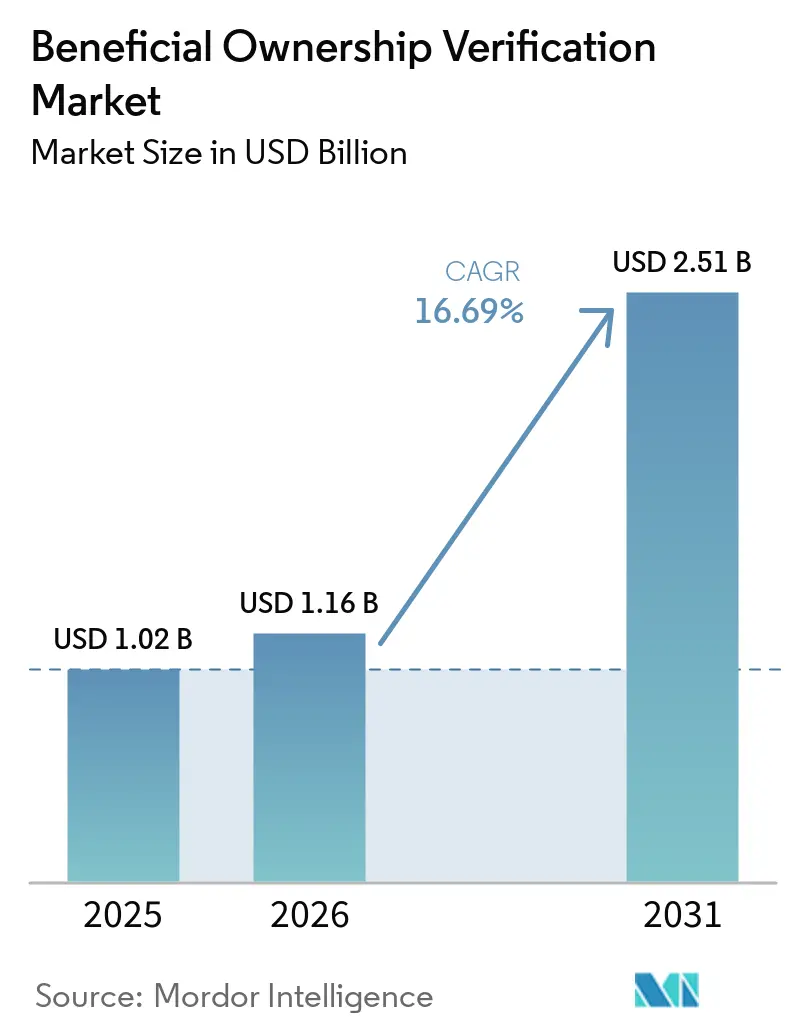
The beneficial ownership verification market size was valued at USD 1.02 billion in 2025 and estimated to grow from USD 1.16 billion in 2026 to reach USD 2.51 billion by 2031, at a CAGR of 16.69% during the forecast period (2026-2031). The beneficial ownership verification market is being shaped by rules that require institutions to identify the people who ultimately control legal entities. These requirements are moving verification away from a single company declaration and toward checks across registries, documents, and ownership records. Digital business onboarding is also expanding the number of verification events, particularly when platforms admit new merchants or corporate users. Providers are responding by combining entity data, ownership mapping, and case management functions into a single workflow. Data-access limits and national data-residency rules still make cross-border delivery more difficult for the beneficial ownership verification market.
Key Report Takeaways
- By component, software held 67.49% of the beneficial ownership verification market share in 2025, while services are projected to expand at a 19.26% CAGR through 2031.
- By deployment mode, cloud-based deployment accounted for 69.73% of the beneficial ownership verification market share in 2025 and is expected to grow at a 21.83% CAGR through 2031.
- By organization size, large enterprises accounted for 64.82% of revenue in 2025, while SMEs are projected to grow at a 20.91% CAGR through 2031.
- By end user, banking and financial institutions held 36.51% of revenue in 2025, while marketplaces, platforms, and e-commerce companies are projected to expand at a 22.73% CAGR through 2031.
- By geography, North America held 39.72% of revenue in the beneficial ownership verification market in 2025, while the Middle East and Africa are projected to expand at a 23.61% CAGR through 2031.
Note: Market size and forecast figures in this report are generated using Mordor Intelligence’s proprietary estimation framework, updated with the latest available data and insights as of January 2026.
Global Beneficial Ownership Verification Market Trends and Insights
Drivers Impact Analysis*
| DRIVER | (~) % IMPACT ON CAGR FORECAST | GEOGRAPHIC RELEVANCE | IMPACT TIMELINE |
|---|---|---|---|
| Stricter Beneficial Ownership Transparency Rules | +5.0% | Global | Long term (≥ 4 years) |
| Expansion of Digital Business Onboarding | +4.2% | Global, with Asia-Pacific and Middle East and Africa spillover | Medium term (2-4 years) |
| Cross-Border Entity Complexity | +3.0% | Global | Long term (≥ 4 years) |
| Continuous Monitoring Adoption | +2.3% | North America and Europe | Medium term (2-4 years) |
| Registry API Normalization Gaps Create Verification Spend | +1.6% | Europe and Asia-Pacific | Short term (≤ 2 years) |
| Risk-Triggered Verification After U.S. CDD Relief | +0.9% | North America | Short term (≤ 2 years) |
| Source: Mordor Intelligence | |||
Stricter Beneficial Ownership Transparency Rules
The FATF revised Recommendations 24 and 25 in 2022, and its 2023 guidance set a clearer expectation for beneficial ownership information to be adequate, accurate, and current.[1] The guidance supports the use of several information sources rather than relying on a single self-declaration. This approach raises the need for ownership-chain checks, record reconciliation, and auditable evidence in the beneficial ownership verification market. Regulation EU 2024/1624 will apply from July 10, 2027, and treats a person holding exactly 25% of shares or voting rights as a beneficial owner. AMLA scheduled work on group-wide beneficial ownership technical standards for submission by July 10, 2026, which added urgency for cross-border financial groups. Official registers serve as cross-checks within the EU framework, supporting multi-source verification workflows.
Expansion of Digital Business Onboarding
Digital-first business acquisition is moving beneficial ownership checks closer to the point where a customer or merchant joins a service. Article 30 of the EU Digital Services Act requires online platforms to obtain, verify, and record trader information. This requirement includes relevant business identity information and extends verification activity beyond established financial institutions. The Asian Development Bank found uneven beneficial ownership disclosure frameworks across Asia and the Pacific in its 2024 assessment.[2] Different national systems make registry aggregation useful for businesses operating across multiple jurisdictions. Higher volumes of smaller onboarding events favor cloud-based services and usage-based purchasing in the beneficial ownership verification market.
Cross-Border Entity Complexity
Layered ownership structures require a separate review of each company, ownership link, and supporting record. A group may hold entities through free zones, mainland registrations, and offshore holding companies, each subject to separate authorities and disclosure rules. This increases the amount of evidence needed for customer due diligence. Transparency International reported weaknesses in record-keeping and verification across many surveyed jurisdictions in the Middle East and North Africa in 2024. Regulation EU) 2024/1624 requires that ownership interests across separate chains be aggregated when assessing control. The beneficial ownership verification market, therefore,e needs tools that can resolve linked entities instead of treating each registry search as a complete answer.
Continuous Monitoring Adoption
Regulated institutions are replacing periodic reviews with systems that can respond to ownership changes and sanctions updates. This makes verification an ongoing operational task rather than a one-time onboarding activity. Fenergo and Moody’s announced a November 2025 partnership to integrate Moody’s Entity Verification API into Fenergo’s FinCrime OS for perpetual KYC. The integration covered more than 600 million companies and 1.7 billion ownership links across more than 200 jurisdictions. Ongoing monitoring can reduce the likelihood that a material ownership change goes unnoticed until the next scheduled review. FinCEN’s Customer Due Diligence Rule continues to require ongoing monitoring of customer relationships, which supports recurring platform use in North America.
Restraints Impact Analysis*
| RESTRAINT | (~) % IMPACT ON CAGR FORECAST | GEOGRAPHIC RELEVANCE | IMPACT TIMELINE |
|---|---|---|---|
| Fragmented Registry Access and Data Quality | -1.5% | Global | Long term (≥ 4 years) |
| U.S. Regulatory Retrenchment Reduces Domestic Reporting Demand | -1.2% | North America | Short term (≤ 2 years) |
| Data Privacy and Residency Requirements | -1.1% | Europe and Asia-Pacific | Medium term (2-4 years) |
| Non-Digital Registries Limit Ownership Evidence | -0.8% | Middle East and Africa and Asia-Pacific | Long term (≥ 4 years) |
| Source: Mordor Intelligence | |||
Fragmented Registry Access and Data Quality
Registry infrastructure remains uneven, including in developed economies with established anti-money-laundering requirements. Germany’s Transparenzregister does not support automated API queries, and teams must use the Handelsregister under GwG Section 20(2).[3] This arrangement can introduce delays and create discrepancies in otherwise automated data flows. The beneficial ownership verification market must therefore draw from more than 1 source when registry data is incomplete or unavailable. Multiple checks raise per-customer operating costs and can slow high-volume onboarding. They also limit the degree of straight-through processing that providers can offer in jurisdictions with restricted or non-digital registries.
Data Privacy and Residency Requirements
The Court of Justice of the European Union’s WM and Sovim rulings ended unrestricted public access to beneficial ownership registers in the European Union. France later introduced Decree No. 2026-310, which requires an access applicant to hold a valid certificate from the Institut national de la propriété industrielle before querying the beneficial ownership register. These controls add lead time to queries that previously had more open access. Data-residency rules across India, China, and Vietnam also require providers to manage data in separate geographic environments. The EU AI Act adds explainability obligations for certain high-risk AI uses, increasing implementation work for smaller buyers. The beneficial ownership verification market must balance automation with access controls, data location, and documented decisions.
*Our forecasts treat driver/restraint impacts as directional, not additive. The impact forecasts reflect baseline growth, mix effects, and variable interactions.
Segment Analysis
By Component: Software Platforms Support Core Compliance Workflows
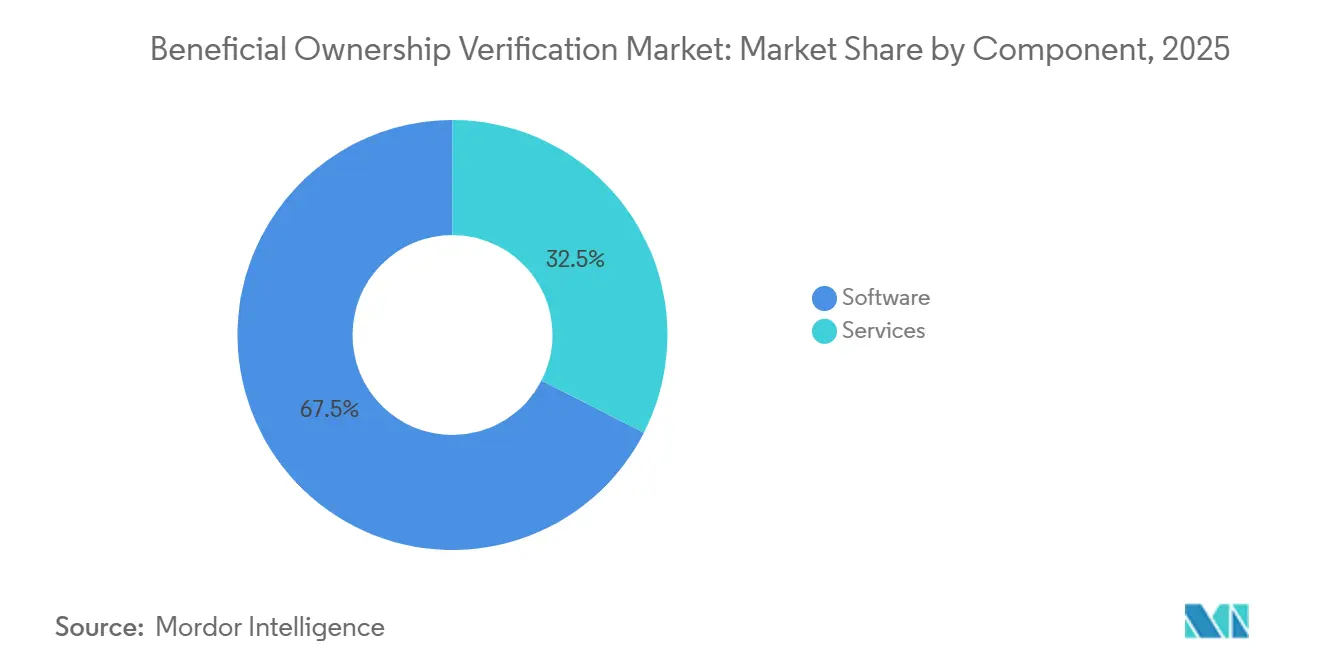
Software held 67.49% of the beneficial ownership verification market share in 2025. Compliance teams use software for verification engines, ownership graph resolution, case handling, and audit record management. These functions sit at the center of know-your-business processes, particularly for institutions that manage complex corporate relationships. Manual re-verification becomes costly when firms must repeatedly check large populations of legal entities. The beneficial ownership verification market size for software remains supported by the need for repeatable, documented checks. Software also helps teams apply the same controls across different business units and jurisdictions.
Services are projected to expand at a 19.26% CAGR through 2031. Mid-sized buyers and digital platforms often use service providers to configure workflows rather than build specialist teams internally. Encompass Corporation launched EC360 in February 2025, combining public data automation, corporate outreach, and digital identity capabilities to support bank compliance. Fenergo launched Fen-AI in July 2026 as a continuous system for regulated client lifecycle management with an Agent-to-Agent Interoperability Framework.[4] These product changes show how vendors are building more integration and workflow capabilities into their software. The eIDAS 2.0 framework is expected to increase interest in platforms capable of ingesting verifiable Legal Entity Identifier credentials between 2026 and 2027.
By Deployment Mode: Cloud Delivery Enables Frequent Updates
Cloud-based deployment held 69.73% of the beneficial ownership verification market share in 2025. It is also projected to expand at a 21.83% CAGR through 2031. Cloud systems can distribute changes to ownership rules, sanctions data, and identity controls without requiring each client to manage a separate release process. This helps organizations maintain more consistent verification practices across locations. The beneficial ownership verification market benefits from cloud delivery when clients need to process frequent registry-change notifications. Cloud infrastructure also supports centralized oversight across multiple legal entities and operating regions.
On-premises systems remain relevant for institutions with strict data residency and internal control requirements. Hybrid delivery is gaining attention among global banks that must address both European data protection rules and Asia-Pacific localization requirements. These hybrid projects can require tailored integration, ongoing support, and closer account management. They can also make switching providers more difficult after a complex implementation. Continuous monitoring requires systems that can receive and process high volumes of change signals without material delay. Deployment decisions in the beneficial ownership verification industry, therefore, depend on the client’s data controls, regional footprint, and need for shared updates.
By Organization Size: Large Enterprises Lead While SMEs Expand
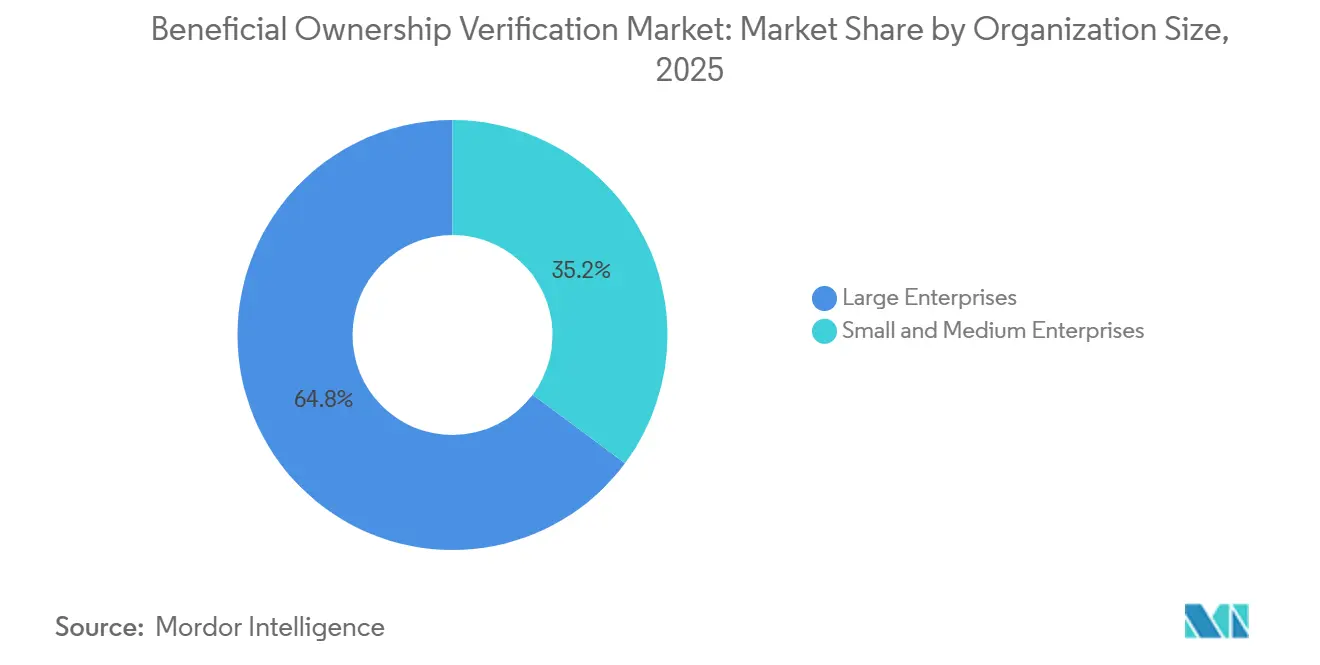
Large enterprises held 64.82% of revenue in 2025. Global financial institutions must assess corporate customers with different risk levels, ownership tiers, products, and jurisdictions. Their established customer due diligence programs make them substantial buyers of enterprise verification platforms. Large banks also influence the requirements placed on their merchants, payment partners, and other counterparties. This creates a wider need for documented beneficial ownership checks. The beneficial ownership verification market continues to draw demand from enterprises that need consistent policies across complex client populations.
SMEs are projected to expand at a 20.91% CAGR through 2031. Regulatory requirements are reaching fintech, crypto-asset, and marketplace businesses that may not have long-standing compliance systems. Payment network rules may require merchant beneficial ownership verification before a firm is granted settlement access. Smaller buyers often place weight on implementation speed and transparent, usage-based pricing. The EU AI Act can add governance work for firms without dedicated teams, increasing the value of built-in decision records. The beneficial ownership verification industry is therefore favoring cloud-native and API-based services for SMEs that need to meet requirements with limited internal resources.
By End User: Financial Institutions Lead While Digital Platforms Accelerate
Banking and financial institutions accounted for 36.51% of the beneficial ownership verification market in 2025. These organizations have long-standing customer due diligence obligations and must evaluate corporate customers across products, risk tiers, and multiple jurisdictions. Fintech and payment service providers form another substantial demand group because their merchants and banking-as-a-service clients create similar exposure. Insurance companies, legal and accounting firms, and government agencies also need ownership information for their distinct compliance, disclosure, or investigative roles. Ninety One selected Fenergo’s unified client lifecycle management platform in September 2026 to automate periodic review and enhanced due diligence. This use case reflects the replacement of legacy processes within regulated financial organizations.
Marketplaces, platforms, and e-commerce companies are projected to expand at a 22.73% CAGR through 2031. These companies need to verify merchants and business users to support trader traceability and risk control. Trulioo launched its UBO Discovery Agent in July 2026 for beneficial ownership discovery within its KYB workflow.[5] A global social commerce platform across Malaysia, Vietnam, and the United Kingdom initially deployed the product. Crypto-asset service providers authorized under MiCA will become AMLR obliged entities from July 2027. This expands the full beneficial ownership identification and customer due diligence requirements to an additional group of digital businesses.
Geography Analysis
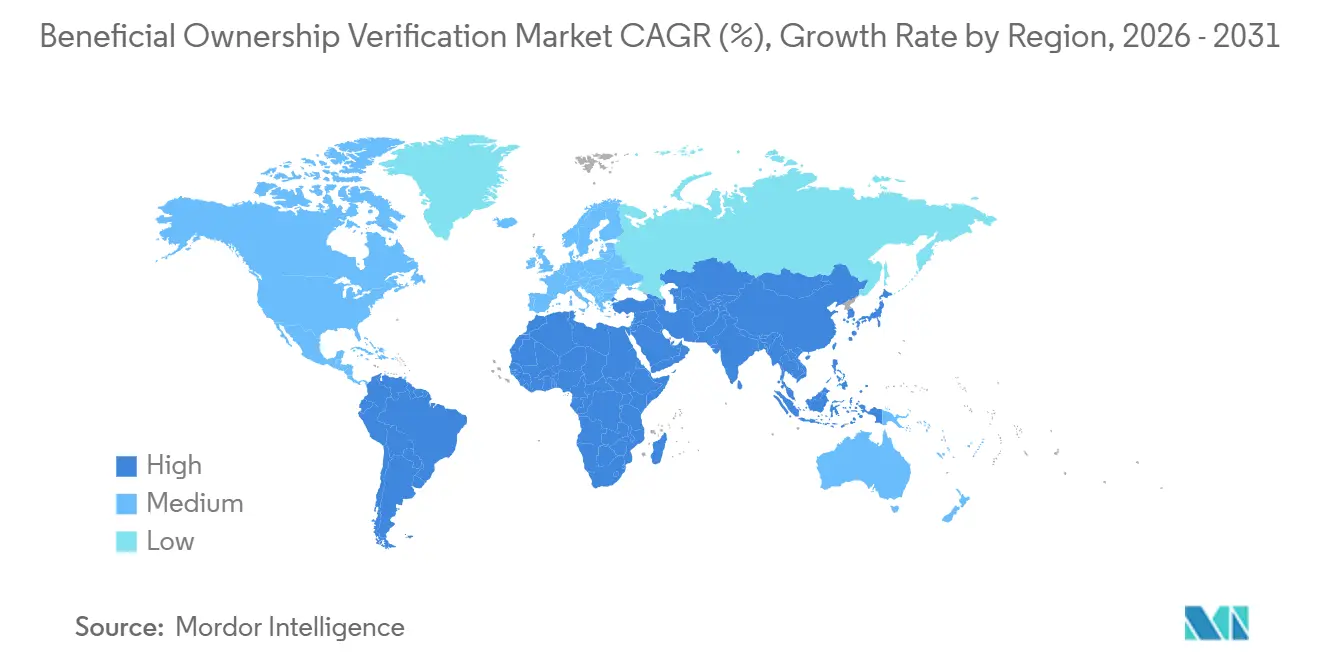
North America held 39.72% of the beneficial ownership verification market share in 2025. The region has a concentrated group of regulated financial institutions, established enterprise software buying practices, and layered obligations under the Bank Secrecy Act and FinCEN’s Customer Due Diligence Rule. FinCEN issued Account Opening Exceptive Relief Order FIN-2026-R001 in February 2026, narrowing re-verification triggers to initial account opening and risk-triggered events.[6] FinCEN permanently exempted U.S. domestic companies from direct beneficial ownership information reporting in August 2026. This change shifts attention from centralized reporting tools toward institution-specific and risk-triggered verification. Canada’s FINTRAC requirements also support cross-border investment by enterprises with North American operations.
Europe is the second-largest regional market for beneficial ownership verification. The EU AML package, including AMLR, AMLD6, and AMLA, is changing customer due diligence requirements across 27 member states between July 2025 and July 2027. AMLA’s 2026-2028 program set a July 10, 2026, deadline for group-wide beneficial ownership technical standards. France designated the INPI as its access certification body under Decree No. 2026-310. The United Kingdom’s Persons with Significant Control regime creates a separate compliance requirement for businesses operating across the United Kingdom and the European Union. Asia-Pacific is formalizing quickly, and the Asian Development Bank identified 9 countries building digital beneficial ownership verification systems in 2024.
The Middle East and Africa are projected to expand at a 23.61% CAGR through 2031. Saudi Arabia’s SAMA required supervised financial institutions to integrate with the Ministry of Commerce’s Wathiq platform in March 2026. The requirement includes discrepancy-reporting obligations and follows Saudi Arabia’s 2025 ultimate beneficial ownership rules. The United Arab Emirates framework under Cabinet Resolution No. 58 of 2020 requires weekly reporting and supports demand for current ownership information. Transparency International found that weaknesses in record-keeping and verification persisted across many surveyed MENA jurisdictions in 2024. South Africa’s active Persons with Significant Control registry and Nigeria’s 5% disclosure threshold create different verification needs across Africa.
Competitive Landscape
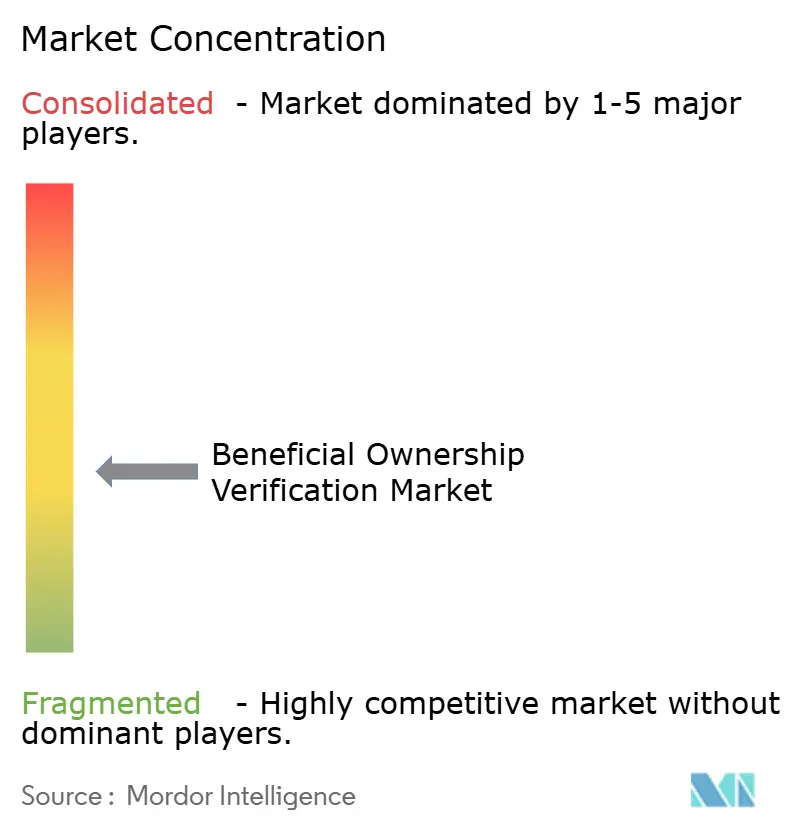
The beneficial ownership verification market is moderately fragmented. Competition includes global data and analytics providers, specialist corporate identity and KYB platforms, and newer providers focused on particular workflow needs. Moody’s Analytics, LSEG, LexisNexis Risk Solutions, Thomson Reuters, and Dun and Bradstreet use broad data holdings and long-standing financial institution relationships. Their platforms place beneficial ownership checks within larger financial crime and risk management services. Encompass Corporation, Fenergo, Trulioo, and Sayari compete through registry connections, ownership-chain capabilities, and flexible workflow design. The beneficial ownership verification market gives specialists room to compete where broad suites have historically put less emphasis on corporate identity workflows.
Providers are differentiating through entity resolution, workflow automation, and the depth of registry coverage. LexisNexis Risk Solutions completed its acquisition of IDVerse in February 2025, adding AI-powered document authentication and deepfake detection to its platforms across more than 190 countries. Encompass Corporation closed a BNP Paribas-led financing round in September 2025 to accelerate development of its EC360 corporate digital identity platform. Veriff acquired KYB specialist Vespia in February 2026, adding business verification and beneficial ownership identification to its identity verification platform. These moves show that identity verification providers are extending their capabilities into corporate verification.
Sayari rebuilt its Commercial World Model on Snowflake in September 2026, consolidating 12 billion records from 715 sources across 250 jurisdictions. The company reported projected infrastructure cost savings exceeding 50%.[7] This type of data infrastructure is difficult for smaller entrants to reproduce across many jurisdictions. Open areas remain in SME perpetual KYB, marketplace onboarding, and crypto-asset compliance tools. Larger incumbents have focused much of their activity on enterprise financial institution deployments.
Beneficial Ownership Verification Industry Leaders
-
Moody's Analytics, Inc.
-
London Stock Exchange Group plc
-
Dun & Bradstreet, LLC
-
Encompass Corporation Ltd.
-
GB Group plc
- *Disclaimer: Major Players sorted in no particular order
Recent Industry Developments
- September 2026: Sayari completed the rebuild of its Commercial World Model on Snowflake, consolidating 12 billion records from 715 sources across 250 jurisdictions, with projected infrastructure cost savings exceeding 50%.
- July 2026: Fenergo launched Fen-AI, a continuous AI-governed client lifecycle management system, including an Agent-to-Agent (A2A) Interoperability Framework for connecting with third-party AI agents.
- July 2026: Trulioo launched the UBO Discovery Agent for beneficial ownership discovery within its KYB workflow, initially deployed by a major global social commerce platform across 3 markets.
- March 2026: SAMA issued Circular No. 472047799 mandating integration with the Ministry of Commerce's Wathiq platform for BO verification, including discrepancy-reporting obligations.
- November 2025: Fenergo and Moody's Corporation partnered with Moody's to integrate Moody's Entity Verification API, covering 600 million companies and 1.7 billion ownership links, into Fenergo's FinCrime OS for perpetual KYC.
Global Beneficial Ownership Verification Market Report Scope
The beneficial ownership verification market comprises solutions and services that identify, verify, and monitor the ultimate beneficial owners (UBOs) and control structures of corporate entities, trusts, funds, and other legal arrangements. These solutions support compliance with anti-money laundering (AML) and corporate transparency regulations, including the U.S. Corporate Transparency Act (CTA), EU beneficial ownership register mandates, and Financial Action Task Force (FATF) Recommendations 24 (legal persons) and 25 (legal arrangements). They integrate corporate registry data, sanctions, and politically exposed person (PEP) screening, adverse media monitoring, corporate structure visualization, and change detection to help financial institutions and other regulated entities meet customer due diligence (CDD) and enhanced due diligence (EDD) obligations, particularly for complex and cross-border ownership structures.
The Beneficial Ownership Verification Market Report is Segmented by Component (Software, and Services), Deployment Mode (Cloud-Based, On-Premises, and Hybrid), Organization Size (Large Enterprises, and Small and Medium Enterprises), End User (Banking and Financial Institutions, Fintech and Payment Service Providers, Insurance Companies, Digital-Asset and Cryptocurrency Businesses, Legal, Accounting, and Corporate-Service Firms, Government Agencies and Investigative Bodies, Real Estate and Property Services, Marketplaces, Platforms, and E-Commerce Companies, and Other End Users), and Geography (North America, South America, Europe, Asia-Pacific, and Middle East and Africa). The Market Forecasts are Provided in Terms of Value (USD).
| Software |
| Services |
| Cloud-Based |
| On-Premises |
| Hybrid |
| Large Enterprises |
| Small and Medium Enterprises |
| Banking and Financial Institutions |
| Fintech and Payment Service Providers |
| Insurance Companies |
| Digital-Asset and Cryptocurrency Businesses |
| Legal, Accounting, and Corporate-Service Firms |
| Government Agencies and Investigative Bodies |
| Real Estate and Property Services |
| Marketplaces, Platforms, and E-Commerce Companies |
| Other End Users |
| North America | United States | |
| Canada | ||
| South America | Brazil | |
| Argentina | ||
| Mexico | ||
| Rest of South America | ||
| Europe | Germany | |
| United Kingdom | ||
| France | ||
| Italy | ||
| Spain | ||
| Russia | ||
| Rest of Europe | ||
| Asia-Pacific | China | |
| Japan | ||
| India | ||
| South Korea | ||
| Australia | ||
| Rest of Asia-Pacific | ||
| Middle East and Africa | Middle East | Saudi Arabia |
| United Arab Emirates | ||
| Rest of Middle East | ||
| Africa | South Africa | |
| Egypt | ||
| Rest of Africa | ||
| By Component | Software | ||
| Services | |||
| By Deployment Mode | Cloud-Based | ||
| On-Premises | |||
| Hybrid | |||
| By Organization Size | Large Enterprises | ||
| Small and Medium Enterprises | |||
| By End User | Banking and Financial Institutions | ||
| Fintech and Payment Service Providers | |||
| Insurance Companies | |||
| Digital-Asset and Cryptocurrency Businesses | |||
| Legal, Accounting, and Corporate-Service Firms | |||
| Government Agencies and Investigative Bodies | |||
| Real Estate and Property Services | |||
| Marketplaces, Platforms, and E-Commerce Companies | |||
| Other End Users | |||
| By Geography | North America | United States | |
| Canada | |||
| South America | Brazil | ||
| Argentina | |||
| Mexico | |||
| Rest of South America | |||
| Europe | Germany | ||
| United Kingdom | |||
| France | |||
| Italy | |||
| Spain | |||
| Russia | |||
| Rest of Europe | |||
| Asia-Pacific | China | ||
| Japan | |||
| India | |||
| South Korea | |||
| Australia | |||
| Rest of Asia-Pacific | |||
| Middle East and Africa | Middle East | Saudi Arabia | |
| United Arab Emirates | |||
| Rest of Middle East | |||
| Africa | South Africa | ||
| Egypt | |||
| Rest of Africa | |||
Key Questions Answered in the Report
What is the beneficial ownership verification market size?
The beneficial ownership verification market size was valued at USD 1.02 billion in 2025 and estimated to grow from USD 1.16 billion in 2026 to reach USD 2.51 billion by 2031, at a CAGR of 16.69% during the forecast period (2026-2031).
What is driving demand for beneficial ownership verification?
Tighter ownership-transparency rules, digital onboarding, complex cross-border entities, and continuous monitoring are increasing demand.
Which component leads beneficial ownership verification spending?
Software led with 67.49% of revenue in 2025, while services is projected to expand at a 19.26% CAGR through 2031.
Why are cloud platforms important for ownership verification?
Cloud-based deployment held 69.73% of revenue in 2025 and is projected to expand at a 21.83% CAGR through 2031 because it supports shared updates and continuous monitoring.
Which users are growing fastest in this field?
Marketplaces, platforms, and e-commerce companies are projected to expand at a 22.73% CAGR through 2031 as trader verification needs increase.
Which region is expanding fastest for beneficial ownership verification?
The Middle East and Africa is projected to expand at a 23.61% CAGR through 2031, supported by formal disclosure rules and registry-connected controls.