
Barley Tea Market Size and Share
Market Overview
| Study Period | 2021 - 2031 |
|---|---|
| Market Size (2026) | USD 1.13 Billion |
| Market Size (2031) | USD 1.48 Billion |
| Growth Rate (2026 - 2031) | 5.54 % |
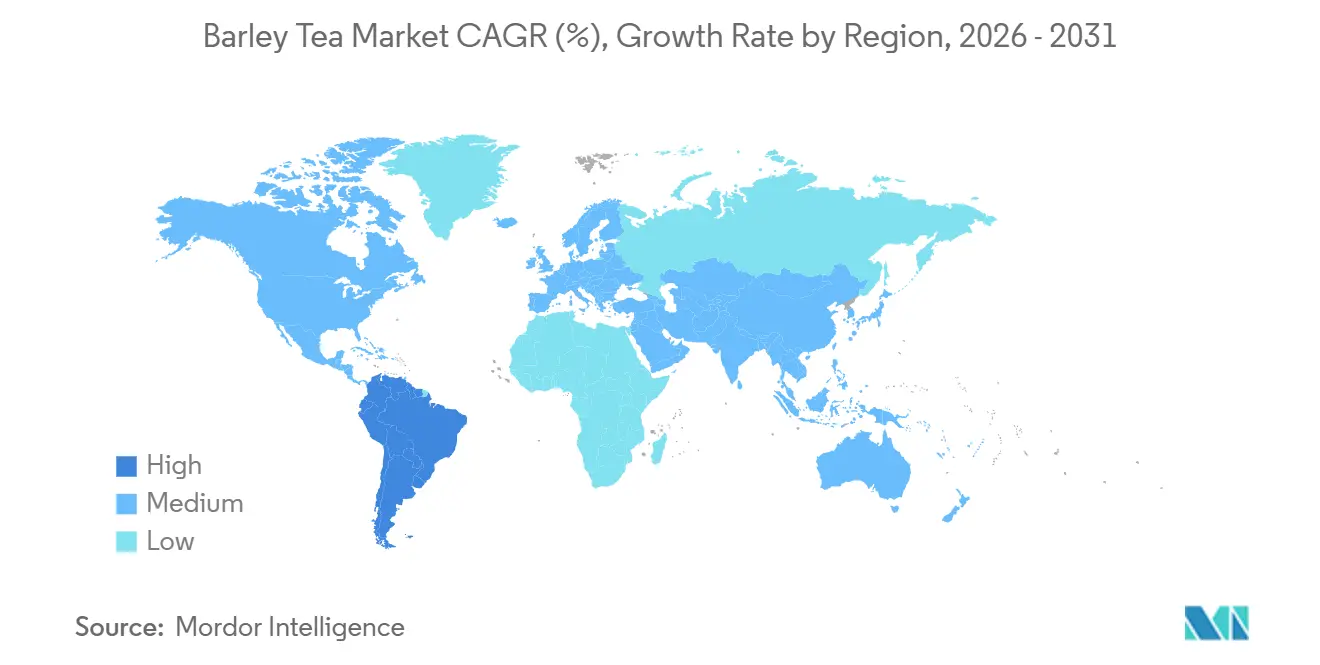
| Fastest Growing Market | South America |
| Largest Market | Asia-Pacific |
| Market Concentration | Medium |
Major Players *Disclaimer: Major Players sorted in no particular order Image © Mordor Intelligence. Reuse requires attribution under CC BY 4.0. | |
Barley Tea Market Analysis by Mordor Intelligence
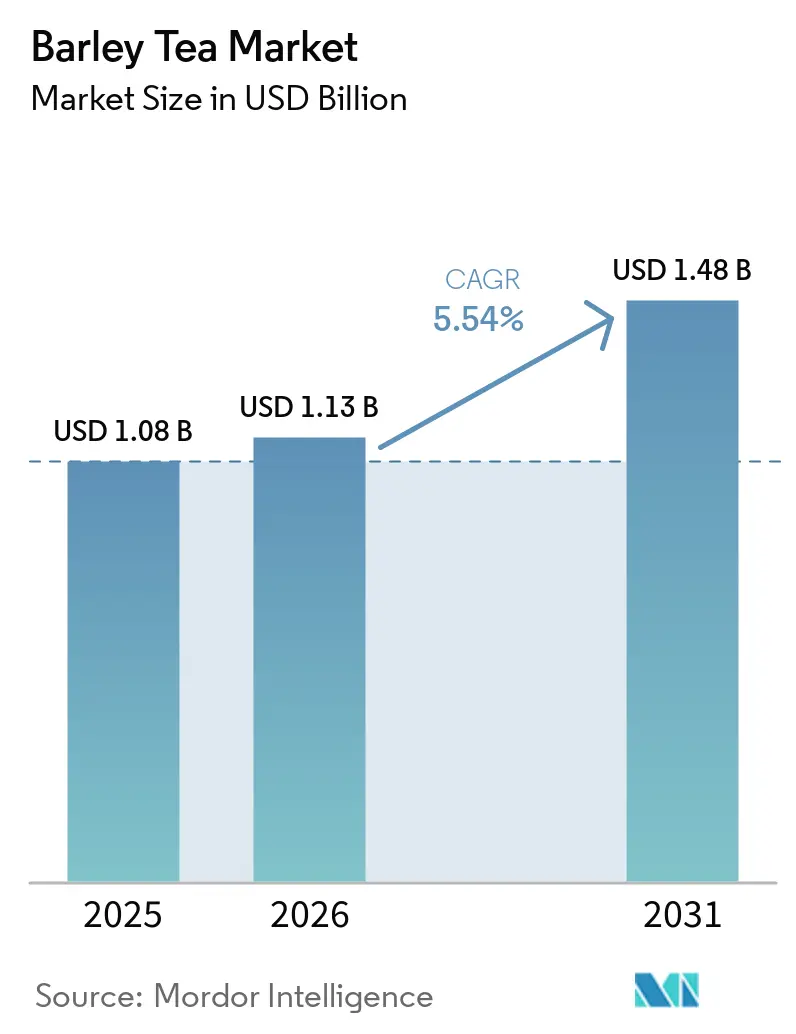
The barley tea market size is expected to grow from USD 1.08 billion in 2025 to USD 1.13 billion in 2026 and is forecast to reach USD 1.48 billion by 2031 at 5.54% CAGR over 2026-2031. Demand is supported by consumers seeking caffeine-free, low-sugar hydration options that fit daily routines. The category also benefits from established consumption habits in East Asia, where barley tea is used as an alternative to water and is available in home-brewed and ready-to-drink formats. Product development is moving toward functional ingredients, flavor extensions, and packaging formats that meet summer hydration needs. Online retail can reduce the physical shelf-access barrier for smaller brands and imported products outside Asia. Supply conditions remain a concern because domestic barley availability in Japan has tightened as farmers respond to stronger rice prices.
Key Report Takeaways
- By product type, roasted barley tea held 55.18% revenue share in 2025, while flavored barley tea is forecast to expand at a 6.29% CAGR through 2031.
- By form, tea bags held 64.18% revenue share in 2025, while loose barley tea is forecast to expand at a 6.63% CAGR through 2031.
- By distribution channel, supermarkets and hypermarkets held 43.58% revenue share in 2025, while online retail stores are forecast to expand at a 7.12% CAGR through 2031.
- By geography, Asia-Pacific held 54.88% revenue share in 2025, while South America is forecast to expand at a 6.54% CAGR through 2031.
Note: Market size and forecast figures in this report are generated using Mordor Intelligence’s proprietary estimation framework, updated with the latest available data and insights as of January 2026.
Market Trends and Insights
Drivers Impact Analysis of Barley Tea Market*
| Driver | (~) % Impact on CAGR Forecast | Geographic Relevance | Impact Timeline |
|---|---|---|---|
| Growing Demand for Caffeine-free Beverages | +1.2% | Global, strongest in North America, Europe, and urban Asia-Pacific | Medium term (2-4 years) |
| Rising Health and Wellness Consciousness | +1.0% | Global, particularly North America and Western Europe | Medium term (2-4 years) |
| Strong Cultural Consumption in East Asia | +0.8% | Japan, South Korea, China, and Southeast Asia | Long term (≥ 4 years) |
| Growing Demand for Functional Beverages | +0.7% | North America and Europe, with secondary relevance in Asia-Pacific | Medium term (2-4 years) |
| Preference for Low- and Zero-sugar Beverages | +0.9% | Global, especially China, Japan, South Korea, and Germany | Short term (≤ 2 years) |
| Rising International Interest in Asian Beverages | +0.6% | North America, Europe, Middle East, and early-stage South America | Long term (≥ 4 years) |
| Source: Mordor Intelligence | |||
Growing Demand for Caffeine-free Beverages
The growing demand for caffeine-free beverages is driving interest in barley tea as consumers increasingly seek beverages that can be consumed throughout the day without the stimulating effects of caffeine. In 2024, 19% of U.S. consumers aware of specific food ingredients reported actively avoiding caffeine, highlighting a measurable preference for reducing caffeine intake. This shift is encouraging consumers to explore naturally caffeine-free alternatives to coffee, black tea, and energy drinks[1]. Barley tea, traditionally consumed without caffeine, aligns well with this preference while offering a familiar tea-based beverage experience. Its suitability for both hot and cold consumption further supports its use across different occasions. Growing awareness of caffeine intake is therefore expanding the consumer base for barley tea, particularly among health- and wellness-conscious consumers seeking everyday beverage alternatives.
Rising Health and Wellness Consciousness
Increasing health and wellness consciousness is encouraging consumers to make healthier choices in their everyday beverage consumption. Growing awareness of excessive sugar, artificial ingredients, and the nutritional drawbacks of conventional soft drinks is shifting demand toward simpler beverage options. Barley tea aligns with this trend as it is naturally caffeine-free and can be consumed regularly without added sugar. Its mild taste and suitability for both hot and cold consumption further support its appeal as an everyday beverage. Consumers are also showing greater interest in traditional beverages that fit wellness-oriented lifestyles. This shift toward healthier and more mindful consumption is supporting the adoption of barley tea across households.
Strong Cultural consumption in East Asia
Long-standing cultural consumption of barley tea in East Asia provides a strong foundation for market growth, particularly in Japan, South Korea, and other parts of the region. Barley tea is traditionally consumed as an everyday beverage in households, restaurants, and foodservice establishments, supporting consistent consumer familiarity. In Japan, mugicha is widely consumed during warmer months, while barley tea also forms part of routine beverage consumption throughout the year. In South Korea, boricha has similarly remained a familiar traditional beverage served in homes and restaurants. This established cultural acceptance reduces barriers to trial and supports repeat consumption among consumers.
Preference for Low- and Zero-sugar Beverages
Growing consumer preference for low- and zero-sugar beverages is supporting demand for barley tea as consumers become more conscious of their daily sugar intake. The WHO recommends limiting free-sugar intake to below 10% of total daily energy intake and suggests that reducing intake below 5% can provide additional health benefits, reinforcing the shift toward lower-sugar consumption[2]. This growing awareness is encouraging consumers to reduce their reliance on sugar-sweetened soft drinks, flavored beverages, and other high-sugar options. Barley tea is well positioned to benefit from this trend as it can be consumed without added sugar while providing a mild, naturally roasted flavor. Its suitability as an everyday beverage further strengthens its appeal among health-conscious consumers seeking lower-sugar alternatives.
Restraints Impact Analysis of Barley Tea Market*
| Restraint | (~) % Impact on CAGR Forecast | Geographic Relevance | Impact Timeline |
|---|---|---|---|
| Limited Consumer Awareness Outside Asia | -0.5% | North America, South America, Middle East and Africa, and the rest of Europe | Medium term (2-4 years) |
| Gluten-related Dietary Limitation | -0.3% | Global, with concentration in North America and Europe | Short term (≤ 2 years) |
| Distinct roasted Flavor Profile | -0.2% | North America, South America, and Middle East and Africa | Medium term (2-4 years) |
| Strong Competition from Substitute Beverages | -0.4% | Global | Short term (≤ 2 years) |
| Source: Mordor Intelligence | |||
Limited Consumer Awareness Outside Asia
Limited consumer awareness outside Asia remains a restraint for the barley tea market, as the beverage has relatively low familiarity among consumers in Western and other non-Asian markets. Unlike coffee, black tea, and herbal infusions, barley tea has limited presence in mainstream beverage portfolios and everyday consumption habits in these regions. Consumers may also be unfamiliar with its roasted flavor profile and traditional preparation methods, creating barriers to product trial and repeat purchases. Limited retail shelf space and lower visibility across supermarkets, cafés, and foodservice outlets further restrict consumer exposure. In addition, manufacturers may face higher marketing and education costs to communicate the product’s taste, caffeine-free profile, and consumption occasions.
Gluten-related Dietary Limitations
Gluten-related dietary limitations can restrain the barley tea market because barley naturally contains gluten, making conventional barley-based beverages unsuitable for consumers following strict gluten-free diets. The Celiac Disease Foundation estimates that celiac disease affects approximately 1 in 100 people globally, although only around 30% of affected individuals are properly diagnosed[3]. This creates a defined consumer segment that may avoid barley tea due to concerns about gluten exposure. The restriction is particularly relevant for consumers with celiac disease or gluten sensitivity who carefully evaluate beverage ingredients before purchase. As awareness of gluten-free diets increases, consumers may increasingly favor naturally gluten-free alternatives such as herbal, fruit, or grain-free teas.
*Our forecasts treat driver/restraint impacts as directional, not additive. The impact forecasts reflect baseline growth, mix effects, and variable interactions.
Barley Tea Market Segment Analysis
By Product Type:
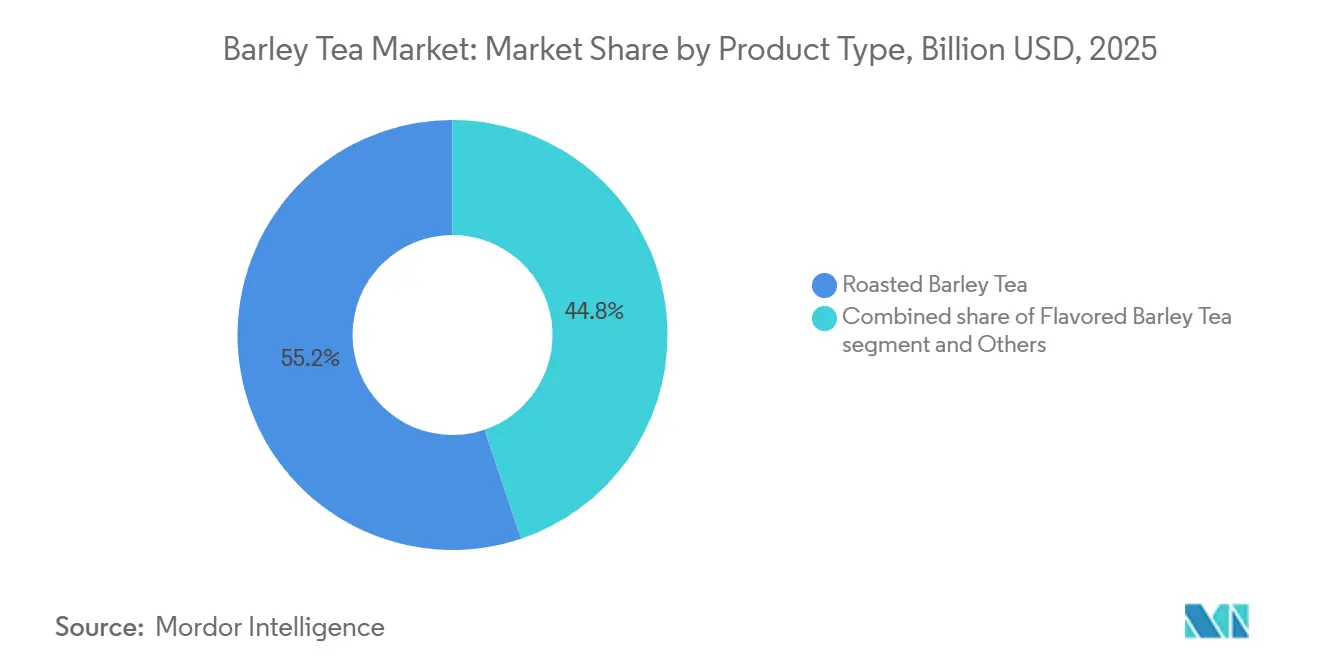
Roasted Barley Tea Holds the Core PositionRoasted barley tea accounted for the largest share of the barley tea market by product type, representing 55.18% of revenue in 2025. Its leading position is supported by the established consumer familiarity with roasted barley tea across major Asian markets, where it is traditionally consumed as a daily beverage. The product's distinctive roasted flavor and naturally caffeine-free profile make it suitable for regular consumption across different age groups. Growing consumer interest in non-caffeinated and naturally positioned beverages is further supporting demand for roasted barley tea. In addition, its availability in convenient formats such as tea bags and ready-to-drink products is helping manufacturers reach a broader consumer base beyond traditional loose-leaf consumption.
Flavored barley tea is projected to be the fastest-growing product type, with revenue expected to expand at a 6.29% CAGR through 2031. The segment is benefiting from consumers' growing preference for novel and differentiated beverage experiences while retaining the perceived natural benefits associated with barley tea. Manufacturers are increasingly incorporating flavors to broaden the appeal of barley tea among younger consumers and those who may find traditional roasted barley tea less distinctive. Flavor variations can also support product premiumization by creating opportunities for more diverse and differentiated product offerings. The expansion of modern retail and e-commerce channels is improving consumer access to flavored barley tea and enabling brands to introduce a wider range of variants.

By Form:
Tea Bags Lead Household ConsumptionTea bags accounted for the largest share of the barley tea market by form, representing 64.18% of revenue in 2025. Their dominant position is primarily supported by the convenience and ease of preparation they offer compared with loose barley tea. Tea bags allow consumers to prepare barley tea quickly with minimal effort, making them well suited to increasingly busy lifestyles and on-the-go consumption occasions. Their standardized portioning also provides consistent flavor and brewing results, which enhances consumer convenience and product reliability. In addition, the widespread availability of tea bags across supermarkets, convenience stores, specialty tea retailers, and online platforms is strengthening their accessibility.
Loose barley tea is projected to be the fastest-growing form, with revenue expected to expand at a 6.63% CAGR through 2031. The segment is gaining traction among consumers who prioritize traditional preparation methods and greater control over the strength and quantity of tea used during brewing. Loose barley tea also appeals to consumers seeking a more authentic barley tea experience, particularly in markets where the beverage has established cultural and consumption traditions. Growing interest in natural and minimally processed beverage formats is further supporting demand for loose products. The format also provides flexibility for household consumption, allowing consumers to adjust brewing quantities according to individual preferences and consumption occasions.
By Distribution Channel:
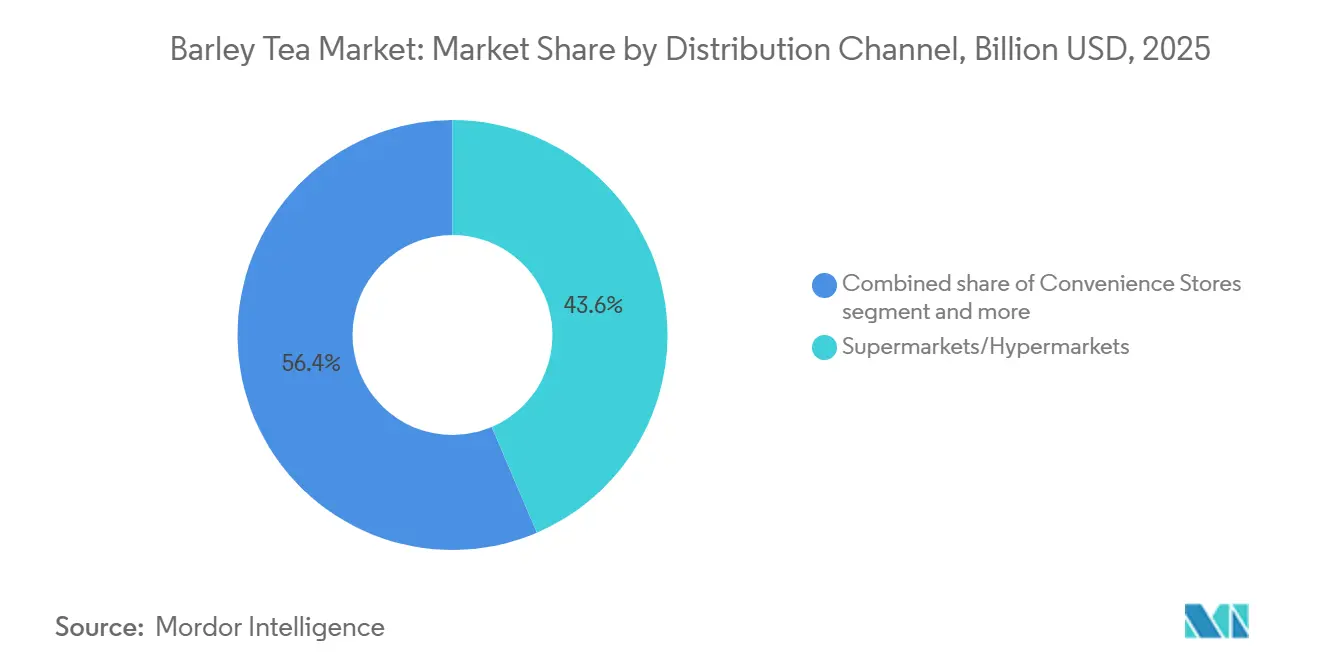
Supermarkets and Hypermarkets Remain the Main ChannelSupermarkets and hypermarkets accounted for 43.58% revenue share in 2025. They are central to household replenishment in Asian and European markets. Their scale supports broad shelf access for tea bags, loose products, and ready-to-drink bottles. Retail promotions and visible shelf placement can also support purchases of familiar brands. Convenience stores have an important secondary role in Japan and South Korea because they meet immediate-consumption needs. Retailer partnerships can give manufacturers a way to match product launches to specific shopper occasions. Large stores can show several pack sizes and formats within one tea aisle. This helps regular consumers select products for home use, travel, or immediate consumption. The channel can also give established brands steady visibility during seasonal demand peaks.
Online retail stores are forecast to grow at a 7.12% CAGR through 2031. The channel can reduce the shelf-access barrier that affects niche imported products outside Asia. It also allows consumers to search directly for caffeine-free grain tea products. Cross-border sellers and direct-to-consumer brands can use online retail to reach consumers who are already interested in Asian beverages. Digital channels can carry detailed product information, which is useful when the flavor profile needs explanation. Search functions also allow buyers to compare pack sizes and preparation formats before choosing a product. Online listings can make repeat purchases easier after an initial trial. These advantages are relevant for tea bags, loose tea, and ready-to-drink products.
Geography Analysis
APAC Barley Tea Market
Asia-Pacific accounted for the largest share of the global barley tea market, representing 54.88% of revenue in 2025. The region's dominance is primarily attributed to the long-standing consumption of barley tea in countries such as Japan, South Korea, and China, where it is widely recognized as a traditional, caffeine-free beverage. Strong consumer familiarity with barley-based beverages supports recurring household consumption and provides a stable demand base for the market. In addition, growing health consciousness and interest in naturally positioned beverages are encouraging consumers to incorporate barley tea into their daily beverage routines.
South America Barley Tea Market
South America is projected to be the fastest-growing regional market, with revenue expected to expand at a 6.54% CAGR through 2031. Growth is being supported by increasing consumer interest in functional and naturally positioned beverages as consumers seek alternatives to conventional caffeinated drinks. Rising exposure to Asian beverage products through international retail, e-commerce, and foodservice channels is also improving consumer awareness of barley tea across the region. The growing availability of imported and locally distributed specialty teas is making barley tea more accessible to consumers beyond traditional tea-drinking segments.
EMEA and North America Barley Tea Market
Europe, North America, and the Middle East & Africa represent emerging markets for barley tea, supported by increasing interest in caffeine-free, natural, and health-oriented beverages. Demand is particularly influenced by Asian consumer communities and growing exposure to international tea products through specialty retailers and online platforms. Product diversification into tea bags, flavored variants, and ready-to-drink formats is also helping broaden consumer appeal. However, comparatively lower consumer familiarity with barley tea than in Asia-Pacific limits the current market size of these regions.
Competitive Landscape
The barley tea market is moderately fragmented, with competition spread across established tea manufacturers, regional producers, specialty beverage companies, and emerging brands. The presence of multiple domestic and international players limits the dominance of any single company and creates a competitive environment across key regional markets. Established players benefit from strong brand recognition, extensive distribution networks, and consumer familiarity, while smaller companies compete through niche positioning and localized offerings.
Product differentiation is a key competitive strategy among market participants. Companies are expanding their portfolios across roasted, flavored, loose, and tea-bag formats to address varying consumer preferences and consumption occasions. Players are also focusing on packaging innovation, convenient formats, and natural or caffeine-free positioning to strengthen product appeal. The introduction of new flavors and ready-to-consume formats is further helping companies attract younger consumers and expand barley tea beyond traditional consumption patterns.
Companies are also focusing on distribution expansion and geographic penetration to strengthen their market positions. Leading and emerging players are increasing product availability through supermarkets and hypermarkets, convenience stores, specialty tea retailers, foodservice outlets, and e-commerce platforms. Expansion into regions outside traditional barley tea-consuming markets, particularly Europe, North America, and South America, is providing additional growth opportunities.
Barley Tea Industry Leaders
-
ITO EN, Ltd.
-
Suntory Holdings Limited
-
Kirin Holdings Company, Limited
-
Otsuka Pharmaceutical Co., Ltd.
-
Sanei Kosan Co., Ltd.
- *Disclaimer: Major Players sorted in no particular order

Barley Tea Market Companies Covered in this Report
- ITO EN, Ltd.
- Suntory Holdings Limited
- Kirin Holdings Company, Limited
- Otsuka Pharmaceutical Co., Ltd.
- Sanei Kosan Co., Ltd.
- Harada Tea Processing Co., Ltd.
- JIN-DA CO., LTD.
- Dongsuh Foods Corporation
- Nikken Foods Co., Ltd.
- Ten Ren Tea Company, Ltd.
- Hakubaku Co., Ltd.
- Odani Kokufun Co., Ltd.
- The Canadian Barley Tea Company
- New Mexico Tea Company
- The Republic of Tea, Inc.
- Sugimoto Tea Company
- Pokka Sapporo Food & Beverage Ltd.
- Lotte Corporation
- Kikkoman Corporation
- Uni-President Enterprises Corporation
Recent Industry Developments in Barley Tea Market
- July 2026: ECHIGO-TSUMARI ART FIELD and Oisix relaunched a pesticide-free, 100% domestically sourced rokujo barley tea, produced by Kawahara Flour Mill. The product uses artisan dual-roasting techniques to create greater flavor complexity and layering, strengthening its positioning as a premium and sustainability-focused barley tea offering.
- June 2026: ITO EN launched the Kenko Mineral Mugicha MLB Club Mascot Special Edition Bottle through Seven-Eleven and major Japanese retailers. The limited-edition product generated strong consumer engagement, with 25 million units sold within two weeks, demonstrating the effectiveness of sports-themed collaborations and collectible packaging in driving barley tea consumption.
- May 2026: ITO EN launched Kenko Mineral Mugicha Ice Slurry, a frozen pouch-format barley tea positioned as the first product of its kind in Japan's tea category. The innovative format provides a convenient and refreshing consumption option, particularly suited to hot-weather occasions, while expanding barley tea beyond conventional bottled and brewed formats.
- July 2025: Dongsuh Foods refreshed its tea packaging portfolio across its barley tea and grain tea range, adopting a simplified pastel-toned “rest and comfort” design aesthetic, updated brand typography, and clearer product differentiation. The redesign aims to strengthen shelf appeal and enhance the brand’s relevance among younger consumer demographics.
Global Barley Tea Market Report Scope
Barley tea is a caffeine-free beverage made by roasting and brewing barley grains (Hordeum vulgare) in hot or cold water. The barley tea market report is segmented by product type, form, distribution channel, and geography. By product type, the market is segmented into roasted barley tea, flavored barley tea and others. By form, the market is segmented into loose-leaf, tea bags, and others. By distribution channel, the market is segmented into supermarkets/hypermarkets, convenience stores, online retail stores, and other distribution channels. By geography, the market is segmented into North America, Europe, Asia-Pacific, South America, the Middle East, and Africa. The market sizing has been done in value terms in USD for all the above mentioned segments.
Segmentation Overview
| Roasted Barley Tea |
| Flavored Barley Tea |
| Other Product Types |
| Loose |
| Tea Bags |
| Others |
| Supermarkets/Hypermarkets |
| Convenience Stores |
| Online Retail Stores |
| Other Distribution Channels |
| North America | United States |
| Canada | |
| Mexico | |
| Rest of North America | |
| Europe | Germany |
| United Kingdom | |
| Italy | |
| France | |
| Spain | |
| Rest of Europe | |
| Asia-Pacific | China |
| India | |
| Japan | |
| Australia | |
| South Korea | |
| Vietnam | |
| Indonesia | |
| Rest of Asia-Pacific | |
| South America | Brazil |
| Argentina | |
| Rest of South America | |
| Middle East and Africa | South Africa |
| Saudi Arabia | |
| United Arab Emirates | |
| Rest of Middle East and Africa |
| By Product Type | Roasted Barley Tea | |
| Flavored Barley Tea | ||
| Other Product Types | ||
| By Form | Loose | |
| Tea Bags | ||
| Others | ||
| By Distribution Channel | Supermarkets/Hypermarkets | |
| Convenience Stores | ||
| Online Retail Stores | ||
| Other Distribution Channels | ||
| By Geography | North America | United States |
| Canada | ||
| Mexico | ||
| Rest of North America | ||
| Europe | Germany | |
| United Kingdom | ||
| Italy | ||
| France | ||
| Spain | ||
| Rest of Europe | ||
| Asia-Pacific | China | |
| India | ||
| Japan | ||
| Australia | ||
| South Korea | ||
| Vietnam | ||
| Indonesia | ||
| Rest of Asia-Pacific | ||
| South America | Brazil | |
| Argentina | ||
| Rest of South America | ||
| Middle East and Africa | South Africa | |
| Saudi Arabia | ||
| United Arab Emirates | ||
| Rest of Middle East and Africa | ||
Key Questions Answered in the Report
What is the forecast growth rate for barley tea?
The Barley Tea Market is forecast to grow at a 5.54% CAGR from 2026 to 2031, increasing from USD 1.13 billion in 2026 to USD 1.48 billion by 2031.
Which barley tea product type leads sales?
Roasted barley tea led with a 55.18% share in 2025, supported by its established role in daily hydration across Japan, South Korea, and China.
Which form of barley tea is growing fastest?
Loose barley tea is forecast to grow at a 6.63% CAGR through 2031, supported by specialty retail and premium sourcing narratives.
Which sales channel has the highest growth potential?
Online retail stores are projected to grow at a 7.12% CAGR through 2031 because they improve access for imported and specialty products.