
Automotive Windshield Market Size and Share
Market Overview
| Study Period | 2020 - 2032 |
|---|---|
| Market Size (2027) | USD 16.02 Billion |
| Market Size (2032) | USD 21.86 Billion |
| Growth Rate (2027 - 2032) | 6.42 % |
| Fastest Growing Market | Asia-Pacific |
| Largest Market | Asia-Pacific |
| Market Concentration | Medium |
Major Players *Disclaimer: Major Players sorted in no particular order Image © Mordor Intelligence. Reuse requires attribution under CC BY 4.0. | |
Automotive Windshield Market Analysis by Mordor Intelligence
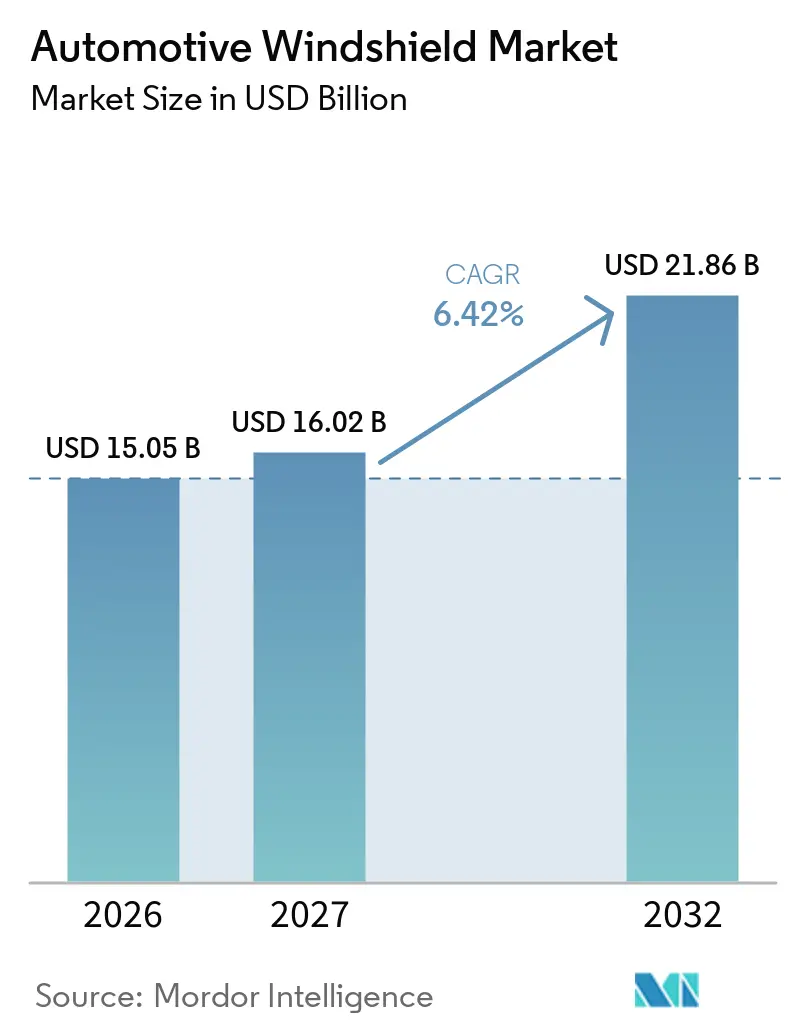
The automotive windshield market size was valued at USD 15.05 billion in 2026, is estimated at USD 16.02 billion in 2027, and is projected to reach USD 21.86 billion by 2032, registering a CAGR of 6.42% between 2027 and 2032. The automotive windshield market is moving beyond its role as a passive safety component because vehicle makers increasingly use the glass to support cameras, sensors, and display systems. This shift raises the technical requirements for optical quality, thermal control, and acoustic performance. It also gives established suppliers an opportunity to compete on engineering capability rather than production scale alone. The automotive windshield market will continue to depend on vehicle production, but replacement demand and the need to calibrate safety systems create a separate source of activity. Suppliers that can combine glass manufacturing, technology integration, and dependable service support are better placed to address these requirements.
Key Report Takeaways
- By glass type, laminated glass held 88.61% of the automotive windshield market share in 2026, and it is forecast to grow at a CAGR of 7.56% through 2032.
- By functionality, standard windshields held 70.42% of the automotive windshield market share in 2026, while value-added windshields are forecast to grow at a CAGR of 10.42% through 2032.
- By position, front windshields held 69.44% of the automotive windshield market share in 2026, and the same is forecast to grow at a CAGR of 7.25% through 2032.
- By vehicle type, passenger cars held 75.35% of the automotive windshield market share in 2026, while heavy commercial vehicles are forecast to grow at a CAGR of 7.97% through 2032.
- By sales channel, original equipment manufacturer held 71.39% of the automotive windshield market share in 2026, while aftermarket and replacement sales are forecast to grow at a CAGR of 6.84% through 2032.
- By geography, Asia-Pacific held 48.67% of the automotive windshield market share in 2026 and is forecast to grow at a CAGR of 7.66% through 2032.
Note: Market numbers in this report are based on Mordor Intelligence's proprietary estimation framework, which combines nine months of actuals with Q4 projections for base year 2026.
Market Trends and Insights
Drivers Impact Analysis of Automotive Windshield Market*
| Driver | (~) % Impact on CAGR Forecast | Geographic Relevance | Impact Timeline |
|---|---|---|---|
| Rising ADAS and Camera-Integrated Windshield Fitment | +1.8% | Global, led by Europe and China | Short term (≤ 2 years) |
| Increasing Adoption of HUD-Compatible and AR-HUD Windshields | +1.5% | Asia-Pacific core (China), spill-over to Europe and North America | Short to medium term (1–3 years) |
| Growth in Vehicle Production and Global Vehicle Parc | +1.2% | Global, high intensity in Asia-Pacific and South America | Medium term (2–4 years) |
| Replacement Demand from Road Debris, Weather and Collision Damage | +0.9% | North America and Europe, with Asia-Pacific growing | Medium term (2–4 years) |
| Windshield Optical Precision Requirements for Automated Driving | +0.6% | Global, led by advanced markets (Germany, Japan, Unite States) | Long term (≥ 4 years) |
| Rising Demand for Solar-Control and Acoustic Windshield Functions | +0.4% | Europe, North America, Asia-Pacific premium segment | Medium to long term (3–5 years) |
| Source: Mordor Intelligence | |||
Rising ADAS and Camera-Integrated Windshield Fitment
The automotive windshield market benefits as cameras and other driver-assistance equipment become more common in new vehicles. These systems need glass with controlled optical properties so that cameras can capture reliable images through the windshield. Replacement work also becomes more specialized because the safety equipment must be recalibrated after glass installation. This requirement favors suppliers and service networks that can support both the part and the installation process. The automotive windshield market therefore gains value from higher technical content even when vehicle volumes grow at a more measured pace. It also raises the importance of close communication among vehicle manufacturers, glass producers, and repairers before a new vehicle program reaches the road.
Increasing Adoption of HUD-Compatible and AR-HUD Windshields
Head-up displays are increasing the demand for windshields with precise optical construction. These products rely on controlled interlayers and uniform glass surfaces to limit distortion in the projected image. Visteon and FUTURUS announced a partnership in 2025 to develop next-generation augmented-reality windshield and panoramic head-up display systems for automakers[1]. This work shows how display suppliers and vehicle-system providers are becoming more connected to windshield development. The automotive windshield market can benefit as heating, acoustic treatment, solar control, and display compatibility become more relevant to vehicle design. Product development now requires coordination between glass geometry, optical materials, display hardware, and the vehicle interior rather than work by any one supplier alone.
Growth in Vehicle Production and Global Vehicle Parc
Vehicle production remains a direct demand base for original equipment windshield fitment. Larger vehicles, including SUVs, pickup trucks, and electric vehicles, often require wider glazing areas and more advanced windshield designs. The growing vehicle parc also creates a future replacement base as windshields are damaged through regular use, collisions, and environmental exposure. Vehicle makers are increasingly specifying acoustic, thermal, and camera-compatible glass, which increases the technical value of each unit. The automotive windshield market benefits from this combination of original fitment demand and replacement needs that develop over the vehicle life cycle.
Replacement Demand from Road Debris, Weather and Collision Damage
Windshield damage from road debris, severe weather, and collisions creates a consistent need for replacement glass. This demand is less discretionary than many vehicle upgrades because damage can affect visibility and vehicle safety. Advanced driver-assistance systems make replacement work more complex when cameras or related components must be recalibrated after installation. This requirement can raise the value of each replacement while increasing the importance of trained installers and suitable equipment. The automotive windshield market is therefore supported by service networks that can provide compliant parts, reliable fitment, and calibration support.
Restraints Impact Analysis of Automotive Windshield Market*
| Restraint | (~) % Impact on CAGR Forecast | Geographic Relevance | Impact Timeline |
|---|---|---|---|
| Energy-Intensive Manufacturing and Soda-Ash Cost Volatility | -0.6% | Global, high exposure in China and Europe | Short to medium term (1–3 years) |
| High Replacement Cost of ADAS- and HUD-Equipped Windshields | -0.5% | North America & Europe, emerging in Asia-Pacific | Medium term (2–4 years) |
| Calibration and Installation Variability After Windshield Replacement | -0.3% | Global, most acute in North America | Short to medium term (1–3 years) |
| Limited Recycling Infrastructure for Laminated Windshields | -0.2% | Europe (regulatory pressure), Global (nascent infrastructure) | Long term (≥ 4 years) |
| Source: Mordor Intelligence | |||
Energy-Intensive Manufacturing and Soda-Ash Cost Volatility
Automotive windshield production depends on float-glass operations that require substantial energy input. Producers also rely on soda ash and other materials whose cost movements can affect manufacturing margins. Continuous furnace operations limit the ability to quickly adjust production when input costs change. This exposure is especially relevant for suppliers that do not have stable energy arrangements or secure material supply relationships. Recycling progress may help reduce material waste over time, as AGC Glass Europe and Reiling reported industrial-scale windshield recycling work in 2026.
High Replacement Cost of ADAS- and HUD-Equipped Windshields
ADAS- and HUD-equipped windshields can contain camera brackets, heating elements, acoustic layers, and specialized optical features. These features increase the cost of the replacement part compared with basic windshield glass. The installation process may also require recalibration to restore the operation of camera-based safety systems. Variations in technician training and equipment can create inconsistent repair outcomes across service locations. The automotive windshield market needs stronger coordination among glass manufacturers, vehicle makers, insurers, and repair networks to support reliable replacement outcomes.
*Our forecasts treat driver/restraint impacts as directional, not additive. The impact forecasts reflect baseline growth, mix effects, and variable interactions.
Automotive Windshield Market Segment Analysis
By Glass Type:
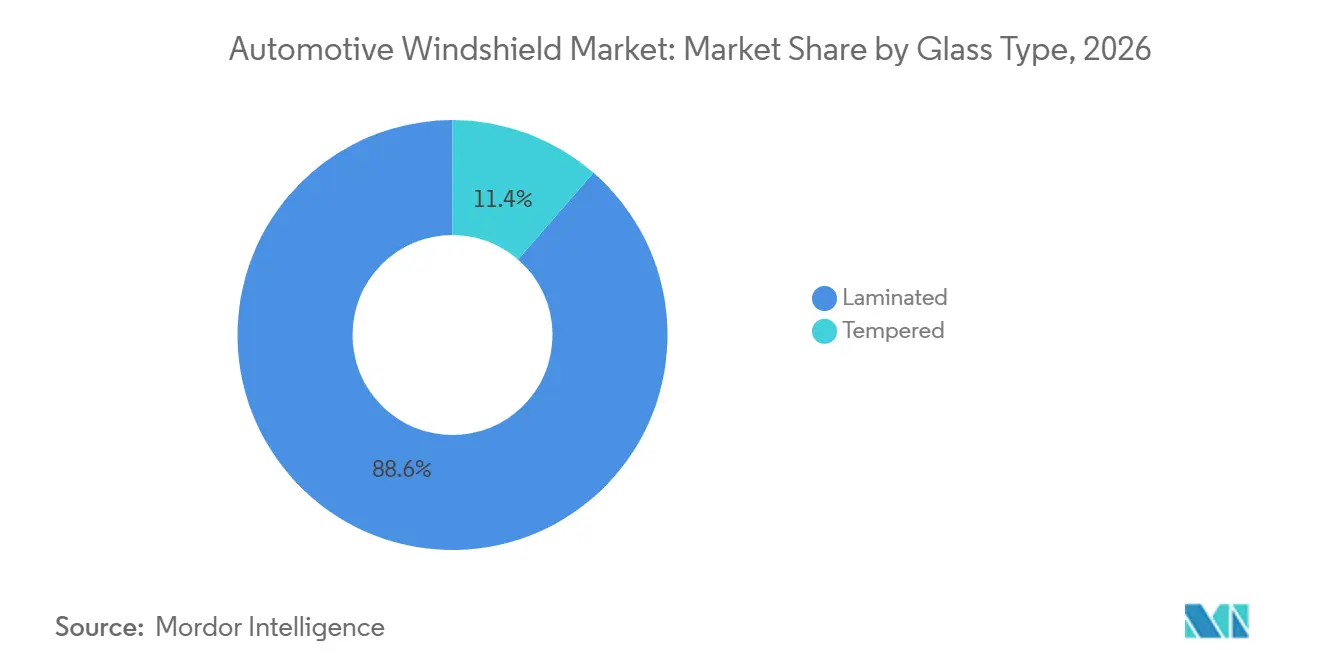
Laminated Glass Leads Safety and Technology IntegrationLaminated glass held 88.61% of the automotive windshield market share in 2026. The construction combines glass layers with an interlayer that helps retain fragments after impact. This characteristic supports its established role in front windshield applications. Laminated structures also offer a practical base for acoustic treatments, heating elements, and display-related optical features. The automotive windshield market relies on this construction because safety and technology requirements increasingly need to be addressed in one component. Its flexibility allows designers to add functions without changing the windshield’s fundamental role in occupant protection and forward visibility.
Laminated glass is forecast to grow at a CAGR of 7.56% through 2032. Its growth is supported by vehicle makers that need stronger optical control for camera-based safety functions. It can also accommodate specialized interlayers that help manage sound, heat, and projected images. AGC Automotive Czech began construction of a new automated laminated windshield line in 2025[2], reflecting continued supplier investment in this production capability. Tempered glass remains relevant for other vehicle glazing positions, but its use in this report is more limited by the functions expected from a front windshield. This difference keeps laminated glass at the center of product development for front-facing vehicle technologies.
By Functionality:
Standard Windshields Retain Scale While Value-Added Products AdvanceStandard windshields held 70.42% of the automotive windshield market share in 2026. Their position reflects demand from mainstream vehicles, older vehicle fleets, and replacement applications. Many buyers still require dependable glazing without a broad set of additional functions. The segment remains important where vehicle affordability and parts availability shape purchasing decisions. Standard products also provide a base volume that supports manufacturing utilization across the automotive windshield industry. Suppliers must preserve reliable performance and broad availability even as vehicle specifications become more complex.
Value-added windshields are forecast to grow at a CAGR of 10.42% through 2032. This category includes acoustic, heated, and display-compatible products, along with other enhanced variants. Electric vehicles can make cabin sound more noticeable, which supports the use of acoustic glass. Cold-weather conditions also make heating functions relevant where clear visibility is needed. As these functions become more common in mainstream vehicle programs, the automotive windshield market will need broader access to specialized materials and process capability. Their wider adoption can gradually change customer expectations of what constitutes a standard vehicle-glazing specification.
By Position:
Front Windshields Remain the Primary Technology InterfaceFront windshields held 69.44% of the automotive windshield market share in 2026. They are the principal optical interface between the vehicle environment and forward-facing camera systems. They also provide the surface through which head-up display information may be viewed. These roles make optical quality and reflection control central design considerations. The automotive windshield market places most of its technology integration at the front of the vehicle because that is where safety, visibility, and occupant interaction meet. Front-glass design must therefore balance many functions without reducing the driver’s view of the road.
Front windshields are forecast to grow at a CAGR of 7.25% through 2032. Rear windshields continue to serve important defogging, visibility, and structural functions. However, the front position carries greater requirements for sensor compatibility and display performance. Mack Trucks introduced its ImpactShield windshield technology in 2026 for heavy-duty applications[3], showing that specialized front-glass development is also reaching commercial vehicles. This spread of advanced glazing into truck platforms can widen the technical scope of the automotive windshield industry. It also suggests that durability and vehicle uptime can become important criteria alongside passenger-vehicle comfort and display features.
By Vehicle Type:
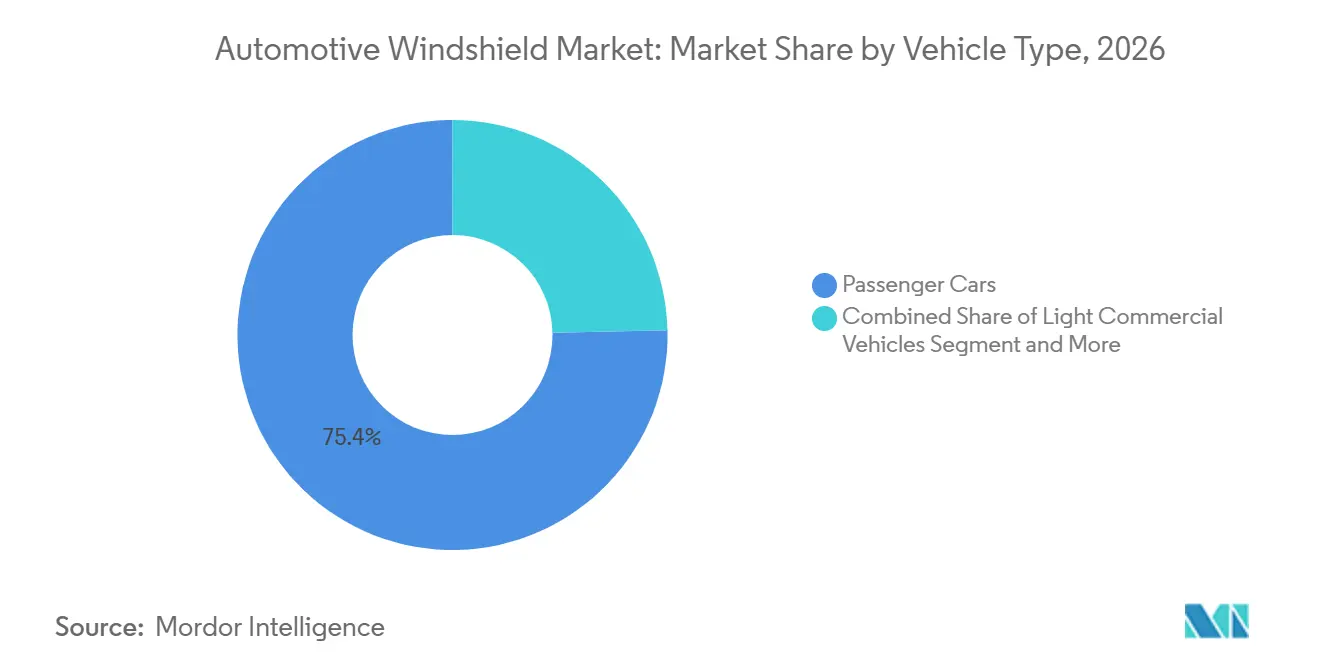
Passenger Cars Lead While Heavy Commercial Vehicles Gain MomentumPassenger cars held 75.35% of the automotive windshield market share in 2026. They provide the broadest base for windshield fitment because they account for a large share of vehicle ownership and production. Passenger vehicle programs also introduce acoustic and safety-related glass features across a wide range of price points. The need for clear vision, cabin comfort, and camera support continues to shape product specifications. The automotive windshield market therefore remains closely tied to passenger-car platform strategies. Product choices made for high-volume passenger models can determine which features reach the replacement channel over time.
Heavy commercial vehicles are forecast to grow at a CAGR of 7.97% through 2032. Fleet operators increasingly assess windshield performance through uptime, durability, and total maintenance needs. Driver-assistance features can also require more controlled optical conditions in commercial vehicle glazing. Mack Trucks’ ImpactShield launch illustrates the interest in purpose-engineered windshield technology for demanding truck use. The automotive windshield market can respond through products that combine reliable protection with service support for fleet customers. Suppliers also need to consider the practical demands of repair timing and parts availability for vehicles that spend extended periods on the road.

By Sales Channel:
OEM Programs Set Requirements and Replacement Demand FollowsOEM held 71.39% of the automotive windshield market share in 2026. Vehicle manufacturers establish the core glass requirements when they develop a new model. These requirements can include optical performance, camera placement, acoustic behavior, and heating capability. The original fitment decision subsequently influences the specification expected in replacement parts. The automotive windshield market depends on close OEM relationships because these programs determine the technical baseline that later reaches the service network. Early collaboration can help glass suppliers align production methods with the functional needs of future vehicle platforms.
Aftermarket and replacement sales are forecast to grow at a CAGR of 6.84% through 2032. The installed base of vehicles with advanced safety features creates a need for parts that match the original technical requirements. Repairers must also manage proper fitment and any calibration work associated with camera systems. Distribution partners can become more important where parts need careful handling and timely availability. The automotive windshield market will increasingly require replacement solutions that are paired with training, equipment access, and reliable service processes. This channel will need to maintain customer confidence while managing a broader range of windshield configurations.
Geography Analysis
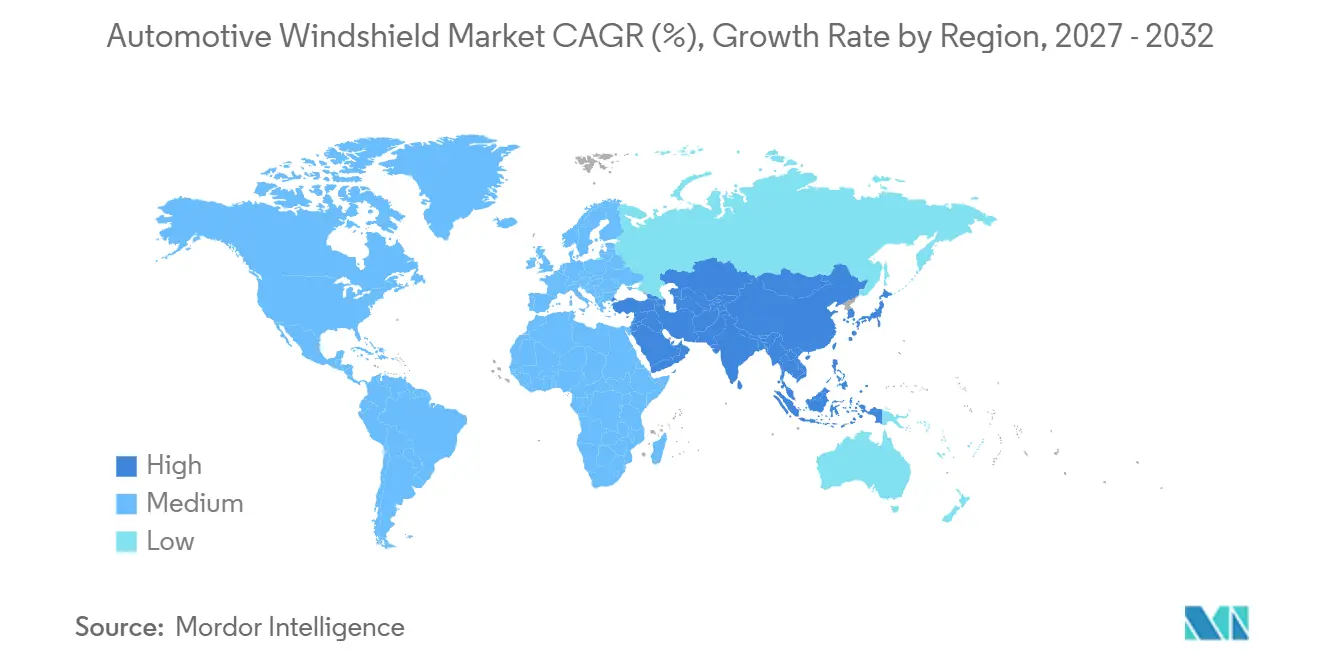
Asia-Pacific held 48.67% of the automotive windshield market share in 2026 and is forecast to grow at a CAGR of 7.66% through 2032. China is the main volume center because of its extensive vehicle manufacturing base. New energy vehicles in the country also support demand for larger and more technically complex front glass. India offers a separate source of demand as vehicle ownership and local production develop. Japan and South Korea continue to influence high-specification vehicle programs through their vehicle makers and component suppliers. The diversity of demand means that suppliers must address both cost-sensitive and technology-focused applications across the region.
North America is characterized by strong demand for trucks, SUVs, and advanced driver-assistance features. These vehicle formats can require large glass areas and more robust performance in demanding conditions. Local production strategies can help suppliers reduce supply-chain exposure and serve OEM and replacement customers more closely. Fuyao has continued to expand its U.S. presence, while other global suppliers maintain regional production and service networks. The automotive windshield market in North America also depends on access to qualified installation and calibration support. Product availability, technician capability, and clear service procedures can be as important as manufacturing capacity in maintaining customer confidence.
Europe has a regulatory environment that reinforces the importance of safe and compatible glazing. Vehicle makers in the region often set demanding requirements for optical quality, acoustic performance, and vehicle integration. Premium OEM programs can influence product designs that later spread to wider global platforms. South America is supported mainly by Brazil, where regional vehicle production and replacement needs remain important. The Middle East and Africa offer developing opportunities as vehicle fleets expand and regional manufacturing plans seek to build local supply capability. Across these areas, suppliers must adapt their commercial approach to local vehicle fleets, logistics conditions, and the maturity of repair networks.
Competitive Landscape
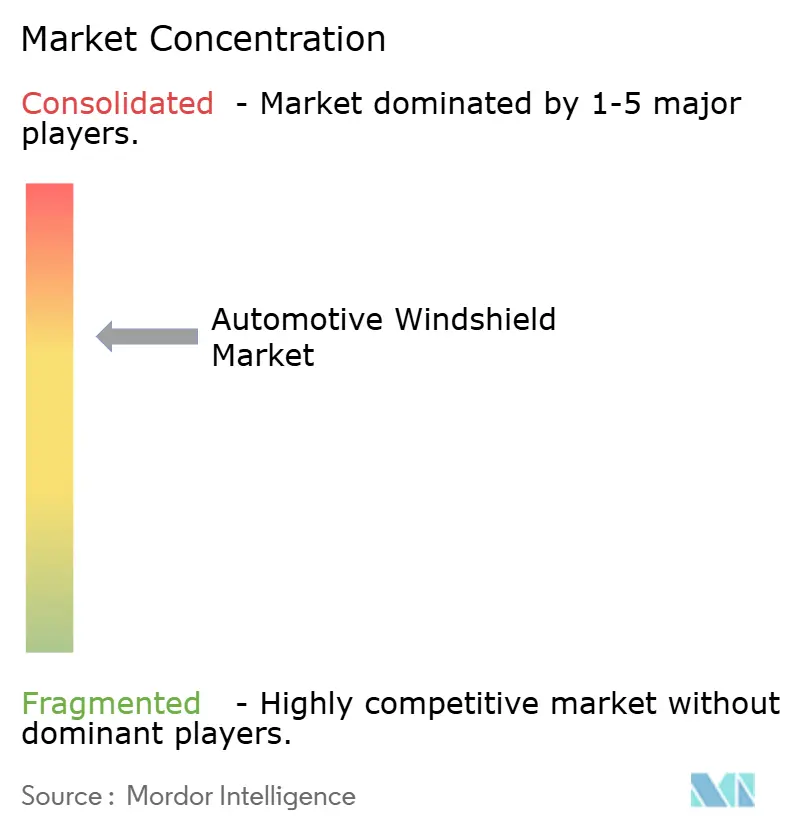
The automotive windshield market is significantly moderated because a group of large global suppliers anchors major OEM relationships while regional producers remain active in replacement channels. AGC Inc., Fuyao Glass Industry Group, Nippon Sheet Glass, Compagnie de Saint-Gobain, and Xinyi Glass Holdings are among the companies shaping the competitive environment. Their advantages are based on production reach, OEM qualification, materials knowledge, and the ability to meet increasingly complex technical specifications. Competition is shifting toward integrated solutions that support sensor compatibility, display functionality, and dependable quality. This structure leaves room for regional suppliers where local service, price, or replacement availability is decisive. It also requires global leaders to maintain strong local execution rather than relying only on their scale.
AGC has emphasized advanced glass development and circular processing as technology requirements become more demanding. Its work with Reiling on automotive windshield recycling points to a strategy that addresses both material recovery and customer sustainability expectations. Fuyao has pursued local supply capability in North America to strengthen its access to vehicle manufacturers and reduce dependence on imported feedstock. NSG continues to compete through its global automotive-glass footprint and relationships across original fitment and replacement channels. The automotive windshield market rewards suppliers that can combine a consistent manufacturing base with timely support for changing vehicle programs. These activities show that manufacturing location, technology investment, and customer support are closely linked in supplier strategy.
Specialized interlayers remain strategically important because they affect acoustic performance, impact behavior, and display quality. Materials suppliers also face pressure to improve optical clarity for head-up display applications and advanced camera systems. Visteon’s work with FUTURUS illustrates how electronics and display companies can influence windshield requirements even when they are not glass producers. Suppliers that establish partnerships across glass, materials, optics, and vehicle systems can improve their position in complex programs. The automotive windshield market will remain competitive because technology integration raises entry barriers but also creates new partnership opportunities. This wider ecosystem makes coordination and intellectual-property management more relevant to long-term supplier positioning.
Automotive Windshield Industry Leaders
-
AGC Inc.
-
Fuyao Glass Industry Group Co., Ltd.
-
Nippon Sheet Glass Co., Ltd.
-
Compagnie de Saint-Gobain
-
Xinyi Glass Holdings Limited
- *Disclaimer: Major Players sorted in no particular order
Automotive Windshield Market Companies Covered in this Report
- AGC Inc.
- Compagnie de Saint-Gobain
- Nippon Sheet Glass Co., Ltd.
- Fuyao Glass Industry Group Co., Ltd.
- Xinyi Glass Holdings Limited
- Guardian Industries Holdings LLC
- Central Glass Co., Ltd.
- Vitro, S.A.B. de C.V.
- Corning Incorporated
- Asahi India Glass Limited
- Atlas Holdings LLC
- Webasto SE
- Eastman Chemical Company
- Kuraray Co., Ltd.
- CSG Holding Co., Ltd.
- Taiwan Glass Industry Corporation
- Sika AG
- PPG Industries, Inc.
Recent Industry Developments in Automotive Windshield Market
- May 2026: Mack Trucks introduced ImpactShield, the first Class 8 truck windshield using Corning Fusion5 Glass, improving durability and minimizing fleet downtime.
- February 2026: Hyundai Mobis announced an alliance with German and French specialized companies to mass-produce the Holographic Windshield Display (HWD).
- February 2026: Garware Hi-Tech Films (GHFL) launched four new automotive care products, including Ceramic & Graphene Coating, Car Care Kit, Window Film Kits, and WindShield Pro.
Global Automotive Windshield Market Report Scope
The Automotive Windshield Market is segmented by Glass Type, Functionality, Position, Vehicle Type, Sales Channel, and Geography. By Glass Type, the market is segmented into Laminated and Tempered. By Functionality, the market is segmented into Standard and Value-Added (Acoustic, Heated, HUD-Compatible, Others). By Position, the market is segmented into Front Windshield and Rear Windshield (Backlite). By Vehicle Type, the market is segmented into Passenger Cars, Light Commercial Vehicles, and Heavy Commercial Vehicles. By Sales Channel, the market is segmented into OEM and Aftermarket / Replacement. By Geography, the market is segmented into North America (United States, Canada, and Mexico), Europe (Germany, France, United Kingdom, Italy, Spain, Russia, Poland, and Rest of Europe), Asia-Pacific (China, Japan, India, South Korea, Indonesia, Thailand, Australia, and Rest of Asia-Pacific), South America (Brazil, Argentina, Colombia, Chile, and Rest of South America), and Middle East and Africa (Türkiye, Saudi Arabia, United Arab Emirates, Israel, South Africa, Egypt, Morocco, and Rest of Middle East and Africa). Market forecasts are provided in terms of Value (USD) and Volume (SQM).
Segmentation Overview
| Laminated |
| Tempered |
| Standard |
| Value-Added (Acoustic, Heated, HUD-Compatible, Others) |
| Front Windshield |
| Rear Windshield (Backlite) |
| Passenger Cars |
| Light Commercial Vehicles |
| Heavy Commercial Vehicles |
| Original Equipment Manufacturers |
| Aftermarket / Replacement |
| North America | United States |
| Canada | |
| Mexico | |
| Rest of North America | |
| Europe | Germany |
| France | |
| United Kingdom | |
| Italy | |
| Spain | |
| Russia | |
| Poland | |
| Rest of Europe | |
| Asia-Pacific | China |
| Japan | |
| India | |
| South Korea | |
| Indonesia | |
| Thailand | |
| Australia | |
| Rest of Asia-Pacific | |
| South America | Brazil |
| Argentina | |
| Colombia | |
| Chile | |
| Rest of South America | |
| Middle East and Africa | Türkiye |
| Saudi Arabia | |
| United Arab Emirates | |
| Israel | |
| South Africa | |
| Egypt | |
| Morocco | |
| Rest of Middle East and Africa |
| By Glass Type | Laminated | |
| Tempered | ||
| By Functionality | Standard | |
| Value-Added (Acoustic, Heated, HUD-Compatible, Others) | ||
| By Position | Front Windshield | |
| Rear Windshield (Backlite) | ||
| By Vehicle Type | Passenger Cars | |
| Light Commercial Vehicles | ||
| Heavy Commercial Vehicles | ||
| By Sales Channel | Original Equipment Manufacturers | |
| Aftermarket / Replacement | ||
| By Geography | North America | United States |
| Canada | ||
| Mexico | ||
| Rest of North America | ||
| Europe | Germany | |
| France | ||
| United Kingdom | ||
| Italy | ||
| Spain | ||
| Russia | ||
| Poland | ||
| Rest of Europe | ||
| Asia-Pacific | China | |
| Japan | ||
| India | ||
| South Korea | ||
| Indonesia | ||
| Thailand | ||
| Australia | ||
| Rest of Asia-Pacific | ||
| South America | Brazil | |
| Argentina | ||
| Colombia | ||
| Chile | ||
| Rest of South America | ||
| Middle East and Africa | Türkiye | |
| Saudi Arabia | ||
| United Arab Emirates | ||
| Israel | ||
| South Africa | ||
| Egypt | ||
| Morocco | ||
| Rest of Middle East and Africa | ||
Key Questions Answered in the Report
What is driving growth in automotive windshields?
Greater use of cameras, driver-assistance systems, display functions, and replacement services is increasing the technical value of windshield assemblies. These changes require suppliers to meet higher standards for optical quality, glass integration, and post-installation support.
Which glass type leads automotive windshield demand?
Laminated glass led with 88.61% share in 2026 and is forecast to grow at a CAGR of 7.56% through 2032. Its layered structure supports occupant protection while enabling acoustic, heating, and display-related functions.
Why are value-added windshields growing faster?
Acoustic, heated, and display-compatible functions address vehicle comfort, visibility, and technology-integration needs. The segment is forecast to grow at a CAGR of 10.42% through 2032 as these functions reach a broader range of vehicle programs.
Which vehicle category is growing fastest for windshield suppliers?
Heavy commercial vehicles are forecast to grow at a CAGR of 7.97% through 2032 as fleets place more emphasis on durable and technically capable glazing. Vehicle uptime, replacement ease, and safety-system compatibility are important purchasing considerations.