
Automotive Window Regulator Market Size and Share
Market Overview
| Study Period | 2020 - 2032 |
|---|---|
| Market Size (2027) | USD 14.81 Billion |
| Market Size (2032) | USD 18.21 Billion |
| Growth Rate (2027 - 2032) | 4.22 % |
| Fastest Growing Market | South America |
| Largest Market | Asia-Pacific |
| Market Concentration | Medium |
Major Players *Disclaimer: Major Players sorted in no particular order Image © Mordor Intelligence. Reuse requires attribution under CC BY 4.0. | |
Automotive Window Regulator Market Analysis by Mordor Intelligence
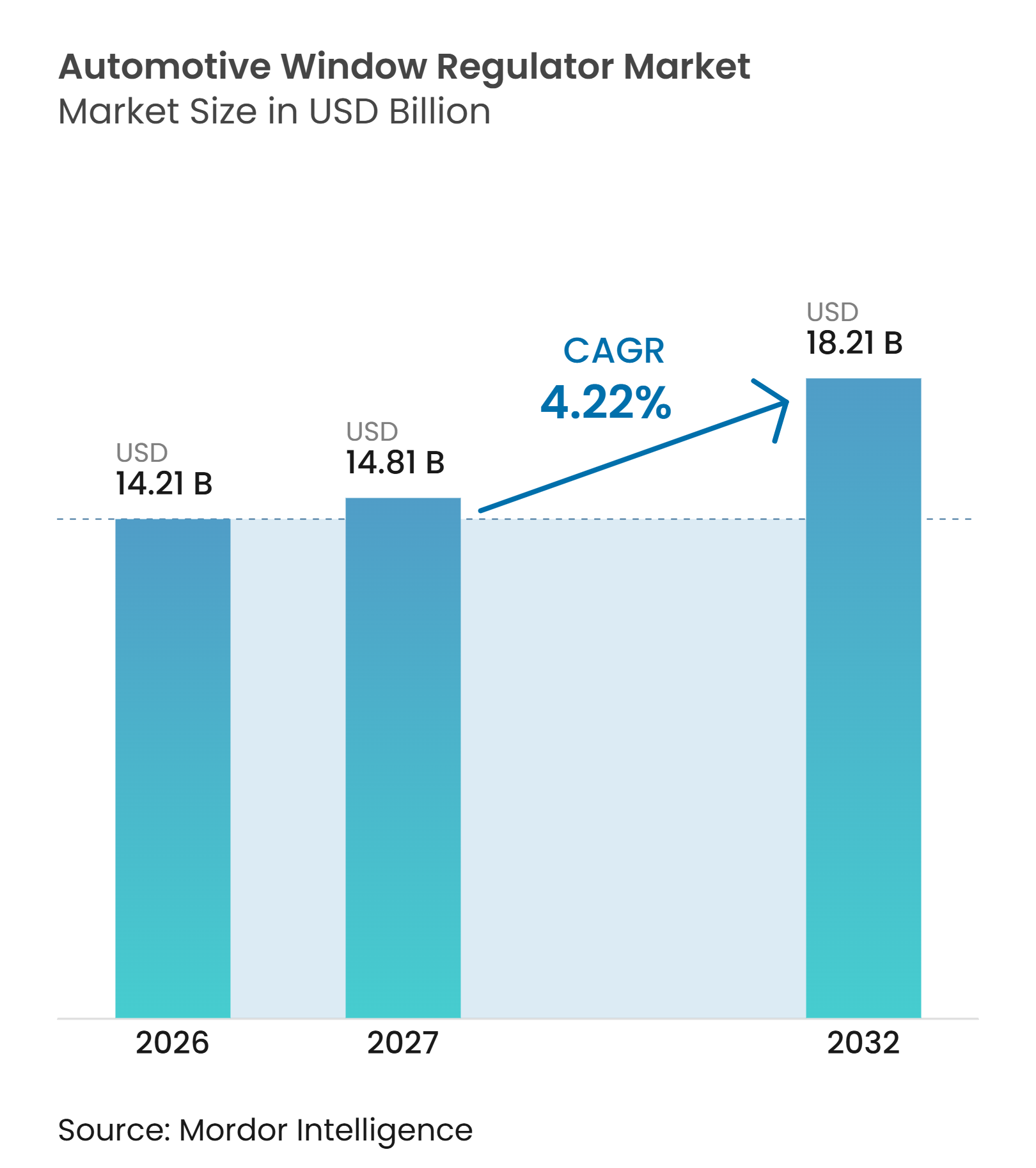
The automotive window regulator market size was valued at USD 14.21 billion in 2026 and is expected to grow from USD 14.81 billion in 2027 to USD 18.21 billion by 2032, at a CAGR of 4.22% during 2027-2032. The automotive window regulator market is supported by rising vehicle output in emerging economies, wider power-window fitment in passenger vehicles, and replacement demand from older vehicles. OEM programs continue to press suppliers to lower component costs, which limits margin flexibility and favors suppliers with efficient designs and established manufacturing footprints. At the same time, electric-vehicle platforms and greater demand for safety functions are moving the automotive window regulator market toward more integrated motor, sensing, and control solutions. The opportunity is split between high-volume vehicle production in Asia-Pacific and replacement demand in mature vehicle fleets. The automotive window regulator market also reflects a gradual shift from basic mechanical assemblies toward products that combine compact packaging, quiet operation, and electronic control.
Key Report Takeaways
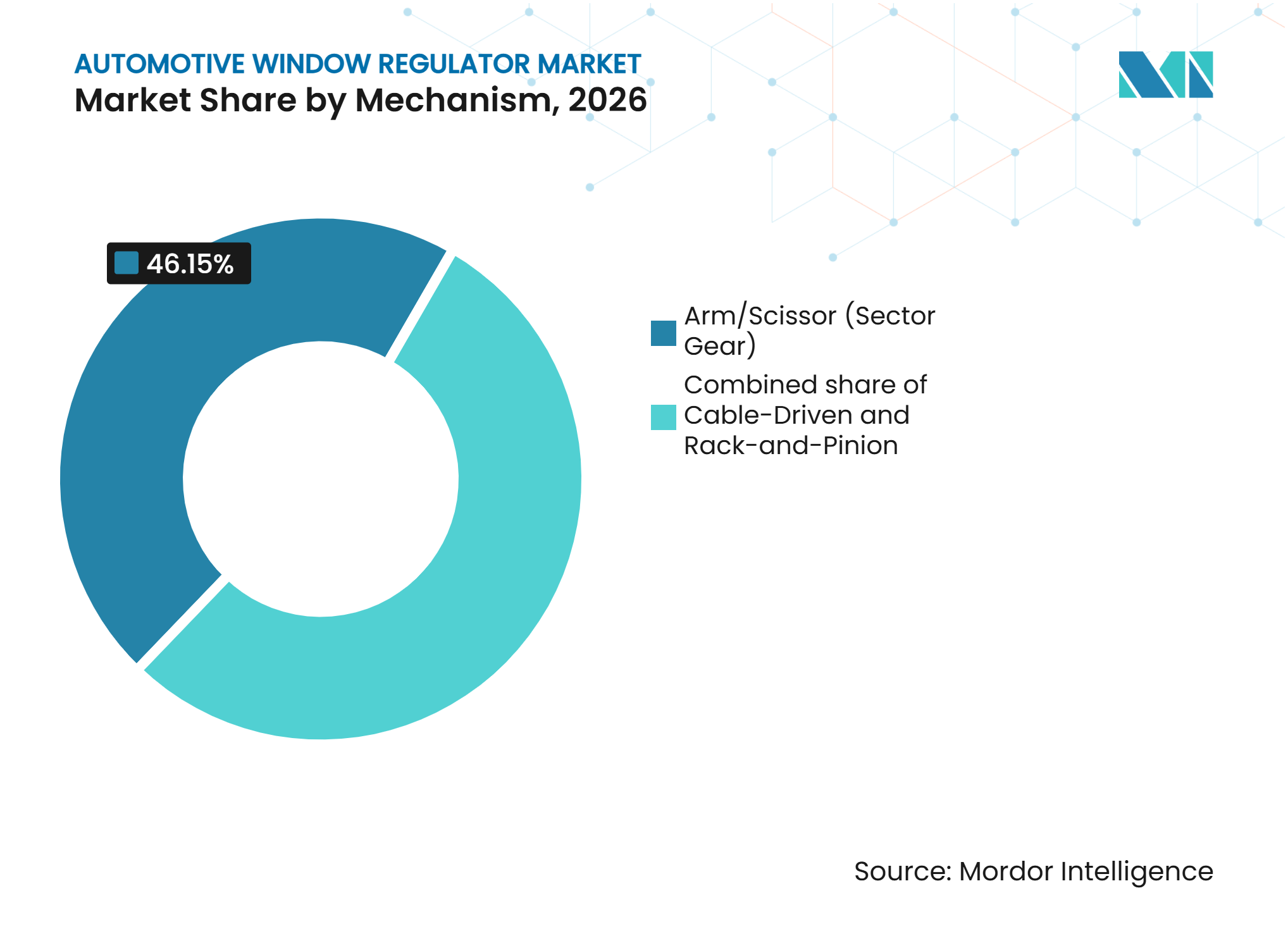
- By mechanism, arm/scissor systems held 46.15% of the automotive window regulator market share in 2026, while cable-driven regulators are forecast to grow at a 5.21% CAGR through 2032.
- By operation, power/electric regulators held 79.03% of the automotive window regulator market share in 2026 and are forecast to grow at a 5.24% CAGR through 2032.
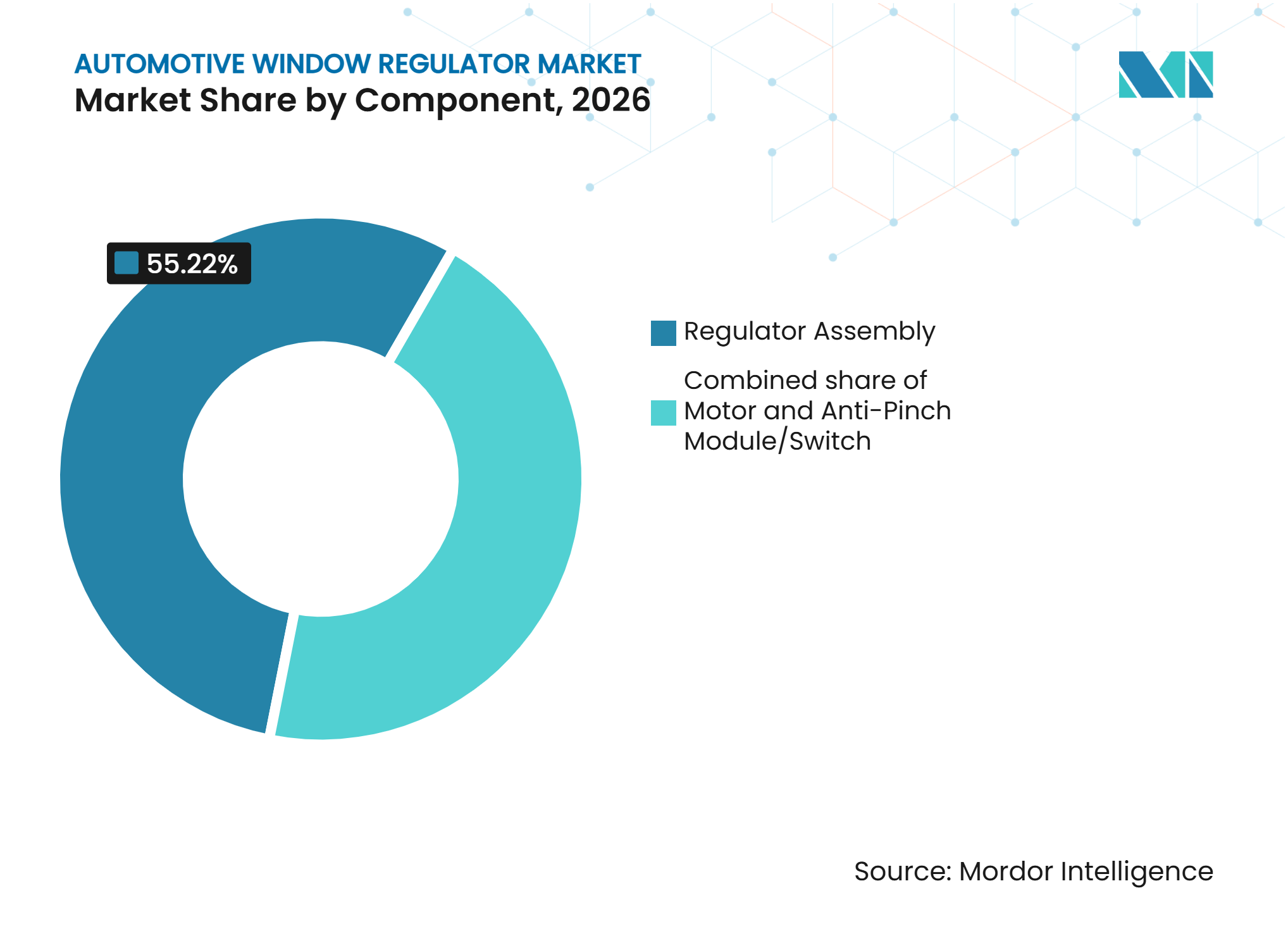
- By component, regulator assemblies held a 55.22% revenue share in 2026, while anti-pinch modules/switches are forecast to grow at a 7.75% CAGR through 2032.
- By door position, front door regulators held a 57.13% revenue share in 2026, while rear door regulators are forecast to grow at a 4.51% CAGR through 2032.
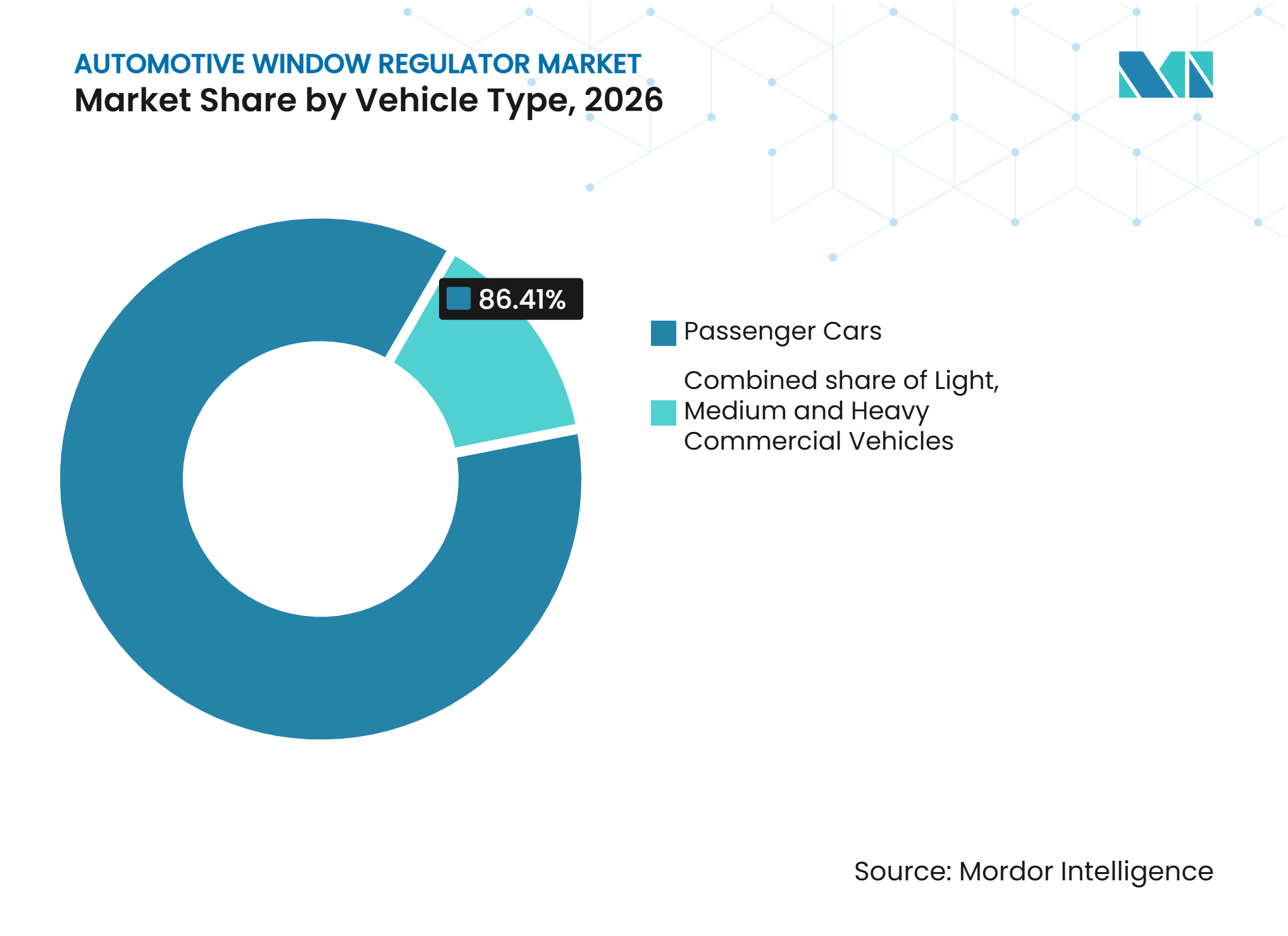
- By vehicle type, passenger cars held an 86.41% revenue share in 2026, while light commercial vehicles are forecast to grow at a 4.81% CAGR through 2032.
- By sales channel, OEM sales held a 69.12% revenue share in 2026, while the aftermarket is forecast to grow at a 6.58% CAGR through 2032.
- By geography, Asia-Pacific held a 54.28% revenue share in 2026, while South America is forecast to grow at a 7.06% CAGR through 2032.
Note: Market numbers in this report are based on Mordor Intelligence's proprietary estimation framework, which combines nine months of actuals with Q4 projections for base year 2026.
Market Trends and Insights
Drivers Impact Analysis of Automotive Window Regulator Market*
| Driver | (~) % Impact on CAGR Forecast | Geographic Relevance | Impact Timeline |
|---|---|---|---|
| Rising Power-Window Penetration in Passenger Vehicles | +1.1% | Global, strongest incremental effect in India, Southeast Asia, and South America | Medium term (2–4 years) |
| Expansion of Vehicle Production Across Asia-Pacific | +0.9% | Asia-Pacific core, with spillover to the Middle East and Africa and South America through export demand | Short term (≤ 2 years) |
| Vehicle-Parc Aging and Failure-Driven Replacement Demand | +0.8% | North America and Europe, followed by South America and the Middle East and Africa | Short term (≤ 2 years) |
| Increasing Integration of Anti-Pinch and Comfort Functions | +0.6% | North America and Europe, with Asia-Pacific as a fast follower | Long term (≥ 4 years) |
| Growing Demand for Compact Cable-Driven Regulators | +0.5% | Global, concentrated in China, India, and Southeast Asia | Medium term (2–4 years) |
| Frameless Doors and Larger Glass Areas in Premium and Electric Vehicles | +0.4% | North America, Germany, South Korea, and China new-energy vehicle platforms | Long term (≥ 4 years) |
| Source: Mordor Intelligence | |||
Rising Power-Window Penetration in Passenger Vehicles
Power-window fitment is extending into entry-level passenger vehicles across South and Southeast Asia. This change brings new demand to vehicle categories that previously used manual systems. The automotive window regulator market benefits because OEMs are standardizing power-window features in lower-priced models. The requirement also creates a clear design challenge because suppliers must control costs while meeting applicable safety requirements. The current United States power-window standard specifies requirements for power-operated window systems and their operation [1]. Suppliers that offer cost-efficient sensing and control capability can address the need for safer, simpler assemblies without separating entry-level and premium applications into wholly different product designs.
Expansion of Vehicle Production Across Asia-Pacific
Asia-Pacific vehicle production reached 59.2 million units in 2025, up 7.6% from the prior year and representing more than 61% of global output [2]. China produced 34.53 million vehicles in 2025, including 16.63 million new-energy vehicles, while Japan produced 8.41 million vehicles and South Korea remained an important production base. This concentration places the automotive window regulator market close to its largest original-equipment demand base. It also makes regional manufacturing proximity more important for suppliers serving local assembly plants. Production in a few major Asian markets can create export and tariff exposure when modules move into North American or Southeast Asian programs. The response is a broader manufacturing footprint that can support customer programs closer to final vehicle assembly.
Vehicle-Parc Aging and Failure-Driven Replacement Demand
Older vehicles create recurring replacement demand when window motors, cables, pulleys, and clips wear out. This supports the aftermarket portion of the automotive window regulator market, particularly in North America and Europe. A larger base of vehicles outside their original warranty period makes repair availability and part coverage more important. ZF Aftermarket stated in April 2026 that its Lemförder window regulator range covered more than 1,600 part numbers for European cars, commercial vehicles, and buses [3]. The range includes manual, electric, cable, scissor, and Bowden mechanism types, which illustrates the breadth needed to serve an aging vehicle parc. Suppliers with broad catalogs can address replacement demand across many vehicle generations, while narrow product ranges risk losing sales when a needed part is unavailable.
Increasing Integration of Anti-Pinch and Comfort Functions
Anti-pinch functions are becoming a standard expectation in power-window programs rather than a feature limited to premium vehicles. The United States standard requires power-operated window systems to meet specific performance requirements. This requirement makes control capability relevant across a wider set of vehicle price points. It also increases the importance of motor electronics and sensing within the automotive window regulator market. Integrated control designs can reduce the number of separate parts while enabling functions such as position sensing and anti-pinch operation. The result is stronger demand for suppliers that can provide a complete assembly rather than only mechanical hardware.
Restraints Impact Analysis of Automotive Window Regulator Market*
| Restraint | (~) % Impact on CAGR Forecast | Geographic Relevance | Impact Timeline |
|---|---|---|---|
| OEM Price-Down Pressure and Long Qualification Cycles | -0.5% | Global, with high pressure in North American and European OEM programs | Medium term (2–4 years) |
| Mechanical Cable, Pulley, and Clip Wear | -0.3% | Global aftermarket, especially in high-humidity climates in Southeast Asia and South America | Short term (≤ 2 years) |
| High SKU Complexity in the Independent Aftermarket | -0.3% | Europe and North America, with an emerging effect in Asia-Pacific | Medium term (2–4 years) |
| Limited BLDC Cost Competitiveness in Value Vehicles | -0.2% | India, Southeast Asia, South America, and Africa | Long term (≥ 4 years) |
| Source: Mordor Intelligence | |||
OEM Price-Down Pressure and Long Qualification Cycles
OEM purchasing programs continue to seek annual cost reductions from window regulator suppliers. Long qualification cycles can lock suppliers into designs and cost assumptions well before volume production begins. This makes rapid responses to changes in material costs difficult, especially for suppliers that do not make their own motor subassemblies. The automotive window regulator market therefore rewards suppliers with scale, integrated engineering, and reliable manufacturing processes. The shift toward 48-volt and LIN-enabled products also requires investment before a supplier can compete for more advanced programs. Higher-cost motor technologies may remain difficult to justify in value-focused vehicles until their cost position improves.
Mechanical Cable, Pulley, and Clip Wear
Window regulators contain moving cables, pulleys, clips, rails, and motor components that can wear during vehicle use. Failures can create repair demand, but they also expose distributors to a large number of vehicle-specific part requirements. The independent aftermarket needs coverage across many older vehicle models, even where demand per part number is limited. Carrying a wide range of low-volume parts requires inventory investment and careful distribution planning. Repair shops may face sourcing delays when parts are not locally available, which can delay nonurgent replacements such as rear window regulators.
*Our forecasts treat driver/restraint impacts as directional, not additive. The impact forecasts reflect baseline growth, mix effects, and variable interactions.
Automotive Window Regulator Market Segment Analysis
By Mechanism:
Cable Systems Gain Traction Across Vehicle SegmentsArm/scissor systems held 46.15% of the automotive window regulator market share in 2026, making them the leading mechanism. Their rigid structure distributes glass-lift loads evenly, which supports use in commercial vehicles and premium passenger applications. Cable-driven regulators are forecast to grow at a 5.21% CAGR through 2032. Their lower weight and compact layout are suited to slim door cavities, compact vehicles, and electric-vehicle platforms. Rack-and-pinion designs remain a smaller choice where precise positioning is more important than cost or packaging.
Inteva received U.S. Patent 12,281,512 in April 2025 for a cable-driven frameless door window regulator [4]. This development shows that cable systems can serve technically demanding frameless-door applications. Their simpler mechanical layouts can shorten customization work for new nameplates. This is useful when vehicle manufacturers work to compressed platform schedules. Suppliers still need to demonstrate durability and fit before winning OEM business.



By Operation:
Power Regulators Consolidate Across All Price TiersPower/electric regulators held 79.03% of the automotive window regulator market share in 2026. They are also forecast to grow at a 5.24% CAGR through 2032, the highest rate among operation types. Manual regulators are increasingly limited to the most price-sensitive vehicle specifications. OEMs in India, Brazil, and Southeast Asia are fitting power windows more widely as buyer expectations change. The automotive window regulator market size for power-operated products is supported by vehicle volume and greater electronic content per vehicle.
Power-window adoption increases demand for motors, control modules, switches, and safety functions. Smart window-control products can combine motor control, position sensing, and anti-pinch logic in a compact architecture. Infineon identifies the TLE9844QX for LIN-slave window-lift applications. LIN-enabled assemblies allow suppliers to compete on safety, connectivity, and programmable functions. Basic relay-driven products remain more exposed to price competition where they offer limited functional differentiation.
By Component:
Anti-Pinch Modules Redefine the Base AssemblyRegulator assemblies held 55.22% of component revenue in 2026. They contain the guide rails, cable or arm mechanism, brackets, and related hardware used to move the glass. Anti-pinch modules and switches are forecast to grow at a 7.75% CAGR through 2032. Their growth reflects broader adoption of power-window safety functions in the automotive window regulator market.
Motors account for most of the remaining component value where they are sourced separately from the regulator structure. The separation between the motor, controller, and safety module is becoming less clear. Inteva introduced its SLIM, or Small Light Inteva Motor, for window regulators in India in November 2025, alongside frameless window regulators. Integrated motor and electronics assemblies can capture a broader share of system value. Stand-alone anti-pinch suppliers face a different competitive position as integration becomes more common.

By Door Position:
Rear Window Demand Rises With Passenger-Parity ExpectationsFront door regulators held a 57.13% revenue share in 2026 because every passenger vehicle requires front-door window systems. Rear door regulators are forecast to grow at a 4.51% CAGR through 2032. The faster rear-door rate reflects stronger attention to rear passenger comfort in premium and near-premium vehicles. SUVs and crossovers often use larger rear glass areas than sedan designs. These designs can require regulators with suitable load capacity and quieter operation.
Rear-door replacement demand follows a different pattern in older vehicles. Owners may defer a failed rear window regulator because it is less urgent than a front-window failure. This can concentrate repair demand when a repair becomes necessary. Cable-driven rear assemblies are increasingly relevant where new door designs need slim packaging around larger glass areas. Suppliers that cover front and rear applications can provide a broader vehicle-specific replacement catalog.
By Vehicle Type:
LCVs Present a Technology-Upgrade OpportunityPassenger cars held an 86.41% revenue share in 2026. Their position reflects the volume of passenger-vehicle production across major manufacturing regions. Light commercial vehicles are forecast to grow at a 4.81% CAGR through 2032. Delivery fleets are seeking higher levels of vehicle comfort and utility, which supports wider use of power-window systems. Medium and heavy commercial vehicles remain a smaller application area because many cab designs are optimized for cost.
Premium truck segments in North America and Europe are beginning to use more power-window features. Fleet buyers may specify power windows and related safety features for delivery vans and similar vehicles. Fleet replacement cycles can differ from passenger-vehicle development programs. This can create more regular sourcing opportunities for suppliers with relevant commercial-vehicle products.
By Sales Channel:
Aftermarket Outpaces OEM Demand as Fleets AgeOEM sales held a 69.12% revenue share in 2026, reflecting the importance of new-vehicle production to regulator demand. The aftermarket is forecast to grow at a 6.58% CAGR through 2032. This is the fastest rate among the sales-channel categories. It reflects replacement demand from older vehicles and the need for parts after original vehicle warranties expire. The automotive window regulator market size for the aftermarket is shaped by the availability of vehicle-specific replacement assemblies.
A broad catalog is necessary because regulator designs differ by model, door position, mechanism, and electrical configuration. Some OEM programs are moving toward integrated door-module sourcing that combines regulators with latches, wiring harnesses, speakers, and other parts. This can concentrate OEM business among larger Tier-1 module assemblers. ZF Aftermarket said its Lemförder range covers manual, electric, cable, scissor, and Bowden types for European cars, commercial vehicles, and buses. This catalog approach shows why coverage and application availability are central to aftermarket competition.
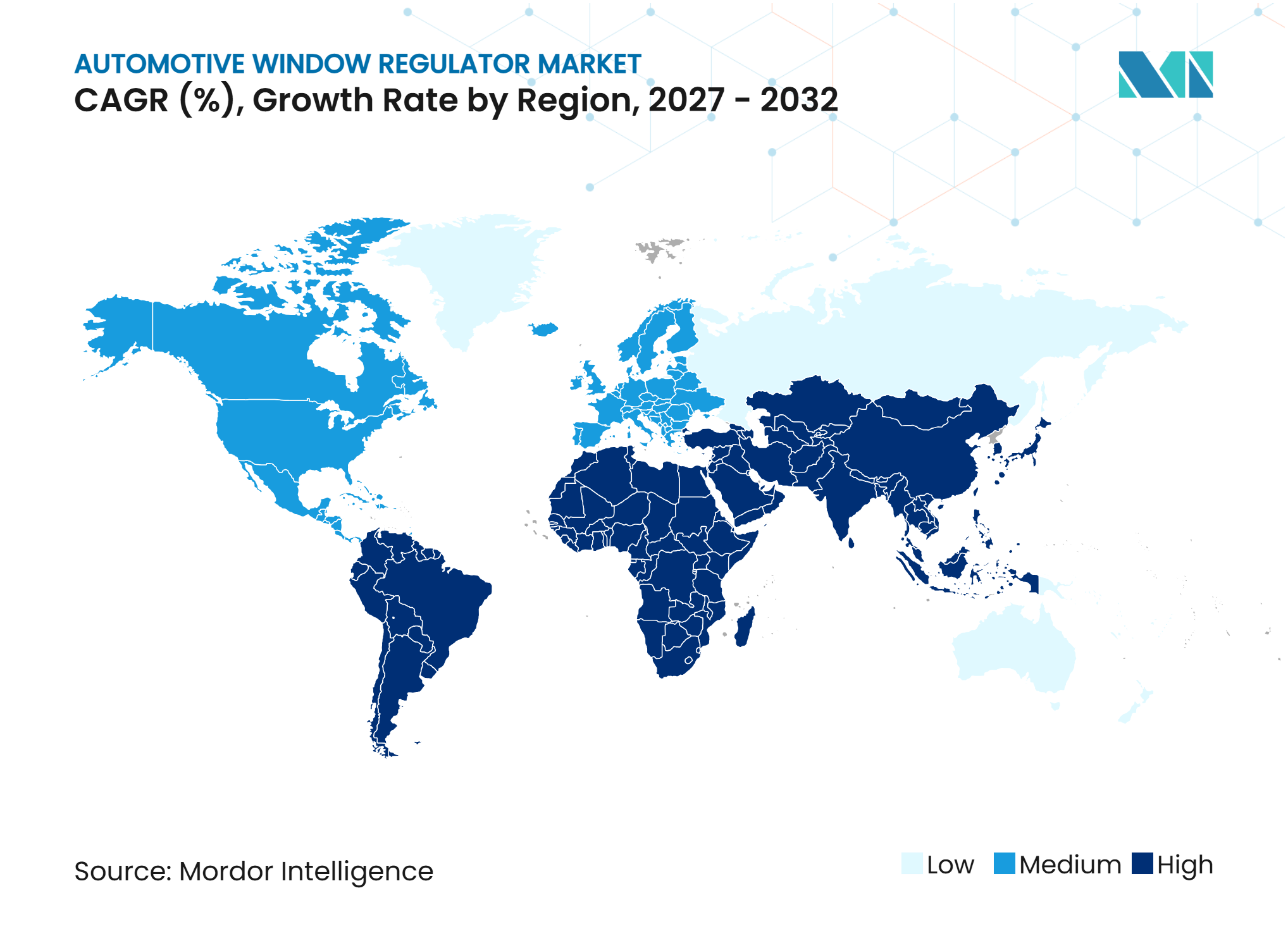
Geography Analysis
Asia-Pacific held 54.28% of the automotive window regulator market share in 2026. Regional vehicle production reached 59.2 million units in 2025, up 7.6% from the prior year. The automotive window regulator market size in Asia-Pacific also reflects substantial differences in vehicle demand. China’s new-energy vehicle output supports demand for compact and electronically controlled products. Japan and South Korea remain important for higher-value platforms with advanced door systems. India adds incremental volume as more passenger vehicles include power windows. A large supplier base supports production close to vehicle assembly sites.
North America is the second-largest regional market, supported by trucks, SUVs, larger door glass areas, and replacement demand from older vehicles. Vehicle production in the United States totaled 10.24 million units in 2025. Europe remains important for safety-related power-window functions and premium vehicle applications.
South America is forecast to grow at a 7.06% CAGR through 2032, the fastest regional rate. Anfavea projects Brazilian vehicle sales of about 3.1 million units for 2026, while production increased 8.7% in the first nine months of 2026. Electrified vehicles accounted for 20.1% of Brazilian light-vehicle registrations from January through September 2026. The Middle East and Africa remain earlier-stage demand areas shaped by imports, local production, and power-window preferences.
Competitive Landscape
Market Concentration

The automotive window regulator market is moderately concentrated at the OEM supply tier. Brose Fahrzeugteile SE & Co. KG, Magna International Inc., Grupo Antolin, HI-LEX Corporation, and Aisin Corporation hold multi-platform positions across major OEM programs, while Inteva Products competes strongly in cable-driven and frameless-door systems. Their established relationships matter because regulators must meet vehicle-specific fit, durability, safety, and production requirements. The competitive environment favors suppliers that can support programs in Asia, North America, and Europe. Larger suppliers can combine mechanical engineering with motor, electronics, and door-module capability.
Localization is central to supplier strategy. Inteva announced a manufacturing and sequencing facility in Auburn Hills, Michigan, in September 2026. These moves combine local manufacturing with product upgrades for changing vehicle electrical architectures, including 48-volt and LIN-enabled door electronics.
Frameless doors, quieter operation, and precise glass movement increase technical requirements. Opportunities remain in cost-conscious anti-pinch solutions and broad aftermarket catalogs for older fleets. Smaller regional suppliers can compete on price in developing-market distribution channels. OEM-quality documentation and validation remain important barriers for fleet and OEM supply.
Automotive Window Regulator Industry Leaders
-
Brose Fahrzeugteile SE & Co. KG
-
Magna International Inc.
-
Grupo Antolin
-
HI-LEX Corporation
-
Aisin Corporation
- *Disclaimer: Major Players sorted in no particular order
Automotive Window Regulator Market Companies Covered in this Report
- Brose Fahrzeugteile SE & Co. KG
- Magna International Inc.
- Inteva Products, LLC
- HI-LEX Corporation
- Aisin Corporation
- MITSUBA Corporation
- Grupo Antolin
- KWANGJIN Co., Ltd.
- Dorman Products, Inc.
- KÜSTER Holding GmbH
- Johnan Manufacturing Inc.
- Valeo SE
- LAMES S.p.A.
- Spark Minda
- TRAC Auto Transmission
- IFB Automotive Private Limited
- Harisons India
Recent Industry Developments in Automotive Window Regulator Market
- September 2026: Inteva Products announced a new manufacturing and sequencing facility in Auburn Hills, Michigan, to support North American OEM programs.
- June 2026: SELECT Automotive added 61 parts to its aftermarket portfolio, including 51 window regulator references for Audi, Range Rover, Mercedes-Benz, Honda, Volkswagen, SEAT, and Skoda applications.
- April 2026: ZF Aftermarket expanded its Lemförder window regulator range to more than 1,600 part numbers covering cars, commercial vehicles, and buses in Europe.
- November 2025: Inteva Products announced a second plant in Pune, India, and launched frameless window regulators and its SLIM window regulator motor for Indian customers.
Global Automotive Window Regulator Market Report Scope
The scope includes segmentation by mechanism (cable-driven, arm/scissor [sector gear], and rack-and-pinion), operation (power/electric window regulator and manual window regulator), component (motor, regulator assembly, and anti-pinch module/switch), door position (front and rear), vehicle type (passenger cars, light commercial vehicles, and medium and heavy commercial vehicles), and sales channel (OEM and aftermarket). The analysis also covers North America (United States, Canada, and Rest of North America), Europe (Germany, United Kingdom, France, Italy, Spain, Russia, Poland, and Rest of Europe), Asia-Pacific (China, Japan, South Korea, India, Indonesia, Thailand, Australia, and Rest of Asia-Pacific), South America (Brazil, Argentina, Colombia, Chile, and Rest of South America), and the Middle East and Africa (Saudi Arabia, United Arab Emirates, Turkey, South Africa, Egypt, Morocco, and Rest of Middle East and Africa). Market size and growth forecasts are presented in value (USD) and volume (units).
Segmentation Overview
| Cable-Driven |
| Arm/Scissor (Sector Gear) |
| Rack-and-Pinion |
| Power/Electric Window Regulator |
| Manual Window Regulator |
| Motor |
| Regulator Assembly |
| Anti-Pinch Module/Switch |
| Front |
| Rear |
| Passenger Cars |
| Light Commercial Vehicles |
| Medium and Heavy Commercial Vehicles |
| OEM |
| Aftermarket |
| North America | United States |
| Canada | |
| Rest of North America | |
| Europe | Germany |
| United Kingdom | |
| France | |
| Italy | |
| Spain | |
| Russia | |
| Poland | |
| Rest of Europe | |
| Asia-Pacific | China |
| Japan | |
| South Korea | |
| India | |
| Indonesia | |
| Thailand | |
| Australia | |
| Rest of Asia-Pacific | |
| South America | Brazil |
| Argentina | |
| Colombia | |
| Chile | |
| Rest of South America | |
| Middle East and Africa | Saudi Arabia |
| United Arab Emirates | |
| Turkey | |
| South Africa | |
| Egypt | |
| Morocco | |
| Rest of Middle East and Africa |
| By Mechanism | Cable-Driven | |
| Arm/Scissor (Sector Gear) | ||
| Rack-and-Pinion | ||
| By Operation | Power/Electric Window Regulator | |
| Manual Window Regulator | ||
| By Component | Motor | |
| Regulator Assembly | ||
| Anti-Pinch Module/Switch | ||
| By Door Position | Front | |
| Rear | ||
| By Vehicle Type | Passenger Cars | |
| Light Commercial Vehicles | ||
| Medium and Heavy Commercial Vehicles | ||
| By Sales Channel | OEM | |
| Aftermarket | ||
| By Geography | North America | United States |
| Canada | ||
| Rest of North America | ||
| Europe | Germany | |
| United Kingdom | ||
| France | ||
| Italy | ||
| Spain | ||
| Russia | ||
| Poland | ||
| Rest of Europe | ||
| Asia-Pacific | China | |
| Japan | ||
| South Korea | ||
| India | ||
| Indonesia | ||
| Thailand | ||
| Australia | ||
| Rest of Asia-Pacific | ||
| South America | Brazil | |
| Argentina | ||
| Colombia | ||
| Chile | ||
| Rest of South America | ||
| Middle East and Africa | Saudi Arabia | |
| United Arab Emirates | ||
| Turkey | ||
| South Africa | ||
| Egypt | ||
| Morocco | ||
| Rest of Middle East and Africa | ||
Key Questions Answered in the Report
What is the projected value of the automotive window regulator market by 2032?
The automotive window regulator market is projected to grow from USD 14.81 billion in 2027 to USD 18.21 billion by 2032, at a 4.22% CAGR during 2027-2032.
Which mechanism is forecast to grow fastest in automotive window regulators?
Cable-driven regulators are forecast to grow at a 5.21% CAGR through 2032, supported by their compact packaging and lower weight.
What is driving aftermarket demand for automotive window regulators?
Older vehicles need replacement motors and mechanical parts, and the aftermarket is forecast to grow at a 6.58% CAGR through 2032.
Which region is expected to grow fastest through 2032?
South America is forecast to grow at a 7.06% CAGR through 2032, supported by stronger Brazilian vehicle demand.