
Automotive Trailer Market Size and Share
Market Overview
| Study Period | 2020 - 2032 |
|---|---|
| Market Size (2027) | USD 36.14 Billion |
| Market Size (2032) | USD 44.86 Billion |
| Growth Rate (2027 - 2032) | 4.42 % |
| Fastest Growing Market | Asia-Pacific |
| Largest Market | North America |
| Market Concentration | Medium |
Major Players *Disclaimer: Major Players sorted in no particular order Image © Mordor Intelligence. Reuse requires attribution under CC BY 4.0. | |
Automotive Trailer Market Analysis by Mordor Intelligence
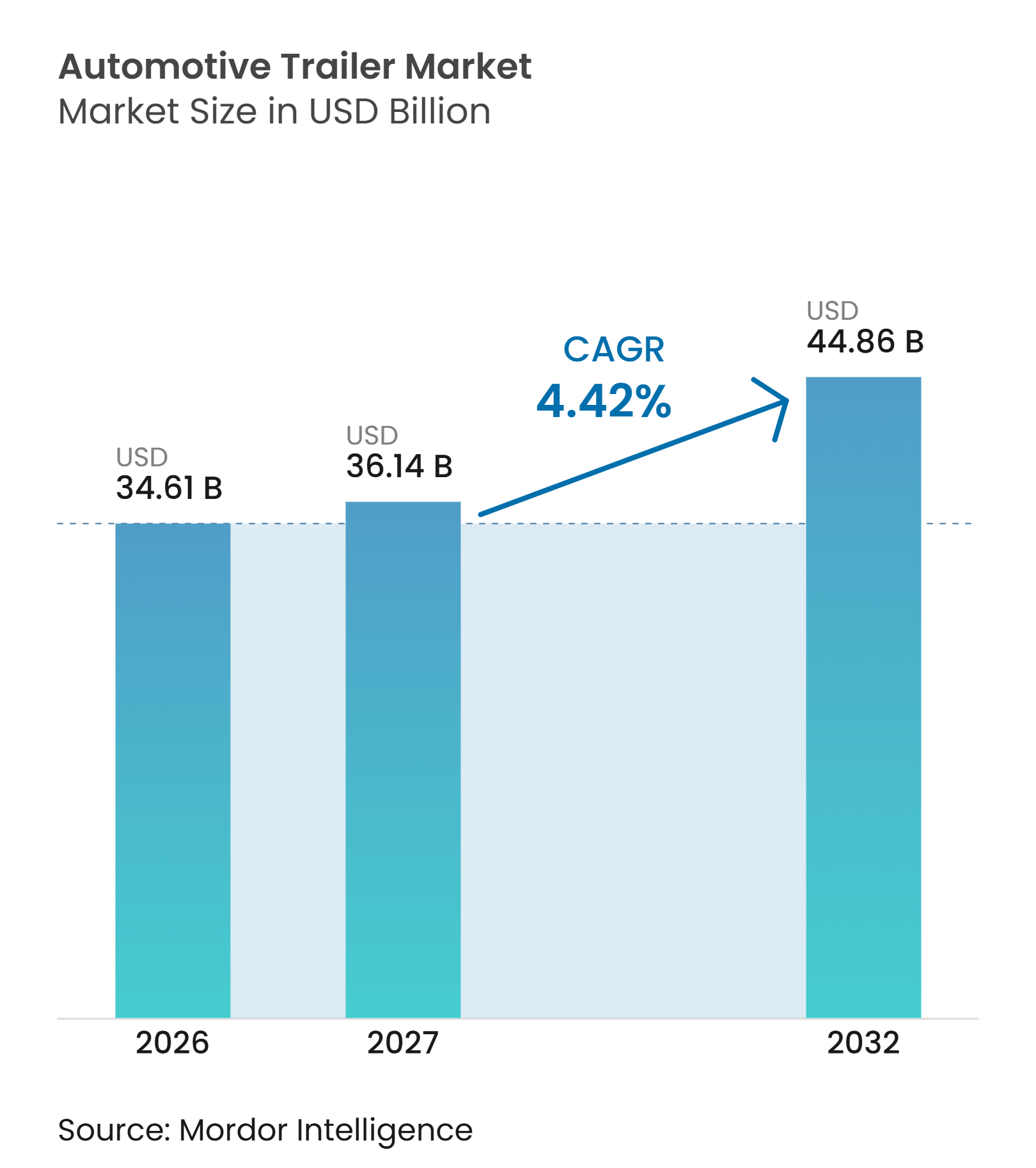
The automotive trailer market size was valued at USD 34.61 billion in 2026 and is expected to grow from USD 36.14 billion in 2027 to USD 44.86 billion by 2032, at a CAGR of 4.42% during 2027-2032. The automotive trailer market is supported by e-commerce distribution, cold-chain investment, replacement demand, and specialized freight requirements. Dense fulfillment networks require more drop trailers and higher trailer-to-tractor ratios than traditional truckload systems. Refrigerated equipment is gaining importance as food and pharmaceutical supply chains require more controlled transport. Competitive strategies are moving beyond unit sales toward service coverage, telematics, lightweight design, and geographic expansion. Cost pressure from materials and the uneven availability of charging and service support continue to shape purchasing decisions.
Key Report Takeaways
- By trailer type, dry vans held a 43.15% share in 2026, while refrigerated trailers are projected to grow at an 8.21% CAGR through 2032.
- By axle, tandem axles held a 57.33% share in 2026, while multi-axle trailers are projected to grow at a 5.32% CAGR through 2032.
- By weight class, heavy trailers held a 64.12% share in 2026, while medium-weight trailers are projected to grow at a 6.55% CAGR through 2032.
- By coupling, semi-trailers held a 74.25% share in 2026, while center-axle trailers are projected to grow at a 5.84% CAGR through 2032.
- By end use, logistics and freight held a 49.15% share in 2026, while automotive transport is projected to grow at a 7.52% CAGR through 2032.
- By geography, North America held a 36.05% share in 2026, while Asia-Pacific is projected to grow at a 6.35% CAGR through 2032.
Note: Market numbers in this report are based on Mordor Intelligence's proprietary estimation framework, which combines nine months of actuals with Q4 projections for base year 2026.
Market Trends and Insights
Drivers Impact Analysis of Automotive Trailer Market*
| Driver | (~) % Impact on CAGR Forecast | Geographic Relevance | Impact Timeline |
|---|---|---|---|
| E-Commerce and Omnichannel Distribution Expansion | +1.2% | Global, with peak intensity in North America, Western Europe, and Asia-Pacific e-commerce corridors | Short term (≤ 2 years) |
| Cold-Chain and Temperature-Controlled Freight Growth | +1.0% | Global, with leading gains in Asia-Pacific, South America, and Middle East and Africa | Medium term (2–4 years) |
| Infrastructure, Construction, and Agricultural Equipment Demand | +0.8% | Asia-Pacific, with spillover to South America and Middle East and Africa | Long term (≥ 4 years) |
| Trailer Fleet Replacement and Payload-Efficiency Requirements | +0.7% | North America and Western Europe | Medium term (2–4 years) |
| Trailer-Centric Telematics and Asset-Utilization Optimization | +0.5% | Global, with early leadership in North America and Western Europe | Medium term (2–4 years) |
| Electrification of Refrigeration Units and Trailer Axles | +0.3% | North America and Western Europe | Long term (≥ 4 years) |
| Source: Mordor Intelligence | |||
E-Commerce and Omnichannel Distribution Expansion
The automotive trailer market benefits from parcel networks that operate with different asset needs than traditional truckload networks. Same-day fulfillment requires dense shuttle activity and more trailers available at fulfillment nodes. These operations often need higher trailer-to-tractor ratios because a trailer can be loaded, staged, and moved without waiting for the same tractor to remain on site. Amazon expanded its branded drop-trailer offering to third-party shippers through its supply chain services, showing that large e-commerce operators regard trailer availability as an operating capability rather than a simple procurement item. This model increases the value of reliable trailer pools, predictable maintenance, and equipment visibility. It also means trailer demand can remain resilient when freight tonnage does not rise at the same pace.
Cold-Chain and Temperature-Controlled Freight Growth
The automotive trailer market gains from cold-chain investment in regions where organized temperature-controlled logistics remains limited. India had 8,815 cold-storage facilities with about 40.21 million tons of capacity in 2025, yet much of its perishable output still moves outside organized cold-chain networks [1]. The Indian government approved a total PMKSY outlay of INR 6,520 crore (approximately USD 745 million) in July 2025, including support for integrated cold-chain infrastructure. This gap places first-mile reefer connectivity between packhouses and distribution points at the center of equipment demand. DP World opened a 110,000 sq. ft. cold-chain facility in Taloja, Navi Mumbai, in May 2025, illustrating the investment in facilities that need dependable refrigerated transport links. Pharmaceutical distribution adds demand for trailer specifications that can manage tighter temperature tolerances and support higher service standards.
Infrastructure, Construction, and Agricultural Equipment Demand
Infrastructure construction supports demand for flatbeds, lowboys, tankers, and other equipment suited to project cargo. The automotive trailer market therefore has exposure to long-cycle investment programs as well as routine consumer freight. Asia-Pacific governments continue to prioritize road and highway investment, with roadways accounting for a major share of transportation infrastructure spending. India's National Infrastructure Pipeline includes more than 9,000 projects, creating sustained need for equipment that can move construction inputs and heavy machinery. Data-center construction and renewable-energy projects also require specialized carriers for transformers, turbine blades, and other oversized loads. Such applications favor extendable trailers and lowboys because operators value load flexibility and reliable equipment support.
Trailer Fleet Replacement and Payload-Efficiency Requirements
Replacement demand remains an important support for the automotive trailer market, particularly where fleets deferred purchases during the freight downturn. Operators replace older units when maintenance exposure, refrigeration performance, or fuel use becomes difficult to manage. Refrigerated fleets face particular pressure because aging units may not meet expected cooling performance or new operational standards. Late-model trailers can include tire-pressure monitoring, aerodynamic features, and composite floors that can reduce tractor fuel use over a unit's operating life. These benefits make fleet renewal a broader operating decision rather than a purchase driven only by trailer age. Leasing also becomes more attractive when fleets want updated equipment while limiting upfront asset risk.
Restraints Impact Analysis of Automotive Trailer Market*
| Restraint | (~) % Impact on CAGR Forecast | Geographic Relevance | Impact Timeline |
|---|---|---|---|
| Cyclical Freight Volumes and Carrier Capital-Expenditure Volatility | -0.6% | North America and Europe | Short term (≤ 2 years) |
| High Steel, Aluminum, Refrigeration, and Component Costs | -0.5% | North America, Europe, and global OEM supply chains | Medium term (2–4 years) |
| Fragmented Cross-Border Regulations and Specification Requirements | -0.3% | Europe-Eurasia corridors, Asia-Pacific routes, and South America | Long term (≥ 4 years) |
| Limited Charging, Service, and Residual-Value Infrastructure for Smart and Electrified Trailers | -0.2% | North America, Eastern Europe, and emerging economies | Medium term (2–4 years) |
| Source: Mordor Intelligence | |||
Cyclical Freight Volumes and Carrier Capital-Expenditure Volatility
Trailer demand follows freight conditions with a lag because carriers can delay purchases when margins are weak. The 2022 to 2025 North American downcycle reduced production activity and left many operators focused on preserving capital. A recovery based on replacement demand is less secure than one based on broad fleet expansion because buyers remain selective about specifications and timing. Uncertainty around trade measures can also delay orders while purchasers assess their delivered cost. In Europe, weak transportation-sector sentiment can limit investment even when deliveries improve. The automotive trailer market is therefore exposed to carrier profitability and the timing of freight recovery.
High Steel, Aluminum, Refrigeration, and Component Costs
Higher material and component costs make it harder for manufacturers to protect margins and for fleets to justify equipment purchases. Aluminum costs have been especially significant for trailers that use lightweight construction to improve payload efficiency. When aluminum becomes expensive, manufacturers may substitute steel in structural applications where the payload trade-off is acceptable. This decision can change maintenance expectations, residual values, and the fuel-efficiency assumptions used by fleet buyers. Refrigeration equipment, electronic systems, and other specialized components can add further cost pressure for reefer configurations. The automotive trailer market must therefore balance operating efficiency against initial acquisition cost.
*Our forecasts treat driver/restraint impacts as directional, not additive. The impact forecasts reflect baseline growth, mix effects, and variable interactions.
Automotive Trailer Market Segment Analysis
By Trailer Type:
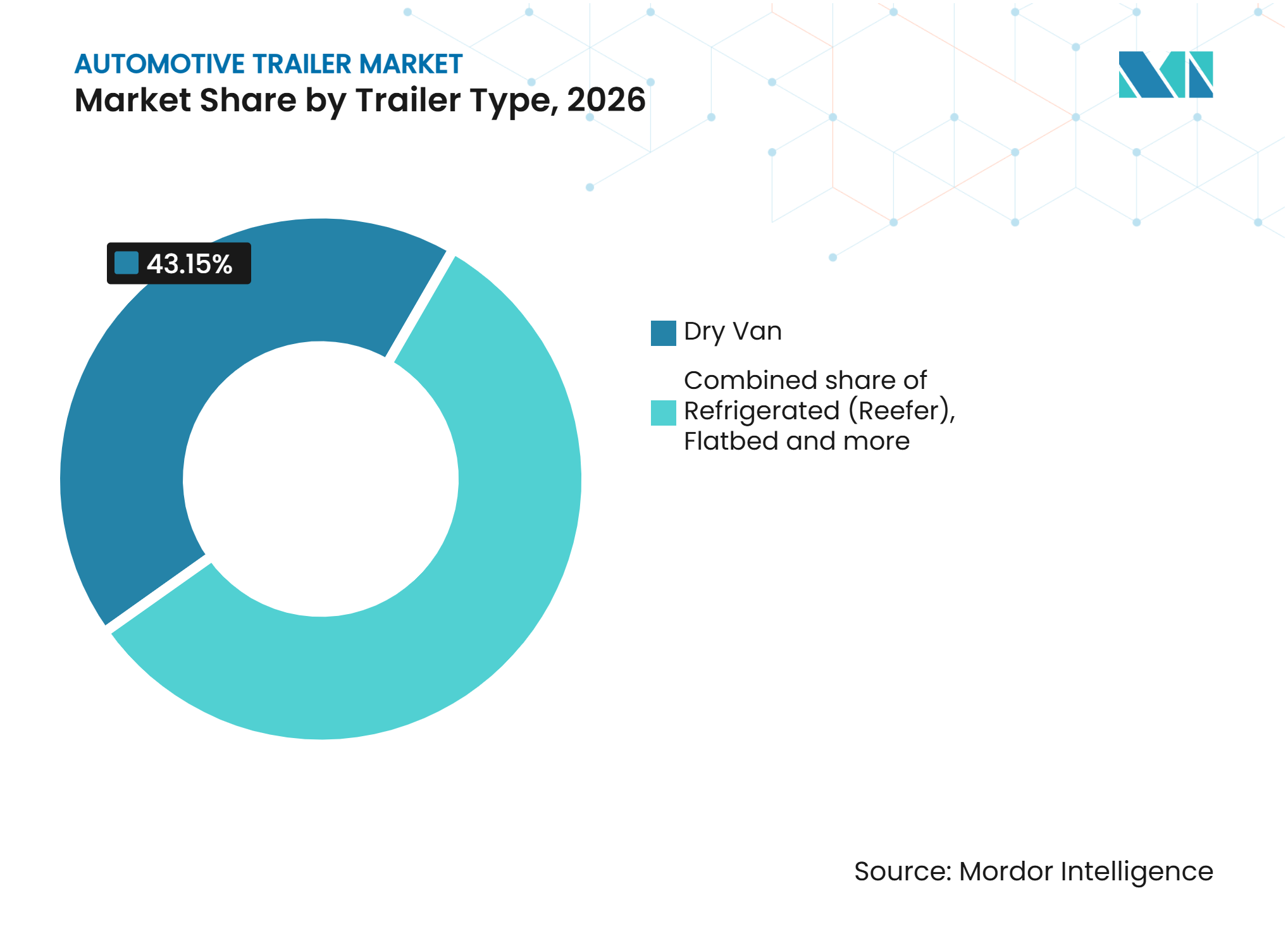
Refrigerated Equipment Expands Through Cold-Chain NeedsDry van trailers held a 43.15% share of the automotive trailer market in 2026, making them the largest trailer type. Their position reflects the scale of general freight, parcel distribution, and conventional truckload operations. Dry vans remain central to North American and European logistics because they can carry a broad range of palletized goods. Their standardized design also supports established repair networks, used-equipment channels, and fleet procurement programs. In the automotive trailer market, the segment benefits when freight providers need equipment that can move between e-commerce, retail, and industrial freight lanes.
Refrigerated trailers are projected to grow at an 8.21% CAGR through 2032, the highest rate among trailer types. This growth follows food distribution, online grocery fulfillment, and pharmaceutical logistics that need stable temperature conditions. The automotive trailer market size for refrigerated trailers is strengthened by the requirement to link new cold-storage facilities with farms, packhouses, distribution centers, and retailers. California's in-use transport refrigeration unit standards continue to require the replacement or upgrade of older units in regulated operations, although CARB withdrew its request for federal authorization of the zero-emission truck TRU requirement in January 2025[2]. The refrigerated fleet's age profile creates a separate replacement need from the wider freight cycle. Operators also evaluate service coverage carefully because refrigerated equipment downtime can lead to product losses. These factors favor manufacturers and leasing providers that can offer maintenance access, temperature monitoring, and reliable parts support.



By Axle:
Tandem Axles Retain a Broad Operating BaseTandem axle configurations held a 57.33% share in 2026. Their leadership reflects their established use in North American long-haul freight and European general cargo operations. Weight-distance taxation rules, bridge-law formulas, and driver training have long been designed around tandem layouts. Fleet maintenance teams also understand their components and operating characteristics well. This established base reduces the incentive to change configurations where existing equipment meets payload and route requirements. Tandem axles offer a practical balance between load distribution, operating cost, and maneuverability. They remain common in dry vans, refrigerated units, flatbeds, and several other trailer formats. The large installed base also supports a wide aftermarket for parts and maintenance.
Multi-axle trailers are expected to grow at a 5.32% CAGR through 2032, the highest rate in the axle segment. Their growth is tied to project logistics, wind-energy components, and oversized freight that require higher load capacity. Infrastructure corridors in Asia-Pacific create routes where hydraulic steering and additional axles can be more valuable than simple operating-cost optimization. The automotive trailer market uses these configurations where loads cannot be moved efficiently with standard general-freight equipment. Multi-axle systems can help operators meet load-distribution requirements while carrying heavy or irregular cargo. India's axle-load enforcement efforts on national highways also support demand for compliant heavy-haulage equipment. The segment remains specialized, but its role grows when project freight expands.
By Weight Class:
Heavy Trailers Lead, While Medium Units Support City LogisticsHeavy trailers above 10 t held a 64.12% share in 2026. Long-haul freight favors these units because greater payloads can spread fixed equipment and driver costs across more cargo. Mature road freight systems in North America continue to depend on heavy trailers for major distribution lanes. A standard 53-foot dry van can carry substantial legal payload in many U.S. states, reinforcing the economic case for heavy units. Heavy trailers also serve construction, industrial, petrochemical, and agricultural bulk applications. Their prevalence makes them a core volume source for the automotive trailer market. Manufacturers can build several trailer types in this class, from dry vans and reefers to flatbeds and tankers.
Medium-weight trailers from 3.5 t to 10 t are forecast to expand at a 6.55% CAGR through 2032. Urban access rules in European cities and selected Asia-Pacific metropolitan areas can restrict heavier vehicles during busy periods. These rules make lighter multi-drop platforms more relevant for distributors serving dense city routes. Medium units can support food, consumer goods, and last-mile logistics where maneuverability matters. Advances in composite materials and high-strength aluminum can improve payload efficiency while staying within weight limits. Medium trailers also serve regional distribution routes that link urban centers with nearby warehouses. This mix of regulation and operating need supports growth that is less dependent on the long-haul freight cycle.
By Coupling:
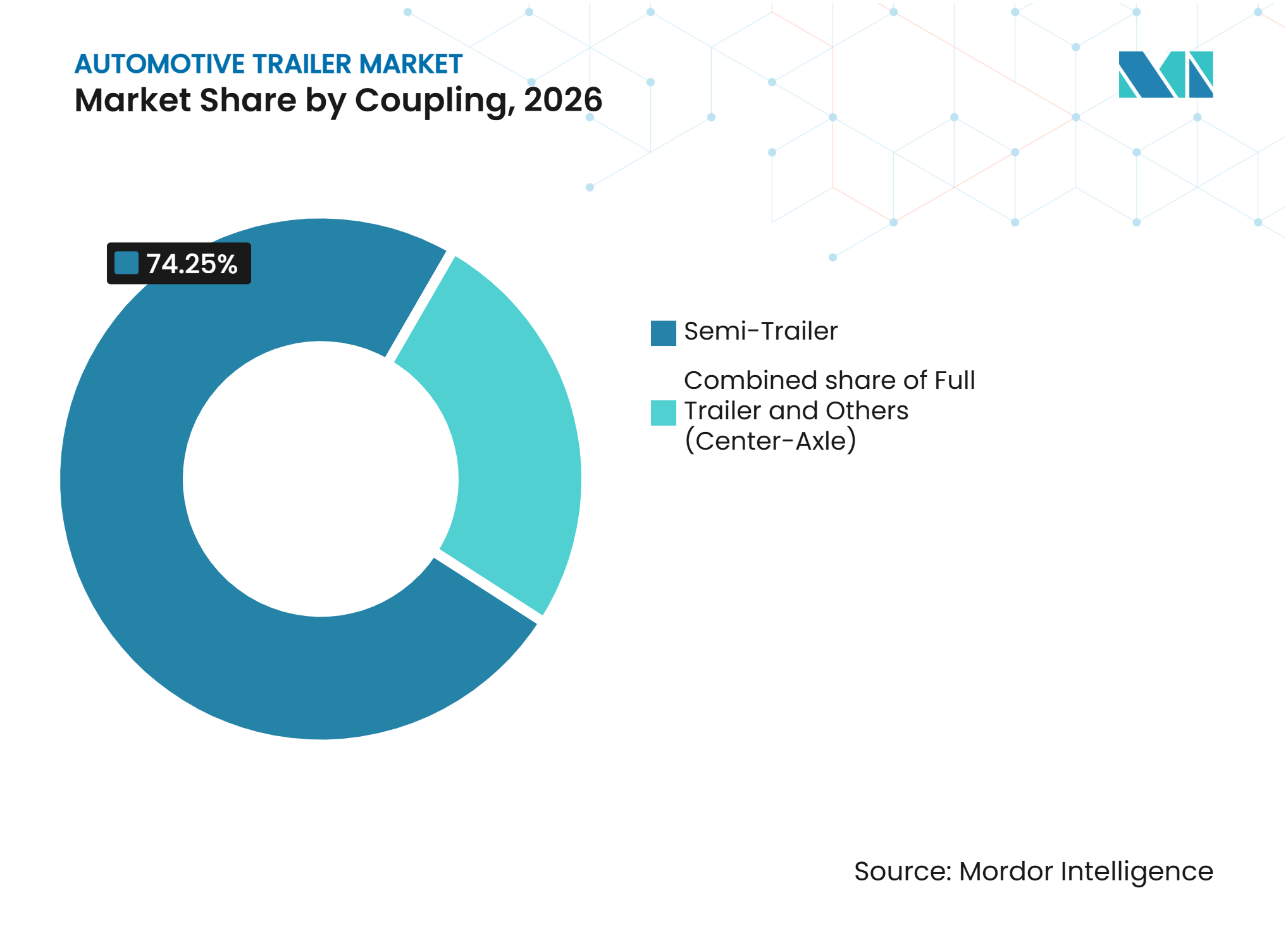
Semi-Trailers Remain the Default Commercial FormatSemi-trailers held a 74.25% share in 2026. Standardized fifth-wheel systems make them the default configuration for commercial freight around the world. Tractor manufacturers, fleet managers, driver training programs, and repair networks are aligned around this coupling format. This creates practical switching costs for operators considering alternatives. Semi-trailers can be used across dry van, refrigerated, flatbed, tanker, and specialized categories. Their adaptability supports their use in both large fleets and independent carrier operations. The automotive trailer market continues to depend on semi-trailers because they fit existing tractor fleets and operating practices. A mature components and service ecosystem further strengthens the format's position.
Center-axle trailers are projected to grow at a 5.84% CAGR through 2032, the highest rate in the coupling segment. They serve agricultural, light industrial, and mixed-cargo applications where turning radius and deck height can be important. Their geometry can suit European haulage applications that require flexibility on constrained roads. Full trailers continue to serve B-train and double-combination operations in North America and Australia on approved corridors. These alternatives remain smaller categories because their use is limited by route rules and customer operating models. Demand for adaptable platforms may increase as city logistics and mixed-load operations become more common.

By End Use:
Logistics and Freight Provides Scale, Automotive Transport Grows FastestLogistics and freight held a 49.15% share in 2026. This end use includes dry vans used in parcel networks, reefers used in food distribution, tankers used in petrochemicals, and other equipment used across distribution systems. Its broad cargo base gives the segment resilience because demand does not depend on a single freight vertical. Logistics customers focus on trailer utilization, access to maintenance, and equipment availability. Pooling models can improve utilization by allowing a trailer to serve several shippers or carriers rather than one dedicated fleet. The automotive trailer market remains closely connected to this end use because nearly every trailer category has a role in freight movement. The scale of the segment also makes it important for replacement demand during a market recovery.
Automotive transport is expected to grow at a 7.52% CAGR through 2032, the fastest rate among end uses. Automakers are diversifying final assembly locations to reduce their exposure to tariff and geopolitical risks. This increases the number of inter-plant movements and final-distribution shipments that require dedicated car carriers. Car-carrier designs must protect finished vehicles while meeting route, loading, and safety requirements. Construction activity supports flatbed and lowboy demand, while agriculture benefits from cold-chain and rural logistics investment. Recreation and travel trailers remain more exposed to consumer confidence and fuel costs than commercial freight equipment. The automotive trailer market therefore combines cyclical consumer-facing categories with more durable industrial and logistics demand.
Geography Analysis
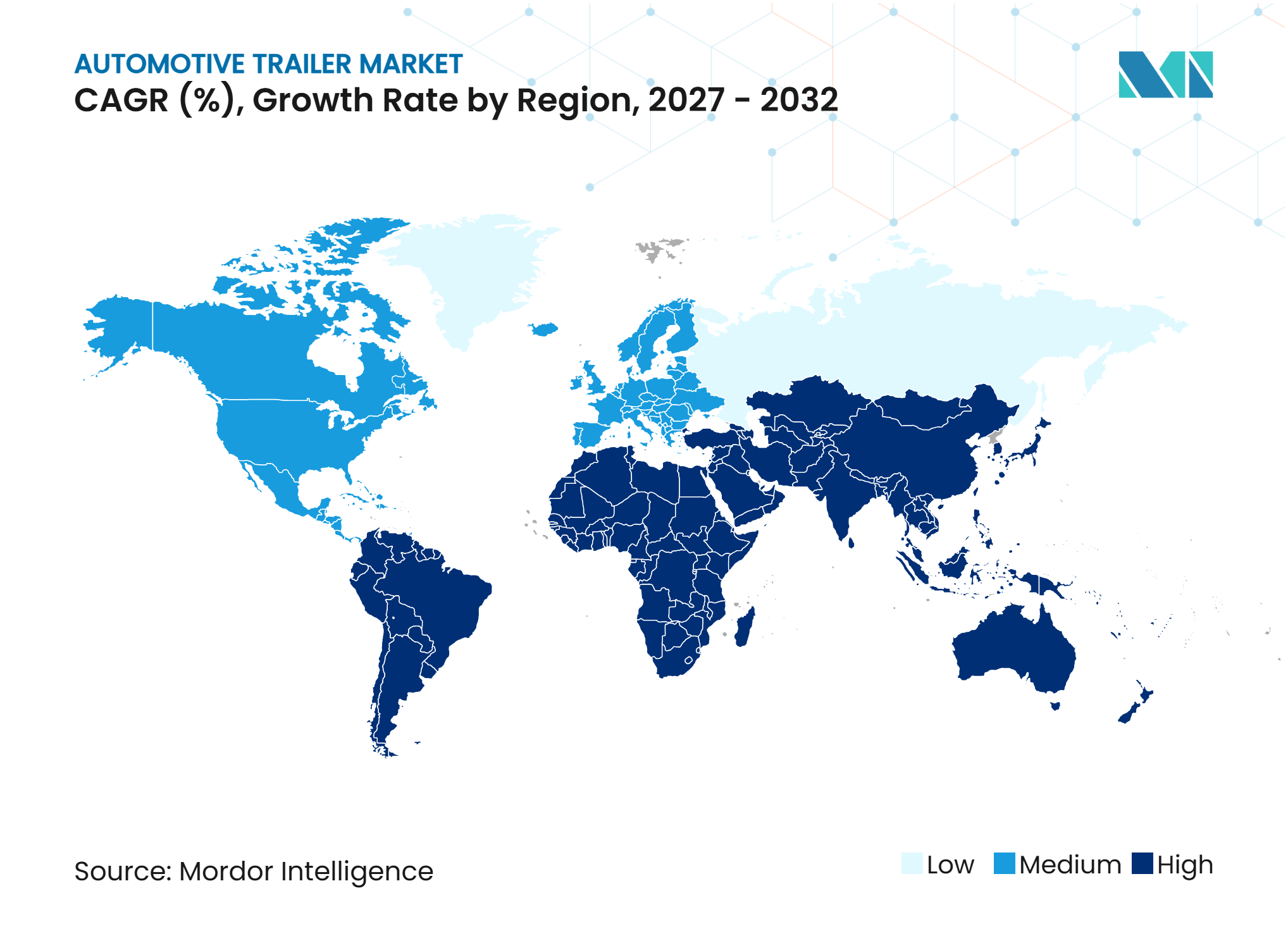
North America held a 36.05% share of the automotive trailer market in 2026. The region has a mature carrier ecosystem, high freight intensity, and established use of the 53-foot dry-van standard. Replacement demand is more important than fleet expansion as carriers renew aging equipment. Trade policy also affects competition because the United States International Trade Commission instituted antidumping and countervailing duty investigations into van-type trailers and subassemblies from Canada, China, and Mexico in November 2025[3]. The investigation can change the delivered cost of imported equipment and influence sourcing choices. North American buyers also face a need for service coverage as refrigeration and electrification systems become more complex.
Asia-Pacific is projected to grow at a 6.35% CAGR through 2032, the fastest regional rate. The automotive trailer market size in the region is supported by manufacturing corridors in China, logistics formalization in India, and supply-chain growth in Southeast Asia. This supports demand for flatbeds, lowboys, tankers, and other project-freight equipment. India's cold-chain gap creates additional potential for short-haul refrigerated equipment, especially between packhouses and distribution points. CIMC Vehicles is also pursuing wider geographic coverage under its Stellar Plan, showing that Asia-Pacific manufacturers are preparing to compete outside their home region.
South America remains more limited in volume but has demand from Brazilian agricultural transport, food exports, urban e-commerce, mining, and energy-sector hauling. Argentina, Chile, and Colombia add demand from mining, agricultural export lanes, and industrial activity. Middle East and Africa benefits from Saudi Arabian megaproject logistics and the longer-term need for transport equipment across Sub-Saharan Africa. CIMC Vehicles agreed in September 2025 to supply 2,000 semi-trailers in Tanzania for delivery in 2026 and announced plans for a Dar es Salaam delivery and service center, indicating a move to establish local operating capacity ahead of expected demand growth. Financing access and road quality remain limits in several markets. Large infrastructure programs and commodity transport needs nonetheless make these regions relevant to long-term geographic strategies.
Competitive Landscape
Market Concentration

The automotive trailer market is moderately concentrated globally, although competitive conditions vary widely by region. Schmitz Cargobull held 25% of newly registered European trailers in FY2025/26. Krone Group, Kögel, and Wielton are important European competitors, while North America has several suppliers focused on different trailer types and customer segments. Wabash National, Great Dane, Utility Trailer Manufacturing, Stoughton, Vanguard National, and Fontaine compete in a more fragmented regional setting. European competition increasingly includes digital service capability and after-sales support alongside unit pricing. Schmitz Cargobull uses the Cargobull Operating System to connect service and digital functions with its equipment offering. This raises the value of an installed base and ongoing customer relationships.
Manufacturers are expanding through product development and geographic investment. CIMC Vehicles' Stellar Plan, which succeeded its Star-Chained program in 2026, builds on the EV-RT electric tractor-trailer platform it launched in November 2025, showing its focus on electric-road-train technology and broader market coverage. Schmitz Cargobull raised its stake in Australia's Freighter Group to 72% in June 2026, extending its refrigerated and general cargo production reach into the Southern Hemisphere. The company also invested in Sub Zero Insulation Technologies in India, strengthening its position in insulation and temperature-controlled transport solutions. These moves reflect an effort to serve regional demand while maintaining product specialization. Expansion into service, insulation, and technology can reduce reliance on unit sales alone. It can also improve customer retention when fleet operators need maintenance and parts support across several countries.
Digital services and electrification remain areas of competitive opportunity. Connected trailers can provide location, condition, and diagnostic information that supports fleet utilization and preventive maintenance. This capability can be especially valuable for refrigerated fleets, where a maintenance failure may affect the cargo itself. Specialist suppliers that focus on e-axles can also target the reefer replacement cycle without manufacturing a complete trailer. This approach may test the ability of manufacturers to keep hardware, digital services, and electrification integrated in one offering. The automotive trailer market therefore rewards companies that can support equipment through its operating life as well as at the point of purchase.
Automotive Trailer Industry Leaders
-
CIMC Vehicles (Group) Co., Ltd.
-
Wabash National Corporation
-
Schmitz Cargobull AG
-
Fahrzeugwerk Bernard KRONE GmbH & Co. KG
-
Utility Trailer Manufacturing Company, LLC
- *Disclaimer: Major Players sorted in no particular order
Automotive Trailer Market Companies Covered in this Report
- Wabash National Corporation
- Great Dane LLC
- Utility Trailer Manufacturing Company, LLC
- Schmitz Cargobull AG
- Fahrzeugwerk Bernard KRONE GmbH & Co. KG
- Hyundai Translead
- CIMC Vehicles (Group) Co., Ltd.
- Stoughton Trailers, LLC
- Kögel Trailer GmbH & Co. KG
- Wielton S.A.
- Fontaine Trailer Company
- Felling Trailers, Inc.
- Big Tex Trailers
- THOR Industries, Inc.
- Humbaur GmbH
- Böckmann Fahrzeugwerke GmbH
- Fruehauf SAS
- Tırsan Treyler San. Tic. A.Ş.
- Lamberet SAS
- Vanguard National Trailer Corporation
Recent Industry Developments in Automotive Trailer Market
- September 2026: Transportation Equipment Network (TEN) said it would add 3,000 new model-year 2027 dry van trailers in October, bringing its North American lease and rental fleet to about 85,000 units ahead of peak season.
- September 2026: Landstar ordered 2,000 new dry van trailers with pulsating brake lights, anti-theft components, and flip-style hazmat placards, with deliveries through the rest of 2026.
- August 2026: Great Dane launched the Freedom Ultra, a welded-aluminum flatbed trailer added to its Freedom flatbed line.
- June 2026: Schmitz Cargobull raised its stake in Australian trailer manufacturer Freighter Group from 26% to 72%, taking majority control.
Global Automotive Trailer Market Report Scope
The scope includes segmentation by trailer type (Dry Van, Refrigerated (Reefer), Flatbed, Lowboy, Tanker, Car Carrier, Utility/Light Trailers, Travel/RV Trailers, and Others), axle (Single Axle, Tandem Axle, and Multi-Axle), weight class (Light (Below 3.5 t), Medium (3.5-10 t), and Heavy (Above 10 t)), coupling (Semi-Trailer, Full Trailer, and Others (Center-Axle)), and end use (Logistics and Freight, Construction, Agriculture, Recreation, Automotive Transport, and Others). The analysis also covers regional-level segmentation, including North America, Europe, Asia-Pacific, South America, and the Middle East and Africa. Market size and growth forecasts are presented by value in USD and volume in Units.
Segmentation Overview
| Dry Van |
| Refrigerated (Reefer) |
| Flatbed |
| Lowboy |
| Tanker |
| Car Carrier |
| Utility/Light Trailers |
| Travel/RV Trailers |
| Others |
| Single Axle |
| Tandem Axle |
| Multi-Axle |
| Light (Below 3.5 t) |
| Medium (3.5-10 t) |
| Heavy (Above 10 t) |
| Semi-Trailer |
| Full Trailer |
| Others (Center-Axle) |
| Logistics and Freight |
| Construction |
| Agriculture |
| Recreation |
| Automotive Transport |
| Others |
| North America | United States |
| Canada | |
| Rest of North America | |
| Europe | Germany |
| France | |
| Italy | |
| Spain | |
| United Kingdom | |
| Poland | |
| Netherlands | |
| Russia | |
| Rest of Europe | |
| Asia-Pacific | China |
| India | |
| Japan | |
| South Korea | |
| Australia | |
| Indonesia | |
| Thailand | |
| Rest of Asia-Pacific | |
| South America | Brazil |
| Argentina | |
| Chile | |
| Colombia | |
| Rest of South America | |
| Middle East and Africa | Saudi Arabia |
| United Arab Emirates | |
| Turkey | |
| Israel | |
| South Africa | |
| Egypt | |
| Nigeria | |
| Rest of Middle East and Africa |
| By Trailer Type | Dry Van | |
| Refrigerated (Reefer) | ||
| Flatbed | ||
| Lowboy | ||
| Tanker | ||
| Car Carrier | ||
| Utility/Light Trailers | ||
| Travel/RV Trailers | ||
| Others | ||
| By Axle | Single Axle | |
| Tandem Axle | ||
| Multi-Axle | ||
| By Weight Class | Light (Below 3.5 t) | |
| Medium (3.5-10 t) | ||
| Heavy (Above 10 t) | ||
| By Coupling | Semi-Trailer | |
| Full Trailer | ||
| Others (Center-Axle) | ||
| By End Use | Logistics and Freight | |
| Construction | ||
| Agriculture | ||
| Recreation | ||
| Automotive Transport | ||
| Others | ||
| By Geography | North America | United States |
| Canada | ||
| Rest of North America | ||
| Europe | Germany | |
| France | ||
| Italy | ||
| Spain | ||
| United Kingdom | ||
| Poland | ||
| Netherlands | ||
| Russia | ||
| Rest of Europe | ||
| Asia-Pacific | China | |
| India | ||
| Japan | ||
| South Korea | ||
| Australia | ||
| Indonesia | ||
| Thailand | ||
| Rest of Asia-Pacific | ||
| South America | Brazil | |
| Argentina | ||
| Chile | ||
| Colombia | ||
| Rest of South America | ||
| Middle East and Africa | Saudi Arabia | |
| United Arab Emirates | ||
| Turkey | ||
| Israel | ||
| South Africa | ||
| Egypt | ||
| Nigeria | ||
| Rest of Middle East and Africa | ||
Key Questions Answered in the Report
What is the projected value of the automotive trailer market by 2032?
The automotive trailer market is projected to reach USD 44.86 billion by 2032, expanding at a 4.42% CAGR from 2027 to 2032.
Which trailer type is growing fastest?
Refrigerated trailers are projected to grow at an 8.21% CAGR through 2032, supported by food, pharmaceutical, and cold-chain transport needs.
Which region is expected to grow fastest through 2032?
Asia-Pacific is forecast to record a 6.35% CAGR through 2032, supported by infrastructure investment, logistics formalization, and cold-chain development.
What is the largest end-use segment for trailers?
Logistics and freight held a 49.15% share in 2026, reflecting the broad use of trailers in parcel, retail, industrial, and distribution transport.