
Automotive Spring Market Size and Share
Market Overview
| Study Period | 2020 - 2032 |
|---|---|
| Market Size (2027) | USD 4.56 Billion |
| Market Size (2032) | USD 6.23 Billion |
| Growth Rate (2027 - 2032) | 6.45 % |
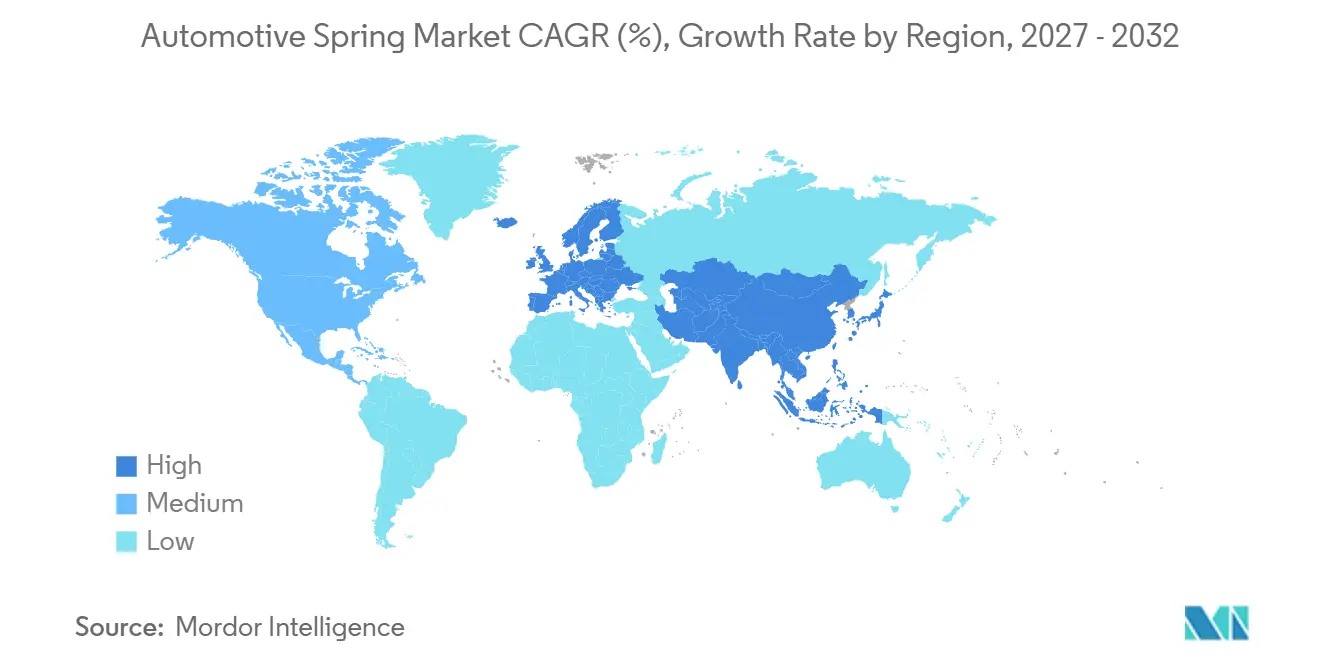
| Fastest Growing Market | Europe |
| Largest Market | Asia-Pacific |
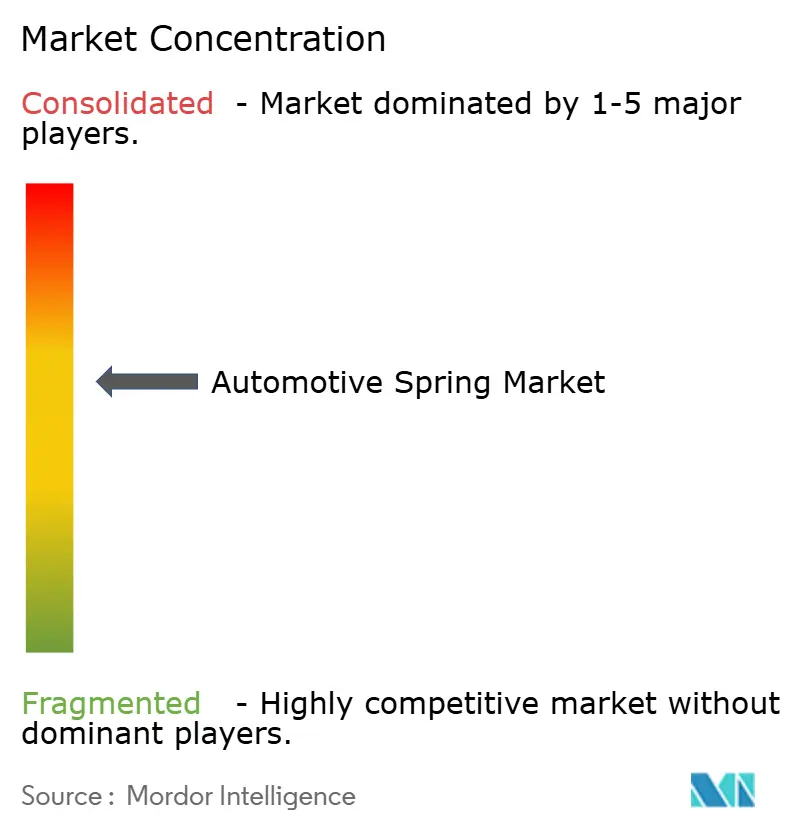
| Market Concentration | Medium |
Major Players *Disclaimer: Major Players sorted in no particular order Image © Mordor Intelligence. Reuse requires attribution under CC BY 4.0. | |
Automotive Spring Market Analysis by Mordor Intelligence
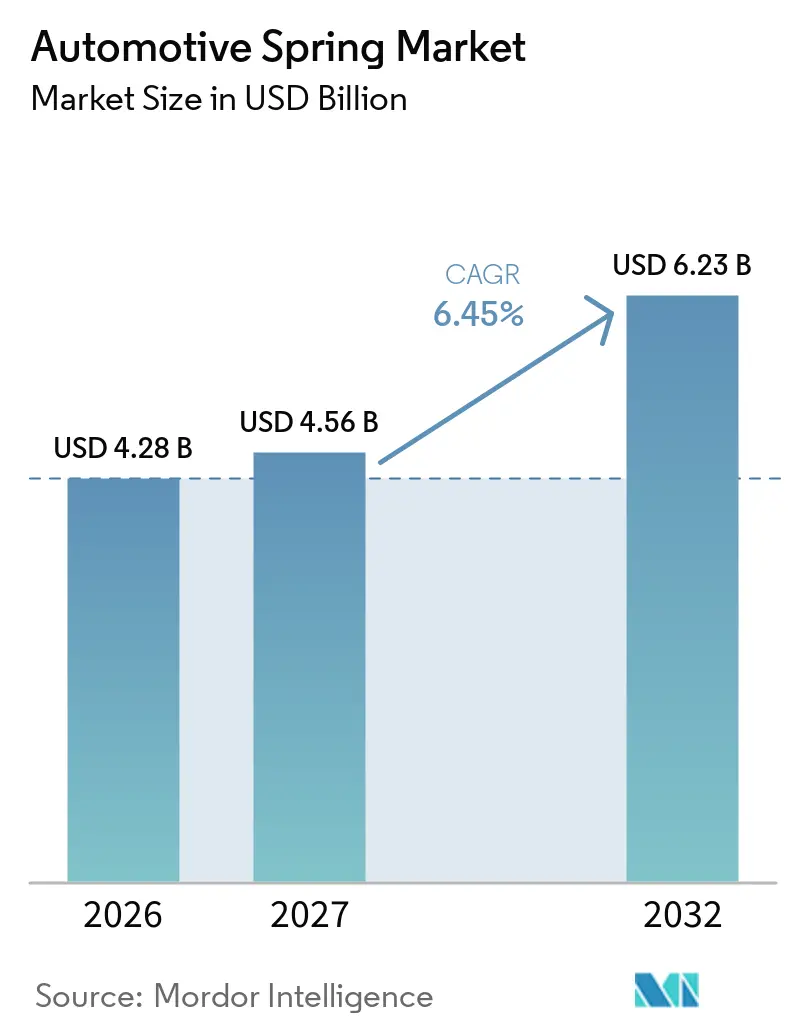
The automotive spring market size was valued at USD 4.28 billion in 2026, is estimated at USD 4.56 billion in 2027, and is projected to reach USD 6.23 billion by 2032, registering a CAGR of 6.45% between 2027 and 2032. Demand is shaped by vehicle production, replacement needs, and the redesign of suspension systems for heavier electrified vehicles. Battery packs alter vehicle mass and weight distribution, which raises the need for springs that meet tighter load and durability requirements. Commercial fleets also need components that can tolerate repeated loading and long operating cycles. Suppliers are responding by advancing material development, investing in regional manufacturing, and working more closely with vehicle manufacturers. The automotive spring market also has opportunities in replacement parts, where aging fleets and workshop access support recurring demand.
Key Report Takeaways
- By spring type, coil springs held a 45.96% share in 2026, while gas springs are forecast to grow at an 8.29% CAGR through 2032.
- By material, steel springs held a 65.26% share in 2026, while composite springs are forecast to grow at an 8.08% CAGR through 2032.
- By vehicle type, passenger cars held a 44.94% share in 2026 and are forecast to grow at a 7.26% CAGR through 2032.
- By powertrain, internal combustion engine vehicles held a 69.45% share in 2026, while electric and hybrid platforms are forecast to grow at a 10.34% CAGR through 2032.
- By application, suspension systems held a 77.21% share in 2026 and are forecast to grow at a 7.62% CAGR through 2032.
- By sales channel, original equipment manufacturers held a 74.05% share in 2026, while the aftermarket is forecast to grow at a 6.55% CAGR through 2032.
- By geography, Asia-Pacific held 53.11% share in 2026, while Europe is forecast to grow at an 8.39% CAGR through 2032.
Note: Market numbers in this report are based on Mordor Intelligence's proprietary estimation framework, which combines nine months of actuals with Q4 projections for base year 2026.
Market Trends and Insights
Drivers Impact Analysis of Automotive Spring Market*
| Driver | (~) % Impact on CAGR Forecast | Geographic Relevance | Impact Timeline |
|---|---|---|---|
| Growth in Commercial Vehicle Production and Freight Activity | +1.8% | Global, led by Asia-Pacific and North America | Medium term (2-4 years) |
| Aftermarket Replacement from Fleet Aging and Road-Induced Fatigue | +1.4% | North America, Europe, Asia-Pacific | Short term (≤ 2 years) |
| EV Battery Mass and Higher Suspension Load Requirements | +1.1% | APAC core, spill-over to Europe and North America | Medium term (2-4 years) |
| Lightweight Composite Spring Adoption | +0.8% | Europe, North America, Asia-Pacific | Long term (≥ 4 years) |
| Parabolic and Mono-Leaf Retrofits for Electric Delivery Fleets | +0.5% | Europe, North America | Medium term (2-4 years) |
| Embedded Load Sensing and Predictive Maintenance | +0.3% | Europe, Asia-Pacific | Long term (≥ 4 years) |
| Source: Mordor Intelligence | |||
Growth in Commercial Vehicle Production and Freight Activity
Commercial vehicle production and freight activity support demand for durable springs in trucks, buses, trailers, and delivery vehicles because these assets must remain safe, stable, and operational while carrying varying loads over long service routes. These vehicles operate under higher payloads and more frequent loading cycles than many passenger vehicles. Their suspension components therefore face more demanding service conditions and a greater likelihood of replacement. Fleet operators also seek parts that support axle life, vehicle stability, and dependable load control. The Automotive spring market benefits when freight operators renew fleets or add capacity for regional delivery routes. This demand is relevant in Asia-Pacific and North America, where manufacturing and logistics activity support large commercial vehicle fleets, and the automotive spring market serves both new equipment programs and the ongoing maintenance needs of operators.
Aftermarket Replacement from Fleet Aging and Road-Induced Fatigue
Replacement demand provides spring suppliers with a sales channel less dependent on new vehicle production. Springs can lose performance after repeated loading, exposure to road conditions, and corrosion over long service periods. Passenger vehicles commonly enter replacement cycles as they age, while high-mileage commercial vehicles may require service sooner. Workshops and distributors are improving parts availability through organized distribution and digital ordering channels. The automotive spring market gains from this shift because buyers can compare products and source replacement parts more readily. Suppliers with established distribution networks can use the aftermarket to balance the pricing pressure often found in original equipment contracts, while the automotive spring market rewards companies that can provide dependable fitment data, delivery, and warranty support.
EV Battery Mass and Higher Suspension Load Requirements
Electric vehicles require suspension systems that account for battery mass and different weight distribution. These requirements can increase the need for springs with controlled deflection, fatigue resistance, and consistent ride behavior. Electrified vehicle layouts make early suspension planning important because spring performance must be considered alongside battery packaging, ride height, and chassis tuning. Vehicle makers must validate spring performance for each platform rather than relying only on prior internal combustion engine specifications, and the automotive spring market must meet those validation needs without compromising ride comfort, durability, or manufacturing practicality. This creates engineering work for suppliers before volume production begins. The automotive spring market therefore benefits from both component demand and platform-specific development work, especially when vehicle makers require testing support before approving a new chassis design.
Lightweight Composite Spring Adoption
Composite springs are gaining attention as vehicle makers seek lower component weight and durable load performance. Glass fiber-reinforced polymer systems are already being used in selected production programs. SGL Carbon received Ford Motor Company's Q1 Award for serial supply of glass fiber-reinforced polymer leaf springs for the Ford Transit rear axle[1]. The recognition shows that composite spring programs can meet the quality requirements of major vehicle manufacturers. Wider use will depend on cost control, production consistency, repair practices, and validation over long service cycles, leaving the Automotive spring market dependent on proof that lightweight options can meet the everyday demands of fleet operators and drivers. The Automotive spring market can gain value where lightweight designs offer a clear vehicle-level benefit, particularly when lower mass supports the wider efficiency and handling targets of a vehicle program.
Restraints Impact Analysis of Automotive Spring Market*
| Restraint | (~) % Impact on CAGR Forecast | Geographic Relevance | Impact Timeline |
|---|---|---|---|
| Volatility in Spring Steel and Alloy Prices | -1.5% | Global | Short term (≤ 2 years) |
| Substitution by Air, Multi-Link, and Active Suspension Systems | -1.1% | Europe, North America, Asia-Pacific premium segment | Long term (≥ 4 years) |
| OEM Price Pressure and Annual Cost-Reduction Mandates | -0.8% | Global | Medium term (2-4 years) |
| Composite Fatigue Validation and Repairability Gaps in Commercial Fleets | -0.5% | Europe, North America | Long term (≥ 4 years) |
| Source: Mordor Intelligence | |||
Volatility in Spring Steel and Alloy Prices
Steel and alloy costs remain important to spring manufacturers because material is a major part of finished component cost. Price movements can reduce margins when suppliers are unable to adjust contract pricing quickly. The effect is strongest in large-volume programs with annual price commitments. Suppliers also need dependable access to grades that meet fatigue and durability standards. Procurement teams can reduce exposure through local sourcing, longer contracts, and careful inventory management, while the automotive spring market also depends on clear material specifications that allow qualified alternatives when supply conditions change unexpectedly. The automotive spring market faces additional pressure when tariffs or trade rules change the cost and availability of imported steel inputs, since component makers must protect quality while changing suppliers or procurement plans.
Substitution by Air, Multi-Link, and Active Suspension Systems
Some premium vehicles and heavy-duty platforms use air, multi-link, or active suspension systems instead of conventional spring arrangements. These systems can improve ride control, load leveling, and vehicle monitoring. Their adoption can reduce demand for particular coil or leaf spring designs in selected applications. ZF introduced its next-generation Smart Chassis Sensor with functions for motion detection, chassis health monitoring, and force and load detection[2]. Suppliers of mechanical springs can respond by developing products that work alongside electronically managed suspension systems, allowing the Automotive spring market to retain a role as chassis functions become more integrated, monitored, and software-supported. The impact is more pronounced in high-value vehicle segments than in basic vehicle platforms, where customers are more willing to pay for ride refinement, adaptive functions, and connected chassis features.
*Our forecasts treat driver/restraint impacts as directional, not additive. The impact forecasts reflect baseline growth, mix effects, and variable interactions.
Automotive Spring Market Segment Analysis
By Spring Type:
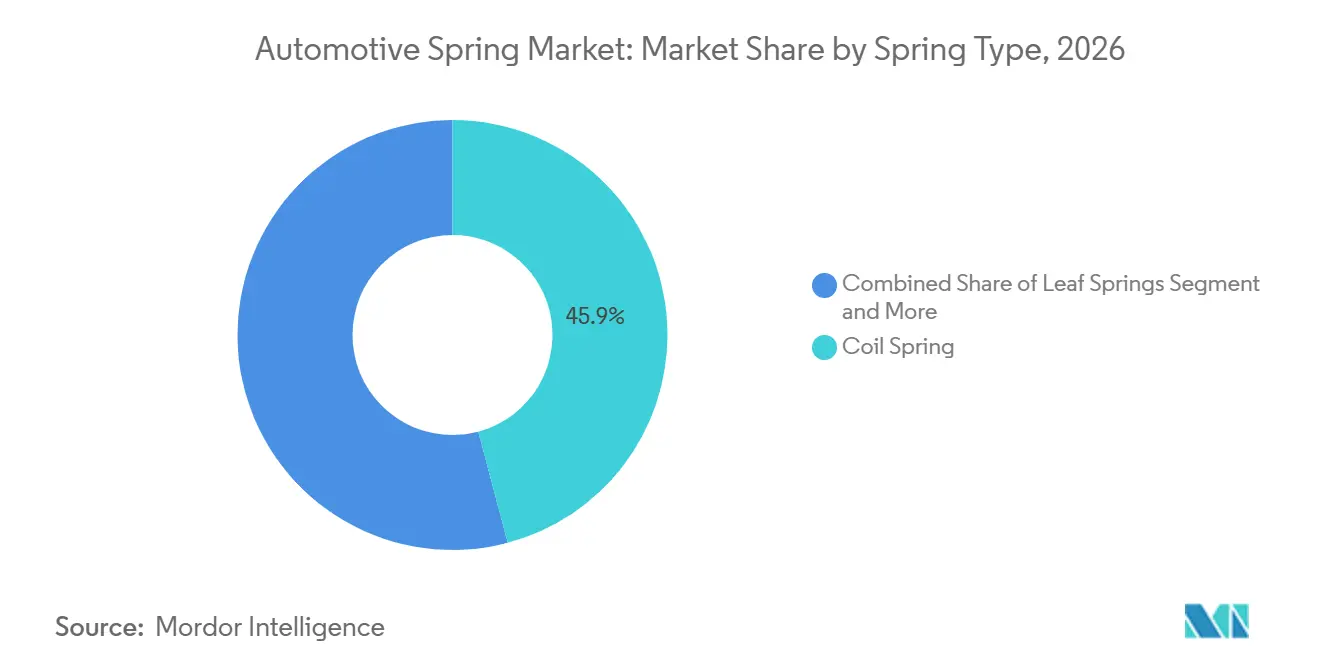
Coil Springs Retain Broad Vehicle UseCoil springs held 45.96% of the automotive spring market share in 2026, while gas springs are forecast to grow at an 8.29% CAGR through 2032. Coil springs remain widely used because they fit common passenger vehicle suspension layouts and can be produced through established processes. Compression, extension, and torsion designs serve different vehicle functions. Compression springs are central to many suspension struts and suspension assemblies. Torsion springs are used in mechanical systems that need rotational force. Extension springs are used in vehicle access and seating mechanisms, where consistent opening force and compact installation are important to the user experience and assembly process.
Gas springs are used in powered tailgates, adjustable seating, access systems, and other mechanisms that benefit from controlled movement. Their higher growth rate reflects rising vehicle content in convenience features across several body styles. Leaf springs remain important in commercial vehicles and pickups because they provide load support and robust durability. Parabolic and mono-leaf designs can help reduce component weight while supporting demanding duty cycles. Air springs may supplement conventional designs where load leveling is required. The automotive spring industry continues to use several spring formats because vehicle function, packaging, and load requirements vary widely across body styles, customer expectations, and operating conditions.

By Material:
Steel Remains the Established Material BaseSteel springs held 65.26% of the automotive spring market share in 2026, while composite springs are forecast to grow at an 8.08% CAGR through 2032. Steel remains widely used because supply chains, manufacturing methods, and durability standards are well established, and its continued use gives the Automotive spring market a familiar material base for applications where cost control and proven service life remain decisive. Different steel grades support passenger vehicles, commercial vehicles, and high-load applications. Alloy steel is used where suppliers need a balance of strength, fatigue resistance, and cost. High-carbon grades are relevant in leaf spring applications that endure repeated loading. Steel also remains practical for high-volume vehicle programs that require consistent sourcing, predictable forming behavior, and manufacturing processes familiar to both suppliers and vehicle makers.
Composite materials include glass fiber-reinforced polymer and carbon fiber-based designs. They can offer lower weight and corrosion resistance in suitable applications. SGL Carbon's Ford recognition demonstrates a current production example for glass fiber-reinforced polymer leaf springs. Material selection depends on vehicle requirements, manufacturing cost, and the ability to validate performance over time. Titanium and specialty alloys remain relevant in selected high-performance uses. Plastics and rubber components also support low-load or noise-control functions in vehicle systems, where their material properties can help manage vibration, movement, or assembly tolerances.
By Vehicle Type:
Passenger Cars Combine Scale with New RequirementsPassenger cars held a 44.94% share in 2026 and are forecast to grow at a 7.26% CAGR through 2032. This position reflects the large vehicle base and the widespread use of springs in passenger-car suspension and convenience systems. Passenger vehicle designs require a balance between ride comfort, handling, cabin quietness, and durability. Electrified passenger cars add further requirements because their weight distribution differs from that of conventional vehicles. Suppliers must adjust spring rates and component designs for individual platforms. These changes can raise the importance of engineering support during vehicle development, as suppliers and vehicle makers assess ride behavior across different loading conditions and road surfaces.
Light commercial vehicles remain relevant because delivery fleets need durable suspension systems and regular service support. Heavy commercial vehicles and buses use components designed for higher payloads and repeated loading. Two-wheelers and three-wheelers contribute high unit volumes in parts of Asia-Pacific, though their component values differ from those of larger vehicles. Vehicle type influences spring design, material choice, and expected replacement intervals. Passenger cars still account for a large share of the automotive spring market demand profile. Commercial formats provide a separate route for suppliers that specialize in load-bearing applications, including products designed for repeated service cycles, heavy loads, and straightforward replacement at fleet workshops.
By Powertrain:
Electrified Platforms Create Design WorkInternal combustion engine vehicles held a 69.45% share in 2026, while electric and hybrid platforms are forecast to grow at a 10.34% CAGR through 2032. Internal combustion engine vehicles remain important because they account for a substantial installed vehicle base. Their spring requirements are familiar to suppliers and are supported by long-standing manufacturing programs. Electric and hybrid vehicles require changes in suspension design to accommodate battery placement and vehicle weight. These platforms can require revised spring geometry and material specifications. Component development is therefore closely tied to vehicle architecture, with spring suppliers needing to understand battery location, axle loading, packaging limits, and the vehicle maker's ride objectives.
Hybrid vehicles provide a bridge between the requirements of conventional and fully electric vehicles. They retain some internal combustion engine systems while adding battery and electric drive components. Battery-electric vehicles require distinct approaches to ride height, stability, and load distribution. Fuel-cell electric vehicles remain relevant for selected commercial uses, where range and refueling needs influence platform design. The automotive spring industry is adapting through higher-strength grades, lighter materials, and closer coordination with chassis engineers. The shift does not remove demand for conventional products, but it changes the mix of specifications that suppliers must support, requiring investment in testing, materials knowledge, and application engineering.
By Application:
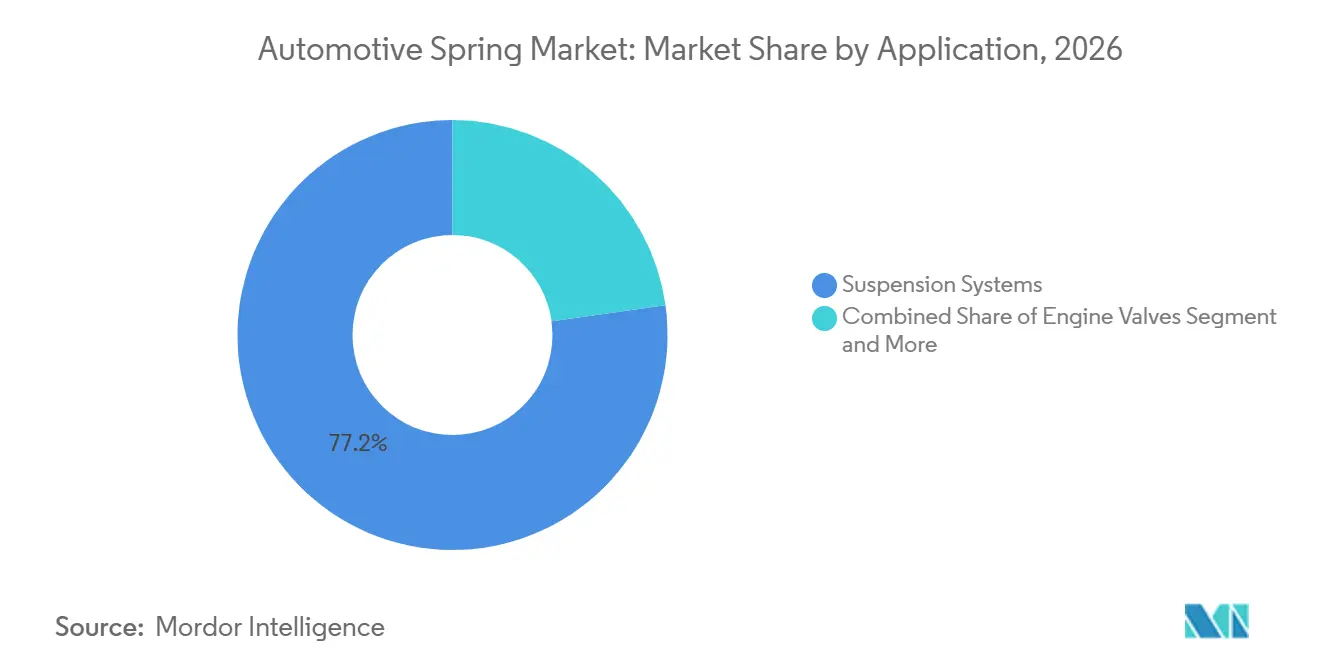
Suspension Systems Remain CentralSuspension systems held 77.21% of the global market share in 2026 and are forecast to grow at a 7.62% CAGR through 2032. Suspension remains the principal application because springs manage vehicle load, ride response, and wheel movement. The component must operate reliably through different road conditions and changing payloads. Vehicle makers also use suspension design to meet expectations for comfort and handling. Electrification increases the importance of managing vehicle mass without compromising ride quality. These factors keep suspension systems central to product development and replacement demand, because buyers cannot defer performance, safety, and ride-quality needs when vehicles remain in service.
Engine valve springs remain relevant in internal combustion engine and hybrid powertrains. Clutch and transmission springs support mechanical functions that remain present in several vehicle configurations. Other applications include fuel systems, seat belt pretensioners, seating, and interior access mechanisms. Safety requirements create defined performance needs for springs used in restraint-related systems. Pure battery-electric vehicles do not use engine valve springs, which changes demand within the application mix. The automotive spring market remains broad because vehicles require multiple spring functions beyond suspension, creating demand across powertrain, safety, interior, and vehicle-access systems throughout the vehicle lifecycle.
By Sales Channel:
Original Equipment Manufacturers Lead While Replacement Demand BroadensOriginal equipment manufacturers held a 74.05% share in 2026, while the aftermarket is forecast to grow at a 6.55% CAGR through 2032. Original equipment supply remains significant because springs are installed during new vehicle production and are sourced through approved supplier programs. These arrangements require reliable quality, delivery performance, and platform-specific engineering support. Suppliers often work with vehicle makers through long product development cycles. Contract terms can also create pressure to improve manufacturing efficiency over the life of a program. Original equipment supply therefore provides volume, but it requires disciplined cost and quality management, including traceability, consistent process control, and the ability to manage production changes without disruption.
The aftermarket serves vehicles that need replacement parts after years of operation. Aging fleets and demanding road use support this source of demand. Distributors, workshops, and digital ordering systems can improve availability for independent repair businesses. Branded suppliers can differentiate through fitment accuracy, product durability, and dependable delivery. Replacement channels may offer suppliers a way to reduce reliance on a limited number of vehicle production programs. The automotive spring market benefits when manufacturers maintain both original equipment and aftermarket relationships, since the two channels offer different customer needs, product lifecycles, and planning horizons.
Geography Analysis
Asia-Pacific held 53.11% of the global market share in 2026. The region has a broad base of vehicle production, component manufacturing, and growing vehicle ownership. China, India, and Southeast Asian countries support demand across passenger vehicles, commercial fleets, and two-wheelers. The region also includes a wide range of vehicle price points, which supports both conventional steel springs and selected advanced designs. Suppliers can use local manufacturing to address cost expectations and shorten delivery routes. NHK Spring announced a third production site in Aurangabad, Maharashtra, for coil springs and stabilizer bars, with production planned from 2027.
Europe is forecast to grow at an 8.39% CAGR through 2032. Regional demand is supported by vehicle programs that place a strong focus on emissions compliance, chassis performance, and electrification. European vehicle makers are also important adopters of premium suspension technology and lightweight components. The Automotive spring market in the region can benefit from projects that require higher-value spring designs for electrified and premium vehicles. Vehicle production conditions remain mixed, but suppliers can find opportunities in platform redesign, replacement demand, and advanced material programs. The European Automobile Manufacturers' Association reported that electrically chargeable trucks represented 4.2% of new registrations in the European Union in 2025[3].
North America has demand from commercial fleet replacement, trailer production, and the independent aftermarket. Light trucks and sport utility vehicles contribute to suspension component demand because their vehicle configurations can require robust load management. Local sourcing and manufacturing resilience have become more relevant to buyers managing supply chain risk. South America has lower regional growth, although country-level fleet renewal and vehicle assembly programs can support localized opportunities. The Middle East and Africa also have selective demand linked to vehicle localization and infrastructure activity. The automotive spring market remains diverse across these regions because operating conditions, fleet ages, and vehicle mixes differ substantially, requiring suppliers to match product ranges and distribution approaches to local requirements.
Competitive Landscape
The automotive spring market has a moderate concentration, which reflects meaningful influence from leading suppliers but leaves room for regional manufacturers and specialized producers. NHK Spring, Mubea, Sogefi, Rassini, and thyssenkrupp are among the recognized suppliers serving vehicle and suspension programs. Their positions are supported by engineering capabilities, customer relationships, manufacturing scale, and regional production networks. Regional producers in India and China continue to compete in volume-led programs and replacement channels. Smaller specialists can also serve narrow areas such as composites, smart sensing, or heavy-duty products. This structure gives vehicle makers a choice of suppliers while maintaining high qualification requirements, as any approved component must meet durability, consistency, and program delivery expectations over an extended period.
Manufacturers are using geographic investment to position themselves near growing vehicle production centers. NHK Spring's planned Aurangabad facility is one example of this approach, with planned production of coil springs and stabilizer bars for the Indian vehicle base. Suppliers are also strengthening their relevance by supporting electrified vehicle platforms and lighter suspension systems. These moves matter because they combine component supply with engineering work that can be difficult to replace quickly. They also help suppliers address changing vehicle architecture without abandoning established spring programs, which remains important while conventional and electrified vehicles operate side by side in many regions.
System integration is becoming more important in parts of the chassis supply chain. ZF's next-generation Smart Chassis Sensor is an example of how load detection and chassis monitoring can be included within broader vehicle systems. This creates a competitive need for spring suppliers to work with suspension and electronics partners where customers request connected chassis functions. At the same time, basic spring products will continue to face competition on price, delivery, quality consistency, and local manufacturing. Suppliers with aftermarket access can offset some dependence on annual vehicle production volumes. The Automotive spring market is therefore competitive across both high-volume standard components and technically specialized products, with supplier success depending on responsiveness, quality execution, engineering depth, and local customer support.
Automotive Spring Industry Leaders
-
NHK Spring Co., Ltd.
-
Muhr und Bender KG (Mubea)
-
Sogefi S.p.A.
-
Rassini S.A.B. de C.V.
-
thyssenkrupp AG
- *Disclaimer: Major Players sorted in no particular order
Automotive Spring Market Companies Covered in this Report
- NHK Spring Co., Ltd.
- Muhr und Bender KG (Mubea)
- Sogefi S.p.A.
- Rassini S.A.B. de C.V.
- thyssenkrupp AG
- ZF Friedrichshafen AG
- Mitsubishi Steel Mfg. Co., Ltd.
- Hendrickson USA LLC
- Jamna Auto Industries Ltd.
- Continental AG
- Chuo Spring Co., Ltd.
- Beijer Components AB
- EATON Detroit Spring
- Dongfeng Motor Suspension Spring Co., Ltd.
- Fangda Special Steel Technology Co., Ltd.
- EMCO Industries
- Betts Spring Manufacturing
- IFC Composite GmbH
- Eibach Federn GmbH
Recent Industry Developments in Automotive Spring Market
- October 2026: Nissan announced that its upcoming Navara Pro PHEV will be offered with a choice of leaf-spring or coil-spring rear suspension, potentially reviving a feature that differentiated previous generations of the brand's utility vehicle.
- September 2026: KW expanded its V3 Safari Style suspension offering. The company stated that the struts, damper bodies, and springs were specifically designed to allow adjustable ride-height increases, with use beyond paved roads as the primary intention.
- February 2026: Stellantis patented a new leaf spring suspension system for cars. The patent aimed to reintroduce a solid rear-axle configuration with rear leaf springs while addressing the limitations that led to the design being phased out of passenger cars.
Global Automotive Spring Market Report Scope
The Automotive Spring Market is segmented by Spring Type, Material, Vehicle Type, Powertrain, Application, Sales Channel, and Geography. By Spring Type, the market is segmented into Coil Springs (Compression Coil Springs, Extension Coil Springs, and Torsion Coil Springs), Leaf Springs (Semi-Elliptic Leaf Springs, Elliptic Leaf Springs, Parabolic Leaf Springs, Mono-Leaf Springs, and Multi-Leaf Springs), Torsion Springs, Gas Springs, Air Springs, and Rubber and Auxiliary Springs. By Material, the market is segmented into High-Carbon Steel, Alloy Steel, Stainless Steel, Glass-Fiber-Reinforced Polymer, Carbon-Fiber Composite, Titanium and Specialty Alloys, and Engineering Plastics and Rubber. By Vehicle Type, the market is segmented into Passenger Cars, Light Commercial Vehicles, Medium Commercial Vehicles, Heavy Commercial Vehicles, Buses and Coaches, Two-Wheelers, and Three-Wheelers and Specialty Vehicles. By Powertrain, the market is segmented into Internal Combustion Engine Vehicles, Hybrid Electric Vehicles, Battery Electric Vehicles, and Fuel-Cell Electric Vehicles. By Application, the market is segmented into Suspension Systems, Engine Valves, Clutch Assemblies, Transmission Systems, Seat Belts and Airbags, Fuel Injection Systems, and Interior and Access Systems. By Sales Channel, the market is segmented into Original Equipment Manufacturers and Independent Aftermarket. By Geography, the market is segmented into North America (United States, Canada, and Rest of North America), South America (Brazil, Argentina, and Rest of South America), Europe (Germany, France, Italy, United Kingdom, Spain, Russia, and Rest of Europe), Asia-Pacific (China, India, Japan, South Korea, Southeast Asia, Australia and New Zealand, and Rest of Asia-Pacific), and Middle East and Africa (Saudi Arabia, United Arab Emirates, Turkey, Israel, South Africa, Egypt, Nigeria, and Rest of Middle East and Africa). Market forecasts are provided in terms of Value (USD) and Volume (Units).
Segmentation Overview
| Coil Springs | Compression Coil Springs |
| Extension Coil Springs | |
| Torsion Coil Springs | |
| Leaf Springs | Semi-Elliptic Leaf Springs |
| Elliptic Leaf Springs | |
| Parabolic Leaf Springs | |
| Mono-Leaf Springs | |
| Multi-Leaf Springs | |
| Torsion Springs | |
| Gas Springs | |
| Air Springs | |
| Rubber and Auxiliary Springs |
| High-Carbon Steel |
| Alloy Steel |
| Stainless Steel |
| Glass-Fiber-Reinforced Polymer |
| Carbon-Fiber Composite |
| Titanium and Specialty Alloys |
| Engineering Plastics and Rubber |
| Passenger Cars |
| Light Commercial Vehicles |
| Medium Commercial Vehicles |
| Heavy Commercial Vehicles |
| Buses and Coaches |
| Two-Wheelers |
| Three-Wheelers and Specialty Vehicles |
| Internal Combustion Engine Vehicles |
| Hybrid Electric Vehicles |
| Battery Electric Vehicles |
| Fuel-Cell Electric Vehicles |
| Suspension Systems |
| Engine Valves |
| Clutch Assemblies |
| Transmission Systems |
| Seat Belts and Airbags |
| Fuel Injection Systems |
| Interior and Access Systems |
| Original Equipment Manufacturers |
| Independent Aftermarket |
| North America | United States |
| Canada | |
| Rest of North America | |
| South America | Brazil |
| Argentina | |
| Rest of South America | |
| Europe | Germany |
| France | |
| Italy | |
| United Kingdom | |
| Spain | |
| Russia | |
| Rest of Europe | |
| Asia-Pacific | China |
| India | |
| Japan | |
| South Korea | |
| Southeast Asia | |
| Australia and New Zealand | |
| Rest of Asia-Pacific | |
| Middle East and Africa | Saudi Arabia |
| United Arab Emirates | |
| Turkey | |
| Israel | |
| South Africa | |
| Egypt | |
| Nigeria | |
| Rest of Middle East and Africa |
| By Spring Type | Coil Springs | Compression Coil Springs |
| Extension Coil Springs | ||
| Torsion Coil Springs | ||
| Leaf Springs | Semi-Elliptic Leaf Springs | |
| Elliptic Leaf Springs | ||
| Parabolic Leaf Springs | ||
| Mono-Leaf Springs | ||
| Multi-Leaf Springs | ||
| Torsion Springs | ||
| Gas Springs | ||
| Air Springs | ||
| Rubber and Auxiliary Springs | ||
| By Material | High-Carbon Steel | |
| Alloy Steel | ||
| Stainless Steel | ||
| Glass-Fiber-Reinforced Polymer | ||
| Carbon-Fiber Composite | ||
| Titanium and Specialty Alloys | ||
| Engineering Plastics and Rubber | ||
| By Vehicle Type | Passenger Cars | |
| Light Commercial Vehicles | ||
| Medium Commercial Vehicles | ||
| Heavy Commercial Vehicles | ||
| Buses and Coaches | ||
| Two-Wheelers | ||
| Three-Wheelers and Specialty Vehicles | ||
| By Powertrain | Internal Combustion Engine Vehicles | |
| Hybrid Electric Vehicles | ||
| Battery Electric Vehicles | ||
| Fuel-Cell Electric Vehicles | ||
| By Application | Suspension Systems | |
| Engine Valves | ||
| Clutch Assemblies | ||
| Transmission Systems | ||
| Seat Belts and Airbags | ||
| Fuel Injection Systems | ||
| Interior and Access Systems | ||
| By Sales Channel | Original Equipment Manufacturers | |
| Independent Aftermarket | ||
| By Geography | North America | United States |
| Canada | ||
| Rest of North America | ||
| South America | Brazil | |
| Argentina | ||
| Rest of South America | ||
| Europe | Germany | |
| France | ||
| Italy | ||
| United Kingdom | ||
| Spain | ||
| Russia | ||
| Rest of Europe | ||
| Asia-Pacific | China | |
| India | ||
| Japan | ||
| South Korea | ||
| Southeast Asia | ||
| Australia and New Zealand | ||
| Rest of Asia-Pacific | ||
| Middle East and Africa | Saudi Arabia | |
| United Arab Emirates | ||
| Turkey | ||
| Israel | ||
| South Africa | ||
| Egypt | ||
| Nigeria | ||
| Rest of Middle East and Africa | ||
Key Questions Answered in the Report
What is driving demand for automotive springs through 2032?
Vehicle production, fleet replacement, commercial transport activity, and electrified vehicle design needs support demand through 2032, while suppliers also respond to changing material, packaging, and durability requirements.
Which spring type leads automotive vehicle applications?
Coil springs held the largest share in 2026 at 45.96%, while gas springs have the fastest projected growth through 2032.
Why are composite springs gaining attention?
Composite springs can reduce weight and have entered selected production programs, including glass fiber-reinforced polymer leaf springs supplied for the Ford Transit rear axle.
How do electric vehicles affect spring design?
Battery placement and vehicle mass distribution require revised suspension specifications, including controlled deflection and fatigue performance, so spring suppliers must work closely with chassis teams during platform development.