
Automotive Lead Acid Batteries Market Size and Share
Market Overview
| Study Period | 2022 - 2032 |
|---|---|
| Market Size (2027) | USD 35.17 Billion |
| Market Size (2032) | USD 43.23 Billion |
| Growth Rate (2027 - 2032) | 4.21 % |
| Fastest Growing Market | Asia-Pacific |
| Largest Market | Asia-Pacific |
| Market Concentration | Medium |
Major Players *Disclaimer: Major Players sorted in no particular order Image © Mordor Intelligence. Reuse requires attribution under CC BY 4.0. | |
Automotive Lead Acid Batteries Market Analysis by Mordor Intelligence
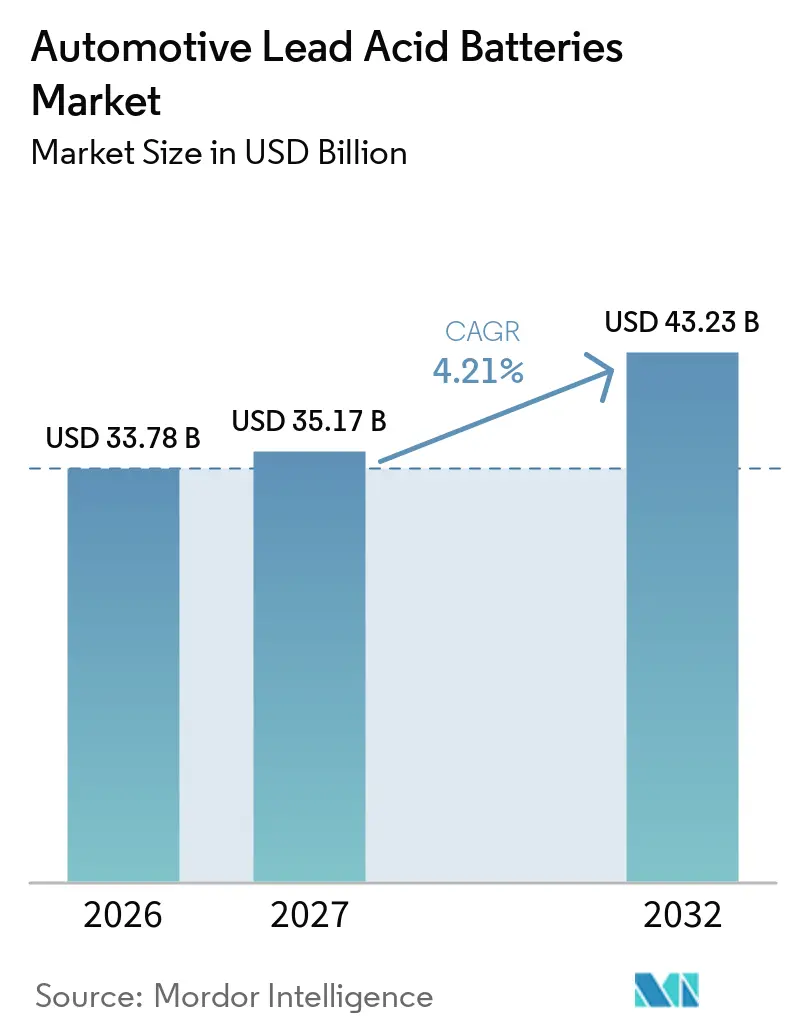
The Automotive Lead Acid Batteries Market size is projected to expand from USD 33.78 billion in 2026 and USD 35.17 billion in 2027 to USD 43.23 billion by 2032, registering a CAGR of 4.21% between 2027 and 2032. Demand is supported by the large installed fleet of internal combustion engine vehicles, which creates recurring replacement demand that is less exposed to new-vehicle production cycles. Replacement needs can increase as vehicles age, helping aftermarket volumes remain stable when original equipment production weakens. Hybrid vehicles also retain a 12V battery for body electronics, safety systems, and emergency functions, which maintain demand alongside high-voltage traction batteries. Producers are focusing on enhanced flooded batteries and absorbent glass mat batteries because start-stop systems require higher cycling performance. The Automotive lead acid batteries market also faces longer-term pressure from battery electric vehicle adoption and lithium-ion use in premium auxiliary applications.
Key Report Takeaways
- By product, Starting, Lighting, and Ignition batteries held 94.4% of the Automotive lead acid batteries market share in 2026, while auxiliary batteries are forecast to grow at a 5.2% CAGR through 2032.
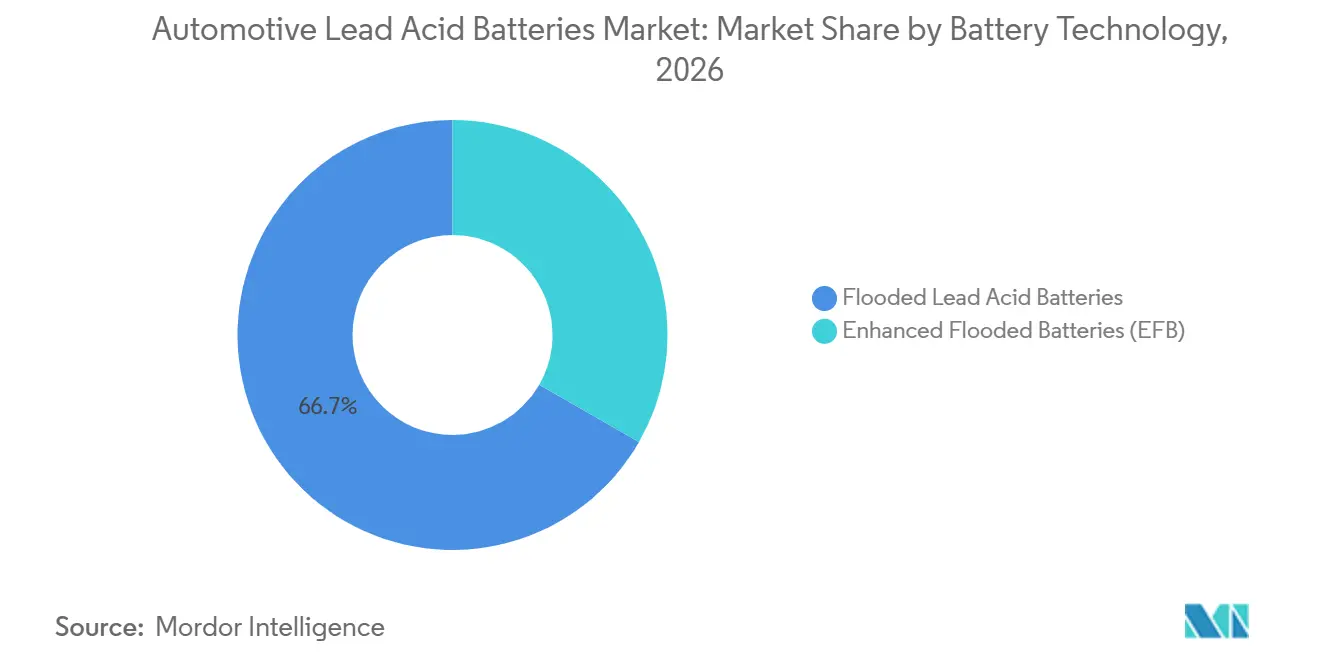
- By battery technology, flooded lead-acid batteries held 66.7% of the Automotive lead acid batteries market share in 2026, while enhanced flooded batteries are forecast to grow at a 4.9% CAGR through 2032.
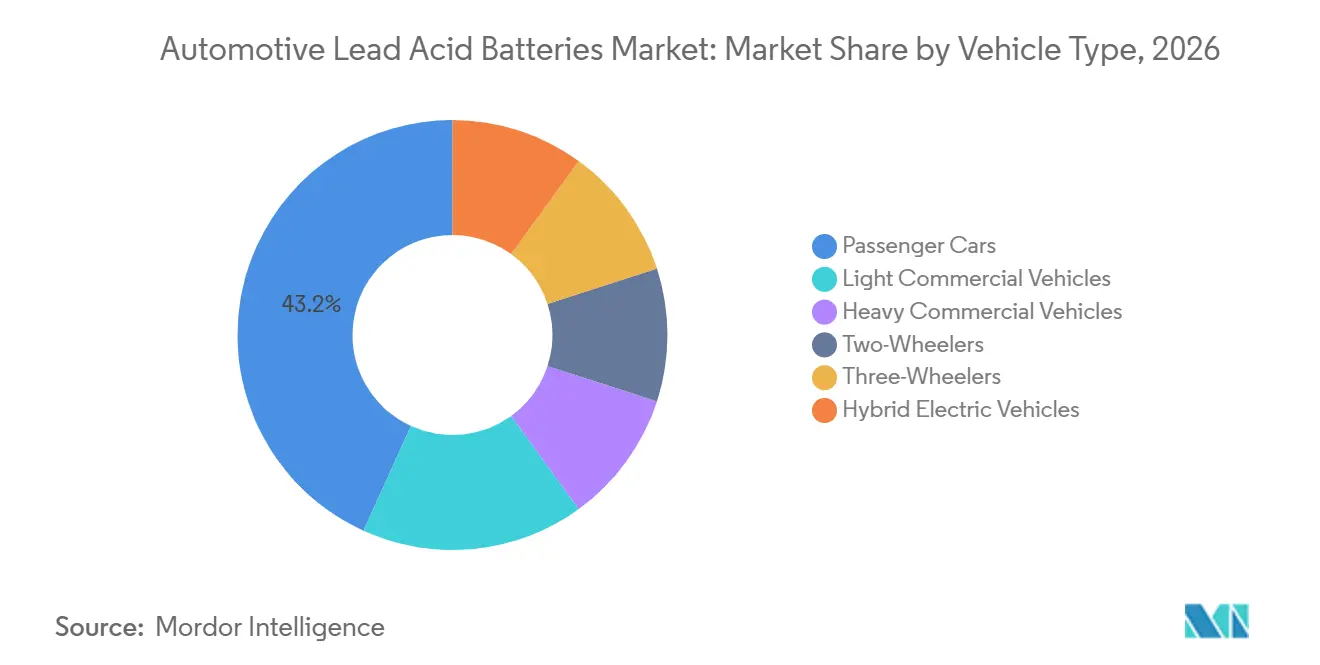
- By vehicle type, passenger cars accounted for 43.2% of the Automotive lead acid batteries market size in 2026, while hybrid electric vehicles are forecast to grow at a 5.9% CAGR through 2032.
- By geography, Asia-Pacific held 47.8% of the Automotive lead acid batteries market size in 2026 and is forecast to grow at a 5.1% CAGR through 2032.
Note: Market numbers in this report are based on Mordor Intelligence's proprietary estimation framework, which combines nine months of actuals with Q4 projections for base year 2026.
Market Trends and Insights
Drivers Impact Analysis of Automotive Lead Acid Batteries Market*
| Driver | (~) % Impact on CAGR Forecast | Geographic Relevance | Impact Timeline |
|---|---|---|---|
| Large Global ICE Vehicle Parc and Replacement Cycles | +1.5% | Global, with strength in North America, Europe, and China | Long term (≥ 4 years) |
| Start-Stop and Micro-Hybrid System Growth | +1.8% | North America and Europe, with expansion into Asia-Pacific and the Middle East and Africa | Medium term (2-4 years) |
| Vehicle Ownership Growth in India, Southeast Asia, and Africa | +1.2% | Asia-Pacific, especially India, Indonesia, and Thailand, with secondary relevance in the Middle East and Africa | Long term (≥ 4 years) |
| 12V Auxiliary Demand in Hybrid and Electric Vehicles | +1.1% | China, Europe, Japan, and South Korea | Medium term (2-4 years) |
| Closed-Loop Lead Recycling and Local Material Availability | +0.8% | North America, Europe, and China | Long term (≥ 4 years) |
| Fleet Electrification and Battery-Health Monitoring | +0.6% | North America, Europe, and Asia-Pacific | Short term (≤ 2 years) |
| Source: Mordor Intelligence | |||
Large Global ICE Vehicle Parc and Predictable Replacement Cycles
The Automotive lead acid batteries market is supported primarily by vehicles already in use rather than by annual new-vehicle output. Sebang Global Battery reported that the global fleet of internal combustion engine vehicles reached 1.67 billion units in 2024, creating a broad base for replacement demand.[1] Lead-acid batteries commonly require replacement on a three-to-five-year cycle, which creates recurring aftermarket volumes. When original equipment production slows, the existing vehicle base continues to age and may require more frequent replacement. Vehicle inspection systems in Germany, Japan, and South Korea can identify weak batteries during routine checks, which supports replacement activity.
Start-Stop and Micro-Hybrid System Proliferation
Start-stop systems place more frequent cycling demands on a battery than conventional starter applications. These systems have encouraged vehicle manufacturers to specify enhanced flooded batteries and absorbent glass mat batteries rather than standard flooded products. Stryten Energy stated that vehicle manufacturers have used enhanced flooded batteries since 2009, particularly in Asian vehicles, and that replacement demand should rise as these vehicles enter later stages of service.[2] EN 50342-6:2025 sets performance requirements for micro-cycle lead-acid starter batteries, reinforcing demand for batteries with higher cycle endurance.[3] This technical shift supports higher-value replacement products in the Automotive lead acid batteries market.
Rising Vehicle Ownership in India, Southeast Asia, and Africa
Vehicle ownership remains lower in India, Indonesia, Vietnam, and Sub-Saharan Africa than in established vehicle markets. Rising incomes in these locations support first-time purchases of cars, two-wheelers, and three-wheelers. Amara Raja reported that passenger vehicle volumes rose 7.9% and two-wheeler volumes increased 10.7% in its fiscal year 2025-26 reporting, while its automotive original equipment business grew faster than the wider industry.[4] China also issued GB/T23638-2025 for motorcycle lead-acid batteries, supporting quality standards in a large two-wheeler category. These trends broaden the Automotive lead acid batteries market through vehicle ownership rather than through a shift to premium battery chemistry.
Expansion of 12V Auxiliary Demand in Hybrid and Electric Vehicles
Hybrid and battery electric vehicles continue to use low-voltage batteries for lighting, safety systems, body electronics, and advanced driver-assistance systems. This arrangement separates essential low-voltage functions from the high-voltage traction battery. Camel Group hosted an International Electrotechnical Commission (IEC) working group meeting in October 2025 to advance IEC 60095-8 testing for 12V lead-acid auxiliary batteries. The work covered peak power capability, cold cranking performance, and cycle endurance. As hybrid vehicle populations increase, the Automotive lead acid batteries market retains a role in low-voltage power even where propulsion uses another chemistry.
Restraints Impact Analysis of Automotive Lead Acid Batteries Market*
| Restraint | (~) % Impact on CAGR Forecast | Geographic Relevance | Impact Timeline |
|---|---|---|---|
| Accelerating Battery Electric Vehicle Adoption | -1.2% | Europe, China, and North America | Long term (≥ 4 years) |
| Lithium-Ion Substitution in Premium Auxiliary Applications | -0.8% | Europe, Japan, and South Korea | Medium term (2-4 years) |
| Lead, Polypropylene, and Compliance-Cost Volatility | -0.5% | Global, with greater exposure in Asia-Pacific and Europe | Short term (≤ 2 years) |
| Regional Shortages of AGM and EFB Capacity | -0.3% | Southeast Asia and the Middle East and Africa | Medium term (2-4 years) |
| Source: Mordor Intelligence | |||
Accelerating Battery Electric Vehicle Adoption
Battery electric vehicle adoption can reduce long-term demand for conventional starting batteries in internal combustion engine vehicles. The effect is most pronounced in China and Europe, where electrification policies are more advanced. Regulation (EU) 2023/1542 raises documentation, labeling, recycled-content, and carbon-footprint requirements for batteries placed in the European Union. Those requirements increase compliance demands, particularly for smaller manufacturers. GS Yuasa nevertheless stated that hybrid and plug-in hybrid demand continues to support automotive lead-acid battery demand while battery electric vehicle adoption develops.
Lithium-Ion Substitution in Premium Auxiliary Applications
Lithium-ion 12V batteries are increasingly used in selected premium vehicle programs because they weigh less and offer strong cycling performance. Clarios produced its one-millionth 12V lithium-ion battery in February 2025, showing that alternative low-voltage chemistries have moved beyond pilot production. The International Electrotechnical Commission (IEC) 60095-1:2018/COR1:2026 corrigendum updates general requirements and test methods for lead-acid starter batteries. Lithium-ion substitution remains concentrated in higher-value original equipment applications rather than the mass replacement channel. It therefore limits the Automotive lead acid batteries market most directly in premium auxiliary applications during the forecast period.
*Our forecasts treat driver/restraint impacts as directional, not additive. The impact forecasts reflect baseline growth, mix effects, and variable interactions.
Automotive Lead Acid Batteries Market Segment Analysis
By Product:
SLI Batteries Anchor Revenue While Auxiliary Gains ShareStarting, Lighting, and Ignition batteries accounted for 94.4% of category value in 2026. Their position reflects their use in nearly every internal combustion engine vehicle and in many hybrid vehicles. Each vehicle requires the battery at original fitment and during subsequent replacement cycles. Micro-hybrid batteries form a secondary product group because start-stop applications require batteries that can handle repeated cycling.
Auxiliary batteries are forecast to grow at a 5.2% CAGR from 2027 to 2032. Hybrid and battery electric vehicles use a 12V unit for body electronics, safety features, and advanced driver-assistance systems. Camel Group's participation in IEC 60095-8 work shows that battery suppliers are preparing for this requirement. Other automotive lead-acid products remain relevant in two-wheeler and three-wheeler applications across Asia and Africa. GB/T23638-2025 raises product requirements for motorcycle lead-acid batteries and favors certified supply.
By Battery Technology:
Flooded Retains Majority While Enhanced Flooded Battery (EFB) Leads GrowthFlooded lead-acid batteries held 66.7% of category value in 2026. Their lower manufacturing cost and broad distribution make them suitable for the large population of vehicles without start-stop systems. The technology also benefits from mature manufacturing and recycling systems. These attributes preserve its relevance in price-sensitive replacement channels.
Enhanced flooded batteries are expected to grow at a 4.9% CAGR from 2027 to 2032. Vehicles fitted with enhanced flooded batteries at original equipment are entering the replacement cycle in greater numbers. Stryten Energy identifies this replacement cycle as an important source of demand for enhanced flooded batteries. EN 50342-6:2025 also supports higher-cycle technologies in vehicles equipped with start-stop systems. Investment in enhanced flooded battery capacity can improve access to premium aftermarket demand.
By Vehicle Type:
Passenger Cars Lead but HEVs Define GrowthPassenger cars accounted for 43.2% of the Automotive lead acid batteries market size in 2026. Their lead reflects the size of the global passenger vehicle fleet and the consistency of battery replacement demand. Light and heavy commercial vehicles add meaningful volume through fleet replacement contracts. Two-wheelers and three-wheelers remain important in Asia-Pacific and Africa, were affordability shapes battery choice.
Hybrid electric vehicles are forecast to grow at a 5.9% CAGR from 2027 to 2032. Each hybrid electric vehicle retains a 12V battery for safety and auxiliary power, even though its traction system uses a high-voltage battery. GS Yuasa expects automotive lead-acid demand to remain near 90% of current levels through 2035 under its planning assumptions. This vehicle type gives the Automotive lead acid batteries industry a continuing route to demand as electrified vehicle sales rise.
Geography Analysis
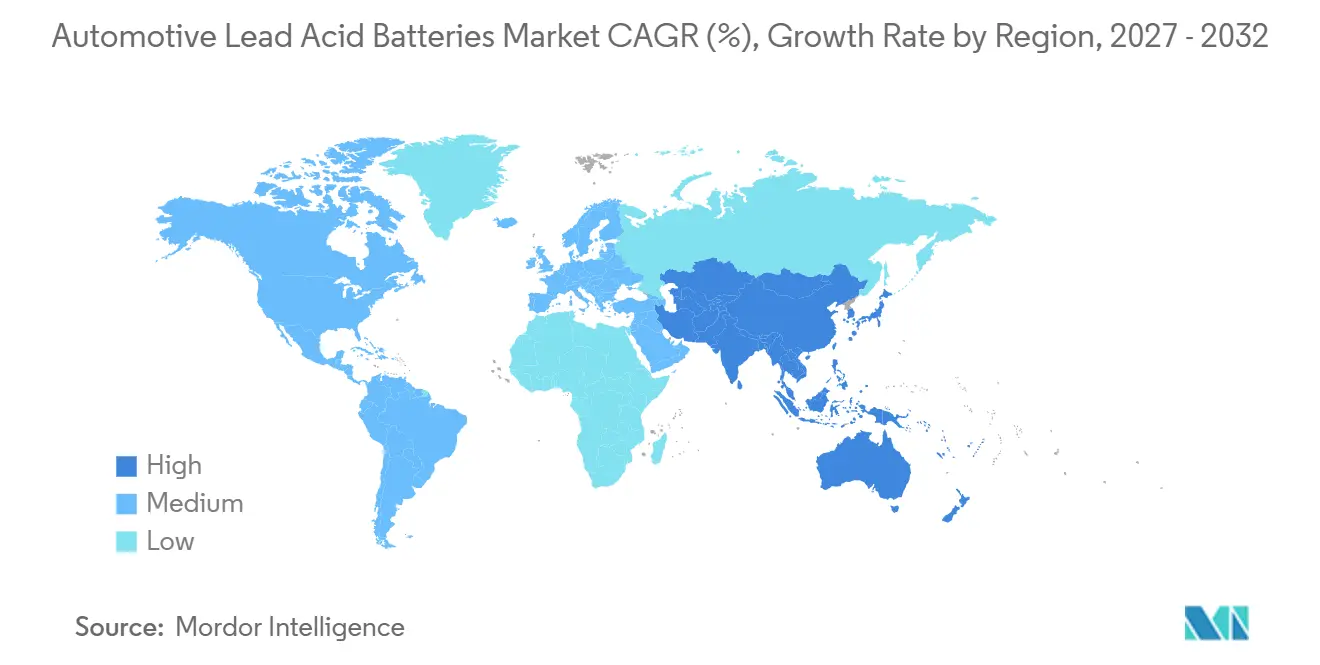
Asia-Pacific holds 47.8% of category value in 2026 and is forecast to grow at a 5.1% CAGR through 2032. China is a central production and consumption base, with Camel Group, Tianneng Battery Group, and Chaowei Power among major regional suppliers. India is an important source of expansion because its vehicle fleet is increasing across passenger vehicles and two-wheelers. Amara Raja reported strong automotive original equipment growth in fiscal year 2025-26 and a broad international presence. Indonesia's two-wheeler fleet and Thailand's automotive assembly base also support regional demand.
North America and Europe account for the next largest demand centers. Battery Council International states that more than 150 million lead batteries are produced annually in the United States. Clarios reported a USD 6 billion American energy manufacturing strategy that includes advanced battery capacity and materials processing. The company also reported more than USD 500 million of investment in U.S. plants by the end of fiscal 2026. In Europe, an older vehicle fleet supports aftermarket demand, while European Union battery rules raise the importance of traceability and recycling.
South America, the Middle East and Africa, and Rest of Europe represent smaller but meaningful markets for the Automotive lead acid batteries market. Brazil leads South America because of its large vehicle fleet and established aftermarket. The Middle East and Africa benefit from growing vehicle ownership and two-wheeler use in Sub-Saharan Africa. Camel Group's supply nomination for a Foton commercial vehicle project in Thailand shows how Chinese producers are extending regional export reach
Competitive Landscape
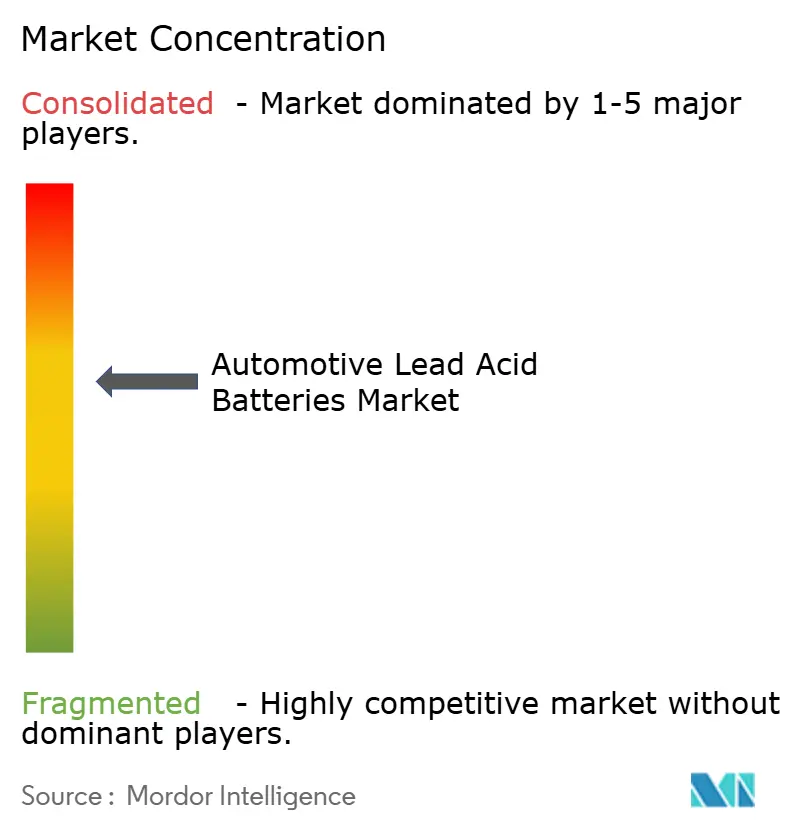
The Automotive lead acid batteries market is moderately concentrated among global producers and a wider group of regional specialists. Clarios, East Penn Manufacturing, GS Yuasa, Camel Group, and Sebang Global Battery operate across multiple regions and product types. Regional producers retain relevance where local distribution, vehicle fitment, or price competitiveness is important. Competitive strength depends on manufacturing scale, replacement-channel access, recycling capability, and advanced battery capacity. Producers with established original equipment approvals also have an advantage in premium applications.
Clarios announced a USD 6 billion U.S. energy manufacturing strategy in 2025 that covers advanced battery production, critical mineral processing, and next-generation battery technologies. The company reported production of its one-millionth 12V lithium-ion battery in February 2025, reflecting a broader low-voltage energy-storage strategy. GS Yuasa is maintaining a focus on automotive lead-acid applications while identifying Chinese competition in ASEAN as a risk. Camel Group is building influence through participation in international testing standards for 12V auxiliary batteries.
Premium enhanced flooded and absorbent glass mat batteries offer an opportunity in the growing start-stop and hybrid replacement base. Suppliers also have room to offer battery-health monitoring services to fleet operators as low-voltage system requirements become more demanding. Sebang Global Battery's supply relationship with Volkswagen and BMW in Germany demonstrates the difficulty of qualifying for premium original equipment channels. FIAMM Energy Technology changed ownership after Resonac agreed to transfer the business to Aurelius Group in August 2025. Competition will remain active as Chinese suppliers add export capacity and established producers protect aftermarket distribution.
Automotive Lead Acid Batteries Industry Leaders
-
Clarios International Inc.
-
GS Yuasa Corporation
-
Exide Technologies, LLC
-
East Penn Manufacturing Company
-
EnerSys
- *Disclaimer: Major Players sorted in no particular order
Automotive Lead Acid Batteries Market Companies Covered in this Report
- Amara Raja Energy & Mobility Limited
- Banner GmbH
- Camel Group Co., Ltd.
- Century Batteries (Australia) Pty Ltd
- Chaowei Power Holdings Limited
- Clarios International Inc.
- Crown Battery Manufacturing Company
- East Penn Manufacturing Company
- EnerSys
- Exide Technologies, LLC
- FIAMM Energy Technology S.p.A.
- GS Yuasa Corporation
- Koyo Battery Co., Ltd.
- Leoch International Technology Limited
- Mutlu Akü ve Malzemeleri Sanayi A.Ş.
- PT Astra Otoparts Tbk
- Sebang Global Battery Co., Ltd.
- Stryten Energy LLC
- The Furukawa Battery Co., Ltd.
- Tianneng Battery Group Co., Ltd.
Recent Industry Developments in Automotive Lead Acid Batteries Market
- May 2026: Clarios published a one-year update on its USD 6 billion US Energy Manufacturing Strategy, confirming more than USD 500 million invested in US plants by the end of fiscal 2026, with advanced AGM production capacity expansions across multiple states.
- October 2025: Camel Group hosted the IEC/TC21 WG2 Working Group Meeting in Wuhan, bringing together experts from Italy, Germany, the United States, and Japan to advance the IEC 60095-8 standard for 12V lead-acid auxiliary battery testing, specifically targeting peak power capability, cold cranking ampere rating, and cycle endurance specifications.
- May 2025: GS Yuasa launched the renewed ECO.R Revolution series for both idling stop and general vehicles in Japan, expanding its premium replacement battery product line to capture a higher aftermarket margin.
- April 2025: Amara Raja Energy and Mobility reported 10.2% revenue growth in FY2025, with lead-acid batteries contributing 95% of revenue. The company launched AGM and Enhanced Flooded Battery (EFB) battery ranges for start-stop applications and extended its international footprint to more than 70 countries.
Global Automotive Lead Acid Batteries Market Report Scope
An automotive lead-acid battery is a rechargeable electrochemical device that stores and delivers electrical energy to start a vehicle's engine, stabilize electrical voltage, and power onboard accessories when the engine is not running.
The automotive lead-acid battery market is segmented into product, battery technology, vehicle type, and geography. By product, the market is divided into starting, lighting, and ignition (SLI) batteries, micro-hybrid batteries, auxiliary batteries, and other automotive lead acid battery products. By battery technology, the market is divided into flooded lead-acid batteries and enhanced flooded batteries (EFB). By vehicle type, the market is segmented into passenger cars, light commercial vehicles, heavy commercial vehicles, two-wheelers, three-wheelers, and hybrid electric vehicles. The report also covers the market size and forecasts for the global automotive lead-acid battery market across 26 countries in key regions. For each segment, the market sizing and forecasts have been provided on the basis of value (USD).
Segmentation Overview
| Starting, Lighting, and Ignition (SLI) Batteries |
| Micro-Hybrid Batteries |
| Auxiliary Batteries |
| Other Automotive Lead Acid Battery Products |
| Flooded Lead Acid Batteries |
| Enhanced Flooded Batteries (EFB) |
| Passenger Cars |
| Light Commercial Vehicles |
| Heavy Commercial Vehicles |
| Two-Wheelers |
| Three-Wheelers |
| Hybrid Electric Vehicles |
| North America | United States |
| Canada | |
| Mexico | |
| Europe | Germany |
| France | |
| Italy | |
| Spain | |
| United Kingdom | |
| Netherlands | |
| Norway | |
| Russia | |
| Rest of Europe | |
| Asia-Pacific | China |
| India | |
| Japan | |
| Australia | |
| Indonesia | |
| Malaysia | |
| Thailand | |
| Rest of Asia-Pacific | |
| South America | Brazil |
| Argentina | |
| Colombia | |
| Rest of South America | |
| Middle East and Africa | Saudi Arabia |
| United Arab Emirates | |
| Egypt | |
| Oman | |
| Nigeria | |
| Rest of Middle East and Africa |
| By Product | Starting, Lighting, and Ignition (SLI) Batteries | |
| Micro-Hybrid Batteries | ||
| Auxiliary Batteries | ||
| Other Automotive Lead Acid Battery Products | ||
| By Battery Technology | Flooded Lead Acid Batteries | |
| Enhanced Flooded Batteries (EFB) | ||
| By Vehicle Type | Passenger Cars | |
| Light Commercial Vehicles | ||
| Heavy Commercial Vehicles | ||
| Two-Wheelers | ||
| Three-Wheelers | ||
| Hybrid Electric Vehicles | ||
| By Geography | North America | United States |
| Canada | ||
| Mexico | ||
| Europe | Germany | |
| France | ||
| Italy | ||
| Spain | ||
| United Kingdom | ||
| Netherlands | ||
| Norway | ||
| Russia | ||
| Rest of Europe | ||
| Asia-Pacific | China | |
| India | ||
| Japan | ||
| Australia | ||
| Indonesia | ||
| Malaysia | ||
| Thailand | ||
| Rest of Asia-Pacific | ||
| South America | Brazil | |
| Argentina | ||
| Colombia | ||
| Rest of South America | ||
| Middle East and Africa | Saudi Arabia | |
| United Arab Emirates | ||
| Egypt | ||
| Oman | ||
| Nigeria | ||
| Rest of Middle East and Africa | ||
Key Questions Answered in the Report
What is the projected value of automotive lead-acid batteries by 2032?
The global automotive lead-acid battery market is forecast to reach USD 43.23 billion by 2032, growing at a 4.21% CAGR from 2027 to 2032.
Why do lead-acid batteries remain relevant in hybrid vehicles?
Hybrid vehicles retain a 12V battery for safety, lighting, body electronics, and emergency functions, even when propulsion uses a high-voltage battery.
Which product category leads automotive lead-acid battery demand?
Starting, Lighting, and Ignition batteries lead, with 94.4% share in 2026.
Which battery technology is growing fastest through 2032?
Enhanced flooded batteries are projected to grow at a 4.9% CAGR because start-stop vehicles require stronger cycling performance.
Which region has the strongest growth outlook for automotive lead-acid batteries?
Asia-Pacific leads with 47.8% share in 2026 and is forecast to grow at a 5.1% CAGR through 2032.
What risks could limit demand for automotive lead-acid batteries?
Battery electric vehicle adoption, lithium-ion substitution in premium auxiliary systems, material costs, and limited AGM and EFB capacity can limit growth.