
Automotive Intelligent Door System Market Size and Share
Market Overview
| Study Period | 2020 - 2032 |
|---|---|
| Market Size (2027) | USD 4.08 Billion |
| Market Size (2032) | USD 6.15 Billion |
| Growth Rate (2027 - 2032) | 8.55 % |
| Fastest Growing Market | South America |
| Largest Market | Asia-Pacific |
| Market Concentration | Medium |
Major Players *Disclaimer: Major Players sorted in no particular order Image © Mordor Intelligence. Reuse requires attribution under CC BY 4.0. | |
Automotive Intelligent Door System Market Analysis by Mordor Intelligence
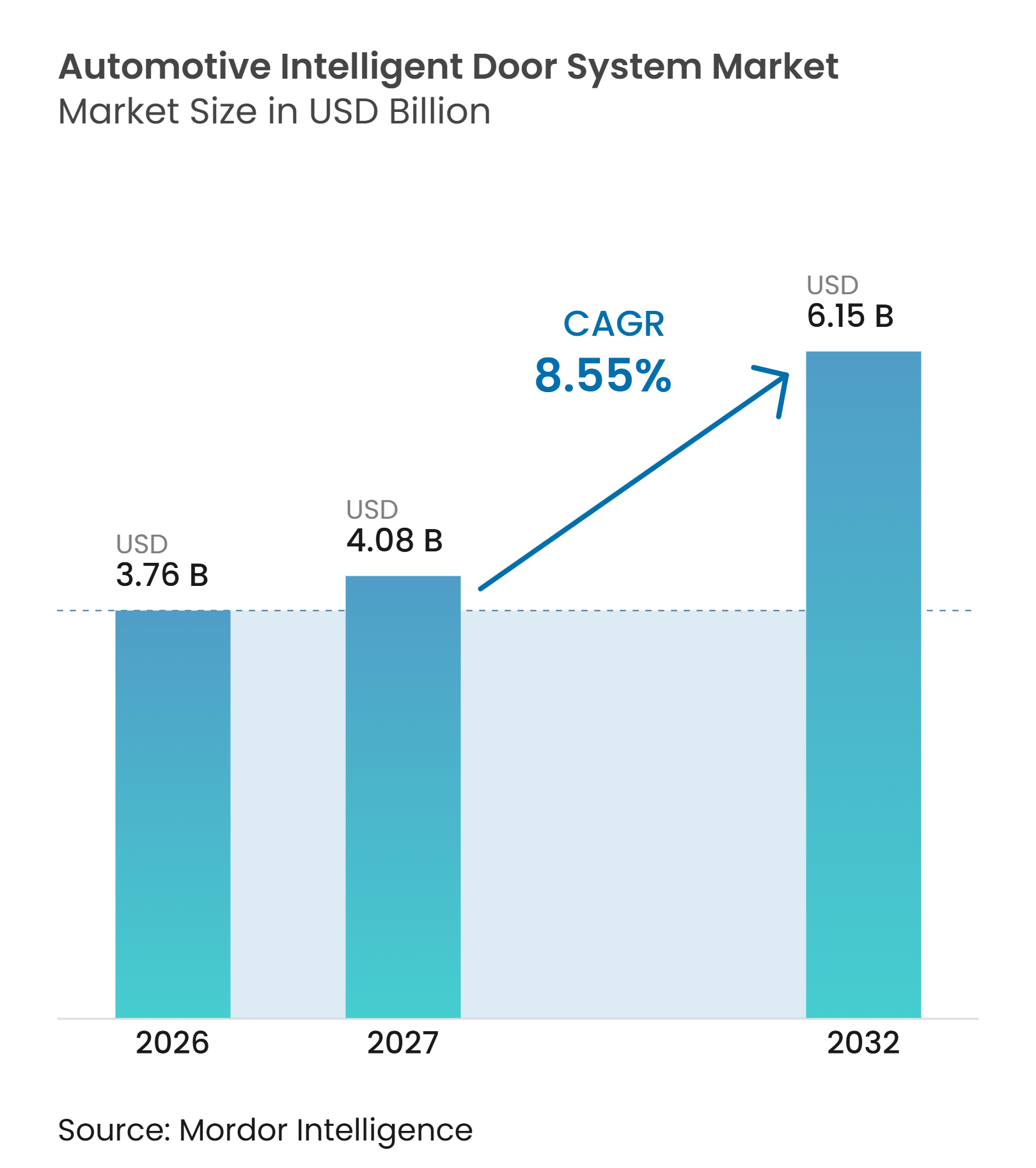
The automotive intelligent door system market size was valued at USD 3.76 billion in 2026 and is expected to grow from USD 4.08 billion in 2027 to USD 6.15 billion by 2032, at a CAGR of 8.55% during 2027-2032. The automotive intelligent door system market is moving from mechanical closure hardware toward connected access, sensing, and control functions that are designed into the vehicle. Electric vehicle programs support this shift by commonly using electronic architectures that accommodate powered latches, retractable handles, and digital access. Suppliers are therefore competing on their ability to combine mechanical reliability with software and electronic integration. The automotive intelligent door system market also benefits when manufacturers use door functions to enhance convenience, vehicle access, and exterior design without decoupling those decisions from the broader electrical architecture.
Key Report Takeaways
- By product, flush/retractable door handles held a 31.07% share in 2026, while power swing and soft-close door systems are projected to grow at an 11.52% CAGR through 2032.
- By component, actuators held a 45.61% share in 2026, while sensors are projected to grow at an 8.99% CAGR through 2032.
- By vehicle type, passenger cars held an 86.19% share in 2026, while commercial vehicles are projected to grow at a 7.01% CAGR through 2032.
- By propulsion, electric vehicles held a 39.09% share in 2026 and are projected to grow at an 11.31% CAGR through 2032.
- By sales channel, original equipment manufacturers held an 82.99% share in 2026, while the aftermarket is projected to grow at a 7.43% CAGR through 2032.
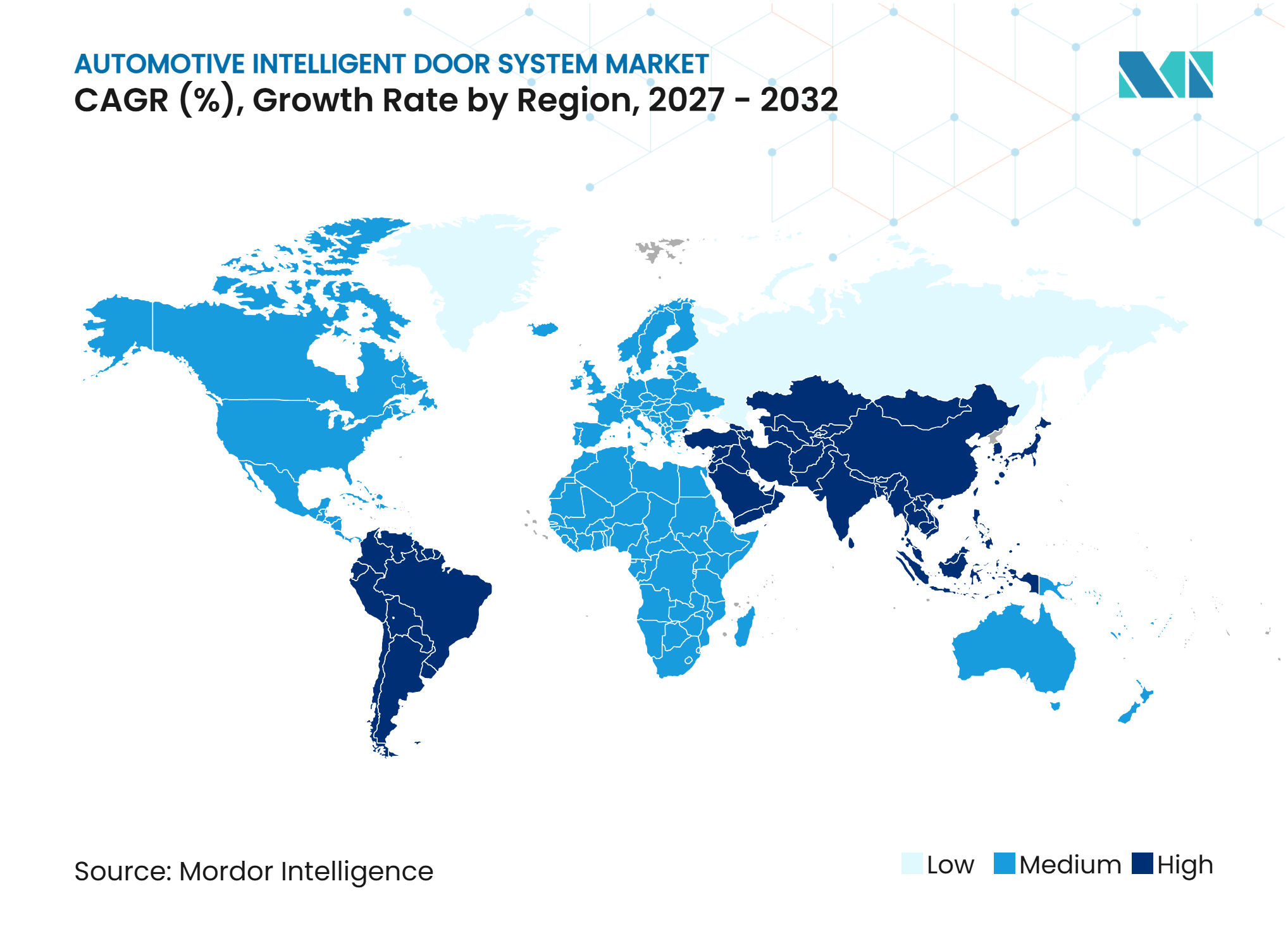
- By geography, Asia-Pacific held a 39.19% share in 2026, while South America is projected to grow at a 9.21% CAGR through 2032.
Note: Market numbers in this report are based on Mordor Intelligence's proprietary estimation framework, which combines nine months of actuals with Q4 projections for base year 2026.
Market Trends and Insights
Drivers Impact Analysis of Automotive Intelligent Door System Market*
| Driver | (~) % Impact on CAGR Forecast | Geographic Relevance | Impact Timeline |
|---|---|---|---|
| Rising Adoption of Electric Vehicles and Software-Defined Vehicle Architectures | +3.2% | Global, concentrated demand in China, Europe, and North America | Medium term (2–4 years) |
| Integration of Door Electronics into Zonal Vehicle Architectures | +2.5% | Global, early-mover OEMs in Germany, South Korea, and China | Medium term (2–4 years) |
| Mainstreaming of Passive Entry and Digital-Key Access | +2.0% | Global, North America and China leading penetration | Short term (≤ 2 years) |
| Premiumization of Convenience and Automated Door Functions | +1.5% | North America, Europe, and China | Short term (≤ 2 years) |
| Fleet and Shared-Mobility Demand for Hands-Free and Remote Door Operation | +0.9% | Asia-Pacific, North America, Europe | Long term (≥ 4 years) |
| Aerodynamic and Styling Benefits of Flush Door Handles | +0.7% | Europe and North America, with China shifting to mechanically backed designs | Short term (≤ 2 years) |
| Source: Mordor Intelligence | |||
Rising Adoption of Electric Vehicles and Software-Defined Vehicle Architectures
Electric vehicle programs are changing the way manufacturers specify access and closure functions. Their electrical layouts can support powered releases, automatic cinching, and electronically managed handle movement from the earliest design stages. Software-defined vehicle programs also require door functions that communicate with other controls and can receive software updates. In November 2025, the Volkswagen Group and Rivian joint venture reported that its zonal software-defined architecture would enter winter testing in early 2026 ahead of its first Group launch in 2027[1]. Shared platforms can apply the same access logic across several vehicle classes. This supports demand for electronic latches, handles, and access sensors. It also raises the need for reliable operation when a vehicle is offline or has a low battery.
Integration of Door Electronics into Zonal Vehicle Architectures
Zonal electrical architectures bring related vehicle functions together around physical areas of the vehicle. In the door area, this can link latches, windows, mirrors, sensors, and access functions through fewer controllers. The approach can reduce separate control units while increasing the importance of the remaining electronics. Suppliers must design components that work within a shared control environment and maintain safety when other functions are managed through the same architecture. A latch or actuator remains necessary, but sensors, communications, and software increasingly define its performance. Vehicle makers may seek integrated modules to reduce development complexity and assign clear testing responsibility. This favors suppliers that can coordinate mechanical, electrical, and digital functions during a single development process.
Mainstreaming of Passive Entry and Digital-Key Access
Passive entry is becoming more familiar to vehicle buyers, especially when electric vehicles are marketed for their ease of use. Digital keys allow access credentials to be managed through connected devices. These systems rely on sensors and communications hardware that must identify an authorized user without false openings. Brose presented a concept vehicle at Auto Shanghai 2025 with gesture-based hands-free door access and radar-based collision protection for its powered side door[2]. Digital access can update permissions after delivery. The system must operate safely without a phone, key, or network connection. Clear manual access and dependable fallback operation remain essential. Suppliers that balance secure access with straightforward physical operation can support wider adoption.
Premiumization of Convenience and Automated Door Functions
Powered doors and soft-close functions are spreading from luxury vehicles to selected electric crossovers and family vehicles. These systems can help users manage heavy doors, tight parking spaces, and hands-full entry situations. They need careful control of force, movement, and obstacle detection. Stabilus received an order in April 2025 from a Chinese automaker for more than 400,000 electromechanical side-door drive systems per year from 2026, including the drive, control unit, radar, and software. The activity shows that door actuation is becoming a defined product category rather than a limited feature. Vehicle makers still need to determine where automated functions justify their additional cost. Motors, sensors, controls, and testing add complexity. Wider adoption will depend on durable, serviceable modules that offer clear benefits in everyday use.
Restraints Impact Analysis of Automotive Intelligent Door System Market*
| Restraint | (~) % Impact on CAGR Forecast | Geographic Relevance | Impact Timeline |
|---|---|---|---|
| High System Cost and Price Pressure in Mass-Market Vehicles | -1.0% | Global, most acute in South Asia, Southeast Asia, South America | Long term (≥ 4 years) |
| Semiconductor, Motor, and Electronic Component Supply Volatility | -0.7% | Global, with higher risk in Europe and North America | Short term (≤ 2 years) |
| False Activation and Reliability Risks Under Ice, Dirt, Water, and Electromagnetic Interference | -0.4% | North America, Europe, and Middle East and Africa | Medium term (2–4 years) |
| Diverging Emergency-Release Regulations and Product Liability Exposure | -0.2% | North America, Europe, and China (mandatory mechanical release from 2027) | Medium term (2–4 years) |
| Source: Mordor Intelligence | |||
High System Cost and Price Pressure in Mass-Market Vehicles
Intelligent door systems add motors, sensors, latches, antennas, wiring, and controls to functions that conventional mechanical doors perform with fewer parts. This increases both material cost and validation work. The full feature set can be difficult to justify in lower-priced vehicles, particularly where affordability guides purchase decisions. Suppliers also face price reductions requested over the life of a vehicle program. This can restrict resources available for new feature development and testing. A staged approach can improve accessibility by introducing passive entry or powered release before more complex systems. Common modules across several configurations can reduce cost. Manufacturers that simplify designs without reducing safety or durability are better placed to meet price targets.
Semiconductor, Motor, and Electronic Component Supply Volatility
Door systems rely on a mix of mechanical and electronic inputs. Sensors, control units, motor drivers, and access modules can each become a supply constraint when availability changes. A shortage in a small electronic part can delay installation of an otherwise complete door system. More integrated systems can increase the effect of disruption when one controller supports several functions. Vehicle production therefore depends on close coordination across many suppliers. Vehicle makers may prefer components with an established supply base and a clear replacement path. Suppliers must balance cost, availability, and long-term support. Strong communication matters because a change in an electronic part can require new testing and approval before production continues.
*Our forecasts treat driver/restraint impacts as directional, not additive. The impact forecasts reflect baseline growth, mix effects, and variable interactions.
Automotive Intelligent Door System Market Segment Analysis
By Product:
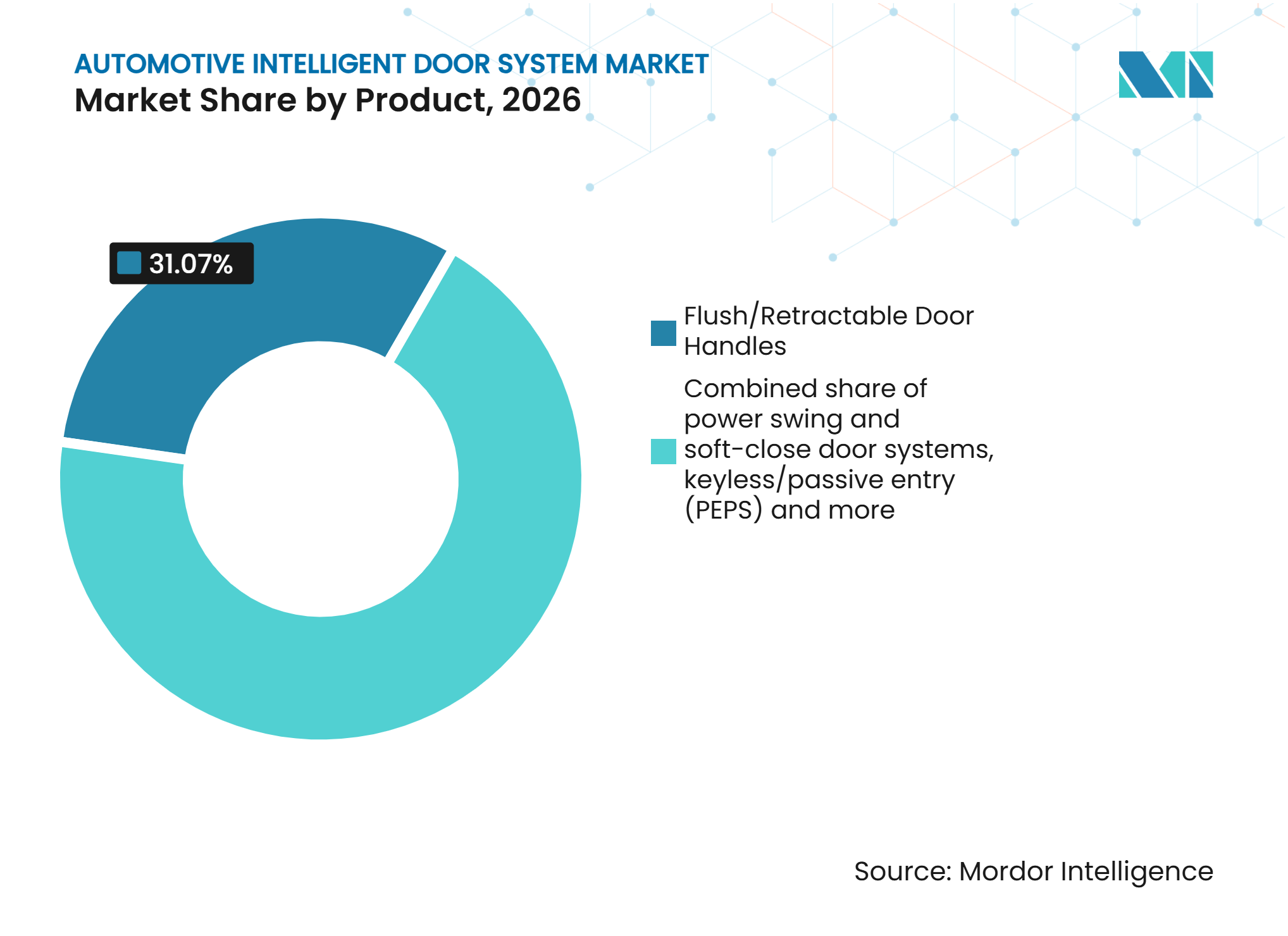
Flush/Retractable Handles Lead While Power Swing and Soft-Close Systems Grow FastestFlush/retractable door handles held 31.07% of the automotive intelligent door system market share in 2026, while power swing and soft-close door systems are forecast to expand at an 11.52% CAGR through 2032. Flush systems are used where vehicle makers want a smooth exterior surface and a controlled access experience. Their design brings together the handle, actuator, sensor, latch interface, and software logic. This makes the product relevant to both design teams and electrical engineering teams. Vehicle makers can use the same basic concept across several trims, although equipment levels may differ. The product’s position reflects its compatibility with electric vehicle styling and connected access functions. China's mandatory standard, effective January 1, 2027, requires mechanical interior and exterior door releases, which is shifting flush-handle designs toward semi-flush or mechanically backed layouts rather than fully concealed electronic handles.
Powered and soft-close systems address a separate need centered on motion assistance and controlled closure. They can help passengers manage larger doors and can support vehicles where entry comfort is a visible product feature. These systems require strong durability because the actuator and closing mechanism are used repeatedly. Obstacle detection and emergency release design remain important parts of the product decision. The automotive intelligent door system industry uses these systems to combine mechanical movement with user-focused access. Wider use will depend on cost control, serviceability, and vehicle makers’ willingness to include the feature outside premium models.



By Component:
Actuators Remain Central While Sensors Gain ImportanceActuators accounted for 45.61% of the automotive intelligent door system market share in 2026, while sensors are expected to grow at an 8.99% CAGR through 2032. An actuator provides the motion needed for retractable handles, powered latches, soft-close functions, and automated door movement. It remains central because intelligent door functions cannot operate without controlled physical movement. Component design must account for force, noise, response time, and repeated use. Suppliers also need to ensure that actuator performance matches the vehicle’s wider electrical system. This makes the actuator a core part of both basic and advanced door configurations.
Sensors provide information that allows a system to recognize users, detect obstacles, and manage door movement safely. Their role grows as vehicle makers add touch-free access, digital key functions, and obstacle detection. The sensor must work with the latch, actuator, and controller rather than as a standalone part. This creates demand for careful calibration and compatible communications. The automotive intelligent door system market depends on sensors that can perform reliably in changing weather and crowded environments. As systems become more integrated, sensor performance can influence the perceived quality of the entire door function.
By Vehicle Type:
Passenger Cars Combine Scale With Above-Market GrowthPassenger cars held 86.19% of the automotive intelligent door system market share in 2026 and are projected to grow at an 8.80% CAGR through 2032. Passenger vehicles are a primary setting for new access and convenience features because manufacturers use them to differentiate models. Electric cars, crossovers, and family vehicles can all use powered releases, passive entry, and flush handles. These features are often introduced first where customers place value on ease of use and design. Passenger vehicle programs also offer suppliers a path to higher volumes once a feature is selected. The segment’s position reflects both its broad production base and its role in introducing new equipment.
Commercial vehicles are projected to grow at a 7.01% CAGR through 2032 and have different operating needs and may adopt selected door functions for fleet use, passenger access, or service efficiency. Their priorities can include durability, remote monitoring, and dependable manual operation. Some fleet uses may benefit from controlled access and hands-free opening. However, equipment decisions are closely tied to operating cost and maintenance needs. The automotive intelligent door system market must offer systems that are easy to diagnose and repair for these users. This can create a more specialized opportunity than the passenger vehicle segment, with different product and service requirements.
By Propulsion:
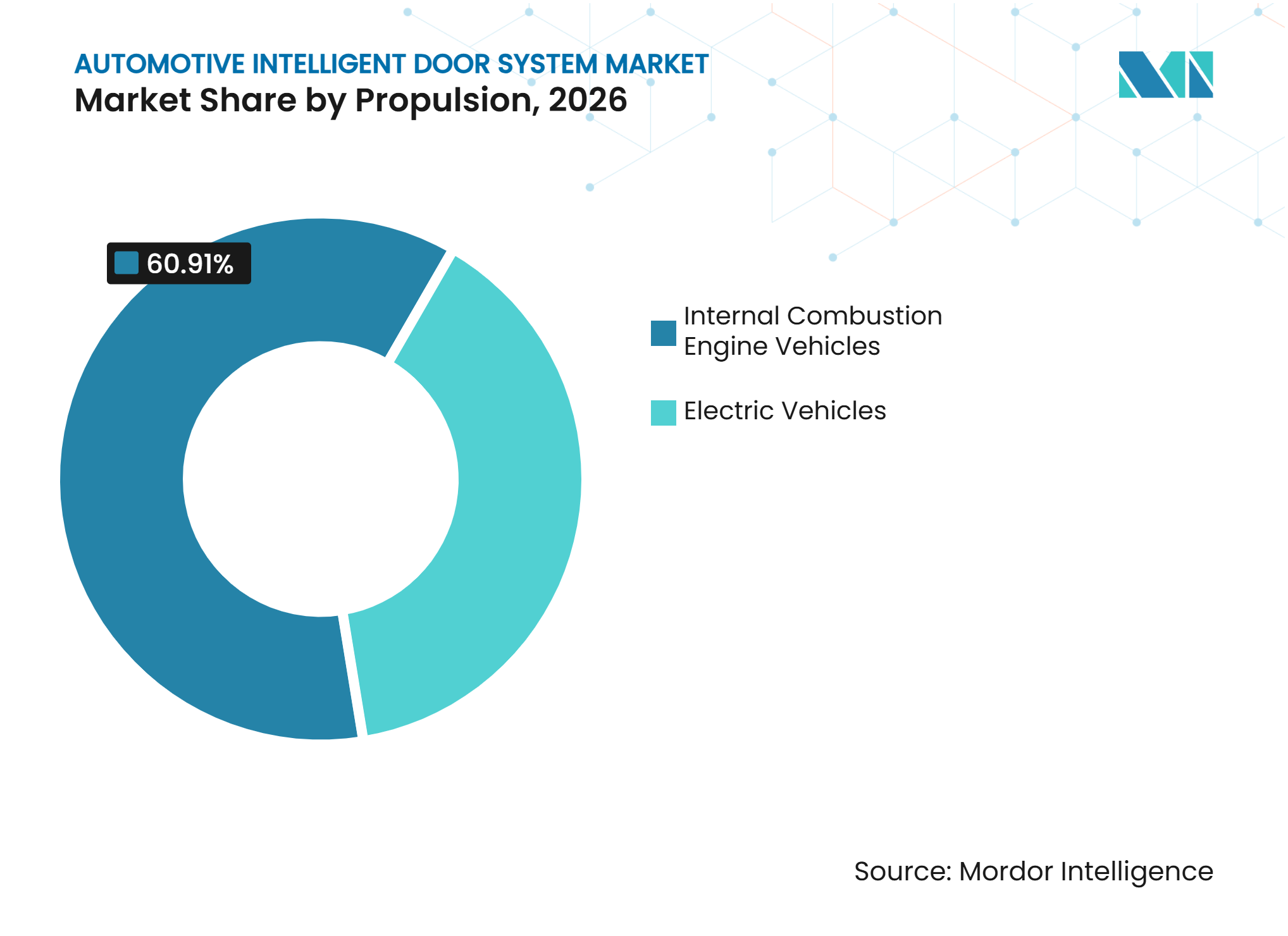
Electric Vehicles Set a Higher Feature BaselineElectric vehicles held 39.09% of the automotive intelligent door system market share in 2026 and are forecast to expand at an 11.31% CAGR through 2032. Electric vehicle makers often use door access and exterior design as part of the overall ownership experience. These vehicles commonly include electronic architectures that support powered latches, digital access, and retractable handles. The result is a higher focus on electronic door content during vehicle development. This does not mean that every electric vehicle uses the same feature set. It does mean that electric platforms provide a strong setting for integrated access functions.
Internal combustion engine vehicles retain a large installed base and continue to use passive entry, electronic latches, and flush handle designs. Electrical architecture can be as important as propulsion when a vehicle maker decides which door functions to include. A combustion vehicle with a modern electrical system may adopt features similar to those on an electric model. Suppliers therefore need products that can work across propulsion types and vehicle platforms. The automotive intelligent door system market benefits when components can be adapted without a complete redesign. This helps manufacturers introduce functions in line with each program’s price and technical requirements.

By Sales Channel:
OEM Integration Remains Dominant While Aftermarket Needs Specialist SupportOriginal equipment manufacturers (OEMs) held 82.99% of the automotive intelligent door system market share in 2026, while the aftermarket is expected to grow at a 7.43% CAGR through 2032. OEMs select door systems during vehicle engineering, when body structure, wiring, safety, and software decisions are made together. This gives the OEM channel a strong role in the market. Suppliers must meet vehicle maker testing, quality, and timing requirements before a part is approved. Once selected, a system can remain linked to a vehicle program for several years. This creates a significant advantage for suppliers with established engineering and manufacturing relationships.
The aftermarket serves vehicles that need replacement components or repairs as the installed base ages. Intelligent door parts can be more difficult to replace than conventional hardware because they may require compatible controls and programming. Specialist repairers and authorized networks may therefore play a larger role than general accessory sellers. Availability of parts, technical documentation, and diagnostic support can shape this channel. The automotive intelligent door system industry has an opportunity to improve service access without compromising safety or system security. The channel will remain selective because door functions affect entry, exit, and vehicle protection.
Geography Analysis
Asia-Pacific held 39.19% of the automotive intelligent door system market share in 2026, while South America is projected to record a 9.21% CAGR through 2032 as Brazilian assembly programs adopt globally aligned platforms with electronic latches and passive entry. China supports regional demand through its large electric vehicle base, active supplier network, and focus on digital vehicle features. Japan and South Korea contribute established vehicle manufacturing programs and a strong record of feature development. The region includes both global suppliers and local companies that compete in actuators, sensors, access modules, and related electronics. This competitive mix can support faster feature development while also increasing price pressure. The automotive intelligent door system market is supported by the region’s broad range of vehicle types, from volume passenger cars to higher-equipped electric models.
North America and Europe are important markets for connected access, powered functions, and safety-related design work. North American vehicle makers focus on user convenience, digital access, and clear safety operation. Regulatory attention to electronic door releases makes robust manual backup and understandable controls important. Europe places strong emphasis on vehicle software, cybersecurity, and type approval processes. These requirements can favor suppliers with established development and validation capabilities. The automotive intelligent door system market in these regions is shaped by the need to combine feature differentiation with dependable operation and documented compliance.
The Middle East and Africa contain varied vehicle demand patterns. Gulf markets can support higher feature content in premium and luxury vehicles, while lower-priced markets may prioritize durable basic access systems. South Africa and Morocco are relevant manufacturing locations as regional assembly activity develops. Oceania largely follows vehicle technology choices made in major importing markets. South America can benefit when local assembly programs use globally aligned platforms and equipment packages. The automotive intelligent door system market across these areas depends on vehicle affordability, manufacturing investment, local service capability, and the pace at which connected vehicle features are introduced.
Competitive Landscape
Market Concentration
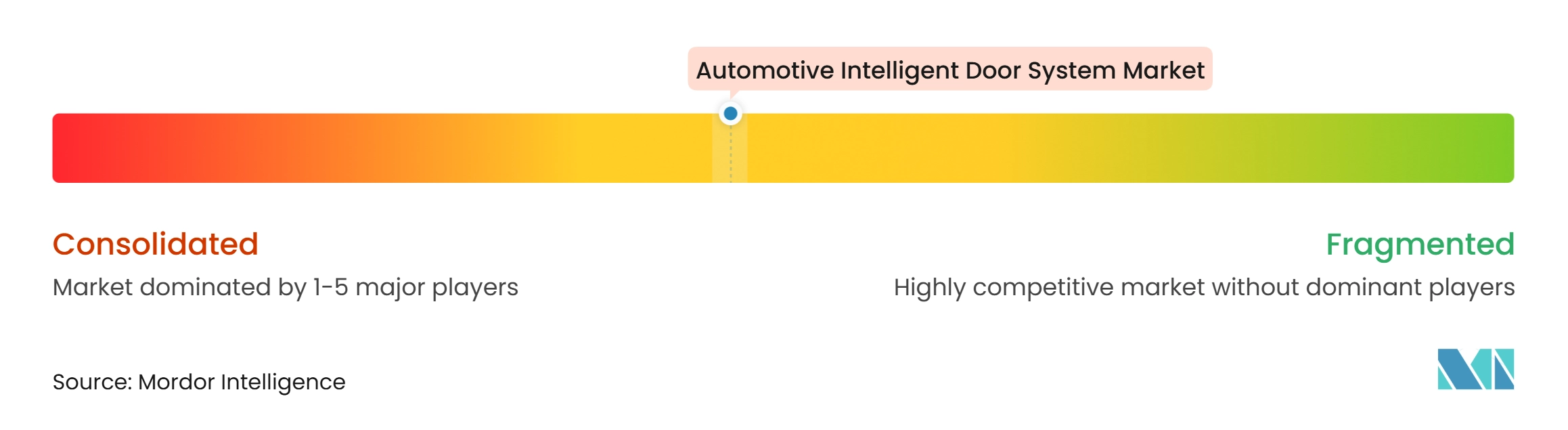
The automotive intelligent door system market is moderately concentrated and comprises full-system suppliers, component specialists, and regional manufacturers. Brose, Magna International, Kiekert, Huf Hülsbeck, and Inteva Products are positioned around high-value functions that combine latches, handles, actuators, sensors, and controls. Competition is not limited to a single part because vehicle makers increasingly evaluate the reliability of the complete access system. Suppliers with long-standing relationships with vehicle makers can offer engineering support and production experience. At the same time, specialized motor, sensor, and access companies remain important to the supply chain. The competitive picture is shaped by the ability to meet safety, software, cost, and production requirements simultaneously.
Technology development is a central competitive factor. Brose’s 2025 Auto Shanghai concept combined gesture-based access with radar-protected power door operation. Stabilus won a 2025 order from a Chinese automaker for more than 400,000 electromechanical side-door drive systems per year, building on its motion-control capabilities. These moves illustrate how suppliers are extending from individual parts into more integrated door functions. Magna continues to position vehicle access as an area where software and mechanical systems are increasingly linked. Companies that can offer validated systems with reliable physical backup are likely to have a stronger position in future vehicle programs.
Supplier selection also depends on financial stability, manufacturing reach, and support for global platforms. Vehicle makers need partners that can supply consistent components across several regions and handle design changes during a program. The automotive intelligent door system market is likely to remain competitive because no single supplier controls every access function. Smaller companies can still participate through specialized technology, local production, or a strong position in a specific component. However, the move toward integrated systems can raise the threshold for companies that cannot support software, electronics, and validation work. The result is a market where partnerships and product scope can matter as much as the design of an individual latch or handle.
Automotive Intelligent Door System Industry Leaders
-
Brose Fahrzeugteile SE and Co. KG
-
Magna International Inc.
-
Kiekert AG
-
Huf Hülsbeck and Fürst GmbH and Co. KG
-
Inteva Products, LLC
- *Disclaimer: Major Players sorted in no particular order
Automotive Intelligent Door System Market Companies Covered in this Report
- Brose Fahrzeugteile SE and Co. KG
- Magna International Inc.
- Kiekert AG
- Inteva Products, LLC
- Aisin Corporation
- Huf Hülsbeck and Fürst GmbH and Co. KG
- AUMOVIO SE
- Robert Bosch GmbH
- Valeo SE
- Hyundai Mobis Co., Ltd.
- Mitsui Kinzoku ACT Corporation
- MinebeaMitsumi Inc.
- STRATTEC Security Corporation
- WITTE Automotive GmbH
- DENSO Corporation
- Alps Alpine Co., Ltd.
- Stabilus SE
- FORVIA SE
- Marquardt GmbH
- Johnson Electric Holdings Limited
Recent Industry Developments in Automotive Intelligent Door System Market
- July 2026: The US National Highway Traffic Safety Administration granted a petition to begin rulemaking on clearer and more reliable door release systems for new motor vehicles.
- February 2026: China's Ministry of Industry and Information Technology issued a mandatory safety standard, effective January 1, 2027, requiring mechanical interior and exterior door releases and ending fully concealed electronic door handles.
- September 2025: NHTSA opened a preliminary evaluation into about 174,000 2021 Tesla Model Y vehicles over electronic door handles that could fail to open from outside.
- April 2025: Stabilus received an order from a Chinese automaker for more than 400,000 electromechanical side-door drive systems per year, with deliveries starting in 2026.
Global Automotive Intelligent Door System Market Report Scope
The Automotive Intelligent Door System Market is segmented by Product, Component, Vehicle Type, Propulsion, Sales Channel, and Geography. By Product, the market is segmented into Power Swing and Soft-Close Door Systems (Including Automatic Opening), Keyless/Passive Entry (PEPS), Electronic Door Latch (E-Latch), Flush/Retractable Door Handles, Power Sliding Doors, and Other Products. By Component, the market is segmented into Actuators, Latches, Sensors, Door Control Modules/ECUs, and Other Components (Switches). By Vehicle Type, the market is segmented into Passenger Cars (Including MPVs) and Commercial Vehicles. By Propulsion, the market is segmented into Internal Combustion Engine Vehicles and Electric Vehicles. By Sales Channel, the market is segmented into Original Equipment Manufacturer and Aftermarket. By Geography, the market is segmented into North America (United States, Canada, and Mexico), Europe (Germany, United Kingdom, France, Italy, Spain, Russia, and Rest of Europe), Asia-Pacific (China, Japan, South Korea, India, Thailand, Indonesia, and Rest of Asia-Pacific), South America (Brazil, Argentina, Colombia, Chile, and Rest of South America), and Middle East and Africa (Turkiye, Saudi Arabia, United Arab Emirates, Israel, Egypt, South Africa, Morocco, and Rest of Middle East and Africa). Market forecasts are provided in terms of Value (USD).
Segmentation Overview
| Power Swing and Soft-Close Door Systems (Including Automatic Opening) |
| Keyless/Passive Entry (PEPS) |
| Electronic Door Latch (E-Latch) |
| Flush/Retractable Door Handles |
| Power Sliding Doors |
| Other Products |
| Actuators |
| Latches |
| Sensors |
| Door Control Modules/ECUs |
| Other Components (Switches) |
| Passenger Cars (Including MPVs) |
| Commercial Vehicles |
| Internal Combustion Engine Vehicles |
| Electric Vehicles |
| Original Equipment Manufacturer |
| Aftermarket |
| North America | United States |
| Canada | |
| Mexico | |
| Europe | Germany |
| United Kingdom | |
| France | |
| Italy | |
| Spain | |
| Russia | |
| Rest of Europe | |
| Asia-Pacific | China |
| Japan | |
| South Korea | |
| India | |
| Thailand | |
| Indonesia | |
| Rest of Asia-Pacific | |
| South America | Brazil |
| Argentina | |
| Colombia | |
| Chile | |
| Rest of South America | |
| Middle East and Africa | Turkiye |
| Saudi Arabia | |
| United Arab Emirates | |
| Israel | |
| Egypt | |
| South Africa | |
| Morocco | |
| Rest of Middle East and Africa |
| By Product | Power Swing and Soft-Close Door Systems (Including Automatic Opening) | |
| Keyless/Passive Entry (PEPS) | ||
| Electronic Door Latch (E-Latch) | ||
| Flush/Retractable Door Handles | ||
| Power Sliding Doors | ||
| Other Products | ||
| By Component | Actuators | |
| Latches | ||
| Sensors | ||
| Door Control Modules/ECUs | ||
| Other Components (Switches) | ||
| By Vehicle Type | Passenger Cars (Including MPVs) | |
| Commercial Vehicles | ||
| By Propulsion | Internal Combustion Engine Vehicles | |
| Electric Vehicles | ||
| By Sales Channel | Original Equipment Manufacturer | |
| Aftermarket | ||
| By Geography | North America | United States |
| Canada | ||
| Mexico | ||
| Europe | Germany | |
| United Kingdom | ||
| France | ||
| Italy | ||
| Spain | ||
| Russia | ||
| Rest of Europe | ||
| Asia-Pacific | China | |
| Japan | ||
| South Korea | ||
| India | ||
| Thailand | ||
| Indonesia | ||
| Rest of Asia-Pacific | ||
| South America | Brazil | |
| Argentina | ||
| Colombia | ||
| Chile | ||
| Rest of South America | ||
| Middle East and Africa | Turkiye | |
| Saudi Arabia | ||
| United Arab Emirates | ||
| Israel | ||
| Egypt | ||
| South Africa | ||
| Morocco | ||
| Rest of Middle East and Africa | ||
Key Questions Answered in the Report
What is driving demand for automotive intelligent door systems?
Electric vehicle programs, digital access, electronic vehicle architectures, and demand for convenient entry functions support adoption.
Which product category leads automotive intelligent door systems?
Flush/retractable door handles lead the product category with a 31.07% share in 2026.
Which automotive intelligent door system component is growing fastest?
Sensors are forecast to grow at an 8.99% CAGR through 2032 as access, obstacle detection, and door-control functions become more connected.
Why are electric vehicles important for door system suppliers?
Electric vehicles held a 39.09% share in 2026 and commonly support integrated electronic access, powered latch, and retractable handle functions.