
Automotive Electronic Expansion Valve Market Size and Share
Market Overview
| Study Period | 2020 - 2032 |
|---|---|
| Market Size (2027) | USD 2.66 Billion |
| Market Size (2032) | USD 4.84 Billion |
| Growth Rate (2027 - 2032) | 12.72 % |
| Fastest Growing Market | Asia-Pacific |
| Largest Market | Asia-Pacific |
| Market Concentration | Medium |
Major Players *Disclaimer: Major Players sorted in no particular order Image © Mordor Intelligence. Reuse requires attribution under CC BY 4.0. | |
Automotive Electronic Expansion Valve Market Analysis by Mordor Intelligence
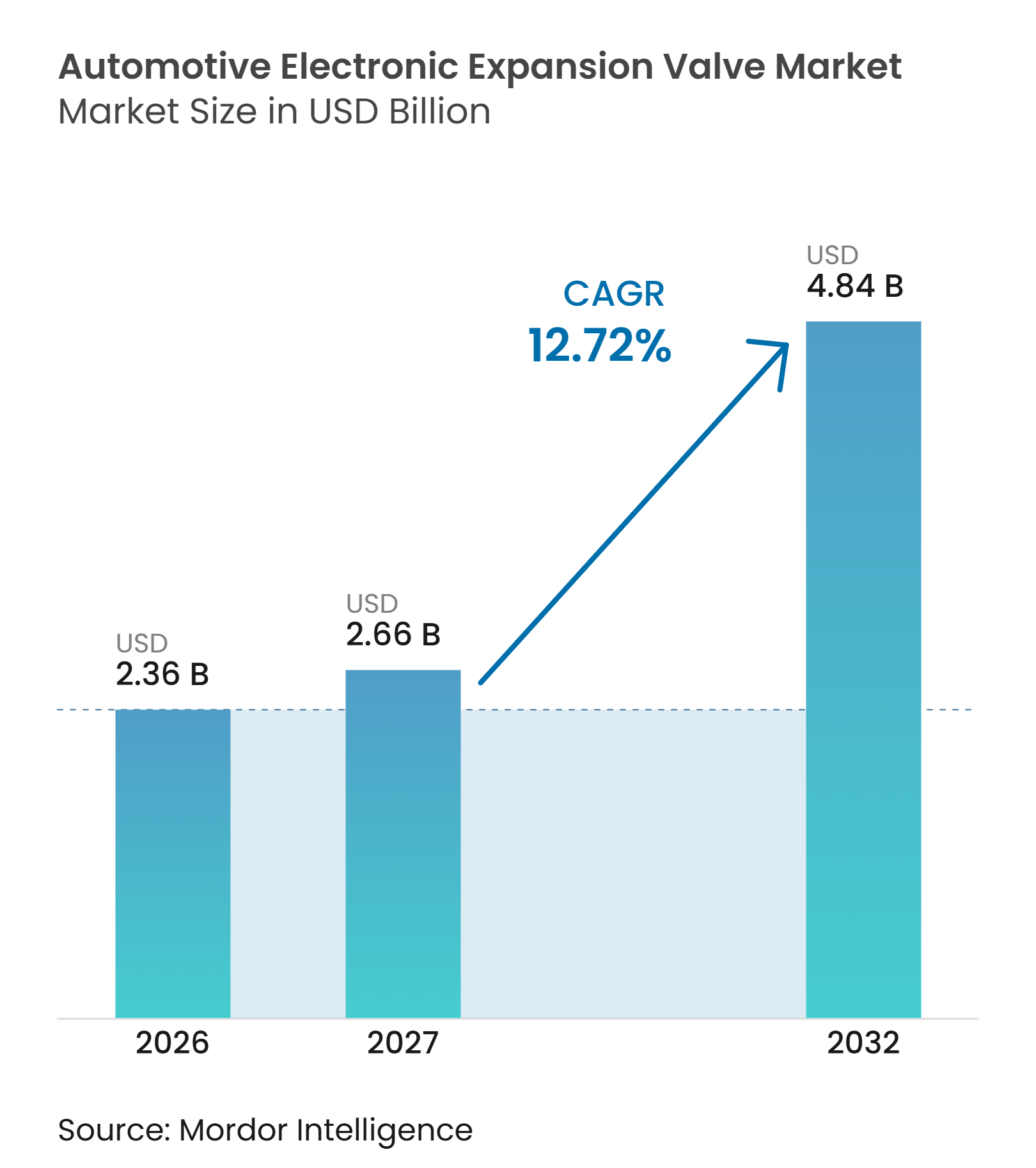
The automotive electronic expansion valve market size was valued at USD 2.36 billion in 2026 and is expected to grow from USD 2.66 billion in 2027 to USD 4.84 billion by 2032, at a CAGR of 12.72% during 2027-2032. The automotive electronic expansion valve market is growing as electric vehicle platforms require controlled refrigerant flow across the cabin, battery, power electronics, and charging systems. A battery-electric platform can use several electronic expansion valve points, while a conventional internal-combustion vehicle generally uses a simpler thermal layout. This higher component content supports demand even where electric vehicle sales growth becomes less uniform across mature countries. Suppliers are responding by combining valves, sensors, and controls into integrated modules that can be qualified for different vehicle platforms. Refrigerant rules and the move toward heat pumps are also widening the automotive electronic expansion valve market opportunity for products that work with several refrigerants.
Key Report Takeaways
- By valve type, integrated/multi-function EXV modules held a 59.13% share in 2026 and are projected to grow at a 17.22% CAGR through 2032.
- By application, cabin HVAC and heat pump held a 70.24% share in 2026, while battery thermal management (chiller) is projected to grow at a 15.13% CAGR through 2032.
- By refrigerant, R134a held a 48.50% share in 2026, while other refrigerants (R744/CO2) are projected to grow at a 19.45% CAGR through 2032.
- By propulsion type, battery electric vehicles held a 74.22% share in 2026 and are projected to grow at a 13.04% CAGR through 2032.
- By sales channel, OEMs held an 89.45% share in 2026, while the aftermarket is projected to grow at a 13.86% CAGR through 2032.
- By geography, Asia-Pacific held a 65.14% share in 2026 and is projected to grow at a 14.25% CAGR through 2032.
Note: Market numbers in this report are based on Mordor Intelligence's proprietary estimation framework, which combines nine months of actuals with Q4 projections for base year 2026.
Market Trends and Insights
Drivers Impact Analysis of Automotive Electronic Expansion Valve Market*
| Driver | (~) % Impact on CAGR Forecast | Geographic Relevance | Impact Timeline |
|---|---|---|---|
| Electrified Vehicle Thermal-Load Complexity | +3.2% | Global, with Asia-Pacific and Europe as primary markets | Short term (≤ 2 years) |
| Heat-Pump Adoption and Cold-Weather Efficiency | +2.6% | Asia-Pacific core, Europe | Short term (≤ 2 years) |
| Battery Fast-Charging and Life-Cycle Requirements | +2.0% | Global | Medium term (2–4 years) |
| Low-GWP Refrigerant Transition | +1.5% | Europe and China primarily, with spillover to North America | Medium term (2–4 years) |
| Rising EXV Content per Vehicle From Multi-Loop Architectures | +1.2% | Global | Medium term (2–4 years) |
| Integrated Chiller-EXV Sensing and Control Modules | +1.0% | Asia-Pacific and Europe | Long term (≥ 4 years) |
| Source: Mordor Intelligence | |||
Electrified Vehicle Thermal-Load Complexity
Battery-electric and plug-in hybrid vehicles have thermal loads that differ from those of internal-combustion vehicles. The battery pack, power electronics, and passenger cabin need separate temperature control under changing driving and charging conditions. Digitally controlled valves can meter refrigerant flow across parallel circuits and support coordinated thermal management. Multi-stage suction-pressure feedforward regulation reduces compressor energy use in coordinated dual-loop electric-vehicle systems. The automotive electronic expansion valve market therefore benefits when vehicle designers replace separate passive devices with controlled multi-loop systems. Higher-energy-density batteries also require closer thermal control, which raises the functional requirements for valve suppliers.
Heat-Pump Adoption and Cold-Weather Efficiency
Heat pumps support cabin heating without relying on combustion-engine waste heat in electric vehicles. The valve must work in cooling mode and provide bypass control in heating mode, so it has a wider operating role than a basic refrigerant component. Valeo stated that its Compact 5-Ways Refrigerant Valve replaces three solenoid valves and one check valve with a single rotating-plate assembly, and the product, named a CES Innovation Awards 2026 honoree in November 2025, was scheduled to enter series production in September 2026 [1]. Electronic expansion valve opening precision is identified as an important factor in automotive heat-pump heating performance and frost management at minus 10°C. This function increases the value of precision control in the automotive electronic expansion valve market as heat-pump systems become more common.
Battery Fast-Charging and Life-Cycle Requirements
Fast charging can create thermal loads that exceed the needs of steady driving. Battery chiller circuits therefore require valves that can respond quickly to changing refrigerant demand. Dun'an supplies large-bore electronic expansion valves for battery direct-cooling and fast-charging thermal circuits. Electronically regulated liquid cooling can maintain battery temperature uniformity below a 5°C difference at 5C discharge rates. These requirements support integrated chiller, valve, sensing, and control modules for platforms with multiple cooling circuits. The automotive electronic expansion valve market gains from this shift because valve performance is becoming part of broader battery durability and charging design requirements.
Low-GWP Refrigerant Transition
The shift to lower-global-warming-potential refrigerants requires products that can operate with different pressures and materials. European Union Regulation 2024/573 established updated rules for fluorinated greenhouse gases and supports a phased reduction in hydrofluorocarbons [2]. The European Commission also published Regulation 2025/1893 on technician training attestations for mobile equipment using fluorinated gases. Suppliers such as Hilite offer electronic expansion valves for several refrigerant families, showing the need for broader multi-refrigerant product lines. R744 systems operate at much higher pressures than R1234yf systems, so durability, sealing, and qualification requirements become more demanding. This regulatory and technical transition favors suppliers that can validate multi-refrigerant products for global vehicle programs.
Restraints Impact Analysis of Automotive Electronic Expansion Valve Market*
| Restraint | (~) % Impact on CAGR Forecast | Geographic Relevance | Impact Timeline |
|---|---|---|---|
| Calibration and Validation Burden | -0.9% | Global, especially Europe, Japan, and North America | Short term (≤ 2 years) |
| Higher System and Electronics Cost | -0.7% | Southeast Asia, South America, and the Middle East and Africa | Medium term (2–4 years) |
| High-Pressure CO2 Durability and Sealing Requirements | -0.3% | Europe and Asia-Pacific | Medium term (2–4 years) |
| Refrigerant-Load Transients Across Cabin and Battery Circuits | -0.2% | Global | Long term (≥ 4 years) |
| Source: Mordor Intelligence | |||
Calibration and Validation Burden
A vehicle-platform electronic expansion valve program can require 18 to 24 months of thermal cycling, vibration, refrigerant compatibility, and electromagnetic-interference testing. A second refrigerant type increases the work because the supplier must prove performance across another operating condition. Sanhua reported in 2025 that it led drafting work for an automotive thermal-system electronic expansion valve standard [3]. The company noted that the existing standard did not include requirements for electronic expansion valves. Until common requirements are fully established, manufacturers continue to work through platform-specific tests. This process limits how quickly new designs can move across programs in the automotive electronic expansion valve market.
Higher System and Electronics Cost
Integrated modules cost more than standalone valves because they combine additional electronics, actuators, sensors, and engineering work. The cost difference is more difficult to absorb in entry-level electric vehicles and in regions with high vehicle price sensitivity. Suppliers can face pressure to lower prices even as thermal-system content per vehicle rises. This pressure is relevant in Southeast Asia, South America, and the Middle East and Africa, where premium electric vehicle infrastructure is still developing. The automotive electronic expansion valve market can still grow in these regions, but adoption of higher-function modules may follow a slower timetable. Larger production volumes can reduce unit costs, although competitive sourcing is likely to continue limiting pricing power.
*Our forecasts treat driver/restraint impacts as directional, not additive. The impact forecasts reflect baseline growth, mix effects, and variable interactions.
Automotive Electronic Expansion Valve Market Segment Analysis
By Valve Type:
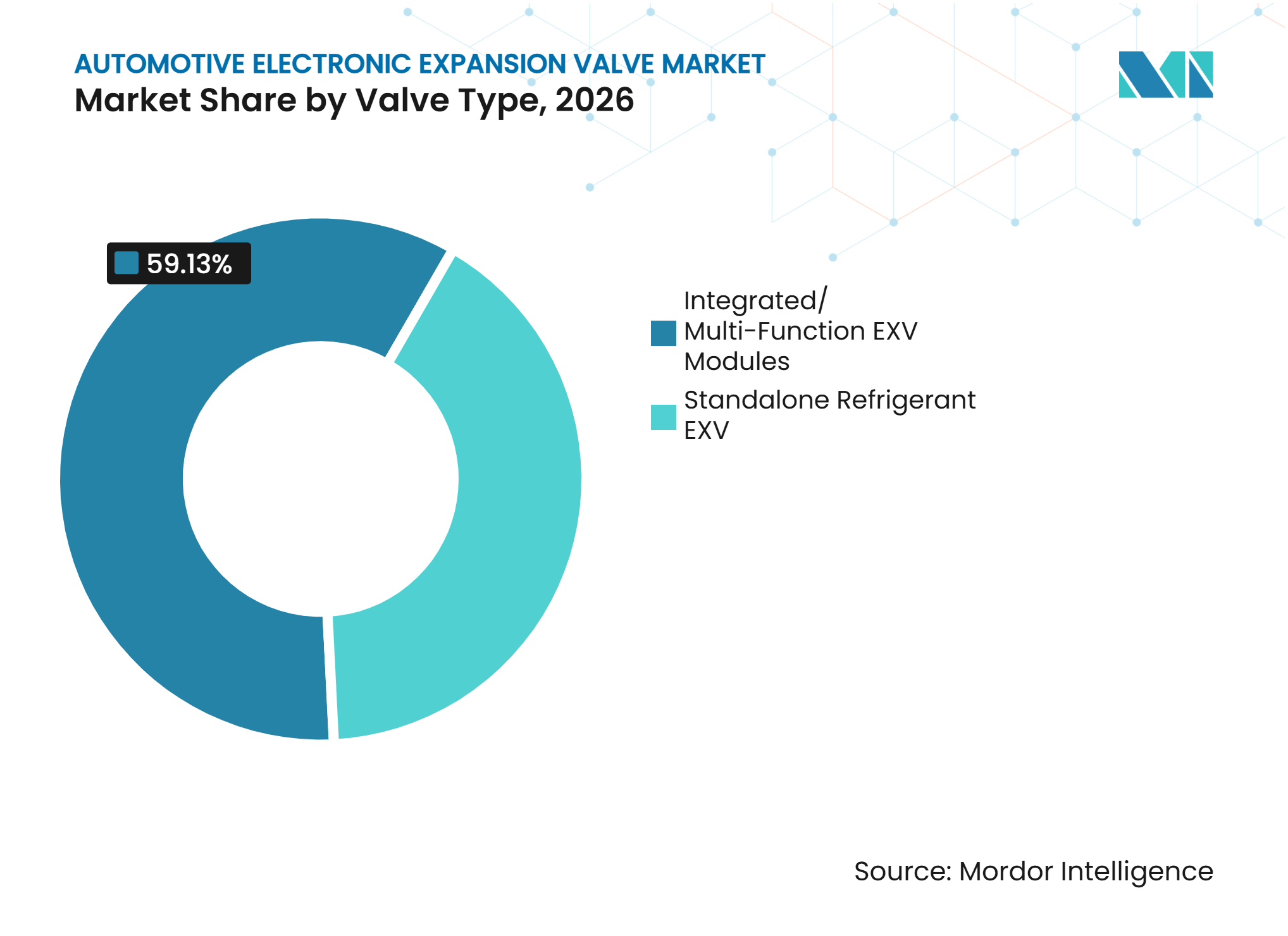
Integrated Modules Set the Preferred ArchitectureIntegrated/multi-function EXV modules held a 59.13% share in 2026 and are projected to grow at a 17.22% CAGR through 2032. These modules combine several refrigerant-control functions in one assembly. The approach reduces connection points in the thermal system. It also reduces assembly work and packaging demands. Tuopu uses a modular coil-and-valve-core approach to shorten development cycles.
Standalone refrigerant EXVs remain useful in vehicles with fewer thermal loops. They suit internal-combustion vehicles and lower-complexity hybrid platforms. They also support like-for-like replacement work. Chinese industry bodies have also begun publishing group standards for new-energy-vehicle thermal-management electronic expansion valves, giving the category a clearer product reference. However, single-function devices do not deliver the packaging and system benefits of integrated modules.


By Application:
Cabin HVAC Retains Scale While Chillers Gain ImportanceCabin HVAC and heat pump applications held a 70.24% share in 2026. The application is used across electric, hybrid, and internal-combustion vehicles. Heat-pump systems need valves to direct refrigerant through heating and cooling paths. This function is important when cold-weather heating affects driving range. The valve must also accommodate different cabin and equipment temperature requirements.
Battery thermal management (chiller) is forecast to grow at a 15.13% CAGR through 2032. Battery cooling demand can shift rapidly during charging and high-load operation. Electronic control helps maintain refrigerant flow under those changing conditions. SAE research found that graduated electronic valve opening can prevent evaporator refrigerant starvation during sudden battery cooling-load changes. Power electronics and advanced driver-assistance hardware add further cooling needs.
By Refrigerant:
R134a Leads While R744 Changes Design RequirementsR134a held a 48.50% share in 2026. Its lead reflects continued use in vehicle air-conditioning systems in China and other Asia-Pacific markets, where most electronic expansion valves are installed. Suppliers have established valve lines for these circuits. Service networks also have experience with the installed base. R1234yf, with a 44.00% share, is the established refrigerant for new passenger vehicles in Europe and is widely used in North America. These positions support continued demand for existing product families. The automotive electronic expansion valve market also requires preparation for other refrigerants.
Other refrigerants (R744/CO2) are forecast to grow at a 19.45% CAGR through 2032. R744 operates at much higher pressure than R1234yf. It therefore requires stronger valves and more demanding sealing performance. R744 has stronger heating performance in subzero conditions than R134a. Hanon Systems said in September 2025 that its Palmela, Portugal plant, which supplies Volkswagen Group's MEB platform, had produced more than one million R744 electric compressors. This transition favors suppliers with validated high-pressure product designs.
By Propulsion Type:
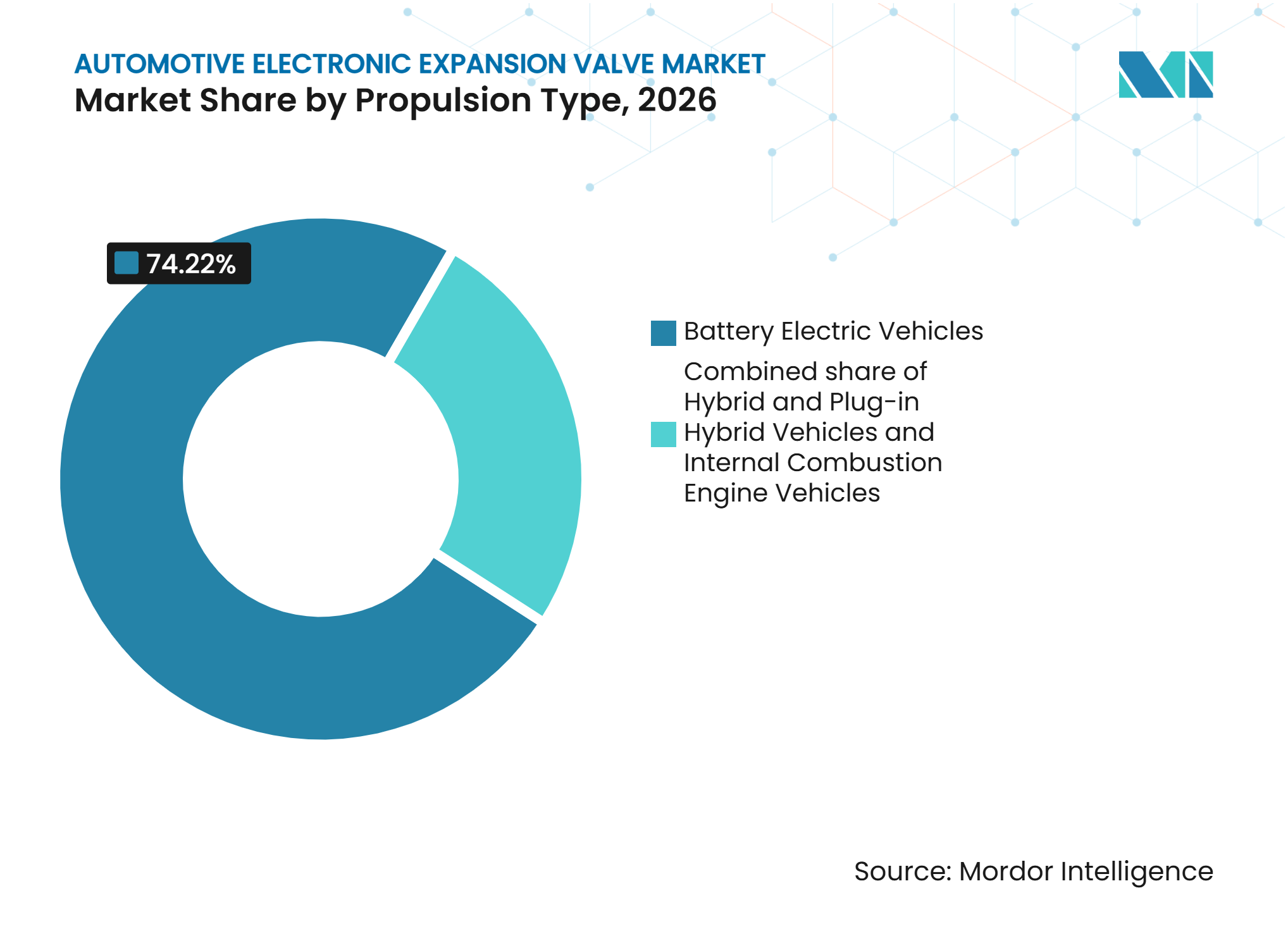
BEVs Create the Highest Valve ContentBEVs accounted for a 74.22% share in 2026 and are projected to grow at a 13.04% CAGR through 2032. Battery-electric vehicles lack engine waste heat for cabin heating. Their heat-pump networks therefore manage passenger comfort and battery conditions. Battery cooling also requires precise response during driving and charging. These needs raise valve content per vehicle. Multi-loop platforms create the strongest demand for controlled refrigerant flow. The automotive electronic expansion valve market benefits from this higher functional content.
Hybrid and plug-in hybrid vehicles also contribute to demand. Their chillers and heat pumps work alongside engine waste-heat recovery. This arrangement retains a role for precise refrigerant control during electric-mode operation. Internal-combustion vehicles continue to support replacement demand. Husco offers proportional and bypass EXVs for EV refrigerant management, indicating continued supplier support for several propulsion types.


By Sales Channel:
OEM Programs Lead While Service Demand BuildsOEM channels held an 89.45% share in 2026, the largest position in the automotive electronic expansion valve market. Valves are designed into a vehicle's thermal architecture. They require platform-specific validation before production. Supply agreements can last for seven to 10 years per vehicle program. This setup favors suppliers that secure early design positions. OEM teams also assess reliability and refrigerant compatibility. These conditions make late supplier entry difficult.
The aftermarket is forecast to grow at a 13.86% CAGR through 2032. Repair demand will rise as electric vehicles age. HELLA expanded its independent aftermarket thermal-management range by 1,500 items to 2,400 in February 2026, adding 11 product categories that include expansion valves, and plans to reach about 6,000 items by the end of 2027. The aftermarket remains smaller than OEM supply but provides an expanding secondary route to revenue.
Geography Analysis
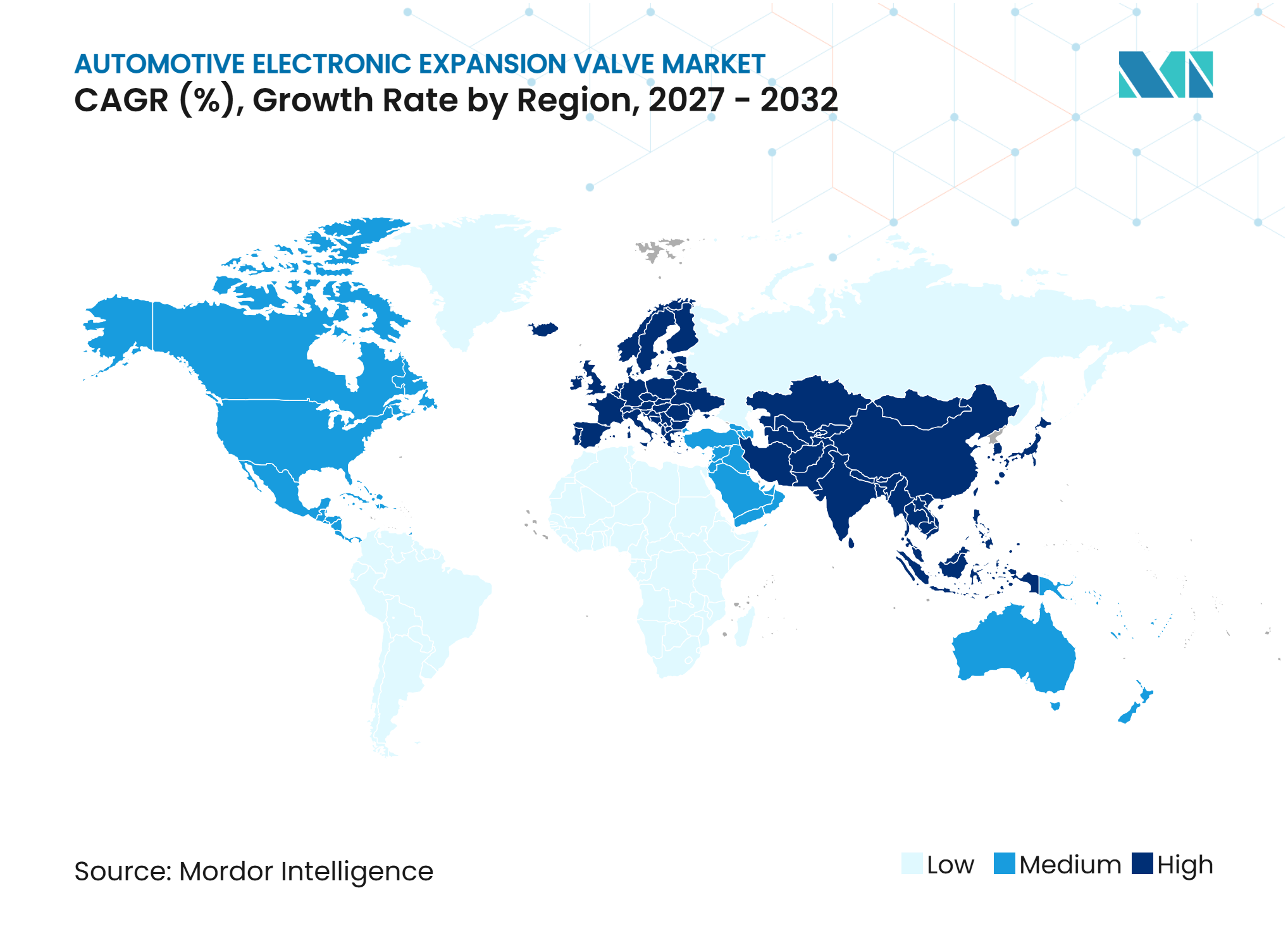
Asia-Pacific held a 65.14% share in 2026 and is forecast to grow at a 14.25% CAGR through 2032. China provides the region's largest electric vehicle production base and local thermal-component supply. Japan adds established Tier 1 relationships through DENSO, Fujikoki, Mitsubishi Heavy Industries Thermal Systems, and TGK. South Korea contributes heat-pump compressor and thermal-management capabilities. The region combines vehicle assembly, component manufacturing, and shorter model-development cycles.
Asian suppliers are building capacity beyond their home markets. Tuopu announced an investment of up to USD 300 million in a Thailand automotive-parts production base in April 2025. The investment supports ASEAN-based manufacturing for global programs. India is becoming more relevant as local automotive HVAC suppliers move into electric vehicle thermal management.
Europe is the second-largest region and is supported by vehicle producers in Germany, France, Sweden, and the Czech Republic. European Union F-gas rules are encouraging lower-global-warming-potential refrigerant choices and related redesign work. Sanhua Automotive is expanding European production at Tychy, Poland, where it is investing in thermal-management components for electric and hybrid vehicles, including valves and heat pumps. North America follows Europe and is shaped by manufacturing growth across the United States, Canada, and Mexico.
Competitive Landscape
Market Concentration

The automotive electronic expansion valve market is moderately concentrated, and Zhejiang Sanhua Intelligent Controls has a leading global position. DENSO, Valeo, MAHLE, and Hanon Systems compete in the premium original-equipment tier. These companies differentiate through refrigerant coverage, controls expertise, reliability, and participation in wider thermal modules. Vehicle manufacturers increasingly buy integrated thermal solutions rather than isolated components. This approach makes engineering collaboration and program qualification central to competition.
Sanhua has invested in standard-setting work for automotive electronic expansion valves. Valeo's Compact 5-Ways Refrigerant Valve, scheduled for series production from September 2026, combines several valves in one assembly. HELLA is expanding independent aftermarket coverage for thermal management parts. Chinese Tier 1 suppliers are also targeting export programs through cost-focused designs and overseas production.
Open areas include R744-compatible products, integrated valve-chiller-sensor modules, and service infrastructure for older electric vehicles. R744 applications require high-pressure valves that maintain sealing and durability under demanding operating conditions. Integrated systems for 800-volt charging platforms need faster control across several cooling circuits. The sector faces risks from slower electric-vehicle adoption in parts of Europe and delays in regulatory approval of R290 in the United States. Supply concentration for stepper-motor actuators and precision valve bodies in East Asia also creates exposure to changing trade policy.
Automotive Electronic Expansion Valve Industry Leaders
-
Zhejiang Sanhua Intelligent Controls Co., Ltd.
-
TGK Co., Ltd.
-
Zhejiang Dun'an Artificial Environment Co., Ltd.
-
Hanon Systems Co., Ltd.
-
Fujikoki Corporation
- *Disclaimer: Major Players sorted in no particular order
Automotive Electronic Expansion Valve Market Companies Covered in this Report
- Zhejiang Sanhua Intelligent Controls Co., Ltd.
- Zhejiang Dun'an Artificial Environment Co., Ltd.
- TGK Co., Ltd.
- Fujikoki Corporation
- Hanon Systems Co., Ltd.
- Egelhof Group
- Pacific Industrial Co., Ltd.
- Hilite International, Inc.
- Ningbo Tuopu Group Co., Ltd.
- Denso Corporation
- Valeo SE
- MAHLE GmbH
- Robert Bosch GmbH
- Aotecar New Energy Technology Group Co., Ltd.
- Subros Limited
Recent Industry Developments in Automotive Electronic Expansion Valve Market
- April 2026: Hanon Systems began supplying its highly integrated cooling entity, which combines the compressor, condenser, and an electronic expansion valve block in one module, for the BMW iX3.
- February 2026: HELLA expanded its independent aftermarket thermal-management range by 1,500 items to 2,400, adding 11 product categories that include expansion valves.
- November 2025: Valeo's Compact 5-Ways Refrigerant Valve, which replaces three solenoid valves and one check valve for EV heat-pump systems, was named a CES Innovation Awards 2026 honoree.
- September 2025: Hanon Systems passed one million cumulative R744 electric compressors produced at its Palmela, Portugal plant, which supplies Volkswagen Group's MEB platform.
Global Automotive Electronic Expansion Valve Market Report Scope
The scope includes segmentation by valve type (Standalone Refrigerant EXV and Integrated/Multi-Function EXV Modules), application (Cabin HVAC and Heat Pump, Battery Thermal Management (Chiller), and Other Applications), refrigerant (R134a, R1234yf, and Other Refrigerants (R744/CO2)), propulsion type (Battery Electric Vehicles, Hybrid and Plug-in Hybrid Vehicles, and Internal Combustion Engine Vehicles), and sales channel (OEM and Aftermarket). The analysis also covers regional-level segmentation, including North America, Europe, Asia-Pacific, South America, and the Middle East and Africa. Market size and growth forecasts are presented by value in USD and volume in Units.
Segmentation Overview
| Standalone Refrigerant EXV |
| Integrated/Multi-Function EXV Modules |
| Cabin HVAC and Heat Pump |
| Battery Thermal Management (Chiller) |
| Other Applications |
| R134a |
| R1234yf |
| Other Refrigerants (R744/CO2) |
| Battery Electric Vehicles |
| Hybrid and Plug-in Hybrid Vehicles |
| Internal Combustion Engine Vehicles |
| OEM |
| Aftermarket |
| North America | United States |
| Canada | |
| Rest of North America | |
| Europe | Germany |
| France | |
| United Kingdom | |
| Italy | |
| Spain | |
| Sweden | |
| Czech Republic | |
| Russia | |
| Rest of Europe | |
| Asia-Pacific | China |
| Japan | |
| South Korea | |
| India | |
| Thailand | |
| Indonesia | |
| Malaysia | |
| Australia | |
| Rest of Asia-Pacific | |
| South America | Brazil |
| Argentina | |
| Chile | |
| Colombia | |
| Rest of South America | |
| Middle East and Africa | Turkey |
| Saudi Arabia | |
| United Arab Emirates | |
| Israel | |
| South Africa | |
| Morocco | |
| Egypt | |
| Rest of Middle East and Africa |
| By Valve Type | Standalone Refrigerant EXV | |
| Integrated/Multi-Function EXV Modules | ||
| By Application | Cabin HVAC and Heat Pump | |
| Battery Thermal Management (Chiller) | ||
| Other Applications | ||
| By Refrigerant | R134a | |
| R1234yf | ||
| Other Refrigerants (R744/CO2) | ||
| By Propulsion Type | Battery Electric Vehicles | |
| Hybrid and Plug-in Hybrid Vehicles | ||
| Internal Combustion Engine Vehicles | ||
| By Sales Channel | OEM | |
| Aftermarket | ||
| By Geography | North America | United States |
| Canada | ||
| Rest of North America | ||
| Europe | Germany | |
| France | ||
| United Kingdom | ||
| Italy | ||
| Spain | ||
| Sweden | ||
| Czech Republic | ||
| Russia | ||
| Rest of Europe | ||
| Asia-Pacific | China | |
| Japan | ||
| South Korea | ||
| India | ||
| Thailand | ||
| Indonesia | ||
| Malaysia | ||
| Australia | ||
| Rest of Asia-Pacific | ||
| South America | Brazil | |
| Argentina | ||
| Chile | ||
| Colombia | ||
| Rest of South America | ||
| Middle East and Africa | Turkey | |
| Saudi Arabia | ||
| United Arab Emirates | ||
| Israel | ||
| South Africa | ||
| Morocco | ||
| Egypt | ||
| Rest of Middle East and Africa | ||
Key Questions Answered in the Report
How large is the automotive electronic expansion valve sector?
The market was valued at USD 2.36 billion in 2026 and is forecast to reach USD 4.84 billion by 2032 at a 12.72% CAGR.
Which valve type is growing fastest?
Integrated/multi-function EXV modules are projected to grow at a 17.22% CAGR through 2032, the fastest among valve types.
Which region leads automotive electronic expansion valve demand?
Asia-Pacific led with a 65.14% share in 2026 and is projected to grow at a 14.25% CAGR through 2032.
Why do OEM channels dominate sales?
OEM channels held an 89.45% share in 2026 because valves require long validation cycles and are designed into vehicle thermal architectures.