
Automotive Cabin Air Filter Market Size and Share
Market Overview
| Study Period | 2020 - 2032 |
|---|---|
| Market Size (2027) | USD 6.17 Billion |
| Market Size (2032) | USD 8.11 Billion |
| Growth Rate (2027 - 2032) | 5.62 % |
| Fastest Growing Market | Asia-Pacific |
| Largest Market | Asia-Pacific |
| Market Concentration | Medium |
Major Players *Disclaimer: Major Players sorted in no particular order Image © Mordor Intelligence. Reuse requires attribution under CC BY 4.0. | |
Automotive Cabin Air Filter Market Analysis by Mordor Intelligence
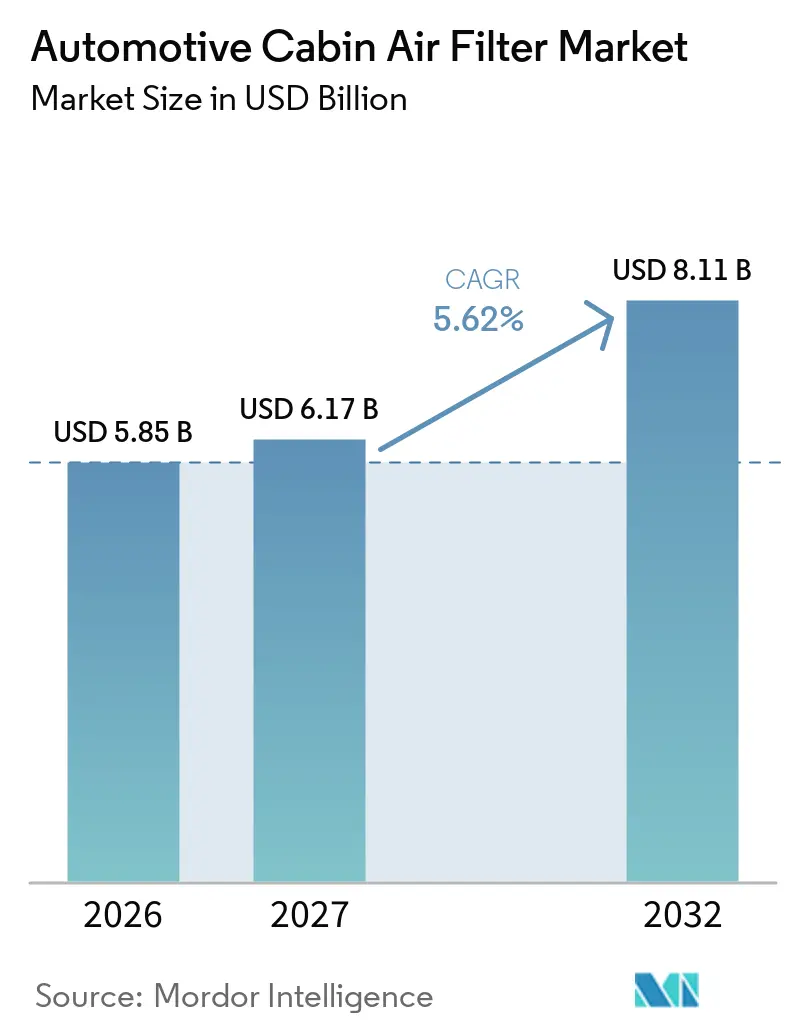
The automotive cabin air filter market size was valued at USD 5.85 billion in 2026 and is forecast to grow from USD 6.17 billion in 2027 to USD 8.11 billion by 2032, at a CAGR of 5.62% over 2027-2032. Demand is supported by greater attention to pollutants entering vehicle cabins and by replacement needs across the existing vehicle fleet. The automotive cabin air filter market is also moving toward activated carbon, HEPA, electrostatic, and antimicrobial media as vehicle owners seek protection from smoke, allergens, odors, and airborne contaminants. Regulation of interior emissions, higher filtration specifications in electric vehicles, and more demanding OEM requirements are raising the technical threshold for suppliers. These conditions favor firms that can combine broad vehicle coverage with validated media performance and dependable replacement availability.
Key Report Takeaways
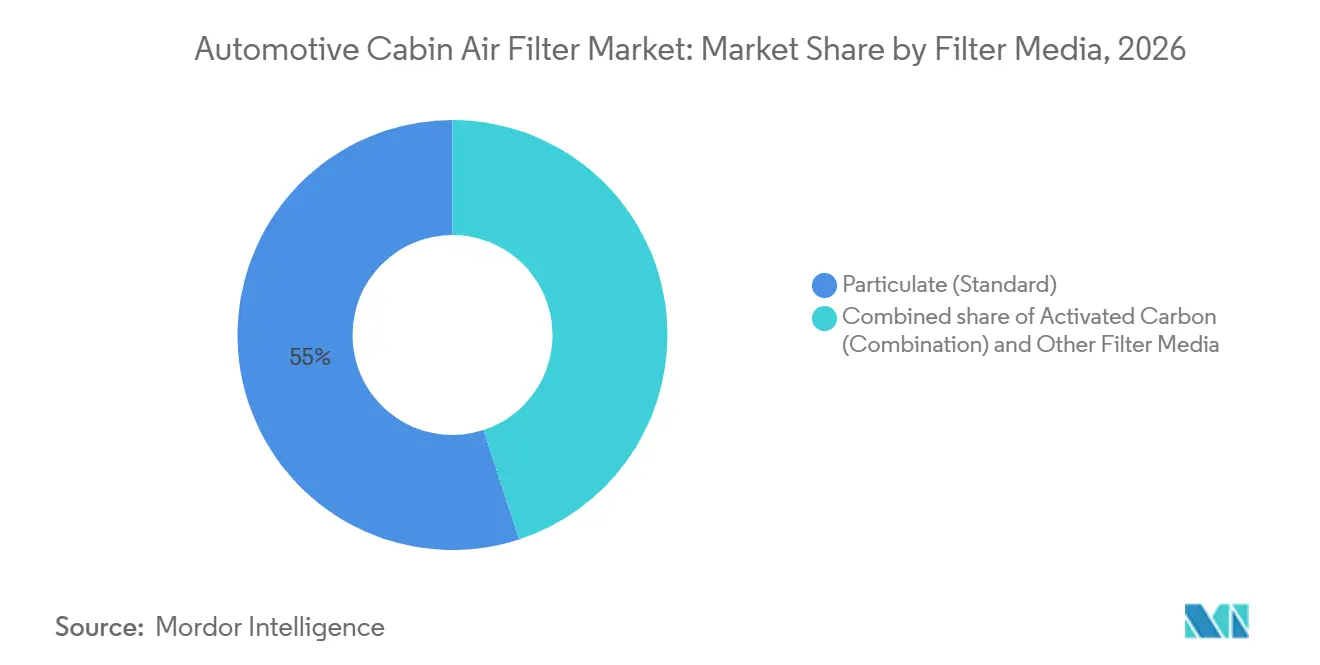
- By filter media, particulate filters held 55.02% of the automotive cabin air filter market share in 2026, while other filter media are projected to grow at an 8.12% CAGR through 2032.
- By vehicle type, passenger cars accounted for 82.44% of revenue in 2026 and are projected to advance at a 5.98% CAGR through 2032.
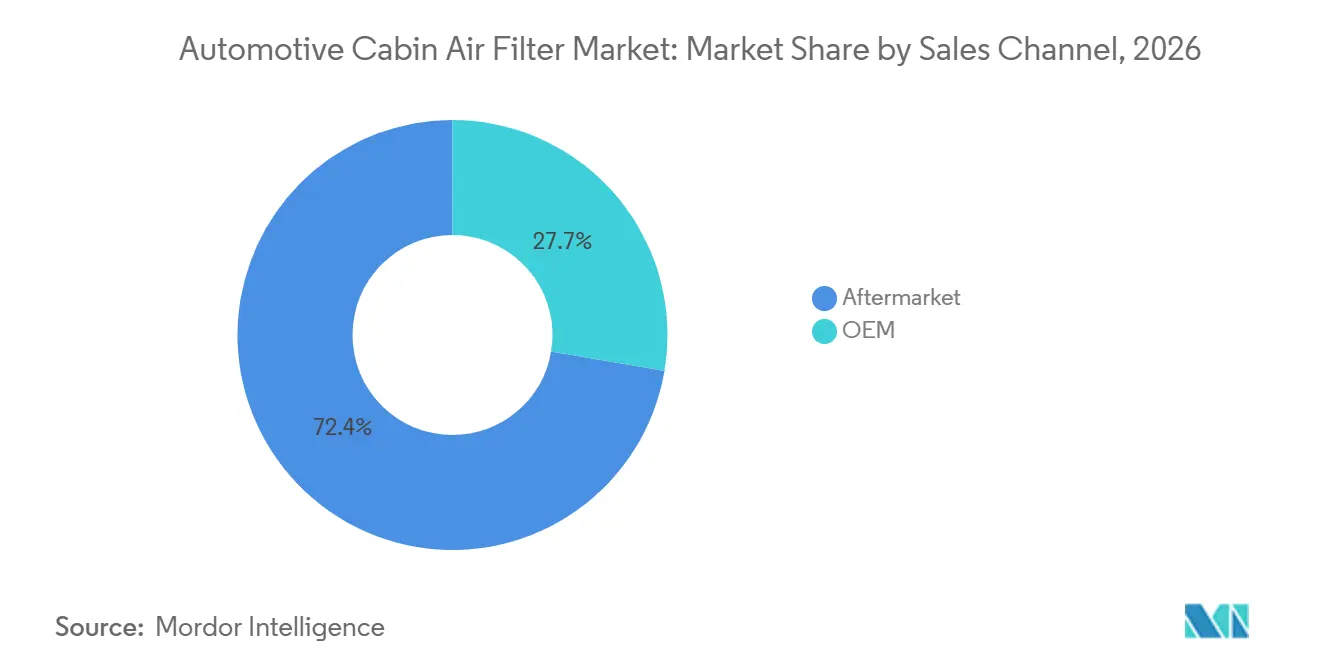
- By sales channel, the aftermarket held 72.35% of revenue in 2026 and is projected to grow at a 6.22% CAGR through 2032.
- By price segment, mid-range filters held 43.18% of revenue in 2026, while premium filters are projected to expand at a 6.82% CAGR through 2032.
- By geography, Asia-Pacific held 34.16% of revenue in 2026 and is forecast to grow at a 7.05% CAGR through 2032.
Note: Market numbers in this report are based on Mordor Intelligence's proprietary estimation framework, which combines nine months of actuals with Q4 projections for base year 2026.
Market Trends and Insights
Drivers Impact Analysis of Automotive Cabin Air Filter Market*
| Driver | (~) % Impact on CAGR Forecast | Geographic Relevance | Impact Timeline |
|---|---|---|---|
| Expansion of the Global Vehicle Parc and Replacement Demand | +1.5% | Global, accelerating in Asia-Pacific and South America | Long term (≥ 4 years) |
| Rising Urban PM2.5 and Allergen Exposure | +1.2% | Global, concentrated in Asia-Pacific megacities and North American wildfire zones | Short term (≤ 2 years) |
| Increasing OEM Adoption of Activated Carbon and High-Efficiency Media | +0.9% | Global, with early gains in Europe and North America | Medium term (2–4 years) |
| Growth of Premium Cabin Air Quality Features in Electric Vehicles | +0.8% | North America, Europe, and China | Medium term (2–4 years) |
| Higher Filter Replacement Frequency in Severe Pollution Conditions | +0.6% | Asia-Pacific core, with spillover to the Middle East and Africa | Short term (≤ 2 years) |
| Integration of Cabin Air Quality Sensors and Filter-Service Alerts | +0.4% | North America and Europe | Long term (≥ 4 years) |
| Source: Mordor Intelligence | |||
Expansion of the Global Vehicle Parc and Replacement Demand
A larger installed fleet increases the number of vehicles that eventually need cabin filter service. Replacement demand becomes less dependent on new vehicle deliveries once vehicles move beyond their initial service period. The automotive cabin air filter market is supported by vehicles that remain in operation long enough to enter independent workshop and retail channels. Older vehicles can also increase competition between brands because consumers have more choice outside the original vehicle service network. The underlying demand remains durable because cabin filters are consumable items rather than permanent vehicle components. Replacement volumes can rise further where high particulate loads shorten practical filter life below manufacturer service intervals, especially during recurring smoke events, prolonged smog periods, and high-pollen seasons.
Rising Urban PM2.5 and Allergen Exposure
Urban air pollution creates a direct reason to replace basic cabin filters with higher-performing products. The WHO stated in February 2025 that 17% more countries had implemented formal limits for PM2.5 and nitrogen dioxide[1]. Its update also linked ambient and household air pollution with nearly 7 million deaths annually. The automotive cabin air filter market benefits when smoke events, allergens, and recurring urban smog make cabin protection a practical maintenance consideration.
Increasing OEM Adoption of Activated Carbon and High-Efficiency Media
OEM adoption of advanced media changes the standard that later replacement filters must meet. In mid-2025, WIX Filters began producing a new in-house cabin filter medium that it says improves particle separation and dust-holding capacity. Freudenberg offers Gas Shield formulations designed for regional pollution patterns, including gases, volatile organic compounds, aldehydes, and ammonia [2]. The automotive cabin air filter industry therefore faces a gradual shift away from products that compete only on low initial price. Suppliers that cannot provide activated carbon or comparable higher-efficiency options may find it harder to serve replacements for newer vehicle platforms that use more demanding factory-fit cabin air quality specifications.
Growth of Premium Cabin Air Quality Features in Electric Vehicles
Electric vehicles make HVAC performance more important because cabin airflow is managed through the vehicle system. DENSO launched its ClearAir+ premium cabin filter line in Europe in autumn 2025 with five-layer media, including antiviral and antibacterial layers [3]. In June 2025, UFI Filters launched aftermarket HEPA (99.975% efficiency at 0.3 µm) and activated-carbon cabin filters for the Tesla Model Y. The automotive cabin air filter market gains value when EV buyers place greater weight on high-efficiency filtration and cabin comfort. Low airflow resistance becomes important because stronger HVAC demand can draw more energy from an EV battery while still meeting driver expectations for cabin comfort, air quality, and reliable climate control. Filter developers must therefore combine performance with manageable airflow resistance.
Restraints Impact Analysis of Automotive Cabin Air Filter Market*
| Restraint | (~) % Impact on CAGR Forecast | Geographic Relevance | Impact Timeline |
|---|---|---|---|
| Price Sensitivity in Emerging-Market Replacement Segments | -1.1% | Emerging Asia-Pacific markets, South America, and the Middle East and Africa | Short term (≤ 2 years) |
| Extended-Life and Sealed HVAC Modules Reducing Replacement Frequency | -0.8% | North America, Europe, and Japan | Long term (≥ 4 years) |
| Pressure-Drop and Energy-Consumption Trade-Offs in High-Efficiency Filters | -0.6% | Global, most acute in EV markets across Europe, China, and North America | Medium term (2–4 years) |
| Limited Standardization of Cabin Filtration Performance Claims | -0.4% | Global | Long term (≥ 4 years) |
| Source: Mordor Intelligence | |||
Price Sensitivity in Emerging-Market Replacement Segments
In India, Southeast Asia, and parts of South America, price sensitivity can limit premium cabin filter adoption. Many vehicles in these markets are older and lower in value, which encourages owners and independent garages to focus on the lowest service cost. Economy-grade or unbranded filters can therefore be selected instead of activated carbon or multi-layer products. This creates pressure on branded suppliers to maintain quality while remaining accessible to price-sensitive buyers. Smaller producers can face a greater burden from input and transport cost volatility because their purchasing scale is more limited. The automotive cabin air filter market in these geographies can consequently retain a larger economy-tier replacement base than higher-value markets.
Extended-Life and Sealed HVAC Modules Reducing Replacement Frequency
Longer service schedules can limit the number of replacement occasions over a vehicle’s operating life. Tesla lists a 2-year cabin air filter schedule for Model 3 and Model Y, and a 3-year schedule for Model S and Model X. BMW service documentation released in July 2025 specifies nanofilter replacement for G60 and G70 models, showing how complex filter specifications can concentrate service in authorized workshops[4]. More complex HVAC layouts can also shift service work toward authorized workshops when filter access requires additional disassembly. MANN+HUMMEL’s Digital Filter Suite uses filter monitoring to support condition-based replacement decisions. The automotive cabin air filter market must therefore balance growing demand for advanced products with service intervals that can reduce unit replacement frequency.
*Our forecasts treat driver/restraint impacts as directional, not additive. The impact forecasts reflect baseline growth, mix effects, and variable interactions.
Automotive Cabin Air Filter Market Segment Analysis
By Filter Media:
Specialty Media Expands Alongside Standard Filter DemandParticulate filters held 55.02% of the automotive cabin air filter market share in 2026 because they suit a wide range of economy and mid-range vehicles. Their broad fitment and familiar service needs keep them central to replacement purchasing decisions. Activated carbon filters form the next tier where drivers place greater importance on odor, nitrogen oxide, and volatile organic compound removal. Other filter media, including HEPA, electrostatic, and antimicrobial products, are forecast to grow at an 8.12% CAGR through 2032. Growth is tied to EV-related demand and rising use of HEPA, electrostatic, and antimicrobial media. This segment’s automotive cabin air filter market size grows with EV adoption and increased attention to smoke, allergens, and airborne pathogens.
Standard particulate filters are likely to retain high unit volumes, but higher-value alternatives can gradually gain revenue weight. The automotive cabin air filter industry is expanding its product range rather than replacing standard filters outright. This keeps lower-cost products relevant where service budgets, vehicle age, and expected performance differ across vehicle owners.

By Vehicle Type:
Passenger Cars Remain the Primary Source of DemandPassenger cars accounted for 82.44% of revenue in 2026 and are projected to expand at a 5.98% CAGR through 2032. The passenger-car automotive cabin air filter market size benefits from the widespread use of cabin filters and the growing presence of EVs with advanced cabin air quality features. Replacement demand is broad because passenger vehicles move through dealership, workshop, retail, and online purchasing channels. These choices make passenger cars the leading source of replacement volume and product upgrades.
Light commercial vehicles offer a smaller revenue base, but their higher annual mileage can require more frequent filter changes. Their service patterns make durability and dust-holding capacity important to fleet operators. Medium and heavy commercial vehicles create a developing OEM supply opportunity in high-growth markets. The automotive cabin air filter market in commercial vehicles remains smaller, but structured OEM supply can improve access and specification consistency. Fleet maintenance contracts can support activated carbon and multi-layer products where operating conditions are demanding. These contracts can make consistent quality and planned service timing more important than one-off retail purchasing.
By Sales Channel:
Aftermarket Replacement Drives the Largest Revenue PoolThe aftermarket held 72.35% of revenue in 2026 and is projected to grow at a 6.22% CAGR through 2032. Its leading revenue position reflects the recurring replacement needs of vehicles after their initial service period. Independent workshops, retail outlets, and online channels give buyers access to price points and filtration technologies. The automotive cabin air filter market depends on catalog depth, prompt availability, and reliable quality claims.
The automotive cabin air filter market rewards suppliers that refresh coverage as vehicle models, imported Chinese brands, and fleet composition change. Catalog capability is therefore as important as media performance in aftermarket competition, especially where model changes and imported vehicle brands create new application requirements. Suppliers must also make application data clear so installers and vehicle owners can select the correct replacement part.
By Price Segment:
Mid-Range Filters Lead While Premium Products Grow FasterMid-range filters held 43.18% of revenue in 2026 because they provide an accessible step up from basic particulate products. Premium filters are forecast to grow at a 6.82% CAGR through 2032, supported by EV adoption and smoke-related demand for higher-efficiency media. The premium automotive cabin air filter market size benefits from activated carbon, antimicrobial layers, and more advanced multi-layer product designs. Economy filters retain demand in price-sensitive replacement situations.
HEPA and antimicrobial EV filters can form an upper tier where certification and validation matter more than entry price. These products give suppliers a way to distinguish advanced filters from standard alternatives. The automotive cabin air filter industry uses material innovation to support premium pricing while maintaining broad mid-range availability across replacement channels, workshop programs, retail shelves, and online parts catalogs. Higher-value product choices can coexist with economy filters that remain important in price-sensitive replacement decisions. This split allows the price structure to reflect different vehicle ages, driving conditions, and buyer expectations.
Geography Analysis
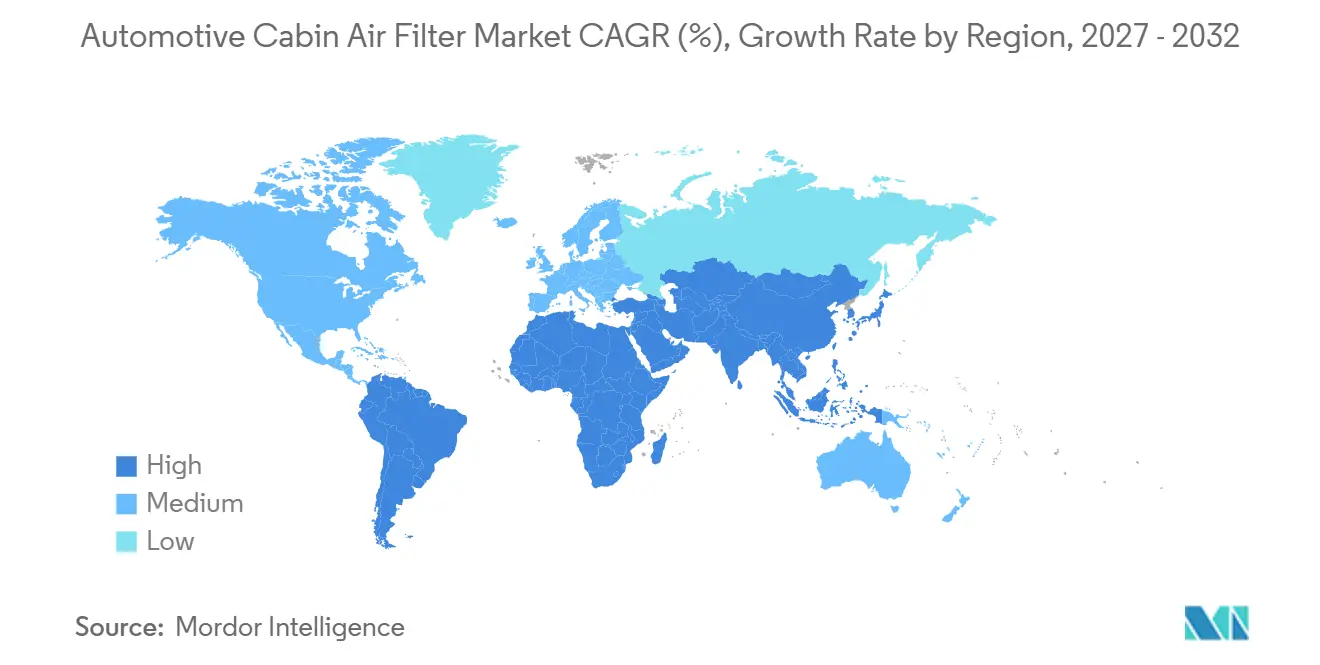
Asia-Pacific held 34.16% of revenue in 2026 and is projected to record a 7.05% CAGR through 2032. China supports regional demand through its large vehicle production base and an expanding replacement population. India supports demand as urban pollution encourages interest in activated carbon and HEPA-grade replacement filters. Japan and South Korea have a smaller volume-growth profile but support higher-value multilayer and activated carbon fitment. The automotive cabin air filter market in Asia-Pacific is shaped by the growing availability of higher-specification products for diverse local driving and pollution conditions.
North America is a high-value region for the automotive cabin air filter market because buyers have a strong interest in advanced cabin protection. Wildfire smoke has broadened interest in HEPA and other high-efficiency products beyond buyers managing allergy concerns. Europe has a comparable premium orientation, supported by health awareness and extensive independent workshop networks. Material compliance is becoming more significant as policymakers give greater attention to vehicle interior air quality and related product specifications. European aftermarket competition places a premium on catalog breadth as newer Chinese vehicle brands enter the region.
South America, the Middle East, Africa, and smaller Asia-Pacific markets provide a varied demand profile. Brazil and Argentina support South American demand through growing urban fleet density and independent workshop networks. Gulf Cooperation Council markets support premium adoption, while Nigeria and South Africa remain more focused on economy-tier products. The automotive cabin air filter market can expand in these areas as distribution coverage, consumer awareness, workshop capability, and local product availability improve.
Competitive Landscape
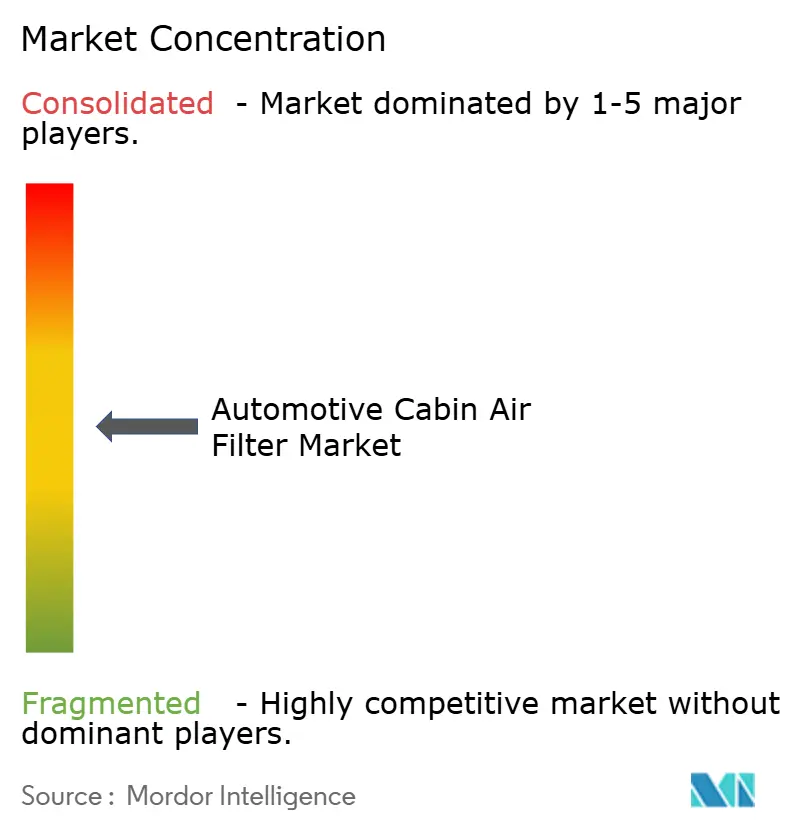
The automotive cabin air filter market is moderately concentrated, with a limited group of filtration specialists holding established first-fit relationships in OEM supply. MANN+HUMMEL, MAHLE, Freudenberg, and Donaldson have recognized positions in filtration and automotive supply. Their advantages include media development, OEM validation processes, broad manufacturing capabilities, and established distribution networks. The aftermarket is more fragmented because regional brands and private-label suppliers compete on price, local access, and application availability. The automotive cabin air filter market therefore combines concentrated OEM relationships with diverse aftermarket competition.
Scale remains important as producers invest in product range, manufacturing capability, and local supply. Atmus announced its USD 450 million acquisition of Koch Filter Corporation in December 2025. Camfil announced its acquisition of F.C.R. in Italy, effective January 2026, to expand local air-filtration expertise. These moves show that the automotive cabin air filter market places greater importance on manufacturing capacity, technical capability, product breadth, and regional supply. They also support closer alignment with regional vehicle applications and replacement availability.
Companies are also competing through material improvements and broader application coverage. MAHLE’s CareMetix Natural product uses sheep’s wool as a substrate component and positions lower microplastic contribution as a product attribute. DENSO’s ClearAir+ range adds multilayer antiviral and antibacterial media to its aftermarket offering. The automotive cabin air filter market leaves room for sensor-based replacement systems and low-resistance EV media, where no single product standard yet defines competition.
Automotive Cabin Air Filter Industry Leaders
-
MANN+HUMMEL
-
MAHLE GmbH
-
Freudenberg SE
-
Donaldson Company, Inc.
-
Robert Bosch GmbH
- *Disclaimer: Major Players sorted in no particular order
Automotive Cabin Air Filter Market Companies Covered in this Report
- MANN+HUMMEL
- MAHLE GmbH
- Donaldson Company, Inc.
- Freudenberg SE
- Robert Bosch GmbH
- DENSO Corporation
- Valeo SE
- Sogefi S.p.A.
- Parker-Hannifin Corporation
- Hengst SE
- K&N Engineering, Inc.
- Toyota Boshoku Corporation
- UFI Filters S.p.A.
- ACDelco
- Premium Guard Inc.
Recent Industry Developments in Automotive Cabin Air Filter Market
- September 2026: MAHLE premiered the CareMetix Natural cabin air filter at Automechanika Frankfurt 2026, replacing part of the plastic in the filter media with sheep’s wool to reduce its microplastic footprint.
- June 2026: Premium Guard Inc. completed Phase 2 of its acquisition of First Brands Group filter assets, adding oil, air, and cabin air filter production lines at Albion, Illinois, and equipment from the former FRAM facility in Greenville, Ohio.
- March 2026: Freudenberg Filtration Technologies launched micronAir neo, a cabin air filter line for automotive OEMs designed to maintain fine-particle filtration efficiency over the filter’s service life.
- October 2025: DENSO launched its ClearAir+ premium cabin air filter range in Europe, with five-layer media including antiviral and antibacterial protection.
Global Automotive Cabin Air Filter Market Report Scope
The scope includes segmentation by filter media (particulate (standard), activated carbon (combination), and other filter media (HEPA, electrostatic, and antimicrobial)), vehicle type (passenger cars, light commercial vehicles, and medium and heavy commercial vehicles), sales channel (OEM and aftermarket (online, retail, and workshops)), and price segment (economy, mid-range, and premium). The analysis also covers regional-level segmentation, including North America, Europe, Asia-Pacific, South America, and the Middle East and Africa. Market size and growth forecasts are presented by value in USD and volume in Units.
Segmentation Overview
| Particulate (Standard) | |
| Activated Carbon (Combination) | |
| Other Filter Media | HEPA |
| Electrostatic | |
| Antimicrobial |
| Passenger Cars |
| Light Commercial Vehicles |
| Medium and Heavy Commercial Vehicles |
| OEM | |
| Aftermarket | Online |
| Retail | |
| Workshops |
| Economy |
| Mid-Range |
| Premium |
| North America | United States |
| Canada | |
| Rest of North America | |
| Europe | Germany |
| United Kingdom | |
| France | |
| Italy | |
| Spain | |
| Russia | |
| Rest of Europe | |
| Asia-Pacific | China |
| Japan | |
| India | |
| South Korea | |
| Australia | |
| Southeast Asia | |
| Rest of Asia-Pacific | |
| South America | Brazil |
| Argentina | |
| Colombia | |
| Chile | |
| Rest of South America | |
| Middle East and Africa | Turkey |
| Saudi Arabia | |
| United Arab Emirates | |
| Israel | |
| South Africa | |
| Egypt | |
| Nigeria | |
| Rest of Middle East and Africa |
| By Filter Media | Particulate (Standard) | |
| Activated Carbon (Combination) | ||
| Other Filter Media | HEPA | |
| Electrostatic | ||
| Antimicrobial | ||
| By Vehicle Type | Passenger Cars | |
| Light Commercial Vehicles | ||
| Medium and Heavy Commercial Vehicles | ||
| By Sales Channel | OEM | |
| Aftermarket | Online | |
| Retail | ||
| Workshops | ||
| By Price Segment | Economy | |
| Mid-Range | ||
| Premium | ||
| By Geography | North America | United States |
| Canada | ||
| Rest of North America | ||
| Europe | Germany | |
| United Kingdom | ||
| France | ||
| Italy | ||
| Spain | ||
| Russia | ||
| Rest of Europe | ||
| Asia-Pacific | China | |
| Japan | ||
| India | ||
| South Korea | ||
| Australia | ||
| Southeast Asia | ||
| Rest of Asia-Pacific | ||
| South America | Brazil | |
| Argentina | ||
| Colombia | ||
| Chile | ||
| Rest of South America | ||
| Middle East and Africa | Turkey | |
| Saudi Arabia | ||
| United Arab Emirates | ||
| Israel | ||
| South Africa | ||
| Egypt | ||
| Nigeria | ||
| Rest of Middle East and Africa | ||
Key Questions Answered in the Report
What is the forecast growth rate for automotive cabin air filters?
The sector is forecast to grow at a 5.62% CAGR from 2027 to 2032, reaching USD 8.11 billion by 2032.
Which filter type holds the largest revenue share?
Particulate filters held 55.02% of revenue in 2026 because of their wide fitment across economy and mid-range vehicles.
Which cabin filter products are growing fastest?
Other filter media, including HEPA, electrostatic, and antimicrobial products, are forecast to grow at an 8.12% CAGR through 2032.
Which sales channel leads replacement demand?
The aftermarket held 72.35% of revenue in 2026 and is forecast to grow at a 6.22% CAGR through 2032.