
Australia Soil Monitoring Market Size and Share
Market Overview
| Study Period | 2022 - 2032 |
|---|---|
| Forecast Data Period | 2027 - 2032 |
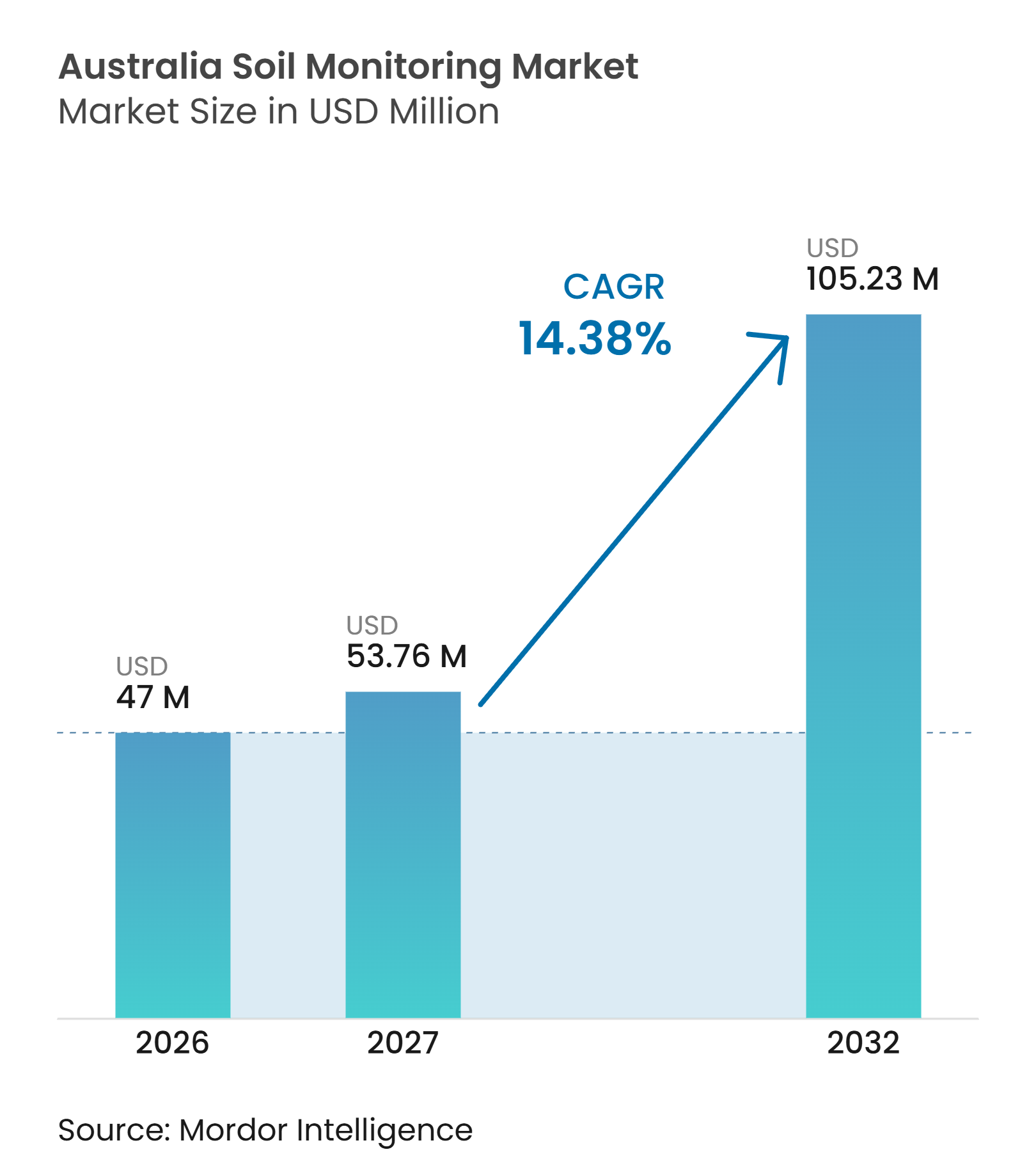
| Base Year Market Size (2026) | USD 47 Million |
| Market Size (2027) | USD 53.76 Million |
| Market Size (2032) | USD 105.23 Million |
| Growth Rate (2027 - 2032) | 14.38 % |
| Market Concentration | Low |
Major Players *Disclaimer: Major Players sorted in no particular order Image © Mordor Intelligence. Reuse requires attribution under CC BY 4.0. | |
Australia Soil Monitoring Market Analysis by Mordor Intelligence
The Australia soil monitoring market size was valued at USD 47.00 million in 2026 and is forecast to reach USD 53.76 million in 2027 and USD 105.23 million by 2032, registering a CAGR of 14.4% from 2027 to 2032. The market is shifting from periodic manual readings toward continuous, sensor-based data collection across broadacre grains, cotton, sugarcane, and horticulture. Pressure on water allocations, fertilizer costs, and carbon-credit requirements is making soil data more central to farm decisions. Suppliers are placing greater emphasis on software integration, recurring subscriptions, and service packages, as sensor data delivers more value when it supports irrigation, nutrient, and crop decisions. The market remains fragmented in 2025, while a broad group of laboratories, agronomy networks, distributors, and software platforms serves the remainder. Growth opportunities depend on reliable local calibration, stronger rural connectivity, and compliance with regulatory requirements.
Key Report Takeaways
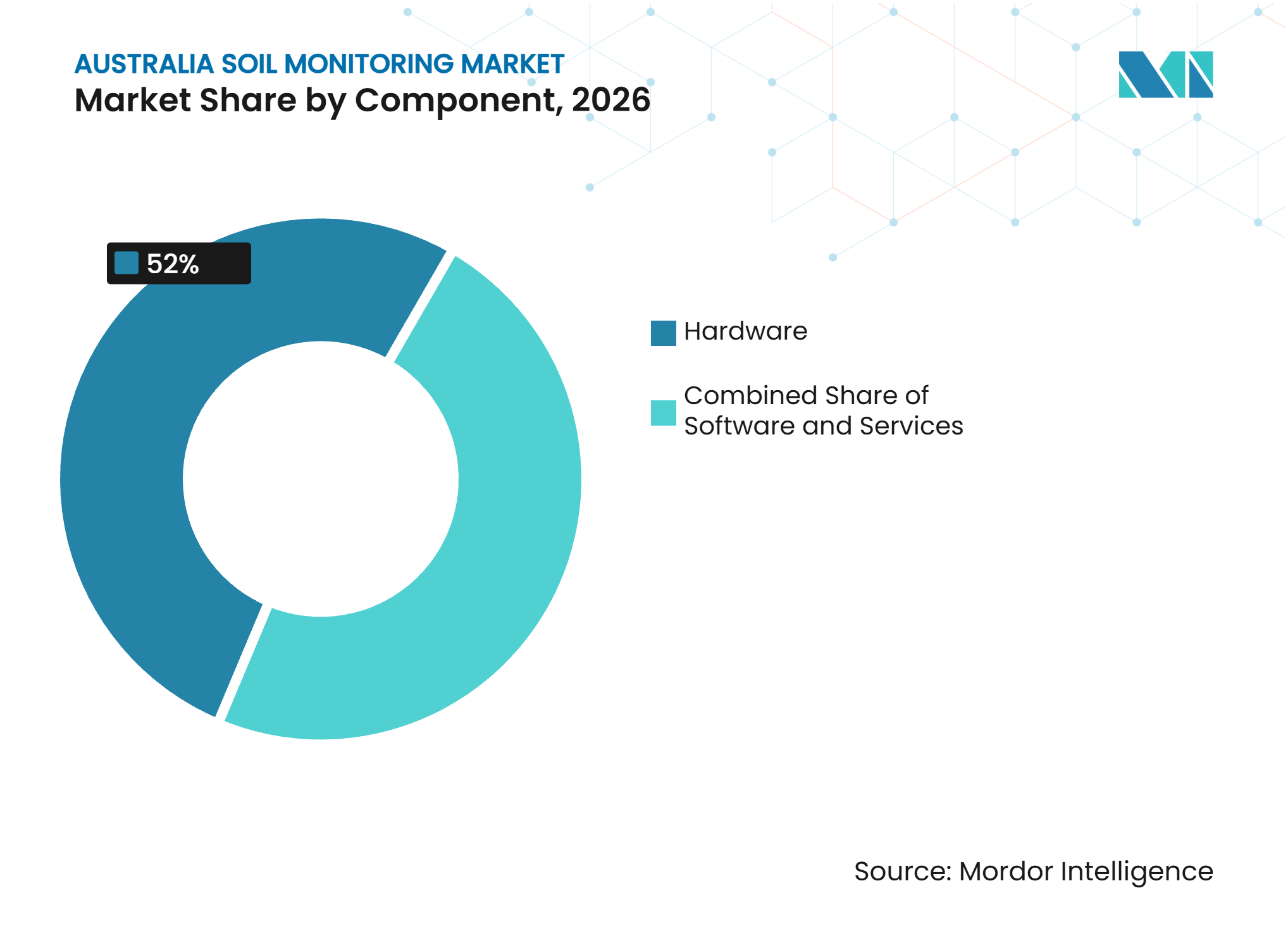
- By component, hardware was the largest segment, accounting for 52.0% of the Australia Soil Monitoring Market share in 2026, while software is the fastest-growing segment and is forecast to grow at a CAGR of 17.2% from 2027 to 2032.
- By product type, in-situ sensors were the largest segment, accounting for 46.0% of the Australia Soil Monitoring Market share in 2026, while remote sensing platforms are the fastest-growing segment and are forecast to grow at a CAGR of 18.1% from 2027 to 2032.
- By connectivity technology, wireless connectivity was the largest segment, accounting for 78.2% of the Australia Soil Monitoring Market size in 2026, and is also the fastest-growing connectivity segment, forecast to expand at a CAGR of 19.8% from 2027 to 2032.
- By application, open-field was the largest segment, accounting for 63.3% of the Australia Soil Monitoring Market share in 2026, while protected cultivation is the fastest-growing segment and is forecast to grow at a CAGR of 14.5% from 2027 to 2032.
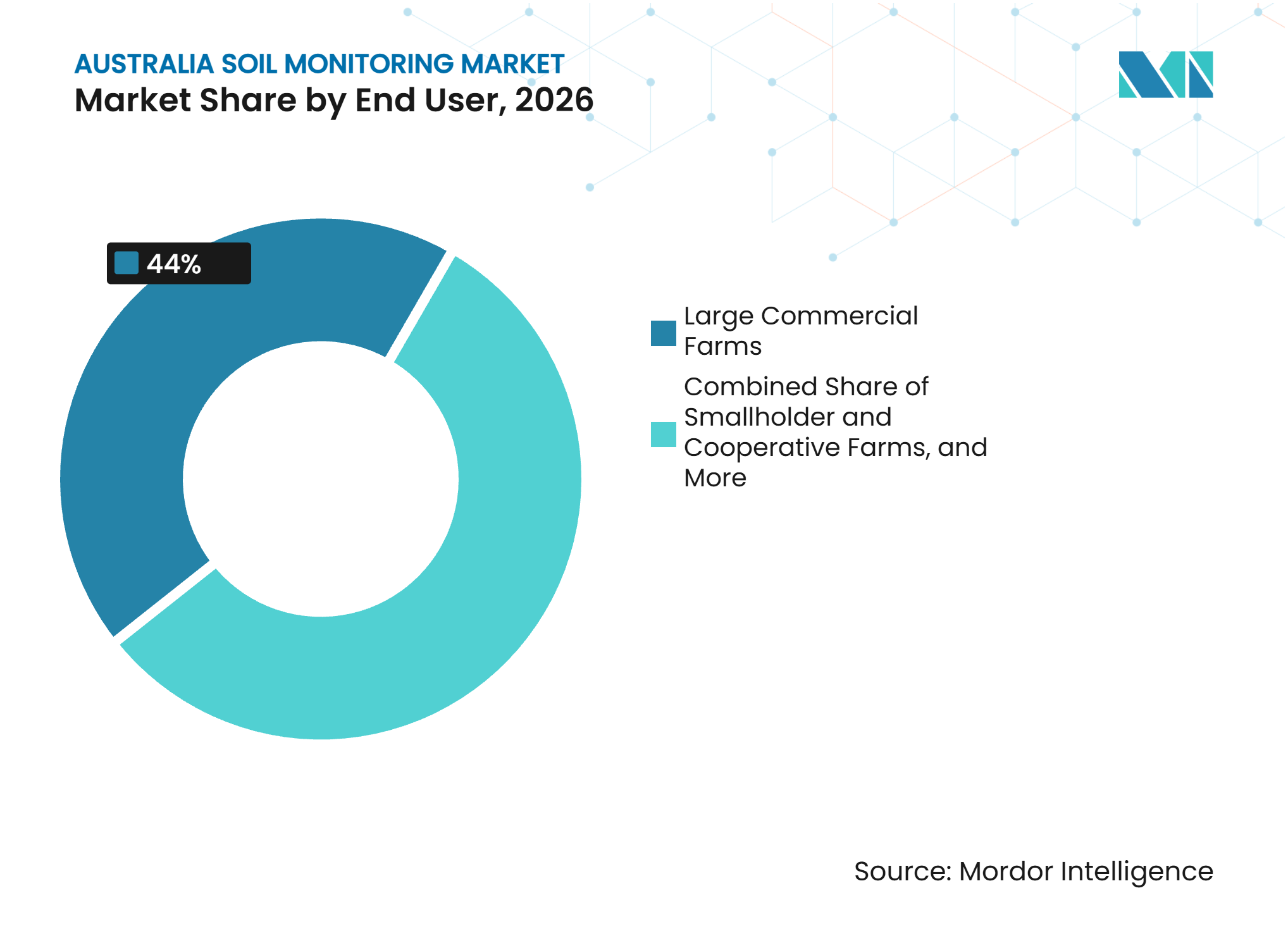
- By end user, large commercial farms were the largest segment, accounting for 44.0% of the Australia Soil Monitoring Market share in 2026, while research institutes and universities are the fastest-growing segment and are forecast to grow at a CAGR of 14.6% from 2027 to 2032.
Note: Market numbers in this report are based on Mordor Intelligence's proprietary estimation framework, which combines nine months of actuals with Q4 projections for base year 2026.
Market Trends and Insights
Drivers Impact Analysis of Australia Soil Monitoring Market*
| Driver | (~) % Impact on CAGR Forecast | Geographic Relevance | Impact Timeline |
|---|---|---|---|
| Precision agriculture adoption reshaping farm-level data architecture | +2.80% | New South Wales, Victoria, Western Australia, and Queensland | Medium term (2–4 years) |
| Water scarcity and irrigation efficiency as a structural market force | +3.10% | Murray–Darling Basin, Queensland, South Australia, and Western Australia | Short term (≤ 2 years) |
| Soil health and nutrient management regulation creating mandated monitoring | +2.20% | Queensland Reef catchments, New South Wales, and Victoria | Medium term (2–4 years) |
| Integration with farm management and analytics platforms multiplying sensor value | +2.00% | Large commercial farms and agronomic service providers across Australia | Medium term (2–4 years) |
| Below-ground wireless sensor deployment in remote production zones | +1.70% | South Australia, Western Australia, Northern Territory, and Queensland | Long term (≥ 4 years) |
| Demand for auditable soil carbon and regenerative agriculture data | +2.00% | New South Wales, Queensland, Western Australia, and South Australia | Medium term (2–4 years) |
| Source: Mordor Intelligence | |||
Precision Agriculture Adoption Reshaping Farm-Level Data Architecture
Precision agriculture in Australia is expanding beyond GPS-guided machinery to include regular soil data collection on broadacre and irrigated farms[1]. In 2025, Australian grain producers continued to underutilize soil and plant testing relative to its decision-making value, leaving room for wider adoption of monitoring tools. The Australia soil monitoring market benefits when producers use data to guide fertilizer, irrigation, and crop management decisions. Lower-cost subscription models can reduce the initial barrier for farms that prefer not to purchase equipment outright. Soil readings become more useful when integrated with variable-rate equipment and farm management systems, as this integration converts sensor measurements into operational actions rather than standalone records. It also shifts competition toward providers that can combine data, agronomy, and software into a functional workflow. The Australia soil monitoring market favors suppliers that can support decision-making beyond data collection.
Water Scarcity and Irrigation Efficiency as a Structural Market Force
Legally binding water-allocation limits in the Murray-Darling Basin keep irrigation efficiency central to farm operations. Soil moisture monitoring helps irrigators document scheduling decisions and manage water across high-value crops. Soil moisture readings can help irrigators reduce water use while maintaining outcomes for high-value crops. Water entitlement values in the Murray-Darling Basin can exceed AUD 500 (USD 325) per megaliter, supporting the business case for monitoring among mid-sized irrigators. The Australian soil monitoring market benefits from this financial pressure, as even limited water savings can offset monitoring costs. Demand is strongest where crop value, irrigation use, and compliance requirements overlap. These conditions make water efficiency a direct driver for adopting continuous soil data.
Soil Health and Nutrient Management Regulation Creating Mandated Monitoring
Queensland Reef Protection requirements oblige farm businesses in Reef catchments to demonstrate evidence of nutrient-management practices. This converts soil monitoring from a discretionary purchase into a compliance-related cost for affected producers. New South Wales applies similar nutrient-management requirements in high-impact agricultural areas. In 2024, AgVita Analytical expanded its Great Barrier Reef catchment analyte suite to support Six Easy Steps Reef Rescue compliance testing for sugarcane and banana producers. The Australian soil monitoring market is supported where testing and monitoring must generate records suitable for regulatory submissions. NATA accreditation under ISO/IEC 17025 and ASPAC proficiency testing are important for laboratory data used in such submissions. These requirements raise the standard for service providers supplying compliance data and favor firms that can deliver traceable testing, monitoring, and reporting.
Integration with Farm Management and Analytics Platforms Multiplying Sensor Value
Sensors become more valuable when farm management systems can combine them with weather, crop, and irrigation data. This integration can support variable-rate nitrogen application, automated irrigation triggers, and disease-risk planning. In November 2025, CropX integrated with Reinke Manufacturing's ReinCloud 3 platform, allowing growers to access soil moisture, evapotranspiration, and weather data within a single irrigation management interface. The Australia soil monitoring market is influenced by how easily data can move between systems used on farms. A unified interface reduces the time needed to interpret information from separate products. It can also make a provider harder to replace once a farm has built its daily routines around that platform. This dynamic favors integrated vendors over suppliers that only sell individual sensors, resulting in a stronger role for software and advisory services alongside hardware sales.
Restraints Impact Analysis of Australia Soil Monitoring Market*
| Restraint | (~) % Impact on CAGR Forecast | Geographic Relevance | Impact Timeline |
|---|---|---|---|
| High upfront cost and uncertain payback for smaller farms | -1.80% | Smallholder and cooperative farms across Australia | Short term (≤ 2 years) |
| Sensor calibration drift in saline, sodic, and highly variable soils | -1.50% | Irrigated regions and saline soils, particularly in Western Australia and South Australia | Medium term (2–4 years) |
| Rural connectivity and power-availability gaps | -1.20% | Western Australia, Northern Territory, Queensland, and South Australia | Long term (≥ 4 years) |
| Data interoperability and agronomy-skill constraints | -1.00% | Remote regions and farms using multiple technology vendors across Australia | Medium term (2–4 years) |
| Source: Mordor Intelligence | |||
High Upfront Cost and Uncertain Payback for Smaller Farms
A multi-depth soil-sensor network can cost AUD 5,000 to AUD 20,000 (USD 3,250 to USD 13,000) per farm zone, excluding ongoing fees. This amount covers hardware, installation, calibration, software subscriptions, and advisory services. Many smallholder operators cannot justify this expense when yield gains remain uncertain from one season to the next. Research published in 2025 noted that the cost and labor involved in soil sampling had already reduced routine testing on large Australian farms. This constraint is more severe for smaller operations with limited capital and access to advisory services. The Australian soil monitoring market may therefore see slower adoption where equipment is sold only through upfront purchases. Subscription arrangements can spread costs over time and reduce the need for large initial payments. Cooperative group purchases and subsidized programs can also improve access for farms that lack scale.
Sensor Calibration Drift in Saline, Sodic, and Highly Variable Soils
Australian farming regions contain saline and sodic soils, heavy cracking clays, and sandy duplex soils. These conditions create significant variation in electrical conductivity and can reduce the accuracy of capacitance sensors without regular recalibration. This challenge is pronounced in irrigated areas of Western Australia and South Australia. METER Group introduced the TEROS 22 in 2025 for high-salinity soil water-potential measurement with zero-calibration operation. The product addresses a demanding use case, but does not eliminate the broader need for reliable calibration across local soils. Universal calibration settings can perform poorly in high-electrical-conductivity conditions. The Australian soil monitoring market is less favorable to products that have not been tested under local soil conditions. Locally calibrated systems from providers such as Sentek Technologies and ICT International have an advantage where soils are highly variable.
*Our forecasts treat driver/restraint impacts as directional, not additive. The impact forecasts reflect baseline growth, mix effects, and variable interactions.
Australia Soil Monitoring Market Segment Analysis
By Component:
Software Subscription Models Accelerating Value MigrationHardware accounted for 52% of the Australia soil monitoring market share in 2026, reflecting equipment demand during the early phase of sensor deployment. This component includes soil moisture, temperature, salinity, nutrient, and pH sensors, as well as data loggers, gateways, and weather stations. Each product addresses a specific agronomic need. Soil moisture sensors generate a significant portion of hardware revenue, as irrigation-dependent farms can deploy them across multiple crop systems. Salinity and electrical conductivity sensors are gaining attention in Western Australia and South Australia, where secondary salinization remains a major land degradation concern. Services form the third component group, with installation, calibration, laboratory testing, and agronomic advice supporting recurring revenue for networks such as Nutrien Ag Solutions and Elders.
Software is forecast to grow at a CAGR of 17.2% from 2027 to 2032, the highest among all component segments. The Australia soil monitoring market is shifting toward subscriptions that interpret data rather than relying solely on equipment sales. AI-based soil interpretation, crop models, and carbon-compliance analytics are driving this shift. Hardware margins may face pressure as sensors become more standardized, while data-platform revenue can offer stronger customer retention and lower capital intensity. In April 2026, CropX launched the Apex multi-depth sensor to feed data directly into its cloud-based agronomy platform, demonstrating how hardware can function as the data collection point for a software service. Suppliers with integrated software offerings are better positioned to build stable, recurring relationships with farms.



By Product Type:
In-Situ Networks Lead, Remote Sensing Platforms AcceleratingIn-situ sensors accounted for 46% of the Australia soil monitoring market in 2026 by product type. Their established role in continuous moisture and salinity monitoring supports their use in irrigated horticulture, grains, and cotton. Measurements at multiple depths, commonly from 10 cm to 90 cm, help users understand root-zone water use. Remote sensing cannot provide the same direct depth profile. Portable probes and test kits serve a separate need for quick field diagnosis. These products avoid the permanent installation costs associated with fixed systems. Agronomic service providers and research users can deploy them for targeted work. The segment structure indicates that different products serve different monitoring conditions.
Remote sensing platforms are forecast to grow at a CAGR of 18.1% from 2027 to 2032, the highest among all product types. Increasing satellite revisit frequency and lower-cost multispectral drone payloads support this growth. In-situ systems and remote sensing are becoming complementary rather than competing products. ICT International used Finapp Cosmic Ray Neutron Sensors alongside traditional soil moisture sensors in a Forestry Corporation NSW bushfire-risk project[2]. The combination supported large-area fuel-load moisture estimates calibrated against point sensors. This type of deployment produces information that a single technology cannot provide alone. Integrated monitoring can offer a pricing advantage in complex use cases. Providers that combine products can address both broad coverage and site-specific data needs.
By Connectivity Technology:
Wireless Dominance Driven by Remote Farm EconomicsWireless connectivity accounted for 78.2% of the Australia soil monitoring market share in 2026 and is forecast to grow at a CAGR of 19.8% from 2027 to 2032, supported by improving farm data economics. Low-power wide-area networks, 4G, NB-IoT, and satellite services are the main wireless options. These systems reduce the need to run cable across large farming areas. Wired systems retain value in protected cultivation and research stations, where cable security and power availability are less of a constraint. Bluetooth and other short-range protocols support portable probes in scouting and laboratory workflows. Connectivity selection depends on farm layout, equipment type, and the need for continuous data transfer.
Below-ground transmission is entering commercial use in Australia at a larger scale. Sentek Technologies is anticipated to launch the BILBY communications node in the second half of 2026. The node can transmit data up to 1 km from a fully buried installation, removing surface wires and solar panels that require maintenance or are vulnerable to damage from livestock and machinery. This design may improve the economics of continuous monitoring of extensive properties, particularly where visible equipment has limited adoption of wider sensors. The Australia soil monitoring market could expand in remote production zones as installations become easier to protect. However, suppliers will still need to address local network and power constraints to convert this technical capability into practical use.
By Application:
Open Field Dominates, Protected Cultivation AcceleratingOpen-field applications accounted for 63.3% of the Australia soil monitoring market size in 2026, supported by demand from broadacre grain, oilseed, cotton, and sugarcane cultivation. Cotton and irrigated horticulture generate higher sensor spending per hectare due to water allocation requirements and crop values. Pasture and livestock systems offer room for additional adoption during the forecast period. Carbon crediting under the Australian Carbon Credit Unit scheme supports interest in continuous monitoring of soil moisture and organic carbon. Queensland sugarcane growers also face reporting requirements under nutrient-runoff regulations. These conditions provide a near-term basis for wider open-field deployments. The segment remains tied to the scale of Australian broadacre farming.
Protected cultivation is forecast to grow at a CAGR of 14.5% from 2027 to 2032. Greenhouses, nurseries, and shade houses require monitoring that accounts for controlled growing conditions. Coco-fiber and rockwool substrates require calibration capabilities that differ from field-soil settings. Sentek released a Coco Fibre calibration on IrriMAX Live in June 2026. The company presented this feature as a distinct capability for protected-cultivation users. Technical specialization can support pricing in high-value horticulture. Forestry remains a smaller application but has strategic relevance for plantation, native-forest, and restoration projects. Soil carbon certification requirements connect forestry monitoring with the need for auditable data.
By End User:
Large Commercial Farms Anchor Revenue, Research Institutes Grow FastestLarge commercial farms accounted for a 44% share of the Australia soil monitoring market in 2026. Their irrigated footprints create the scale needed to justify investments across multiple farm zones. These operators are the primary users of multi-depth in-situ networks, real-time subscriptions, and agronomic advisory packages. Smallholder and cooperative farms hold a meaningful but underserved position. Their adoption is limited by cost and payback concerns described in the restraints section. Group purchasing and subsidized programs can gradually improve access. Government agencies and NGOs form a stable procurement group. Their spending is tied to compliance monitoring and environmental restoration rather than farm productivity alone.
Research institutes and universities are forecast to grow at a CAGR of 14.6% from 2027 to 2032. Federal research activity in soil health, carbon cycling, and climate-adaptive agriculture supports this demand. The Soil Cooperative Research Center is a focal point of institutional demand, as it commissions bespoke sensors for national experiments. Agronomic service providers and environmental consultancies represent an emerging end-user group. They deploy sensors for grower clients and package the resulting data with advisory services. This model expands the role of monitoring beyond equipment ownership by individual farms and gives advisers a way to build subscription-based services around soil data. The Australia soil monitoring market can therefore grow through both direct farm use and professional service delivery.

Geography Analysis
New South Wales remains the largest regional market for soil monitoring solutions, supported by extensive irrigated horticulture, viticulture, cotton, and winter cereal production. Strong adoption across the Riverina, Murrumbidgee, and Macquarie regions is driven by water licensing requirements and irrigation optimization. The state also benefits from a large network of agronomic service providers and environmental consultancies that deploy monitoring solutions for growers. Growing nutrient management requirements near environmentally sensitive waterways further support demand for accurate soil monitoring data.
Queensland is estimated to be the fastest-growing regional market, driven by nutrient management regulations in the Great Barrier Reef catchments, which encourage greater adoption of soil monitoring technologies for compliance and precision agriculture. Western Australia is also experiencing strong growth, supported by large-scale grain production, widespread saline soil conditions, and continued investments in agricultural input and distribution infrastructure. Across these states, regulation, irrigation management, and soil characteristics are key factors driving demand for soil monitoring solutions.
Victoria continues to benefit from its diverse dairy, horticulture, and broadacre cropping industries, while South Australia is supported by wine grape, almond, and irrigated vegetable production concentrated along the Murray River. Tasmania represents a niche but valuable market due to its high-value horticulture sector and agricultural research activities. The Northern Territory and Australian Capital Territory remain comparatively smaller markets, with demand driven primarily by carbon monitoring programs, government agencies, and research institutions.
Competitive Landscape
Market Concentration
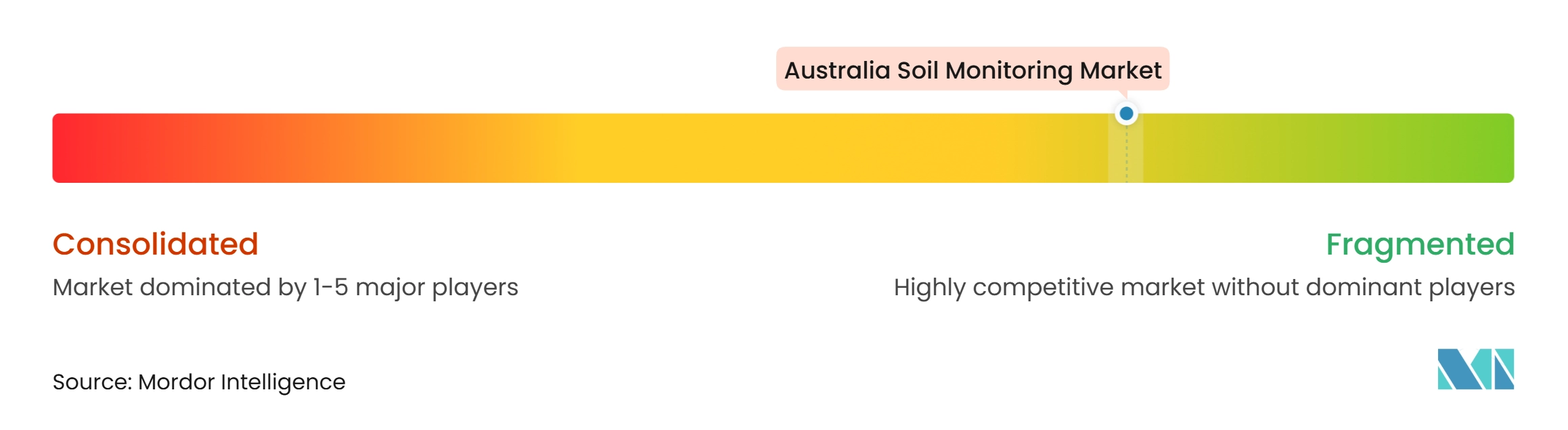
The Australia soil monitoring market is highly fragmented, with no single supplier holding a national leadership position across the full range of products and services. Major players operating in the market in 2025 include Sentek Technologies, METER Group, CropX Inc., Campbell Scientific, and The Toro Company. Competition spans precision agriculture sensor companies, irrigation and turf platforms, laboratories, field-sampling equipment specialists, and analytical instrument providers. A buyer building a full monitoring program may need to source sensors, connectivity, software, laboratory analysis, and advisory services from multiple providers, making the competitive environment both vertical and horizontal.
Platform integration is a central area of differentiation in 2026. In February 2025, The Toro Company formed an exclusive partnership with TerraRad to develop Spatial Adjust, soil-moisture sensing and irrigation-control software, adding data capabilities to an established irrigation brand. CropX expanded its platform strategy with the April 2026 launch of its Apex sensor, which provides multi-depth data to its cloud-based agronomy platform. Sentek's commercialization of BILBY offers a separate example of product development focused on remote installations. These developments indicate that suppliers are competing on data access, software integration, and operating conditions rather than sensor specifications alone.
Subscription services for smallholder and cooperative farms, below-ground wireless systems for extensive grazing, and carbon measurement services remain underdeveloped areas. In December 2025, SGS acquired Australian Superintendence Company, strengthening its agricultural quality-assurance position in Australia and creating cross-selling opportunities linked to export-crop compliance testing[3]. ISO/IEC 17025-accredited laboratory data is increasingly relevant to carbon verification and reef-catchment nutrient reporting, and established NATA accreditation gives Eurofins and SGS an advantage in this area. The Australia soil monitoring market will continue to reward suppliers that can offer credible monitoring records across equipment, data, and laboratory services.
Australia Soil Monitoring Industry Leaders
-
Sentek Technologies
-
METER Group
-
CropX Inc.
-
Campbell Scientific
-
The Toro Company
- *Disclaimer: Major Players sorted in no particular order
Australia Soil Monitoring Market Companies Covered in this Report
- Sentek Technologies
- METER Group
- CropX Inc.
- Campbell Scientific
- The Toro Company
- Stevens Water Monitoring Systems, Inc.
- ICT International Pty Ltd
- SoilCares Research B.V.
- SGS Australia Pty Ltd
- Eurofins Scientific Australia Pty Ltd
- Nutrien Ag Solutions Australia Pty Ltd
- Elders Limited
- AgVita Analytical
- Eijkelkamp North America and Australia
- Spectrum Technologies, Inc.
Recent Industry Developments in Australia Soil Monitoring Market
- April 2026: CropX Technologies launches Apex multi-depth soil sensor. CropX launched the Apex sensor, offering configurable depth options of 12-inch, 24-inch, and 36-inch, 4-inch interval data recording, and seamless integration into the CropX digital agronomy platform. The sensor supports AI-powered agronomic analytics for enterprise-scale growers and agronomic service providers globally, including deployments across Australia
- March 2026: CropX launches CropX Vision AI-powered vineyard water stress monitoring tool. The globally released CropX Vision tool enables vineyard operators to measure vine water stress from a single canopy image, using computer vision and agronomic modeling. The technology builds on Tule Technologies' California-proven canopy sensing system, acquired by CropX in 2023, and targets high-value wine-grape production regions including Australia's Barossa and Clare valleys.
- November 2025: CropX acquires Acclym, formerly Agritask, for enterprise-scale sustainability. CropX completed its seventh strategic acquisition, Acclym, an enterprise agricultural intelligence company with a 15-year record in food and beverage sustainability programs. The acquisition extends its platform to Scope 3 supply-chain emissions tracking and soil organic carbon modeling
Australia Soil Monitoring Market Report Scope
Soil monitoring is the systematic process of measuring, collecting, and analyzing physical, chemical, and biological properties of soil over time to assess its health, fertility, moisture status, and environmental condition.
The Soil Monitoring Market Report is Segmented by Component (Hardware, and More), by Product Type (In-Situ Sensors, and More), by Connectivity Technology (Wired and Wireless), by Application (Open Field, and More), by End-User (Large Commercial Farms, and More). The Market Forecasts are Provided in Terms of Value (USD).
Segmentation Overview
| Hardware |
| Software |
| Services |
| In-Situ Sensors |
| Remote Sensing Platforms |
| Portable Probes and Test Kits |
| Wired |
| Wireless (LPWAN, Cellular, Satellite) |
| Open Field |
| Protected Cultivation |
| Forestry |
| Large Commercial Farms |
| Smallholder and Cooperative Farms |
| Research Institutes and Universities |
| Government and Non-Profit Organizations (NGOs) |
| By Component | Hardware |
| Software | |
| Services | |
| By Product Type | In-Situ Sensors |
| Remote Sensing Platforms | |
| Portable Probes and Test Kits | |
| By Connectivity Technology | Wired |
| Wireless (LPWAN, Cellular, Satellite) | |
| By Application | Open Field |
| Protected Cultivation | |
| Forestry | |
| By End User | Large Commercial Farms |
| Smallholder and Cooperative Farms | |
| Research Institutes and Universities | |
| Government and Non-Profit Organizations (NGOs) |
Key Questions Answered in the Report
What is the projected value of the Australia soil monitoring market by 2032?
The Australia soil monitoring market is forecast to reach USD 105.23 million by 2032, growing at a CAGR of 14.4% from 2027 to 2032.
Which component is growing fastest in Australia soil monitoring?
Software is forecast to grow at a CAGR of 17.2% from 2027 to 2032, driven by increasing demand for connected analytics, crop models, and compliance tools among farms.
Why are soil moisture sensors important for Australian farms?
They support irrigation decisions where water availability, entitlement costs, and reporting requirements make precise scheduling valuable.
Which product type leads soil monitoring deployment in Australia?
In-situ sensors accounted for 46% of the Australia soil monitoring market share in 2026, supported by their ability to provide continuous root-zone moisture and salinity data.