
Australia Lime Market Analysis by Mordor Intelligence
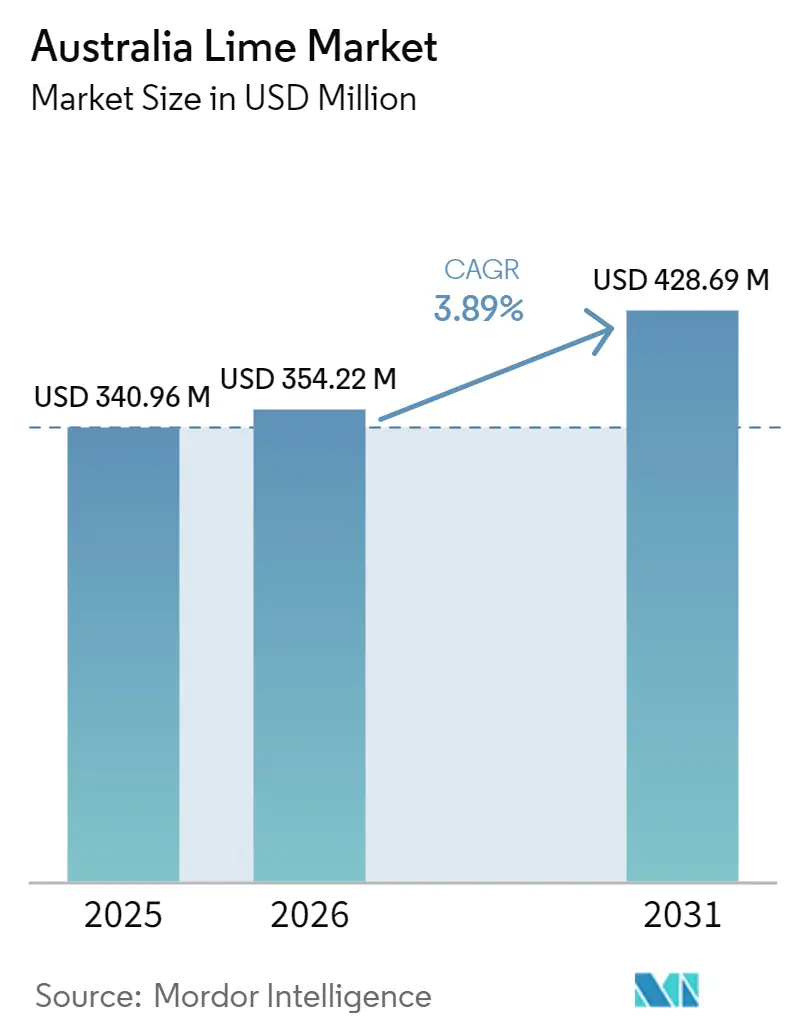
The Australia lime market was valued at USD 340.96 million in 2025 and is forecast to grow from USD 354.22 million in 2026 to USD 428.69 million by 2031, at a CAGR of 3.89% from 2026 to 2031. Commercial lime production is concentrated in Queensland and South Australia, while native finger limes are cultivated across selected regions of Queensland and northern New South Wales, creating distinct supply chains for conventional and specialty fruit. Market growth is supported by rising domestic consumption, expanding export opportunities across the Asia-Pacific, and increasing demand for premium Australian native produce. Seasonal weather conditions continue to influence production volumes and fruit quality, encouraging growers to invest in improved orchard management and resilient varieties. Stringent biosecurity regulations, together with premium positioning and expanding retail and foodservice demand, are projected to support the long-term development of the lime market in Australia.
Key Report Takeaways
- Australian lime production is concentrated in warm tropical and subtropical regions, with Queensland accounting for the largest share of national output. Major commercial growing areas include Mareeba in Far North Queensland, Lismore in northern New South Wales, the Riverland region of South Australia, and Darwin in the Northern Territory, where favorable climatic conditions support year-round production.
Note: Market size and forecast figures in this report are generated using Mordor Intelligence’s proprietary estimation framework, updated with the latest available data and insights as of January 2026.
Australia Lime Market Trends and Insights
Drivers Impact Analysis*
| Driver | (~) % Impact on CAGR Forecast | Geographic Relevance | Impact Timeline |
|---|---|---|---|
| Rising domestic consumption of fresh limes | +0.8% | Australia, with demand concentrated in metropolitan Queensland and New South Wales | Short term (≤ 2 years) |
| Growth of foodservice, beverages, and gourmet cooking | +0.8% | Sydney, Melbourne, Brisbane, and Perth | Short term (≤ 2 years) |
| Expansion of export opportunities in Asia-Pacific | +0.7% | Japan, South Korea, Indonesia, Singapore, Hong Kong, and Taiwan | Medium term (2-4 years) |
| Consumer preference for vitamin C-rich and natural foods | +0.6% | Australia and Asian export markets | Medium term (2-4 years) |
| Increasing demand for native finger lime applications | +0.4% | Eastern Australia and selected export markets | Long term (≥ 4 years) |
| Improved variety development and orchard productivity | +0.4% | Far North Queensland, Sunraysia, and Riverland | Medium term (2-4 years) |
| Source: Mordor Intelligence | |||
Rising Domestic Consumption of Fresh Limes
Increasing household demand for fresh limes is supporting market growth by encouraging higher retail purchases and wider consumption across Australia, driven by increasing use in home cooking, beverages, salads, and international cuisines. According to the Australian Horticulture Statistics Handbook 2024–25, the retail supply wholesale value of fresh lemons and limes increased to USD 117.42 million (AUD 169.2 million) in the year ending June 2025, up 10% from USD 106.82 million (AUD 153.9 million) in 2024, reflecting stronger domestic retail demand[1]Source: Hort Innovation, “Australian Horticulture Statistics Handbook 2024–25,” horticulture.com.au.. Growing consumer preference for fresh citrus ingredients, wider supermarket availability, and year-round purchasing are supporting higher household consumption and sustained market growth across Australia.
Growth of Foodservice, Beverages, and Gourmet Cooking
Expanding demand from the foodservice and beverage industry is strengthening market growth by increasing the use of fresh limes across diverse culinary applications, as they remain an essential ingredient in cocktails, fresh juices, premium beverages, Thai and Vietnamese cuisine, and specialty applications. According to the Australian Bureau of Statistics (ABS), cafes, restaurants, and takeaway food services recorded USD 3,890.36 million (AUD 5,605.7 million) in seasonally adjusted turnover in April 2025, reflecting sustained activity across Australia's hospitality sector[2]Source: Australian Bureau of Statistics, "Retail Trade, Australia, April 2025," abs.gov.au.. Expanding foodservice demand is increasing procurement of fresh citrus, while chefs and beverage operators increasingly prefer limes for their distinctive acidity, aroma, and consistent juice content in premium menu offerings.
Expansion of Export Opportunities in Asia-Pacific
Growing access to premium export markets across the Asia-Pacific region is creating new growth opportunities for Australian lime producers, helping them improve access to overseas markets amid counter-seasonal citrus demand. According to the ITC Trade Map (2024), Australia exported USD 8.91 million in fresh lemons and limes, with Japan accounting for USD 6.20 million, or nearly 70% of the total export value, making it the country's largest export destination[3]Source: World Integrated Trade Solution (WITS), “Australia – Lemons and Limes, Fresh or Dried Exports by Country, 2024,” wits.worldbank.org.. Growing demand across Japan and other Asia-Pacific markets, supported by Australia's phytosanitary standards and counter-seasonal supply, is encouraging growers to increase production and to invest in export-oriented production.
Consumer Preference for Vitamin C-Rich and Natural Foods
Increasing consumer awareness of the nutritional benefits of fresh citrus fruits is boosting demand for limes as a natural and healthy food choice, as consumers increasingly seek fresh produce with recognized nutritional benefits in the country. According to a 2024 peer-reviewed review published in the National Library of Medicine (PMC), lemons and limes are among the richest natural sources of vitamin C within the Citrus genus, and proper storage temperature and duration are critical for preserving vitamin C content after harvest. Growing consumer awareness of immune health, combined with demand for minimally processed natural foods, is encouraging fresh lime purchases and supporting sustained market demand.
Restraints Impact Analysis*
| Restraint | (~) % Impact on CAGR Forecast | Geographic Relevance | Impact Timeline |
|---|---|---|---|
| Climate variability and extreme weather events | -0.6% | Far North Queensland and coastal New South Wales | Short term (≤ 2 years) |
| Competition from imported fresh limes | -0.5% | Sydney, Melbourne, Brisbane, and Perth | Short term (≤ 2 years) |
| High perishability and short selling windows | -0.4% | Australia’s retail and wholesale supply chain | Medium term (2-4 years) |
| Limited scale and market coordination among native lime growers | -0.3% | Eastern Australia | Long term (≥ 4 years) |
| Source: Mordor Intelligence | |||
Climate Variability and Extreme Weather Events
Frequent adverse weather conditions are disrupting lime production and creating supply uncertainties, reducing supply across major growing regions. According to the Australian Horticulture Statistics Handbook 2024–25, fresh lemon and lime production declined by 9.6% to 83,666 metric tons in 2025, primarily due to adverse weather conditions in Queensland, Australia's largest producing state for lemons and limes. Tropical cyclones, excessive rainfall, flooding, and prolonged dry periods can reduce yields, affect fruit quality, delay harvesting, and create supply shortages, resulting in higher production costs, price volatility, and uncertainty for domestic and export markets.
High Perishability and Short Selling Windows
The highly perishable nature of fresh limes increases the risk of quality deterioration and supply chain losses, particularly during distribution delays, as fresh limes require rapid harvesting, cooling, transportation, and retail distribution to maintain quality. According to a 2024 peer-reviewed study published in the National Library of Medicine (PMC), storage temperature and duration significantly influence vitamin C retention and overall fruit quality in lemons and limes, highlighting the importance of efficient postharvest handling. Delays across the supply chain can accelerate quality deterioration, shorten shelf life, increase wastage, and reduce growers' ability to consistently supply premium domestic and export markets.
*Our forecasts treat driver/restraint impacts as directional, not additive. The impact forecasts reflect baseline growth, mix effects, and variable interactions.
Geography Analysis
Queensland remains the center of Australia's lime production due to its favorable tropical climate, established citrus-growing regions, and integrated harvesting and packing infrastructure. Major production areas across Far North Queensland and Central Queensland supply fresh fruit to domestic retailers and export markets throughout an extended harvesting season. According to the Australian Horticulture Statistics Handbook 2024–25, Queensland accounted for 62.4% of Australia's fresh lemon and lime production in the year ended June 2025, confirming its dominant position in national supply.
South Australia, New South Wales, and Victoria complement Queensland's production by providing additional seasonal supply, modern packing facilities, and efficient logistics for domestic distribution and export markets. The Riverland, Riverina, and Sunraysia regions play important roles in maintaining fruit availability while supporting postharvest handling and quality management. These states strengthen Australia's citrus supply chain by extending harvest periods across different climatic zones, reducing regional supply fluctuations, and improving the reliability of fresh lime deliveries to wholesalers, retailers, foodservice operators, and international customers.
Australia's export activity is concentrated in premium overseas markets that value high-quality fresh citrus, supported by strict phytosanitary standards, reliable seasonal availability, and established export infrastructure. South Australia's well-developed packing facilities and efficient access to the Port of Adelaide strengthen its role in supplying international buyers across Asia and other regions. According to the Australian Horticulture Statistics Handbook 2024–25, South Australia exported 2,532 metric tons of fresh lemons and limes, representing 52.6% of Australia's export volume in the year ended June 2025, highlighting the state's position as the country's primary citrus export gateway and its importance in supporting Australia's fresh lime trade.
Competitive Landscape
The Australia lime market includes both large commercial citrus producers and specialized native lime growers. Competition is driven by production capacity, fruit quality, postharvest handling capabilities, and access to domestic and export distribution networks. Established companies benefit from vertically integrated operations spanning orchard management, grading, packing, storage, and logistics, while smaller producers differentiate themselves through premium finger lime varieties, value-added products, and niche market positioning. Investment in sustainable production practices, quality assurance, and export readiness supports competitiveness across the Australian fresh lime industry.
Key participants continue to strengthen their market positions by investing in postharvest technology, sustainable packaging, orchard productivity, and premium product offerings. Costa Group Holdings Limited, Nutrano Produce Group Pty Ltd, and Mildura Fruit Company Pty Ltd leverage extensive production networks and modern packing infrastructure to serve retail and export markets. Native lime producers, including The Lime Caviar Company Pty Ltd, OZ Finger Lime Pty Ltd, Green Valley Fingerlimes, and Gondwana Native Limes, focus on specialty citrus products, premium branding, foodservice applications, and export market development to expand their competitive presence.
Innovation and sustainability continue to shape competition as growers invest in packaging, postharvest management, and export readiness to strengthen customer relationships. In May 2025, Nutrano Produce Group Pty Ltd introduced certified compostable fruit stickers across selected citrus lines, replacing conventional plastic labels with home-compostable alternatives to reduce packaging waste and support sustainability initiatives. This development reflects the increasing emphasis on environmentally responsible packaging, product differentiation, and compliance with retailer sustainability expectations, helping suppliers strengthen their position in premium domestic and international fresh produce markets.
Recent Industry Developments
- June 2026: Costa Group Holdings Limited, Australia's largest horticultural and citrus grower, launched PostHarvest Technologies' Atmos atmospheric monitoring system across its citrus facilities following a successful trial. The deployment improves citrus degreening through real-time ethylene monitoring, enhancing fruit quality and operational efficiency while reducing postharvest food waste.
- May 2025: Nutrano Produce Group Pty Ltd partnered with Sinclair to introduce certified compostable fruit stickers across selected Australian citrus lines. The initiative improves product traceability while supporting sustainability through home- and industrial-compostable labels certified under Australian Standard AS 5810.
- May 2025: Mildura Fruit Company Pty Ltd acquired Pacific Fresh's citrus packing business in Leeton, New South Wales, expanding its packing operations and processing capacity. The acquisition strengthened the company's presence across the Riverina and Sunraysia citrus production regions.


Australia Lime Market Report Scope
Limes are small, green citrus fruits characterized by their tangy flavor and high acidity. They are widely used in cooking, beverages, and as garnishes, and are a rich source of vitamin C.
The Australia Lime Market Report Includes Production Analysis (Volume), Consumption Analysis (Value and Volume), Export Analysis (Value and Volume), Import Analysis (Value and Volume), Wholesale Price Trend Analysis and Forecast, Regulatory Framework, Logistics and Infrastructure, and Seasonality Analysis. The Market Forecasts are Provided in Terms of Value (USD) and Volume (Metric Tons).
Production Analysis
| Production Volume |
| Area Harvested and Yield |
Trade Analysis (Value and Volume)
| Import Market Analysis | Import Value and Volume |
| Key Supplying Markets | |
| Export Market Analysis | Export Value and Volume |
| Key Destinations Markets |
| Production Analysis | Production Volume | |
| Area Harvested and Yield | ||
| Trade Analysis (Value and Volume) | Import Market Analysis | Import Value and Volume |
| Key Supplying Markets | ||
| Export Market Analysis | Export Value and Volume | |
| Key Destinations Markets | ||


Key Questions Answered in the Report
What is the projected value of the Australia lime market by 2031?
The Australia lime market is forecast to reach USD 428.69 million by 2031, at a CAGR of 3.89% from 2026 to 2031.
Which Australian state produces the most lemons and limes?
Queensland accounted for 62.4% of national combined lemon and lime output in the year ended June 2025.
What is driving demand for limes in Australia?
Household cooking, retail demand, foodservice use, premium beverage demand, and export opportunities support demand.
What risks affect lime growers in Australia?
Tropical cyclones, flooding, product perishability, and competition from imported limes are the key risks.
Page last updated on:


 Your data is secure and never sold or shared.


