
Asia-Pacific Soil Monitoring Market Size and Share
Market Overview
| Study Period | 2021 - 2031 |
|---|---|
| Forecast Data Period | 2026 - 2031 |
| Base Year Market Size (2025) | USD 270 Million |
| Market Size (2026) | USD 310 Million |
| Market Size (2031) | USD 530 Million |
| Growth Rate (2026 - 2031) | 11.32 % |
| Market Concentration | Low |
Major Players *Disclaimer: Major Players sorted in no particular order Image © Mordor Intelligence. Reuse requires attribution under CC BY 4.0. | |
Asia-Pacific Soil Monitoring Market Analysis by Mordor Intelligence
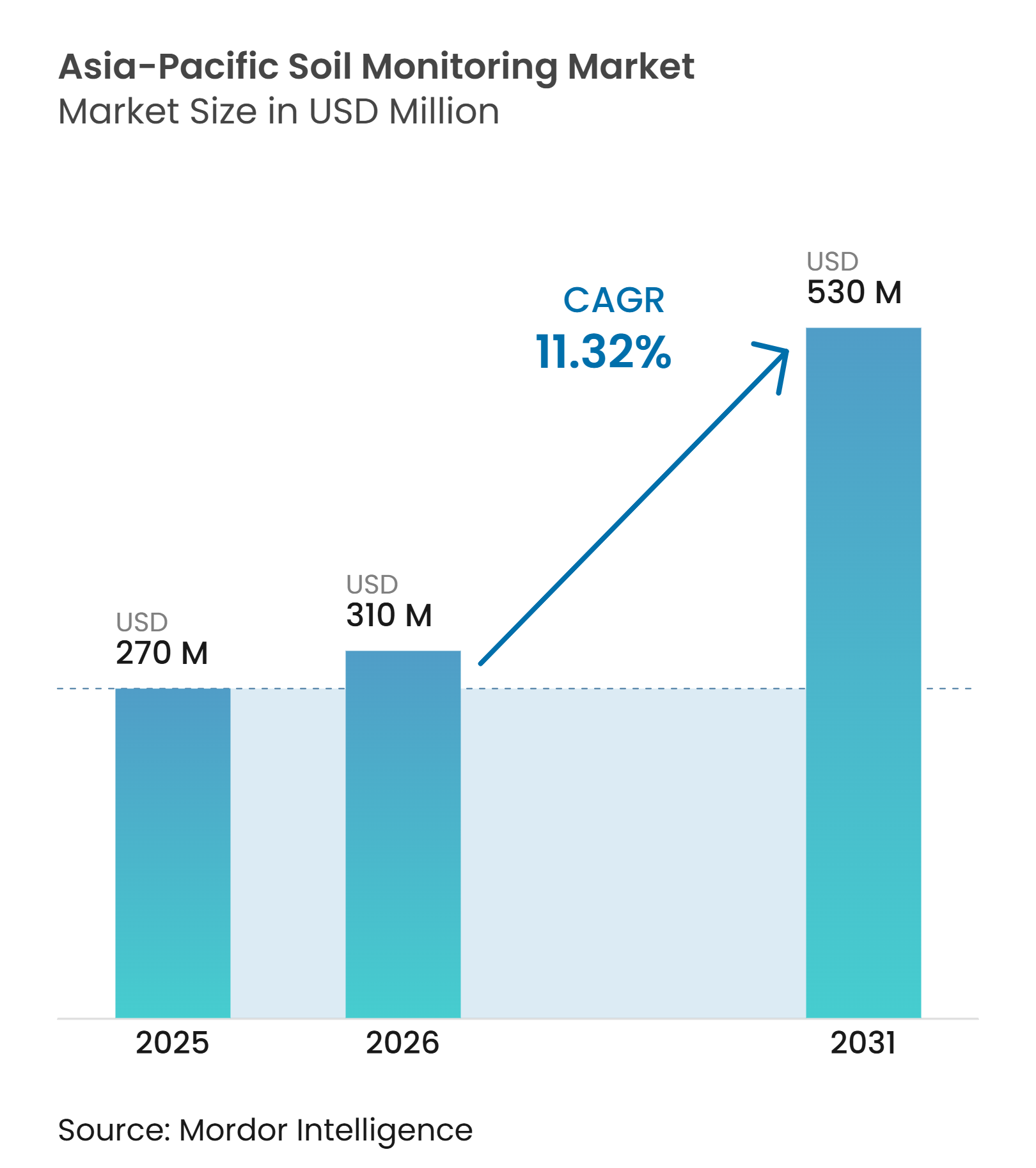
The Asia-Pacific soil monitoring market was valued at USD 270.00 million in 2025 and is forecast to grow from USD 310.00 million in 2026 to USD 530.00 million by 2031, at a CAGR of 11.32% during the forecast period 2026–2031. Demand is driven by the need to manage water, nutrients, and soil conditions across diverse farming systems. Governments and agricultural agencies across the region are investing in soil health programs to improve crop yields and reduce input costs. China and India are developing digital agriculture programs that require wider soil data collection. Increasing water stress is raising the importance of soil moisture and salinity measurements in irrigated farming, particularly in arid and semi-arid zones where efficient water use is critical. Suppliers are integrating field sensors with satellite data, weather records, and farm management platforms. This integration enables more precise, real-time decision-making for farmers and agronomists. This shift is creating recurring service opportunities alongside equipment sales in the Asia-Pacific soil monitoring market.
Key Report Takeaways
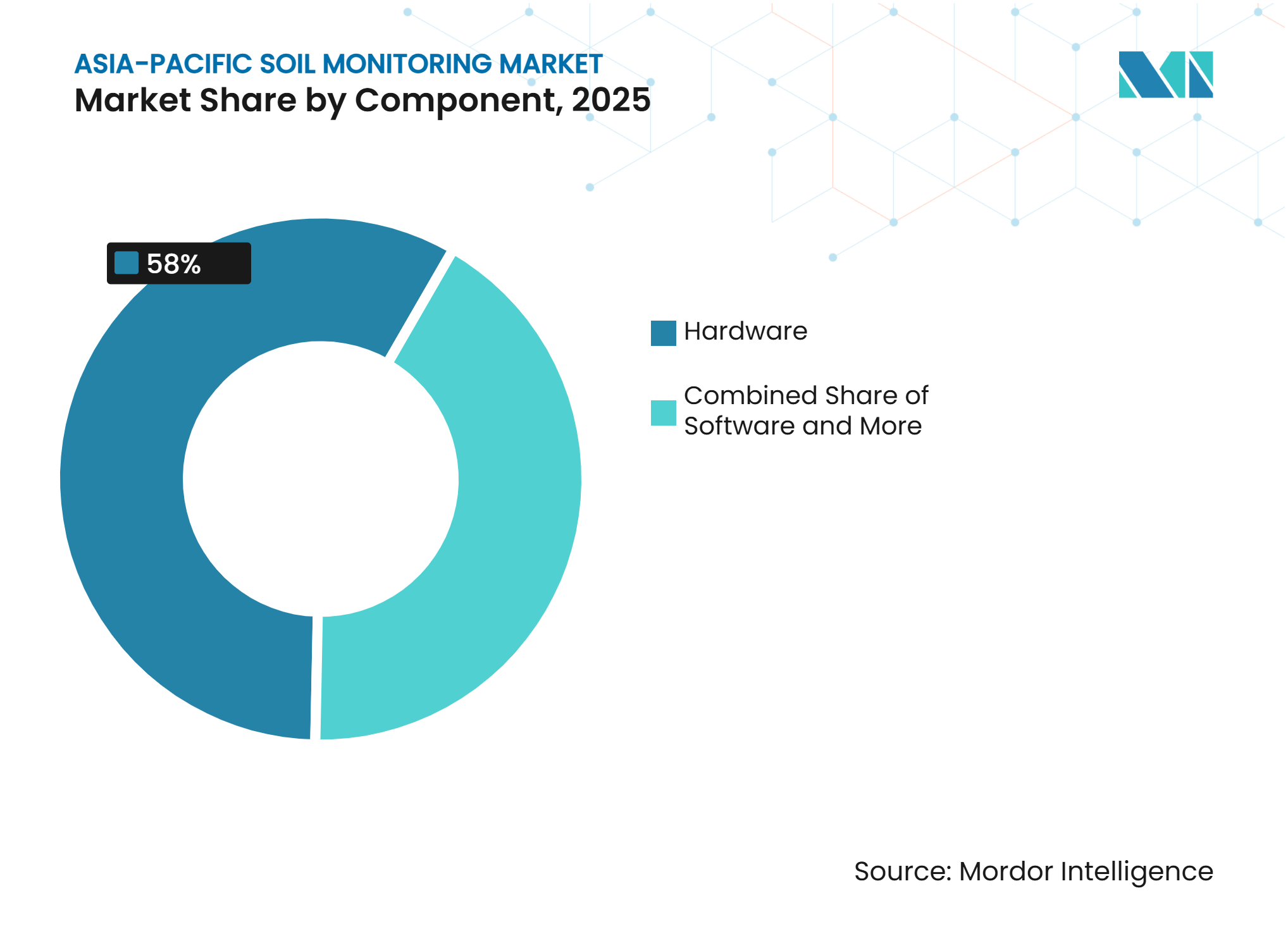
- By component, hardware was the largest segment and held 58.0% of the Asia-Pacific soil monitoring market share in 2025, while services are the fastest-growing segment and are forecasted to expand at a 16.3% CAGR between 2026 and 2031.
- By product type, in-situ sensors were the largest segment and held 46.0% of the Asia-Pacific soil monitoring market size in 2025, while remote sensing platforms are the fastest-growing segment and are forecasted to expand at an 18.1% CAGR between 2026 and 2031.
- By connectivity technology, wireless was the largest segment and held 70.0% of the market share in 2025, while wireless is also the fastest-growing segment and is forecasted to expand at a 19.8% CAGR between 2026 and 2031.
- By application, open field was the largest segment and held 63.0% of the market share in 2025, while protected cultivation is the fastest-growing segment and is forecasted to expand at a 14.2% CAGR between 2026 and 2031.
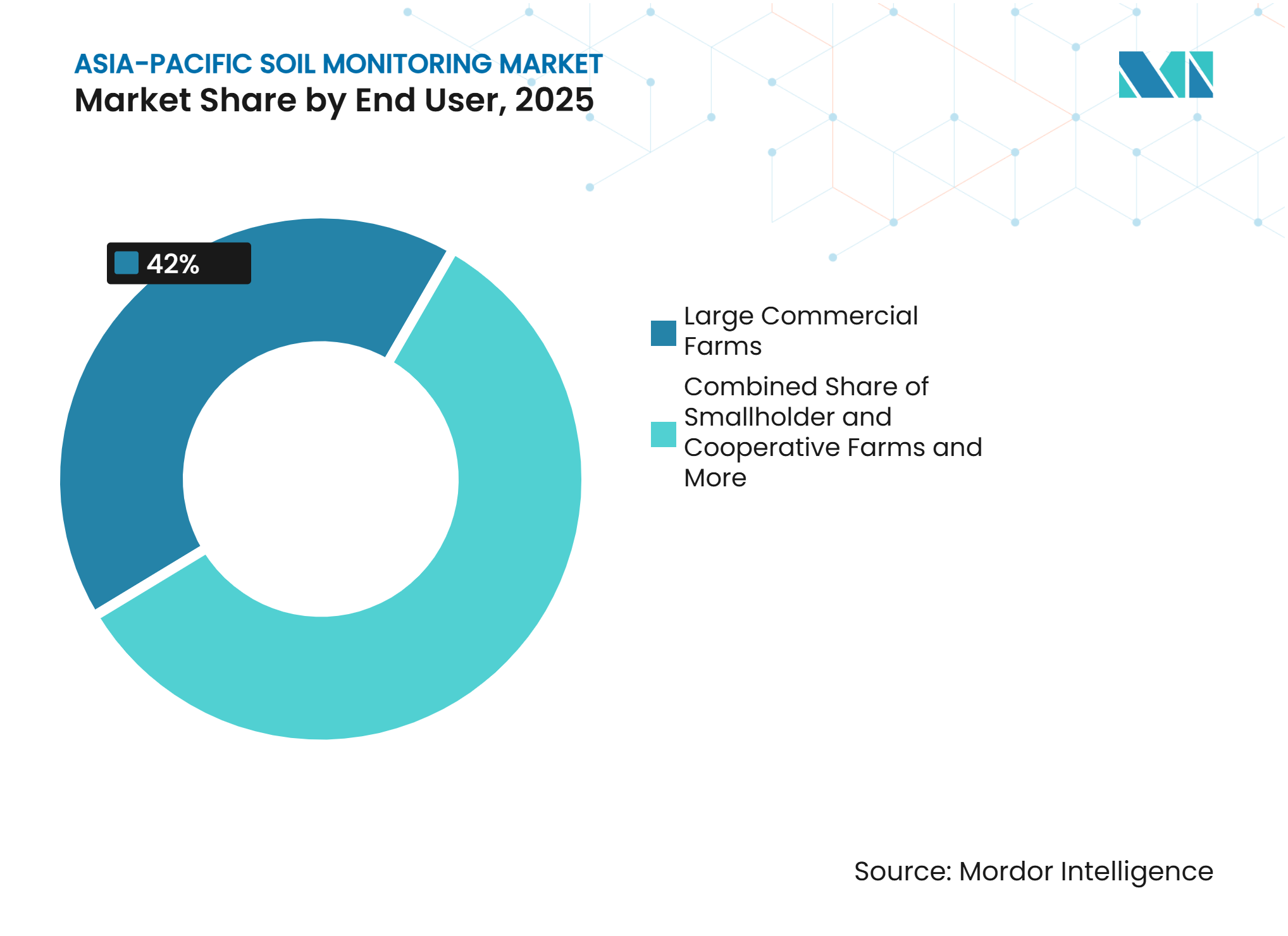
- By end user, large commercial farms were the largest segment and held 42.0% of the market share in 2025, while research institutes and universities are the fastest-growing segment and are forecasted to expand at a 14.6% CAGR between 2026 and 2031.
Note: Market size and forecast figures in this report are generated using Mordor Intelligence’s proprietary estimation framework, updated with the latest available data and insights as of January 2026.
Market Trends and Insights
Drivers Impact Analysis of Asia-Pacific Soil Monitoring Market*
| Driver | (~) % Impact on CAGR Forecast | Geographic Relevance | Impact Timeline |
|---|---|---|---|
| Precision agriculture and smart irrigation adoption | +4.2% | China, India, Australia, and Japan | Medium term (2-4 years) |
| China and India digital agriculture programs | +3% | China and India primarily, with spillover to Association of Southeast Asian Nations (ASEAN) | Short term (≤ 2 years) |
| Water scarcity and irrigation efficiency requirements | +2.5% | Asia-Pacific, with highest emphasis in India, China, and Australia | Short term (≤ 2 years) |
| Soil data integration with farm management platforms | +1.8% | Global, with emphasis on commercial farms in China, Australia, and Japan | Medium term (2-4 years) |
| Localized calibration for diverse Asian soil textures | +1% | Asia-Pacific, including India, China, Japan, and Southeast Asia | Long term (≥ 4 years) |
| Sensor-based verification for export quality and carbon programs | +0.8% | Australia, Southeast Asia, and India | Long term (≥ 4 years) |
| Source: Mordor Intelligence | |||
Precision Agriculture and Smart Irrigation Adoption
The growing adoption of precision agriculture and smart irrigation is increasing demand for soil monitoring technologies across the Asia-Pacific region. Commercial farms are increasingly integrating soil moisture sensors and other field-monitoring devices with automated irrigation systems and digital farm-management platforms to improve water-use efficiency and optimize crop production. Research published in Sustainability in 2025 on digital transformation in Chinese agriculture highlights the use of digital technologies, including precision agriculture and smart irrigation, to support more efficient and sustainable farm management. As soil data becomes integrated with irrigation control, farm-management software, and decision-support tools, demand extends beyond standalone sensors to connected monitoring platforms, analytics, and data services. These integrated systems can also increase switching costs because replacing a monitoring provider may require new hardware, system integration, and migration of historical data, supporting recurring demand for established soil monitoring solutions.
China and India Digital Agriculture Programs
China and India are strengthening the integration of soil information into national agricultural planning and digital agriculture programs, creating demand for technologies that can collect, analyze, and manage soil data at scale. China’s agricultural technology guidelines for 2024–2028 call for the development of rapid soil testing technologies, a digital soil information system, a multidimensional soil monitoring network, and farmland evaluation and early-warning platforms. In February 2025, China’s Ministry of Agriculture and Rural Affairs reported that a nationwide soil assessment had collected 3.11 million samples from 2.87 million sites, demonstrating the scale of soil data generation required for agricultural planning and farmland-quality management[1]. India’s Digital Agriculture Mission, approved in September 2024, includes the Krishi Decision Support System and a comprehensive Soil Fertility and Profile Map, further increasing the emphasis on structured and geospatial agricultural data. These large-scale initiatives are anticipated to support demand for soil sensors, rapid testing equipment, field-data collection systems, remote sensing, analytical platforms, and data-management services across the Asia-Pacific soil monitoring market.
Water Scarcity and Irrigation Efficiency Requirements
Increasing water scarcity and pressure to improve irrigation efficiency are driving demand for soil moisture and salinity monitoring technologies across irrigated farmland in the Asia-Pacific region. Agriculture accounts for roughly 70% of freshwater withdrawals in Asia and the Pacific, while the Food and Agriculture Organization of the United Nations (FAO) estimates that regional water demand could exceed available supply by 40% by 2030, driven by population growth, urban expansion, and water-intensive agriculture[2]. The Asian Development Bank’s Asian Water Development Outlook 2025 also highlights rising climate and water-related risks, including drought exposure and the need for increased investment in water infrastructure and more efficient water management across the region. Continuous soil monitoring enables growers to schedule irrigation based on field-level soil moisture conditions rather than fixed intervals, helping optimize water application and reduce unnecessary irrigation. Government-supported irrigation modernization and on-farm water-efficiency programs in markets such as India and Australia can further support investment in these technologies. As water availability increasingly affects crop productivity and quality, particularly in irrigated and export-oriented production, demand for connected soil moisture, salinity, and multi-parameter monitoring systems is anticipated to increase across the Asia-Pacific soil monitoring market.
Soil Data Integration With Farm Management Platforms
The integration of soil monitoring data with farm management and irrigation platforms is increasing the value of connected soil monitoring solutions across the Asia-Pacific region, particularly in digitally advancing agricultural markets such as China, Japan, and Australia. Farms in these markets are increasingly adopting digital tools for crop, irrigation, and resource management, creating opportunities to integrate soil measurements with broader farm-management workflows. In November 2025, CropX Technologies expanded its partnership with Reinke Manufacturing by integrating soil moisture, evapotranspiration, and weather data into Reinke’s ReinCloud 3 irrigation interface, enabling growers to use field-level information within irrigation management workflows. Such integration reduces manual data handling and allows soil measurements to directly support irrigation and farm-management decisions. It also expands revenue opportunities beyond hardware through software subscriptions, data services, Application Programming Interface (API) integrations, and technical support. As farms in China, Japan, and Australia increasingly connect soil sensors with digital agricultural and irrigation systems, established platform integrations and accumulated field data can increase the operational effort involved in switching suppliers, supporting customer retention and creating opportunities for integrated soil monitoring providers in the Asia-Pacific market.
Restraints Impact Analysis of Asia-Pacific Soil Monitoring Market*
| Restraint | (~) % Impact on CAGR Forecast | Geographic Relevance | Impact Timeline |
|---|---|---|---|
| Upfront cost and payback constraints for smallholder farms | -1.5% | India, China, Southeast Asia, and South Asia broadly | Short term (≤ 2 years) |
| Rural connectivity and technical-skills gaps | -1% | India’s rural belt, Southeast Asia, and remote Australia | Medium term (2-4 years) |
| Cross-soil sensor variability and calibration burden | -0.7% | Asia-Pacific, with highest relevance in India, China, and Southeast Asia | Long term (≥ 4 years) |
| Data interoperability across fragmented farm systems | -0.5% | Asia-Pacific, including government procurement channels | Medium term (2-4 years) |
| Source: Mordor Intelligence | |||
Upfront Cost and Payback Constraints for Smallholder Farms
High upfront costs for soil monitoring equipment, installation, subscriptions, calibration, and maintenance can constrain adoption among smallholder farmers across the Asia-Pacific region. Small and fragmented landholdings make it more difficult for farmers to spread monitoring costs across a large cultivated area, particularly for lower-value staple crops where the financial return from precision-management technologies may be limited. India, Vietnam, Indonesia, and Bangladesh have substantial smallholder farming populations, creating a large but price-sensitive potential customer base for soil monitoring solutions. Although cooperative procurement, government support programs, and pay-per-use service models can reduce the initial investment burden, access to such financing and service arrangements remains uneven across rural markets. Consequently, suppliers may need to offer low-cost, portable, solar-powered, or shared monitoring solutions to improve the economic viability of adoption, while the relatively high cost of sophisticated multi-parameter systems can continue to restrain market penetration in price-sensitive segments of the Asia-Pacific soil monitoring market.
Rural Connectivity and Technical-Skills Gaps
Limited rural connectivity and technical skills can constrain the deployment and effective use of connected soil monitoring systems across the Asia-Pacific region. Field sensors depend on cellular networks, low-power wide-area network (LPWAN) infrastructure, or local gateways to transmit measurements to cloud-based platforms, while coverage and network reliability can vary across remote agricultural areas in countries such as India, Myanmar, Indonesia, and Australia. A 2025 Institute of Electrical and Electronics Engineers (IEEE) conference study demonstrated the technical feasibility of an NB-IoT and STM32-based soil monitoring system, reporting packet loss of less than 1% under network conditions where connectivity was available. However, reliable data transmission alone does not ensure effective adoption, as farmers may also require technical support to install, calibrate, maintain, and interpret sensor systems. Differences in telecommunications infrastructure, spectrum regulations, and national frequency-allocation requirements can further complicate the deployment of connected monitoring equipment across multiple markets. Consequently, suppliers need to adapt connectivity technologies, hardware configurations, and service support to local network conditions, increasing deployment complexity and operating costs in the Asia-Pacific soil monitoring market.
*Our forecasts treat driver/restraint impacts as directional, not additive. The impact forecasts reflect baseline growth, mix effects, and variable interactions.
Asia-Pacific Soil Monitoring Market Segment Analysis
By Component:
Hardware Leads Initial Deployments, Services Build Recurring RevenueHardware held 58.0% of the Asia-Pacific soil monitoring market share in 2025, making it the largest component. Its leading position reflects the upfront investment required to establish soil monitoring infrastructure, including in-situ probes, sensor arrays, wireless telemetry nodes, data loggers, and related field equipment. Large commercial farms and agricultural enterprises generally require durable equipment capable of collecting multiple soil parameters across extensive and geographically dispersed fields. Hardware also remains essential for generating the field-level measurements that support connected software platforms, analytics, and decision-support systems. As adoption expands across commercial agriculture, demand for reliable multi-parameter monitoring equipment is anticipated to remain a major contributor to the Asia-Pacific soil monitoring market.
The services segment is forecast to expand at a 16.3% CAGR between 2026 and 2031, making it the fastest-growing component. Growth is supported by increasing demand for installation, calibration, maintenance, data management, analytics, and subscription-based monitoring services that reduce the technical burden on farm operators. Cloud connectivity and remote data management are enabling soil-monitoring suppliers to expand beyond one-time equipment sales toward recurring software, data, and monitoring services. By connecting soil sensors with cloud-based platforms, suppliers can provide continuous access to field measurements, automated alerts, data visualization, and decision-support tools, creating opportunities for subscription-based and service-oriented revenue models. METER Group's ZENTRA Cloud, for example, provides cloud-based management and visualization of data from connected soil and environmental sensors, illustrating the integration of monitoring hardware with digital data-management services. As soil monitoring systems become increasingly connected and data-intensive, recurring service offerings are anticipated to capture a growing share of market spending.



By Product Type:
In-Situ Sensors Lead, Remote Sensing Platforms Advance FastestIn-situ sensors held 46.0% of the Asia-Pacific soil monitoring market share in 2025, making them the largest product type because they provide direct and continuous measurements of field-level soil conditions. Commercial farms, research stations, and precision irrigation projects use in-situ systems to monitor parameters such as soil moisture, temperature, and electrical conductivity at specific depths. Products such as Sentek Technologies’ Drill & Drop probes and METER Group’s TEROS series support applications across horticulture, viticulture, and broadacre agriculture. Portable probes and field-testing equipment also remain relevant where permanent sensor networks are not economically or operationally practical, particularly for extension services and smallholder farming. The continued need for localized measurements across diverse agricultural systems supports the leading position of in-situ sensors in the Asia-Pacific soil monitoring market.
Remote sensing platforms are forecast to expand at an 18.1% CAGR between 2026 and 2031, making it the fastest-growing product type. Growth is supported by the increasing availability of satellite-based soil and land monitoring data, Unmanned Aerial Vehicle (UAV)-based imaging, and public agricultural monitoring systems that can provide information across large and geographically dispersed areas. The NASA-ISRO Synthetic Aperture Radar (NISAR) mission, for example, provides soil-moisture products at 100-meter spatial resolution, with products validated over India’s Indo-Gangetic Plains in early 2026. Remote sensing can complement ground-based sensors by extending spatial coverage and identifying areas requiring more detailed field investigation, rather than replacing localized measurements. As satellite and aerial data become increasingly integrated with farm-management and soil-monitoring platforms, remote sensing is anticipated to gain importance across the Asia-Pacific market.
By Connectivity Technology:
Wireless Supports Coverage and Data FrequencyWireless connectivity held 70.0% of the Asia-Pacific soil monitoring market revenue in 2025, making it the largest connectivity technology, and is forecast to expand at a 19.8% CAGR between 2026 and 2031, making it the fastest-growing segment. Its leading position reflects the flexibility of deploying connected soil sensors across agricultural fields without extensive physical cabling. Low-power wide-area network (LPWAN) technologies, including Long Range Wide Area Network (LoRaWAN) and narrowband Internet of Things (NB-IoT), are particularly relevant for battery-powered field sensors because they support long-range communication with relatively low power consumption. A 2025 study of LoRaWAN-based agricultural monitoring highlighted the technology's potential for low-power, long-range communication in remote monitoring applications. LoRaWAN can support battery-powered field sensors and long-range data transmission, making it suitable for connected soil-monitoring systems deployed across geographically dispersed agricultural areas. NB-IoT provides another option where cellular infrastructure is available, enabling soil measurements to be transmitted to cloud-based monitoring platforms. These wireless technologies can reduce installation complexity and enable monitoring networks to be expanded across geographically dispersed fields.
Wired connectivity remains relevant for permanent installations where reliable power and cabling infrastructure are already available, including research stations, greenhouses, and controlled agricultural environments. Satellite connectivity can also support monitoring in remote locations where terrestrial cellular or LPWAN coverage is limited, particularly across remote areas of Australia and parts of Southeast Asia. However, higher equipment and communication costs can limit its use to applications where terrestrial connectivity is impractical. As soil monitoring systems increasingly rely on continuous data transmission, cloud analytics, and remote access, connectivity selection remains an important factor influencing the deployment cost, coverage, scalability, and operating economics of soil monitoring systems across the Asia-Pacific market.
By Application:
Open Field Holds the Broadest Base, Protected Cultivation Gains PaceOpen field cultivation accounted for 63.0% of the Asia-Pacific soil monitoring market revenue in 2025, making it the largest application segment. Its leading position is supported by the region’s extensive production of grains, cotton, rice, sugarcane, and plantation crops, particularly across China, India, and Australia. Soil monitoring systems are used in these large-scale agricultural operations to support irrigation scheduling, nutrient management, and salinity monitoring. The extensive cultivated area and increasing emphasis on input efficiency create a broad demand base for field-level soil monitoring technologies across open-field production.
Protected cultivation is forecast to expand at a 14.2% CAGR between 2026 and 2031, making it the fastest-growing application segment. Greenhouse clusters in Japan, controlled-environment agriculture in China, and high-value vegetable and floriculture production in Southeast Asia are supporting demand for frequent soil monitoring. The higher economic value of protected-cultivation crops can provide a stronger business case for monitoring investments, while controlled growing conditions allow sensor data to be directly incorporated into irrigation and nutrient-management systems. Emerging applications such as soil organic carbon measurement for agricultural carbon-credit programs provide additional opportunities for field monitoring technologies across the region.
By End User:
Commercial Farms Lead Spending, Research Institutions Expand DemandLarge commercial farms accounted for 42.0% of the Asia-Pacific soil monitoring market revenue in 2025, making them the largest end-user segment. Their larger cultivated areas improve the economic case for investment in soil sensors, connected monitoring networks, and cloud-based agronomic platforms by spreading technology costs across more hectares. Broadacre farms in Australia, large-scale agricultural operations in China, and plantation holdings in India provide important demand bases for multi-parameter soil monitoring systems. These users increasingly integrate soil data with precision agriculture, irrigation management, and other digital farm-management applications, supporting demand for connected monitoring technologies.
Research institutes and universities are forecast to expand at a 14.6% CAGR between 2026 and 2031, making them the fastest-growing end-user segment. Research organizations use soil monitoring equipment to conduct field trials, validate sensor performance, develop soil models, and generate datasets that can support wider commercial adoption. Demand is also supported by research into soil carbon, precision agriculture, and the validation of satellite-derived soil information against ground measurements. Smallholder and cooperative farms remain more sensitive to upfront costs and are therefore more likely to rely on shared equipment, subsidies, or service-based models. Government agencies and nongovernmental organizations represent additional demand as large-scale soil surveys and monitoring programs expand across markets such as China and India.

Geography Analysis
China held 46.0% of the Asia-Pacific soil monitoring market share in 2025, making it the largest market in the region. Its large agricultural base and government-led investment in farmland monitoring and digital agriculture support demand for soil monitoring technologies. China’s agricultural technology guidelines for 2024–2028 call for rapid soil testing technologies, a digital soil information system, and a multidimensional soil monitoring network. In February 2025, China’s Ministry of Agriculture and Rural Affairs reported that a nationwide soil assessment had collected 3.11 million samples from 2.87 million sites, demonstrating the scale of soil data collection supporting farmland management.
India is forecast to expand at a 15.2% CAGR between 2026 and 2031, making it the fastest-growing country in the market. The country’s Digital Agriculture Mission includes the Krishi Decision Support System and a comprehensive Soil Fertility and Profile Map, supporting greater integration of soil information into digital agricultural systems. By June 2026, India’s Soil and Land Use Survey had covered 52.38 million hectares using satellite and ground-based data[3]. In addition, NISAR-derived soil-moisture products provide 100-meter-resolution information, supporting agricultural monitoring and irrigation-related applications across India. These initiatives are expanding the potential user base for both ground-based and remote soil monitoring technologies.
Japan and Australia represent established markets supported by precision agriculture adoption, commercial farming, and digital farm-management infrastructure. Southeast Asia, particularly Thailand, Vietnam, and Indonesia, provides additional demand from large agricultural and export-oriented production systems. In Thailand, a 2026 research demonstrated satellite-based mapping of soil properties including organic matter, nitrogen, phosphorus, and potassium in sugarcane fields, highlighting the expanding application of remote sensing for agricultural soil assessment. Overall, adoption across the Asia-Pacific soil monitoring market is supported by large-scale agricultural production, government soil-monitoring programs, and increasing integration of soil data with digital agriculture systems.
Competitive Landscape
Market Concentration
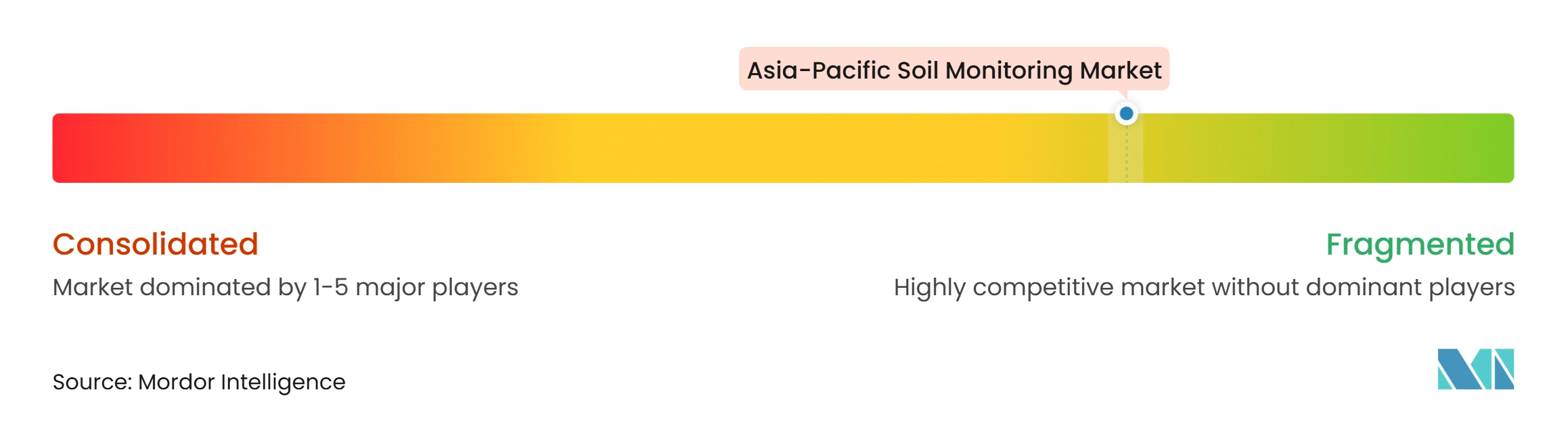
The Asia-Pacific soil monitoring market is fragmented, with competition distributed across specialized sensor manufacturers, agritech companies, environmental monitoring providers, and digital agriculture platforms. Key players include Sentek Technologies Pty Ltd, METER Group, Inc., CropX Technologies Ltd, Campbell Scientific, Inc., and Pessl Instruments GmbH. Competitive positioning is supported by sensor portfolios, regional distribution networks, technical support, and the ability to integrate field measurements with digital platforms. Suppliers are increasingly combining ground-based sensors with satellite and weather data, connectivity solutions, and agronomic analytics to provide more comprehensive monitoring and decision-support capabilities for agricultural users.
CropX Technologies Ltd expanded its soil monitoring portfolio in April 2026 with the launch of Apex, a multi-depth soil sensor designed to measure volumetric water content, temperature, and salinity and integrate with the CropX digital agronomy platform. The sensor is available in 12-inch, 24-inch, and 36-inch configurations, with sensing points at 4-inch intervals, and uses SDI-12 connectivity. In March 2026, CropX Technologies Ltd. also introduced CropX Vision, an AI-powered tool designed to assess vineyard water stress from photographs. METER Group's soil and environmental monitoring portfolio, including its TEROS and SOLYX product lines, provides additional competition in applications requiring continuous soil measurement and monitoring under challenging field conditions. These developments demonstrate increasing competition around measurement depth, parameter coverage, platform integration, and crop-specific analytics.
Other players are differentiating through specialized monitoring technologies and application-specific solutions. Soil Scout Oy focuses on wireless subterranean soil monitoring, while Teralytic provides multi-parameter wireless soil sensing for agricultural applications. Such solutions can be relevant to high-value and protected cultivation where detailed monitoring across multiple soil locations can provide sufficient economic value to justify sensor deployment. Players also compete on connectivity, interoperability, calibration support, and data-management capabilities as agricultural and public-sector monitoring networks become more connected. The growing deployment of government-led soil monitoring programs across China and India further increases the importance of standardized data formats, local technical support, and systems capable of integrating measurements from multiple sources.
Asia-Pacific Soil Monitoring Industry Leaders
-
Sentek Technologies Pty Ltd
-
METER Group, Inc.
-
CropX Technologies Ltd.
-
Campbell Scientific, Inc.
-
Pessl Instruments GmbH (Lindsay Corporation)
- *Disclaimer: Major Players sorted in no particular order
Asia-Pacific Soil Monitoring Market Companies Covered in this Report
- METER Group, Inc.
- Sentek Technologies Pty Ltd
- CropX Technologies Ltd.
- Campbell Scientific, Inc.
- Pessl Instruments GmbH (Lindsay Corporation)
- Stevens Water Monitoring Systems, Inc.
- The Toro Company
- Irrometer Company, Inc.
- Acclima, Inc.
- Delta-T Devices Ltd
- Soil Scout Oy
- Teralytic, Inc.
Recent Industry Developments in Asia-Pacific Soil Monitoring Market
- June 2026: India's government launched the Khet Bachao Abhiyan, which includes farmer awareness activities focused on soil testing, balanced fertilizer use, Soil Health Cards, and sustainable farming practices. The initiative further supports the use of soil-testing data in nutrient-management decisions.
- December 2025: Chinese Academy of Agricultural Sciences (CAAS) launched Nonggeng Model 1.0, a multimodal agricultural large model for high-standard farmland monitoring and supervision, cultivated-land protection, and quality improvement. It incorporates agricultural spatial and temporal data and specialized models for farmland and crop monitoring.
- November 2025: CropX and Reinke expanded their partnership by integrating CropX soil, weather, and agronomic data directly into ReinCloud 3, allowing soil information to be used alongside center-pivot irrigation controls.
Asia-Pacific Soil Monitoring Market Report Scope
The Soil Monitoring Market refers to the segment of the market that focuses on the use of technology to monitor soil conditions, which is crucial for agriculture and environmental management. It encompasses various components and is driven by the need for real-time data on soil parameters such as moisture, temperature, and nutrient content.
The Asia-Pacific Soil Monitoring Market Report is Segmented by Component (Hardware, Software and Services), by Product Type (In-Situ Sensors, Remote-Sensing Platforms and Portable Probes and Test Kits), by Connectivity Technology (Wired and Wireless), by Application (Open Field, Protected Cultivation and Forestry), by End-User (Large Commercial Farms, Smallholder and Cooperative Farms, Research Institutes and Universities, and Government and NGOs), and by Geography (India, China, and More). The Market Forecasts are Provided in Terms of Value (USD).
Segmentation Overview
| Hardware |
| Software |
| Services |
| In-Situ Sensors |
| Remote-Sensing Platforms |
| Portable Probes and Test Kits |
| Wired |
| Wireless (LPWAN, Cellular, Satellite) |
| Open Field |
| Protected Cultivation |
| Forestry |
| Large Commercial Farms |
| Smallholder and Cooperative Farms |
| Research Institutes and Universities |
| Government and NGOs |
| China |
| India |
| Japan |
| Australia |
| Rest of Asia-Pacific |
| By Component | Hardware |
| Software | |
| Services | |
| By Product Type | In-Situ Sensors |
| Remote-Sensing Platforms | |
| Portable Probes and Test Kits | |
| By Connectivity Technology | Wired |
| Wireless (LPWAN, Cellular, Satellite) | |
| By Application | Open Field |
| Protected Cultivation | |
| Forestry | |
| By End User | Large Commercial Farms |
| Smallholder and Cooperative Farms | |
| Research Institutes and Universities | |
| Government and NGOs | |
| By Geography | China |
| India | |
| Japan | |
| Australia | |
| Rest of Asia-Pacific |
Key Questions Answered in the Report
What is the Asia-Pacific soil monitoring market size?
The Asia-Pacific soil monitoring market was valued at USD 270.00 million in 2025 and is forecasted to reach USD 530.00 million by 2031, at 11.32% CAGR between 2026 and 2031.
Which country holds the largest share in Asia-Pacific soil monitoring?
China held 46.0% of regional revenue in 2025, supported by farmland monitoring investment and national soil information programs.
Why does wireless connectivity matter for soil monitoring?
Wireless technology held 70.0% of revenue in 2025 and is forecasted to expand at a 19.8% CAGR between 2026 and 2031 because it supports wider field coverage.
What is limiting adoption among smaller farms?
Upfront device, installation, calibration, and service costs can make payback difficult for smallholder farms.