
Asia-Pacific Packaged Chia Seeds Market Size and Share
Market Overview
| Study Period | 2021 - 2031 |
|---|---|
| Forecast Data Period | 2026 - 2031 |
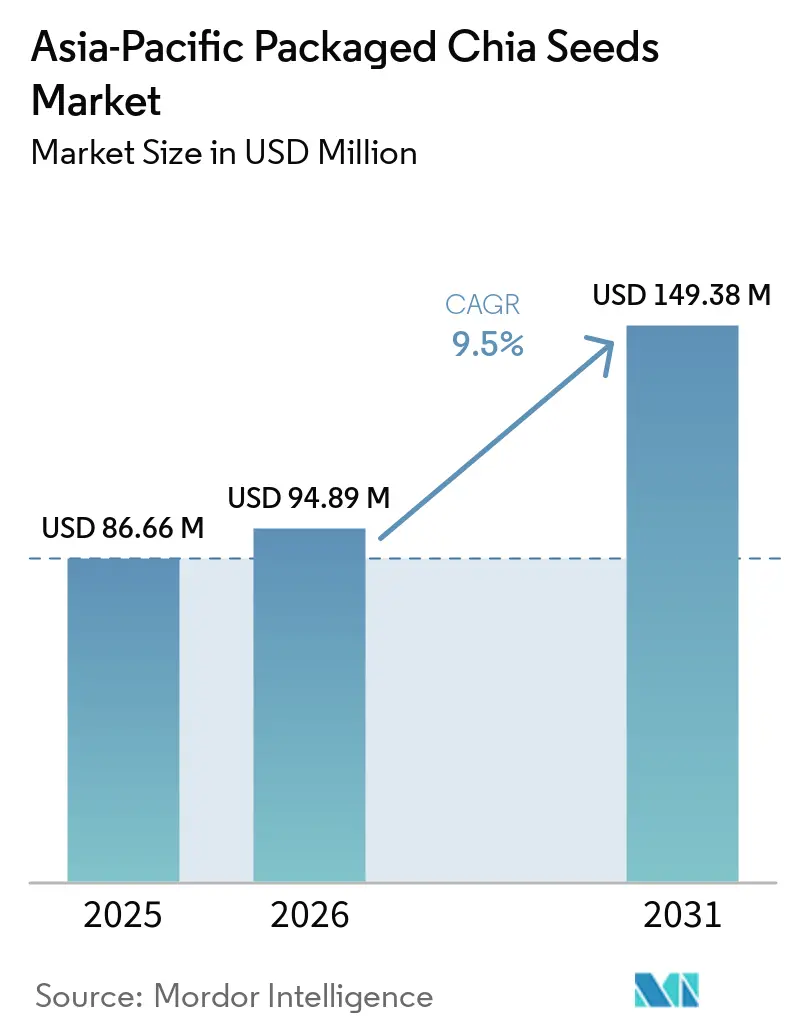
| Base Year Market Size (2025) | USD 86.66 Million |
| Market Size (2026) | USD 94.89 Million |
| Market Size (2031) | USD 149.38 Million |
| Growth Rate (2026 - 2031) | 9.50 % |
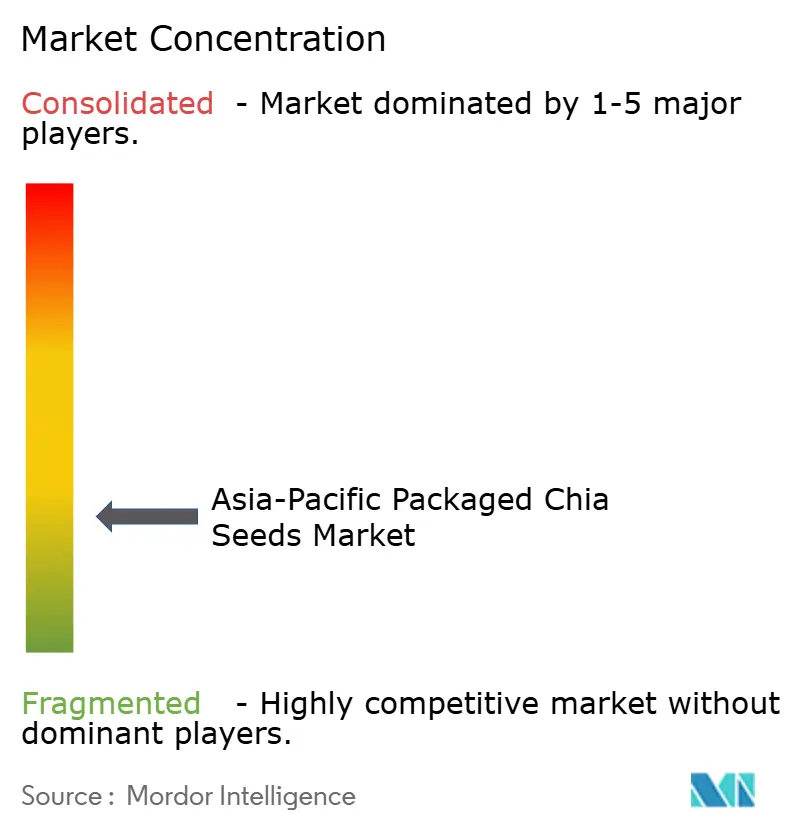
| Market Concentration | Low |
Major Players *Disclaimer: Major Players sorted in no particular order Image © Mordor Intelligence. Reuse requires attribution under CC BY 4.0. | |
Asia-Pacific Packaged Chia Seeds Market Analysis by Mordor Intelligence
The Asia-Pacific packaged chia seeds market was valued at USD 86.66 million in 2025, estimated to reach USD 94.89 million in 2026, and is projected to reach USD 149.38 million by 2031, growing at a CAGR of 9.50% from 2026 to 2031. The market is supported by increasing consumer interest in health-oriented and nutrient-dense foods, as chia seeds are increasingly perceived as a convenient way to enhance the nutritional profile of everyday diets. Growing awareness of functional foods and a broader shift toward natural and wholesome food choices are strengthening demand for packaged chia seeds. The expansion of modern grocery and online retail channels is improving product accessibility, while innovations in packaging, pack sizes, processing, and product formats are making chia seeds easier to store and use.
Key Report Takeaways
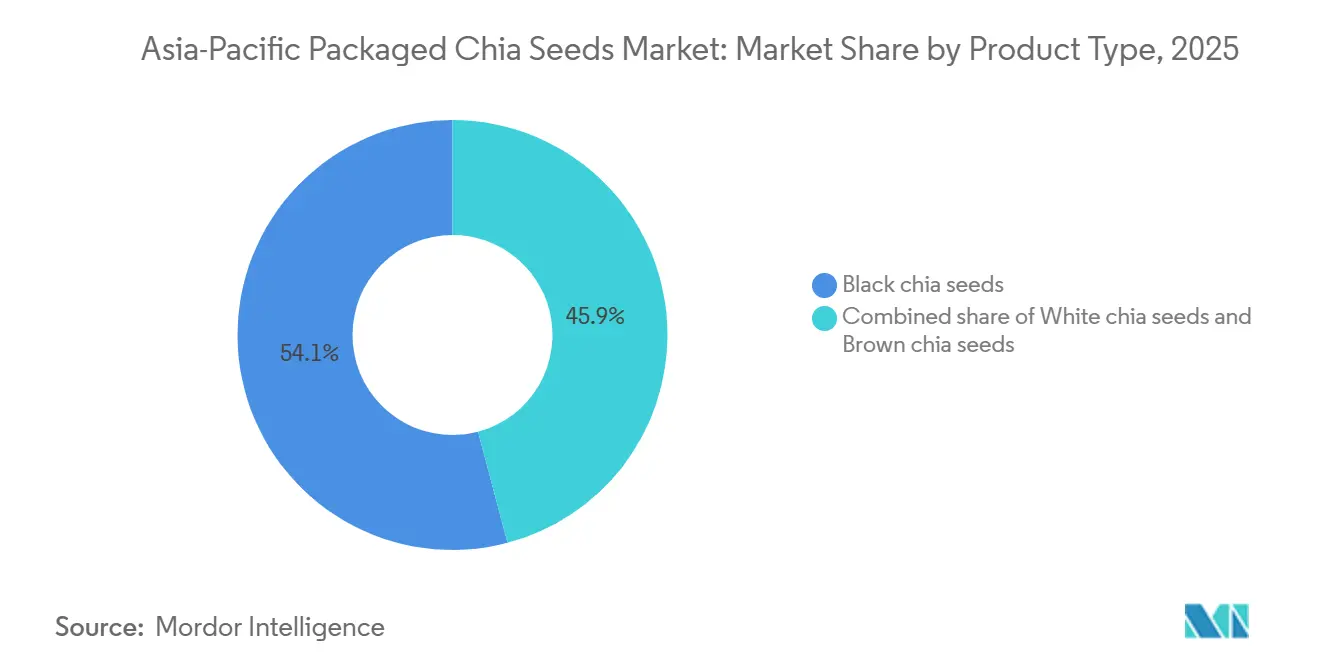
- By product type, black chia seeds held 54.12% of the Asia-Pacific packaged chia seeds market share in 2025, while white chia seeds are forecast to grow at a 10.21% CAGR through 2031.
- By nature, conventional chia seeds accounted for 85.34% of the Asia-Pacific packaged chia seeds market share in 2025, while organic chia seeds are projected to expand at an 11.08% CAGR through 2031.
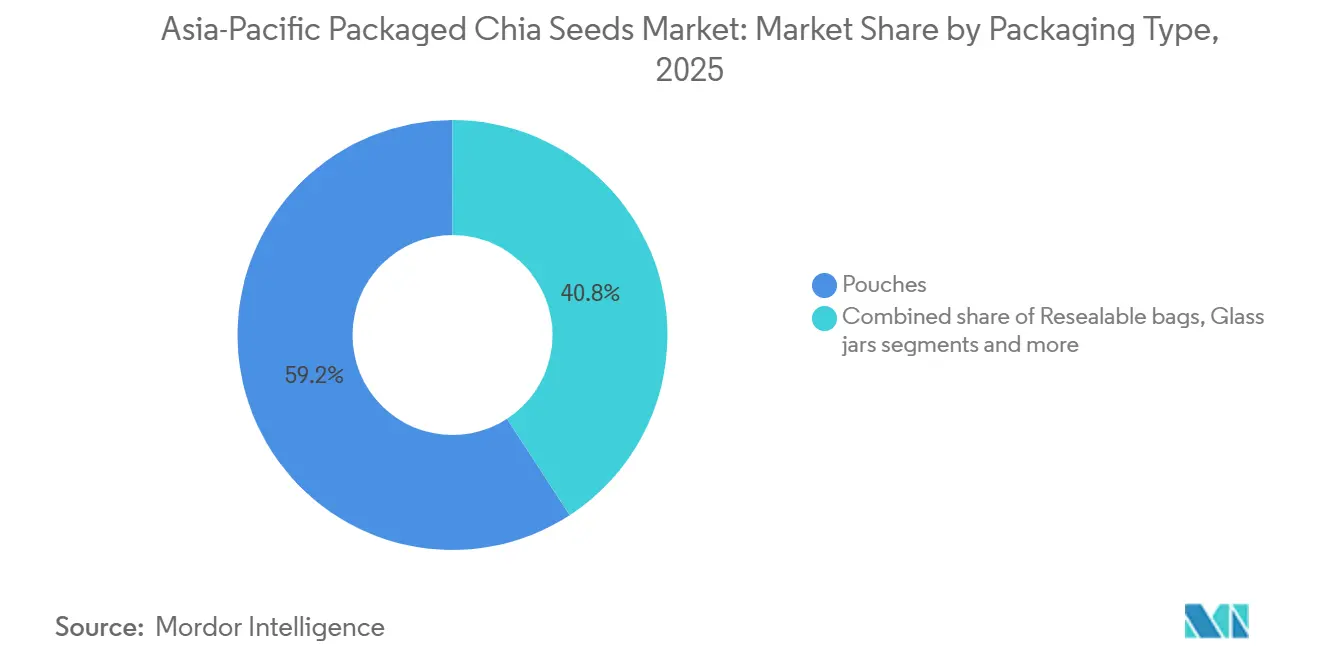
- By packaging type, pouches represented 59.18% of the Asia-Pacific packaged chia seeds market share in 2025, while resealable bags are expected to record a 10.02% CAGR through 2031.
- By distribution channel, supermarkets and hypermarkets captured 54.34% of the Asia-Pacific packaged chia seeds market share in 2025, while online retail is projected to grow at an 11.95% CAGR through 2031.
- By geography, China accounted for 31.23% of the Asia-Pacific packaged chia seeds market share in 2025, while India is forecast to expand at a 10.47% CAGR through 2031.
Note: Market size and forecast figures in this report are generated using Mordor Intelligence’s proprietary estimation framework, updated with the latest available data and insights as of January 2026.
Asia-Pacific Packaged Chia Seeds Market Trends and Insights
Drivers Impact Analysis*
| Driver | (~) % Impact on CAGR Forecast | Geographic Relevance | Impact Timeline |
|---|---|---|---|
| Growing demand for fiber-rich foods supporting digestive wellness | +2.0% | Global; peak impact in China, India, and Japan | Medium term (2–4 years) |
| Rising popularity of chia-based beverages and smoothies | +1.5% | Asia-Pacific core, China, India, Australia; spill-over to Southeast Asia | Medium term (2–4 years) |
| Growing preference for natural and clean-label ingredients | +1.8% | Australia, Japan, South Korea; progressively expanding to Southeast Asian Nations | Long term (≥ 4 years) |
| Increasing product innovation in packaged chia seed formats | +1.2% | China and Australia as leading innovation hubs; India gaining | Short term (≤ 2 years) |
| Expansion of plant-based and flexitarian eating | +1.4% | China, India, Southeast Asia; significant urban concentration | Medium term (2–4 years) |
| Increasing incorporation of chia into bakery and snacks | +1.0% | Asia-Pacific core, with early gains in China, Japan, and South Korea | Short term (≤ 2 years) |
| Source: Mordor Intelligence | |||
Growing Demand for Fiber-Rich Foods Supporting Digestive Wellness
Growing awareness of digestive health is driving demand for naturally fiber-rich foods such as chia seeds across Asia-Pacific, as consumers increasingly incorporate nutrient-dense ingredients into everyday diets. For instance, according to Crohn's & Colitis Australia (CCA), 179,420 Australians were living with inflammatory bowel disease (IBD) in 2025[1]. The continued prevalence of chronic gastrointestinal conditions is increasing attention toward dietary patterns that support digestive health and regularity. This is creating opportunities for packaged chia seeds, as they provide a convenient source of dietary fiber that can be easily incorporated into breakfast foods, smoothies, yogurt, and other everyday meals. As digestive health becomes a more prominent factor in health-focused food choices, demand for convenient, fiber-rich packaged ingredients such as chia seeds is expected to grow.
Rising Popularity of Chia-Based Beverages and Smoothies
The rising popularity of chia-based beverages and smoothies is driving demand for packaged chia seeds by expanding their use across convenient and customizable drink formats. Chia seeds can be easily added to smoothies, juices, flavored water, shakes, and other beverages. Their ability to absorb liquid and develop a gel-like texture adds visual and textural appeal, while their mild taste allows them to be combined with fruits, vegetables, dairy, and plant-based beverages without substantially altering the underlying flavor profile. The growing availability of recipes and ready-to-prepare beverage formats is further encouraging household use, increasing the frequency of chia consumption and supporting demand for packaged chia seeds across Asia-Pacific. This trend is also reflected in the expanding retail presence of packaged chia seeds, with more products being positioned specifically for beverage applications, making it easier for consumers to incorporate chia seeds into their daily routines.
Growing Preference for Natural and Clean-Label Ingredients
The growing preference for natural and clean-label ingredients is supporting demand for packaged chia seeds, as consumers increasingly seek food products with recognizable ingredients, transparent sourcing, and fewer artificial additives. For instance, according to the Ministry of Agriculture, Forestry and Fisheries (MAFF) of Japan, more than 84% of consumers in 2024 considered choosing environmentally friendly agricultural and food products, indicating strong consumer attention toward products associated with sustainable and responsible production[2]. This preference supports demand for packaged chia seeds, particularly single-ingredient, minimally processed, and transparently labeled formats, as these attributes align with consumers' increasing interest in simpler and more naturally positioned food products.
Increasing Product Innovation in Packaged Chia Seed Formats
Increasing product innovation in packaged chia seed formats is supporting market growth by improving convenience, portion suitability, storage, and product freshness for household consumers. Manufacturers are introducing varied pack sizes and functional packaging features to address different consumption frequencies and reduce the need for consumers to store large quantities after opening. For instance, in September 2026, GGT Foods launched 200 g packs of chia seeds in a smaller, resealable format designed to reduce product wastage and maintain freshness after opening. Such consumer-oriented formats improve ease of handling and storage while offering greater flexibility in purchase quantities, encouraging trial and repeat purchases, and supporting the expansion of the packaged chia seeds market.
Restraints Impact Analysis*
| Restraint | (~) % Impact on CAGR Forecast | Geographic Relevance | Impact Timeline |
|---|---|---|---|
| Higher price compared with conventional seeds and grains | -1.5% | Price-sensitive markets, India (Tier 2–3 cities), Indonesia, Thailand | Long term (≥ 4 years) |
| Competition from locally available nutrient-rich seeds | -1.2% | India (flaxseed, sesame), China (sesame, flax), Southeast Asia | Medium term (2–4 years) |
| Food safety and regulatory compliance requirements | -0.8% | China (NHC/GB standards), India (FSSAI), South Korea (MFDS) | Short term (≤ 2 years) |
| Storage and freshness challenges for chia seed products | -0.9% | Emerging markets with limited cold-chain infrastructure, Indonesia, Thailand, India Tier 2–3 | Medium term (2–4 years) |
| Source: Mordor Intelligence | |||
Higher Price Compared With Conventional Seeds and Grains
Higher prices compared with conventional seeds and grains can restrain the growth of the packaged chia seeds market by increasing the cost of incorporating chia into regular household diets. Chia seeds command a premium over widely consumed staple seeds and grains, which can limit purchase frequency, particularly among price-sensitive consumers. The price difference may also lead consumers to substitute chia with more familiar and lower-cost alternatives such as flaxseeds, sunflower seeds, sesame seeds, oats, and other commonly available grains and seeds. This can limit mass-market penetration and prompt consumers to purchase smaller packs or use chia selectively rather than as a routine dietary ingredient.
Food Safety and Regulatory Compliance Requirements
Food safety and regulatory compliance requirements can restrain the Asia-Pacific packaged chia seeds market by increasing testing, certification, traceability, labeling, and documentation requirements for manufacturers and importers. Packaged chia seeds must meet country-specific standards for contaminants, pesticide residues, microbiological safety, packaging materials, and product labeling before reaching consumers. Differences in food safety and labeling requirements across Asia-Pacific countries can further increase compliance complexity for companies selling products across multiple markets. These requirements raise quality-control and regulatory costs and can be particularly challenging for smaller suppliers, potentially slowing the introduction of new packaged chia seed products and limiting market expansion.
*Our forecasts treat driver/restraint impacts as directional, not additive. The impact forecasts reflect baseline growth, mix effects, and variable interactions.
Segment Analysis
By Product Type: Black Chia Dominates, White Chia Accelerates
Black chia seeds accounted for 54.12% of product-type revenue in 2025. Their segment leadership is supported by a well-established varietal identity, naturally dark seed coat, and favorable nutritional composition. The darker seed appearance provides a strong visual cue for product recognition, while the high concentration of polyunsaturated fatty acids, dietary fiber, and protein reinforces its positioning as a nutrient-dense whole seed. Black chia also contains phenolic compounds and antioxidant constituents, enabling positioning across multiple nutritional attributes rather than a single functional benefit. The combination of established varietal recognition, distinctive appearance, and broad nutrient composition continues to support the segment's leading position.
White chia seeds are projected to expand at a 10.21% CAGR through 2031, supported by their lighter seed color, differentiated appearance, and ability to preserve the visual characteristics of foods in which they are incorporated. Their pale color makes the seeds less visually prominent than black chia when used in lighter-colored food matrices, creating a distinct positioning based on appearance. White chia retains the core nutritional attributes associated with chia seeds while exhibiting differences in specific fatty acid and phenolic profiles. The combination of visual subtlety, nutritional comparability, and varietal differentiation is supporting faster adoption of white chia within the product-type segment.

By Nature: Conventional Holds Scale, Organic Captures Premiumization
Conventional chia seeds accounted for 85.34% of nature-segment revenue in 2025, maintaining their dominant position due to the maturity of conventional cultivation practices and the established availability of standard-grade chia seeds. Conventional production offers greater flexibility in sourcing and processing, allowing suppliers to maintain relatively consistent seed characteristics such as size, cleanliness, moisture content, and purity. The absence of organic certification requirements enables conventional products to be positioned as the standard packaged format, supporting broader market penetration. Their established production infrastructure, standardized quality characteristics, and wider sourcing base continue to underpin the segment's leading revenue contribution.
Organic chia seeds are projected to grow at an 11.08% CAGR through 2031, reflecting increasing differentiation based on certified cultivation practices and production transparency. Organic chia production restricts the use of specified synthetic agricultural inputs and requires compliance with recognized organic standards, giving the segment a distinct certification-based value proposition. Traceability of farming practices and certification can strengthen consumer confidence in the production method, while the absence of conventional agricultural inputs provides a clear point of differentiation at the product level. The combination of certified organic status, documented production practices, and stronger provenance attributes is supporting the faster expansion of organic chia seeds within the nature segment.
By Packaging Type: Pouches Scale Accessibility, Resealable Bags Capture Repeat Buyers
Pouches accounted for 59.18% of packaging-segment revenue in 2025, supported by their efficient use of packaging material, compact structure, and suitability for standardized filling and sealing operations. Their flexible format allows manufacturers to optimize package dimensions across different pack sizes while providing efficient storage and transportation characteristics. Pouches can also incorporate barrier layers that help protect chia seeds from moisture, oxygen, and external contaminants, which is important for maintaining seed quality during storage. The combination of material efficiency, format flexibility, product protection, and operational compatibility supports the segment's leading position.
Resealable bags are projected to expand at a 10.02% CAGR through 2031, driven by their repeated-use functionality and improved product handling after opening. The resealable closure helps consumers control exposure of the remaining seeds to air and moisture between uses, while allowing the package to be opened and closed without transferring the contents to another container. This format is particularly suited to chia seeds because consumption typically occurs in small quantities over multiple occasions, making repeated access an important packaging attribute. The combination of closure functionality, portion flexibility, and improved post-opening handling is supporting faster growth of resealable bags within the packaging segment.
By Distribution Channel: Supermarkets Anchor Volume, Online Retail Drives the Next Wave
Supermarkets and hypermarkets accounted for 54.34% of distribution channel revenue in 2025, reflecting their strong fit for packaged chia seeds through broad shelf presence, immediate product access, and the ability to compare different varieties, pack sizes, and product claims in-store. The physical retail environment allows consumers to directly examine packaging, nutritional information, organic certifications, ingredient details, and freshness-related information before purchase. The organized retail format also supports consistent product merchandising, dedicated health-food sections, and greater assortment visibility, helping packaged chia seeds reach consumers beyond specialized health-food outlets.
Online retail stores are projected to expand at an 11.95% CAGR through 2031, driven by the convenience of home delivery, broader product assortment, and easier comparison of brands, pack sizes, nutritional information, and certifications. Digital platforms allow packaged chia seeds to be searched and purchased without requiring consumers to visit specialized stores, while product descriptions and customer reviews provide additional information during purchase decisions. China's National Bureau of Statistics reported that online retail sales of physical goods increased by 5.2% in 2025, while online sales of food increased by 14.5%, indicating continued growth in digital food purchasing. This expanding online food retail environment provides a supportive distribution pathway for shelf-stable packaged products such as chia seeds.
Geography Analysis
China held the largest share of the Asia-Pacific packaged chia seeds market, accounting for 31.23% of regional revenue in 2025. This position is supported by the increasing integration of chia seeds into packaged health-oriented foods and the expanding availability of imported and packaged seed products through mainstream retail and e-commerce channels. China's established packaged-food distribution infrastructure supports wider product availability across retail formats.
India is projected to be the fastest-growing market in the region, expanding at a CAGR of 10.47% through 2031. Growth is supported by increasing consumer interest in nutrient-rich seeds and their incorporation into packaged wellness and nutrition products. According to UN Comtrade data, India imported USD 110.07 million worth of chia seeds in 2025, making it the world's third-largest chia seed importer, which reflects strong reliance on international supply to meet domestic demand[3]. The expanding availability of packaged chia seeds across modern retail and e-commerce channels is further supporting market growth.
Australia and Japan represent the region's more mature chia seed markets, supported by established consumer familiarity with chia seeds, developed packaged-food markets, and broad availability across organized retail and online channels. Indonesia and South Korea are important developing markets, driven by growing interest in functional foods, plant-based nutrition, wellness-oriented products, and convenient packaged food formats. Other markets across Southeast Asia and Oceania are also contributing to regional expansion as chia seeds gain wider distribution through modern grocery and e-commerce channels.
Competitive Landscape
The Asia-Pacific packaged chia seeds market is fragmented, with competition spread across major players including The Chia Co., GGT Foods, Nutiva, Inc., The Hain Celestial Group, Inc., and Tata Consumer Products Limited, alongside a broader group of regional packaged-seed and health-food brands. Companies compete on product varieties, pack sizes, organic and natural positioning, sourcing, packaging formats, retail availability, and online distribution. The presence of both dedicated chia specialists and diversified packaged-food companies contributes to a competitive market structure.
Competition is also expanding in the organic packaged chia seeds segment within the Asia-Pacific market. Companies differentiate through organic certification, clean-label positioning, seed purity, sourcing claims, pack sizes, and consumer packaging formats. For example, Organic Tattva offers certified organic chia seeds sourced from organic farms, with machine cleaning, hygienic packaging, and quality testing, while the broader retail landscape includes organic and natural chia offerings from several regional brands.
The competitive landscape is further shaped by innovation in processing technology, particularly in seed cleaning, sorting, milling, quality control, packaging, and moisture protection. Companies are adopting improved processing and packaging technologies to enhance product consistency, extend freshness, reduce contamination risks, and improve handling efficiency. For example, GGT Foods uses mechanical filtration and double-sorting processes before packaging and employs moisture-locking packaging to maintain product quality. These developments are creating differentiation beyond the basic chia seed product, with competition increasingly centered on processing precision, packaging functionality, quality assurance, traceability, and supply chain efficiency.
Asia-Pacific Packaged Chia Seeds Industry Leaders
-
The Chia Co
-
GGT Foods
-
Nutiva, Inc.
-
The Hain Celestial Group, Inc.
-
Tata Consumer Products Limited
- *Disclaimer: Major Players sorted in no particular order
Recent Industry Developments
- March 2026: Laird Superfood completed the acquisition of Navitas LLC (Navitas Organics) for USD 38.5 million. The transaction creates a broader functional nutrition platform with complementary superfood portfolios, shared e-commerce distribution, and expanded reach into natural and conventional grocery channels.
- July 2025: Nourish Organics launched a new range of organic and active seeds, including Organic Chia Seeds, expanding its packaged food portfolio. The Organic Chia Seeds are rich in Omega-3 fatty acids, fiber, antioxidants, and plant-based protein.
Asia-Pacific Packaged Chia Seeds Market Report Scope
Chia seeds are derived from the Salvia hispanica plant and are small, nutrient-dense seeds containing dietary fiber, plant-based protein, omega-3 fatty acids, minerals, and other nutritional components. The Asia-Pacific packaged chia seeds market is segmented by product type, nature, packaging type, and distribution channel. Based on product type, the market is segmented into white chia seeds, black chia seeds, and brown chia seeds. Based on nature, the market is segmented into organic chia seeds and conventional chia seeds. Based on packaging type, the market is segmented into pouches, resealable bags, glass jars, plastic containers/bottles, and others. Based on distribution channel, the market is segmented into supermarkets/hypermarkets, convenience and grocery stores, online retail stores, and other distribution channels. Based on geography, the market is segmented into China, Japan, India, Australia, Indonesia, South Korea, Thailand, Singapore, and the rest of Asia-Pacific. For each segment, the market sizing and forecast have been done based on the value (in USD million).
| White chia seeds |
| Black chia seeds |
| Brown chia seeds |
| Organic chia seeds |
| Conventional chia seeds |
| Pouches |
| Resealable bags |
| Glass jars |
| Plastic containers/bottles |
| Others |
| Supermarkets/Hypermarkets |
| Convenience and Grocery Stores |
| Online Retail Stores |
| Other Distribution Channels |
| China |
| Japan |
| India |
| Australia |
| Indonesia |
| South Korea |
| Thailand |
| Singapore |
| Rest of Asia-Pacific |
| By Product Type | White chia seeds |
| Black chia seeds | |
| Brown chia seeds | |
| By Nature | Organic chia seeds |
| Conventional chia seeds | |
| By Packaging Type | Pouches |
| Resealable bags | |
| Glass jars | |
| Plastic containers/bottles | |
| Others | |
| By Distribution Channel | Supermarkets/Hypermarkets |
| Convenience and Grocery Stores | |
| Online Retail Stores | |
| Other Distribution Channels | |
| By Geography | China |
| Japan | |
| India | |
| Australia | |
| Indonesia | |
| South Korea | |
| Thailand | |
| Singapore | |
| Rest of Asia-Pacific |
Key Questions Answered in the Report
What is the projected size of the Asia-Pacific packaged chia seeds market by 2031?
The Asia-Pacific packaged chia seeds market is projected to reach USD 149.38 million by 2031, rising from USD 94.89 million in 2026 at a CAGR of 9.50%.
Which product type leads sales in the Asia-Pacific packaged chia seeds market?
Black chia seeds led product-type revenue with a 54.12% share in 2025, supported by stronger consumer familiarity and established use in functional foods.
Which chia seed type is expected to grow the fastest in Asia-Pacific?
White chia seeds are forecast to grow at a 10.21% CAGR through 2031. Their mild flavor and light color support use in smoothies, bakery products, and dairy alternatives.
Is organic chia growing faster than conventional chia in Asia-Pacific?
Yes. Conventional chia seeds held 85.34% share in 2025, but organic chia seeds are expected to grow faster at an 11.08% CAGR through 2031.