
Asia-Pacific Medical and Healthcare Technical Textile Market Size and Share
Market Overview
| Study Period | 2021 - 2032 |
|---|---|
| Forecast Data Period | 2027 - 2032 |
| Base Year Market Size (2026) | USD 7.63 Billion |
| Market Size (2027) | USD 8.07 Billion |
| Market Size (2032) | USD 11.07 Billion |
| Growth Rate (2027 - 2032) | 6.53 % |
| Market Concentration | Medium |
Major Players *Disclaimer: Major Players sorted in no particular order Image © Mordor Intelligence. Reuse requires attribution under CC BY 4.0. | |
Asia-Pacific Medical and Healthcare Technical Textile Market Analysis by Mordor Intelligence
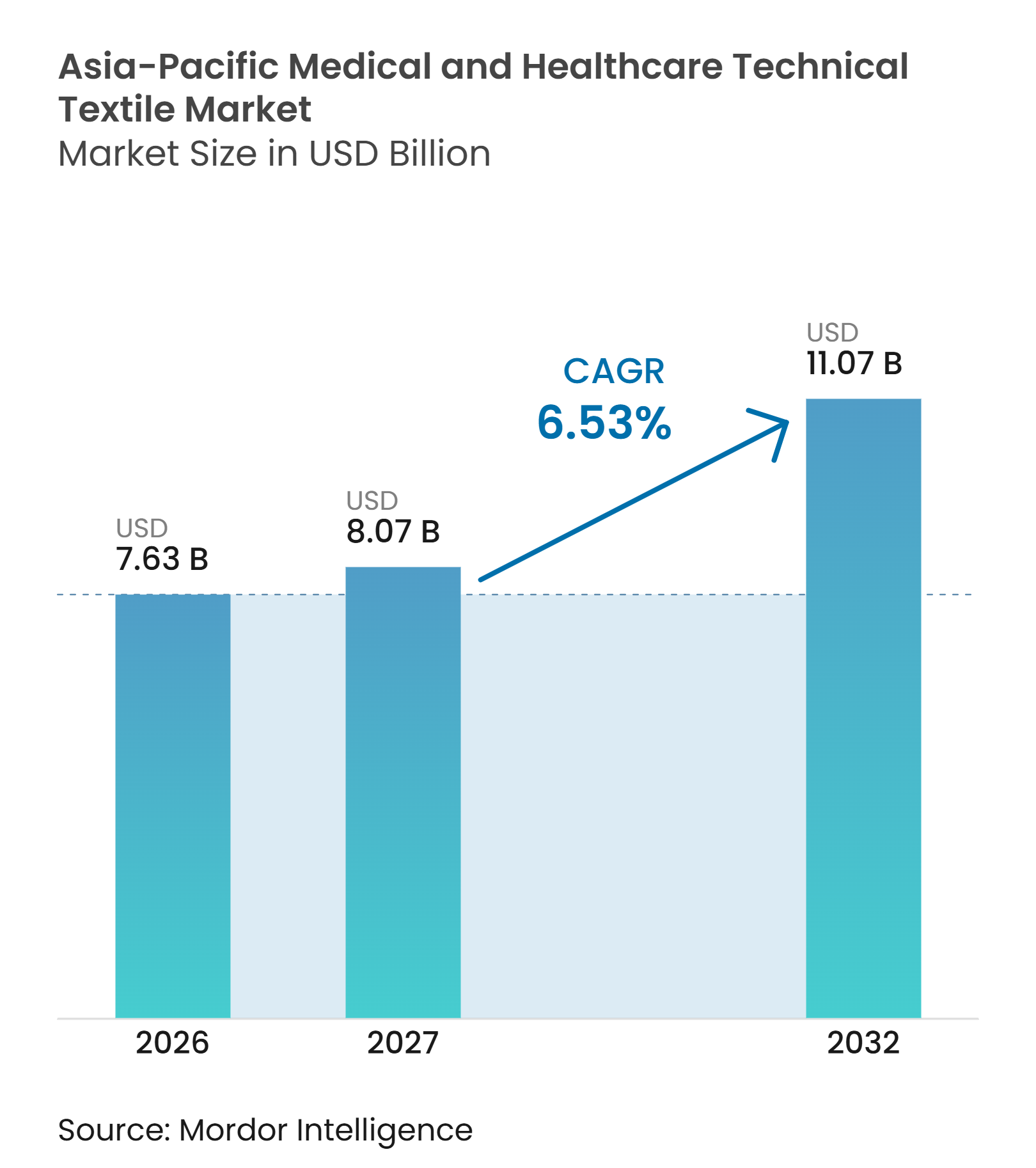
The Asia-Pacific Medical And Healthcare Technical Textile Market size is projected to expand from USD 7.63 billion in 2026 and USD 8.07 billion in 2027 to USD 11.07 billion by 2032, registering a CAGR of 6.53% between 2027 and 2032.
The Asia-Pacific medical and healthcare technical textile industry is supported by population aging, rising chronic-wound care needs, hospital capacity expansion, and stricter infection-control requirements across the region. More than 60% of the global population aged 60 and over lives in Asia-Pacific, while China had 310 million people aged 60 and over at the end of 2024, supporting recurring demand for wound care, incontinence, surgical, and patient-care textiles. The market is also shifting from low-specification materials toward certified products for surgical and clinical applications, including nonwovens with antimicrobial properties, sensing capabilities, and performance-monitoring features. China remains a key market due to its established nonwoven manufacturing capacity, polypropylene supply, hospital expansion, and policy support for domestic medical-device supply chains. India offers growth opportunities as surgical volumes, health-insurance coverage, medical tourism, and local standards activity advance. Regional manufacturing investments are helping shorten supply chains and improve access to certified materials, including for hospitals outside major cities.
Key Report Takeaways
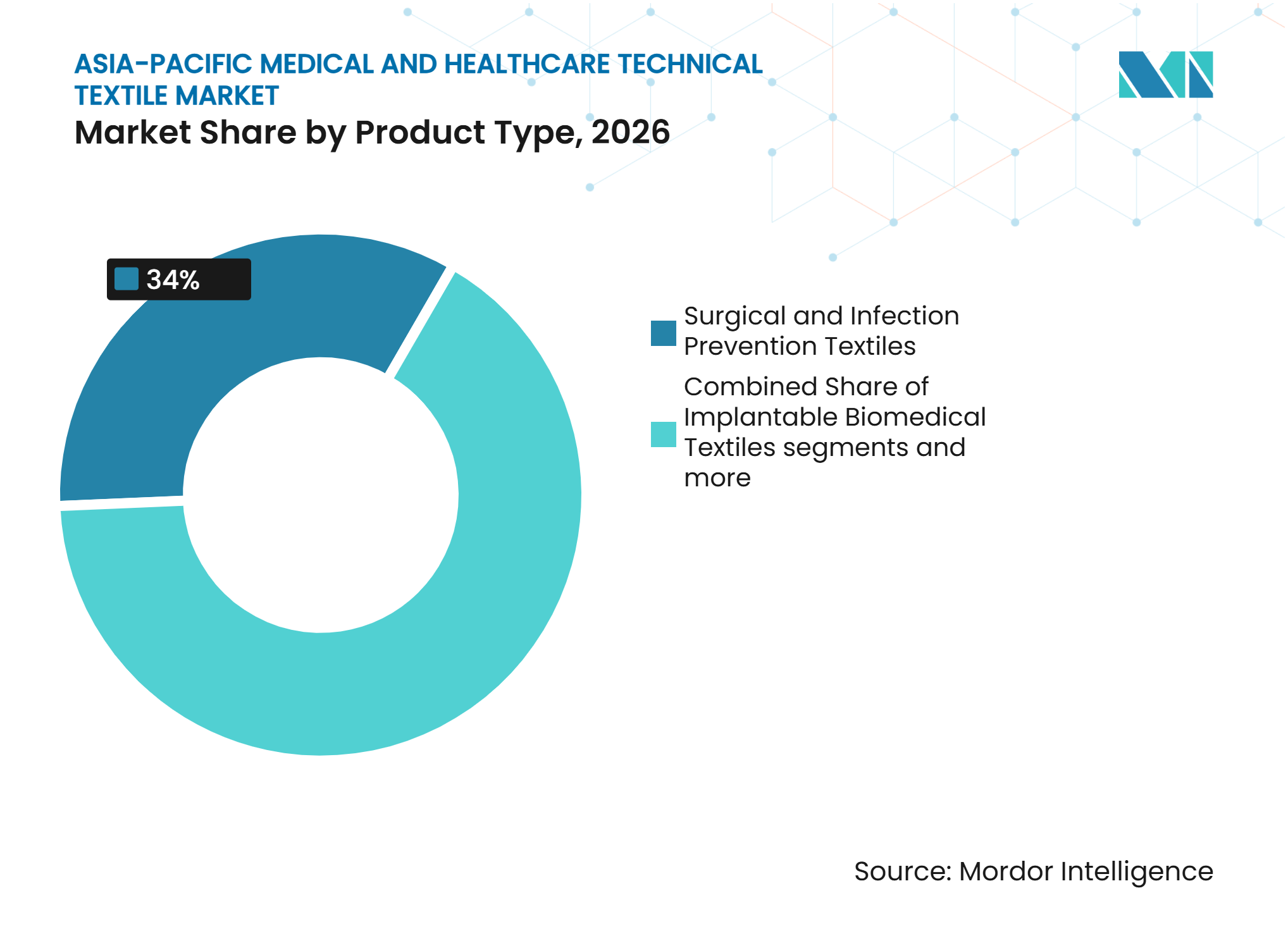
- By product type, surgical and infection prevention textiles held 34% of the Asia-Pacific medical and healthcare technical textile market share in 2026, while implantable biomedical textiles recorded the highest projected CAGR at 8.2% through 2032.
- By material type, polypropylene held 32% of Asia-Pacific medical and healthcare technical textile market size in 2026, while bioresorbable synthetic fibers and polymers recorded the highest projected CAGR at 8.5% through 2032.
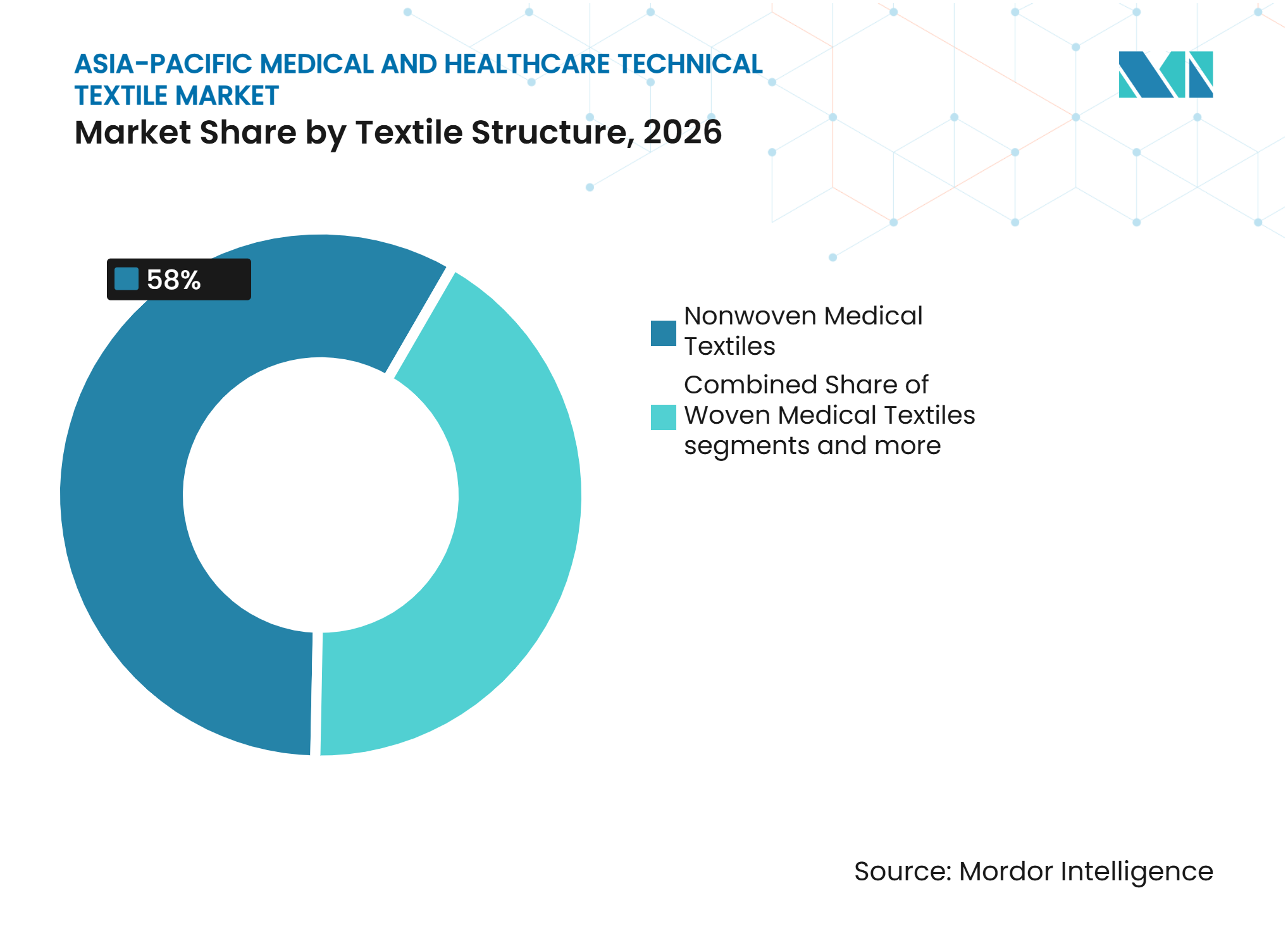
- By textile structure, nonwoven medical textiles held 58% of revenue in 2026, while knitted medical textiles recorded the highest projected CAGR at 7.2% through 2032.
- By geography, China held 32% of revenue in 2026, while India recorded the highest projected CAGR at 8.5% through 2032.
Note: Market numbers in this report are based on Mordor Intelligence's proprietary estimation framework, which combines nine months of actuals with Q4 projections for base year 2026.
Market Trends and Insights
Drivers Impact Analysis of Asia-Pacific Medical and Healthcare Technical Textile Market*
| Driver | (~) % Impact on CAGR Forecast | Geographic Relevance | Impact Timeline |
|---|---|---|---|
| Aging Population and Chronic-Wound Prevalence | +2.1% | Pan-regional, highest in China, Japan, South Korea, and Southeast Asia | Long term (≥ 4 years) |
| Healthcare Infrastructure and Surgical Access Expansion | +1.8% | India, Indonesia, Vietnam, Philippines, Australia, and Pacific island nations | Medium term (2-4 years) |
| Infection-Control Standardization and Single-Use Adoption | +1.2% | China, India, ASEAN, Taiwan, and South Korea | Short term (≤ 2 years) |
| Localized Medical-Textile Manufacturing and Supply-Chain Independence | +0.8% | China, India, Taiwan, Vietnam, Thailand, and Indonesia | Medium term (2-4 years) |
| Asia-Pacific Medical Tourism and Cross-Border Procedure Volumes | +0.5% | India, Thailand, Malaysia, Singapore, South Asia | Medium term (2-4 years) |
| Smart, Antimicrobial, and Sensor-Enabled Textile Commercialization | +0.4% | South Korea, Japan, India, Singapore, and Australia | Long term (≥ 4 years) |
| Source: Mordor Intelligence | |||
Aging Population and Chronic-Wound Prevalence
Population aging is increasing care needs faster than many health systems can add capacity. More than 30 countries in Asia-Pacific are classified as super-aged or rapidly aging; Malaysia became an aging society in 2021, and Bangladesh expects people aged 60 and over to represent 20% of its population by 2050.[1] A 2025 meta-analysis of 46 studies found pooled chronic-wound prevalence of 32.1% across Asian populations, with diabetic foot ulcers as the most common type and Southeast Asia reporting 50.8%. Chronic wounds require longer dressing cycles and can increase use of foam, alginate, and antimicrobial nonwoven products. Japan and South Korea also combine older populations with high bed availability and longer acute-care stays, which supports sustained patient-care textile demand.[2] The Asia-Pacific medical and healthcare technical textile market benefits as care shifts toward products that manage moisture, infection risk, and patient comfort across repeated treatment cycles.
Healthcare Infrastructure and Surgical Access Expansion
Hospital construction and broader surgical access are increasing the procurement of procedure-related textiles. The World Health Organization reported in October 2025 that 80% of Western Pacific countries include surgical care in universal health coverage benefit packages, while 40% have adopted the WHO Surgical Safety Checklist in first-level hospitals.[3] These measures require more consistent sterile-field management and use of certified gowns and drapes. In Indonesia, the Asian Infrastructure Investment Bank approved EUR 197.9 million (USD 232.8 million) in October 2025 to reconstruct 3 hospitals and increase bed capacity from 271 to 550. Singapore is adding 2,800 public acute and community hospital beds between 2025 and 2030, while the Asian Development Bank approved USD 106.9 million for secondary health care services in Sri Lanka. The regional hospital discharge rate of 134 per 1,000 people also points to high procedural activity.
Infection-Control Standardization and Single-Use Adoption
Infection-control rules are creating a compliance baseline for disposable medical textiles. China’s GB 19082-2023 standard for disposable medical protective clothing became effective in December 2025 and introduced revised 4-tier barrier-performance classifications. India’s IS 17334:2025 specifies performance requirements for single-use and reusable medical and surgical gowns and drapes, while the Medical Textiles (Quality Control) Second Amendment Order, 2025, extended the deadline for selling declared legacy stock to 31 December 2025. China’s WS/T 508-2025 standard became effective in February 2026 and formalized washing and disinfection requirements for medical textiles in healthcare institutions. Together, these requirements encourage hospitals to replace unclassified materials with products that document barrier performance and decontamination suitability. The Asia-Pacific medical and healthcare technical textile industry gains from procurement cycles that place greater weight on tested performance and traceability.
Localized Medical-Textile Manufacturing and Supply-Chain Independence
Regional production is becoming more important as buyers seek shorter lead times and more dependable access to certified materials. Covestro began producing Desmopan Rx medical-grade thermoplastic polyurethane in Changhua, Taiwan, in June 2025, its 2nd globally qualified site after North America. The material meets ISO 10993 and YY/T 1557 requirements and can be used in nonwovens, surgical drapes, wound dressings, and protective garments. Mölnlycke opened its first wound care manufacturing site in Changshu, China, in November 2025, with production expected in late 2026 or early 2027. Winner Medical also expanded its manufacturing network to Vietnam in 2025. Local capacity makes it easier to compete on consistent quality, service responsiveness, and regulatory readiness rather than only on unit price.
Restraints Impact Analysis of Asia-Pacific Medical and Healthcare Technical Textile Market*
| Restraint | (~) % Impact on CAGR Forecast | Geographic Relevance | Impact Timeline |
|---|---|---|---|
| Regulatory Fragmentation Across National Frameworks | -0.7% | Pan-regional, particularly China, India, Japan, and Australia | Long term (≥ 4 years) |
| Single-Use Waste, Microplastic Exposure, and Limited Healthcare-Textile Recycling | -0.4% | ASEAN, India, and China | Long term (≥ 4 years) |
| Medical-Grade Polypropylene and Specialty-Fiber Supply Volatility | -0.5% | China, India, and ASEAN markets where polypropylene nonwovens dominate procurement | Short term (≤ 2 years) |
| Price-Sensitive Public Procurement and Premium-Product Adoption Gaps | -0.5% | ASEAN and South Asia, particularly Indonesia, the Philippines, Bangladesh, and Myanmar | Medium term (2-4 years) |
| Source: Mordor Intelligence | |||
Regulatory Fragmentation Across National Frameworks
Medical textile suppliers face separate regulatory requirements across China, India, Japan, and Australia. China’s NMPA, India’s CDSCO, Japan’s PMDA, and Australia’s TGA have different classifications, documentation needs, and post-market requirements. A 2025 peer-reviewed review found that differences remain in registration pathways, manufacturing audits, and clinical evidence despite international efforts toward regulatory cooperation. Evidence accepted by 1 authority may not be accepted by another, which requires suppliers to maintain parallel compliance programs. This can concentrate new premium-product launches in Japan, Australia, and South Korea, where approval pathways and purchasing requirements are more established. The Asia-Pacific medical and healthcare technical textile market also faces input cost pressure from medical-grade polypropylene and specialty-fiber availability. At the same time, public tenders in ASEAN and South Asia continue to favor lower-priced products.
Single-Use Waste, Microplastic Exposure, and Limited Healthcare-Textile Recycling
The growing use of single-use products brings environmental and disposal challenges. The OECD reported in 2025 that Southeast and East Asia remain a major global hotspot for plastic pollution, with waste generation outpacing collection and treatment capacity. A 2025 life-cycle assessment found measurable microplastic and heavy-metal emissions from healthcare waste treatment pathways, including incineration and landfill disposal of polypropylene-based materials. UNDP documented that upgraded facilities in Bangladesh, Bhutan, and the Maldives still depend mainly on disposal even where autoclaves and real-time waste-tracking systems are available. Future single-use plastic rules could affect non-biodegradable medical textile products as governments increase scrutiny. Suppliers without material-substitution or waste-management programs may face more disruption as procurement requirements change.
*Our forecasts treat driver/restraint impacts as directional, not additive. The impact forecasts reflect baseline growth, mix effects, and variable interactions.
Asia-Pacific Medical and Healthcare Technical Textile Market Segment Analysis
By Product Type:
Infection Prevention Leads While Implantable Gain GroundSurgical and Infection Prevention Textiles accounted for 34% of revenue in 2026, giving this category the leading position in the Asia-Pacific medical and healthcare technical textile market. Rising surgical volumes, tighter infection-control rules, and the WHO Action Framework for Safe and Affordable Surgery support recurring purchases of gowns, drapes, wraps, and other barrier products. Surgical-care integration into first-level hospitals makes sterile-field products a routine procurement item. Wound Care and Non-Implantable Therapeutic Textiles have a broad demand base because chronic wounds need multi-layer composite dressings. The 32.1% pooled prevalence of chronic wounds reported across Asian studies points to continued demand.
Implantable Biomedical Textiles are forecast to grow at 8.2% CAGR through 2032. Growth is linked to minimally invasive procedures, hernia and cardiovascular surgeries, and greater clinical acceptance of bioresorbable scaffolds in Japan, South Korea, and urban China. Healthcare Hygiene and Absorbent Care Textiles benefit from aging populations in Northeast Asia and from incontinence-product demand. Extracorporeal and Medical Device-Integrated Textiles include dialysis membranes and blood-filter housings. Hospital and Patient Care Textiles face tighter requirements for moisture management and reliable decontamination.



By Material Type:
Polypropylene Leads While Bioresorbable AdvancePolypropylene held 32% of revenue in 2026 because it is widely used in spunbond, meltblown, and SMS nonwoven structures. These structures are central to surgical gowns, masks, and disposable drapes. The Asia-Pacific medical and healthcare technical textile industry relies on polypropylene for high-volume barrier products because it balances processability, barrier performance, and cost. Reliance on medical-grade polypropylene also exposes suppliers to raw-material supply volatility. Procurement teams need reliable, approved sources, especially where nonwoven products dominate hospital purchasing.
Bioresorbable Synthetic Fibers and Polymers are projected to expand at an 8.5% CAGR through 2032. They are used in degradable sutures, mesh reinforcements, and implantable scaffolds at expanding surgical centers. Covestro’s Taiwan facility supports regional access to medical-grade TPU for specialized applications. Polyester, polyamide, cotton, natural fibers, regenerated cellulosic fibers, polyurethane, and elastomeric fibers each retain defined roles in wound care, compression, grafts, and wearable-device substrates. Multifunctional composites that combine structure, antimicrobial finishing, and sensing features represent the longer-term development direction.
By Textile Structure:
Nonwovens Entrench While Knits Gain Technical GroundNonwoven medical textiles accounted for 58% of revenue in 2026, the largest share of the Asia-Pacific medical and healthcare technical textile market. Hospitals use spunbond, meltblown, SMS, and hydroentangled nonwovens in disposable products that need certified barrier performance. The established preference for single-use materials helps sustain this structure’s leading role. Nonwovens are widely used in gowns, masks, drapes, wound dressings, and sterilization products. Standards that define protection and decontamination needs reinforce their use in clinical settings.
Knitted medical textiles are forecast to grow at 7.2% CAGR through 2032. Their elasticity, compliance, and controllable porosity are useful in implantable mesh, hernia repair, vascular grafts, and compression therapy. A 2025 study demonstrated a bactericidal textile that signals when its copper oxide coating loses effectiveness. Woven textiles provide dimensional stability, while braided textiles serve precise uses in sutures and catheter sheaths. Other engineered formats include electrospun nanofiber scaffolds for wound care and tissue engineering.

Geography Analysis
China
China held 32% of regional revenue in 2026 and remained the largest country within the Asia-Pacific medical and healthcare technical textile market. Its position reflects domestic capacity in nonwovens and polypropylene intermediates, an expanding urban hospital network, and policy support for local medical-device manufacturing. China’s basic health insurance covers 1.3 billion people, creating a large base for hospital procurement. Mölnlycke’s Changshu site indicates interest in localized advanced wound-care capacity.
India
India is forecast to record an 8.5% CAGR through 2032, the fastest geographic growth rate in the Asia-Pacific medical and healthcare technical textile market; government health programs, infrastructure spending, higher surgical volumes, and inbound medical tourism support this outlook. Ayushman Bharat PM-JAY covers more than 500 million people and supports access to inpatient care and related consumables. India received 644,387 medical tourists in 2024 and 131,856 medical tourists from January through April 2025, with e-medical visas available to nationals of 171 countries. BIS convened 120 representatives in October 2025 to discuss medical textile standards, supporting local manufacturers seeking alignment with international performance expectations.
Rest of Asia-Pacific
Japan and South Korea are technically mature markets with demand for higher-value implantable and extracorporeal products, supported by established capabilities at Asahi Kasei Medical and Toray. Indonesia, Vietnam, and other Southeast Asian markets are mainly volume-led. The Asian Infrastructure Investment Bank-backed Indonesia hospital project will expand procedural capacity and add cardiovascular and cancer services. Vietnam is attracting manufacturing investment as part of supply-chain diversification, including Winner Medical’s 2025 production-base development. Taiwan is increasing its role as a precision manufacturing base, while Australia and Taiwan remain compliance-oriented markets where providers prioritize certified products. Sri Lanka and Pacific island nations are receiving targeted multilateral health investment that can gradually increase demand despite smaller individual volumes.
Competitive Landscape
Market Concentration
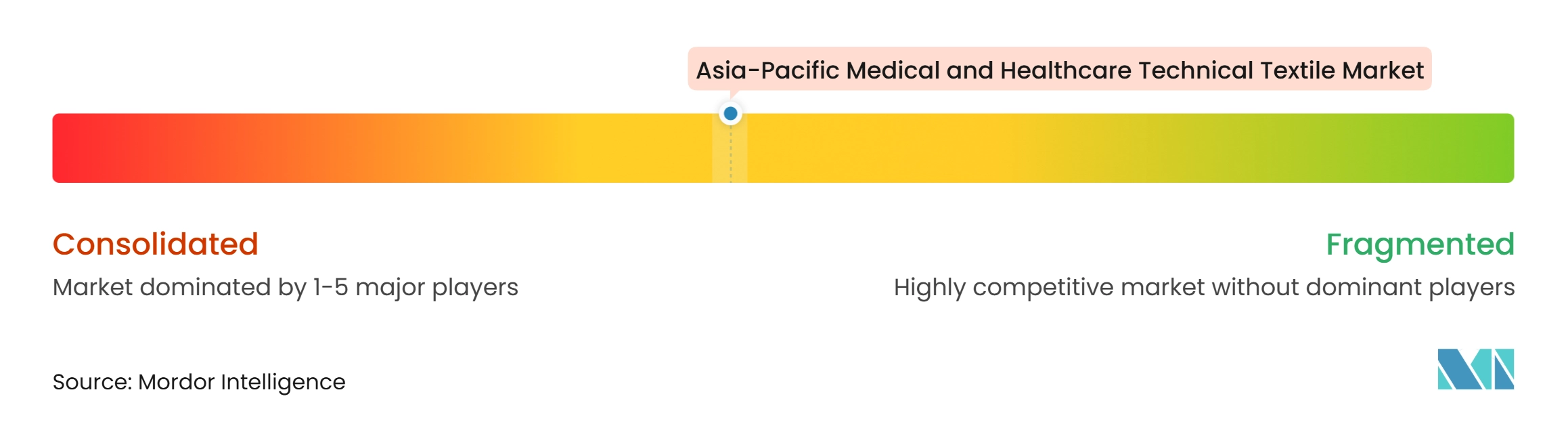
The Asia-Pacific medical and healthcare technical textile market exhibits a medium level of market concentration, with global integrated suppliers active in high-barrier technical segments and regional producers serving both commodity and value-added applications. Freudenberg Performance Materials, Ahlstrom, Mölnlycke, Kimberly-Clark, and DuPont are established in surgical gowns, sterilization wraps, and advanced wound care. Winner Medical, Toray, Asahi Kasei, HOGY Medical, and Jiangsu Yuyue Medical compete across a broader range of regional segments. Production location, product performance, and compliance capabilities increasingly shape competition. The Asia-Pacific medical and healthcare technical textile market rewards dependable compliance, local service, and consistent product quality. It has openings in affordable advanced wound care for tier-2 and tier-3 hospitals, export-compliant private-label manufacturing, and sensor-enabled home-care products.
Freudenberg acquired the remaining 25% stake in Japan Vilene Company from Toray in November 2025 for EUR 100 million (USD 117.6 million). The transaction made Freudenberg the sole owner of Japan Vilene’s 15-site global nonwoven network, which serves medical, automotive, electrical, and industrial markets. Mölnlycke’s China site is intended to improve supply-chain resilience, reduce delivery times, and support future wound-care capacity. Covestro’s medical-grade TPU production in Taiwan reflects a similar focus on regional material supply.
Researchers at BITS Pilani developed a multilayer smart wound dressing using silver-coated antimicrobial fibers and a colorimetric hydrogel sensor that can indicate infection without laboratory equipment. The product was reported to cost INR 10-20 per unit (USD 0.1-0.2), with commercialization targeted for 2026. A bactericidal textile reported in Materials Today Bio can indicate when its antibacterial coating loses effectiveness, allowing condition-based replacement. These developments raise the importance of embedded sensing and measurable clinical performance.
Asia-Pacific Medical and Healthcare Technical Textile Industry Leaders
-
Freudenberg Performance Materials
-
Ahlstrom-Munksjö Oyj
-
Asahi Kasei Corporation
-
Toray Industries, Inc.
-
Winner Medical Co., Ltd.
- *Disclaimer: Major Players sorted in no particular order
Asia-Pacific Medical and Healthcare Technical Textile Market Companies Covered in this Report
- Freudenberg Performance Materials
- Ahlstrom-Munksjö Oyj
- Asahi Kasei Corporation
- Toray Industries, Inc.
- Winner Medical Co., Ltd.
- Kimberly-Clark Corporation
- 3M Company
- DuPont de Nemours, Inc.
- Cardinal Health, Inc.
- Medline Industries, LP
- Smith & Nephew plc
- Mölnlycke Health Care AB
- Halyard Health, Inc.
- Owens & Minor, Inc.
- Fitesa S.A.
- Indorama Ventures Public Company Limited
- Hyosung Corporation
- Asahi Kasei Medical Co., Ltd.
- Sefar AG
- HOGY Medical Co., Ltd.
- Jiangsu Yuyue Medical Equipment & Supply Co., Ltd.
- KPR Mill Limited
- Medtronic plc
- B. Braun Melsungen SE
Recent Industry Developments in Asia-Pacific Medical and Healthcare Technical Textile Market
- July 2026: Freudenberg Performance Materials acquired Foshan United Medical, a Chinese advanced wound-care supplier with approximately 200 employees. The acquisition expands Freudenberg's medical textile capabilities across nonwoven production, functionalized fibres, sterilization, and finished wound dressings, including foam, alginate, and antimicrobial products.
- March 2026: Lenzing's Prachinburi facility began producing nonwoven-grade lyocell fibres for applications such as wipes and personal-hygiene products. The expansion strengthens regional supplies of wood-based cellulosic fibres, providing medical and hygiene nonwoven manufacturers with an additional material option for developing resource-efficient products.
- November 2025: Freudenberg SE acquired the remaining 25% stake in Japan Vilene Company from Toray Industries for EUR 100 million (USD 117.6 million), making Freudenberg the sole owner of JVC’s 15-site global nonwoven network. JVC serves medical, automotive, electrical, and industrial segments across Asia, and the acquisition positions Freudenberg to integrate JVC’s medical nonwoven capabilities directly into its global health-and-hygiene portfolio.
- October 2025: The Asian Infrastructure Investment Bank approved a EUR 197.9 million (USD 232.8 million) sovereign-backed investment for the reconstruction of RSAB Harapan Kita and the arrangement of 3 Berlian Hospitals in Indonesia. The project nearly doubles bed capacity from 271 to 550 and introduces cardiovascular and cancer services not previously available.
Asia-Pacific Medical and Healthcare Technical Textile Market Report Scope
The Asia-Pacific Medical and Healthcare Technical Textile Market Report is Segmented by Product Type (Hospital and Patient Care Textiles, Implantable Biomedical Textiles, and More), by Material Type (Polypropylene (PP), Polyester (PET), and More), by Textile Structure (Nonwoven Medical Textiles, Woven Medical Textiles, and More), and by Geography (China, Japan, and More). The Market Forecasts are Provided in Terms of Value (USD).
Segmentation Overview
| Surgical and Infection Prevention Textiles |
| Wound Care and Non-Implantable Therapeutic Textiles |
| Healthcare Hygiene and Absorbent Care Textiles |
| Implantable Biomedical Textiles |
| Extracorporeal and Medical Device-Integrated Textiles |
| Hospital and Patient Care Textiles |
| Polypropylene (PP) |
| Polyester (PET) |
| Polyethylene (PE) |
| Polyamide (Nylon) |
| Cotton and Other Natural Fibers |
| Regenerated Cellulosic Fibers |
| Polyurethane and Other Elastomeric Fibers |
| Bioresorbable Synthetic Fibers and Polymers |
| Other Specialty Fibers and Materials |
| Nonwoven Medical Textiles |
| Woven Medical Textiles |
| Knitted Medical Textiles |
| Braided Medical Textiles |
| Other Engineered Medical Textile Structures and Products |
| China |
| Japan |
| India |
| South Korea |
| Taiwan |
| Australia |
| Indonesia |
| Vietnam |
| Rest of Asia-Pacific |
| By Product Type | Surgical and Infection Prevention Textiles |
| Wound Care and Non-Implantable Therapeutic Textiles | |
| Healthcare Hygiene and Absorbent Care Textiles | |
| Implantable Biomedical Textiles | |
| Extracorporeal and Medical Device-Integrated Textiles | |
| Hospital and Patient Care Textiles | |
| By Material Type | Polypropylene (PP) |
| Polyester (PET) | |
| Polyethylene (PE) | |
| Polyamide (Nylon) | |
| Cotton and Other Natural Fibers | |
| Regenerated Cellulosic Fibers | |
| Polyurethane and Other Elastomeric Fibers | |
| Bioresorbable Synthetic Fibers and Polymers | |
| Other Specialty Fibers and Materials | |
| By Textile Structure | Nonwoven Medical Textiles |
| Woven Medical Textiles | |
| Knitted Medical Textiles | |
| Braided Medical Textiles | |
| Other Engineered Medical Textile Structures and Products | |
| By Geography | China |
| Japan | |
| India | |
| South Korea | |
| Taiwan | |
| Australia | |
| Indonesia | |
| Vietnam | |
| Rest of Asia-Pacific |
Key Questions Answered in the Report
What is the projected value of the Asia-Pacific medical and healthcare technical textile market by 2032?
The Asia-Pacific medical and healthcare technical textile market is projected to reach USD 11.07 billion by 2032, growing at a 6.53% CAGR from 2027. The Asia-Pacific medical and healthcare technical textile market is supported by aging populations and hospital capacity expansion.
Which product category has the largest regional revenue share?
Surgical and infection prevention textiles lead with 34% of regional revenue in 2026, supported by hospital expansion and stricter infection-control requirements.
Which material is growing fastest in medical technical textiles across Asia-Pacific?
Bioresorbable synthetic fibers and polymers are projected to grow at 8.5% CAGR by 2032 because of their use in degradable sutures, mesh, and implantable scaffolds.
Why does India offer a strong growth opportunity for suppliers?
India is projected to grow at 8.5% CAGR through 2032, supported by health coverage expansion, medical tourism, infrastructure investment, and domestic standards activity.
What is driving demand for nonwoven medical textiles?
Nonwoven medical textiles held 58% of revenue in 2026 because hospitals use them in disposable barrier products such as gowns, masks, drapes, and dressings.
What are the main challenges for manufacturers in Asia-Pacific?
Separate national regulatory requirements, supply volatility for medical-grade materials, price-sensitive public procurement, and single-use waste management can limit adoption and raise operating complexity.