
Asia-Pacific Manufacturing Inspection Services Market Size and Share
Market Overview
| Study Period | 2021 - 2032 |
|---|---|
| Forecast Data Period | 2027 - 2032 |
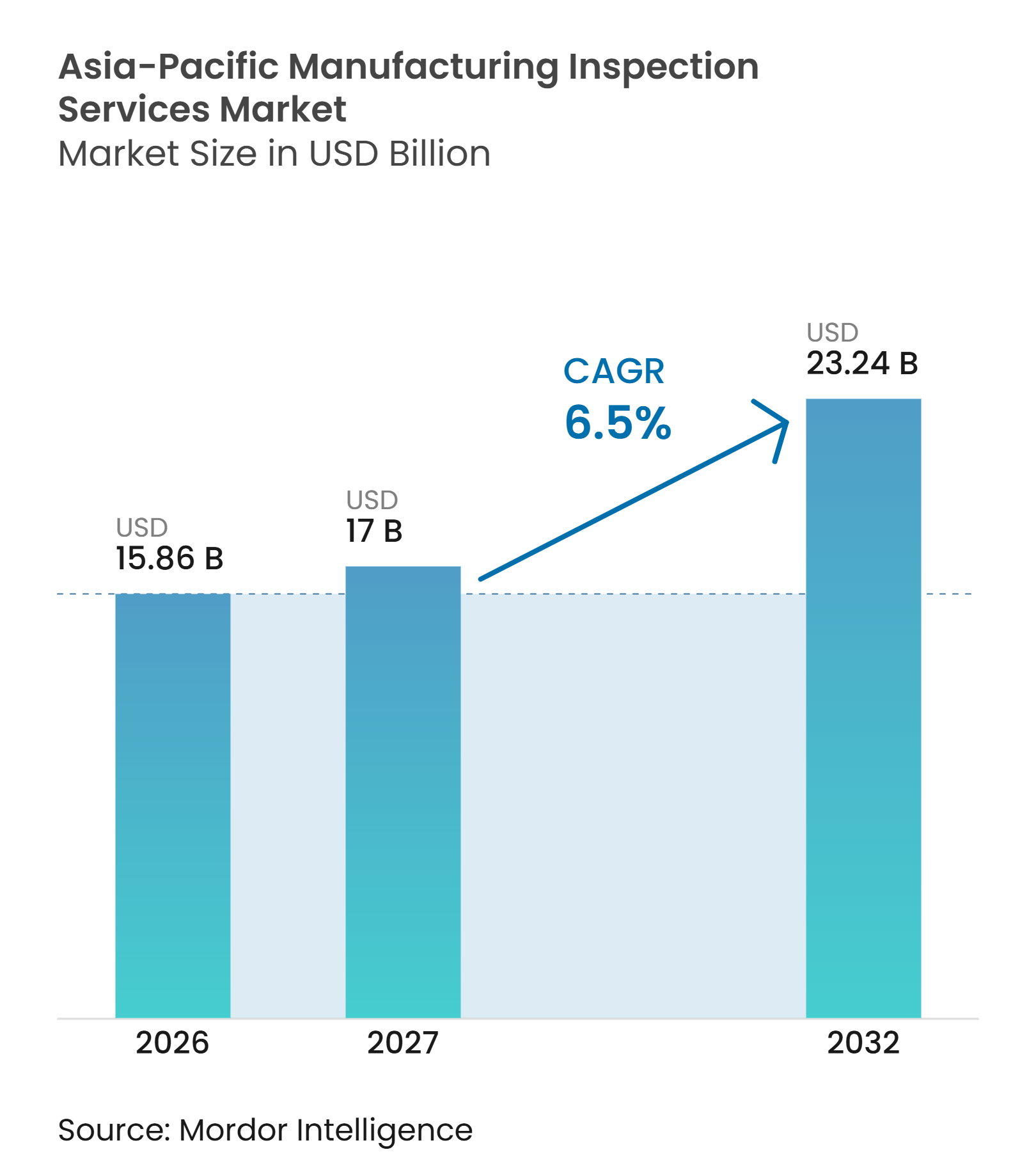
| Base Year Market Size (2026) | USD 15.86 Billion |
| Market Size (2027) | USD 17 Billion |
| Market Size (2032) | USD 23.24 Billion |
| Growth Rate (2027 - 2032) | 6.50 % |
| Market Concentration | Medium |
Major Players *Disclaimer: Major Players sorted in no particular order Image © Mordor Intelligence. Reuse requires attribution under CC BY 4.0. | |
Asia-Pacific Manufacturing Inspection Services Market Analysis by Mordor Intelligence
The Asia-Pacific Manufacturing Inspection Services Market size is projected to be USD 15.86 billion in 2026, USD 17 billion in 2027, and reach USD 23.24 billion by 2032, growing at a CAGR of 6.5% from 2027 to 2032.
China remains the principal source of demand because it combines scale in export manufacturing with expanding product compliance requirements. India provides the strongest growth outlook as electronics exports and semiconductor investment add new points where external verification is needed. Export conformity rules, battery safety obligations, and connected factory systems are increasing the amount of documentation and testing required across production lines. Providers that can combine accredited inspection with digital reporting are better placed to serve multinational manufacturers. The ISO/IEC 17020:2026 transition also favors organizations that can demonstrate competence, impartiality, and documented risk controls. In addition, the expansion of electronics manufacturing, electric vehicle supply chains, and battery production is increasing demand for component testing, process verification, supplier audits, and final product inspection. Manufacturers operating across China, India, and other Asia-Pacific markets increasingly require consistent inspection protocols to meet destination-market regulations and maintain traceability across multi-tier supplier networks. This creates opportunities for service providers offering integrated inspection, testing, certification support, and digital documentation solutions. However, differences in national accreditation frameworks, shortages of qualified technical personnel, and the cost of upgrading inspection systems may constrain smaller providers.
Key Report Takeaways
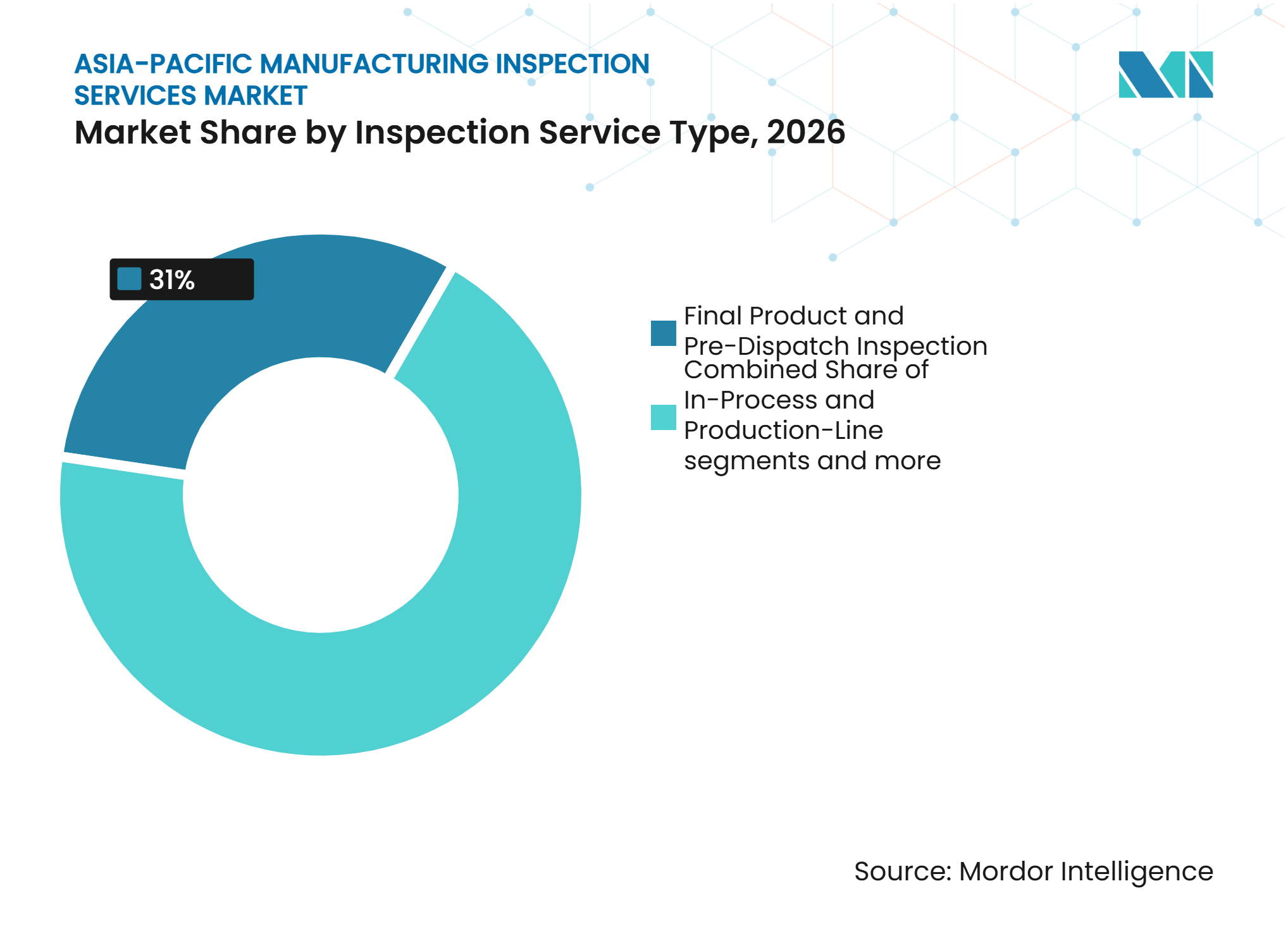
- By inspection service type, final product and pre-dispatch inspection held 31% of the Asia-Pacific Manufacturing Inspection Services Market share in 2026, while manufacturing process and production surveillance inspection is forecast to grow at an 8% CAGR through 2032.
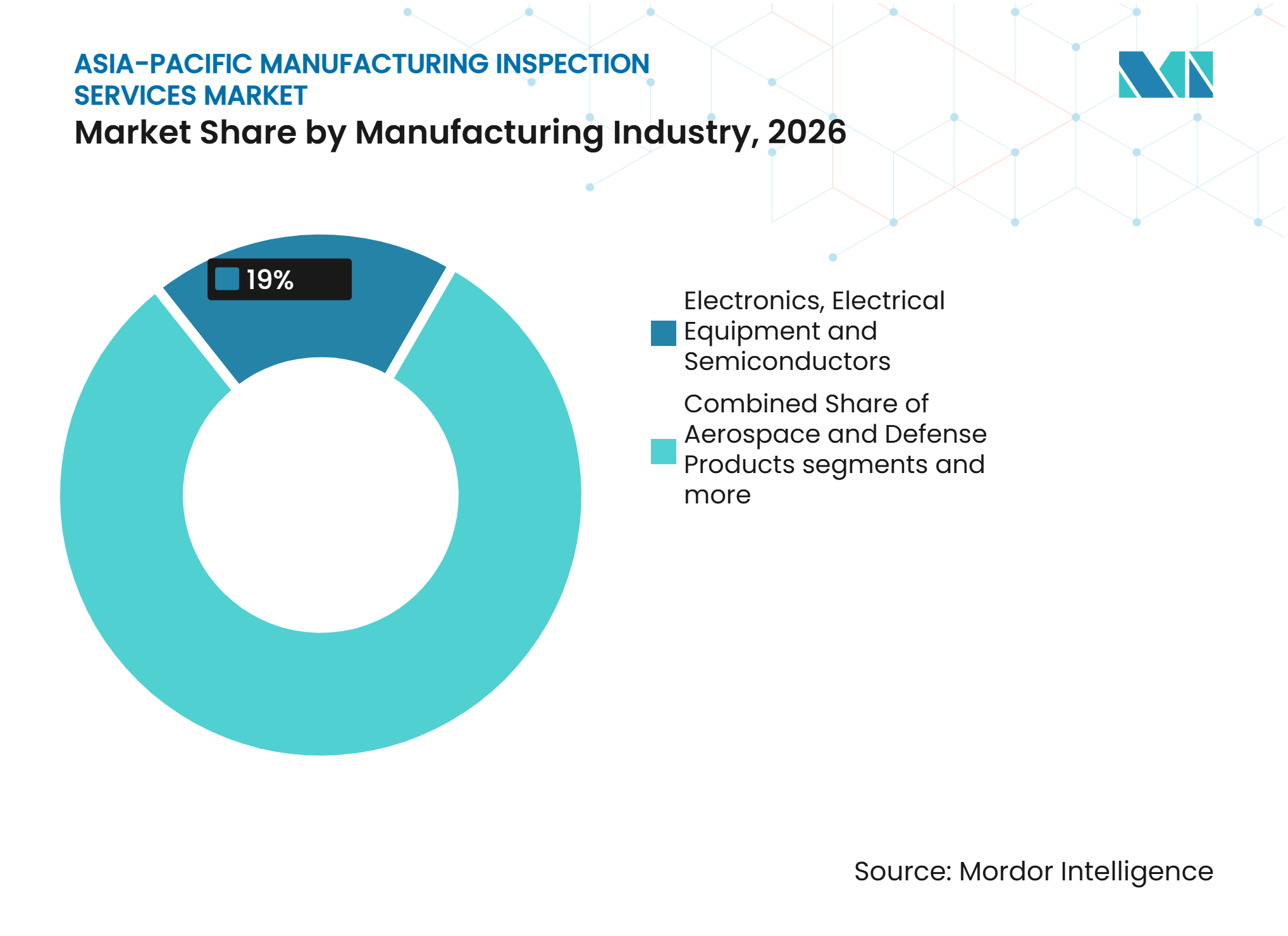
- By manufacturing industry, electronics, electrical equipment and semiconductors held 19% of the Asia-Pacific Manufacturing Inspection Services Market size in 2026 and is forecast to grow at an 8.1% CAGR through 2032.
- By geography, China held 60% of the Asia-Pacific Manufacturing Inspection Services Market share in 2026, while India is forecast to grow at a 9% CAGR through 2032.
Note: Market numbers in this report are based on Mordor Intelligence's proprietary estimation framework, which combines nine months of actuals with Q4 projections for base year 2026.
Market Trends and Insights
Drivers Impact Analysis of Asia-Pacific Manufacturing Inspection Services Market*
| Driver | (~) % Impact on CAGR Forecast | Geographic Relevance | Impact Timeline |
|---|---|---|---|
| Expanding Electronics and Semiconductor Manufacturing | +2.0% | APAC-wide, concentrated in China, Taiwan, South Korea, and India | Short term (≤ 2 years) |
| Rising EV, Battery, and Automotive Component Production | +1.5% | China, South Korea, Japan, and ASEAN, including Thailand and Vietnam | Medium term (2-4 years) |
| Export-Linked Quality and Conformity Requirements | +1.0% | China, India, Vietnam, and ASEAN exporters | Short term (≤ 2 years) |
| Smart-Factory Adoption and Connected Production Lines | +0.8% | China, Japan, South Korea, Singapore, and ASEAN industrial parks | Medium term (2-4 years) |
| Shortage of Advanced Inspection Laboratories and Skilled Inspectors | +0.5% | India, ASEAN, and Rest of Asia-Pacific | Medium term (2-4 years) |
| Traceability Requirements for High-Mix, Low-Volume Manufacturing | +0.4% | Japan, South Korea, Taiwan, Australia, and precision manufacturing clusters in ASEAN | Long term (≥ 4 years) |
| Source: Mordor Intelligence | |||
Expanding Electronics and Semiconductor Manufacturing
Electronics and semiconductor production is the largest volume source of demand for the Asia-Pacific manufacturing inspection services market. China reported 10.6% growth in value-added output among major electronic information manufacturers in 2025. The same sector generated CNY 17.4 trillion (USD 2.5 trillion) in combined revenue during 2025.[1] India reported electronics exports of USD 38.6 billion in FY2024-25, up 32.6% from the preceding year. A higher component count in more complex devices increases the number of inspection stages even when unit output alone does not change. India has approved USD 18.0 billion of semiconductor fabrication investments across 10 projects, and pilot production began at the CG Power facility in August 2025.[2]
Rising EV, Battery, and Automotive Component Production
Battery cells, modules, and packs require more demanding inspection than many conventional automotive components. China broadened battery safety testing under GB38031-2025, including thermal runaway and crash-simulation requirements for relevant new-energy vehicle battery configurations. Those requirements expand the role of verification during cell and pack development. Thailand's EV30@30 policy is attracting global original equipment manufacturer battery assembly investment, which creates an additional ASEAN inspection base. Automated battery lines reduce some manual visual work, but they also require detection of electrode alignment, electrolyte fill variation, and welding defects. These needs support the use of machine vision and X-ray equipment in the Asia-Pacific manufacturing inspection services market. South Korea's expansion of KC certification into newer battery chemistries adds country-specific compliance work for manufacturers serving the local market.
Export-Linked Quality and Conformity Requirements
Exporters need conformity evidence that is accepted by destination markets, and the required evidence is becoming more extensive. India has 156 Quality Control Orders covering 672 products. The Department of Consumer Affairs has targeted more than 1,500 products for BIS certification by the end of FY2025-26.[3] The Safety of Household, Commercial and Similar Electrical Appliances Quality Control Order issued in May 2025 became effective in March 2026. China also extended China Compulsory Certification requirements to additional product categories, including EV chargers and lithium batteries, during 2025. APEC made AI standards harmonization and conformity assessment for AI-enabled goods a 2025 priority, which points to further verification needs as these goods enter cross-border trade.
Smart-Factory Adoption and Connected Production Lines
Connected production systems are moving inspection from an end-of-line activity toward continuous process control. Rockwell Automation found that 94% of Asia-Pacific manufacturers surveyed have invested in, or plan to invest in, AI and related systems over the following 5 years. Quality control was the leading stated use case at 47%, ahead of cybersecurity at 44% and process optimization at 43%. The World Economic Forum added 12 sites to its Lighthouse Network in September 2025, including facilities in China, Thailand, and Singapore that use AI analytics, digital twins, and real-time monitoring. The Asia Productivity Organization also documented the use of IoT, robotics, and synchronized digital supply systems in manufacturing sites in Taiwan. Inspection providers increasingly need to supply structured data that can be used by manufacturing execution and enterprise resource planning systems, rather than relying only on PDF reports.
Restraints Impact Analysis of Asia-Pacific Manufacturing Inspection Services Market*
| Restraint | (~) % Impact on CAGR Forecast | Geographic Relevance | Impact Timeline |
|---|---|---|---|
| High Cost of Advanced Inspection Equipment and Specialist Services | -1.2% | APAC-wide, most acute for small and midsized supply chains in India, ASEAN, and Rest of Asia-Pacific | Short term (≤ 2 years) |
| Fragmented National Accreditation and Acceptance Frameworks | -0.8% | ASEAN, India, Rest of Asia-Pacific, and China | Medium term (2-4 years) |
| Limited Acceptance of Remote and AI-Assisted Inspection Evidence | -0.5% | Japan, South Korea, Taiwan, and global export lanes | Medium term (2-4 years) |
| Shortage of Qualified Level II and Level III Inspection Personnel | -0.4% | India, ASEAN, Rest of Asia-Pacific, and selective parts of China | Long term (≥ 4 years) |
| Source: Mordor Intelligence | |||
High Cost of Advanced Inspection Equipment and Specialist Services
Phased-array ultrasonic testing, industrial computed tomography, and automated optical inspection systems can exceed the capital capacity of smaller manufacturers. A fully equipped advanced nondestructive testing laboratory can require investment above USD 500,000. This cost limits direct ownership among many small and mid-sized suppliers. It also limits the service range of smaller inspection providers, leaving advanced work to a narrower group of accredited organizations. The American Society for Nondestructive Testing and the American Welding Society formalized a March 2025 collaboration to expand training and certification in India, including plans for a Gujarat hub. A limited pool of qualified Level II and Level III personnel increases specialist service costs and can lead manufacturers to focus on final-product checks instead of process surveillance.
Fragmented National Accreditation and Acceptance Frameworks
National inspection systems differ across China, India, Japan, South Korea, Taiwan, Singapore, and ASEAN economies. A result accepted in one market can require re-testing through an approved laboratory in the destination market. This adds cost and time for manufacturers that supply several Asia-Pacific destinations. ISO/IEC 17020:2026 establishes a common direction for inspection bodies, with a global transition deadline of March 27, 2029. Singapore has stated that SAC-accredited inspection bodies that do not complete the transition by the deadline will have their accreditation suspended. The shift may improve consistency over time, but it requires gap assessments, reassessment, and management-system changes that are harder for smaller providers to fund and manage.
*Our forecasts treat driver/restraint impacts as directional, not additive. The impact forecasts reflect baseline growth, mix effects, and variable interactions.
Asia-Pacific Manufacturing Inspection Services Market Segment Analysis
By Inspection Service Type:
Final Inspection Commands Share, Surveillance AcceleratesFinal product and pre-dispatch inspection accounted for 31% of Asia-Pacific manufacturing inspection services market share in 2026. Global brand owners continue to use a documented inspection gate before goods leave the factory. Export-oriented manufacturers in China, Vietnam, Bangladesh, and Cambodia use pre-shipment checks to support buyer confidence and protect recurring order flows. This makes final inspection the most widely used and most volume-oriented service type. The service remains important for buyers that need a consistent record before products cross a border. It also helps manufacturers identify visible defects, packaging errors, and labeling issues before shipment. This operating model keeps the Asia-Pacific manufacturing inspection services market tied to daily factory output and customer release schedules.
Manufacturing process and production surveillance inspection is forecast to grow at an 8% CAGR through 2032. This part of the Asia-Pacific manufacturing inspection services market is supported by AI-based anomaly detection and embedded sensors that enable continuous monitoring. The World Economic Forum's new Lighthouse facilities in China, Thailand, and Singapore show the use of real-time quality dashboards and automated escalation protocols. These systems create machine-readable defect records that can support corrective action inside factories. Pre-production material checks and first-article inspection are also important when OEMs qualify new suppliers in additional regional locations. In-process inspection grows steadily in automotive and semiconductor lines, while reinspection remains necessary when a defect can affect an entire batch in safety-sensitive products. This broad mix of work gives the Asia-Pacific manufacturing inspection services market recurring demand beyond the final check before dispatch.



By Manufacturing Industry:
Electronics Anchors Both Scale and GrowthElectronics, electrical equipment, and semiconductors held 19% of the Asia-Pacific manufacturing inspection services market share in 2026. The segment is also projected to grow at an 8.1% CAGR through 2032. China's integrated circuit output reached 484.3 billion units in 2025, an increase of 10.9% from the previous year. Inspection is needed throughout electronics manufacturing, from wafer production through package testing and finished-product label verification. New fabrication projects in India add further requirements for wafer-level and package-level inspection. Taiwan and South Korea remain important locations for higher-value work in substrates, memory, printed circuit boards, and advanced packaging. The concentration of these technical supply chains reinforces the Asia-Pacific manufacturing inspection services market across Northeast Asia.
Automotive and automotive components form the second-largest manufacturing industry segment in the Asia-Pacific manufacturing inspection services market. The EV transition expands inspection beyond dimensional checks into battery module and pack performance. Aerospace and defense products generate higher value per inspection because suppliers must meet AS9100 and NADCAP requirements. Pharmaceuticals, medical devices, and life sciences products retain high inspection demand relative to their volume because ISO 13485 and national pharmacopoeia rules require rigorous controls. India, China, and Japan each provide demand through generics, medical technology, and precision-device production. Textiles, chemicals, food and beverage, building materials, packaging, and consumer products provide a wide volume base that helps maintain demand through industrial investment cycles. This breadth makes the Asia-Pacific manufacturing inspection services market less dependent on the timing of investment in any one sector.

Geography Analysis
China accounted for 60% of the Asia-Pacific manufacturing inspection services market share in 2026. Its scale reflects manufacturing activity across electronics, industrial components, pharmaceuticals, automotive assemblies, and specialty chemicals. China's electronic information manufacturing sector generated CNY 17.4 trillion (USD 2.5 trillion) in revenue in 2025. China Compulsory Certification expansions for EV chargers and lithium batteries widen the range of products needing compliance review. Japan and South Korea have a different demand profile that is centered on precision automotive, electronics, semiconductor, and battery work. Taiwan remains a specialized location where BSMI obligations and semiconductor supply-chain requirements support premium demand in PCB production and advanced packaging. The concentration of these technical supply chains reinforces the Asia-Pacific manufacturing inspection services market across Northeast Asia. These activities make the Asia-Pacific manufacturing inspection services market relevant to production quality at each stage of electronics manufacturing.
India is forecast to grow at a 9% CAGR between 2027 and 2032, the strongest geographic rate in the Asia-Pacific manufacturing inspection services market. Electronics exports reached USD 22.2 billion in the first half of FY2025-26, representing a 41.9% increase. The expansion of Quality Control Orders also increases domestic compliance work and strengthens the basis for external recognition of Indian-made products. More than 1,500 products are targeted for BIS certification by the end of FY2025-26. New semiconductor facilities, electronics plants, and automotive component capacity widen the base for testing, inspection, and certification services. As these facilities move into production, the Asia-Pacific manufacturing inspection services market gains demand from supplier approval through final dispatch.
ASEAN is diverse because its member economies contribute different forms of manufacturing demand. Thailand is adding battery assembly activity under EV30@30, while Vietnam is expanding electronics production and associated pre-shipment checks. Singapore operates as a regional center for advanced laboratory and precision inspection services, supported by TÜV SÜD's SGD 100 million (USD 77.9 million) regional hub. Indonesia, Malaysia, and the Philippines add demand from components, food processing, and export manufacturing. Australia is smaller but serves higher-value agricultural commodities, mining equipment, and conformity work. Bangladesh, Sri Lanka, and Pakistan remain earlier-stage markets where export manufacturing is the main source of inspection demand. Their development gives the Asia-Pacific manufacturing inspection services market a broader base across emerging manufacturing locations.
Competitive Landscape
Market Concentration
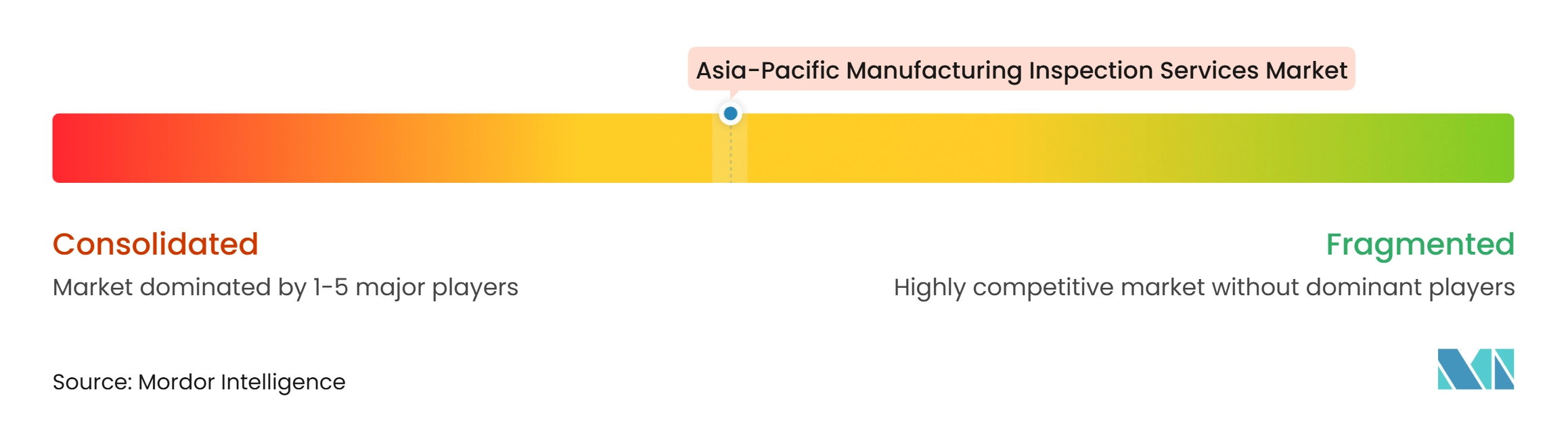
The Asia-Pacific manufacturing inspection services market exhibits a medium level of market concentration. SGS, Bureau Veritas, Intertek, TÜV SÜD, TÜV Rheinland, and DEKRA have broad geographic coverage and portfolios spanning multiple industrial sectors. Their accreditation coverage and laboratory networks enable them to support customers operating in several countries. Regional organizations such as China Certification and Inspection Group, Centre Testing International, QIMA, Japan Quality Assurance Organization, Korea Testing and Research Institute, and SIRIM QAS retain strong positions in their home markets. These providers benefit from local regulatory knowledge and long-standing customer relationships. The competitive field therefore includes global network scale and local familiarity rather than a single uniform model. This balance of global scale and local access defines competition in the Asia-Pacific manufacturing inspection services market.
Acquisitions are an important part of competitive strategy in the Asia-Pacific manufacturing inspection services market. Bureau Veritas completed 6 acquisitions in the first half of 2025 and reported 6.7% organic revenue growth over that period. TÜV NORD acquired EPI Group in October 2025 and identified Asia-Pacific digital infrastructure as a strategic focus. Intertek acquired Envirolab in Australia in September 2025, expanding its environmental testing footprint. These moves show how providers are using specialist capabilities and local assets to extend service coverage. They also support the ability to provide combined inspection, testing, certification, and advisory work.
Technology is becoming a clearer differentiator in the Asia-Pacific manufacturing inspection services market. AI-supported defect classification, digital reports that work with factory systems, and remote surveillance are increasingly relevant in multinational OEM tenders. Digital platforms that combine camera surveillance with cloud-based analytics may challenge the reliance on billable on-site inspector days. At the same time, ISO/IEC 17020:2026 raises the importance of robust quality management, competence, impartiality, and risk controls. The standard creates a path for larger accredited providers to assist manufacturers and smaller inspection bodies with transition planning before the March 27, 2029 deadline. This combination of accreditation, technical capability, and data integration is likely to shape competition across the region. It also makes technology investment central to the Asia-Pacific manufacturing inspection services market as factory quality systems become more connected.
Asia-Pacific Manufacturing Inspection Services Industry Leaders
-
SGS SA
-
Bureau Veritas SA
-
Intertek Group plc
-
TÜV SÜD AG
-
TÜV Rheinland AG
- *Disclaimer: Major Players sorted in no particular order
Asia-Pacific Manufacturing Inspection Services Market Companies Covered in this Report
- SGS SA
- Bureau Veritas SA
- Intertek Group plc
- TÜV SÜD AG
- TÜV Rheinland AG
- DEKRA SE
- UL Solutions Inc.
- DNV AS
- TÜV NORD AG
- ALS Limited
- Eurofins Scientific SE
- Applus Services, S.A.
- MISTRAS Group, Inc.
- Element Materials Technology Group Limited
- Bureau of Indian Standards-recognized inspection providers
- China Certification and Inspection Group
- Centre Testing International Group Co., Ltd.
- Korea Testing and Research Institute
- Japan Quality Assurance Organization
- QIMA Limited
- SIRIM QAS International Sdn Bhd
- PT SUCOFINDO
Recent Industry Developments in Asia-Pacific Manufacturing Inspection Services Market
- May 2026: TÜV SÜD published its POWER 2030 strategic framework, structured around scaling the core inspection and certification business, developing services in sustainability and digital trust, and investing in talent, with APAC identified as a priority growth corridor.
- December 2025: SGS acquired Australian Superintendence Company, a specialist in agricultural quality assurance for export grains, legumes, and oilseeds, adding 40 inspection and laboratory experts and expanding SGS's agricultural assurance capabilities under its "Strategy 27, Accelerating Growth, Building Trust" framework.
- October 2025: TÜV NORD completed the acquisition of EPI Group, one of the world's largest audit, certification, and training providers for data centers, with CEO Dirk Stenkamp explicitly citing Asia-Pacific as a strategic focus, strengthening TÜV NORD's positioning in gigawatt-class AI data center markets across the region.
Asia-Pacific Manufacturing Inspection Services Market Report Scope
The Asia-Pacific Manufacturing Inspection Services Market Report is segmented by Inspection Service Type (Pre-Production Material and Component Inspection, First-Article and Initial Production Inspection, and more), by Manufacturing Industry (Automotive and Automotive Components, Aerospace and Defense Products, and more), and by Geography (China, Japan, India, and more). The Market Forecasts are Provided in Terms of Value (USD).
Segmentation Overview
| Pre-Production Material and Component Inspection |
| First-Article and Initial Production Inspection |
| In-Process and Production-Line Inspection |
| Final Product and Pre-Dispatch Inspection |
| Manufacturing Process and Production Surveillance Inspection |
| Quality Containment and Reinspection Services |
| Automotive and Automotive Components |
| Aerospace and Defense Products |
| Electronics, Electrical Equipment, and Semiconductors |
| Industrial Machinery, Equipment, and Fabricated Metals |
| Chemicals, Plastics and Industrial Materials |
| Food and Beverage Products |
| Pharmaceuticals, Medical Devices, and Life Sciences Products |
| Textiles, Apparel, Footwear, and Accessories |
| Furniture, Homeware, Toys, and Other Consumer Products |
| Building Materials and Construction Products |
| Packaging, Paper, and Printed Products |
| Other Manufactured Products |
| China |
| Japan |
| India |
| South Korea |
| Taiwan |
| Australia |
| ASEAN(Indonesia, Vietnam, Thailand, Singapore, Malaysia, Philippines, etc.) |
| Rest of Asia-Pacific |
| By Inspection Service Type | Pre-Production Material and Component Inspection |
| First-Article and Initial Production Inspection | |
| In-Process and Production-Line Inspection | |
| Final Product and Pre-Dispatch Inspection | |
| Manufacturing Process and Production Surveillance Inspection | |
| Quality Containment and Reinspection Services | |
| By Manufacturing Industry | Automotive and Automotive Components |
| Aerospace and Defense Products | |
| Electronics, Electrical Equipment, and Semiconductors | |
| Industrial Machinery, Equipment, and Fabricated Metals | |
| Chemicals, Plastics and Industrial Materials | |
| Food and Beverage Products | |
| Pharmaceuticals, Medical Devices, and Life Sciences Products | |
| Textiles, Apparel, Footwear, and Accessories | |
| Furniture, Homeware, Toys, and Other Consumer Products | |
| Building Materials and Construction Products | |
| Packaging, Paper, and Printed Products | |
| Other Manufactured Products | |
| By Geography | China |
| Japan | |
| India | |
| South Korea | |
| Taiwan | |
| Australia | |
| ASEAN(Indonesia, Vietnam, Thailand, Singapore, Malaysia, Philippines, etc.) | |
| Rest of Asia-Pacific |
Key Questions Answered in the Report
What is the projected value of Asia-Pacific manufacturing inspection services in 2032?
The Asia-Pacific manufacturing inspection services market is projected to reach USD 23.24 billion by 2032, growing at a 6.5% CAGR over 2027-2032.
Which inspection service has the largest share in Asia-Pacific?
Final Product and Pre-Dispatch Inspection leads service demand with a 31% share in 2026.
Which manufacturing sector creates the strongest demand for inspection?
Electronics, electrical equipment, and semiconductors lead with a 19% share in 2026 and the highest projected growth rate of 8.1% through 2032.
Why is India a major growth area for inspection providers?
India is forecast to grow at a 9% CAGR as electronics exports, semiconductor investment, and domestic Quality Control Orders expand verification needs.
How are smart factories changing manufacturing inspection?
Connected factories are increasing demand for continuous monitoring, machine-readable reports, automated defect escalation, and integration with factory software.
What is the main challenge for smaller inspection providers?
High equipment costs, limited specialist personnel, and differing national accreditation systems can limit the range and scale of services they provide.