
Asia-Pacific Inspection Services Market Size and Share
Market Overview
| Study Period | 2021 - 2032 |
|---|---|
| Forecast Data Period | 2027 - 2032 |
| Base Year Market Size (2026) | USD 56.88 Billion |
| Market Size (2027) | USD 61.32 Billion |
| Market Size (2032) | USD 88 Billion |
| Growth Rate (2027 - 2032) | 7.49 % |
| Market Concentration | Medium |
Major Players *Disclaimer: Major Players sorted in no particular order Image © Mordor Intelligence. Reuse requires attribution under CC BY 4.0. | |
Asia-Pacific Inspection Services Market Analysis by Mordor Intelligence
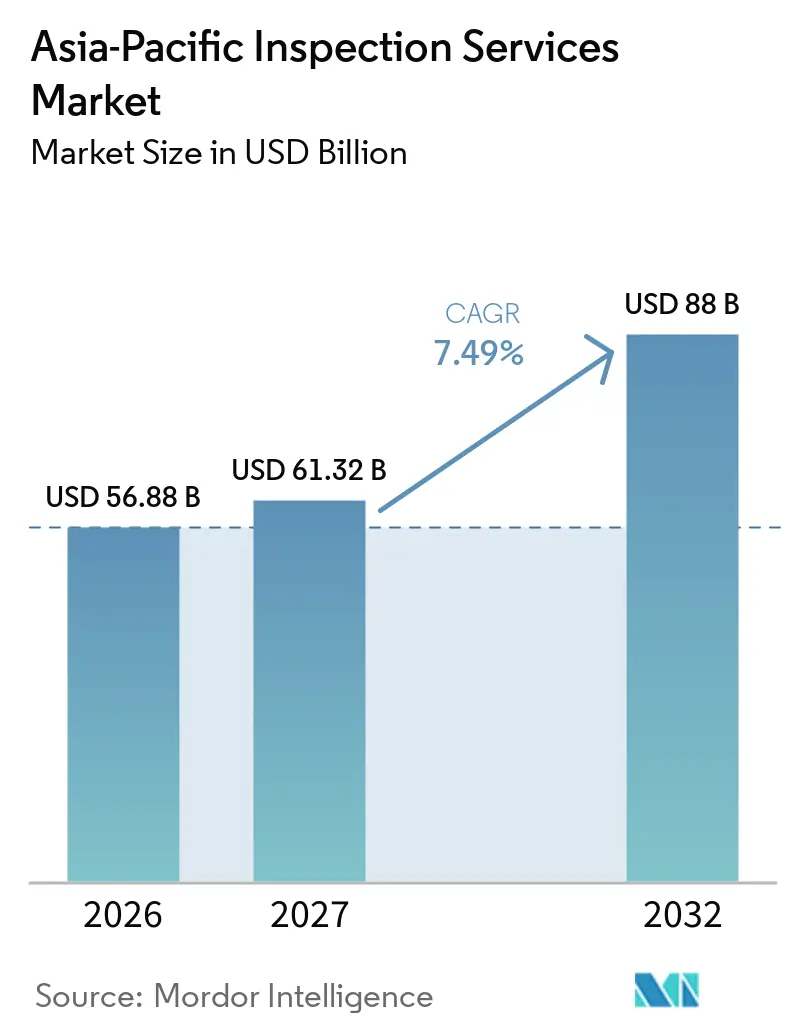
The Asia-Pacific Inspection Services Market size is expected to grow from USD 56.88 billion in 2026 to USD 61.32 billion in 2027 and is forecast to reach USD 88 billion by 2032 at 7.49% CAGR over 2027-2032.
Manufacturing capacity is expanding across China, India, and ASEAN economies, which increases the need for independent quality, safety, and conformity checks throughout production and distribution. The development of electronics, automotive, chemicals, pharmaceuticals, and industrial machinery manufacturing creates demand for product testing, supplier audits, process inspections, and regulatory compliance assessments. Large infrastructure programs also require verification during construction, commissioning, and operation, creating recurring work for inspection providers across transportation, energy, utilities, and industrial facilities. The expansion of renewable energy installations, power transmission networks, and industrial projects further increases the need for equipment integrity assessments, structural inspections, and preventive maintenance verification. Export rules are making inspection a condition for access to overseas markets rather than a discretionary operating expense, particularly for products subject to technical standards, traceability requirements, and destination-market certification. At the same time, complex supply chains are encouraging manufacturers and international buyers to conduct independent supplier assessments to reduce quality deviations, shipment rejections, and operational risks.
Key Report Takeaways
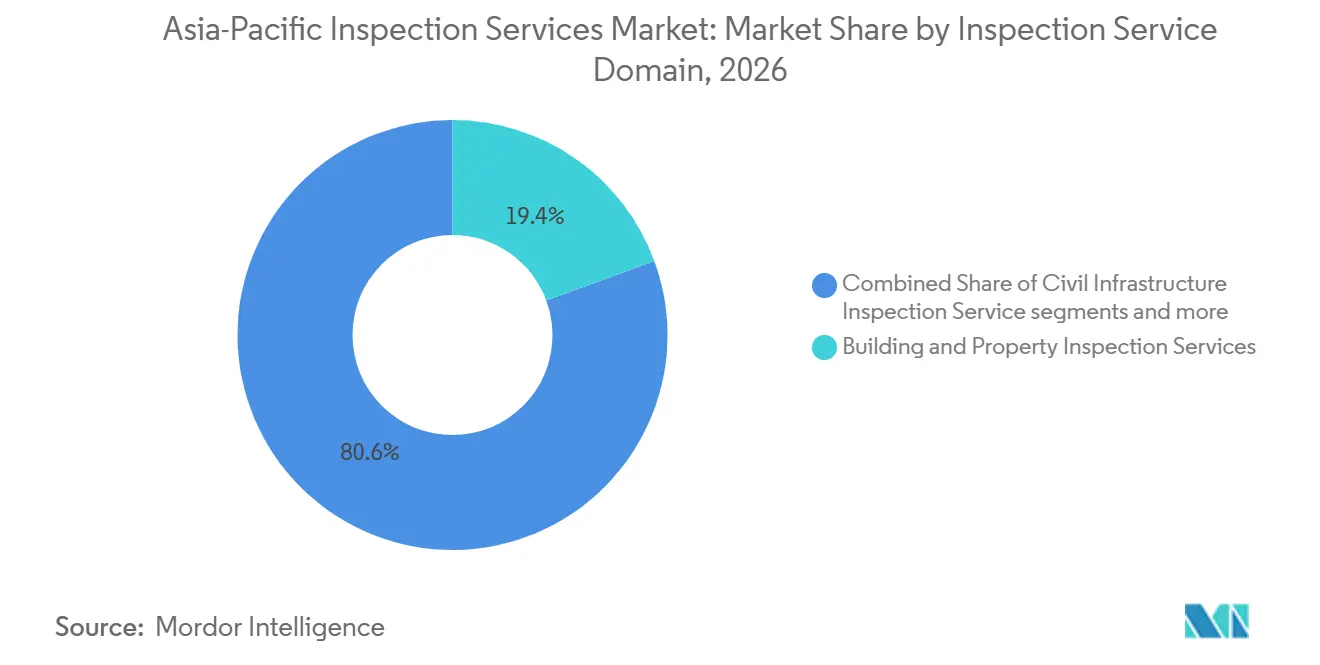
- By inspection service domain, building and property inspection services held 19.4% of the Asia-Pacific inspection services market share in 2026, while civil infrastructure inspection services are forecast to grow at an 8.9% CAGR through 2032.
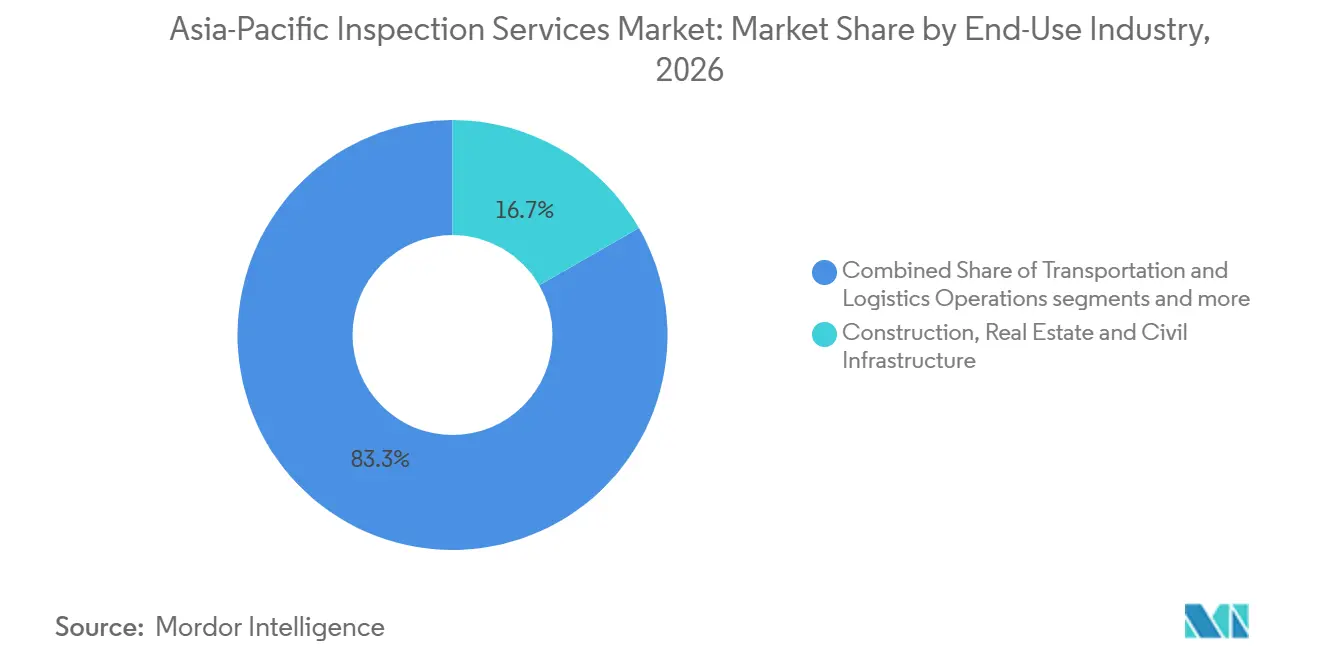
- By end-use industry, construction, real estate, and civil infrastructure accounted for 16.7% of the Asia-Pacific inspection services market size in 2026 and are forecast to grow at an 8.3% CAGR through 2032.
- By geography, China held 42% of the regional revenue in 2026, while India is forecast to grow at a 12% CAGR through 2032.
Note: Market numbers in this report are based on Mordor Intelligence's proprietary estimation framework, which combines nine months of actuals with Q4 projections for base year 2026.
Market Trends and Insights
Drivers Impact Analysis of Asia-Pacific Inspection Services Market*
| Driver | (~) % Impact on CAGR Forecast | Geographic Relevance | Impact Timeline |
|---|---|---|---|
| Cross-Border Manufacturing and Export Compliance | +2.0% | China, Vietnam, India, and ASEAN | Short term (≤ 2 years) |
| Infrastructure, Energy, and Industrial Asset Expansion | +1.7% | Asia-Pacific, anchored in China, India, and Southeast Asia | Medium term (2-4 years) |
| Electrification, EV Batteries, and Semiconductor Complexity | +1.2% | China, South Korea, Japan, and Taiwan | Medium term (2-4 years) |
| Digital, Remote, and AI-Enabled Inspection Adoption | +1.0% | Asia-Pacific, led by Japan, South Korea, Singapore, and Australia | Long term (≥ 4 years) |
| Supplier-Evidence Portability Across Relocating ASEAN Production Networks | +0.6% | Vietnam, Thailand, Indonesia, and Malaysia | Medium term (2-4 years) |
| Battery Passport and Product-Carbon Evidence Requirements | +0.4% | China, Malaysia, Japan, and South Korea | Medium term (2-4 years) |
| Source: Mordor Intelligence | |||
Cross-Border Manufacturing and Export Compliance
Export markets increasingly require verification within product-safety and market-access rules. New factories need supplier qualification, process checks, and product verification before serving United States, European, or Japanese buyers. China added EV supply equipment and civilian uncrewed aircraft to its compulsory certification catalog in 2025, increasing recurring compliance activity. [1]ASEAN pharmaceutical manufacturing arrangements also support the use of inspection evidence across member states.[2] The Asia-Pacific Inspection Services Market gains repeat demand because each new production site must maintain evidence for several export destinations.
Infrastructure, Energy, and Industrial Asset Expansion
Asia-Pacific requires USD 43 trillion in transport infrastructure investment between 2020 and 2035, creating sustained demand for technical inspections, quality assurance, and compliance verification across roads, railways, ports, airports, and associated infrastructure.[3] Asset owners need checks before construction, during delivery, and throughout long operating lives to verify material quality, structural integrity, contractor performance, and adherence to applicable engineering standards. ASEAN economies require USD 184 billion in annual infrastructure investment through 2030, supporting inspection requirements across transport corridors, utilities, industrial parks, and urban development projects. India needs USD 55 billion in annual urban infrastructure investment through 2036, increasing the need for inspections of water supply systems, wastewater treatment facilities, metro networks, bridges, and public infrastructure. As projects become larger and involve multiple contractors, independent inspection providers help identify construction defects, verify equipment specifications, and reduce the risk of costly rework or delays during commissioning.
Electrification, EV Batteries, and Semiconductor Complexity
Battery compliance creates inspection needs from production through end-of-life recordkeeping, as manufacturers and supply-chain participants face growing requirements for traceability, safety validation, and lifecycle data management. China required battery passports for traction batteries from February 1, 2025, with 32 lifecycle data points and penalties of up to CNY 500,000 (USD 71,412.5) for a violation. Malaysia introduced MS 2818 in November 2025 as ASEAN's first formal EV battery passport standard. The Global Battery Alliance's battery passport work also supports common reporting on greenhouse gases and due diligence, increasing the importance of reliable data collection, verification, and documentation across battery value chains. These requirements create opportunities for inspection providers to verify battery materials, manufacturing processes, product safety, environmental disclosures, and the consistency of information recorded throughout the product lifecycle. As battery production expands, inspections of cell manufacturing, module assembly, pack integration, and storage systems also become important for identifying defects and managing thermal, electrical, and mechanical risks. Semiconductor plants in Taiwan and South Korea, with added activity in Japan and India, require continuous monitoring, equipment qualification, and process checks to maintain precision manufacturing conditions and minimize contamination-related losses.
Digital, Remote, and AI-Enabled Inspection Adoption
AI-assisted defect recognition, drones, and remote visual tools are reducing the cost of standard inspections while improving coverage, consistency, and reporting speed. These technologies also bring formal inspection services to smaller properties, local infrastructure assets, and commercial fleets that often had not used them because of cost or accessibility constraints. NovaPeak and Panasonic R&D Center Singapore formed a partnership in March 2026 to deploy LiveInspect.AI across construction, infrastructure, manufacturing, and logistics, illustrating the growing application of AI-enabled inspection across multiple industries. Automated image analysis can help identify visible cracks, corrosion, surface defects, and equipment abnormalities, allowing inspectors to prioritize assets that require closer examination. Drone-based inspections also improve access to bridges, elevated structures, industrial rooftops, and other locations where manual inspection can involve additional equipment, time, or safety risks. Digital records make it easier to retain inspection evidence throughout an asset's life, compare findings across inspection cycles, and support maintenance planning and regulatory audits. Remote methods can reduce inspector-hour requirements when work does not need a physical specialist on site, while AI-assisted workflows can help standardize routine assessments across geographically dispersed facilities.
Restraints Impact Analysis of Asia-Pacific Inspection Services Market*
| Restraint | Impact (%) | Geographic Scope | Timeframe |
|---|---|---|---|
| Fragmented National Standards and Accreditation Regimes | -0.80% | Asia-Pacific, especially cross-border inspection activity | Long term (≥ 4 years) |
| Shortage of Certified Level II and Level III Inspectors | -0.60% | Asia-Pacific, especially South and Southeast Asia | Medium term (2–4 years) |
| Cybersecurity Liability for Connected and Remote Inspection Data | -0.40% | Asia-Pacific, especially Singapore, Japan, and Australia | Medium term (2–4 years) |
| Data Ownership and Evidence-Chain Interoperability Across EPC, OEM, and Asset-Owner Systems | -0.20% | China, South Korea, Australia, and India | Long term (≥ 4 years) |
| Source: Mordor Intelligence | |||
Fragmented National Standards, Accreditation, and Data Interoperability
Separate national accreditation systems raise costs for inspection providers serving more than one country, as they must align their quality-management procedures, technical documentation, personnel competencies, and audit processes with different regulatory and accreditation requirements. ISO/IEC 17020:2026 introduced risk-based thinking, a two-category independence model, and data-control provisions for inspection bodies, requiring providers to review their existing operating frameworks. Singapore adopted a three-year transition policy following the standard's publication in March 2026. Malaysia issued transition guidance requiring compliance by March 26, 2029, while Australia released application documents for the revised standard. Different rules governing data ownership, digital records, and evidence exchange across engineering, procurement, and construction (EPC) contractors, original equipment manufacturers (OEMs), and asset-owner systems add further friction, particularly when inspection assignments span multiple jurisdictions or involve complex industrial supply chains. Providers may need to invest in interoperable data systems, revised reporting protocols, additional staff training, and country-specific compliance procedures to maintain accreditation and meet client requirements.
Shortage of Certified Senior Inspectors and Connected-Data Risks
Level II and Level III personnel remain a capacity constraint for high-complexity inspection work. ISO 9712 requires documented industrial experience, which a shorter training route cannot replace. The IAEA Regional Cooperative Agreement delivered regional Level 2 certification in radiographic testing and phased-array ultrasonic testing during 2025. This recent regional training points to a gap between the available qualified workforce and rising industrial demand. Connected inspection systems also expose providers to cybersecurity and liability concerns when field records are shared remotely. Larger networks with training programs and secure data systems can capture premium work, while smaller operators may remain concentrated in lower-complexity services.
*Our forecasts treat driver/restraint impacts as directional, not additive. The impact forecasts reflect baseline growth, mix effects, and variable interactions.
Asia-Pacific Inspection Services Market Segment Analysis
By Inspection Service Domain:
Building and Property Leads, While Civil Infrastructure ExpandsBuilding and property inspection services held 19.4% of the Asia-Pacific inspection services market share in 2026. Mandatory pre-occupancy, handover, periodic statutory, and structural safety requirements support this position. Structural, building-envelope, mechanical, electrical, plumbing, and fire-safety checks generate frequent contract work. Property-condition reviews and construction-phase verification add demand across residential, commercial, and institutional properties. This service domain benefits from requirements that asset owners generally cannot defer. Its broad customer base also provides stability when large project activity slows.
Civil infrastructure inspection services are forecast to grow at an 8.9% CAGR through 2032. Roads, bridges, tunnels, rail lines, dams, and water systems require verification as they are delivered and operated. The Asian Transport Observatory expects up to 15,000 km of new metro lines and 2,000 km of LRT lines in the region by 2035. Each new route creates a long-lived need for structural monitoring and conformity work. Industrial facilities and fixed asset inspection services remain important because plants, pressure vessels, pipelines, storage tanks, and utilities face mandated inspection intervals. Manufactured products, vehicles, cargo, and operational-site services add a diverse set of revenue sources across the Asia-Pacific inspection services market.

By End-Use Industry:
Construction Holds the Largest Position and Drives GrowthConstruction, real estate, and civil infrastructure accounted for 16.7% of the regional revenue in 2026. The sector also has the highest forecast CAGR among end-use industries at 8.3% through 2032. State-backed infrastructure programs produce large contracts during construction and repeat work during operation. Inspection demand continues through maintenance because roads, buildings, rail assets, and water systems must meet safety and performance requirements. This dual source of demand supports the Asia-Pacific inspection services market size for the construction end-use. It also makes project delivery and asset maintenance closely linked revenue pools for providers.
Oil and gas, petroleum refining, and petrochemicals retain a major buyer role because refineries, terminals, offshore facilities, pressure equipment, and pipelines need periodic integrity assessments. Power, renewable energy, and utility projects create newer needs for solar commissioning, offshore wind installation, and hydrogen facility conformity checks. Manufacturing and industrial processing require raw material, in-process, and finished product verification across electronics, automotive, pharmaceutical, and consumer goods plants. Transportation and logistics rely on checks for port, rail, road, and aviation assets as regional connectivity expands. Mining, agriculture, food and beverage, retail, healthcare, and public institutions add specialized work tied to safety, environmental, and facility requirements. Household property inspection remains underdeveloped in fast-urbanizing locations, leaving an additional volume opportunity for the Asia-Pacific inspection services market.
Geography Analysis
APAC Inspection Services Market
China held 42% of the Asia-Pacific Inspection Services Market share in 2026. Its manufacturing scale, compulsory product requirements, and aging industrial base support a broad inspection workload. Japan strengthened product-safety obligations for foreign sellers from December 25, 2025, including domestic representative and PSE technical standards requirements. South Korea's KC mark and KGMP requirements support demand for certification-linked work. Taiwan's semiconductor and advanced manufacturing base requires specialized cleanrooms, equipment, and process inspection. These markets give providers access to higher-specification assignments where local accreditation and technical capability matter.
India and ASEAN Inspection Services Market
India is forecast to grow at a 12% CAGR through 2032, the fastest rate among the countries considered. Its fiscal 2025 to 2026 infrastructure allocation was USD 134 billion, which supports demand across civil works and related assets. BIS factory-surveillance guidance issued in February 2026 strengthened monitoring procedures at licensed manufacturing premises. New facilities in Vietnam, Thailand, Indonesia, and Malaysia require factory qualification and ongoing process checks. Vietnam and Malaysia are building export-compliance and digital certification capacity, while Malaysia's battery-passport standard creates a further route for advanced verification.
Oceania and APAC Inspection Services Market
Australia has a premium inspection base linked to LNG, offshore oil and gas, mining, property, and building-code requirements. NATA's August 2026 guidance raised the preparation required for inspection bodies moving to ISO/IEC 17020:2026. Intertek's contract with Santos shows the demand for long-term digital asset-integrity and NDT support in mature energy operations. New Zealand and Hong Kong provide material demand through building rules and infrastructure renewal. Bangladesh and Pakistan remain earlier-stage markets where greater garment and textile exports are making pre-shipment checks more routine. The wider regional footprint lets the Asia-Pacific inspection services market combine mature premium assignments with expanding compliance demand in developing economies.
Competitive Landscape
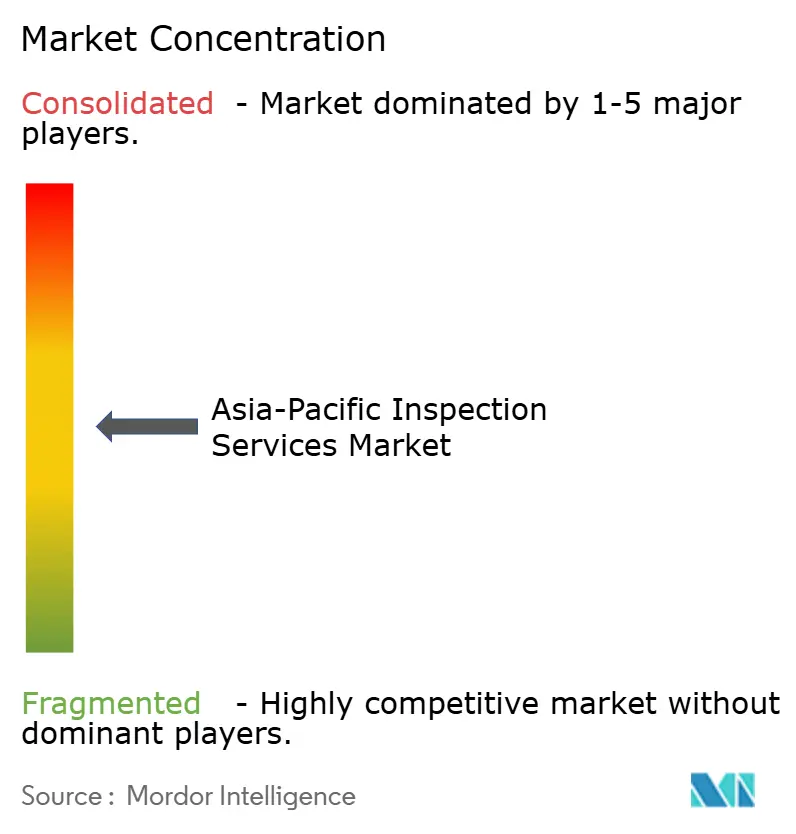
The Asia-Pacific inspection services market exhibits a medium level of market concentration. SGS, Bureau Veritas, Intertek, TÜV SÜD, TÜV Rheinland, DNV, Lloyd's Register, and DEKRA operate field and laboratory networks across the region. China Certification and Inspection Group, Korea Testing and Research Institute, PT SUCOFINDO, and SIRIM QAS International have strong positions in domestic statutory work. Local licensing can limit the ability of multinational providers to enter protected inspection streams. This mix makes local credentials and government relationships important alongside international network coverage. Leading providers compete through technical depth, accreditation portfolios, digital platforms, and carefully selected acquisitions.
Bureau Veritas acquired Lotusworks in April 2026, adding a mission-critical platform for data centers and semiconductor manufacturing. Intertek acquired solar PV laboratory assets from Mitsui Chemicals India in April 2026, strengthening its renewable-energy assurance capacity in western India. Apave agreed to acquire Singapore-based GEI in May 2026, adding inspection, NDT, and calibration capabilities in Southeast Asia. These moves show that providers are buying regional reach and specialized capabilities rather than relying only on organic expansion. Digital systems are equally important because customers need usable evidence across asset owners, contractors, and equipment suppliers.
Open areas remain in secondary-city industrial coverage, shared digital evidence platforms, and solutions that meet local data-residency expectations. NovaPeak's partnership with Panasonic R&D Center Singapore illustrates how software firms can work with accredited inspection bodies rather than replace them. QIMA, ALS Limited, Applus Services, MISTRAS Group, ABS Group, Japan Quality Assurance Organization, UL Solutions, and Apave compete through selected countries and vertical strengths. The proposed June 2026 acquisition of Intertek by Isotope Bidco points to continuing consolidation among global TIC providers. Competitive pressure is likely to remain strongest where large contracts need broad coverage, digital records, and scarce specialist skills. The Asia-Pacific inspection services market, therefore, rewards scale in complex assignments while leaving room for focused local and technical specialists.
Asia-Pacific Inspection Services Industry Leaders
-
SGS SA
-
Bureau Veritas SA
-
Intertek Group plc
-
TÜV SÜD AG
-
TÜV Rheinland AG
- *Disclaimer: Major Players sorted in no particular order
Asia-Pacific Inspection Services Market Companies Covered in this Report
- SGS SA
- Bureau Veritas SA
- Intertek Group plc
- TÜV SÜD AG
- TÜV Rheinland AG
- DEKRA SE
- DNV AS
- ALS Limited
- Eurofins Scientific SE
- Applus Services, S.A.
- MISTRAS Group, Inc.
- Element Materials Technology Group
- UL Solutions Inc.
- Lloyd's Register Group Limited
- QIMA Limited
- Japan Quality Assurance Organization
- China Certification and Inspection Group
- Korea Testing and Research Institute
- PT SUCOFINDO (Persero)
- SIRIM QAS International Sdn. Bhd.
- Apave Group
- ABS Group of Companies, Inc.
Recent Industry Developments in Asia-Pacific Inspection Services Market
- June 2026: Intertek Group plc confirmed its board agreed to terms on a recommended cash acquisition by Isotope Bidco Limited, marking significant consolidation at the apex of the global TIC industry with implications for regional pricing dynamics, laboratory-footprint rationalization, and Asia-Pacific digital inspection investment capacity.
- May 2026: Apave Group signed an agreement to acquire Singapore-based GEI, a specialist in industrial inspection, NDT, and calibration/metrology in Southeast Asia, immediately strengthening its regional platform and adding advanced PAUT and metrology capability in line with its AMPLIFY 2030 strategic plan Apave, 2026.
Asia-Pacific Inspection Services Market Report Scope
The Asia-Pacific Inspection Services Market Report is Segmented by Inspection Service Domain (Building and Property Inspection Services, Civil Infrastructure Inspection Services, and More), and by End-Use Industry (Construction, Real Estate and Civil Infrastructure, Households and Individual Consumers, Power Generation, Renewable Energy and Utilities, and More). The Market Forecasts are Provided in Terms of Value (USD).
Segmentation Overview
| Building and Property Inspection Services | Residential, Commercial and Institutional Building Inspections |
| Structural, Building Envelope, MEP and Fire-Safety Inspections | |
| Property Condition, Construction and Handover Inspections | |
| Civil Infrastructure Inspection Services | Roads, Bridges, Tunnels and Rail Track Infrastructure |
| Dams, Civil Water Infrastructure and Other Civil Engineering Structures | |
| Industrial Facilities and Fixed Asset Inspection Services | Industrial Plants and Installed Process Equipment |
| Pressure Vessels, Pipelines and Storage Tanks | |
| Energy Generation and Utility Systems | |
| Other Stationary Industrial Equipment | |
| Manufactured Product and Production-Process Inspection Services | Raw Material and Component Inspection |
| In-Process Manufacturing Inspection | |
| Finished-Product and Production-Process Conformity Inspection | |
| Transportation Vehicle and Mobile Asset Inspection Services | Road Vehicles and Commercial Fleets |
| Rail Rolling Stock | |
| Aircraft and Aviation Assets | |
| Ships and Other Marine Vessels | |
| Other Mobile Transportation Assets | |
| Commodity, Cargo and Trade Inspection Services | Bulk and Containerized Cargo Inspection |
| Traded Commodity Inspection | |
| Consignment Condition, Quantity and Quality Verification | |
| Loading, Unloading and Custody-Transfer Inspection | |
| Other Operational Site and Process Inspection Services | Physical Hygiene and Workplace Safety Inspection |
| Agricultural Site Inspection | |
| Other Operational Compliance Inspection |
| Oil and Gas, Including Petroleum Refining and Petrochemicals |
| Power Generation, Renewable Energy and Utilities |
| Manufacturing and Industrial Processing (Excluding Industries Separately Classified) |
| Construction, Real Estate and Civil Infrastructure |
| Transportation and Logistics Operations |
| Mining and Quarrying |
| Agriculture, Food and Beverage |
| Wholesale, Retail and Commodity Trading |
| Healthcare, Pharmaceuticals and Life Sciences |
| Households and Individual Consumers |
| Other Commercial Services and Public Institutions |
| China |
| Japan |
| India |
| South Korea |
| Taiwan |
| Australia |
| ASEAN (Indonesia, Thailand, Vietnam, Malaysia, Singapore, Philippines, Myanmar, Cambodia, Laos, Brunei, Timor-Leste) |
| Rest of Asia-Pacific (Hong Kong, New Zealand, Bangladesh, Pakistan, Sri Lanka, etc.) |
| By Inspection Service Domain | Building and Property Inspection Services | Residential, Commercial and Institutional Building Inspections |
| Structural, Building Envelope, MEP and Fire-Safety Inspections | ||
| Property Condition, Construction and Handover Inspections | ||
| Civil Infrastructure Inspection Services | Roads, Bridges, Tunnels and Rail Track Infrastructure | |
| Dams, Civil Water Infrastructure and Other Civil Engineering Structures | ||
| Industrial Facilities and Fixed Asset Inspection Services | Industrial Plants and Installed Process Equipment | |
| Pressure Vessels, Pipelines and Storage Tanks | ||
| Energy Generation and Utility Systems | ||
| Other Stationary Industrial Equipment | ||
| Manufactured Product and Production-Process Inspection Services | Raw Material and Component Inspection | |
| In-Process Manufacturing Inspection | ||
| Finished-Product and Production-Process Conformity Inspection | ||
| Transportation Vehicle and Mobile Asset Inspection Services | Road Vehicles and Commercial Fleets | |
| Rail Rolling Stock | ||
| Aircraft and Aviation Assets | ||
| Ships and Other Marine Vessels | ||
| Other Mobile Transportation Assets | ||
| Commodity, Cargo and Trade Inspection Services | Bulk and Containerized Cargo Inspection | |
| Traded Commodity Inspection | ||
| Consignment Condition, Quantity and Quality Verification | ||
| Loading, Unloading and Custody-Transfer Inspection | ||
| Other Operational Site and Process Inspection Services | Physical Hygiene and Workplace Safety Inspection | |
| Agricultural Site Inspection | ||
| Other Operational Compliance Inspection | ||
| By End-Use Industry | Oil and Gas, Including Petroleum Refining and Petrochemicals | |
| Power Generation, Renewable Energy and Utilities | ||
| Manufacturing and Industrial Processing (Excluding Industries Separately Classified) | ||
| Construction, Real Estate and Civil Infrastructure | ||
| Transportation and Logistics Operations | ||
| Mining and Quarrying | ||
| Agriculture, Food and Beverage | ||
| Wholesale, Retail and Commodity Trading | ||
| Healthcare, Pharmaceuticals and Life Sciences | ||
| Households and Individual Consumers | ||
| Other Commercial Services and Public Institutions | ||
| By Geography | China | |
| Japan | ||
| India | ||
| South Korea | ||
| Taiwan | ||
| Australia | ||
| ASEAN (Indonesia, Thailand, Vietnam, Malaysia, Singapore, Philippines, Myanmar, Cambodia, Laos, Brunei, Timor-Leste) | ||
| Rest of Asia-Pacific (Hong Kong, New Zealand, Bangladesh, Pakistan, Sri Lanka, etc.) | ||
Key Questions Answered in the Report
What is the projected value of the Asia-Pacific Inspection Services Market by 2032?
The Asia-Pacific inspection services market is projected to reach USD 88 billion by 2032, from USD 56.88 billion in 2026, at a 7.49% CAGR from 2027 to 2032.
Which inspection service domain is growing fastest in Asia-Pacific?
Civil infrastructure inspection services is the fastest-growing service domain, with an 8.9% CAGR forecast through 2032.
Which end-use sector leads demand for inspection services in the Asia-Pacific?
Construction, real estate, and civil infrastructure led with 16.7% of the regional revenue in 2026 and is forecast to grow at an 8.3% CAGR through 2032.
Which country has the largest regional inspection services revenue base?
China held 42% of the regional revenue in 2026, supported by its manufacturing base, compulsory product rules, and asset-integrity needs.
Which country is expected to grow fastest through 2032?
India is forecast to expand at a 12% CAGR through 2032, supported by infrastructure spending and stronger factory-surveillance procedures.
How are digital tools changing inspection services in the Asia-Pacific?
AI-assisted recognition, drones, remote visual checks, and digital records lower the cost of routine work and make inspection more practical for smaller assets.