
Asia-Pacific Inspection Equipment Market Size and Share
Market Overview
| Study Period | 2021 - 2032 |
|---|---|
| Forecast Data Period | 2027 - 2032 |
| Base Year Market Size (2026) | USD 16.65 Billion |
| Market Size (2027) | USD 18.20 Billion |
| Market Size (2032) | USD 28.20 Billion |
| Growth Rate (2027 - 2032) | 9.15 % |
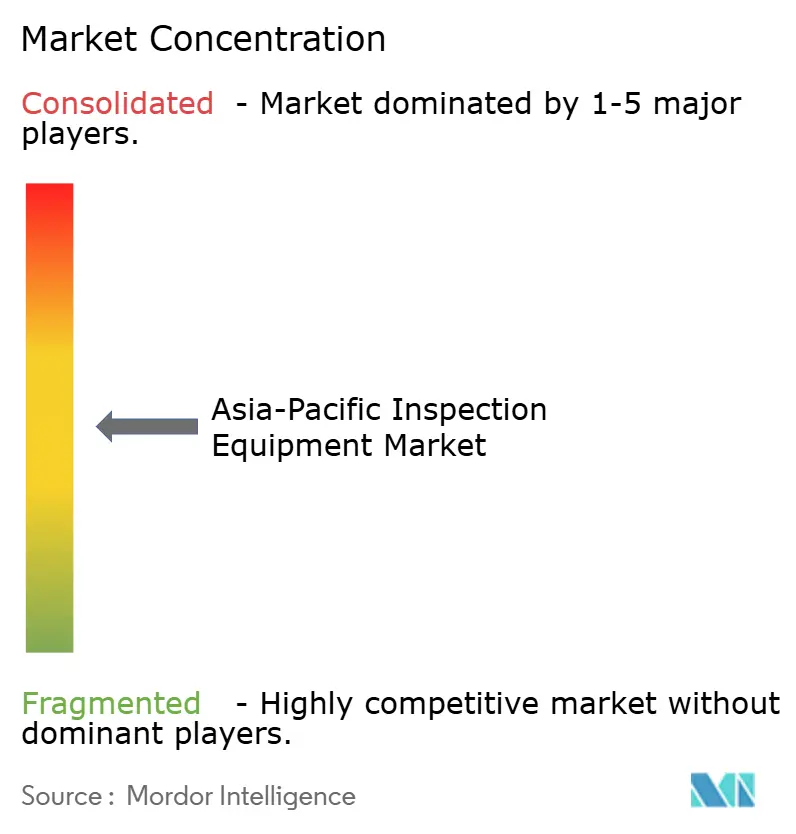
| Market Concentration | Medium |
Major Players *Disclaimer: Major Players sorted in no particular order Image © Mordor Intelligence. Reuse requires attribution under CC BY 4.0. | |
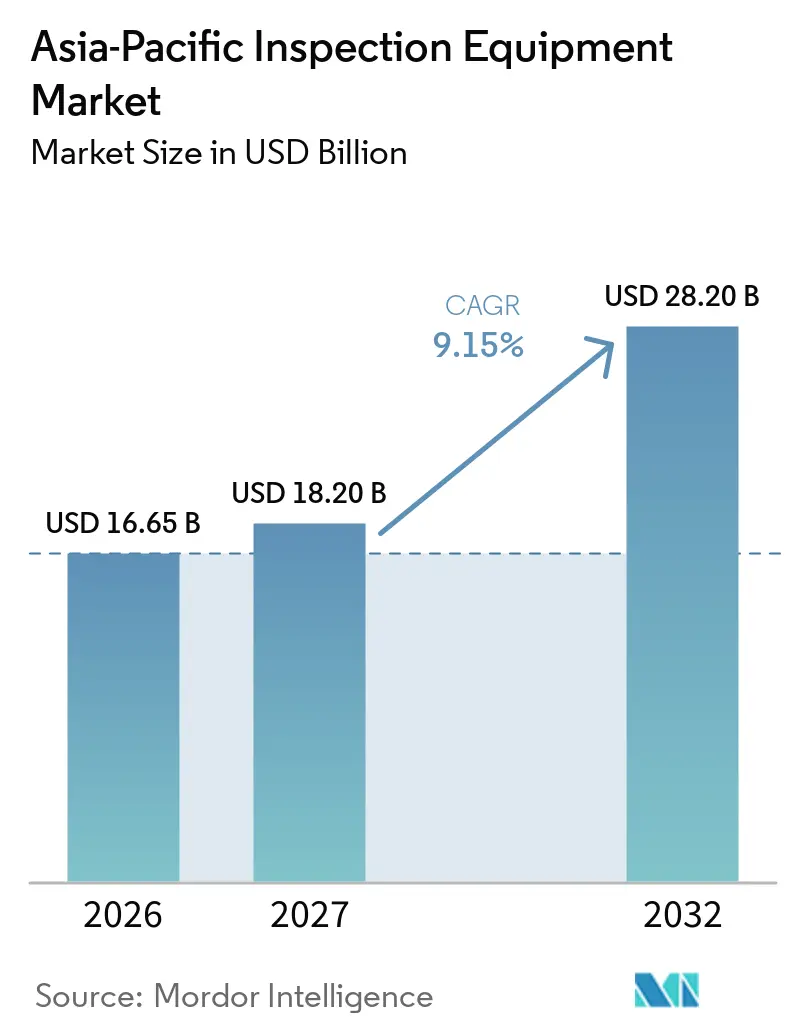
Asia-Pacific Inspection Equipment Market Analysis by Mordor Intelligence
The Asia-Pacific Inspection Equipment Market size is projected to expand from USD 16.65 billion in 2026 and USD 18.20 billion in 2027 to USD 28.20 billion by 2032, registering a CAGR of 9.15% between 2027 and 2032.
The Asia-Pacific inspection equipment market is supported by semiconductor node transitions, electric vehicle battery capacity, and traceability requirements across export supply chains. Manufacturers are shifting from final quality checks to inspection systems embedded in production processes. This change links equipment purchases more closely to yield control, defect prevention, and supplier qualification requirements. Semiconductor fabrication plants require advanced metrology and automated inspection equipment to identify microscopic defects, monitor process variation, and maintain consistency as chip designs become more complex. Similarly, battery manufacturers are adopting inspection systems to assess electrode coatings, cell dimensions, weld integrity, and battery pack assembly, where undetected defects can affect safety and performance. The expansion of electronics manufacturing, automotive component production, and industrial automation across China, Japan, South Korea, Taiwan, and India also supports demand for machine vision, dimensional measurement, non-destructive testing, and automated optical inspection systems. Export-oriented manufacturers increasingly rely on standardized inspection records to demonstrate product conformity, improve production consistency, and meet customer audit requirements across international supply chains.
Key Report Takeaways
- By equipment type, optical and visual inspection equipment held a 42.3% of the Asia-Pacific inspection equipment market share in 2026, while electron-beam inspection equipment is projected to expand at a 10.9% CAGR through 2032.
- By application, manufactured product and production-process inspection accounted for 66.7% of the Asia-Pacific inspection equipment market size in 2026 and is projected to expand at a 9.3% CAGR through 2032.
- By end-use industry, electronics, semiconductor, and electrical equipment manufacturing held a 37.1% revenue share in 2026 and is projected to expand at a 10.1% CAGR through 2032.
- By geography, China held a 38% revenue share in 2026, while Japan is projected to expand at a 9.2% CAGR through 2032.
Note: Market numbers in this report are based on Mordor Intelligence's proprietary estimation framework, which combines nine months of actuals with Q4 projections for base year 2026.
Asia-Pacific Inspection Equipment Market Trends and Insights
Drivers Impact Analysis*
| Driver | (~) % Impact on CAGR Forecast | Geographic Relevance | Impact Timeline |
|---|---|---|---|
| Expansion of Smart Manufacturing and Automated Quality Control | +2.8% | APAC-wide, with highest intensity in China, Japan, South Korea, and Taiwan | Medium term (2-4 years) |
| Semiconductor, Electronics, and Battery Manufacturing Expansion | +2.2% | China, Taiwan, South Korea, and Japan | Short term (≤ 2 years) |
| Tightening Product-Safety and Export-Quality Requirements | +1.6% | ASEAN, China, and India | Medium term (2-4 years) |
| AI-Enabled Inspection for High-Mix, Low-Volume Production | +1.1% | Japan, South Korea, and China | Medium term (2-4 years) |
| Inspection Traceability for Multi-Site Asian Supply Chains | +0.8% | ASEAN, China, India, and multi-country Asia-Pacific operations | Medium term (2-4 years) |
| Growing Renewable Energy Infrastructure and Grid Asset Inspection Demand | +0.6% | China, India, Australia, and ASEAN | Long term (≥ 4 years) |
| Source: Mordor Intelligence | |||
Expansion of Smart Manufacturing and Automated Quality Control
The Asia-Pacific inspection equipment market benefits as automated quality control becomes a standard capital item within smart factories. The regional smart manufacturing base was valued at USD 58.5 billion in 2025 and is projected to reach USD 92.6 billion by 2031. Manufacturers increasingly need documented traceability when supplying automotive and electronics original equipment manufacturers. Inspection systems can capture production evidence while identifying defects before final assembly. Private 5G pilots in Chinese and Japanese factories support the use of mobile inspection equipment where fixed wired cells are unsuitable. ISO 9001 requirements, Chinese GB standards, and Indian BIS certification schemes reinforce procurement across quality-sensitive operations.
Semiconductor, Electronics, and Battery Manufacturing Expansion
The Asia-Pacific inspection equipment market is gaining from concentrated investment in semiconductors, electronics, and battery production. Global semiconductor equipment revenue reached USD 135.1 billion in 2025, up 15% from 2024.[1] China, Taiwan, and South Korea accounted for 79% of global equipment investment during 2025. Taiwan recorded USD 31.5 billion in investment, while South Korea recorded USD 25.8 billion. Advanced nodes require more frequent process-control measurements, which supports electron-beam and hybrid optical inspection systems. New battery lines in China, South Korea, and Thailand also require CT and X-ray inspection during cell production and qualification. These investments are expanding demand for inspection equipment across wafer fabrication, advanced packaging, printed circuit board assembly, and battery manufacturing, where small defects can affect production yields and product reliability. Manufacturers are increasingly integrating automated optical inspection, dimensional measurement, and non-destructive testing into production lines to identify defects earlier and reduce dependence on end-of-line sampling.
Tightening Product-Safety and Export-Quality Requirements
Quality documentation requirements in export manufacturing also support the Asia-Pacific inspection equipment market. The EU General Product Safety Regulation has been fully effective since 2024, raising documentation expectations for products entering European markets. United States digital traceability requirements affect electronics, toys, and medical devices supplied by regional contract manufacturers. Updated quality system rules also increase the use of in-process verification in pharmaceutical and medical-device production. Thailand linked smart-factory incentives in the Eastern Economic Corridor to automotive quality compliance in 2025. The policy supports AI-enabled inspection among automotive-parts exporters receiving Board of Investment support.[2]
AI-Enabled Inspection for High-Mix, Low-Volume Production
The Asia-Pacific inspection equipment market has wider applications in factories producing many product variants in smaller volumes. Conventional rule-based vision systems often require lengthy adjustments when a product configuration changes. AI-based platforms can update inspection models without replacing the associated hardware. Cognex launched the In-Sight 3900 in May 2026, with inspection performance up to four times faster than earlier systems and resolution up to 25 megapixels. Panasonic began global licensing of its AI Platform for Visual Inspection in March 2026 for use with drones, robots, cameras, and industrial computers. These platforms support inspection traceability across multi-site Asian supply chains and help reduce manual work during product changeovers.
Restraints Impact Analysis*
| Restraint | (~) % Impact on CAGR Forecast | Geographic Relevance | Impact Timeline |
|---|---|---|---|
| High Capital Cost and Integration Complexity | -1.8% | ASEAN, India, and Rest of Asia-Pacific | Long term (≥ 4 years) |
| Shortage of Skilled Inspection and Data-Engineering Personnel | -1.2% | India, ASEAN, and Rest of Asia-Pacific | Long term (≥ 4 years) |
| Cybersecurity Exposure from Connected Inspection Systems | -0.8% | APAC-wide | Medium term (2-4 years) |
| Fragmented Metrology and Calibration Standards Across Asia-Pacific Jurisdictions | -0.5% | ASEAN, India, and multi-jurisdiction Asia-Pacific operations | Long term (≥ 4 years) |
| Source: Mordor Intelligence | |||
High Capital Cost and Integration Complexity
The Asia-Pacific inspection equipment market faces slower adoption among small and medium-sized manufacturers with limited capital budgets. A fully integrated AI vision cell can require USD 250,000 to more than USD 1 million for sensors, computing hardware, robotic handling, and commissioning. The installation process can also involve connecting systems with existing MES, ERP, and SCADA environments. These integrations may require six to eighteen months before inspection data can be used in operations. Smart manufacturing subsidies and production-linked incentive programs can reduce acquisition costs for eligible companies. Many micro-enterprises and informal businesses remain outside those programs, and maintenance, calibration, and software fees can extend the payback period.
Shortage of Skilled Inspection and Data-Engineering Personnel
The Asia-Pacific inspection equipment market needs personnel who understand metrology, production systems, data governance, and AI model validation. India reported uneven geographic and sectoral availability of graduates in relevant advanced manufacturing fields.[3] This gap can delay system deployment and reduce the benefits gained after installation. Vietnam also faces a mismatch between electronics investment needs and the depth of its precision-engineering workforce. Connected inspection systems create cybersecurity exposure that requires additional operational skills and safeguards. Differing metrology and calibration requirements across jurisdictions add complexity for manufacturers operating regional production networks.
*Our forecasts treat driver/restraint impacts as directional, not additive. The impact forecasts reflect baseline growth, mix effects, and variable interactions.
Segment Analysis
By Equipment Type: Optical Systems Lead as Electron-Beam Demand Surges
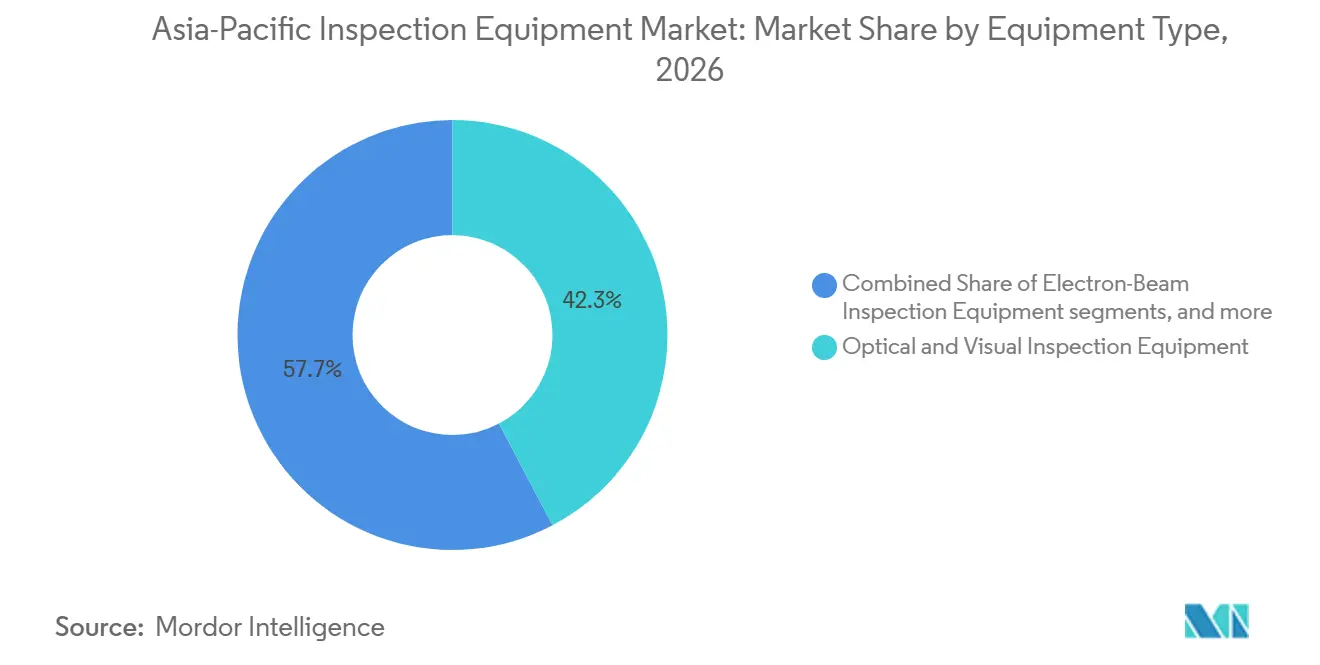
Optical and visual inspection equipment held 42.3% of the Asia-Pacific inspection equipment market share in 2026. Its scale reflects extensive machine-vision use in electronics assembly, food and beverage packaging, and automotive body-panel manufacturing. Machine vision and automated optical inspection systems form the largest part of this equipment category. Their use is widening because they can examine repeatable production tasks at line speed. KEYENCE introduced its IV4-H Series AI Vision Sensor in September 2026 to automate vision parameter setup and reduce training demands in high-mix manufacturing. Optical tools remain suitable for many surface, packaging, and assembly inspection tasks, which preserve their broad installed base.
Electron-beam inspection equipment is projected to grow at a 10.9% CAGR through 2032. The Asia-Pacific inspection equipment market size for this category is supported by demand for defect detection in advanced logic, HBM, and 3D-NAND production. Electron-beam systems can identify defect classes that optical systems cannot reliably resolve at sub-10nm dimensions. Dimensional and geometric equipment, including coordinate measuring machines and laser scanners, continues to serve aerospace and precision automotive requirements. Hexagon released OPTIV S 4.4.3 in September 2026 with AI Edge Detection and AI Illumination capabilities. Ultrasonic, acoustic, radiographic CT, electromagnetic, and thermal equipment remain relevant where energy, aerospace, food safety, and infrastructure requirements call for specialized inspection methods.

By Primary Inspection Application: Production-Process Inspection Commands Two-Thirds of Demand
Manufactured product and production-process inspection represented 66.7% of the Asia-Pacific application revenue in 2026 and is projected to expand at a 9.3% CAGR through 2032. The segment supports high-throughput assembly and fabrication operations where defect detection affects yield and supplier qualification. It is the principal application for machine vision, automated optical inspection, coordinate measurement systems, and inline checkweighing equipment. Export-oriented production facilities have a strong need to document process conditions and product conformity. The segment also benefits as manufacturers introduce automated inspections earlier in the production flow. This pattern makes in-process inspection a core demand source for the Asia-Pacific inspection equipment market.
Aging bridges, tunnels, dams, and port assets across China, Japan, and ASEAN support civil infrastructure inspection. Public authorities are formalizing the procurement of drone-based nondestructive testing and ground-penetrating radar for asset monitoring. Industrial facilities and fixed asset inspection use thermal, ultrasonic, and eddy-current methods for turbines, pressure vessels, and electrical switchgear. These services can expand as renewable energy assets enter major maintenance periods. Building and property inspection is growing with more formal safety verification requirements. Commodity, cargo, and trade inspection is also expanding with anti-counterfeiting requirements and trade controls in China, India, and ASEAN.
By End-Use Industry: Electronics and Semiconductor Sector Commands Priority Budgets
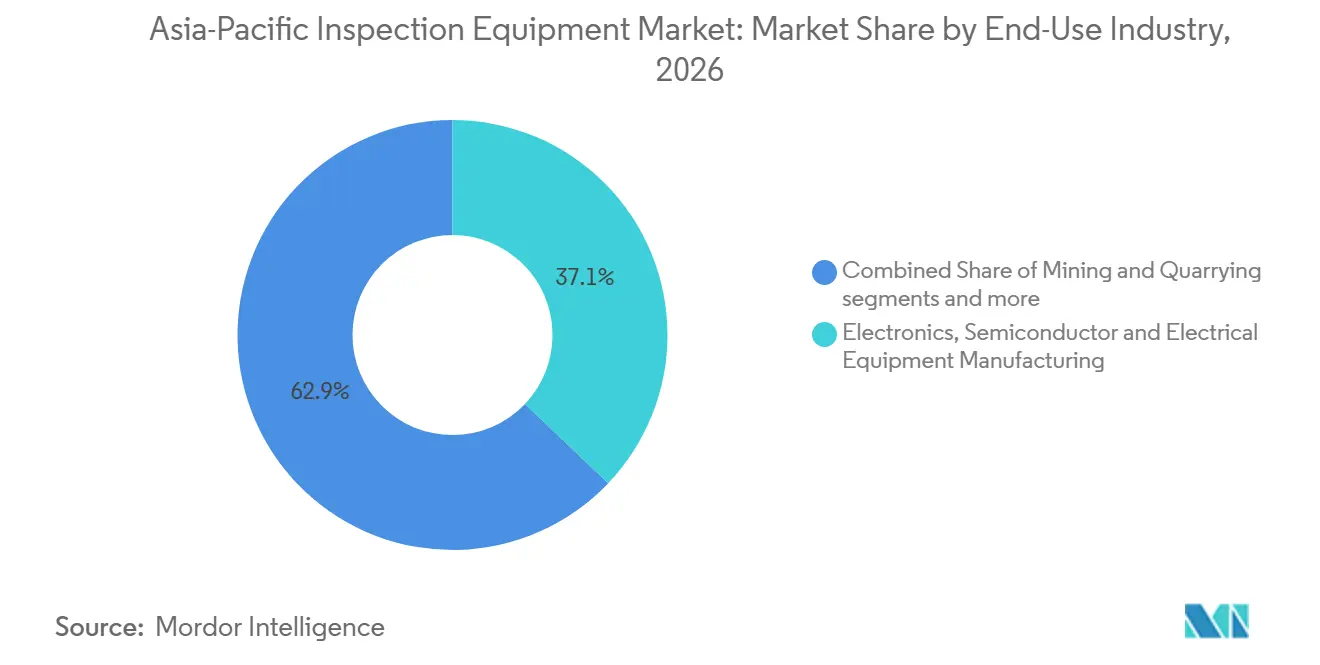
Electronics, semiconductor, and electrical equipment manufacturing held a 37.1% end-use revenue share in 2026 and is projected to grow at a 10.1% CAGR through 2032. The Asia-Pacific inspection equipment industry benefits because each logic and memory generation adds inspection steps and tighter measurement requirements. China, Taiwan, and South Korea accounted for 79% of global semiconductor equipment investment in 2025. Inspection and metrology tools generally account for 15% to 18% of fab equipment budgets at advanced nodes. This investment base creates sustained demand for process-control systems. It also supports applications for advanced wafer inspection, packaging inspection, and defect classification.
Automotive and component manufacturers need battery-cell CT inspection, motor-winding verification, and power-electronics automated optical inspection. IATF 16949 requirements maintain demand for calibration and documentation across automotive supply chains. Oil and gas operators use phased-array ultrasonic and radiographic inspection for pipelines and pressure vessels. Power generation and renewable energy operators use inspection equipment for turbine blades, solar panels, and grid transformers. These requirements broaden demand beyond semiconductor production and reduce dependence on one manufacturing cycle. The Asia-Pacific inspection equipment industry therefore serves both high-volume factory lines and long-life industrial assets.
Geography Analysis
China held 38% of the Asia-Pacific inspection equipment market share in 2026. The country combines a large electronics and semiconductor base, domestic electric vehicle production, and quality surveillance requirements connected to product safety and exports. China invested USD 49.3 billion in semiconductor equipment during 2025. Its GB/T 46924-2025 standard became effective in July 2026 and sets technical requirements for drone-based inspection of photovoltaic power plants. The standard formalizes procurement requirements across a solar base exceeding 700 GW.
Japan is projected to record a 9.2% CAGR through 2032, the fastest among the geographic segments. Semiconductor revitalization policy supports new fab investment and related inspection equipment procurement. South Korea’s HBM and DRAM investment cycle supports wafer-level inspection demand. Taiwan’s advanced packaging expansion requires sub-micron 3D inspection capabilities. India is developing into a growth area through production-linked incentive-supported electronics manufacturing. Together, these markets make the Asia-Pacific inspection equipment market less dependent on any single production center.
ASEAN is gaining electronics and automotive capacity in Vietnam, Malaysia, Thailand, and Indonesia. Japanese, Korean, and European original equipment manufacturers embed inspection system requirements in many of these new facilities. Thailand’s smart-factory incentive structure links support to automotive quality compliance. Australia’s demand centers on infrastructure, mining, and utilities, including thermal systems, ultrasonic tools, borescopes, and ore-sample X-ray scanning. Power and Water Corporation issued an April 2026 tender for UAV inspection of 66 kV and 132 kV transmission structures. Other Asia-Pacific markets remain earlier-stage and focus more heavily on food safety, border inspection, and channel-led distribution.
Competitive Landscape
The Asia-Pacific inspection equipment market exhibits a medium level of market concentration. KEYENCE, Cognex, Hexagon, and Olympus have established positions in machine vision, metrology, and nondestructive testing. Their installed bases are reinforced by application engineering support and calibration networks. Leading suppliers are adapting their platforms for AI-supported inspection and lower operator dependence. Semiconductor cybersecurity requirements, including E187, add qualification considerations for vendors serving advanced fabs. This favors suppliers that can support both technical performance and secure equipment operation.
Hexagon released OPTIV S 4.4.3 in September 2026 with AI-assisted measurement capabilities intended to improve consistency and simplify programming. Cognex launched the Insight 1750 Series in September 2026 for wafer and panel identification with traceability support. Cognex also reported that more than 100 customers had adopted its OneVision platform after its June 2025 beta launch. Panasonic’s visual inspection platform extends compatible deployment across drones, robots, CCTV, and industrial computers. These actions show how suppliers are combining equipment sales with software deployment across multiple facilities.
Smaller regional suppliers can compete when they provide closer integration with local customer specifications. Affordable modular systems remain an opportunity for small manufacturers in ASEAN and South Asia. Inspection-as-a-service, remote calibration, and cloud-hosted model management are changing the supplier relationship after installation. Measures of competitive position may therefore extend beyond hardware units to software seats and data-service revenues. MISTRAS Group is less aligned with this equipment-focused scope because its Asia-Pacific activity is primarily inspection services. MinebeaMitsumi is also less aligned because it supplies components rather than inspection systems, while Evident and Tokyo Seimitsu are more direct equipment alternatives.
Asia-Pacific Inspection Equipment Industry Leaders
-
KEYENCE CORPORATION
-
Cognex Corporation
-
OMRON Corporation
-
Mettler-Toledo International Inc.
-
ZEISS
- *Disclaimer: Major Players sorted in no particular order
Recent Industry Developments
- September 2026: Hexagon Manufacturing Intelligence launched the OPTIV S 4.4.3 optical CMM at IMTS, delivering a 30% improvement in machine dynamics, 15% shorter inspection cycle times, and new AI Edge Detection and AI Illumination capabilities for electronics, medical devices, automotive, and precision engineering applications. Commercial release commenced on September 14, 2026.
- September 2026: Cognex Corporation launched the Insight 1750 Series, a next-generation wafer and panel identification system integrating advanced AI capabilities for semiconductor manufacturers, supporting job conversion from existing In-Sight 1740 installations and offering traceability improvements with minimal process disruption.
- September 2026: Hexagon Manufacturing Intelligence launched HYPERSCAN SR, a 1.3 kg portable laser scanner capturing up to four million points per second, with target-free wide-area scanning, an on-device voice assistant, and calibration to VDI/VDE 2634-3, enabling field inspection of machine frames, tooling, and vehicle components.
- May 2026: Cognex Corporation launched the Insight 3900, its highest-performance embedded AI vision system powered by Qualcomm Dragonwing platforms. It achieves inspections up to 4X faster than prior-generation systems at up to 25 MP resolution and supports full-speed production-line inspection without an external PC. Fuji Seal adopted it on high-speed packaging lines.
Asia-Pacific Inspection Equipment Market Report Scope
The Asia-Pacific Inspection Equipment Market Report is Segmented by Equipment Type (Optical and Visual Inspection Equipment, and More), by Primary Inspection Application (Building and Property Inspection, Civil Infrastructure Inspection, and More), by End-Use Industry (Automotive and Automotive Component Manufacturing, and More), and by Geography (China, Japan, and More). The Market Forecasts are Provided in Terms of Value (USD).
| Optical and Visual Inspection Equipment | Machine Vision and Automated Optical Inspection Systems |
| Borescopes and Remote Visual Inspection Systems | |
| Other Optical and Surface Inspection Equipment | |
| Dimensional and Geometric Inspection Equipment | Coordinate Measuring Machines |
| Laser Scanning and 3D Measurement Systems | |
| Other Dimensional and Surface Profiling Inspection Systems | |
| Ultrasonic and Acoustic Inspection Equipment | Conventional Ultrasonic Inspection Systems |
| Phased-Array and Advanced Ultrasonic Inspection Systems | |
| Acoustic Emission and Acoustic Imaging Systems | |
| Radiographic and Computed Tomography Inspection Equipment | Conventional and Digital Radiography Systems |
| Industrial Computed Tomography Systems | |
| Cargo and Consignment X-Ray Inspection Systems | |
| Electromagnetic and Magnetic Inspection Equipment | Eddy-Current Inspection Systems |
| Magnetic Particle and Magnetic Flux Leakage Inspection Systems | |
| Ground-Penetrating Radar and Other Electromagnetic Inspection Systems | |
| Thermal and Infrared Inspection Equipment | Handheld Thermal Imaging Systems |
| Fixed and Integrated Thermal Inspection Systems | |
| Electron-Beam Inspection Equipment | Electron-Beam Defect Inspection and Review Systems |
| Other Charged-Particle Inspection Systems | |
| Other Specialized Inspection Equipment | Leak and Pressure-Integrity Inspection Systems |
| Automated Checkweighing and Other Physical Conformity Inspection Systems | |
| Other Dedicated Inspection Instruments and Systems |
| Building and Property Inspection |
| Civil Infrastructure Inspection |
| Industrial Facilities and Fixed Asset Inspection |
| Manufactured Product and Production-Process Inspection |
| Transportation Vehicle and Mobile Asset Inspection |
| Commodity, Cargo and Trade Inspection |
| Other Operational Site and Process Inspection |
| Oil and Gas, Including Refining and Petrochemicals |
| Power Generation, Renewable Energy and Utilities |
| Automotive and Automotive Component Manufacturing |
| Aerospace and Defense Manufacturing |
| Electronics, Semiconductor and Electrical Equipment Manufacturing |
| Other Manufacturing and Industrial Processing |
| Construction, Real Estate and Civil Infrastructure |
| Transportation and Logistics Operations |
| Mining and Quarrying |
| Agriculture, Food and Beverage |
| Healthcare, Pharmaceuticals and Life Sciences |
| Wholesale, Retail and Commodity Trading |
| Government, Regulatory and Border Inspection Agencies |
| Other End Users |
| China |
| Japan |
| India |
| South Korea |
| Taiwan |
| Australia |
| ASEAN |
| Rest of Asia-Pacific |
| By Equipment Type | Optical and Visual Inspection Equipment | Machine Vision and Automated Optical Inspection Systems |
| Borescopes and Remote Visual Inspection Systems | ||
| Other Optical and Surface Inspection Equipment | ||
| Dimensional and Geometric Inspection Equipment | Coordinate Measuring Machines | |
| Laser Scanning and 3D Measurement Systems | ||
| Other Dimensional and Surface Profiling Inspection Systems | ||
| Ultrasonic and Acoustic Inspection Equipment | Conventional Ultrasonic Inspection Systems | |
| Phased-Array and Advanced Ultrasonic Inspection Systems | ||
| Acoustic Emission and Acoustic Imaging Systems | ||
| Radiographic and Computed Tomography Inspection Equipment | Conventional and Digital Radiography Systems | |
| Industrial Computed Tomography Systems | ||
| Cargo and Consignment X-Ray Inspection Systems | ||
| Electromagnetic and Magnetic Inspection Equipment | Eddy-Current Inspection Systems | |
| Magnetic Particle and Magnetic Flux Leakage Inspection Systems | ||
| Ground-Penetrating Radar and Other Electromagnetic Inspection Systems | ||
| Thermal and Infrared Inspection Equipment | Handheld Thermal Imaging Systems | |
| Fixed and Integrated Thermal Inspection Systems | ||
| Electron-Beam Inspection Equipment | Electron-Beam Defect Inspection and Review Systems | |
| Other Charged-Particle Inspection Systems | ||
| Other Specialized Inspection Equipment | Leak and Pressure-Integrity Inspection Systems | |
| Automated Checkweighing and Other Physical Conformity Inspection Systems | ||
| Other Dedicated Inspection Instruments and Systems | ||
| By Primary Inspection Application | Building and Property Inspection | |
| Civil Infrastructure Inspection | ||
| Industrial Facilities and Fixed Asset Inspection | ||
| Manufactured Product and Production-Process Inspection | ||
| Transportation Vehicle and Mobile Asset Inspection | ||
| Commodity, Cargo and Trade Inspection | ||
| Other Operational Site and Process Inspection | ||
| By End-Use Industry | Oil and Gas, Including Refining and Petrochemicals | |
| Power Generation, Renewable Energy and Utilities | ||
| Automotive and Automotive Component Manufacturing | ||
| Aerospace and Defense Manufacturing | ||
| Electronics, Semiconductor and Electrical Equipment Manufacturing | ||
| Other Manufacturing and Industrial Processing | ||
| Construction, Real Estate and Civil Infrastructure | ||
| Transportation and Logistics Operations | ||
| Mining and Quarrying | ||
| Agriculture, Food and Beverage | ||
| Healthcare, Pharmaceuticals and Life Sciences | ||
| Wholesale, Retail and Commodity Trading | ||
| Government, Regulatory and Border Inspection Agencies | ||
| Other End Users | ||
| By Geography | China | |
| Japan | ||
| India | ||
| South Korea | ||
| Taiwan | ||
| Australia | ||
| ASEAN | ||
| Rest of Asia-Pacific | ||
Key Questions Answered in the Report
What is the projected value of the Asia-Pacific inspection equipment market by 2032?
The sector is projected to reach USD 28.2 billion by 2032, growing at a 9.15% CAGR from 2027 to 2032. The expansion reflects investment in semiconductor production, battery manufacturing, and traceable production processes.
Which equipment category leads regional demand?
Optical and visual inspection equipment leads with 42.3% revenue share in 2026. It is used widely in electronics assembly, food and beverage packaging, and automotive body-panel manufacturing.
Which inspection technology is growing fastest?
Electron-beam inspection equipment is projected to grow at a 10.9% CAGR through 2032. Its relevance is strongest in advanced logic, HBM, and 3D-NAND applications requiring fine defect detection.
Why are semiconductor manufacturers important buyers of inspection systems?
Advanced logic and memory production requires more process-control measurements and finer defect detection at each technology generation. China, Taiwan, and South Korea accounted for 79% of global semiconductor equipment investment in 2025.
Which country leads regional demand for inspection equipment?
China leads with 38% revenue share in 2026, supported by semiconductor, electronics, electric vehicle, and solar manufacturing. The country invested USD 49.3 billion in semiconductor equipment during 2025.
What limits adoption among smaller manufacturers?
High system costs, lengthy integration work, skills shortages, cybersecurity requirements, and varying calibration practices can delay adoption. Integrated AI vision systems can require USD 250,000 to more than USD 1 million.