
Asia-Pacific Commercial Greenhouse Market Size and Share
Market Overview
| Study Period | 2021 - 2031 |
|---|---|
| Forecast Data Period | 2026 - 2031 |
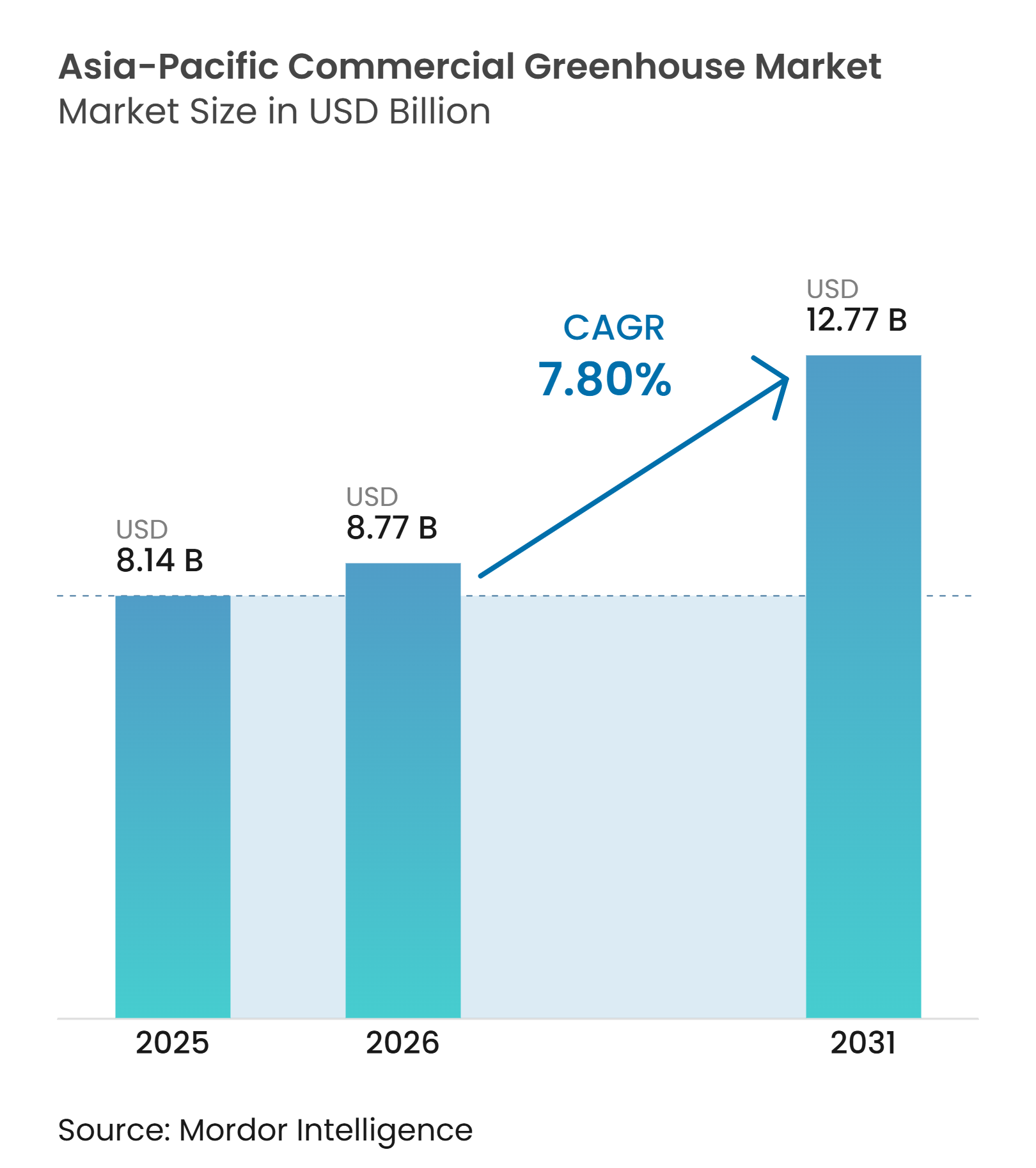
| Base Year Market Size (2025) | USD 8.14 Billion |
| Market Size (2026) | USD 8.77 Billion |
| Market Size (2031) | USD 12.77 Billion |
| Growth Rate (2026 - 2031) | 7.80 % |
| Market Concentration | Low |
Major Players *Disclaimer: Major Players sorted in no particular order Image © Mordor Intelligence. Reuse requires attribution under CC BY 4.0. | |
Asia-Pacific Commercial Greenhouse Market Analysis by Mordor Intelligence
The Asia-Pacific commercial greenhouse market was valued at USD 8.14 billion in 2025 and is forecast to grow to USD 8.77 billion in 2026 and reach USD 12.77 billion by 2031, at a CAGR of 7.80% during the forecast period 2026 to 2031. The market is shifting from open-field horticulture toward controlled production as growers respond to urban demand, weather disruptions, and stricter quality requirements. Public policy in China and India supports protected cultivation, equipment modernization, and food security, providing a clearer investment case for projects. Declining costs of hydroponic components, lighting, and climate controls are expanding access to automated systems for mid-sized growers. The market also benefits from retailer requirements for traceability and residue controls from fresh-produce suppliers. High initial investment and energy costs remain significant constraints, particularly for smaller growers and facilities with limited access to long-term financing.
Key Report Takeaways
- By equipment, heating systems was the largest segment and held 61.0% of the Asia-Pacific commercial greenhouse market share in 2025, while climate control and automation software is the fastest-growing segment and is forecast to expand at a 13.2% CAGR between 2026 and 2031.
- By crop, fruits and vegetables was the largest segment and held 48.0% of the Asia-Pacific commercial greenhouse market size in 2025, while cannabis and specialty crops is the fastest-growing segment and is forecast to expand at a 14.5% CAGR between 2026 and 2031.
- By greenhouse type, plastic-film greenhouses were the largest segment and held 57.0% of the market share in 2025, while glass greenhouses are the fastest-growing segment and are forecast to expand at a 12.2% CAGR between 2026 and 2031.
- By cultivation technology, hydroponic cultivation systems was the largest segment and held 42.0% of the market share in 2025, while hybrid and vertical integration is the fastest-growing segment and is forecast to expand at an 11.2% CAGR between 2026 and 2031.
- By end user, commercial growers was the largest segment and held 58.0% of the market share in 2025, while research and educational institutes is the fastest-growing segment and is forecasted to expand at a 13.5% CAGR between 2026 and 2031.
Note: Market size and forecast figures in this report are generated using Mordor Intelligence’s proprietary estimation framework, updated with the latest available data and insights as of January 2026.
Market Trends and Insights
Drivers Impact Analysis of Asia-Pacific Commercial Greenhouse Market*
| Driver | (~) % Impact on CAGR Forecast | Geographic Relevance | Impact Timeline |
|---|---|---|---|
| Protected-Cultivation Subsidies and Food-Security Programs | +2.2% | China, India, Japan, South Korea, Australia | Short term (≤ 2 years) |
| Urban Fresh-Produce Import Substitution in China, Japan, and South Korea | +1.4% | China, Japan, South Korea | Medium term (2-4 years) |
| Monsoon, Heat, and Typhoon Risk Increasing Controlled-Environment Adoption | +1.1% | India, China, Japan, South Korea, Australia | Short term (≤ 2 years) |
| Asia-Pacific Expansion of Hydroponic and Climate-Control Automation Supply Chains | +1.6% | China, Japan, South Korea, India, Australia | Medium term (2-4 years) |
| Premium Retail Traceability and Residue-Control Requirements | +0.9% | Japan, South Korea, Australia, China | Medium term (2-4 years) |
| Modular Greenhouse Economics for Fragmented Farms | +0.8% | India, Vietnam, Thailand, Indonesia, Philippines | Long term (≥ 4 years) |
| Source: Mordor Intelligence | |||
Protected-Cultivation Subsidies and Food-Security Programs
Government support for protected cultivation is encouraging investment in greenhouse infrastructure and associated production technologies across Asia-Pacific. In China, the Ministry of Agriculture and Rural Affairs (MARA) has identified intelligent production, low-carbon facilities, seed self-sufficiency, and crop-structure optimization as priorities for greenhouse and horticultural development, while food security remains an important consideration in the expansion of protected cultivation. In India, the 2025 Mission for Integrated Development of Horticulture (MIDH) guidelines provide 50% assistance for sensor-based automation systems for fertigation, subject to a minimum protected-cultivation area of 2,500 square meters per beneficiary[1]. The National Horticulture Board (NHB) also issued modifications to its MIDH-related guidelines for protected cultivation in August 2025. These measures reduce the initial investment barrier for greenhouse projects and support adoption of structures, fertigation, automation, climate control, and resource-efficient production technologies, strengthening the demand base for the Asia-Pacific commercial greenhouse market.
Urban Fresh-Produce Import Substitution in China, Japan, and South Korea
Urbanization and rising demand for reliable supplies of fresh produce are supporting the development of controlled horticulture in major Asia-Pacific markets such as China, Japan, and South Korea. In China, recent greenhouse and horticulture policy discussions have highlighted domestic self-sufficiency for crops such as tomatoes and cut flowers, strengthening the case for controlled production systems located closer to major consumption centers. At the same time, modern retail and food-service channels increasingly require consistent quality, traceability, pesticide-residue compliance, and reliable supply schedules. Controlled-environment facilities can provide greater control over irrigation, crop protection, production conditions, and harvest batches, making it easier for commercial growers to meet standardized procurement requirements. Certification systems such as GlobalG.A.P. can further support access to organized retail and premium markets. These factors strengthen the commercial case for greenhouse production by linking controlled cultivation not only to yield and climate management but also to supply reliability, traceability, and retail compliance.
Monsoon, Heat, and Typhoon Risk Increasing Controlled-Environment Adoption
Climate variability, including monsoons, extreme heat, and typhoons, can increase production and quality risks for open-field horticulture across South and Southeast Asia. Controlled-environment facilities provide growers with greater control over temperature, humidity, irrigation, and crop-protection conditions, supporting more consistent production under variable outdoor conditions. At the same time, improving the availability of hydroponic components, light-emitting diode (LED) lighting, climate sensors, and automated irrigation technologies is supporting greenhouse modernization across China, South Korea, and Japan. Signify reported that an earlier LED installation at Woodeumgee Farm in South Korea generated 27% higher tomato yields and 40% energy savings compared with high-pressure sodium lighting[2]. Koidra also validated its KoPilot climate-control platform with Netafim Japan irrigation equipment in a commercial tomato trial in Saitama conducted between November 2024 and July 2025. These demonstrated productivity and resource-efficiency gains strengthen the commercial case for automation, climate control, and integrated irrigation systems within the Asia-Pacific commercial greenhouse market.
Modular Greenhouse Economics for Fragmented Farms
India, Indonesia, Vietnam, Thailand, and the Philippines have large bases of smallholder and mid-sized farms, creating demand for greenhouse systems that can be scaled according to available capital and production requirements. These growers may face constraints in financing fully integrated, high-technology facilities at the initial stage, increasing the relevance of modular polyhouses, basic climate sensors, fertigation systems, and staged technology upgrades. Netafim introduced GrowSphere FLEX in 2026 to provide digital irrigation and fertigation controls for farms that do not require the higher specification of its GrowSphere MAX platform. The modular format allows growers to add irrigation, fertigation, automation, and monitoring capabilities as crop volumes, commercial contracts, and cash flow develop. This staged investment model can lower the initial capital requirement and broaden the addressable customer base for greenhouse technology providers, supporting unit demand across the Asia-Pacific commercial greenhouse market even when individual projects begin at a smaller scale.
Restraints Impact Analysis of Asia-Pacific Commercial Greenhouse Market*
| Restraint | (~) % Impact on CAGR Forecast | Geographic Relevance | Impact Timeline |
|---|---|---|---|
| High Upfront Capital and Long Payback Periods | -2.6% | India, China, Indonesia, Philippines | Short term (≤ 2 years) |
| Energy-Cost Volatility and Power-Intensity Exposure | -1.8% | Japan, South Korea, Australia, China | Medium term (2-4 years) |
| Interoperability Gaps Across Climate, Lighting, and Crop-Data Stacks | -1.3% | Japan, Australia, China, South Korea | Medium term (2-4 years) |
| Water-Recirculation and Discharge-Compliance Costs | -0.9% | Australia, India, China, Japan | Long term (≥ 4 years) |
| Source: Mordor Intelligence | |||
High Upfront Capital and Long Payback Periods
High-technology greenhouse projects require substantial upfront investment in structures, climate-control systems, irrigation, fertigation, lighting, automation, and production-management technologies before commercial returns are generated. This creates a significant capital barrier for growers, particularly smaller and mid-sized operators with limited access to financing or subsidies. Payback periods can also lengthen when utilization rates are low, crop prices fluctuate, or production volumes are insufficient to spread fixed costs across a larger output base. Energy and water-management systems add to the initial investment, while heating, cooling, supplemental lighting, filtration, and recirculation increase ongoing operating costs. Although government programs in markets such as China and India can reduce part of the investment burden, eligibility requirements and remaining co-financing requirements can still limit adoption. Consequently, the high initial capital requirement and extended payback period can restrain investment in advanced commercial greenhouse systems across the market.
Interoperability Gaps Across Climate, Lighting, and Crop-Data Stacks
Commercial greenhouse facilities increasingly combine climate-control systems, LED lighting, irrigation controllers, sensors, and crop-monitoring platforms from different vendors, creating challenges in integrating data and control functions across systems. A 2025 review published in Sensors examined 114 peer-reviewed studies on smart-greenhouse monitoring and control and identified interoperability, sensor calibration, data consistency, and communication-protocol alignment as continuing implementation challenges[3]. The review specifically noted that proprietary technologies can obstruct smooth integration between intelligent-control systems. These challenges are particularly relevant as growers connect climate, irrigation, lighting, and crop-monitoring technologies into unified management platforms. Priva and Grodan, for example, announced the integration of GroSens root-zone sensor data into Priva One in May 2026 to improve the use of root-zone information in irrigation decisions. Even with such integrations, multi-vendor facilities can require additional software configuration, compatible communication protocols, and specialized technical expertise. These interoperability requirements increase implementation complexity and can raise the cost and operational risk of adopting highly integrated commercial greenhouse technologies across Asia-Pacific.
*Our forecasts treat driver/restraint impacts as directional, not additive. The impact forecasts reflect baseline growth, mix effects, and variable interactions.
Asia-Pacific Commercial Greenhouse Market Segment Analysis
By Equipment:
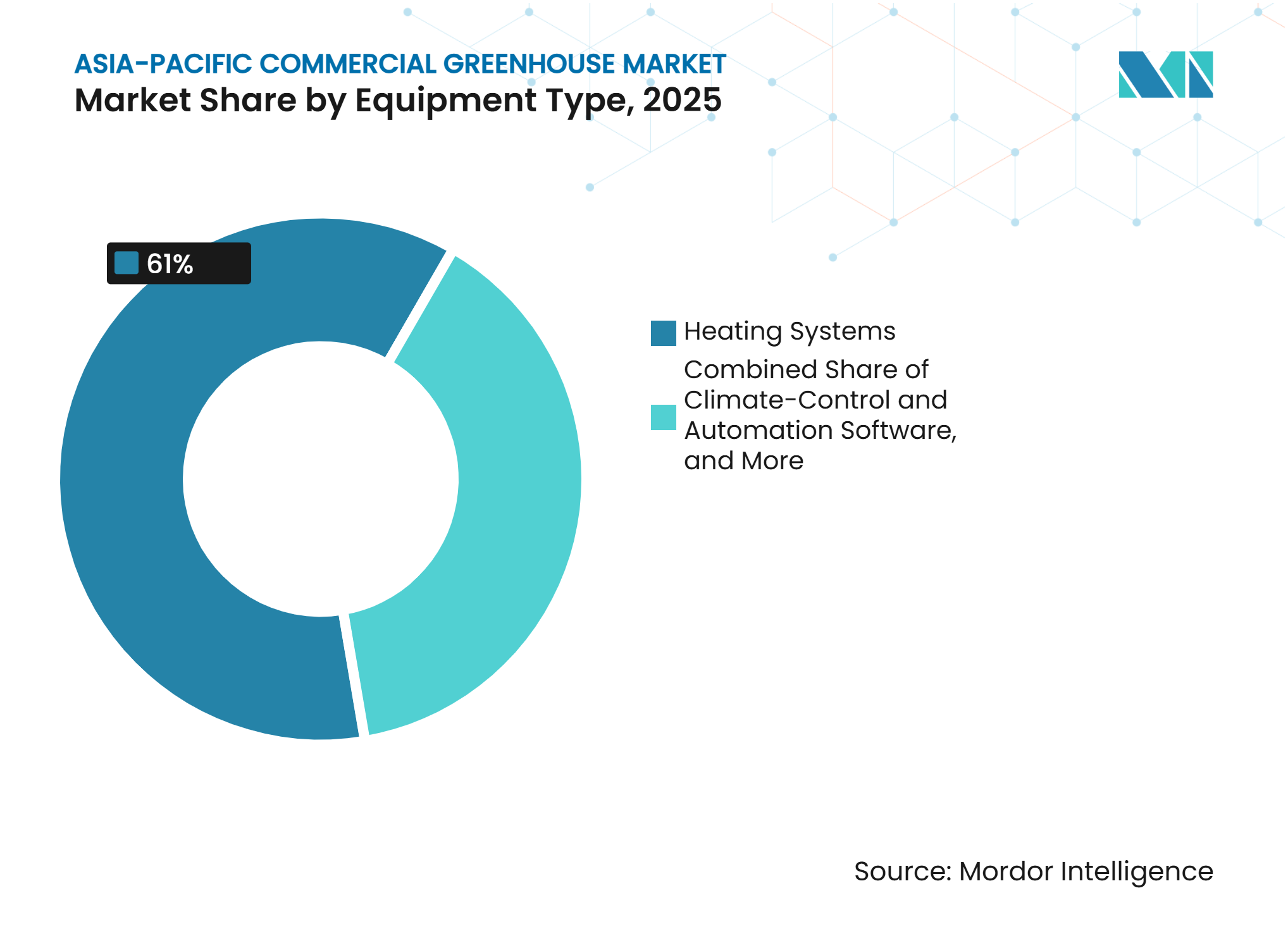
Heating Retains the Largest Base While Software Adds Recurring ValueHeating systems were the largest segment by equipment type, accounting for 61.0% of the Asia-Pacific commercial greenhouse market share in 2025, supported by demand for controlled-temperature production in cooler markets such as northern China, Japan, and South Korea. These systems are essential for maintaining crop growth during colder periods and supporting year-round cultivation. Cooling and ventilation systems, and irrigation and fertigation systems remain important established equipment categories because they are essential for maintaining temperature, humidity, water, and nutrient conditions throughout the production cycle. Screening and shading systems help manage solar radiation and greenhouse temperatures, while structural components, including glazing systems and frames and trusses, continue to represent significant investment areas, particularly in new greenhouse construction and large-scale facility expansion.
Climate control and automation software is the fastest-growing equipment segment, projected to expand at a 13.2% CAGR between 2026 and 2031, driven by increasing adoption of automated fertigation, predictive climate management, digital crop monitoring, and integrated equipment controls. These developments reflect a shift toward integrated greenhouse systems in which software increasingly coordinates irrigation, fertigation, lighting, climate, and crop data. Cooling and ventilation systems remain important for temperature and humidity management, while connected environmental controls are encouraging greater integration between physical equipment and digital management platforms.



By Crop:
Fruits and Vegetables Provide the Revenue Base While Specialty Crops Raise Equipment NeedsFruits and vegetables was the largest segment by crop, accounting for 48.0% of the Asia-Pacific commercial greenhouse market size in 2025, supported by production of tomatoes, cucumbers, leafy greens, peppers, berries, and similar crops across China, Japan, South Korea, and Australia. These crops are well suited to protected cultivation because greenhouse systems allow growers to manage production timing, crop quality, and water use. Beijing Kingpeng reported that its intelligent multi-span greenhouse achieved a summer cherry tomato yield of 26 kilograms per square meter during the 2025–2026 growing season. Flowers and ornamentals serve retail and event markets, particularly in Japan and China, while herbs and microgreens support short-cycle production and localized supply models.
Cannabis and specialty crops are the fastest-growing crop segment, projected to expand at a 14.5% CAGR between 2026 and 2031, supported by demand for highly controlled production environments and specialized cultivation systems. Australia and Thailand have regulatory frameworks supporting professionally managed cultivation for medical and specialty applications. These crops require close management of temperature, humidity, carbon dioxide, and light spectrum, increasing the relevance of advanced climate-control, lighting, automation, and monitoring technologies. The higher technical requirements of specialty crops can increase equipment intensity per cultivation area and create opportunities for suppliers offering integrated production systems. Crop diversification therefore expands the application base of commercial greenhouse technologies beyond conventional fruits, vegetables, flowers, and ornamentals.
By Greenhouse Type:
Plastic Film Supports Scale While Glass Serves High-Specification ProjectsPlastic-film greenhouses was the largest greenhouse type, accounting for 57.0% of the Asia-Pacific commercial greenhouse market in 2025, supported by lower construction costs and broad adoption across China and capital-constrained markets in South and Southeast Asia. China’s focus on renewing existing solar and plastic greenhouses supports continued investment in irrigation, ventilation, sensors, and automation within the installed base. Growers can upgrade individual systems without replacing the entire greenhouse structure, making plastic-film facilities an accessible entry point for commercial production. Glass greenhouses and rigid polycarbonate structures serve higher-specification applications, with polycarbonate providing an intermediate option between plastic film and glass in terms of structural performance and thermal properties.
Glass greenhouses are the fastest-growing greenhouse type, projected to expand at a 12.2% CAGR between 2026 and 2031, supported by demand for premium crops, high light transmission, durable structures, and automation-compatible layouts. Hybrid and semi-closed greenhouses provide an additional option for operators seeking improved climate and energy management through controlled ventilation and partial air recirculation. Beijing Kingpeng's Cuihu Smart Agriculture Innovation Center Phase 2 includes 35,000 square meters of semi-closed greenhouse space, demonstrating the deployment of this structure at commercial scale. Structure selection therefore remains influenced by crop value, local climate, energy requirements, automation needs, and the operator's available capital, with plastic-film structures supporting broader market penetration while glass and semi-closed formats address more technology-intensive production systems.
By Cultivation Technology:
Hydroponic Systems Lead Adoption While Hybrid and Vertical Formats AdvanceHydroponic cultivation systems were the largest segment by cultivation technology, accounting for 42.0% of the Asia-Pacific commercial greenhouse market share in 2025, supported by adoption in Japan, South Korea, and Australia, where water efficiency, production consistency, and traceability are important operating priorities. Nutrient Film Technique (NFT), Deep Water Culture (DWC), and Drip Hydroponics enable controlled nutrient delivery and year-round production while reducing reliance on soil and exposure to soil-borne diseases. Soil and substrate cultivation remains important in India and China, where growers have established experience with soil-based production. Coco coir and rockwool provide intermediate options by combining controlled growing media with fertigation and greenhouse environmental management.
Hybrid and vertical integration is the fastest-growing cultivation technology segment, projected to expand at an 11.2% CAGR between 2026 and 2031, supported by increasing interest in intensive production systems in South Korea, Japan, and urban China, where land availability and proximity to premium markets can support higher-density cultivation. Enthing signed a KRW 15.8 billion AI agriculture platform supply contract for the I Am Farm Tower project in Yeoju in February 2026, with the facility planned to produce high-value crops using an integrated controlled-environment production model. Multi-layer systems can increase output per unit of land while integrating artificial lighting, environmental controls, irrigation, and crop monitoring. However, higher electricity requirements and greater system complexity can constrain adoption where energy costs are high or premium market access is limited. Consequently, integrated formats are gaining relevance where land constraints, logistics advantages, crop value, and controlled-environment production economics can support the additional capital and operating requirements.
By End User:
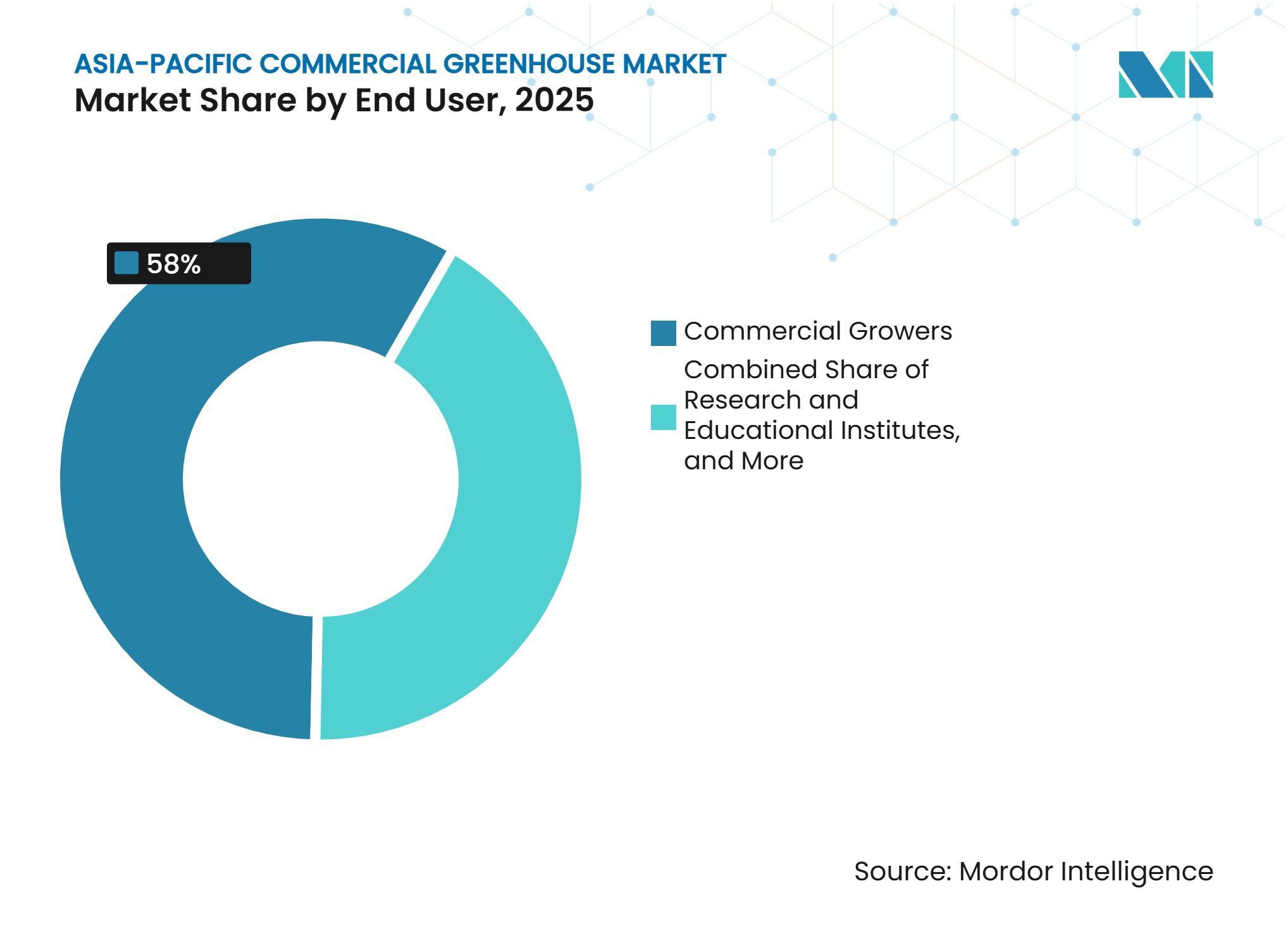
Commercial Growers Lead While Research Institutes AccelerateCommercial growers were the largest end-user segment, accounting for 58.0% of the Asia-Pacific commercial greenhouse market share in 2025, supported by demand for climate control, irrigation, lighting, and cultivation systems for production serving retail, food service, and wholesale channels. The segment includes large-scale glasshouse operators as well as mid-sized businesses transitioning from open-field production. Centuria Capital Group acquired the 43-hectare Two Wells hydroponic glasshouse in South Australia for AUD 168 million (USD 110.5 million) in November 2025, illustrating continued investment in large-scale commercial protected cultivation. Retail garden centers and nurseries represent another end-user group, with demand centered on controlled propagation and plant-production environments.
Research and Educational Institutes is the fastest-growing end-user segment, projected to expand at a 13.5% CAGR between 2026 and 2031, supported by investment in agricultural artificial intelligence (AI), speed-breeding, and smart-farming research. Saveer Biotech commissioned an advanced speed-breeding facility at the Indian Council of Agricultural Research–Indian Institute of Oilseeds Research (ICAR-IIOR) in Hyderabad in May 2026, demonstrating the use of controlled environments for accelerated crop research. South Korea's National Agriculture AX Platform is also planned to develop AI-integrated commercial greenhouse capacity in Muan County. Research and educational facilities can serve as testing environments for new cultivation methods, automation technologies, and climate-management systems before broader commercial deployment, supporting demand for advanced greenhouse infrastructure and digital technologies.

Geography Analysis
China was the largest geography in the Asia-Pacific commercial greenhouse market in 2025, accounting for 42.0% of market share. It remains the regional anchor because of its established greenhouse base, equipment supply chains, and policy support for protected cultivation. China's Ministry of Agriculture and Rural Affairs (MARA) emphasized intelligent facilities, low-carbon production, seed self-sufficiency, and regional crop alignment in its July 2025 greenhouse and horticulture policy discussions. The Gobi agriculture model in Gansu also supports greenhouse development on non-arable land, helping reduce competition with grain-producing areas. The market is increasingly shifting from expanding greenhouse area toward improving productivity, automation, and resource efficiency within existing facilities.
India is the fastest-growing geography, projected to expand at a 10.4% CAGR between 2026 and 2031, supported by relatively low protected-cultivation penetration, government support, and growing requirements for consistent quality and supply from organized retail channels. The Agricultural Infrastructure Fund (AIF) provides an interest-subvention framework that can complement eligible horticulture investments. South Korea is strengthening its position in technology-intensive cultivation through smart-farm clusters and artificial intelligence-enabled production programs. Chungnam Province began construction of the Naepo Agri-Bio Convergence Industry Cluster in February 2026, a KRW 680.3 billion (USD 461 million) project targeted for completion in 2028. Japan remains a technically advanced market, although high fixed and operating costs continue to influence investment decisions in plant-factory and controlled-environment projects.
Australia supports high-specification greenhouse development and institutional investment in controlled agriculture. Centuria Capital Group's November 2025 acquisition of the Two Wells hydroponic glasshouse in South Australia expanded its controlled-environment agriculture portfolio to more than 150 hectares. Hort Innovation's Hort Frontiers program has also allocated AUD 52 million (USD 34 million) toward technologies addressing labor requirements in protected cropping, including automated pollination, harvesting, and packing. Thailand is developing controlled cultivation applications for medical cannabis and urban vegetable production, while Singapore's limited agricultural land base supports intensive hydroponic and vertical-farming formats. These differences in land availability, technology adoption, investment capacity, and crop priorities create distinct growth opportunities across the Asia-Pacific commercial greenhouse market.
Competitive Landscape
Market Concentration
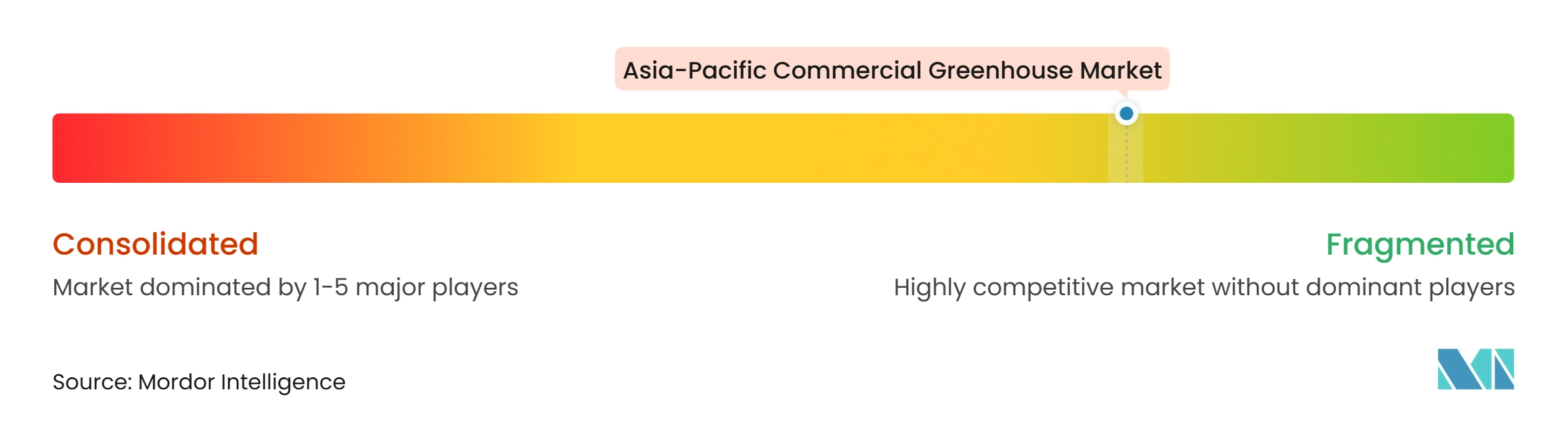
The Asia-Pacific commercial greenhouse market is moderately fragmented, with Beijing Kingpeng International Hi-Tech Corporation, Netafim Ltd., Richel Group SAS, Priva Holding B.V., and Certhon Build B.V. identified among the major players in 2025. European players such as Priva Holding B.V., Certhon Build B.V., Dalsem B.V., Van der Hoeven Horticultural Projects B.V., Hoogendoorn Growth Management B.V., and Ridder B.V. compete through integrated greenhouse systems, automation, climate management, and established grower relationships. Their solutions are particularly relevant to premium commercial operators in Japan, South Korea, and Australia. Local fabricators and regional integrators remain important competitors in plastic-film greenhouse projects across India and Southeast Asia, where lower-cost structures and modular solutions can be more relevant than fully integrated automation.
Competition is increasingly shifting from greenhouse structures toward integrated climate, irrigation, lighting, and data-management solutions. Priva Holding B.V. integrated GroSens root-zone sensor data into Priva One in 2026, strengthening connectivity between crop-root-zone information and greenhouse management. In March 2026, Netafim Ltd. and Amazon India announced a water-stewardship partnership covering farms near Bengaluru and Hyderabad. These developments demonstrate how players are combining physical equipment with digital monitoring and resource-management capabilities. Signify also competes through LED lighting solutions for controlled-environment agriculture, where energy efficiency and crop-specific lighting requirements are important purchasing considerations.
Beijing Kingpeng International Hi-Tech Corporation maintains a strong position in China through turnkey greenhouse and smart-agriculture solutions and is also expanding its international project presence. In March 2026, the company began work on a research greenhouse complex at Sultan Qaboos University in Oman, representing an overseas engineering, procurement, and construction (EPC) project in the Middle East. Competitive opportunities remain in software interoperability, cooling-oriented greenhouse systems for tropical climates, and modular solutions for smaller commercial farms. Buyers are also placing greater emphasis on operational performance, resource efficiency, food-safety practices, and environmental management capabilities. Consequently, competitive differentiation increasingly depends on a player's ability to combine greenhouse structures with climate control, irrigation, automation, data management, technical support, and project execution rather than supplying individual components alone.
Asia-Pacific Commercial Greenhouse Industry Leaders
-
Beijing Kingpeng International Hi-Tech Corporation
-
NETAFIM Ltd. (Orbia Advance Corporation, S.A.B. de C.V.)
-
Richel Group S.A.
-
Priva Holding B.V.
-
Certhon Build B.V.
- *Disclaimer: Major Players sorted in no particular order
Asia-Pacific Commercial Greenhouse Market Companies Covered in this Report
- Netafim Ltd. (Orbia Advance Corporation, S.A.B. de C.V.)
- Richel Group SAS
- Priva Holding B.V.
- Certhon Build B.V. (DENSO Corporation)
- Dalsem B.V. (GreenV)
- Van der Hoeven Horticultural Projects B.V. (Arvesta N.V.)
- Signify N.V.
- Hoogendoorn Growth Management B.V. (Batenburg Techniek N.V.)
- Ridder Holding Harderwijk B.V.
- Argus Control Systems Ltd. (Controlled Environments Limited)
- Beijing Kingpeng International Hi-Tech Corporation
- The Glasshouse Company Pty Ltd
- Top Greenhouses Ltd.
- Saveer Biotech Limited
- Kryzen Biotech Private Limited
Recent Industry Developments in Asia-Pacific Commercial Greenhouse Market
- May 2026: Priva Holding B.V. and Grodan announced a partnership to integrate GroSens root-zone sensor data directly into Priva One. The integration allows growers to view root-zone conditions alongside other greenhouse parameters within Priva's platform, supporting more responsive irrigation management.
- March 2026: Sumitomo Corporation entered into a capital and business alliance with HarvestX, a Japanese developer of AI-powered automated pollination robots for strawberries and automated cultivation technologies for plant factories. The partnership is aimed at expanding automation solutions for controlled-environment agriculture.
- November 2025: Centuria Capital Group announced the acquisition of the 43-hectare Two Wells hydroponic glasshouse in South Australia for AUD 168 million (USD 110.5 million). The facility is operated by Perfection Fresh, and the acquisition increased Centuria's agricultural portfolio to more than 150 hectares of glasshouse assets and more than 160 hectares of protected-cropping agriculture.
Asia-Pacific Commercial Greenhouse Market Report Scope
A commercial greenhouse is a greenhouse that is used for the cultivation of commercial crops that will be sold in the market.
The Asia-Pacific Commercial Greenhouse Market Report is Segmented by Equipment Type (Heating Systems, and More), by Crop Type (Fruits and Vegetables, and More), by Greenhouse Type (Glass Greenhouse, and More), by Cultivation Technology (Hydroponic, and More), by End User (Commercial Growers, and More), and by Geography (India, China, and More). The Market Forecasts are Provided in Terms of Value (USD).
Segmentation Overview
| Heating Systems | |
| Cooling and Ventilation Systems | |
| LED Grow Lighting | |
| Irrigation and Fertigation Systems | |
| Climate-Control and Automation Software | |
| Screening and Shading | |
| Structural Components | Glazing Systems |
| Frames and Trusses |
| Fruits and Vegetables | Tomatoes |
| Cucumbers | |
| Lettuce and Leafy Greens | |
| Peppers | |
| Strawberries and Berries | |
| Flowers and Ornamentals | Cut Flowers |
| Potted and Bedding Plants | |
| Herbs and Microgreens | |
| Cannabis and Specialty Crops | Medical Cannabis |
| Seedlings and Propagation Crops |
| Glass Greenhouses |
| Plastic-Film Greenhouses |
| Rigid Polycarbonate Greenhouses |
| Hybrid and Semi-Closed Greenhouses |
| Hydroponic | Nutrient Film Technique |
| Deep Water Culture | |
| Drip Hydroponics | |
| Non-Hydroponic Soil and Substrate | Soil-Based |
| Coco Coir and Rockwool Substrate | |
| Hybrid and Vertical Integration |
| Commercial Growers |
| Research and Educational Institutes |
| Retail Garden Centers and Nurseries |
| China |
| Japan |
| India |
| South Korea |
| Australia |
| Rest of Asia-Pacific |
| By Equipment Type | Heating Systems | |
| Cooling and Ventilation Systems | ||
| LED Grow Lighting | ||
| Irrigation and Fertigation Systems | ||
| Climate-Control and Automation Software | ||
| Screening and Shading | ||
| Structural Components | Glazing Systems | |
| Frames and Trusses | ||
| By Crops | Fruits and Vegetables | Tomatoes |
| Cucumbers | ||
| Lettuce and Leafy Greens | ||
| Peppers | ||
| Strawberries and Berries | ||
| Flowers and Ornamentals | Cut Flowers | |
| Potted and Bedding Plants | ||
| Herbs and Microgreens | ||
| Cannabis and Specialty Crops | Medical Cannabis | |
| Seedlings and Propagation Crops | ||
| By Greenhouse Type | Glass Greenhouses | |
| Plastic-Film Greenhouses | ||
| Rigid Polycarbonate Greenhouses | ||
| Hybrid and Semi-Closed Greenhouses | ||
| By Cultivation Technology | Hydroponic | Nutrient Film Technique |
| Deep Water Culture | ||
| Drip Hydroponics | ||
| Non-Hydroponic Soil and Substrate | Soil-Based | |
| Coco Coir and Rockwool Substrate | ||
| Hybrid and Vertical Integration | ||
| By End User | Commercial Growers | |
| Research and Educational Institutes | ||
| Retail Garden Centers and Nurseries | ||
| By Geography | China | |
| Japan | ||
| India | ||
| South Korea | ||
| Australia | ||
| Rest of Asia-Pacific | ||
Key Questions Answered in the Report
What is the Asia-Pacific commercial greenhouse market size?
The Asia-Pacific commercial greenhouse market is valued at USD 8.77 billion in 2026 and is forecast to reach USD 12.77 billion by 2031, at a 7.80% CAGR between 2026 and 2031.
Which country leads commercial greenhouse revenue in Asia-Pacific?
China led regional revenue with a 42.0% share in 2025, supported by its installed base, equipment supply chain, and protected-cultivation policy focus.
What equipment is most used in commercial greenhouses?
Heating Systems held 61.0% of equipment revenue in 2025, while Climate Control and Automation Software is forecasted to record the fastest growth at a 13.2% CAGR between 2026 and 2031.
Which crops create the largest demand for protected cultivation?
Fruits and vegetables accounted for 48.0% of the market in 2025, while cannabis and specialty crops is forecasted to advance at a 14.5% CAGR between 2026 and 2031.