
Asia-Pacific Cargo Insurance Market Size and Share
Market Overview
| Study Period | 2020 - 2031 |
|---|---|
| Forecast Data Period | 2026 - 2031 |
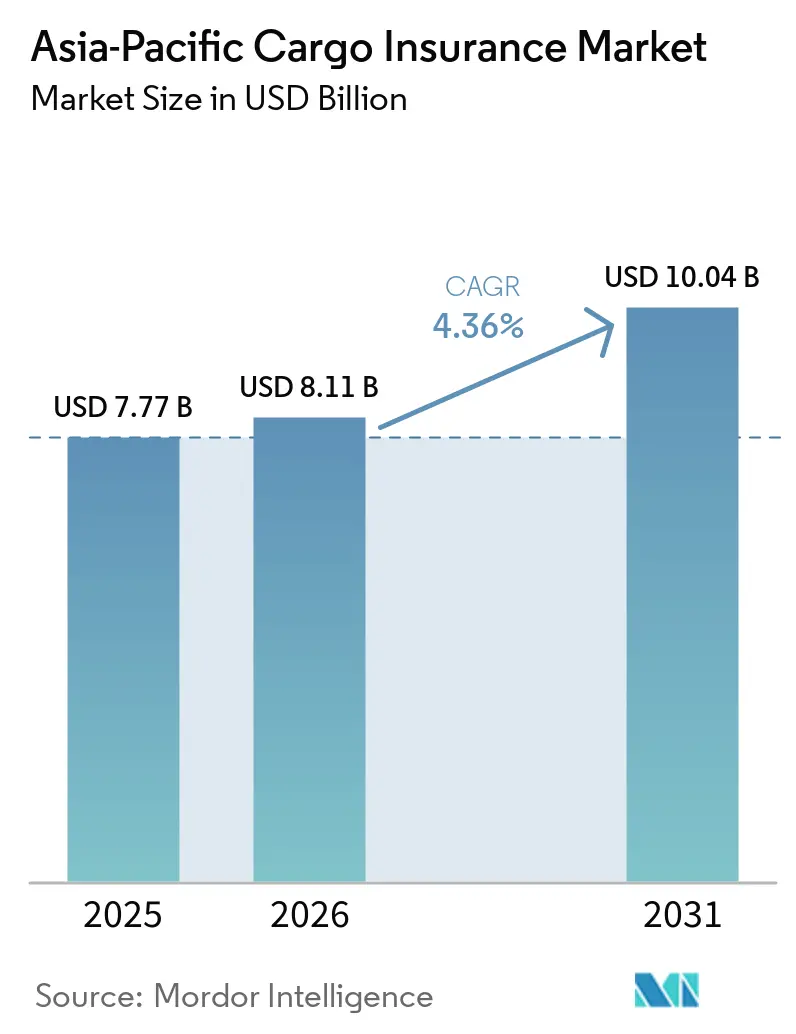
| Base Year Market Size (2025) | USD 7.77 Billion |
| Market Size (2026) | USD 8.11 Billion |
| Market Size (2031) | USD 10.04 Billion |
| Growth Rate (2026 - 2031) | 4.36 % |
| Market Concentration | Low |
Major Players *Disclaimer: Major Players sorted in no particular order Image © Mordor Intelligence. Reuse requires attribution under CC BY 4.0. | |
Asia-Pacific Cargo Insurance Market Analysis by Mordor Intelligence
The Asia-Pacific cargo insurance market was valued at USD 7.77 billion in 2025, is estimated at USD 8.11 billion in 2026, and is projected to reach USD 10.04 billion by 2031, growing at a CAGR of 4.36% from 2026 to 2031. Premium growth is increasingly linked to higher insured shipment values, more cross-border transactions, and new forms of cover rather than broad-based rate increases. Well-performing programs secured rate reductions of 5% to 10% or more at renewal as regional capacity remained strong. Tariff-related commodity price changes, cross-border e-commerce, parametric delay protection, and embedded micro-insurance are broadening the exposures that carriers can insure. The Asia-Pacific cargo insurance market also faces pricing pressure on standard containerized programs, while specialist risks require more tailored underwriting. Carriers that build risk models around changing Regional Comprehensive Economic Partnership trade routes can better address new cargo flows and more complex exposure patterns.
Key Report Takeaways
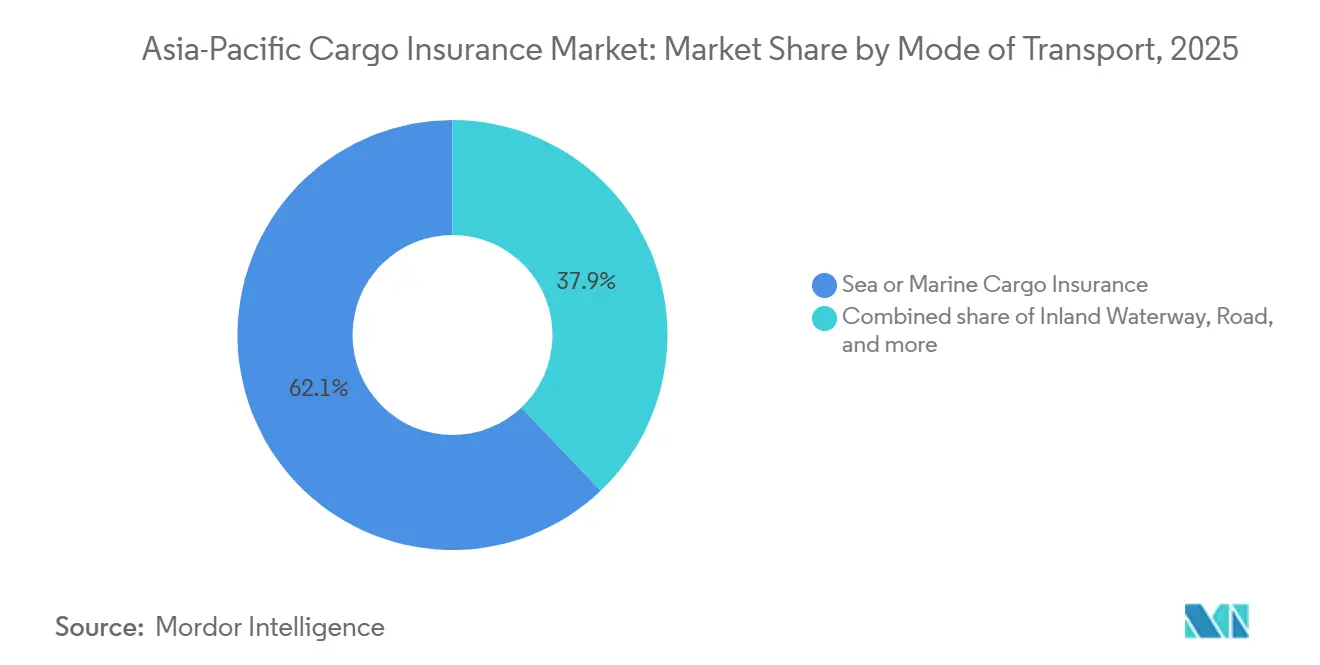
- By mode of transport, sea and marine cargo insurance captured 62.1% of the Asia-Pacific cargo insurance market share in 2025, while air cargo is projected to grow at a 5.9% CAGR through 2031.
- By cargo profile, containerized cargo captured 46.7% of the Asia-Pacific cargo insurance market share in 2025, while project, heavy-lift, and out-of-gauge cargo is projected to grow at a 6.4% CAGR through 2031.
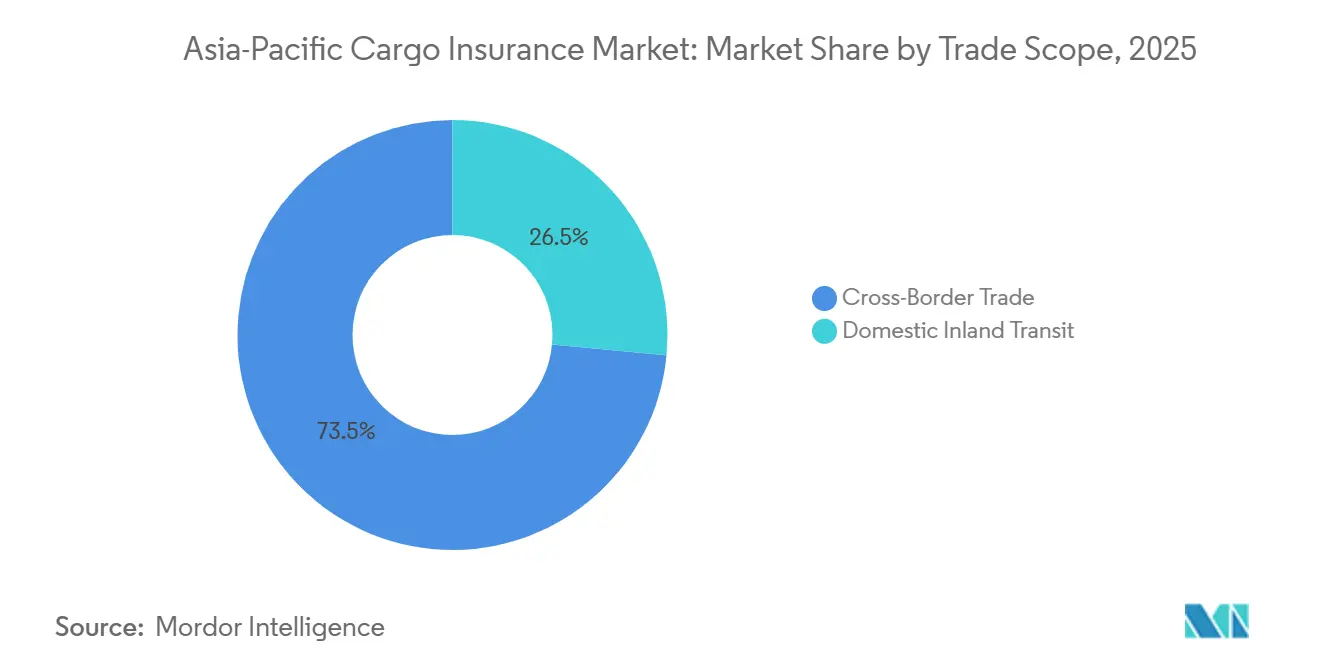
- By trade scope, cross-border trade captured 73.5% of the Asia-Pacific cargo insurance market share in 2025 and is projected to grow at a 5.4% CAGR through 2031.
- By distribution channel, brokers and agents captured 53.2% of the Asia-Pacific cargo insurance market share in 2025, while online and digital platforms are projected to grow at a 7.2% CAGR through 2031.
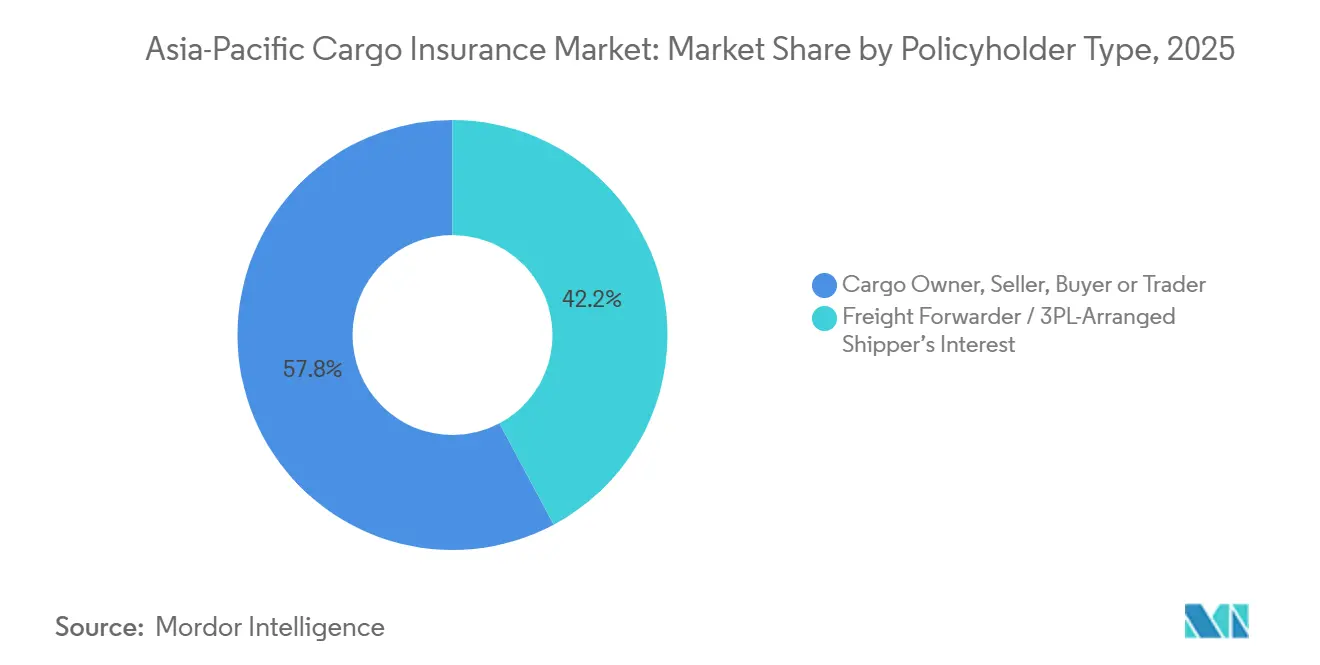
- By policyholder type, cargo owners, sellers, buyers, and traders captured 57.8% of the Asia-Pacific cargo insurance market share in 2025, while freight forwarders and 3PL-arranged shippers' interest cover is projected to grow at a 5.6% CAGR through 2031.
- By end-user industry, manufacturing captured 31.1% of the Asia-Pacific cargo insurance market share in 2025, while retail, consumer goods, and e-commerce are projected to grow at a 7% CAGR through 2031.
- By geography, China captured 37.9% of the Asia-Pacific cargo insurance market share in 2025, while India is projected to grow at a 6.8% CAGR through 2031.
Note: Market size and forecast figures in this report are generated using Mordor Intelligence’s proprietary estimation framework, updated with the latest available data and insights as of January 2026.
Asia-Pacific Cargo Insurance Market Trends and Insights
Drivers Impact Analysis*
| Driver | (~) % Impact on CAGR Forecast | Geographic Relevance | Impact Timeline |
|---|---|---|---|
| Cross-Border Trade and Manufacturing Exports | +1.2% | Asia-Pacific, with a concentration in China, Vietnam, and India | Medium term (2-4 years) |
| E-Commerce and High-Frequency Small Shipments | +0.9% | China, India, Indonesia, and the core Association of Southeast Asian Nations markets | Short term (≤ 2 years) |
| Higher Cargo Values and Cold-Chain Dependence | +0.7% | Japan, China, Australia, and India's pharmaceutical corridors | Long term (≥ 4 years) |
| Embedded Insurance and Automated Certificates | +0.6% | Singapore, Australia, China, and wider Association of Southeast Asian Nations markets | Short term (≤ 2 years) |
| Supply-Chain Disruption and Delay-Cost Protection | +0.5% | Global, with high exposure in China and South Korea export corridors | Short term (≤ 2 years) |
| Multimodal and Intra-Asia Trade Corridors | +0.4% | Association of Southeast Asian Nations, Greater China, and South Asia | Medium term (2-4 years) |
| Source: Mordor Intelligence | |||
Expansion of Cross-Border Trade and Manufacturing Exports
The Regional Comprehensive Economic Partnership is in its 4th year of full implementation and is increasing the density of trade within the region. Manufacturing activity is extending from China into Vietnam, Thailand, and Indonesia, which creates additional insured corridors rather than merely shifting existing volumes. A study of 12 Regional Comprehensive Economic Partnership members found that China’s cross-border e-commerce export potential with several partners remained below 0.8 utilization[1]. Longer routes can add transit legs and increase the time for which shipments remain exposed. Inventory stockpiling before tariff deadlines also creates a need for warehouse-to-warehouse extensions beyond a standard voyage policy. Regional customs and rules-of-origin requirements add documentation work, surveys, and endorsements for insurers serving cross-jurisdiction shipments.
Growth of E-Commerce and High-Frequency Small Shipments
E-commerce is adding cargo insurance demand that was not previously served through conventional declaration-based policies. China’s return-shipping insurance contributed to cargo premium growth that exceeded 7.1% export volume growth in 2024[2]. India’s e-commerce logistics activity supports demand for embedded cover across a growing number of parcel movements. High-frequency parcel traffic is difficult to price through manual declarations because misclassification, undeclared lithium-ion batteries, and fraudulent returns can be concentrated in these flows. Thailand removed its de minimis threshold in January 2026, and Vietnam removed a comparable exemption in February 2025, creating customs records for parcels that may previously have lacked formal insurance documentation. These records can support coverage at booking, while adding compliance responsibilities for cross-border sellers.
Increasing Cargo Values and Cold-Chain Dependence
Higher cargo values increase declared insured amounts even when shipment counts do not change. Electronics, pharmaceuticals, energy equipment, and specialty components carry high values and may require tailored conditions. Temperature-controlled pharmaceutical shipments can produce full-value claims when a temperature excursion makes biologics commercially unusable. Cold-chain routes, therefore, require documented handling, route visibility, and coverage for a wider set of loss scenarios. Lithium-ion batteries also add fire-related severity concerns across consumer goods, electric vehicles, and energy-storage equipment. The Asia-Pacific cargo insurance market benefits from these higher-value movements, but underwriting must reflect the technical features of each cargo class.
Digital Embedded Insurance and Automated Certificate Issuance
Embedded insurance activates cover when a shipment is booked through a digital connection. This process reduces the time between creating an exposure and placing the related insurance. Sensor data on cargo condition, location, and shock can support pricing models that use verified shipment information. Willog introduced a cargo insurance subsidiary offering parametric and umbrella cover based on verified sensor data, including disposal and re-shipment costs after temperature excursions[3]. Electronic cargo reporting under the International Maritime Organization's Maritime Single Window supports more standardized data across participating ports. Digital certificates can make insurance easier to obtain for routine shipments while leaving complex placements with specialist intermediaries.
Restraints Impact Analysis*
| Restraint | ~ % Impact on CAGR Forecast | Geographic Relevance | Impact Timeline |
|---|---|---|---|
| Regulatory Fragmentation Across Regional Markets | -0.4% | Association of Southeast Asian Nations, South Asia, and emerging Southeast Asian economies | Long term (≥ 4 years) |
| Catastrophe Accumulation at Ports and Inland Hubs | -0.4% | China, Japan, Taiwan, Australia, and the wider Asia-Pacific region | Long term (≥ 4 years) |
| Cyber-Enabled Cargo Theft and Data Vulnerability | -0.3% | China, Japan, South Korea, Singapore, India, Australia, and major Asia-Pacific logistics hubs | Medium to long term (2–4+ years) |
| Low Awareness and Underinsurance Among Small Exporters | -0.3% | South Asia, Southeast Asia, and emerging Asia-Pacific export markets | Long term (≥ 4 years) |
| Source: Mordor Intelligence | |||
Regulatory Fragmentation Across Asia-Pacific Markets
The region includes more than a dozen national licensing and foreign-ownership frameworks, which increases the complexity of regional placements. Vietnam requires Vietnamese-language policy translations, and some domestic inland transit legs require locally admitted policies. The Institute Cargo Clauses are accepted internationally for voyages, but their scope does not remove national requirements for domestic or inland cover. Shippers may need several local endorsements rather than one Singapore-issued program across multiple countries. Customs changes in Thailand and Vietnam show that regulation is evolving quickly, while insurance product harmonization remains slower. Smaller exporters may rely on carrier liability or retain risk when the cost of a legally compliant program becomes too high.
Catastrophe Accumulation at Ports and Inland Hubs
Large ports, terminals, and distribution centers concentrate cargo values in a small number of locations. A typhoon, fire, or other event can therefore generate losses across cargo, hull, terminal liability, and business interruption at the same time. Ocean-voyage claims represented 37% of total loss location in 2024, up from a long-run average of 25%. Large distribution centers add single-location inventory exposures, particularly where e-commerce has increased storage density. Lithium-ion cargo requires close attention under dangerous goods and declaration requirements because undeclared or misdeclared loads can worsen a fire event. The Asia-Pacific cargo insurance market faces continued pressure to match catastrophe exposure with appropriate limits and reinsurance capacity.
*Our forecasts treat driver/restraint impacts as directional, not additive. The impact forecasts reflect baseline growth, mix effects, and variable interactions.
Segment Analysis
By Mode of Transport: Sea Retains Premium Scale While Air Cargo Grows Faster
Sea and marine cargo insurance accounted for 62.1% of premiums in 2025, giving it the largest Asia-Pacific cargo insurance market share among transport modes. Deep-sea and short-sea routes provide the policy volume that supports treaty reinsurance structures. Standardized Institute Cargo Clauses and transparent open-cover pricing have also made this business highly competitive. Large shippers can compare terms and rates across several insurers with relative ease. Sea transport remains central because of the region’s container throughput and established trading routes.
Air cargo is projected to grow at a 5.9% CAGR through 2031, above the overall forecast pace. Time-sensitive semiconductors, pharmaceuticals, and express parcels raise the insured value carried per kilogram. India handled 6.78 lakh (0.678 million) tonnes of international air cargo at major airports in the April to June quarter of fiscal year 2025, and e-commerce accounted for 70% of express-carrier international shipments. Temperature-controlled pharmaceuticals require close control because a documented temperature excursion can make the goods unusable. Road, rail, and inland waterway coverage is also expanding as intermodal connections link ports with inland production centers.
By Cargo Profile: Containerized Cargo Anchors Volume While Specialist Cargo Adds Complexity
Containerized cargo held 46.7% of 2025 premiums and remained the largest cargo-profile segment. It supports deep-sea trade between the Asia-Pacific, Europe, and North America. Open-cover programs make it a dependable source of underwriting volume. Digital platforms are increasing price competition on more routine container shipments. Dry bulk and liquid bulk businesses can move with commodity prices even when shipment units remain unchanged.
Project, heavy-lift, and out-of-gauge cargo is projected to grow at a 6.4% CAGR through 2031. Energy-transition projects require shipments of wind turbine blades, transformer modules, electrolyzer stacks, and utility-scale battery packs. Allianz Commercial identified these movements as a source of unusual risk because of their weight, value, and technical novelty. Some high-mass cargo moves on dry bulk vessels that are not designed for specialist stowage. Rolling cargo also benefits from automotive exports, though electric vehicle batteries increase fire-severity concerns. Break-bulk cargo remains relevant for machinery, steel, and capital goods that cannot be containerized.
By Trade Scope: Cross-Border Trade Remains the Core Source of Premiums
Cross-border trade captured 73.5% of premiums in 2025 and held the leading Asia-Pacific cargo insurance market size position within the trade scope. It is also projected to grow at a 5.4% CAGR through 2031. Regional Comprehensive Economic Partnership trade links are raising the commercial value carried across borders. Lower tariff barriers and regional specialization can increase insured values even where shipment counts are stable. The resulting role of cross-border business is structural rather than temporary.
Research covering 12 member economies found that logistics infrastructure and digital payment systems influence China’s cross-border e-commerce potential within the region. Domestic inland transit remains less fully insured, especially among smaller manufacturers using limited carrier liability. New inland depots, coastal links, and rail connections increase the number of domestic legs that require cover. Thailand and Vietnam’s customs changes create a formal trail for lower-value cross-border parcels. Logistics platforms can use that trail to trigger insurance when a shipment is booked. The Asia-Pacific cargo insurance industry can therefore extend cover to trade that had previously remained informal or uninsured.
By Distribution Channel: Brokers Lead Complex Placements While Digital Platforms Expand
Brokers and agents held 53.2% of 2025 premium placements, reflecting their lead in complex multinational programs. Open-cover facilities can require locally admitted policies, reinsurance support, and specific liability coordination. These requirements still favor intermediary expertise for institutional accounts. Direct insurer channels retain relevance for large domestic shippers and state-owned trading enterprises. Brokers remain important where coverage terms must be tailored to a route, commodity, or insured.
Online and digital platforms are projected to grow at a 7.2% CAGR through 2031. Application programming interface connections allow insurance to be offered through transport management and freight-booking systems. Loadsure integrated its cargo coverage with BrokerPro in June 2026, enabling binding and certificate generation when a shipment is created. Kapoklog also provided per-shipment all-risk quotes to freight forwarders within their existing workflow. Managing general agents are automating simpler containerized risks while retaining specialist review for high-value or complex shipments. This channel change separates standardized volume from the work that still requires human underwriting judgment.
By Policyholder Type: Cargo Owners Lead While Forwarders Gain Ground
Cargo owners, sellers, buyers, and traders captured 57.8% of premiums in 2025. This reflects traditional arrangements where sellers obtain cover under Cost, Insurance, and Freight terms and large shippers manage open-cover relationships. Direct procurement allows major cargo owners to negotiate terms around established shipment patterns. It also gives them control over declarations and claims administration. This remains the largest policyholder group in the Asia-Pacific cargo insurance market.
Freight forwarder and 3PL-arranged shipper’s interest cover is projected to grow at a 5.6% CAGR through 2031. Digital freight platforms can aggregate thousands of shipments and secure better open-cover economics than a single owner may obtain. The arrangement may create coverage gaps when goods move under Free on Board terms without a clear handoff between seller and buyer. Small and medium exporters can be exposed when risk transfers and insurance arrangements are incomplete. India’s RELIEF scheme included INR 85 crore (USD 10 million) for micro, small, and medium enterprise exporters without existing export credit cover. Logistics providers are increasingly combining transport, financing, and risk-management services within the same customer relationship.
By End-User Industry: Manufacturing Leads Premiums While Retail and E-Commerce Grow Faster
Manufacturing held 31.1% of 2025 premiums and led the Asia-Pacific cargo insurance market share by end-user industry. Electronics, automotive components, industrial machinery, and consumer goods often move through planned open-cover facilities. These policies are aligned with procurement cycles and trade-credit terms. Manufacturing shipments tend to involve larger lots and scheduled declarations. This provides a more structured underwriting profile than high-frequency parcel flows.
Retail, consumer goods, and e-commerce are projected to grow at a 7% CAGR through 2031. Cross-border parcels are expanding while insurance penetration per order rises from a low base. Consumer electronics and lithium-ion batteries remain challenging risk categories despite broader market capacity. Pharmaceutical and chemical traffic requires temperature-excursion cover and regulatory-grade cold-chain records. Infrastructure owners need early insurance engagement for heavy construction materials and may require marine warranty surveyor approval. Food, beverages, agriculture, energy, and bulk commodities remain exposed to commodity values that can change premium levels.
Geography Analysis
China held 37.9% of regional premiums in 2025 and had the largest Asia-Pacific cargo insurance market share by geography. China’s position reflects its role in goods exports and wider use of insurance for domestic e-commerce shipments. The International Union of Marine Insurance stated that some recorded 2024 growth reflected businesses entering formal reporting frameworks. The reported 9.7% year-on-year increase, therefore, included a reporting effect as well as underlying activity.
India is projected to grow at a 6.8% CAGR through 2031, the fastest rate among the geographic segments. The Bharat Maritime Insurance Pool became operational in May 2026 and reduced war-risk premium rates by 35% to 40% from conflict-peak levels. By July 30, 2026, the pool had introduced a sovereign-backed protection and indemnity product through New India Assurance. The product provides up to USD 1.5 billion in combined capacity for crew and cargo liability, pollution liability, and wreck removal. India’s ports handled 855 million tonnes in fiscal year 2024-25, and cargo across all ports exceeded 1.6 billion tonnes.
Southeast Asia includes Indonesia, Singapore, Malaysia, Vietnam, Thailand, and several smaller markets. Singapore remains an important regional insurance hub for cross-border programs under Institute Cargo Clauses. Indonesia and Vietnam are gaining export activity as manufacturing investment expands beyond China. New routes through Vietnam, Thailand, and Malaysia require risk models suited to their own cargo concentration and accumulation patterns. Malaysia, Indonesia, and Vietnam each have different certification, insurance, and customs requirements. Australia has a mature profile tied to mining, liquefied natural gas, and other commodity exports, while New Zealand benefits from dairy, seafood, and agricultural exports. The United Kingdom, the United States, and Asia-Pacific trade relationships remain relevant for containerized flows, although the regional analysis centers on intra-Asia movements.
Competitive Landscape
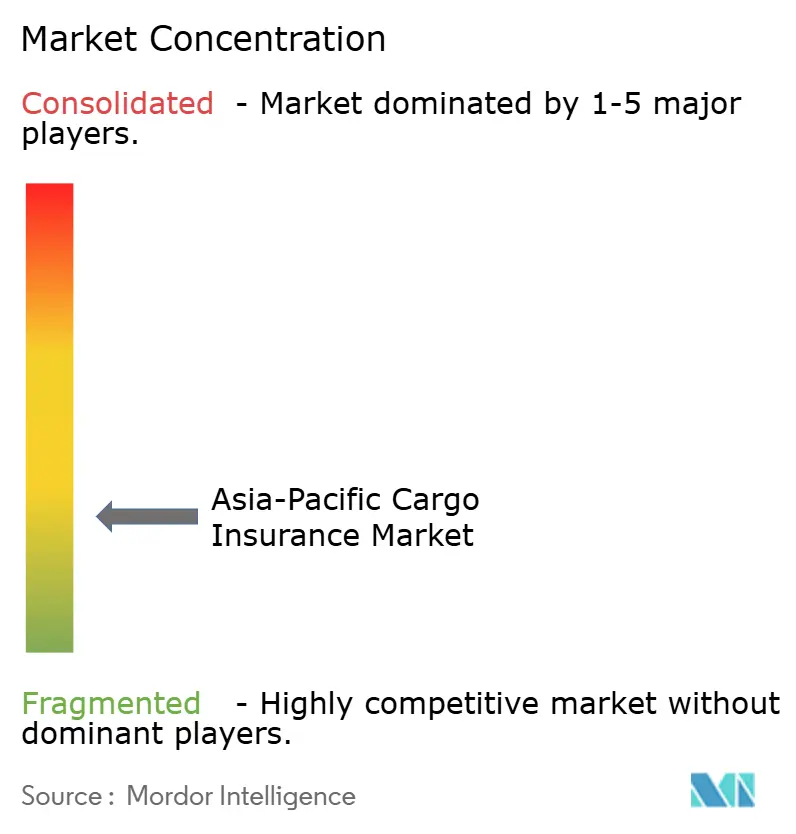
The Asia-Pacific cargo insurance market is fragmented. Allianz, AXA XL, Chubb, Tokio Marine, Zurich, QBE, and the Lloyd’s market compete for large multinational open-cover accounts. Their strengths include balance sheets, treaty capacity, claims networks, and specialist underwriting resources. Domestic insurers, managing general agents, and digital insurtechs compete more heavily on price, speed, and workflow integration for smaller clients. Pricing has remained soft since mid-2024, which has encouraged broader terms and larger line sizes even for risks exposed to disruption. This environment raises the importance of underwriting discipline for war, route-disruption, and specialist cargo exposures.
Tokio Marine’s Asia-Pacific net written premiums rose 18.5% year on year to JPY 104.4 billion (USD 656 million) in the first quarter of fiscal year 2026. Its combined ratio improved to 87.6% from 91.5% over the same period. Berkshire Hathaway acquired a 2.49% interest in Tokio Marine in March 2026 for USD 1.8 billion. The partnership supports reinsurance collaboration and global merger and acquisition co-investment. Tokio Marine also acquired a minority stake in Igloo, adding access to embedded transit-protection distribution across Southeast Asian logistics and e-commerce platforms. These moves show how established insurers are combining underwriting capacity with digital distribution access.
Chubb introduced a digital cargo platform for small and medium enterprise exporters in Singapore, Hong Kong, and Australia in March 2025. The platform provided an application programming interface-connected instant-binding quotes through freight-booking platforms. Loadsure’s BrokerPro connection shows a similar effort to place insurance at the moment a shipment is created. Allianz Commercial has also identified renewable-energy project cargo as an area with growing specialized risk. Parametric port-closure and route-disruption cover, protection for underinsured smaller exporters, and renewable-energy equipment remain areas where product design can differ among insurers. The companies include multinational carriers, domestic insurers, reinsurers, and technology-led intermediaries. This breadth reflects the different underwriting, distribution, and capacity roles found across the regional value chain. Large accounts tend to require carrier networks and treaty support, while smaller shipment volumes can be served through local carriers and digital workflows. This split explains why the narrative describes meaningful competition without presenting a combined market-share figure for the leading firms.
Asia-Pacific Cargo Insurance Industry Leaders
-
Allianz SE
-
Chubb Limited
-
American International Group, Inc.
-
Tokio Marine Holdings, Inc.
-
AXA S.A.
- *Disclaimer: Major Players sorted in no particular order
Recent Industry Developments
- July 2026: India’s Bharat Maritime Insurance Pool, operationalised in May 2026 under a sovereign guarantee by India’s Department of Financial Services, issued 1,608 war-risk and hull-risk policies by July 29, 2026, cutting war-risk premium rates 35-40% from conflict-peak levels. On July 30, 2026, BMIP launched India’s first sovereign-backed P&I insurance product underwritten by New India Assurance Company, providing a combined capacity of up to USD 1.5 billion for crew and cargo liability, pollution liability, and wreck removal.
- June 2026: Loadsure and BrokerPro TMS announced a strategic partnership embedding AI-powered cargo insurance natively into BrokerPro’s freight-broker TMS workflow, enabling coverage binding and certificate generation at the moment of shipment creation without leaving the platform.
- March 2026: India launched the RELIEF scheme, Risk and Export Loss Insurance for Exporters during Force-majeure, allocating INR 497 crore (USD 58 million) across enhanced export credit insurance, freight and insurance reimbursement, and micro, small, and medium enterprise-specific coverage.
- March 2026: Berkshire Hathaway acquired a 2.49% stake in Tokio Marine Holdings for USD 1.8 billion, forming a strategic partnership for reinsurance collaboration and global merger and acquisition co-investment.
Asia-Pacific Cargo Insurance Market Report Scope
| Sea (Deep-Sea and Short-Sea / Coastal) |
| Inland Waterway |
| Road |
| Rail |
| Air |
| Containerized Cargo |
| Dry Bulk Cargo |
| Liquid Bulk Cargo |
| Break-Bulk and General Cargo |
| Project, Heavy-Lift and Out-of-Gauge |
| Rolling Cargo / Ro-Ro |
| Cross-Border (Import, Export, Entrepôt) |
| Domestic Inland Transit |
| Brokers and Agents |
| Direct Insurers |
| Online and Digital Platforms |
| Cargo Owner, Seller, Buyer or Trader |
| Freight Forwarder / 3PL-Arranged Shipper’s Interest |
| Food, Beverage, and Agri-Commodities |
| Energy and Bulk Commodities |
| Chemicals and Pharmaceuticals |
| Automotive and Industrial Equipment |
| Electronics and High-Value Manufactured Goods |
| Retail, Consumer Goods, and E-Commerce |
| Construction and Infrastructure Project Owners |
| Other End-User Industries |
| China |
| Japan |
| India |
| South Korea |
| Australia |
| Indonesia |
| Singapore |
| Malaysia |
| Vietnam |
| Thailand |
| New Zealand |
| Rest of Asia-Pacific |
| By Mode of Transport | Sea (Deep-Sea and Short-Sea / Coastal) |
| Inland Waterway | |
| Road | |
| Rail | |
| Air | |
| By Cargo Profile | Containerized Cargo |
| Dry Bulk Cargo | |
| Liquid Bulk Cargo | |
| Break-Bulk and General Cargo | |
| Project, Heavy-Lift and Out-of-Gauge | |
| Rolling Cargo / Ro-Ro | |
| By Trade Scope | Cross-Border (Import, Export, Entrepôt) |
| Domestic Inland Transit | |
| By Distribution Channel | Brokers and Agents |
| Direct Insurers | |
| Online and Digital Platforms | |
| By Policyholder Type | Cargo Owner, Seller, Buyer or Trader |
| Freight Forwarder / 3PL-Arranged Shipper’s Interest | |
| By End-User Industry | Food, Beverage, and Agri-Commodities |
| Energy and Bulk Commodities | |
| Chemicals and Pharmaceuticals | |
| Automotive and Industrial Equipment | |
| Electronics and High-Value Manufactured Goods | |
| Retail, Consumer Goods, and E-Commerce | |
| Construction and Infrastructure Project Owners | |
| Other End-User Industries | |
| By Geography | China |
| Japan | |
| India | |
| South Korea | |
| Australia | |
| Indonesia | |
| Singapore | |
| Malaysia | |
| Vietnam | |
| Thailand | |
| New Zealand | |
| Rest of Asia-Pacific |
Key Questions Answered in the Report
What is the forecast for Asia-Pacific cargo insurance?
The Asia-Pacific cargo insurance market size is forecast to reach USD 10.04 billion by 2031, growing at a 4.4% CAGR from 2026.
Which transport mode has the largest premium base?
Sea and marine cargo insurance led with 62.1% of 2025 premiums, supported by regional container trade.
Which cargo profile is growing the fastest?
Project, heavy-lift, and out-of-gauge cargo is expected to grow at a 6.4% CAGR through 2031.
Why is digital cargo coverage expanding?
Application programming interface connections allow insurance to be bound and certificates to be issued during shipment booking.
Which geography is growing most quickly?
India is projected to record a 6.8% CAGR through 2031, supported by port infrastructure and sovereign-backed capacity.
What are the main risks for cargo insurers?
Regulatory fragmentation, catastrophe accumulation at ports, lithium-ion battery risks, and disruption-related delays remain major concerns.