
Asia Pacific Building Inspection Services Market Size and Share
Market Overview
| Study Period | 2020 - 2031 |
|---|---|
| Forecast Data Period | 2026 - 2031 |
| Base Year Market Size (2025) | USD 2.13 Billion |
| Market Size (2026) | USD 2.30 Billion |
| Market Size (2031) | USD 3.40 Billion |
| Growth Rate (2026 - 2031) | 8.13 % |
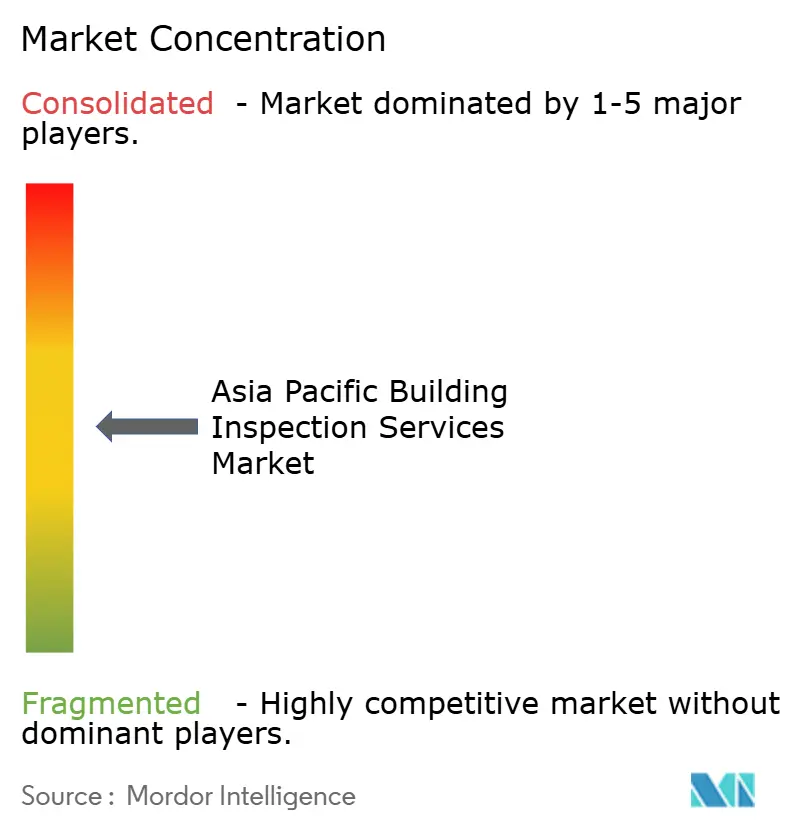
| Market Concentration | Medium |
Major Players *Disclaimer: Major Players sorted in no particular order Image © Mordor Intelligence. Reuse requires attribution under CC BY 4.0. | |
Asia Pacific Building Inspection Services Market Analysis by Mordor Intelligence
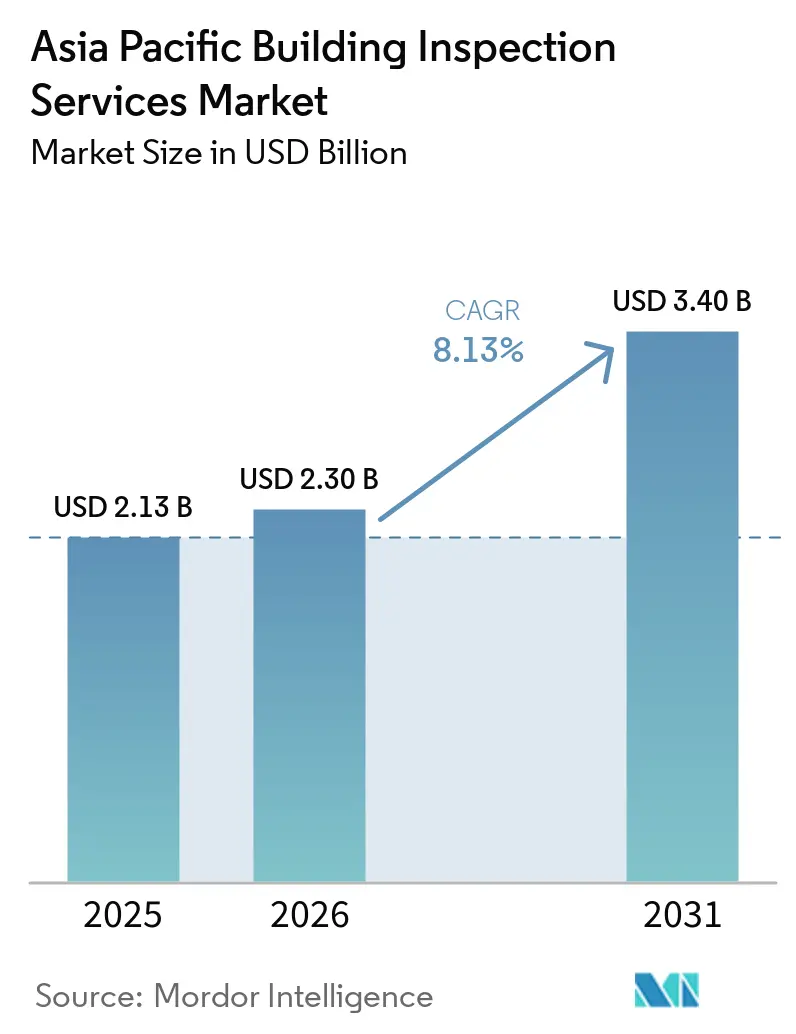
The Asia Pacific Building Inspection Services Market size is projected to be USD 2.13 billion in 2025, USD 2.30 billion in 2026, and reach USD 3.40 billion by 2031, growing at a CAGR of 8.13% from 2026 to 2031. Continued urban development, stricter defect and handover requirements, and broader use of digital inspection records are supporting the Asia Pacific building inspection services market. Inspection is becoming a contractual and legal requirement for more assets, rather than a discretionary activity. Green building programs and public infrastructure upgrades are also widening the range of services required by asset owners. These conditions favor providers that can combine accredited personnel, local code knowledge, and technology-enabled reporting. The Asia Pacific building inspection services market also has opportunities in secondary cities and specialized assignments, where internal inspection teams often lack capacity.
Key Report Takeaways
- By service, Commercial Building Inspection Services led with 43.2% of the Asia Pacific building inspection services market share in 2025, while Other Specialized Services is forecast to grow at a 10.4% CAGR through 2031.
- By sourcing type, Outsourced Services held 58.1% of the Asia Pacific building inspection services market share in 2025 and is also forecast to grow at a 9.3% CAGR through 2031.
- By application, Commercial accounted for 46.8% of the Asia Pacific building inspection services market size in 2025, while Other Applications is forecast to grow at a 12.2% CAGR through 2031.
- By end user, Property Owners and Investors held 35.2% of the Asia Pacific building inspection services market share in 2025, while Government and Municipalities are forecast to grow at a 10.1% CAGR through 2031.
- By geography, China held 38.7% of the Asia Pacific building inspection services market size in 2025, while India is forecast to grow at a 9.22% CAGR through 2031.
Note: Market size and forecast figures in this report are generated using Mordor Intelligence’s proprietary estimation framework, updated with the latest available data and insights as of January 2026.
Asia Pacific Building Inspection Services Market Trends and Insights
Drivers Impact Analysis*
| Drivers | (~) % Impact on CAGR Forecast | Geographic Relevance | Impact Timeline |
|---|---|---|---|
| Urbanization and New-Build Construction | +2.8% | Asia Pacific, with the strongest relevance in India, China, and Southeast Asia | Short term (≤ 2 years) |
| Smart-City and Green-Building Programs | +1.9% | Singapore, China, Australia, South Korea, and India | Medium term (2-4 years) |
| Stronger Handover and Defect-Liability Requirements | +1.5% | Australia, India, Malaysia, and the Philippines | Short term (≤ 2 years) |
| Infrastructure Modernization and Climate Resilience | +1.2% | China, India, Indonesia, and Pacific island nations | Medium term (2-4 years) |
| Remote Inspection for Secondary Cities and Difficult Terrain | +0.9% | India, Indonesia, and Southeast Asia | Medium term (2-4 years) |
| Digital Defect Records for High-Rise and Megaproject Governance | +0.7% | China, Hong Kong, Singapore, South Korea, and Australia | Long term (≥ 4 years) |
| Source: Mordor Intelligence | |||
Urbanization and New-Build Construction
New construction and urban renewal are increasing the number of assets that need assessment before handover, during defect-liability periods, and after occupancy. The Asia Pacific building inspection services market, therefore, benefits from a larger installed base of residential, commercial, and public buildings. The United Nations Economic and Social Commission for Asia and the Pacific projects that the region’s urban population, already above 2.2 billion, will increase by 50% by 2050[1]. Greater building density in secondary cities can tighten the availability of qualified inspectors relative to the number of assets. Remote inspection tools can help providers reach difficult terrain and lower-tier cities, although physical verification remains important for many regulated tasks. This setting supports outsourced specialists who can mobilize certified teams across multiple locations.
Smart-City and Green-Building Programs
Green certification and smart-city investment are expanding the inspection work needed to verify building performance and compliance. The World Green Building Council reported that green buildings in the Asia Pacific can command rental premiums of up to 11% and can deliver energy savings of 20% to 60%[2]. These economic benefits give owners a reason to maintain certification through periodic checks rather than treat it as a one-time exercise. Singapore’s Green Mark, Australia’s Green Star Buildings v1.1, and India’s GRIHA framework create a need for documented assessment against stated criteria[3]. The United Nations Development Program noted that the Asia Pacific was expected to receive 40% of global smart-city investment by 2025, increasing the need for protocols suited to connected building systems. Digital defect records for high-rise and large projects can improve accountability where several contractors and public agencies are involved.
Stronger Handover and Defect-Liability Requirements
Stronger handover rules are making independent inspection more important for developers, owners, and buyers. India’s Real Estate Regulation and Development Act provides for a 5-year defect-liability period under Section 14(3), and state enforcement is making occupancy and defect records more consequential in transactions. Maharashtra RERA began statewide verification of developer-submitted occupancy certificates across more than 2,600 projects in 2025. Malaysia’s housing framework requires developers to rectify defects identified within 24 months of vacant possession. These requirements extend the period in which inspection evidence has commercial and legal value. They also encourage clients to use independent certified assessors instead of developer-controlled self-assessment.
Infrastructure Modernization and Climate Resilience
Infrastructure modernization is broadening the Asia Pacific building inspection services market beyond new construction. Aging assets need periodic assessment when governments invest in retrofit, maintenance, and climate resilience. Japan’s Green Transformation program is supporting investment in data centers, semiconductor facilities, and renewable infrastructure, where commissioning and compliance verification are particularly important. South Korea strengthened periodic safety requirements for Class 1 and Class 2 structures through amendments effective in December 2025. This type of regulation turns maintenance inspection into a recurring obligation and can make demand less sensitive to short-term construction cycles. It also raises the value of firms that understand local asset rules and can provide reliable evidence for public owners.
Restraints Impact Analysis*
| Restraints | (~) % Impact on CAGR Forecast | Geographic Relevance | Impact Timeline |
|---|---|---|---|
| Uneven Availability of Skilled Inspectors | -1.2% | Australia, India’s Tier 2 and Tier 3 cities, and Southeast Asia | Short term (≤ 2 years) |
| Inconsistent Code Enforcement Across Countries and Cities | -0.8% | Asia Pacific, particularly Indonesia, the Philippines, and Vietnam | Medium term (2-4 years) |
| Limited Interoperability of Digital Inspection Systems | -0.5% | Asia Pacific, especially for cross-border clients | Medium term (2-4 years) |
| Technology-Adoption Gaps Among Smaller Contractors | -0.4% | Southeast Asia and South Asia’s Tier 2 and Tier 3 markets | Long term (≥ 4 years) |
| Source: Mordor Intelligence | |||
Uneven Availability of Skilled Inspectors
A limited supply of qualified inspectors can restrict service capacity even where demand is rising. Jobs and Skills Australia listed Building Inspector as a shortage occupation across every Australian state and territory in its 2025 list. The New South Wales Government committed AUD 9.2 million in 2025 to accelerate building certification and trades licensing approvals. Shortages are especially difficult in residential and small-commercial work, where fee levels may not attract highly credentialed personnel. Providers may respond through training, geographic partnerships, and drone-supported surveys, but technology cannot replace every on-site judgment. The result can be uneven service quality between large cities and less-developed locations.
Inconsistent Code Enforcement Across Countries and Cities
Different building codes and uneven local enforcement make it harder to deliver a standardized service across the Asia Pacific. Indonesia’s 2021 Building Approval system replaced the former IMB construction permit, but implementation quality can differ by province. The country’s Ministry of Public Works issued Regulation No. 6/2025, which sets risk-based licensing standards for public works activities, including construction supervision. Digital systems also face interoperability limits when regional clients manage assets in multiple jurisdictions. Smaller contractors may lack the resources or incentive to adopt new inspection technologies. Until enforcement and data practices become more consistent, providers must adapt methods and documentation to each local setting.
*Our forecasts treat driver/restraint impacts as directional, not additive. The impact forecasts reflect baseline growth, mix effects, and variable interactions.
Segment Analysis
By Service: Commercial Mandates Anchor Revenue, Specialized Inspection Expands Faster
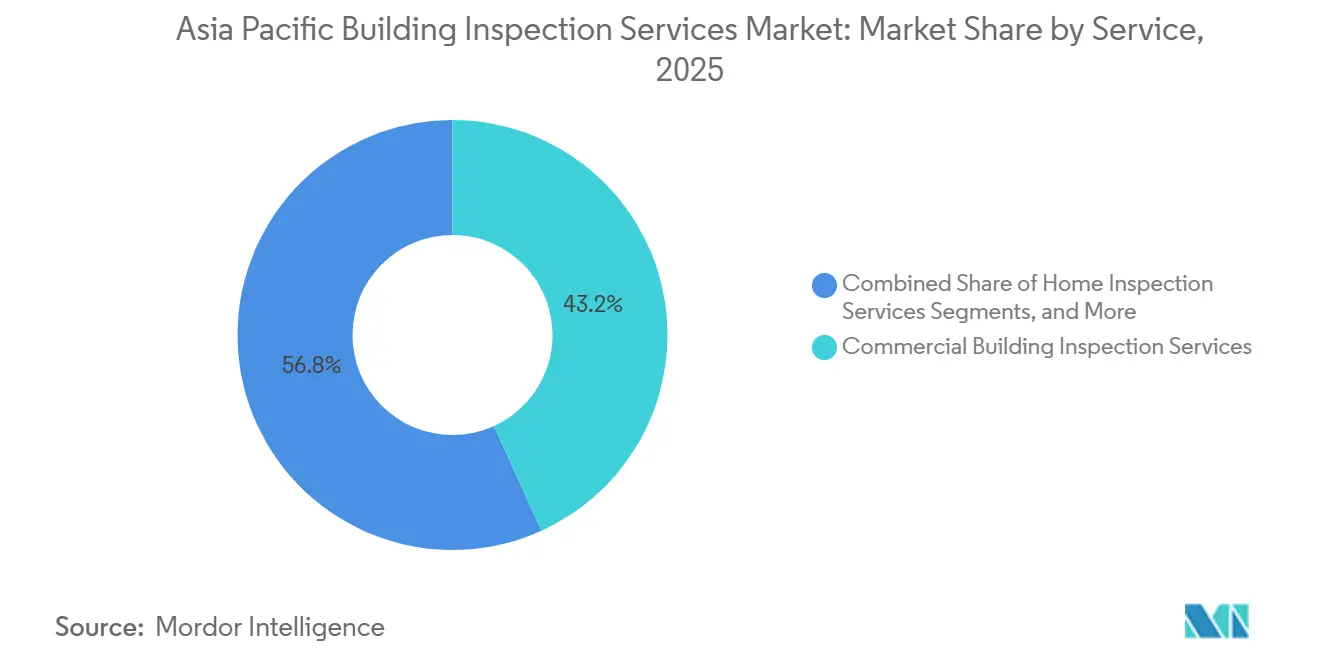
Commercial Building Inspection Services held 43.2% of the Asia Pacific building inspection services market share in 2025, supported by complex compliance and liability requirements for offices, logistics facilities, retail properties, industrial sites, and mixed-use assets. Commercial clients often need documented fire safety, energy performance, facade condition, and mechanical-system checks, while Home Inspection Services and Specific Element Inspection Services continue to serve stable demand pools. Green certification and disclosure expectations reinforce the need for more frequent and detailed assessments in major markets. Commercial work also has high value per engagement because the assets are often large and operationally important.
Other Specialized Services are forecast to grow at a 10.4% CAGR from 2026 to 2031 and include energy audits, indoor air-quality testing, facade-specific inspections, asbestos surveys, acoustic assessment, and green-certification verification. Clients are increasingly awarding these assignments to providers with narrow certifications or technical capabilities rather than buying a single general service. Japan’s ERI Inspection Center was formed in July 2025 through the integration of ERISolution and Taito Building and Equipment Inspection Center, offering drone-based exterior-wall surveys, asbestos surveys, and 3D laser scanning under Japan’s building standards framework. This shift creates opportunities for specialists and reduces the certainty of broad generalist contracts. At the same time, data-center and semiconductor facilities also require structural, mechanical, electrical, plumbing, commissioning, and thermal-imaging checks.

By Sourcing Type: Outsourced Services Leads as Requirements Outpace Internal Capacity
Outsourced Services accounted for 58.1% of the Asia Pacific building inspection services market size in 2025. The segment’s lead reflects the challenge of maintaining certified staff, specialized equipment, and current local-code expertise within a property owner’s organization. More detailed requirements for green certification, seismic compliance, defect records, and digital documentation favor external providers that can spread scarce skills across a larger client base. Large state-owned enterprises and public agencies still retain internal teams where they have established technical workforces.
Outsourced Services is also the fastest-growing sourcing channel, with a forecast of 9.3% CAGR through 2031. This combination shows that internal capability building is not keeping pace with the changing scope of inspection work. China’s quality-insurance initiatives link third-party inspection to property cover, while the Suzhou Industrial Park pilot indicates that inspection records may have value beyond compliance through tradable carbon assets. In-house teams remain relevant in China and South Korea. Still, rising accreditation and technology-investment needs give the Asia Pacific building inspection services industry a strong incentive to build locally compliant outsourced capacity.
By Application: Commercial Assets Lead, While Other Applications Broaden Scope
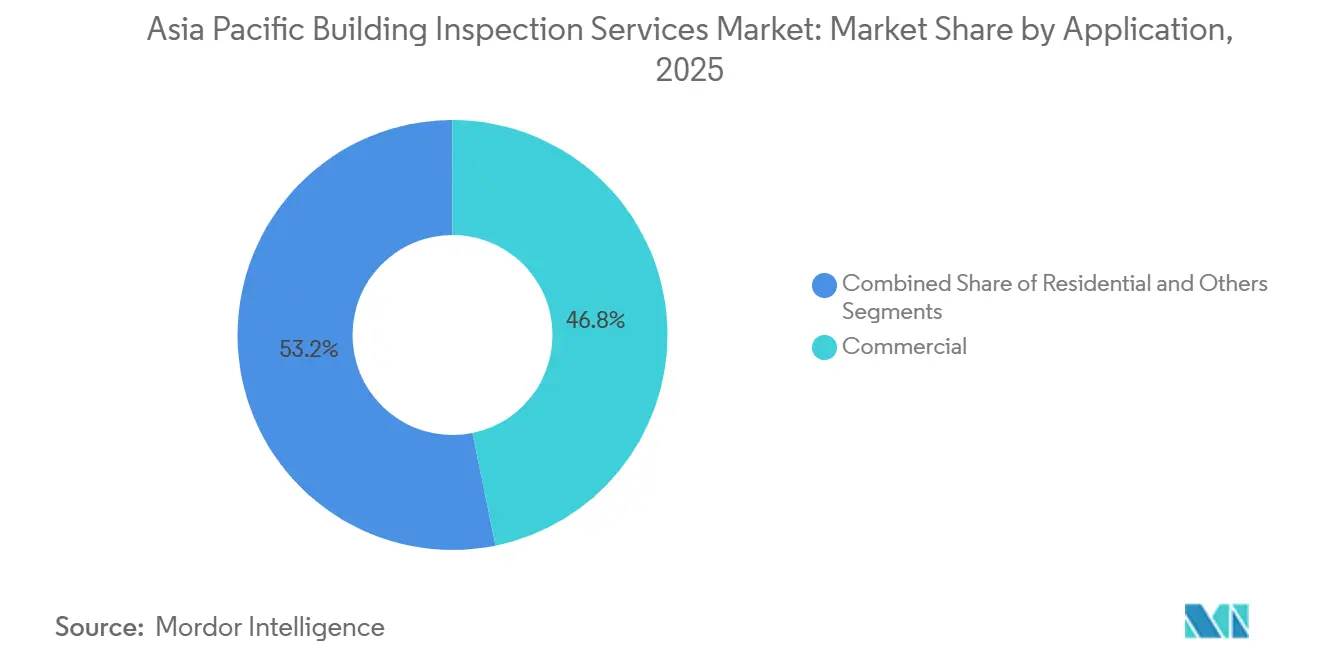
Commercial applications held 46.8% of the Asia Pacific building inspection services market share in 2025. Public-access buildings and commercial facilities carry material liability exposure, which supports regular inspection and documented evidence that safety systems, structural elements, and operating conditions meet applicable standards. Residential demand remains fragmented in several markets because pre-purchase inspection is voluntary, although it is commonly used in Australian residential transactions. Commercial demand also benefits from the concentration of high-value assets in large urban centers.
Other Applications is forecast to expand at a 12.2% CAGR through 2031 as inspection work moves into industrial assets, public infrastructure, heritage properties, and specialized facilities. Public operators are embedding periodic structural assessment in asset-management programs instead of acting only after visible deterioration. Hong Kong Polytechnic University deployed a multi-tier artificial intelligence bridge inspection system across 11 local bridges in 2025, reducing inspection time by 50% and reporting 80% accuracy. Hong Kong Metropolitan University and Hong Yip Service developed a mixed-reality system for 5 common residential defect categories, and these examples show how digital systems can extend inspection while requiring usable field evidence.
By End User: Property Owners Lead Demand, Government Adds Recurring Work
Property Owners and Investors held 35.2% of revenue in 2025, making them the largest end-user group. Their spending reflects asset-value protection, insurance expectations, green-building requirements, and obligations during defect-liability periods. The World Green Building Council reported that 44% of investors in the Asia Pacific identified sustainability-related obsolescence as their main concern for assets, making reliable building-performance information useful for investment, leasing, and refinancing decisions. Insurance and financial institutions can reinforce demand when inspection frequency is included in underwriting requirements.
Government and Municipalities are forecast to grow at a 10.1% CAGR through 2031. Public owners are moving from reactive maintenance toward planned inspection programs for transport, utility, health-care, and civic assets. South Korea’s public building-maintenance portal aggregates inspection-agency registration and periodic inspection history at city, county, and district levels, supporting public accountability and auditable outsourced work. Facility-management firms, real-estate agencies, and brokers can also commission more inspections as verified records become more important in operations and property transactions.
Geography Analysis
China held 38.7% of the Asia Pacific building inspection services market share in 2025, supported by the scale of its built environment and tighter requirements across asset categories. The 2025 policy cycle under the 15th Five-Year Plan introduced carbon-emissions inspection requirements for new public buildings with 100% mandated coverage. The Yangtze River Delta and Pearl River Delta accounted for 52% of Chinese inspection demand, while demand for older-building inspections rose 47% in northeastern provinces as urban renewal increased. China’s domestic inspection technology ecosystem is developing digital-twin models that combine Building Information Modeling and inspection data for continuous structural monitoring. This mix of new construction, urban renewal, and digital records strengthens demand for local specialists and multinational testing, inspection, and certification providers.
India is the fastest-growing country in the Asia Pacific building inspection services market, with a forecast CAGR of 9.22% through 2031. State-level RERA enforcement is increasing the importance of occupancy certificates and defect-liability documentation in major cities and increasingly in Tier 2 locations. Maharashtra’s 2025 verification program makes the documentation process more visible to developers and property purchasers. India also offers a case for remote inspection in locations where qualified personnel are not evenly distributed. Firms that combine local regulatory knowledge with scalable field coverage are better positioned to serve this demand.
Japan, South Korea, and Australia are mature inspection markets with detailed standards and growing technology use. Takenaka Corporation and H3 Zoom launched artificial intelligence-powered Facade Inspector and Interior Inspector systems in Japan in August 2025 for automated defect identification and report generation. South Korea introduced a National Certified Supervisory System in September 2026 that will select up to 150 certified construction supervisors in its first year and expand to additional infrastructure categories by 2027. Indonesia and other Southeast Asian markets are building regulatory capacity as demand develops, and providers need local accreditation, language capability, and on-the-ground networks before expanding beyond primary cities.
Competitive Landscape
The Asia Pacific building inspection services market is moderately concentrated at the high-value end, where SGS Group, Bureau Veritas, and Intertek Group plc have broad multi-jurisdictional coverage. Residential and small-commercial work is more fragmented because local specialists understand country-specific codes, client practices, and permit processes. Bureau Veritas completed the acquisition of The APP Group in December 2024 and completed its integration as Bureau Veritas Buildings and Infrastructure Pty Ltd in December 2025. The acquisition added more than 500 employees and over 200 specialist subcontractors to its regional buildings and infrastructure platform. This approach strengthens access to government, transport, social infrastructure, and large corporate assignments.
Digital capability is becoming an important area of differentiation in the Asia Pacific building inspection services market. SGS acquired Fulcrum Robotics in September 2025 to add unmanned aerial, submersible, and artificial intelligence-powered systems for industrial and infrastructure inspection. In November 2025, SGS signed an agreement to acquire Information Quality in Australia, adding digital engineering, asset-data, and information-management capabilities to its service offering. Panasonic Holdings launched global licensing for its artificial intelligence platform for visual inspection in March 2026, and Singapore-based NovaPeak uses it for facade inspections across more than 1,000 buildings. TÜV SÜD opened a SGD 100 million regional hub in Singapore to support sustainability and digital-trust work in the Association of Southeast Asian Nations.
Technology does not eliminate the importance of professional certification, especially for regulated work. International Organization for Standardization accreditation and local schemes such as Green Mark, NABERS, BREEAM, and RERA-related requirements remain barriers to entry for complex assignments. No provider has a dominant regional position in drone-based secondary-city inspection, carbon-asset certification using inspection data, or subscription-based structural-health monitoring, leaving room for specialists that meet local regulations. The Asia Pacific building inspection services industry remains competitive because scale, local credentials, specialist knowledge, and digital delivery must work together.
Asia Pacific Building Inspection Services Industry Leaders
-
SGS Group
-
Bureau Veritas
-
Intertek Group plc
-
TÜV SÜD AG
-
TÜV Rheinland AG
- *Disclaimer: Major Players sorted in no particular order
Recent Industry Developments
- September 2026: South Korea’s Ministry of Land, Infrastructure and Transport announced the rollout of the National Certified Supervisory System, selecting up to 150 certified construction supervisors in its first year and committing to expand the program to roads, transportation, water resources, and urban development by 2027. The reform evaluates supervisory performance rather than credentials alone and is designed to raise oversight quality on construction sites.
- March 2026: Panasonic Holdings Corporation announced the global launch of licensing for its AI Platform for Visual Inspection, developed by Panasonic R&D Center Singapore. Singapore-based NovaPeak Pte. Ltd. adopted the platform for its LiveInspect.AI building-facade inspection solution across more than 1,000 Singapore buildings.
- December 2025: Bureau Veritas completed full integration of The APP Group, renaming it Bureau Veritas Buildings and Infrastructure Pty Ltd and appointing Melanie Kurzydlo as Vice President, Buildings and Infrastructure for the Pacific region. The integration brings more than 500 staff and over 200 specialist subcontractors into Bureau Veritas’ Asia Pacific platform.
Asia Pacific Building Inspection Services Market Report Scope
| Home Inspection Services |
| Specific Element Inspection Services |
| Commercial Building Inspection Services |
| Other Specialised Services |
| In-House Services |
| Outsourced Services |
| Residential |
| Commercial |
| Other Applications |
| Real-Estate Agencies and Brokers |
| Property Owners and Investors |
| Government and Municipalities |
| Insurance and Financial Institutions |
| Facility-Management Firms |
| China |
| India |
| Japan |
| South Korea |
| Australia |
| Indonesia |
| Rest of Asia-Pacific |
| By Service | Home Inspection Services |
| Specific Element Inspection Services | |
| Commercial Building Inspection Services | |
| Other Specialised Services | |
| By Sourcing Type | In-House Services |
| Outsourced Services | |
| By Application | Residential |
| Commercial | |
| Other Applications | |
| By End User | Real-Estate Agencies and Brokers |
| Property Owners and Investors | |
| Government and Municipalities | |
| Insurance and Financial Institutions | |
| Facility-Management Firms | |
| By Countries | China |
| India | |
| Japan | |
| South Korea | |
| Australia | |
| Indonesia | |
| Rest of Asia-Pacific |
Key Questions Answered in the Report
What is the projected value of building inspection services in the Asia Pacific by 2031?
The sector is forecast to reach USD 3.4 billion by 2031, expanding at an 8.13% CAGR from 2026 to 2031.
Which service category leads regional revenue?
Commercial Building Inspection Services led revenue with 43.2% share in 2025, supported by complex compliance and liability requirements.
Why are outsourced inspection services growing in the Asia Pacific?
Outsourced Services held 58.1% share in 2025 and is forecast to grow at 9.3% CAGR because many owners lack internal certified staff and specialized tools.
Which country has the largest share of regional demand?
China led with 38.7% share in 2025, supported by its large built environment and expanding compliance requirements.
Which country is expected to grow fastest through 2031?
India is forecast to grow at a 9.22% CAGR through 2031 as RERA enforcement increases the importance of occupancy and defect documentation.
How is technology changing building inspection services?
Drone surveys, artificial intelligence defect detection, digital twins, and digital records can improve access, reporting speed, and traceability for regulated work.