
Asia-Pacific Boiler Feed Pumps Market Size and Share
Market Overview
| Study Period | 2022 - 2032 |
|---|---|
| Forecast Data Period | 2027 - 2032 |
| Base Year Market Size (2026) | USD 370.13 Million |
| Market Size (2027) | USD 385.64 Million |
| Market Size (2032) | USD 473.38 Million |
| Growth Rate (2027 - 2032) | 4.19 % |
| Market Concentration | Medium |
Major Players *Disclaimer: Major Players sorted in no particular order Image © Mordor Intelligence. Reuse requires attribution under CC BY 4.0. | |
Asia-Pacific Boiler Feed Pumps Market Analysis by Mordor Intelligence
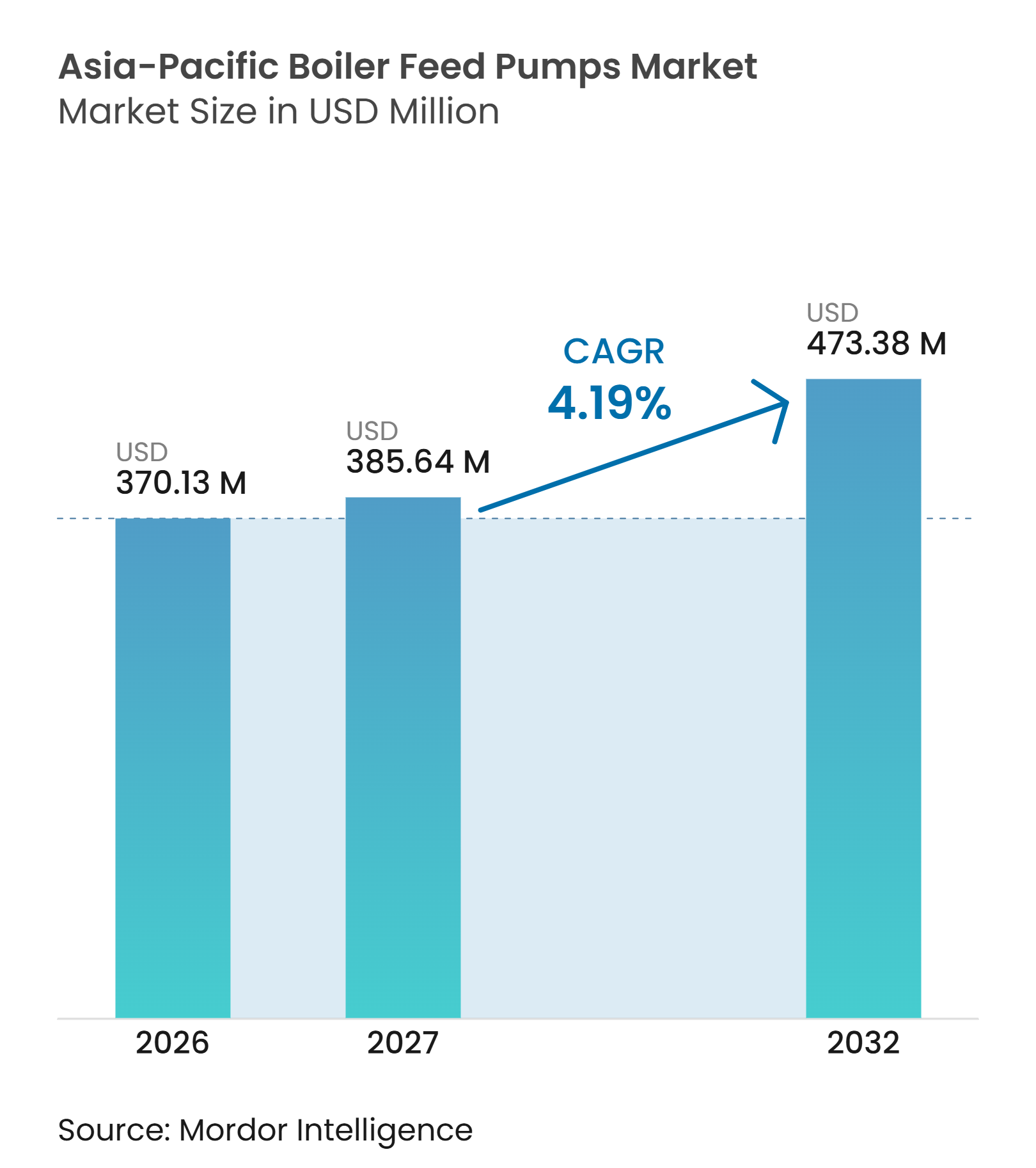
The Asia-Pacific Boiler Feed Pumps Market size is expected to increase from USD 370.13 million in 2026 to USD 385.64 million in 2027 and reach USD 473.38 million by 2032, growing at a CAGR of 4.19% over 2027-2032. Thermal and combined-cycle additions remain the central source of new equipment demand because each plant needs a dedicated feedwater pump train. The region’s large operating boiler fleet also supports replacement work as operators seek reliable operation at changing load levels. China has the largest demand base, while India has the strongest projected expansion rate among the geographies covered. Suppliers are increasingly competing through service coverage, repair capability, and digital condition monitoring rather than pump hardware alone. The Asia-Pacific boiler feed pumps market therefore retains opportunities in high-pressure applications even as renewable generation limits new thermal awards in some mature countries.
Key Report Takeaways
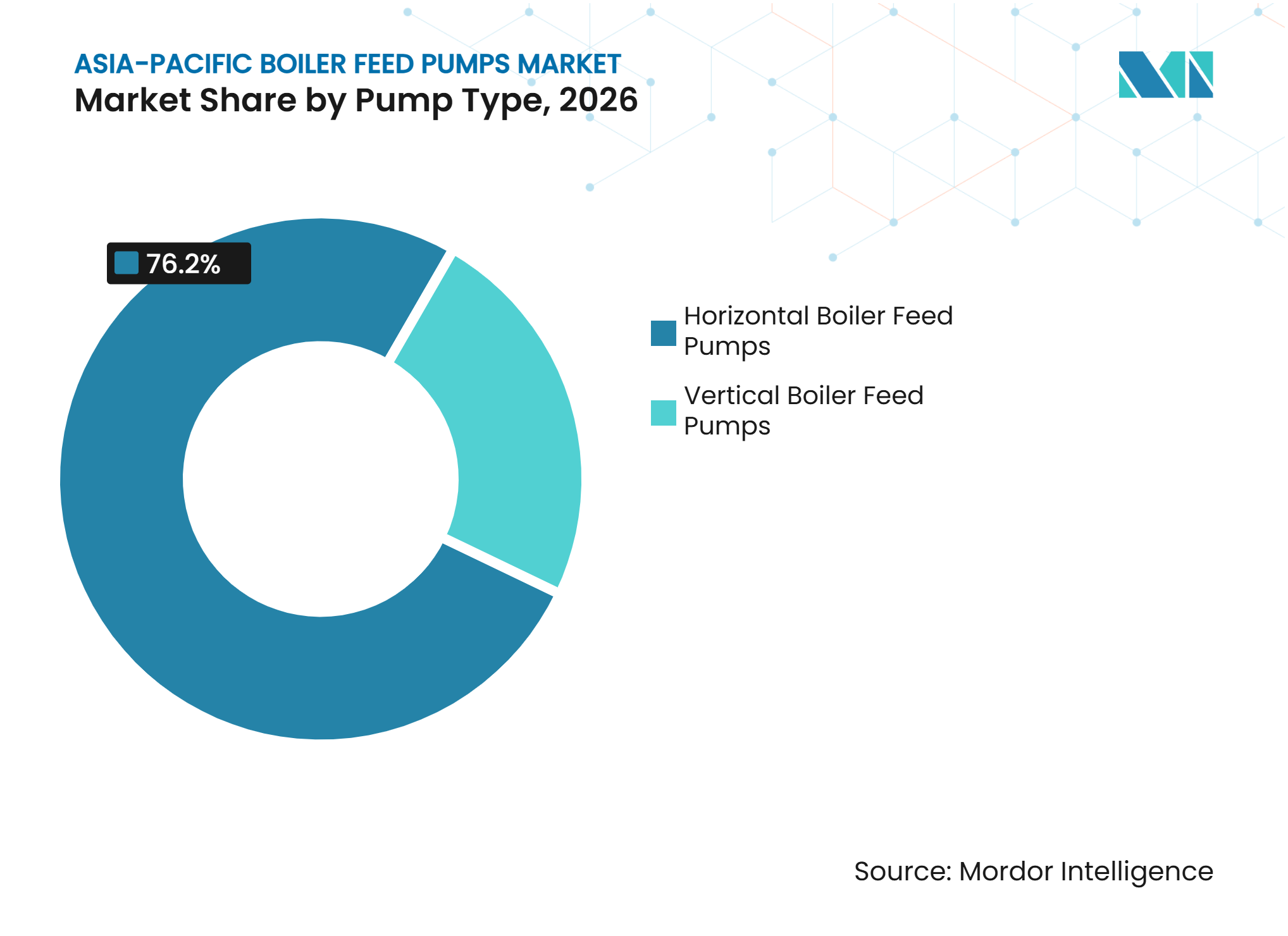
- By pump type, horizontal pumps held 76.2% of the Asia-Pacific boiler feed pumps market share in 2026, while vertical pumps are forecast to grow at a 4.5% CAGR through 2032.
- By pump design, multistage centrifugal pumps held 87.4% of the Asia-Pacific boiler feed pumps market share in 2026, while barrel-type pumps are forecast to grow at a 4.3% CAGR through 2032.
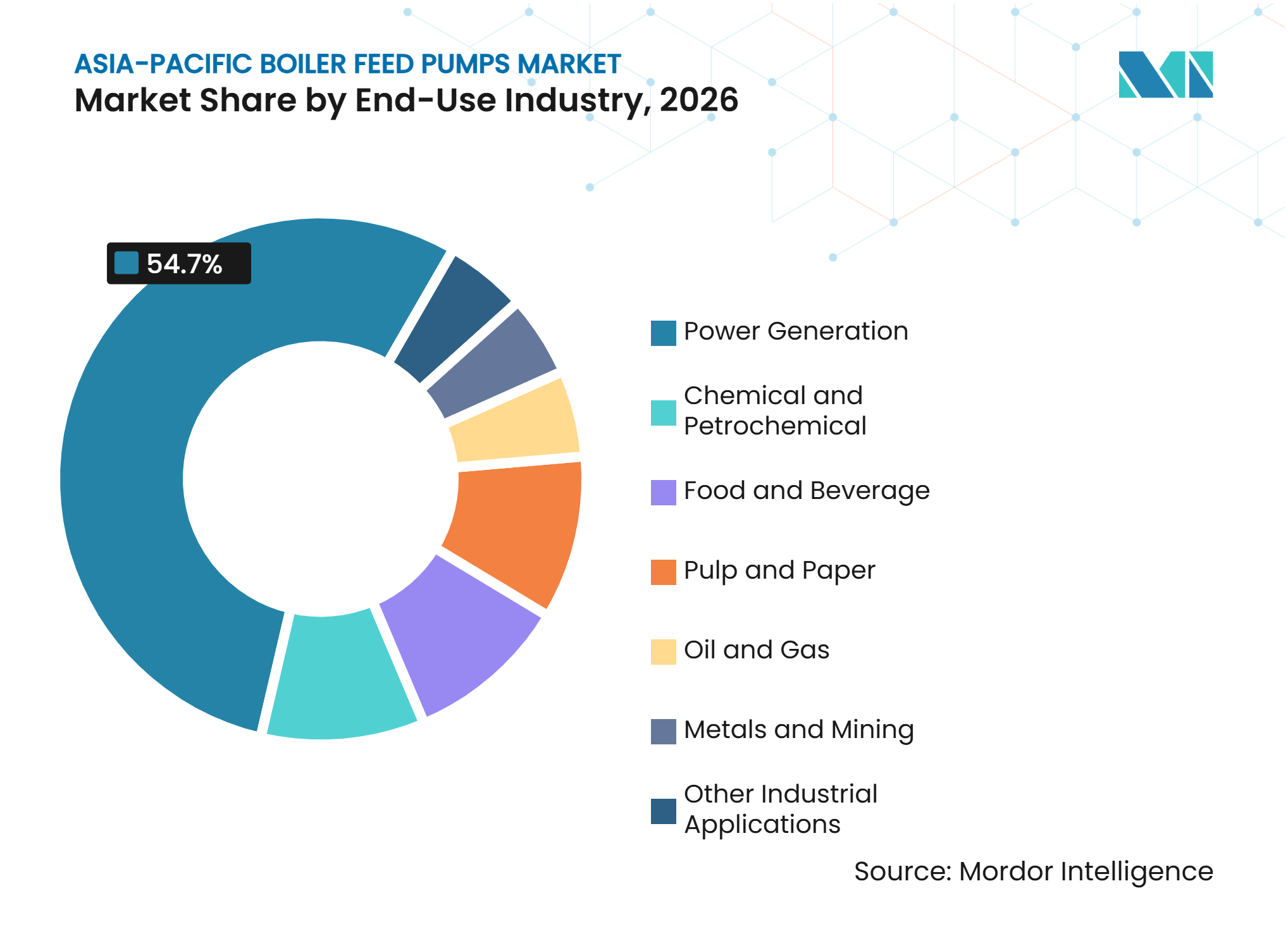
- By end-use industry, power generation held 54.7% of the Asia-Pacific boiler feed pumps market share in 2026, while chemical and petrochemical applications are forecast to grow at a 4.7% CAGR through 2032.
- By geography, China held 37.1% of the Asia-Pacific boiler feed pumps market share in 2026, while India is forecast to grow at a 5.1% CAGR through 2032.
Note: Market numbers in this report are based on Mordor Intelligence's proprietary estimation framework, which combines nine months of actuals with Q4 projections for base year 2026.
Market Trends and Insights
Drivers Impact Analysis of Asia-Pacific Boiler Feed Pumps Market*
| Driver | (~) % Impact on CAGR Forecast | Geographic Relevance | Impact Timeline |
|---|---|---|---|
| Thermal and Combined-Cycle Capacity Additions | +1.5% | China, India, Indonesia, Vietnam, broad Asia-Pacific | Long term (≥ 4 years) |
| Industrial Steam Demand in China and India | +1.0% | China, India, spill-over to Southeast Asia | Medium term (2-4 years) |
| Boiler Fleet Modernization and Replacement Cycles | +0.8% | China, India, Japan, South Korea | Medium term (2-4 years) |
| Variable-Load Operation Creating Retrofit Demand | +0.5% | China, India, Australia | Short term (≤ 2 years) |
| High-Efficiency Pump and Motor Upgrades | +0.6% | Global, with early gains in Japan and South Korea | Medium term (2-4 years) |
| Digital Condition Monitoring Adoption | +0.4% | Japan, South Korea, Australia, spill-over to China | Medium term (2-4 years) |
| Source: Mordor Intelligence | |||
Thermal and Combined-Cycle Capacity Additions Propel New Equipment Demand
New thermal capacity remains a direct driver for the Asia-Pacific boiler feed pumps market because every boiler needs main, booster, and auxiliary feedwater equipment. The work involves more than a single pump purchase because the package must meet the boiler’s design conditions and support the plant’s required availability, while Reuters reported that coal-fired plants accounted for 24% of power projects under construction across 10 major Asian economies, equal to nearly 250 GW of active construction in 2025.[1] Large supercritical plants need high-pressure pump trains that are designed for their specified operating conditions, including the planned pressure, flow, and standby arrangement. Research on an ultra-supercritical 900 MW steam plant found that higher steam parameters require corresponding changes in boiler feed pump drive configuration and power requirements.[2] India added 5.09 GW of thermal capacity in the first half of fiscal year 2025-26, and 37.62 GW was under construction as of September 2025. These projects support orders for engineered systems with long qualification and delivery cycles, where early engagement can influence design selection and service planning.
Industrial Steam Demand in China and India Opens a Non-Power Revenue Channel
Industrial steam systems create demand outside utility power generation for the Asia-Pacific boiler feed pumps market. Chemical, petrochemical, refining, and process facilities need dependable feedwater delivery where steam is used for heating or production. Their boiler systems often operate continuously, so an equipment failure can interrupt an important production process and create an immediate maintenance need. These customers often need corrosion-resistant materials and designs that can operate under demanding temperature and pressure conditions, while their procurement decisions place weight on lifecycle performance, maintenance access, spare-parts availability, and the ability to schedule work during planned shutdowns. This gives suppliers an opportunity to serve projects that do not follow the utility-sector investment cycle. It also broadens the role of the Asia-Pacific boiler feed pumps industry beyond the region’s power stations.
High-Efficiency Pump and Motor Upgrades Support Replacement Demand
Efficiency upgrades support replacement activity where existing units no longer meet the operating needs of a boiler system. Higher steam pressures increase the importance of pump hydraulic design and motor performance, because a modest loss in efficiency can raise energy use over an extended operating period. A 2025 study of 1,000 MW boiler feedwater pumps found that a blade wrap angle of 120° to 130° provided a strong balance between cavitation performance and energy efficiency.[3] This type of design improvement matters when operators evaluate equipment for demanding feedwater duties and compare the cost of a replacement with expected operating benefits. Japan and South Korea are relevant early markets because their mature installed bases place more emphasis on replacement quality than new thermal construction. The Asia-Pacific boiler feed pumps market can benefit where upgrades improve operating stability, reduce maintenance burdens, and support energy-use objectives.
Digital Condition Monitoring Adoption Redefines Maintenance Economics
Digital condition monitoring is moving maintenance decisions from fixed schedules toward equipment-condition assessment. Instead of waiting for a routine inspection interval, operators can review signals that indicate a developing fault and prioritize the most urgent work, and a study using data from an Indonesian coal plant found that a Long Short-Term Memory (LSTM) autoencoder could identify early signs of shaft bending and impeller wear-ring deterioration before failure. Separate 2025 research reported an R² of 0.9838 for a model used to predict boiler feed pump energy consumption and classify anomalies into warning levels.[4] The tools can help operators plan repairs before a failure affects plant availability and can give service teams clearer evidence when they recommend an intervention. For equipment makers, monitoring systems can strengthen service contracts and create recurring aftermarket work. Japan, South Korea, Australia, and China are relevant adoption markets because utilities and industrial sites value uptime and predictive maintenance.
Restraints Impact Analysis of Asia-Pacific Boiler Feed Pumps Market*
| Restraint | (~) % Impact on CAGR Forecast | Geographic Relevance | Impact Timeline |
|---|---|---|---|
| Renewable Generation Displacing New Thermal Capacity | -1.1% | Japan, South Korea, Australia, advanced Asia-Pacific markets | Long term (≥ 4 years) |
| High Capital and Lifecycle Cost of High-Pressure Systems | -0.6% | Asia-Pacific-wide, with intensity in emerging Southeast Asia | Medium term (2-4 years) |
| Stainless Steel, Nickel, and Duplex Material Cost Volatility | -0.5% | Global supply chain, procurement impact in China and India | Short term (≤ 2 years) |
| Low-Load Cavitation and Fatigue Risk in Flexible Operation | -0.3% | China, India, Indonesia, high cycling-intensity markets | Medium term (2-4 years) |
| Source: Mordor Intelligence | |||
Renewable Growth Pressures the Long-Term Thermal Capacity Pipeline
Rising renewable generation can reduce the number of new thermal projects in mature Asia-Pacific economies. This change is most material in Japan, South Korea, and Australia, where the pipeline is shifting toward renewable and gas-based capacity. While fewer greenfield thermal plants can limit demand for new boiler feed pump installations, existing coal plants can still require replacement pumps and upgrades when they operate more flexibly or remain online longer than planned. The Central Electricity Authority’s flexibility requirements in India have also focused attention on coal plants operating at lower minimum loads and defined ramp rates. These operating conditions can increase attention to pump reliability, vibration behavior, and service response during maintenance work. The Asia-Pacific boiler feed pumps market is therefore supported by aftermarket activity even where new-build demand is less certain.
Stainless Steel, Nickel, and Duplex Material Cost Volatility Squeezes Procurement Budgets
High-pressure boiler feed pumps can require stainless steel, duplex grades, and nickel-bearing alloys in wet components. These materials are used where the application calls for strength, corrosion resistance, or stable operation under demanding service conditions, and Damstahl reported nickel prices of USD 14,500 to USD 15,500 per ton through the third quarter of 2025 after prices rose earlier in the year. Price movement can make budgeting harder for suppliers and project buyers, particularly when a quotation must remain valid through an extended engineering and delivery period. The issue is particularly important for fixed-price contracts, where materials costs can change during the procurement and manufacturing cycle. Buyers may extend technical and commercial reviews before awarding high-value equipment packages and may examine material specifications closely before final approval. This can delay orders within the Asia-Pacific boiler feed pumps market, especially for pumps serving supercritical or ultra-supercritical boilers.
*Our forecasts treat driver/restraint impacts as directional, not additive. The impact forecasts reflect baseline growth, mix effects, and variable interactions.
Asia-Pacific Boiler Feed Pumps Market Segment Analysis
By Pump Type:
Horizontal Configurations Serve Large Plant RequirementsHorizontal pumps held 76.2% of the Asia-Pacific boiler feed pumps market share in 2026. Their position reflects the use of large multistage horizontal configurations in utility-scale coal and gas plants. Between-bearing layouts provide access for maintenance, which is important where sites have demanding availability targets and must complete planned service work without disrupting the wider generating unit. KSB received an order in July 2025 for 15 sets of main boiler feed pumps, booster pumps, motors, and accessories for National Thermal Power Corporation (NTPC)’s Gadarwara Stage-II and Nabinagar Stage-II supercritical projects. Such projects illustrate the need for robust pumps that can support high discharge pressure service, integrate with supporting equipment, and operate within a defined plant engineering specification. Horizontal units also suit applications where operators need a proven format for high-capacity boiler feed duties.
Vertical pumps are forecast to expand at a 4.5% CAGR through 2032. Their compact footprint can support installations where available floor space or layout limits the use of a horizontal package, particularly when the plant must fit new equipment into an existing operating area. This matters in industrial plants and chemical facilities that use modular equipment arrangements and seek practical options for a replacement without major changes to adjacent systems. Vertical systems can also fit replacement projects where retaining the existing civil arrangement reduces shutdown complexity. The segment is relevant to smaller boiler installations and process steam systems across Southeast Asia. These use cases give vertical products a focused role within the broader Asia-Pacific boiler feed pumps market.



By Pump Design:
Multistage Centrifugal Pumps Lead High-Pressure ServiceMultistage centrifugal pumps accounted for 87.4% of the Asia-Pacific boiler feed pumps market share in 2026. Modern high-pressure steam generation needs several impellers to generate the required head, with each stage contributing to the rise of overall pressure needed to deliver feedwater to the boiler. The design is particularly important for supercritical and ultra-supercritical units, where single-stage pumps cannot meet the required pressure range. The 2025 AIP Advances study on 1,000 MW feedwater pumps also shows how impeller geometry affects cavitation performance and efficiency. Pump makers continue to refine hydraulic components because availability and energy performance influence purchase decisions, especially where customers compare operating costs and maintenance requirements over a long service period. This keeps multistage centrifugal equipment central to the Asia-Pacific boiler feed pumps industry.
Barrel-type pumps are forecast to grow at 4.3% CAGR through 2032. Their double-casing construction and cartridge-removable arrangement support the highest-pressure service applications, where containment, inspection access, and reliable operation are important parts of the equipment requirement. These designs are relevant to advanced thermal plants and other systems with stringent reliability requirements, including facilities that cannot accept prolonged interruptions to steam generation. PowerChina SPEM reported 2026 boiler feed pump supply contracts for the Huaneng Shanyin and Huaneng Yantai combined heat-and-power projects. The awards show that domestic suppliers are participating in demanding high-capacity projects. Single-stage and ring-section designs remain relevant for auxiliary duties and smaller industrial boilers where high-pressure service is not required.
By End-Use Industry:
Power Generation Leads While Chemical and Petrochemical Applications AcceleratePower generation commanded 54.7% of the Asia-Pacific boiler feed pumps market size in 2026. It requires the largest pump packages because a generating station may need main pumps, booster pumps, and standby trains that protect operations when an individual unit needs inspection or repair. Thermal power projects use equipment designed for stringent pressure, flow, and availability requirements. Reuters reported that large coal and gas project pipelines remained under construction across major Asian economies in 2025. These projects typically involve detailed testing, engineering review, and a service plan because the pumps are critical to boiler availability and are selected as part of a larger feedwater system.
Chemical and petrochemical applications are forecast to expand at a 4.7% CAGR through 2032. Process facilities use steam for heating and production and can require pumps with specialized materials when fluid conditions and operating environments place additional demands on wetted parts. Buyers may prioritize corrosion resistance, reliable operation, and maintenance support alongside hydraulic performance. This expands demand beyond the power generation cycle and gives suppliers a broader mix of opportunities across continuous-process plants. The segment also helps suppliers diversify their customer base within the Asia-Pacific boiler feed pumps market.

Geography Analysis
China
China held 37.1% of the Asia-Pacific boiler feed pumps market share in 2026. Its scale reflects a large thermal generation base and a substantial population of industrial boilers. KSB expanded its Guangzhou Service Center in June 2025 to 3,500 square meters and reported a tenfold increase in business volume to USD 10.50 million (CNY 70 million). The facility serves Guangdong, Guangxi, Hunan, Hainan, and Fujian, highlighting the importance of fast local aftermarket support. Domestic suppliers also participate in high-capacity projects, as PowerChina SPEM’s 2026 Combined Heat and Power (CHP) awards indicate.
India
India is forecast to grow at a 5.1% CAGR through 2032, the highest rate among the geographies covered. The Asia-Pacific boiler feed pumps market size in India is supported by a thermal construction pipeline of 37.62 GW as of September 2025. New plants require high-pressure feedwater systems that match their operating parameters. KSB’s 2025 order for National Thermal Power Corporation (NTPC) supercritical projects demonstrates continuing demand for main boiler feed and booster pump packages. Local production, service capacity, compliance with project specifications, and dependable access to experienced technical support will remain relevant competitive factors for Indian buyers.
Southeast Asia and Other Asia-Pacific Markets
Indonesia, Vietnam, Thailand, Japan, South Korea, Australia, and the Rest of Asia-Pacific have different demand profiles. Indonesia’s 2025-2034 Electricity Supply Business Plan (RUPTL) identifies 16.6 GW of new non-renewable capacity in its first 5 years, which can support coal and gas project demand. Torishima received an order in December 2025 for hot well pumps for the 80 MW Muara Laboh Unit 2 geothermal project in West Sumatra. Japan and South Korea are more focused on high-specification replacement work, maintenance, and digital upgrades, while Australia is shifting over time toward gas and renewable configurations.
Competitive Landscape
Market Concentration
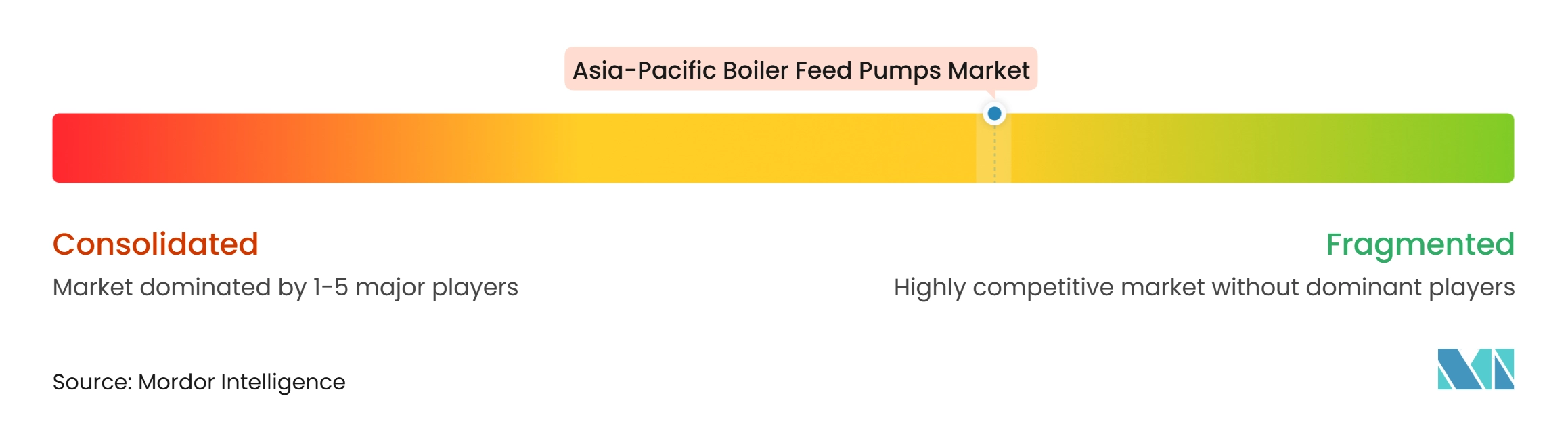
The Asia-Pacific boiler feed pumps market is moderately consolidated. KSB, Sulzer, Flowserve, EBARA, Grundfos, and Torishima serve high-value engineered projects, while regional suppliers compete for industrial and standard-specification orders. The main technical differentiators include hydraulic performance, reliability, engineering support, and after-sales capability. API 610 is a key specification for demanding centrifugal pump services, while project owners may also require IEC-compliant electrical and testing arrangements. KSB’s Guangzhou investment shows how OEMs are strengthening local repair and response capacity in China.
Aftermarket services are a major part of competitive positioning in the Asia-Pacific boiler feed pumps market. Sulzer opened a service center in Bintulu, Sarawak, in January 2025 and stated that the site increased regional servicing capacity by 80%. The facility supports repair, overhaul, and retrofit work for rotating equipment in East Malaysia, Sabah, and Brunei, where customers value quicker access to specialized field and workshop support. KSB’s expanded Guangzhou center is a second example of a service-led regional strategy. Digital monitoring can also link pump hardware to predictive maintenance programs, supported by research on early anomaly detection in boiler feed pumps.
Domestic suppliers are gaining visibility in major Chinese projects. PowerChina SPEM’s 2026 supply contracts for Huaneng Shanyin and Huaneng Yantai show that local manufacturers can compete for large high-efficiency CHP applications. Global suppliers retain advantages where projects demand long operating references, specialized hydraulic designs, or extensive service networks. Torishima’s Indonesian geothermal order shows that pump makers can extend their regional presence into energy-transition projects.
Asia-Pacific Boiler Feed Pumps Industry Leaders
-
KSB SE and Co. KGaA
-
Flowserve Corporation
-
Sulzer Ltd.
-
Grundfos Holding A/S
-
EBARA Corporation
- *Disclaimer: Major Players sorted in no particular order
Asia-Pacific Boiler Feed Pumps Market Companies Covered in this Report
- Bharat Heavy Electricals Limited (BHEL)
- CNP Pumps India Private Limited
- Dalian Deep Blue Pump Co., Ltd.
- Dongfang Turbine Co., Ltd.
- EBARA Corporation
- Flowserve Corporation
- Grundfos Holding A/S
- Hangzhou Steam Turbine Co., Ltd.
- Hunan Sanchang Pump Co., Ltd.
- Hunan XEMC Changsha Pump Works Co., Ltd.
- Kirloskar Brothers Limited
- KSB SE and Co. KGaA
- LEO Group Co., Ltd.
- PowerChina SPEM Company Limited
- Shanghai Kaiquan Pump (Group) Co., Ltd.
- Shinko Ind. Ltd.
- Speck Pumpen
- Sulzer Ltd.
- Torishima Pump Manufacturing Co., Ltd.
- WPIL Limited
Recent Industry Developments in Asia-Pacific Boiler Feed Pumps Market
- February 2026: Chinese pump manufacturer DaTongLongYuan announced that it won the bid for the high-pressure boiler feed pump project at PLN Nusantara Power's Pulang Pisau power plant in Indonesia. The contract covers a complete set of high-pressure boiler feed pump equipment, including motors and hydraulic couplings, and includes installation and construction services.
- September 2025: Flowserve Corporation and Core Energy Systems signed a strategic agreement to locally manufacture primary coolant pumps for India's pressurized heavy water reactor fleet at Flowserve's Coimbatore facility, authorized under US Department of Energy (DOE) 10 CFR Part 810. India targets 100 GW of nuclear capacity by 2047, and the collaboration marks a significant technology-transfer milestone for India's domestic nuclear supply chain.
- July 2025: KSB Limited received an order from Larsen & Toubro for 15 sets of main boiler feed pumps, booster pumps, motors, and accessories for National Thermal Power Corporation (NTPC)’s Gadarwara Super Thermal Power Project (STPP) Stage-II (2×800 MW) and Nabinagar STPP Stage-II (3×800 MW) supercritical power plants. This marks KSB's first supercritical order from L&T for 800 MW-class thermal projects, strengthening its position in India's high-capacity power sector, with deliveries linked to milestones through 2028.
- June 2025: KSB relocated and expanded its Guangzhou Service Center to 3,500 square meters, achieving a tenfold increase in business volume to USD 10.50 million (CNY 70 million). The center serves Guangdong, Guangxi, Hunan, Hainan, and Fujian provinces, reinforcing KSB's aftermarket-first strategy in China's industrial south, with International Electrotechnical Commission (IEC)-compliant repair and precision-testing capabilities.
Asia-Pacific Boiler Feed Pumps Market Report Scope
A boiler feed pump (BFP) is a specialized high-pressure device that supplies feedwater to a steam boiler to maintain the required water and steam generation levels.
Asia-Pacific boiler feed pumps market is segmented into pump type, pump design, end-use industry, and geography. By pump type, the market is segmented into horizontal boiler feed pumps, and vertical boiler feed pumps. By pump design, the market is divided into multistage centrifugal pumps, single-stage centrifugal pumps, barrel-type boiler feed pumps, and ring-section boiler feed pumps. By end-use industry, the market is divided into power generation, oil and gas, chemical and petrochemical, food and beverage, pulp and paper, metals and mining, and other industrial applications. The report also covers the market size and forecasts for the Asia-Pacifi boiler feed pumps market across 8 key countries. For each segment, the market sizing and forecasts have been provided on the basis of value (USD).
Segmentation Overview
| Horizontal Boiler Feed Pumps |
| Vertical Boiler Feed Pumps |
| Multistage Centrifugal Pumps |
| Single-Stage Centrifugal Pumps |
| Barrel-Type Boiler Feed Pumps |
| Ring-Section Boiler Feed Pumps |
| Power Generation |
| Oil and Gas |
| Chemical and Petrochemical |
| Food and Beverage |
| Pulp and Paper |
| Metals and Mining |
| Other Industrial Applications |
| China |
| India |
| Japan |
| South Korea |
| Australia |
| Indonesia |
| Vietnam |
| Thailand |
| Rest of Asia-Pacific |
| By Pump Type | Horizontal Boiler Feed Pumps |
| Vertical Boiler Feed Pumps | |
| By Pump Design | Multistage Centrifugal Pumps |
| Single-Stage Centrifugal Pumps | |
| Barrel-Type Boiler Feed Pumps | |
| Ring-Section Boiler Feed Pumps | |
| By End-Use Industry | Power Generation |
| Oil and Gas | |
| Chemical and Petrochemical | |
| Food and Beverage | |
| Pulp and Paper | |
| Metals and Mining | |
| Other Industrial Applications | |
| By Geography | China |
| India | |
| Japan | |
| South Korea | |
| Australia | |
| Indonesia | |
| Vietnam | |
| Thailand | |
| Rest of Asia-Pacific |
Key Questions Answered in the Report
What is the projected growth rate for Asia-Pacific boiler feed pumps?
The Asia-Pacific boiler feed pumps market is projected to grow at a 4.19% CAGR from 2027 to 2032, increasing from USD 370.13 million in 2026 to USD 473.38 million in 2032.
Which pump type has the largest regional share?
Horizontal pumps held 76.2% share in 2026 because they are widely used in large utility-scale boiler applications. Their maintenance accessibility and suitability for high-capacity arrangements support their current position in major coal and gas-fired boiler installations across the region.
What pump design leads high-pressure boiler applications in Asia-Pacific?
Multistage centrifugal pumps held 87.4% share in 2026 because modern high-pressure steam systems require several impellers to generate the needed head. The design is closely aligned with supercritical and ultra-supercritical service requirements, where reliable pressure generation, hydraulic efficiency, cavitation control, and practical maintenance access are important.
Which end-use application is growing fastest?
Chemical and petrochemical applications are forecast to grow at a 4.7% CAGR through 2032, above the overall regional rate. Process facilities use steam for heating and production, which creates demand outside the utility power cycle and gives suppliers a route into industrial plant projects.
Which country is expected to grow fastest in the region?
India is forecast to grow at a 5.1% CAGR through 2032, supported by its thermal capacity construction pipeline. High-pressure equipment needs in supercritical projects also support demand for engineered boiler feed systems, including main pump, booster pump, motor, and accessories packages.
How do suppliers compete for boiler feed pump projects?
Suppliers compete through engineered pump performance, high-pressure reliability, local repair coverage, retrofit capability, and digital monitoring services. Service-center investment and predictive maintenance support are increasingly important alongside the initial equipment sale, particularly for operators that need quick repair decisions and planned maintenance support.