
Asia-Pacific Agricultural Robots Market Size and Share
Market Overview
| Study Period | 2021 - 2031 |
|---|---|
| Forecast Data Period | 2026 - 2031 |
| Base Year Market Size (2025) | USD 2.35 Billion |
| Market Size (2026) | USD 2.79 Billion |
| Market Size (2031) | USD 5.49 Billion |
| Growth Rate (2026 - 2031) | 14.47 % |
| Market Concentration | Medium |
Major Players
*Disclaimer: Major Players sorted in no particular order Image © Mordor Intelligence. Reuse requires attribution under CC BY 4.0. |
|
Asia-Pacific Agricultural Robots Market Analysis by Mordor Intelligence
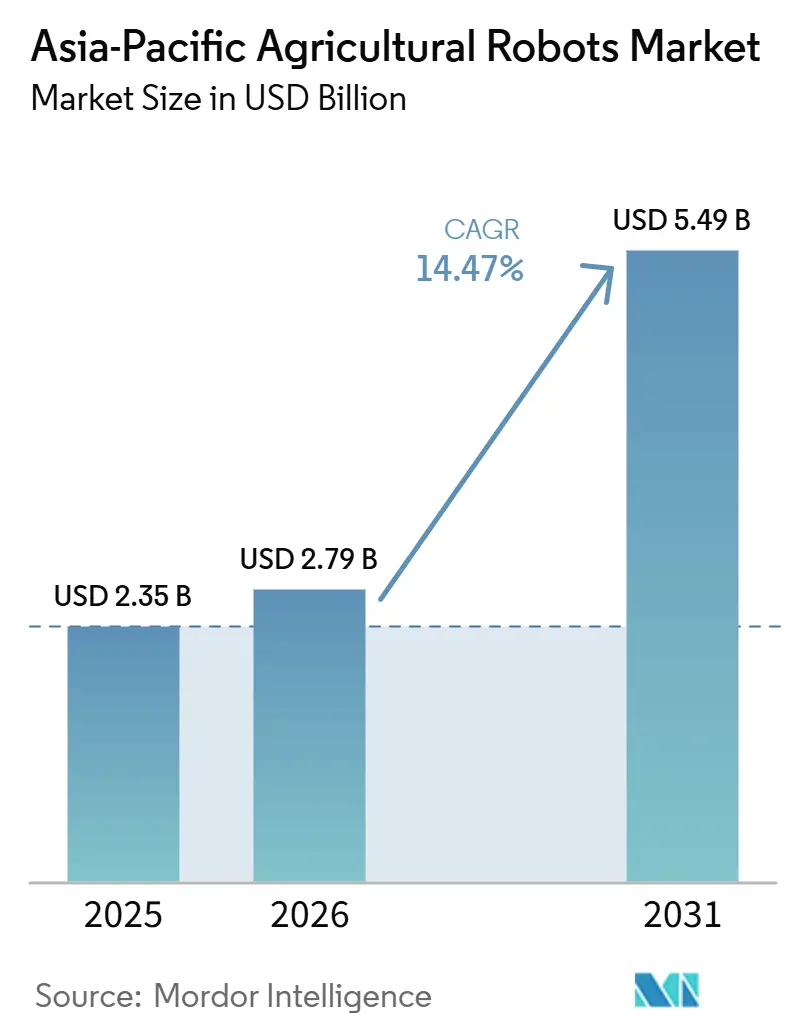
The Asia-Pacific agricultural robots market was valued at USD 2.35 billion in 2025 and is projected to grow from USD 2.79 billion in 2026 to USD 5.49 billion by 2031, registering a CAGR of 14.47% over the forecast period. Labor shortages and an aging agricultural workforce are accelerating the adoption of automation across farming operations. Growing demand for precision agriculture is driving the deployment of robotic solutions for spraying, harvesting, weeding, and crop monitoring to improve productivity, reduce input costs, and enhance operational efficiency. The increasing availability of robotics-as-a-service models and AI-enabled technologies is making agricultural robots more accessible to small and medium-sized farms, supporting broader market adoption. Manufacturers are focusing on autonomous technologies, software integration, and cost-effective solutions. At the same time, opportunities remain focused on precision farming, controlled-environment agriculture, and expanding smart farming initiatives across the region.
Key Report Takeaways
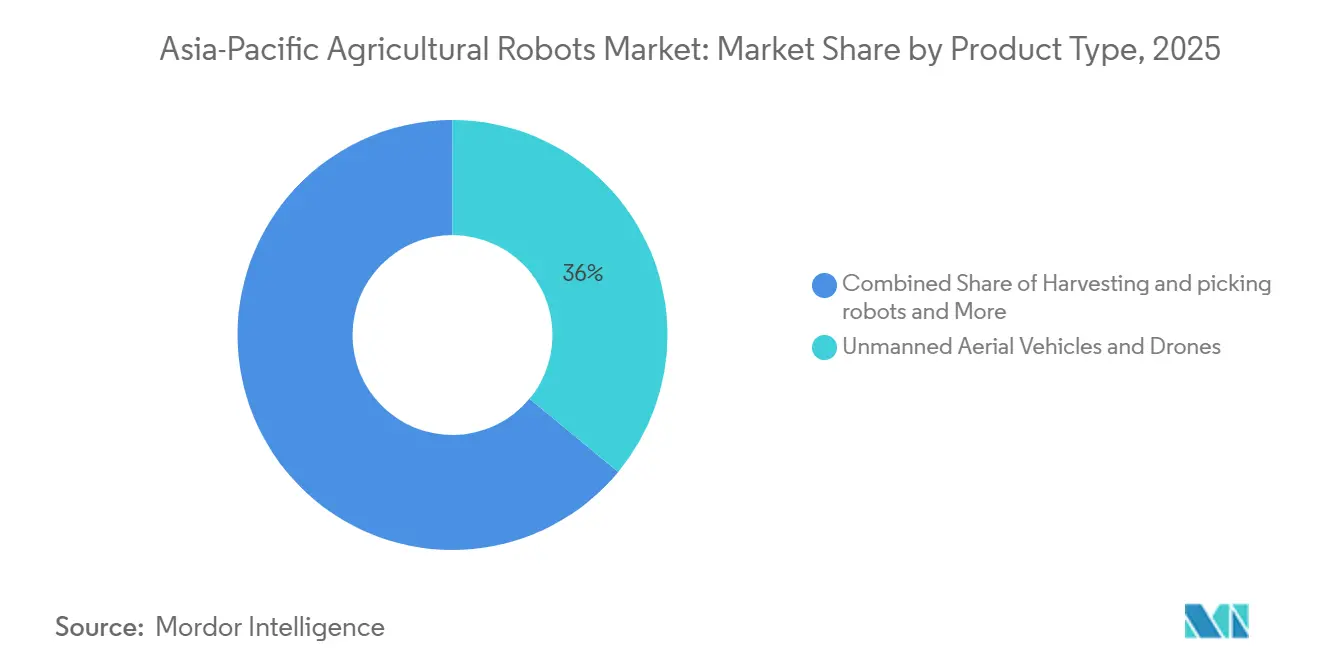
- By product type, unmanned aerial vehicles and drones accounted for the largest share at 36.0% of the Asia-Pacific agricultural robots market in 2025, while the harvesting and picking robots segment is forecast to grow at the fastest CAGR of 18.9% from 2026 to 2031.
- By application, crop farming held the largest 44.0% share in 2025, while the Asia-Pacific agricultural robots market size for greenhouse farming is forecast to grow at the fastest CAGR of 17.4% from 2026 to 2031.
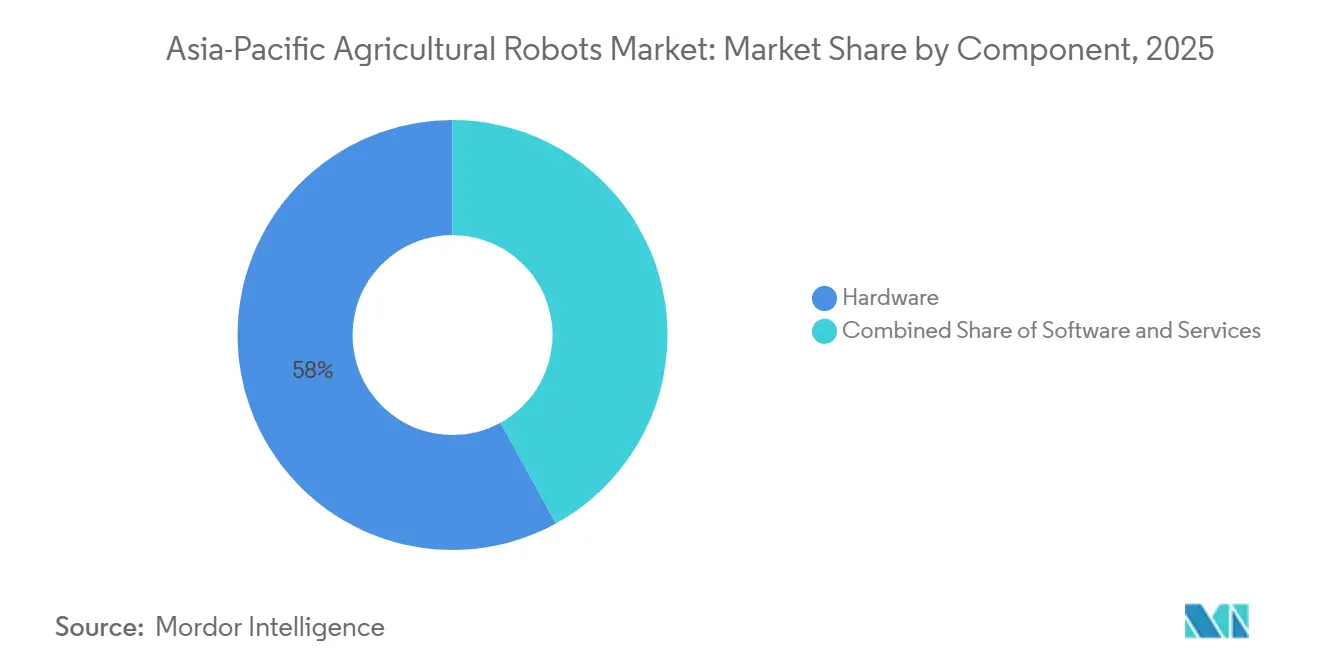
- By component, hardware accounted for the largest share at 58.0% in 2025, while software is forecast to grow at the fastest CAGR of 16.7% from 2026 to 2031.
- By geography, China accounted for the largest share at 31.0% in 2025, while India is forecast to grow at the fastest CAGR, 16.2%, from 2026 to 2031.
Note: Market size and forecast figures in this report are generated using Mordor Intelligence’s proprietary estimation framework, updated with the latest available data and insights as of January 2026.
Asia-Pacific Agricultural Robots Market Trends and Insights
Drivers Impact Analysis*
| Driver | (~) % Impact on CAGR Forecast | Geographic Relevance | Impact Timeline |
|---|---|---|---|
| Accelerating agricultural labor shortages in East Asia and Oceania | +4.8% | Japan, South Korea, Australia, and China coastal provinces | Short term (≤ 2 years) |
| Rising need for precision crop intervention in high-value farms | +3.2% | Japan, South Korea, Australia, China, and India | Medium term (2-4 years) |
| Government incentives for smart farming and automation | +3.0% | China, India, South Korea, Japan, Indonesia, and Philippines | Short term (≤ 2 years) |
| Declining economics of sensors, vision systems, and edge AI hardware | +2.5% | Regional, with Asia-Pacific manufacturing advantage | Medium term (2-4 years) |
| Expansion of robotics-as-a-service for small and mid-sized farms | +1.8% | India, Indonesia, Thailand, Philippines, and Vietnam | Medium term (2-4 years) |
| Autonomous robotics adoption in controlled-environment agriculture | +1.5% | China, Japan, South Korea, and Australia | Long term (≥ 4 years) |
| Source: Mordor Intelligence | |||
Accelerating Agricultural Labor Shortages in East Asia and Oceania
Labor shortages are emerging as a primary driver of the Asia-Pacific agricultural robots market, as producers increasingly automate labor-intensive farm operations. According to Japan's Ministry of Agriculture, Forestry and Fisheries (MAFF), the country had 1.11 million core agricultural workers in 2024, with an average age of 69.2 years and 60.9% aged 70 years or older, highlighting a growing workforce imbalance[1]Source: Ministry of Agriculture, Forestry and Fisheries (MAFF), "First Basic Plan for Food, Agriculture, and Rural Areas Based on the Revised Basic Act (Reference)," maff.go.jp.. This aging labor force is accelerating investments in autonomous tractors, robotic harvesters, drones, and other precision farming technologies to maintain productivity, improve operational efficiency, and ensure timely field operations across the region.
Government Incentives for Smart Farming and Automation
Government support is accelerating the adoption of agricultural robots across the Asia-Pacific region by reducing investment barriers and strengthening the smart farming ecosystem. According to the Ministry of Agriculture, Food and Rural Affairs (MAFRA) of South Korea, in 2025, the government designated two Smart Farming Support Centers to promote technology development, workforce training, industry growth, and wider adoption of smart farming solutions under the Act on Fostering and Supporting Smart Farming[2]Source: Ministry of Agriculture, Food and Rural Affairs (MAFRA), "South Korea's First Master Plan for Promotion of the Growth of the Smart-Farming Industry for the Years 2025–2029," mafra.go.kr.. These policy initiatives encourage investments in autonomous agricultural machinery, robotics, and digital farming technologies, supporting faster commercialization and long-term market growth across the region.
Declining Economics of Sensors, Vision Systems, and Edge AI Hardware
Declining costs of sensors, computer vision, and edge AI are improving the commercial viability of agricultural robots across the Asia-Pacific region by enabling affordable real-time autonomous operations. According to a 2025 study published in Scientific Reports, the Tiny-LiteNet edge-AI model achieved 98.6% classification accuracy and was integrated into a crop pest and disease detection device powered by a Raspberry Pi 5. The study reported an inference time of 80 milliseconds and a model size of 1.2 MB, although separate benchmarking sections reported 16-millisecond Raspberry Pi 5 latency and a 0.72 MB model size. These developments enable high-performance crop monitoring and disease detection using low-cost hardware, supporting wider deployment of agricultural robots for precision farming across farms of varying sizes.
Autonomous Robotics Adoption in Controlled-Environment Agriculture
Controlled-environment agriculture is creating long-term growth opportunities for the Asia-Pacific agricultural robots market, as greenhouse farming increasingly depends on automation, precision, and AI-enabled operations. In 2025, Fanhe Greenhouse completed a CNY 580 million (USD 80 million) smart farming project in Jeollanam-do, South Korea, comprising 48 AI-driven hybrid greenhouses spanning 35 hectares, developed in collaboration with Korea Agricultural Infrastructure Corporation (KAIC)[3]Source: Fanhe Greenhouse, "Fanhe Greenhouse Completes Pioneering China-Korea Smart Farming Project," finegreenhouse.com.. The expansion of large-scale intelligent greenhouse facilities is driving demand for autonomous monitoring, robotic harvesting, precision spraying, and climate-control technologies, supporting broader adoption of agricultural robots across protected cultivation systems in the Asia-Pacific region.
Restraints Impact Analysis*
| Restraint | (~) % Impact on CAGR Forecast | Geographic Relevance | Impact Timeline |
|---|---|---|---|
| High upfront capital cost and retrofit complexity | -2.8% | India, Indonesia, Thailand, Philippines, and Vietnam | Short term (≤ 2 years) |
| Fragmented farm digitization and interoperability gaps | -1.6% | Southeast Asia, South Asia, and rural China | Medium term (2-4 years) |
| Rural connectivity limits for cloud-connected autonomy | -1.2% | Indonesia, Philippines, and India, Pacific island systems | Long term (≥ 4 years) |
| Safety, liability, and cybersecurity concerns for autonomous farm machines | -0.8% | Regional, with country-level regulatory variation | Long term (≥ 4 years) |
| Source: Mordor Intelligence | |||
High Upfront Capital Cost and Retrofit Complexity
High upfront capital costs and retrofit complexity remain significant restraints on the Asia-Pacific agricultural robots market, particularly in smallholder-dominated farming systems. According to NITI Aayog's Frontier Tech Hub report (2025), more than 86% of India's farmers cultivate an average landholding of just 0.74 hectares. Such small and fragmented farms often lack the financial capacity to invest in expensive autonomous machinery. Additionally, integrating robotic technologies with existing tractors and equipment requires additional retrofit, installation, and maintenance expenditures. These cost barriers continue to limit large-scale adoption of agricultural robots across developing markets in the Asia-Pacific region.
Safety, Liability, and Cybersecurity Concerns for Autonomous Farm Machines
Safety, liability, and cybersecurity concerns continue to restrain the Asia-Pacific agricultural robots market as autonomous machines increasingly operate alongside farm workers. According to the Ministry of Agriculture, Food and Rural Affairs (MAFRA) of South Korea, in 2025, the government is establishing testing standards for autonomous agricultural machinery and agricultural robots to verify conformity with specified safety requirements and testing methods prior to wider commercialization. Failure to comply with evolving safety, operational, and cybersecurity requirements can delay product approvals, increase compliance costs, and slow the large-scale deployment of autonomous agricultural robots across the region.
*Our forecasts treat driver/restraint impacts as directional, not additive. The impact forecasts reflect baseline growth, mix effects, and variable interactions.
Segment Analysis
By Product Type: Drones Lead Scale While Harvesting Robots Drive Future Growth
Unmanned aerial vehicles and drones accounted for the largest share of 36.0% in the Asia-Pacific agricultural robots market in 2025. Their dominant position reflects strong adoption across broad-acre farming for crop spraying, field monitoring, and precision mapping, where rapid aerial coverage improves operational efficiency. Drones are particularly suited to fragmented farmland and diverse cropping systems common across several Asia-Pacific countries, enabling growers to optimize field operations with lower labor requirements. Their versatility, relatively simple deployment, and expanding service-based operating models continue to strengthen their position as the most widely adopted agricultural robotic platform in the region.
Harvesting and picking robots are forecast to grow at the fastest CAGR of 18.9% from 2026 to 2031. Rising labor shortages in fruit, vegetable, orchard, and greenhouse production are encouraging growers to automate harvesting activities that require speed, consistency, and precision. Improvements in robotic vision, artificial intelligence, and end-effector technologies are expanding commercial applications for delicate crops, improving picking accuracy and reducing crop damage. As manufacturers continue developing flexible harvesting systems capable of handling multiple crop varieties, harvesting robots are projected to become one of the fastest-growing product categories in the Asia-Pacific agricultural robots market.



By Application: Crop Farming Maintains Leadership While Greenhouse Farming Accelerates
Crop farming held the largest share of the Asia-Pacific agricultural robots market at 44.0% in 2025. The segment benefits from extensive cultivation of cereals, grains, oilseeds, and other field crops, which require efficient spraying, scouting, planting, and crop monitoring. Large cultivation areas provide greater opportunities for automation by improving equipment utilization and reducing operating costs over multiple growing seasons. Continued investments in precision agriculture, autonomous guidance systems, and digital farm management solutions are supporting robotic adoption across commercial crop production, along with improvements in productivity and resource efficiency.
The Asia-Pacific agricultural robots market for greenhouse farming is forecast to grow at the fastest CAGR of 17.4% from 2026 to 2031. Controlled-environment agriculture increasingly depends on automation to maintain consistent growing conditions while improving labor productivity and crop quality. Robotic technologies support greenhouse operators through automated harvesting, crop monitoring, climate management, and precision input application within controlled production environments. Continuous improvements in artificial intelligence, sensing technologies, and environmental control systems are making greenhouse automation more practical across high-value horticultural production, creating strong long-term opportunities for agricultural robotics throughout the Asia-Pacific region.
By Component: Hardware Dominates While Software Expands Rapidly
Hardware accounted for the largest share at 58.0% in 2025. Demand remains concentrated in physical equipment, including autonomous platforms, sensors, cameras, navigation systems, robotic arms, and onboard computing units that form the foundation of agricultural automation. Initial investments in robotic equipment continue to account for the largest share of deployment costs as growers establish automation capabilities across farming operations. Ongoing purchases of replacement components, fleet expansion, and equipment upgrades continue to support hardware demand throughout the regional agricultural robotics industry.
Software is forecast to grow at the fastest CAGR of 16.7% from 2026 to 2031. Increasing demand for artificial intelligence, machine vision, fleet management, predictive analytics, and farm management platforms is driving software adoption across robotic farming operations. Advanced software enables autonomous decision-making, precision task execution, and real-time performance optimization, while improving connectivity between agricultural machines and digital farm management systems. As robotic deployments become more sophisticated, software solutions are projected to generate greater recurring value through continuous updates, analytics capabilities, and integrated automation services across the Asia-Pacific agricultural robots market.
Geography Analysis
China accounted for the largest share at 31.0% of the Asia-Pacific agricultural robots market in 2025. The country maintains this position through extensive agricultural mechanization, a well-established robotics manufacturing ecosystem, and widespread deployment of precision farming technologies. Strong domestic production capabilities, expanding smart agriculture initiatives, and broad adoption of agricultural drones continue to support robotic implementation across field crops and horticulture. The presence of established agricultural equipment manufacturers and continued investment in artificial intelligence, autonomous machinery, and digital farming solutions further reinforce China's position as the largest regional market.
India is forecast to grow at the fastest CAGR of 16.2% from 2026 to 2031. The country's agricultural robotics market is expanding as growers increasingly seek affordable automation solutions that improve productivity while addressing labor shortages and fragmented farm operations. Service-based business models, precision spraying technologies, and autonomous farming equipment are becoming more accessible to small and medium-sized farms. Continued government support for digital agriculture, a growing agricultural technology startup base, and increasing private investment in smart farming solutions are projected to accelerate agricultural robot adoption across diverse cropping systems throughout the forecast period.
Japan, Australia, South Korea, Indonesia, Thailand, and other Asia-Pacific countries continue to strengthen the regional agricultural robotics ecosystem through technology innovation, research partnerships, and smart farming initiatives. In June 2025, Agricultural Robotics completed its AUD 1.5 million (USD 0.95 million) Accelerating Commercialisation Grant, supporting the development and field deployment of autonomous mango harvesting technologies in Australia. Such commercialization initiatives are expanding robotic applications in horticulture while encouraging broader adoption of autonomous harvesting, machine vision, and precision agriculture technologies across emerging Asia-Pacific agricultural markets.
Competitive Landscape
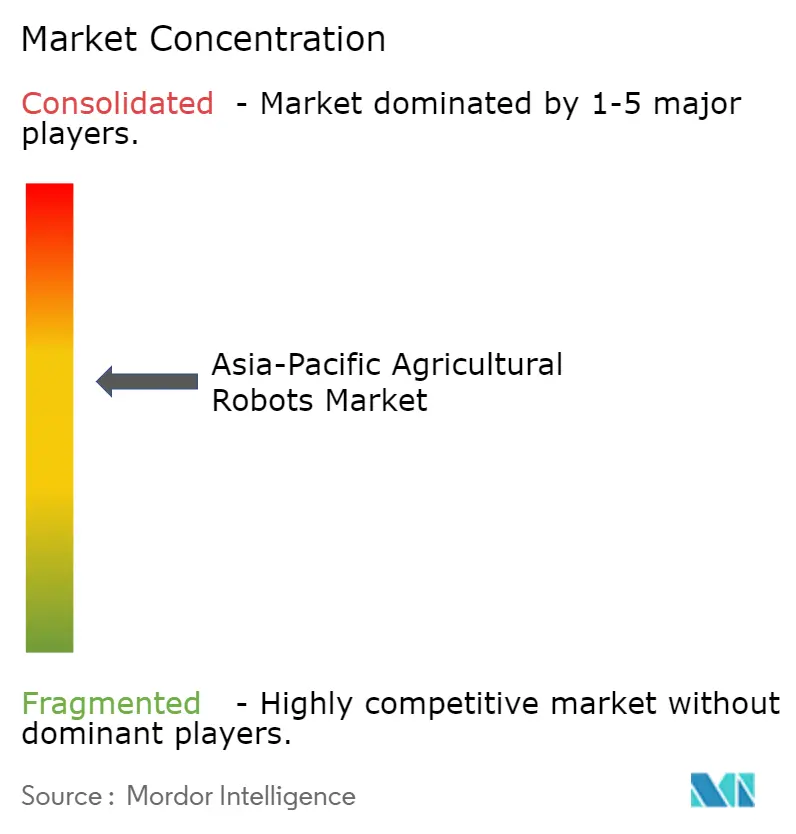
The Asia-Pacific agricultural robots market is moderately consolidated in 2025, with SZ DJI Technology Co., Ltd., Deere and Company, Kubota Corporation, Yanmar Holdings Co., Ltd., and AGCO Corporation among the key participants. These companies compete through broad product portfolios spanning agricultural drones, autonomous tractors, precision guidance systems, and intelligent farming solutions, while leveraging established distribution networks and continuous investments in automation technologies. Competition is increasingly focused on integrating artificial intelligence, precision agriculture capabilities, software-enabled farm management, and localized after-sales support to strengthen customer relationships and expand adoption across diverse agricultural production systems.
Manufacturers are increasingly shifting from standalone machinery sales toward integrated smart farming ecosystems that combine autonomous equipment, artificial intelligence, cloud-based analytics, and precision agriculture software. Companies continue expanding their portfolios through new autonomous platforms, strategic collaborations, and digital farming solutions that improve operational efficiency and reduce labor dependence. Competitive differentiation is also being driven by robotics-as-a-service offerings, machine vision technologies, and fleet management platforms that improve accessibility for small and medium-sized farms. Vendors with strong research capabilities, localized technical support, and integrated digital solutions are strengthening their competitive positions across the Asia-Pacific agricultural robots market.
Competitive opportunities remain strongest in emerging agricultural markets where automation adoption is at an early stage, and demand continues shifting toward affordable precision farming solutions. At its Global Dealer Conference in January 2026, FJ Dynamics International Limited announced a target of expanding its worldwide network to more than 1,000 authorized dealers, strengthening localized sales and after-sales support for precision agriculture technologies. Expanding distribution capabilities, field service networks, and customer training programs are becoming important competitive differentiators as agricultural robotics adoption accelerates across the Asia-Pacific region.
Asia-Pacific Agricultural Robots Industry Leaders
-
SZ DJI Technology Co., Ltd.
-
Deere and Company
-
Kubota Corporation
-
YANMAR HOLDINGS CO., LTD.
-
AGCO Corporation
- *Disclaimer: Major Players sorted in no particular order

Recent Industry Developments
- January 2026: FJ Dynamics International Limited announced at its Global Dealer Conference 2026 that it had expanded its global partner network to more than 1,000 authorized dealers across over 100 countries, strengthening sales, technical support, and precision agriculture deployment in the Asia-Pacific region.
- July 2025: SZ DJI Technology Co., Ltd. launched the DJI AGRAS T100, AGRAS T70P, and AGRAS T25P agricultural drones globally, including Asia-Pacific, which offer higher payload capacity, AI-powered flight algorithms, and improved autonomous spraying and spreading capabilities for precision agriculture.
- March 2025: Kubota Corporation unveiled its Type V and Type S autonomous platform robots at Expo 2025 Osaka, Kansai, strengthening its precision farming portfolio and reinforcing the adoption of AI-enabled agricultural robotics across Japan and the broader Asia-Pacific agricultural robots market.


Asia-Pacific Agricultural Robots Market Report Scope
Agricultural robots are autonomous or semi-autonomous machines designed to perform farming tasks with minimal human intervention. They are used for planting, spraying, harvesting, weeding, monitoring crops, and livestock management to improve productivity, precision, operational efficiency, and resource utilization.
The Asia-Pacific agricultural robots market report is segmented by product type (driverless tractors, unmanned aerial vehicles and drones, milking robots, harvesting and picking robots, weeding robots, and other product types), by component (hardware, software, and services), by application (crop farming, livestock management, dairy management, aquaculture, and greenhouse farming), and by geography (China, Japan, India, Australia, South Korea, Indonesia, Thailand, and the rest of Asia-Pacific). The market forecasts are provided in terms of value (USD).
| Driverless Tractors |
| Unmanned Aerial Vehicles and Drones |
| Milking Robots |
| Harvesting and Picking Robots |
| Weeding Robots |
| Other Product Types |
| Crop Farming |
| Livestock Management |
| Dairy Management |
| Aquaculture |
| Greenhouse Farming |
| Hardware |
| Software |
| Services |
| China |
| Japan |
| India |
| Australia |
| South Korea |
| Indonesia |
| Thailand |
| Rest of Asia-Pacific |
| By Product Type | Driverless Tractors |
| Unmanned Aerial Vehicles and Drones | |
| Milking Robots | |
| Harvesting and Picking Robots | |
| Weeding Robots | |
| Other Product Types | |
| By Application | Crop Farming |
| Livestock Management | |
| Dairy Management | |
| Aquaculture | |
| Greenhouse Farming | |
| By Component | Hardware |
| Software | |
| Services | |
| By Geography | China |
| Japan | |
| India | |
| Australia | |
| South Korea | |
| Indonesia | |
| Thailand | |
| Rest of Asia-Pacific |


Key Questions Answered in the Report
What is the markets size of the Asia-Pacific agricultural robots market in 2025 and what will be projected size by 2031?
The Asia-Pacific agricultural robots market was valued at USD 2.35 billion in 2025 and stands at USD 2.79 billion in 2026, with forecast value reaching USD 5.49 billion by 2031.
What is driving agricultural robot adoption across Asia-Pacific?
The strongest drivers are labor shortages, aging farm workforces, demand for precision crop intervention, policy support for smart farming, and lower costs for sensing and edge computing systems.
Which product category leads regional revenue?
Unmanned Aerial Vehicles and drones led the market with a largest 36.0% share in 2025 because they fit large crop areas and fragmented field layouts well.
Which application is growing the fastest in the region?
Greenhouse farming is the fastest-growing application, with forecast growth of 17.4% from 2026 to 2031, supported by climate control, data-rich operations, and higher-value crop economics.
Page last updated on:





