
Market Overview
| Study Period | 2021 - 2031 |
|---|---|
| Forecast Data Period | 2026 - 2031 |
| Base Year Market Size (2025) | 3.78 Billion liters |
| Market Volume (2026) | 3.89 Billion liters |
| Market Volume (2031) | 4.48 Billion liters |
| Growth Rate (2026 - 2031) | 2.88 % |
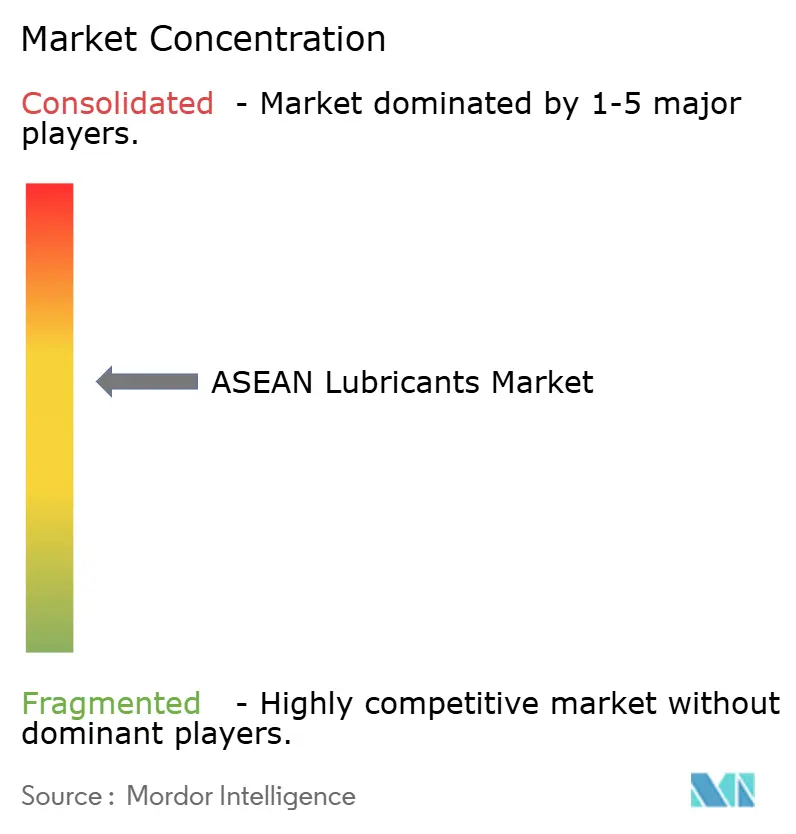
| Market Concentration | Medium |
Major Players *Disclaimer: Major Players sorted in no particular order Image © Mordor Intelligence. Reuse requires attribution under CC BY 4.0. | |
ASEAN Lubricants Market Analysis by Mordor Intelligence
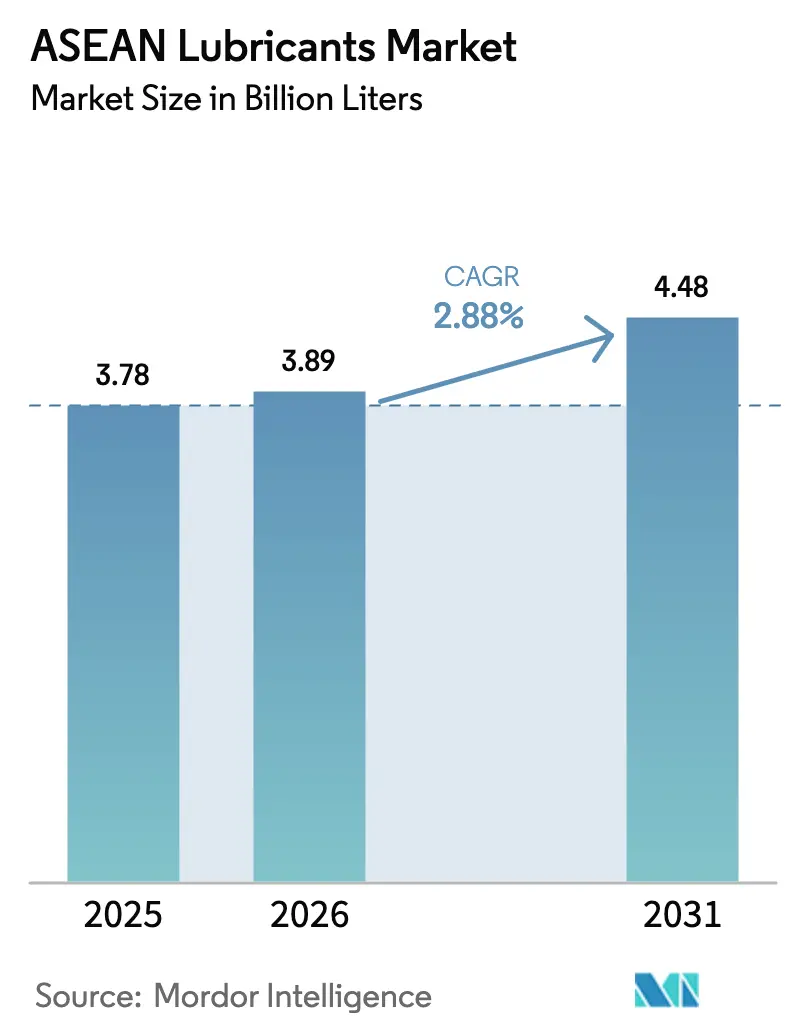
The ASEAN Lubricants Market size is projected to be 3.78 Billion liters in 2025, 3.89 Billion liters in 2026, and reach 4.48 Billion liters by 2031, growing at a CAGR of 2.88% from 2026 to 2031. This steady trajectory reflects the intersection of longer drain intervals made possible by synthetic formulations, the first meaningful uptick in electrified power-trains, and input-cost swings that compress blender margins. Base-oil investments in Singapore, refinery constraints in Vietnam, and biodiesel mandates in Indonesia are reshaping trade flows and blurring the historical line between domestic and cross-border supply. Competitive strategies are coalescing around synthetic premiumization, service-layer digitization, and supply-chain hedging that links base-stock security with additive integration. These shifts give the ASEAN lubricants market new opportunities in industrial equipment, marine bunkering, and predictive-maintenance bundles while tempering growth in traditional passenger-car engine oils.
Key Report Takeaways
- By product type, automotive engine oil held 33.12% of the ASEAN lubricants market share in 2025 while industrial engine oil is forecast to grow at a 2.96% CAGR through 2031.
- By end-user industry, the automotive segment captured 55.12% volume in 2025 whereas the industrial segment is expected to post a 2.83% CAGR to 2031.
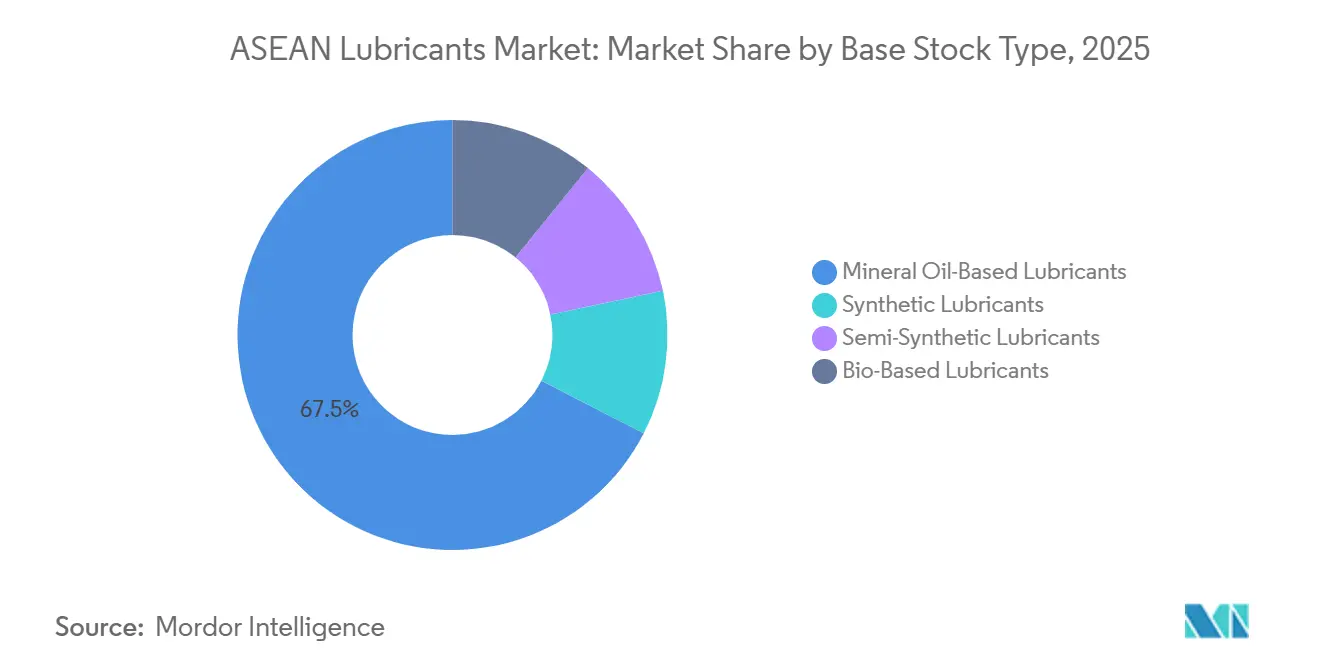
- By base-stock type, mineral oils controlled 67.45% of 2025 volumes and bio-based lubricants represent the fastest growth at a 3.36% CAGR to 2031.
- By geography, Indonesia accounted for 31.46% of 2025 volume yet Vietnam is projected to lead with a 3.41% CAGR through 2031.
Note: Market size and forecast figures in this report are generated using Mordor Intelligence’s proprietary estimation framework, updated with the latest available data and insights as of January 2026.
Market Trends and Insights
Drivers Impact Analysis of ASEAN Lubricants Market*
| Driver | (~) % Impact on CAGR Forecast | Geographic Relevance | Impact Timeline |
|---|---|---|---|
| Growing vehicle parc and freight movement | +0.8% | Indonesia, Thailand, Vietnam, Philippines | Medium term (2-4 years) |
| Rapid industrialisation and manufacturing expansion | +0.7% | Vietnam, Indonesia, Thailand | Long term (≥4 years) |
| Shift towards high-performance synthetic lubricants | +0.5% | Singapore, Malaysia, Thailand | Medium term (2-4 years) |
| Digitalised distribution and predictive-lubrication services | +0.3% | Singapore, Malaysia, urban Indonesia and Thailand | Long term (≥4 years) |
| Rise of ASEAN marine-bunkering hubs | +0.4% | Singapore, Malaysia (Port Klang, Johor) | Short term (≤2 years) |
| Source: Mordor Intelligence | |||
Growing Vehicle Parc and Freight Movement
Commercial and passenger fleets continue to swell, yet two-wheeler dominance in Indonesia and Vietnam shifts demand toward small-sump volumes that turn over faster than car lubricants. Philippines automakers plan to assemble 480 000 units in 2025 while Malaysia produced 738 000 units in 2024 and targets 750 000 in 2025[1]. Freight growth tied to USD 222 billion in 2024 FDI inflows increases duty cycles for trucks and construction machinery. Suppliers that tailor two-wheeler and commercial-vehicle oils with enhanced shear stability and detergent chemistry benefit from higher replacement frequency. PETRONAS Sprinta and Mobil Super Moto lines already exploit this dynamic, reinforcing why the ASEAN lubricants market will keep an automotive volume edge even as per-unit consumption falls.
Rapid Industrialisation and Manufacturing Expansion
Relocation of electronics, semiconductor, and renewable component plants from China into Vietnam, Indonesia, and Thailand is lifting consumption of metalworking fluids, hydraulic oils, and turbine oils. The International Energy Agency sees regional oil use in industry rising to 6.4 million bpd by 2030 as new fabs and data centers go live[2]. Specialty additive demand is advancing faster than commodity grades, as shown by PETRONAS Chemicals which cited higher engineered-fluid sales in early 2024 despite weaker additive margins. This diversification makes the ASEAN lubricants market less tied to passenger-car cycles and more dependent on capital-equipment investments.
Shift Towards High-Performance Synthetic Lubricants
OEM factory-fill specifications for low-viscosity synthetics lock in aftermarket pull-through. PTT Lubricants’ EVOTEC platform, TotalEnergies’ expanded solar-powered Singapore blender, and ExxonMobil’s focus on PAO and ester base stocks illustrate the pivot toward higher margin fluids that extend drain intervals and boost fuel economy. Distributors face working-capital pressure because synthetic SKUs move slowly outside major metros, yet predictive analytics can refine stocking strategy and mitigate inventory risk.
Digitalised Distribution and Predictive-Lubrication Services
Condition-monitoring sensors that track viscosity, base number, and ferrous debris are embedding lubricants into broader maintenance contracts. Shell data show maintenance cost savings above 20% when predictive analytics guide oil changes. Castrol’s Fleet Health AI reports one-third fleet cost reduction and has convinced 74% of managers to invest in telematics despite patchy 5G coverage. In the ASEAN lubricants market, larger blenders pair fluids with dashboards and API integrations that raise switching costs and secure fleet loyalty.
Restraints Impact Analysis of ASEAN Lubricants Market*
| Restraint | (~) % Impact on CAGR Forecast | Geographic Relevance | Impact Timeline |
|---|---|---|---|
| Longer drain intervals in modern engines | -0.6% | Singapore, Malaysia, urban Thailand and Indonesia | Medium term (2-4 years) |
| Base-oil price volatility | -0.4% | All ASEAN, linked to Brent | Short term (≤2 years) |
| Accelerated EV adoption in key states | -0.5% | Thailand, Indonesia, Singapore | Long term (≥4 years) |
| Source: Mordor Intelligence | |||
Longer Drain Intervals in Modern Engines
Synthetic multigrades that meet ACEA C5 and API SP extend service intervals to 20 000 km, halving annual per-vehicle demand. Liqui Moly guidance and OEM validation of TotalEnergies Quartz EV-Drive show viscosity stability beyond 100,000 km. Blenders respond by upselling synthetics at a 30% price premium yet must invest in mechanic training and point-of-sale promotion in cost-sensitive markets.
Base-Oil Price Volatility
Average product prices fell in early 2024 even as silicone prices rose after an unplanned Chinese outage, underscoring how tight supply can detach from crude trends. ExxonMobil’s new Group II stream in Singapore alleviates some spot exposure, but Indonesia’s B40 mandate diverts feedstock toward biofuel and tightens base-stock pools. Regional players with limited hedging capacity endure the sharpest margin compression.
*Our forecasts treat driver/restraint impacts as directional, not additive. The impact forecasts reflect baseline growth, mix effects, and variable interactions.
ASEAN Lubricants Market Segment Analysis
By Product Type:
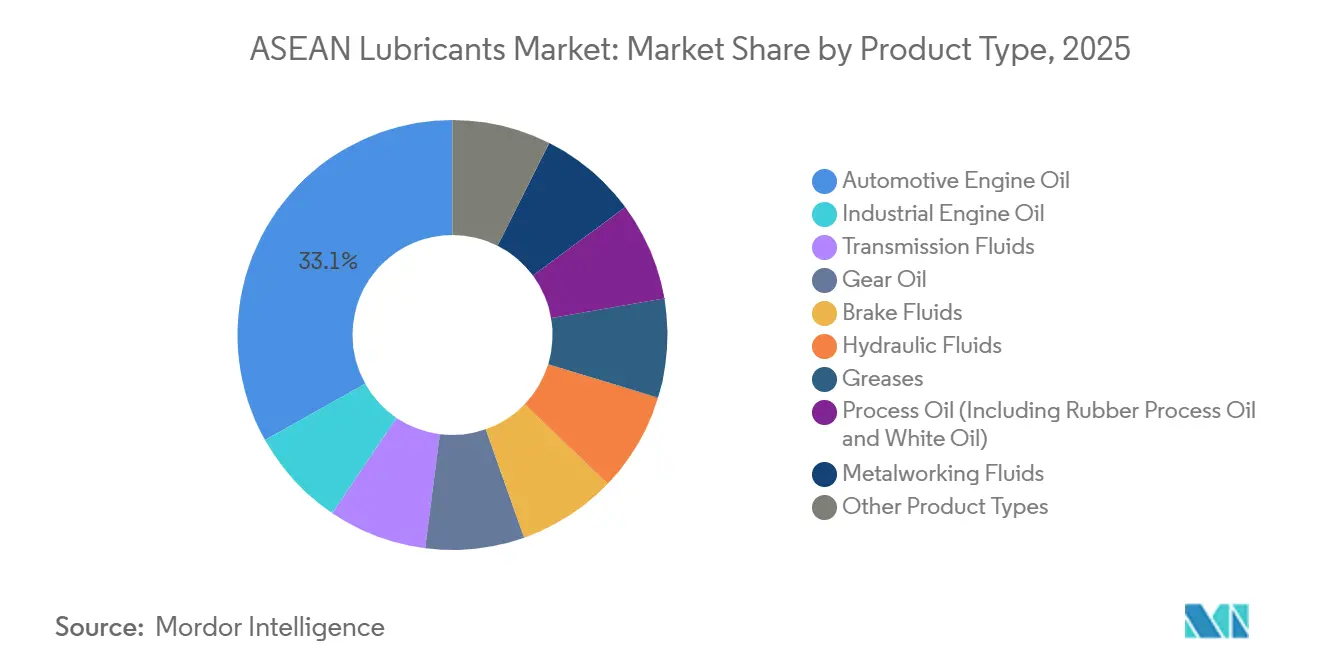
Industrial Oils Outpace Automotive in GrowthAutomotive engine oil held 33.12% volume share in 2025, yet industrial engine oil is forecast to grow at 2.96% CAGR through 2031, the fastest rate among all product types, reflecting ASEAN's manufacturing buildout and power-generation investments that now rival passenger-vehicle parc expansion as the primary demand vector. Transmission fluids, gear oils, and brake fluids collectively serve the automotive drivetrain segment, where the shift to dual-clutch transmissions (DCT) in China and continuously variable transmissions (CVT) in Japan is spilling into ASEAN OEM specifications, requiring ATF formulations with enhanced shear stability and friction modifiers. Metalworking fluids benefit from clean-room manufacturing where bio-stable emulsions cut disposal costs. The ASEAN lubricants market size for turbine oils is poised to expand alongside gas-fired peaking plants that balance rising renewable penetration. Process oils remain a stable niche tied to tire and pharmaceutical output where food-grade white oils command premium pricing.
A dedicated grease wave is unfolding. Shell’s new Indonesian plant adds 12 million liters of capacity for lithium and calcium sulfonate greases that serve automotive bearings, industrial machinery, and marine deck equipment. Castrol’s electric-vehicle greases are engineered for electrical compatibility and reduced rolling resistance, a design that supports the 13,478 EV sales logged in Malaysia during 2024. Bio-based greases using ester base stocks already meet maritime biodegradability mandates and deliver the fastest gains within the broader lubricant basket.

By End-User Industry:
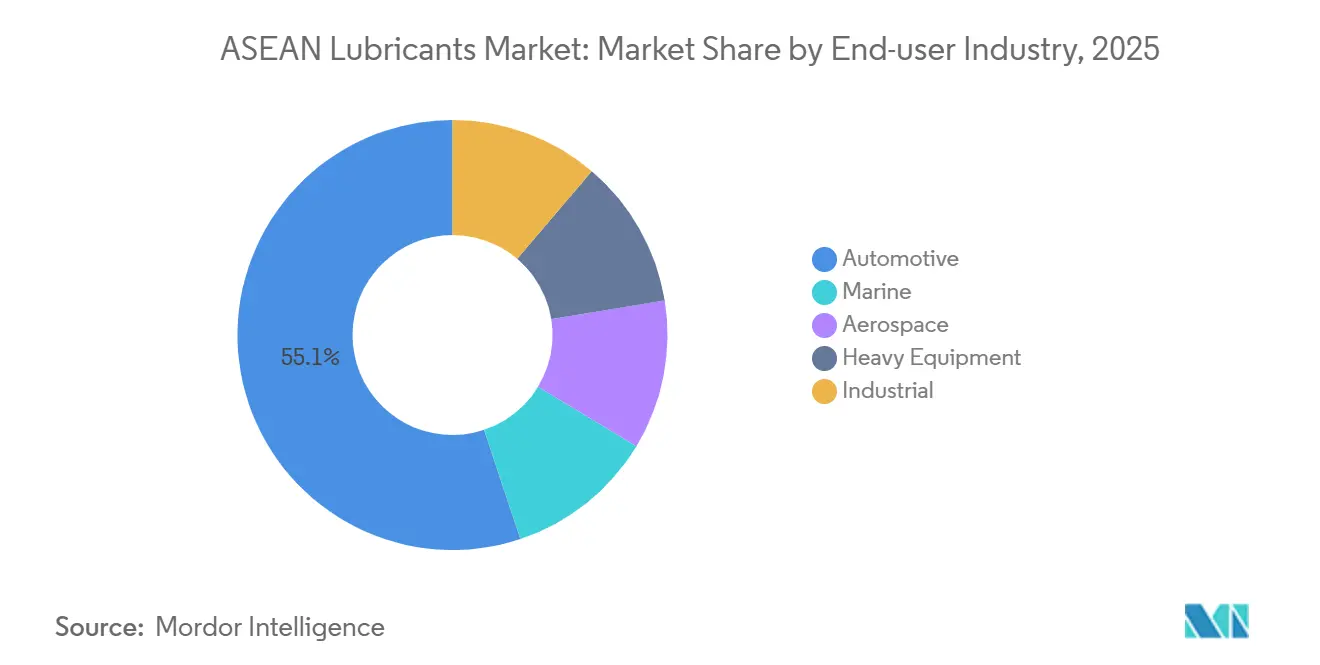
Industrial Segment Closes Gap on Automotive DominanceAutomotive applications still deliver 55.12% of 2025 volume, yet industrial end users will add most incremental liters through 2031. Two-wheelers contribute outsize demand thanks to Indonesia and Vietnam each exceeding 100 million registered motorcycles, a figure that cements high-frequency oil changes despite small sump volumes. Commercial vehicles maintain demand as e-commerce drives last-mile logistics throughout the ASEAN lubricants market. Marine volumes climb in tandem with record bunker throughput at Singapore and Port Klang where B30 blends require high-alkaline cylinder oils.
The industrial segment is forecast to grow at 2.83% CAGR through 2031, narrowing the gap as manufacturing, power generation, and heavy equipment demand accelerates. Industrial users exhibit diversified needs. Metalworking shops in Vietnam, semiconductor clean rooms in Malaysia, and gas turbines across Thailand all rely on high-performance fluids with stringent cleanliness and oxidation profiles. PETRONAS reports aviation turbine oil sales rising alongside air travel recovery, while mining operations adopt predictive-maintenance platforms that bundle lubrication, edge sensors, and analytics. Industrial buyers value service reliability and technical support more than headline price, a contrast that helps premium suppliers grow mix even where volumes lag automotive totals.
By Base Stock Type:
Bio-Based Gains Share Despite Mineral DominanceMineral oils retain a 67.45% volume stronghold although bio-based lubricants carry the top growth rate at 3.36% CAGR. Synthetic base stocks from ExxonMobil’s 20,000 bpd Singapore expansion and TotalEnergies’ 310,000 tpa blender cater to low-viscosity engine oils and EV driveline fluids that require high viscosity index and oxidative endurance. Semi-synthetics bridge cost gaps in rural channels where full synthetics face resistance.
Bio-based lubricants advance where environmental liability is high, including forestry machinery and harbor equipment subject to spill regulations. EU RED III and SAF quotas influence OEM purchasing across the supply chain, encouraging ester-based fluids even in ASEAN. PETRONAS’ Pengerang biorefinery and its silicone plant in Gebeng supply feedstocks for hybrid formulations that blend mineral, synthetic, and bio components for balanced cost and performance.
Geography Analysis
ASEAN Lubricants Market
Indonesia leads with 31.46% of 2025 regional volume, supported by Pertamina Lubricants’ 36% domestic share and 612 430 kl sales in 2024. Vietnam, however, is set for the fastest 3.41% CAGR to 2031 as Idemitsu’s Nghi Son refinery lifts output to 11.4 million t at 120% capacity and manufacturing FDI floods into the north. Thailand balances a mature automotive base with BYD’s new EV plant, implying a pivot from engine oils to EV fluids. Malaysia combines semiconductor growth with Port Klang’s bunkering trade, while Singapore, despite modest consumption, anchors supply logistics thanks to world-scale blending and base-stock capacity.
Vietnam Lubricants Market
Vietnam’s outsized growth invites supply chain arbitrage. Tight local base-stock availability raises spot prices for finished lubricants, advantaging importers who store cargo in bonded depots around Hai Phong and Ho Chi Minh City. Government interventions in fuel pricing can magnify spreads, rewarding agile distributors. Rural Vietnam maintains a vast two-wheeler parc, ensuring engine-oil demand remains relevant even as Hanoi and Ho Chi Minh City shift to electric scooters.
Regulatory Landscape
ASEAN lubricant regulation is tightening around product quality, traceability, and conformity assessment, with continuing use of international performance benchmarks (for example API categories for engine oils) alongside national rules. In Indonesia, Ministry of Industry Regulation No. 8 of 2025 made SNI compliance mandatory for motor vehicle lubricating oils (replacing the 2018 rule), and shifted submissions to the SIINas electronic platform. BBLM was also appointed as an LSPro for mandatory SNI certification under a 2025 ministerial decision. These steps raise the compliance bar for producers and importers and change how finished lubricants are labeled, documented, and admitted through formal market channels.
Thailand uses trader and product controls through the Department of Energy Business (DOEB), including notification requirements for engine oil appearance and quality (for Director-General approval) and distribution restrictions that exclude low-performance API categories (such as SA/SB for gasoline and CA/CB for diesel). At the regional level, the ASEAN Consultative Committee for Standards and Quality (ACCSQ) under the ASEAN Economic Community Strategic Plan 2026-2030 continues work on harmonization and conformity assessment. When national requirements align, this can support mutual recognition approaches that reduce duplicate testing for cross-border trade.
Value Chain Analysis
The value chain starts with base oil supply (mineral Group I/II and higher-performance Group II/III streams) and additives, then moves to blending and packaging into multi-channel distribution serving automotive, industrial, marine, aerospace, heavy equipment, and other end users. Singapore remains a pivotal upstream and logistics node for ASEAN, reinforced by ExxonMobil starting up its Singapore Resid Upgrade Project in September 2025. The project added 20,000 bpd of high-value lubricant base stock capacity and introduced grades such as EHC 340 MAX. This upstream capacity supports synthetic and premium formulations and also affects intra-ASEAN trade flows, where import-dependent markets manage bonded storage, distributor working capital, and lead times.
Midstream conversion capacity is also changing. Shell announced in September 2024 a new grease manufacturing plant at its Marunda Lubricants Oil Blending Plant complex in Bekasi, Indonesia, planned at 12 kilotonnes per year, strengthening local supply for higher-value greases used across industrial machinery, automotive bearings, and marine applications. Downstream, compliance and quality notification regimes (for example DOEB controls in Thailand) add testing and documentation steps that influence distributor selection, channel strategy, and brand authentication efforts. Industry coordination and knowledge transfer are supported by the Asian Lubricants Industry Association (ALIA), which represents over 100 businesses spanning producers, additive suppliers, and distributors across the region.
Competitive Landscape
The ASEAN Lubricants Market is moderately consolidated. Regional challengers assert home advantage. Pertamina dominates in Indonesia through retail station outreach and government contracts. PTT Lubricants owns strong local share and exports EVOTEC synthetics after winning the Prime Minister’s Export Award. Idemitsu backs its Vietnamese downstream ambitions with refinery supply security. These players grow by matching multinational portfolio breadth with localized distribution and faster regulatory approvals. Technology and service layers increasingly determine differentiation. Predictive maintenance, telematics, and API integration create sticky fleet relationships. Bio-based niche leadership in marine and forestry keeps pricing power for players who certify biodegradability early.
ASEAN Lubricants Industry Leaders
-
Castrol Limited
-
Caltex
-
Shell plc
-
PT Pertamina (Persero)
-
Petroliam Nasional Berhad (PETRONAS)
- *Disclaimer: Major Players sorted in no particular order
ASEAN Lubricants Market Companies Covered in this Report
- Caltex
- Castrol Limited
- Exxon Mobil Corporation
- FUCHS
- Idemitsu Kosan Co., Ltd.
- Petroliam Nasional Berhad (PETRONAS)
- PT Pertamina (Persero)
- PTT Lubricants
- Shell plc
- TotalEnergies
- Valvoline Global Operations
- SK Enmove
- ENEOS Corporation
- Sinopec Lubricant (Singapore) Pte Ltd,
- Repsol
- Gulf Oil International
- Motul SA
- LUKOIL
- Gazpromneft Lubricants
Market Opportunities and Future Outlook
The market is opening visible opportunities in supply security and circular base oils, as Singapore attracts capital into higher-value base stock and used-oil upgrading pathways. ENEOS signed agreements in May 2026 to acquire Chevron’s downstream fuels and lubricants marketing businesses across multiple ASEAN markets (including Singapore, Malaysia, Philippines, Vietnam, and Indonesia) and related assets such as the Penjuru terminal and lubricants facility in Singapore. This reshapes route-to-market control and can support faster portfolio rollouts across Caltex-branded networks. Aster Chemicals and Energy’s December 2025 plan to invest USD 155 million to upgrade the Bukom Refinery (including a USD 71 million upgrade to the Lube Oil Complex) and its April 2026 MoU with Puraglobe to explore a re-refined base oil facility in Singapore also point to an active push toward higher-value Group II/III-type output and circular feedstock options.
Compliance-led formalization and premiumization is another opportunity area, given stricter government enforcement of quality and documentation. Indonesia’s mandatory SNI framework under Regulation No. 8 of 2025 and electronic submissions via SIINas increase the advantage of suppliers with strong QA systems and auditable supply chains, while also supporting anti-counterfeit efforts in high-throughput two-wheeler and PCMO channels. On the demand side, the report’s observed shift toward industrialization, marine bunkering hubs, and service-layer digitization broadens offerings beyond liters. This includes condition monitoring, predictive maintenance bundles, and specialty fluids (for example greases and thermal management fluids) tied to industrial equipment and emerging electrified powertrains.
Recent Industry Developments in ASEAN Lubricants Market
- May 2026: ENEOS signed agreements to acquire Chevron's downstream fuels and lubricants marketing businesses across Southeast Asia and Australia for USD 2.17 billion, including lubricant-related assets such as the Penjuru terminal and lubricants facility in Singapore. The transaction shifts control of major retail and commercial channels across ASEAN markets where Caltex has established distribution, strengthening ENEOS's ability to coordinate supply, branding, and product placement across the region.
- November 2025: Kixx partnered with GS25 to launch the first Kixx Station in Vietnam, combining lubricant retail with oil change services. The format supports product authentication and increases conversion at the point of service, a relevant differentiator in two-wheeler-heavy markets where counterfeit risk and fragmented workshops can erode branded volumes.
- September 2024: Shell announced plans to build a new grease manufacturing plant at its Marunda Lubricants Oil Blending Plant complex in Bekasi, Indonesia, with planned capacity of 12 kilotonnes per year. Adding local grease output strengthens availability for industrial and automotive applications and reduces reliance on imported specialty greases that can face longer lead times and higher logistics costs.
ASEAN Lubricants Market Report Scope and Research Methodology
Market Definition and Coverage
For this study, the ASEAN lubricants market covers finished lubricants sold and consumed across the key ASEAN countries, measured in volume (liters) across automotive and industrial use, including oils and greases.
Scope exclusions: Excludes upstream base oil trade and additives as standalone markets, along with lubricants consumed outside Indonesia, Thailand, Vietnam, the Philippines, Malaysia, and Singapore.
Segments Covered in This Report
- By Product Type
- Automotive Engine Oil
- Industrial Engine Oil
- Transmission Fluids
- Gear Oil
- Brake Fluids
- Hydraulic Fluids
- Greases
- Process Oil (Including Rubber Process Oil and White Oil)
- Metalworking Fluids
- Turbine Oil
- Transformer Oil
- Other Product Types
- By End-user Industry
- Automotive
- Passenger Vehicles
- Commercial Vehicles
- Two-Wheelers
- Marine
- Aerospace
- Heavy Equipment
- Construction
- Mining
- Agriculture
- Industrial
- Power Generation
- Metallurgy and Metalworking
- Textiles
- Oil and Gas
- Other End-Use Industries
- Automotive
- By Base Stock Type
- Mineral Oil-Based Lubricants
- Synthetic Lubricants
- Semi-Synthetic Lubricants
- Bio-Based Lubricants
- By Geography
- Indonesia
- Malaysia
- Philippines
- Singapore
- Thailand
- Vietnam
Data Sources, Market Sizing, and Validation
Desk Research
Desk research starts with mapping lubricant demand drivers that are publicly visible and easy to track over time. We use sources such as ASEANstats, national statistics offices, energy and industry ministries, and customs and trade portals to understand vehicle parc direction, manufacturing activity, and cross border lubricant movement where it is reported.
After that, the model inputs are tightened using automotive associations, port and maritime authorities, and technical publications that discuss lubricant drain intervals and specification shifts, followed by company filings, investor presentations, and credible press coverage for capacity and channel signals. Patent databases are also screened to understand where formulation changes can alter mix and average treat rates for key products. The desk source list is illustrative only, and many other public and paid sources were also used to collect, check, and clarify data points.
Primary Interviews and Surveys
Primary interviews and surveys were used to validate how lubricant demand actually converts into liters sold in each major country, and to close gaps where public data is delayed or not directly comparable. We spoke with stakeholders across the value chain (blenders, distributors, service networks, and large lubricant buyers in transport and industry), and then cross checked country level assumptions so one market was not over generalized from another.
Distribution of primary research fieldwork respondents
| Company type | Respondent position |
|---|---|
| Top tier: 32% | CXOs: 13% |
| Mid tier: 54% | Functional/Unit leaders: 36% |
| Smaller Players: 14% | Managers: 51% |
Market-Sizing & Forecasting
Sizing is built using a top-down demand pool that is reconstructed from lubricant consumption drivers, and then checked using selective bottom-up roll ups to keep the totals realistic. In practice, we start from country level indicators like vehicle parc and sales by category, industrial output trends that proxy machine hours, and marine and logistics activity where it changes lubricant usage intensity, which are then translated into lubricant liters through typical drain intervals and application based usage factors.
To keep the model grounded, several fingerprints are used as inputs, such as the split between passenger and commercial vehicles, oil change frequency and sump sizes, manufacturing and mining activity direction, the pace of synthetic and semi synthetic adoption, and the balance between automotive and industrial demand by country. Where bottom-up data is incomplete, gaps are handled through channel checks and mix normalization, before being reconciled back to the demand pool so the final number stays traceable.
Forecasts are produced using scenario analysis, because policy shifts, electrification pace, and industrial cycle swings can change growth without warning in some ASEAN countries. The scenarios are anchored to variables that interviewees consistently confirm, and the mid case is carried into the published forecast after consistency checks.
Data Validation & Update Cycle
Outputs are validated in multiple steps so unusual jumps are caught early and explained clearly. We compare the modeled liters with independent signals like vehicle parc direction, industrial activity trend lines, and reported lubricant supply or trade cues where available, and then review outliers at country and application level.
Before sign off, an analyst review is done to check unit consistency, country sum totals, and mix logic so that changes in one assumption do not quietly distort the whole series. Reports are refreshed annually, and interim updates are made when material events occur, after which the latest pass is applied before delivery so clients receive an updated view.
Mordor Intelligence's Asean Lubricants Market Sizing Compared With Other Published Estimates
Published market sizes can differ even when the topic sounds the same, because sources choose different countries, product inclusions, and even different units like value versus liters. The timing of exchange rates, assumptions on synthetic penetration, and how trade flows are treated can also push numbers apart.
The main gap drivers in ASEAN lubricants are usually whether only automotive oils are counted or whether industrial and specialty fluids are included, and whether estimates cover all ASEAN members or only the largest six markets. Another common difference comes from how drain intervals are assumed to evolve with newer engine standards and longer life oils, and from whether cross border supply is netted out or added on top. Keeping the scope tied to finished lubricants consumed in the six covered countries and reporting the market in volume is the choice applied here, with the base year anchored at 3.78 billion liters (2025) by Mordor Intelligence.
Benchmark comparison
| Source | Market Size | Gaps in Research Methodology |
|---|---|---|
| Mordor Intelligence | USD 3.78 B (2025) | |
| Industry Association A | USD 4.05 B (2025) | Often aggregates a wider ASEAN footprint beyond the six covered countries and may include industrial process oils and adjacent fluids, which can lift total liters when converted and presented as a single number. |
| Trade Journal B | USD 3.30 B (2025) | May focus on automotive lubricants sold through formal channels only, and can apply conservative assumptions on drain interval extension and synthetic mix, which reduces implied consumption volume. |
The spread in published figures is largely explained by scope boundaries (countries covered and which lubricant families are included) and by how usage factors like drain intervals are updated. When the inputs are tied to visible demand indicators and the exclusions are explicit, the resulting market size becomes easier to replicate and more dependable for planning.
Key Questions Answered in the Report
How large is the ASEAN lubricants market in 2026 and what growth is expected by 2031?
The market stands at 3.89 billion liters in 2026 and is forecast to reach 4.48 billion liters by 2031, reflecting a 2.88% CAGR.
Which product type will grow the fastest through 2031?
Industrial engine oil will grow the fastest at a 2.96% CAGR as manufacturing and power-generation investments rise.
Which country will see the highest growth in lubricant demand?
Vietnam is projected to post a 3.41% CAGR through 2031, the quickest in the region.
What base-stock segment shows the highest growth potential?
Bio-based lubricants carry the fastest growth at a 3.36% CAGR due to marine biodegradability mandates and sustainability goals.
How is electrification affecting lubricant suppliers?
EV adoption reduces engine oil volume but stimulates demand for EV transmission fluids, dielectric coolants, and specialty greases that command higher margins.