
Argentina Lime Market Analysis by Mordor Intelligence
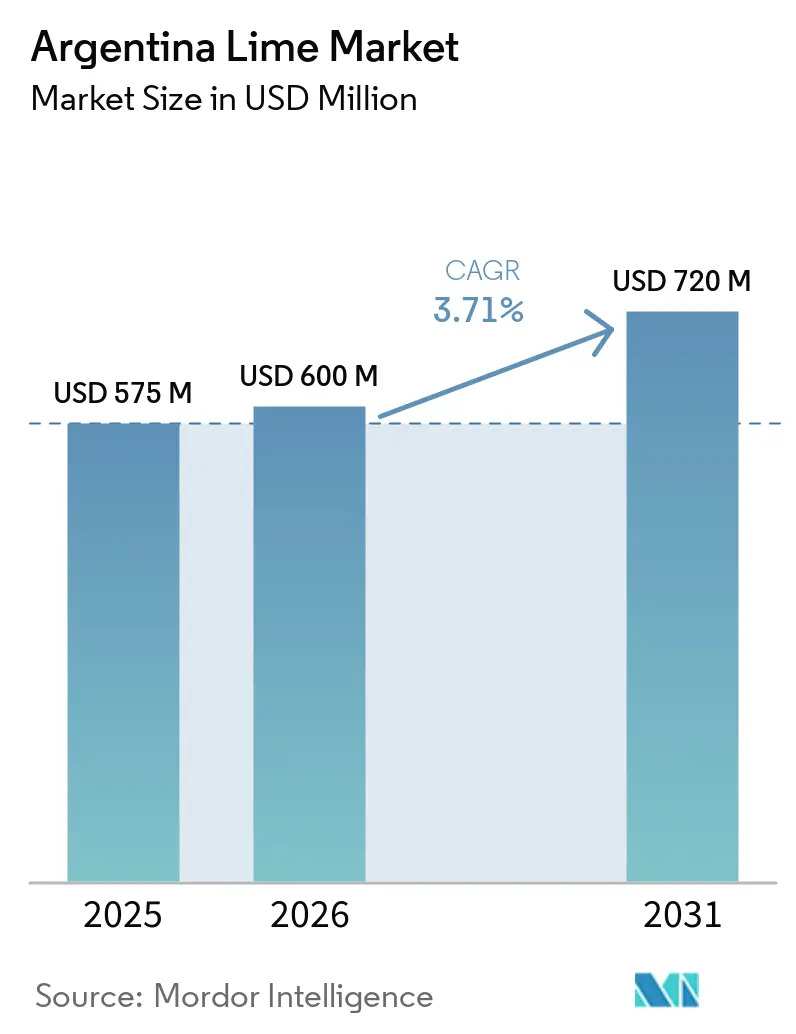
The Argentina lime market size is valued at USD 575 million in 2025, and is anticipated to grow from USD 600 million in 2026, and reach USD 720 million by 2031, growing at a CAGR of 3.71% from 2026 to 2031. Demand is anchored by industrial processors that convert three-quarters of harvested fruit into juice concentrate, essential oil, dehydrated peel, and powder, allowing exporters to command higher margins in ingredient and fragrance channels. Tucumán and Salta benefit from warmer winters that lengthen the bloom window, driving incremental yield gains even as total planted area has contracted. The January 2025 minimum price agreement with the United States protects earnings for juice concentrate and stabilizes capital planning for replanting and factory upgrades. Demand in the European Union for certified organic fruit and derivatives is surging following the 2023 reopening of organic citrus imports, while domestic beverage formulators are increasing the inclusion rates of natural citrus acids and flavors. Mid-term growth is therefore a balance of higher-value derivative expansion and structural threats from Huanglongbing vector incursions, inland freight costs, and seasonal price swings.
Key Report Takeaways
- Tucuman accounts for around 80% of Argentina's lemon and lime production, supported by favorable climatic conditions and established processing infrastructure. Nearly 75% of harvested limes are converted into value-added products such as juice concentrate, essential oils, dehydrated peel, and powders, allowing exporters to achieve higher margins in global ingredient markets.
Note: Market size and forecast figures in this report are generated using Mordor Intelligence’s proprietary estimation framework, updated with the latest available data and insights as of January 2026.
Argentina Lime Market Trends and Insights
Drivers Impact Analysis*
| Driver | (~) % Impact on CAGR Forecast | Geographic Relevance | Impact Timeline |
|---|---|---|---|
| Climate Linked Yield Gains | +0.8% | Tucumán, Salta, Jujuy | Medium term (2-4 years) |
| Multi Year Juice Export Contracts | +0.9% | Northwest and Northeast | Short term (≤ 2 years) |
| Growing Ready to Drink (RTD) Beverage Demand | +0.6% | Buenos Aires, Córdoba, Santa Fe | Medium term (2-4 years) |
| Shift to Lime Based Meat Preservatives | +0.5% | Pampas abattoir hubs | Long term (≥ 4 years) |
| Government Phytosanitary Subsidy | +0.4% | Northwest and Northeast | Short term (≤ 2 years) |
| Dehydrated Lime Value Addition | +0.7% | Tucumán processing hubs | Medium term (2-4 years) |
| Source: Mordor Intelligence | |||
Climate Linked Yield Gains
According to the United States Department of Agriculture, mild weather during the 2025 growing cycle boosted Argentina's lemon and lime production significantly, exceeding forecasts[1]. Favorable conditions, unlike frost-driven declines in the Mediterranean, drove a 43% rise in export value, solidifying Argentina's position as a key citrus supplier. Growers optimized irrigation and canopy management to leverage the extended flowering period, offsetting the loss of the majority of hectares since 2023. However, agronomists warn that rising temperatures accelerate the spread of the citrus greening vector, increasing biosecurity challenges. Sustained mild winters are anticipated to add significant growth to Argentina's lime market CAGR in the medium term, while prioritizing disease management in orchard budgets.
Multi Year Juice Export Contracts
The January 2025 floor price pact with the United States locked in margins for lemon and lime concentrate, giving processors confidence to sign multi-year supply contracts[2]. Revenue certainty accelerates replanting programs, new evaporator lines, and worker training, which together lift throughput capacity in the main factories. Parallel talks with European Union buyers focus on organic puree and oil, capitalizing on the 2023 policy shift that allowed sodium bicarbonate postharvest treatments[3]. Secured offtake contracts de-risk capital outlays for freeze dryers and aroma recovery units that target premium niches. Export contract momentum contributes the largest positive swing among drivers, adding 0.9 percentage points to the forecast CAGR during the next two seasons when new orchards mature.
Growing Ready to Drink (RTD) Beverage Demand
Soft drink, craft mixer, and ready-to-drink alcohol brands are reformulating with natural lime juice and essential oils as consumers reject artificial flavors. INTA Famaillá surveys show a 25% reduction in lemon-planted areas in Tucumán, from 51,972 hectares in 2021 to 39,040 hectares in 2025, driven by growers shifting to sugarcane or grains due to low profitability. Lime juice is also replacing synthetic citric acid in flavored water, aligning with clean-label trends. Domestic beverage consumption, accounting for one-quarter of harvested fruit, is anticipated to grow as purchasing power improves, diversifying revenue beyond exports.
Shift to Lime Based Meat Preservatives
Research by the National Institute of Agricultural Technology showed that feeding cattle wet lemon pulp improved lipid profiles, prompting broader trials exploring antimicrobial lime oil coatings on beef primals. Abattoirs in Buenos Aires and Santa Fe provinces now pilot citric-based rinse solutions to extend shelf life without synthetic benzoates. Export buyers in Asia and Europe reward suppliers that reduce chemical additives, pulling citrus derivatives into meat supply chains. Although still small, this cross-sector use case strengthens downstream demand predictability. The meat channel, therefore, adds 0.5 percentage points to growth, but the payoff skews toward the long term after regulatory validation and equipment retrofits are completed.
Restraints Impact Analysis*
| Restraint | (~) % Impact on CAGR Forecast | Geographic Relevance | Impact Timeline |
|---|---|---|---|
| Citrus Greening Huanglongbing (HLB) Outbreaks | −1.2% | Tucumán, Salta, Corrientes, and Misiones | Long term (≥ 4 years) |
| Post Harvest Price Volatility | −0.6% | National markets | Short term (≤ 2 years) |
| High Inland Freight to Ports | −0.8% | Tucumán and Salta to Rosario/Buenos Aires | Medium term (2-4 years) |
| Stringent European Union (EU) Pesticide-Residue Limits | −0.4% | Tucumán, Salta, and national | Medium term (2-4 years) |
| Source: Mordor Intelligence | |||
Citrus Greening Huanglongbing (HLB) Outbreaks
The 2024 discovery of the Asian citrus psyllid in commercial groves of Tucumán shattered the long-held buffer that confined vectors to backyard trees in the Northeast. Once bacteria infect a tree, yields plunge, and fruit quality deteriorates, forcing costly removal and replanting. Replacement takes 5 years to reach full production, tying up capital while revenues dip. The European Environmental Agency, with INTA Famaillá Surveys, shows the planted area shrank 20% between 2021 and 2025, reflecting grower exits in hot-spot districts. Unless biological control suppresses psyllid populations, greening could wipe out the 0.8-point climate yield bonus and drag CAGR down by 1.2 percentage points over the long horizon.
Post Harvest Price Volatility
Roughly 60% of national output hits packinghouses in a six-week window, overwhelming limited cold storage and driving spot prices below break-even for non-integrated growers. Frost shocks or labor disruptions can invert the curve, triggering sudden spikes that deter long-term contracting with domestic buyers. Such swings complicate loan servicing and deter orchard investment because projected cash flow varies wildly year to year. Processors respond by ramping dehydration capacity but still depend on fresh-grade fruit for contracts that impose tight delivery windows. Persistent volatility further restrains the Argentine lime market CAGR in the short term as risk-averse financiers tighten credit lines.
*Our forecasts treat driver/restraint impacts as directional, not additive. The impact forecasts reflect baseline growth, mix effects, and variable interactions.
Geography Analysis
The Northwest accounted for the largest share of national lime volume in 2025, led by Tucumán plants that process up to 400,000 metric tons of fruit annually. Salta and Jujuy strengthen the cluster as yield gains from warmer winters offset orchard removals tied to greening risk. The Northeast is the fastest-growing region, 2026-2031, as Corrientes and Misiones attract dehydrator investments to supply European powder contracts. Export proximity to fluvial ports and lower freight outlays widen grower margins and accelerate new plantings in those provinces.
Cuyo, comprising La Rioja and San Juan, operates under strict irrigation quotas that cap large-scale expansion yet support steady output for domestic processors. The Pampas provinces of Buenos Aires, Córdoba, and Santa Fe focus on beverage and meat-processing channels and benefit from shorter hauls to high-population centers. Patagonia contributes niche organic fruit to premium retail programs but remains constrained by cool climates and long supply chains. Collectively, these regions add supply diversity, cushioning national output against localized droughts or pest shocks.
Looking ahead, Northwest processors are adding freeze-dry towers to reduce shipping weight, while Northeast cooperatives are scaling certified organic acreage to capture European premiums. Cuyo growers test deficit irrigation and solar pumping to stretch scarce water, and Pampas bottlers invest in cold-pressed facilities that demand consistent juice inputs. Patagonia positions its organic narrative for domestic e-commerce channels, signaling incremental volume despite climatic limits. These coordinated moves across regions are anticipated to lift aggregate throughput and enhance Argentina’s resilience, supporting sustained market expansion through 2031.
Competitive Landscape
San Miguel S.A. leads this group through an integrated Tucumán complex that crushes 400,000 metric tons of fruit each year and powers part of its operation with a solar array completed in 2025. Citricola San Antonio S.A. is the largest fresh-fruit exporter, focusing on premium lime lots that meet strict phytosanitary requirements for United States and European Union buyers. Both companies funnel capital into frost-mitigation nets and satellite-guided irrigation that lower crop losses and boost juice recovery rates.
Citrusvil S.A. (Grupo Lucci) specializes in high-resolution satellite scouting that detects canopy stress before visible symptoms appear, lifting field efficiency and supporting ISO-22000 certification. Citromax S.A.C.I. (Citromax Group) captures fragrance margins by distilling bespoke oil fractions for global flavor houses and by patenting aroma recovery steps that preserve volatile compounds. Latin Lemon S.A. (Latin Lemon S.A.) targets wellness markets with spray-dried powder and fiber ingredients that fit clean-label requirements and ship at a fraction of the weight of concentrate. Mid-tier firms rent toll-drying time from these processors, keeping plants near full capacity and reinforcing incumbent cost advantages.
Growth strategies hinge on deeper technology adoption and vertical partnerships that draw smallholders into certified supply chains. Leading players are expanding freeze-dry towers that raise value per kilogram and hedge freight risk, while cooperatives secure export audits funded through long-term off-take contracts. Shared truck fleets and cold-room leasing cut logistics costs for growers, anchoring loyalty and stabilizing raw fruit supply. These coordinated investments are anticipated to lift derivative output, open new organic channels, and sustain Argentina’s role as a dominant supplier through 2031.
Recent Industry Developments
- October 2025: India and Argentina signed an agriculture cooperation plan that includes joint research on citrus disease control and postharvest technology transfer. Collaboration opens a pathway for advanced greening-management techniques and potential market access in South Asia, which can stimulate long-term demand for Argentine lime products.
- August 2025: Grupo Calidra unveiled plans for a new kiln and logistics hub in Tucumán to boost hydrated-lime production for agriculture and mining. Easier access to agricultural lime for soil pH correction can lower input costs for citrus growers in the Northwest, thereby indirectly improving orchard productivity and supporting market growth.
- January 2025: The United States Department of Commerce amended the agreement, suspending the antidumping duty investigation on lemon juice from Argentina and extending minimum price provisions and compliance monitoring. The renewal secures stable export margins for Argentine processors, encouraging new capacity investments that expand overall lime-derivative volumes.
Argentina Lime Market Report Scope
Lime is a citrus fruit primarily used for food and cosmetics. The Argentina Lime Market Report Includes Production Analysis (Volume), Consumption Analysis (Value and Volume), Import Analysis (Value and Volume), Export Analysis (Value and Volume), Wholesale Price Trend Analysis and Forecast, Regulatory Framework, List of Key Players, Logistics and Infrastructure, and Seasonality Analysis. The Market Forecasts are Provided in Terms of Value (USD) and Volume (Metric Tons).
Argentina
| Production Analysis | Production Volume | |
| Area Harvested and Yield | ||
| Consumption Analysis (Value and Volume) | ||
| Trade Analysis (Value and Volume) | Import Market Analysis | Import Value and Volume |
| Key Supplying Markets | ||
| Export Market Analysis | Export Value and Volume | |
| Key Destinations Markets | ||
| Wholesale Price Trend Analysis and Forecast | ||
| Regulatory Framework | ||
| Logistics and Infrastructure | ||
| Seasonality Analysis | ||
| Argentina | Production Analysis | Production Volume | |
| Area Harvested and Yield | |||
| Consumption Analysis (Value and Volume) | |||
| Trade Analysis (Value and Volume) | Import Market Analysis | Import Value and Volume | |
| Key Supplying Markets | |||
| Export Market Analysis | Export Value and Volume | ||
| Key Destinations Markets | |||
| Wholesale Price Trend Analysis and Forecast | |||
| Regulatory Framework | |||
| Logistics and Infrastructure | |||
| Seasonality Analysis | |||
Key Questions Answered in the Report
What is the current value of the Argentina lime market?
The market stands at USD 600 million in 2026.
Which province contributes the largest share of national lime supply?
Tucumán in the Northwest delivers roughly 80% of Argentina's lemon and lime output.
Which region is projected to be the fastest growing between 2026 and 2031?
The Northeast, led by Corrientes and Misiones, is forecast to expand at a 5.8 % CAGR from 2026-2031
How does citrus greening affect future production?
Huanglongbing infections are anticipated to trim 1.2 percentage points from forecast CAGR by constraining orchard longevity and increasing replanting costs.
Why are processors investing in dehydration technology?
Powder cuts freight weight, commands higher prices in functional food applications, and buffers revenue against seasonal spot-price volatility.
What drives the European Union's demand for Argentine limes?
The 2023 reopening of organic citrus imports and the preference for natural flavor ingredients are accelerating European Union contracts, especially for certified organic derivatives.